
Lazy Susan hardware: 7 must-buy upgrades for smooth, quiet cabinets

Fed up with a sticky, noisy turntable in your corner cabinet? Small changes to lazy susan hardware can make shelves spin smoothly and hold more. This guide shows seven top upgrades, from heavy-duty ball-bearing plates and low-profile bearings to non-slip liners and full kits. You’ll also get simple measuring tips and a short install checklist to get things working fast.
Table of Contents
Upgrading lazy susan hardware is one of the fastest ways to make corner cabinets feel bigger, quieter, and easier to use. This guide helps you pick the right parts, measure correctly, and install upgrades that last.
Why Upgrade Lazy Susan Hardware
Common stock issues
Most factory setups fail in the same places: rough spinning, sagging shelves, and a center pole that drifts out of plumb over time. Once the rotating plate wears or screws loosen, wobble starts, items tip, and the cabinet becomes “storage you avoid” instead of storage you use.
Weight ratings also get ignored in real kitchens where cast-iron, small appliances, and bulk food stacks add up fast. Many entry setups feel fine at first but bind under load, because the bearing surface is small and the steel is thin, which makes friction and noise worse with every month of use.
Upgrade benefits
Better lazy susan hardware fixes the daily annoyances: precision ball bearings spin smoothly, thicker plates resist flex, and rust-resistant finishes keep motion consistent in humid kitchens. If you want a reference point for what “good” looks like in real product lines and configurations, the Rev-A-Shelf lazy susans info pages show common formats and why certain mounts work better in corner cabinets.
Upgrades also help you reclaim space you already paid for. When shelves stay level and rotate easily, you can store heavier items confidently, reduce breakage, and stop “digging” for things stuck in the back, which makes organization easier to maintain.
Lazy Susan Hardware Types by Cabinet Shape
Kidney-shaped
Kidney-shaped shelves fit classic L-corner base cabinets where the door opening is smaller than the cabinet’s back corner. This style normally uses a center post, and upgrading lazy susan hardware here usually means replacing the bearing/plate, the pole sockets, or the entire rotating assembly so the shelves stay steady under real kitchen loads.
Size matters: a common rule is the shelf diameter must stay smaller than the usable interior space, and many setups top out at roughly a 32-inch unit in a 34-inch cabinet. If you want manufacturer-style guidance on layouts and components, Knape & Vogt’s Lazy Susans PDF is a helpful reference for typical systems and mounting approaches.
Pie-cut
Pie-cut units work with bi-fold corner doors where the shelf swings out as the doors open, so you access items without reaching deep inside. This setup depends on tight door alignment and smooth pivot points, so focus on hinge-clearance and door hardware condition before swapping parts.
Upgrading this style often means replacing the shelf bearings or the linkage components so the shelf movement matches the doors. If your doors droop or scrape, solve that first; then upgrade the rotating parts so the motion stays smooth even when the shelves are loaded.
D-shaped
D-shaped shelves have a flat back edge that sits close to the cabinet door line, which can give you a little more usable surface at the front. Many D-shaped designs work without a tall center post, so mounting-plate quality and screw bite into the shelf matter more than pole alignment.
If you’re doing a retrofit, D-shaped can be forgiving because you can place a heavy-duty bearing plate under the shelf and keep the top clear for tall items. That makes lazy susan hardware plates and rings a smart upgrade path when the original pole system is worn out or missing parts.
Full-round
Full-round shelves fit pantries, blind corners with wide openings, and open shelving where you want simple 360-degree access. These often use either a telescoping post or a bottom-mount bearing, and upgrading lazy susan hardware here is usually straightforward because the shelf is symmetrical and easy to center.
For tall pantry setups, check vertical adjustability so you can set shelf spacing for cereal boxes, oils, and appliances. If you build your own shelves, start with stable sheet goods; this overview of cabinet plywood grades helps you pick material that stays flat and holds screws well, which improves long-term rotation.
Measuring for the Right Lazy Susan Hardware Fit
Cabinet size basics
Start by measuring the cabinet’s interior width, depth, and opening, not the outside face frame. Many base corner cabinets are sold as 33–36 inches wide (nominal), while wall corner cabinets are often 24–27 inches, so always verify the inside dimensions before ordering a lazy susan hardware replacement.
Next, measure height from cabinet floor to the underside of the countertop (or to the next fixed shelf in a pantry). This height drives whether you can use a telescoping pole, how many shelves fit, and whether you need a low-profile bearing plate to gain vertical-space.
Shape matching
Match the shelf shape to the cabinet opening and door swing: kidney for classic L-corners, pie-cut for door-attached motion, D-shaped for a flat front line, and full-round for open access. A practical rule is to measure the diagonal clearance and subtract 1–2 inches so shelves don’t rub hinges, face frames, or door hardware, which prevents binding.
| Cabinet / shelf shape | What to measure | Quick fit tip |
|---|---|---|
| Kidney-shaped corner base | Interior diagonal + door opening width | Pick a shelf size that clears hinges by 1–2 inches |
| Pie-cut (bi-fold doors) | Door swing path + inside corner clearance | Confirm shelves can move with doors without scraping |
| D-shaped | Front clearance line + back corner depth | Center the bearing precisely to avoid front-edge drift |
| Full-round | Interior diameter area + vertical height | Use a low-profile plate if height is tight |
Clearance rules
Plan for three clearances: side-to-side clearance (shelf edge to cabinet wall), door/hinge clearance (shelf edge to hinge barrels and screws), and vertical clearance (shelf height to items above). The easiest way to avoid mistakes is to mock the shelf outline with cardboard and spin it in place, so you spot interference before drilling.
If you’re installing a new mounting plate, mark centerlines on the cabinet floor and on the shelf bottom, then match them before you drive screws. Better alignment reduces noise, protects the bearings, and makes even budget lazy susan hardware feel smoother.
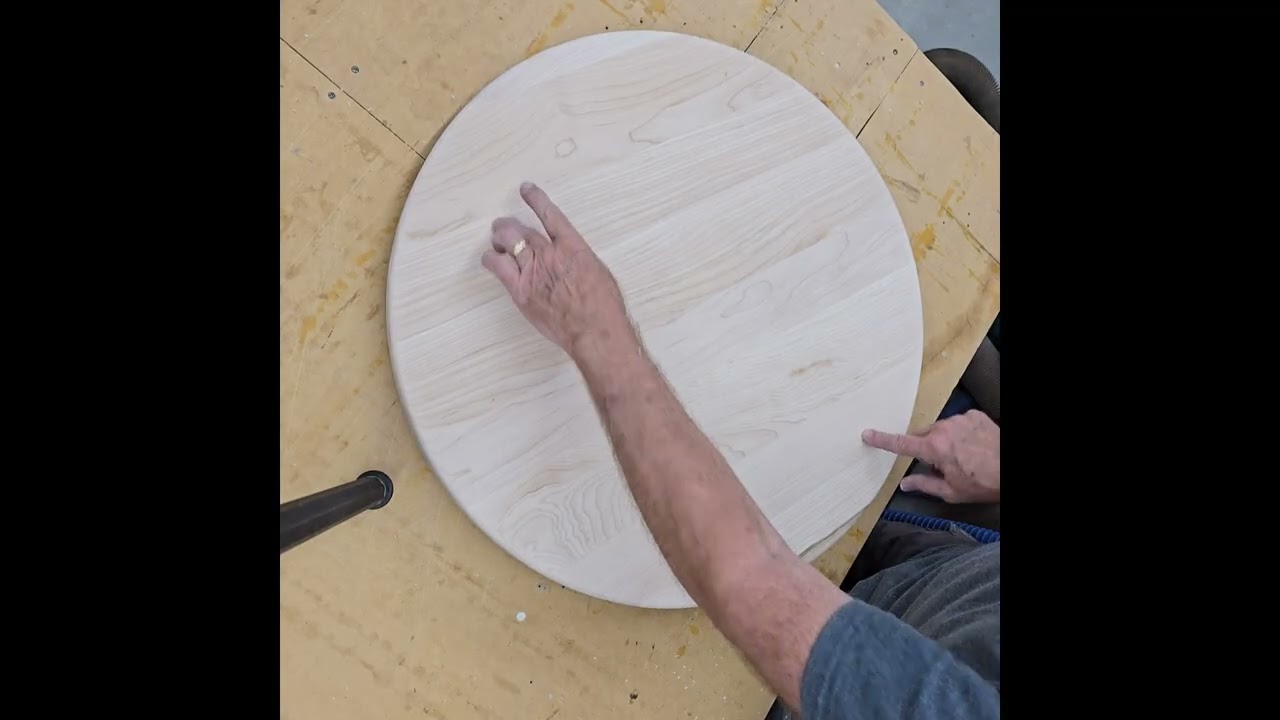
Must-Buy Upgrade: Heavy-Duty Ball-Bearing Plates
If your shelf drags, clicks, or wobbles, replacing the bearing plate is the fastest upgrade because it fixes motion at the source. Look for thick steel, smooth ball bearings, and a load rating that matches how you actually store cookware, since load-capacity is what keeps rotation consistent over time.
Here are heavy-duty bearing plates worth considering for demanding shelves and rotating platforms.

12 Inch Super-Strong Lazy Susan Turntable
- Rated for up to 1000 lb heavy loads
- Precision ball bearings for smooth, quiet rotation
- Generous 12-inch diameter for larger trays and shelves
- Heavy steel construction for long-term durability
- Ideal for kitchen, garage, or workshop rotating storage
 Buy on Amazon

9 Inch 750 lb Heavy-Duty Lazy Susan Plate
- Supports up to 750 lb for heavy items
- Smooth ball-bearing swivel for easy access
- Compact 9-inch size fits corner cabinets and small tables
- Robust steel build for lasting strength
- Quick to install for DIY upgrades
Buy on Amazon
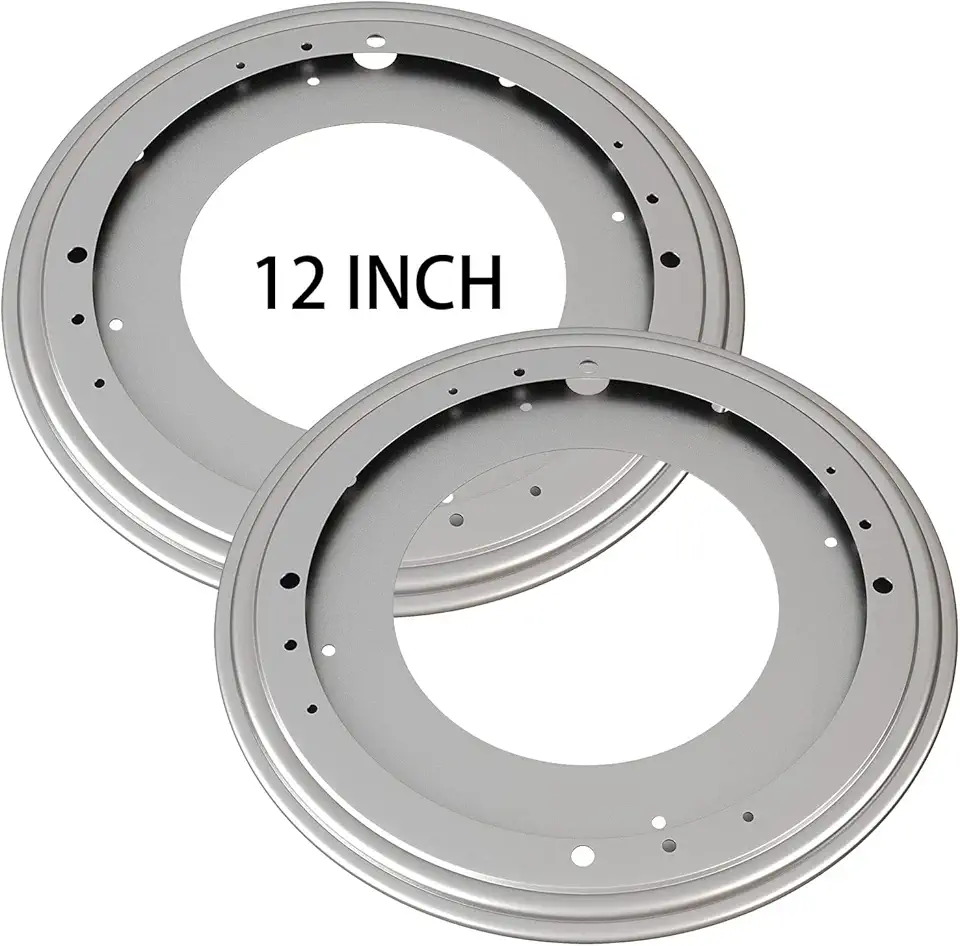
2-Pack 12 Inch Heavy-Duty Lazy Susan Plates
- Two plates rated for up to 1000 lb load capacity each
- Thick 5/16-inch construction for superior rigidity
- Designed for rotating tables, shelves, and serving trays
- Robust build for demanding applications
- Easy to mount for quick upgrades or replacements
Buy on Amazon
For cabinet shelves, a wider plate can reduce rocking because the load spreads across a larger bearing circle, but only if the shelf bottom is flat and screw holes are placed evenly. If you’re matching parts for a branded corner system, check the part diagrams from Hardware Resources BLSK228 set to compare how plates, poles, and shelf hubs are typically paired.
Must-Buy Upgrade: Low-Profile and Square Bearings
Low-profile bearings help when the cabinet has limited vertical space, or when you need to keep a shelf as low as possible above the cabinet floor. Square plates also make sense under square trays, pull-out platforms, or DIY organizers where mounting-symmetry is easier to lay out than a round pattern.
Here are compact bearing options that work well for tight cabinets, small turntables, and multi-project restocks.

Low-Profile 6 Inch Lazy Susan Turntable
- Supports up to 500 lb load
- Smooth steel ball-bearing rotation for effortless access
- Low-profile design fits tight cabinets and tables
- Heavy-gauge construction for reliable stability
- Simple installation and low maintenance
Buy on Amazon

6 Inch Square Lazy Susan Bearing Plates — 6-Pack
- Six plates for multiple projects or replacements
- Each plate rated to handle heavy loads (up to 500 lb)
- Zinc-plated steel resists rust and wear
- Perfect for serving trays, craft tables, and storage racks
- Compact, easy-to-mount swivel plates
Buy on Amazon

4 Inch Lazy Susan Bearings — 2 Pack
- Two compact bearings for corner cabinets or small turntables
- Smooth swivel action for quick access
- Sturdy steel construction for reliable performance
- Simple replacement for worn-out plates
- Great for improving shelf organization and accessibility
Buy on Amazon
If you’re replacing several worn units at once, a lazy susan hardware kit that bundles plates and mounting screws can save time and reduce mid-project trips to the store. In tight corner cabinets, low-profile plates also reduce the chance of a shelf edge rubbing the face frame because the shelf sits closer to its intended height and stays more level under load.
Must-Buy Upgrade: Non-Slip Liners and Specialty Plates
If items slide during rotation, fix grip before you blame the bearings. A silicone liner adds surface-friction, protects finishes, and reduces the clinking that makes lazy susans feel cheap; it’s also one of the few upgrades you’ll notice instantly on day one.
Specialty plates help when you want corrosion resistance, lighter weight, or a replacement base ring for a DIY build. Aluminum can be nice for tabletop projects, while a base-only bearing ring is useful if your existing top plate or shelf hub is still good and you just need to restore smooth-rotation.
Here are a couple of specialty options that fit different replacement and build styles.

10 Inch Aluminum Heavy-Duty Lazy Susan Plate
- Lightweight aluminum construction for easy handling
- Heavy-duty design supports regular use
- Corrosion-resistant finish for long-lasting appearance
- Smooth swivel performance for effortless rotation
- Ideal for dining tables and display turntables
Buy on Amazon
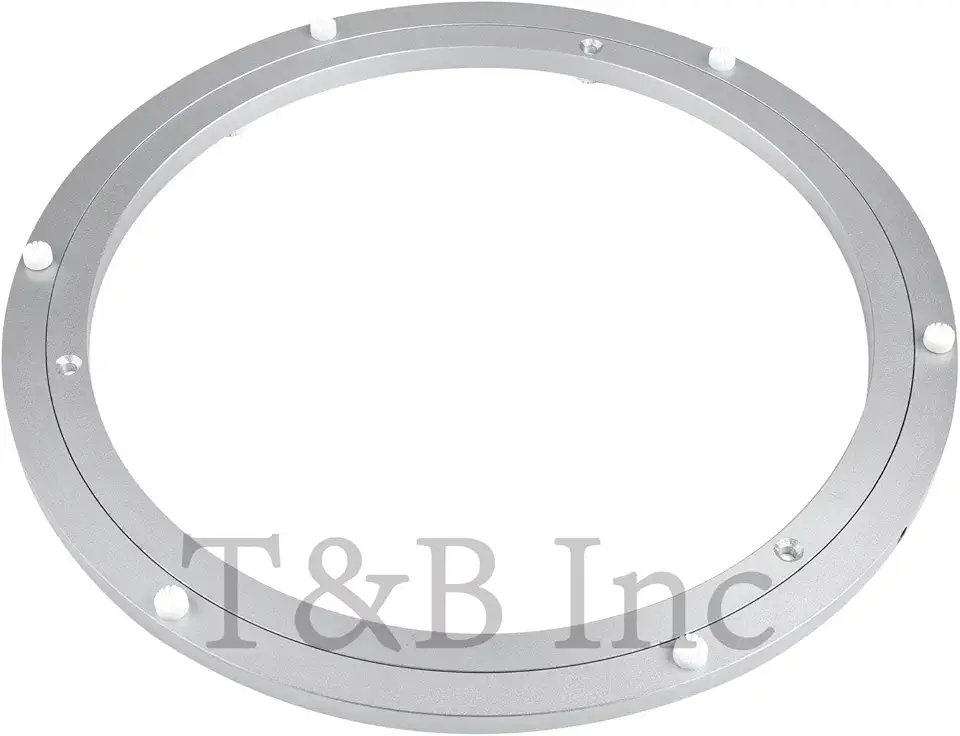
12 Inch Heavy-Duty Turntable Bearing Ring (Base Only)
- Heavy-gauge metal construction for maximum durability
- 300mm (12-inch) size fits standard lazy susan projects
- Smooth rotation for effortless access to stored items
- Ideal as a replacement part or DIY component
- Simple mounting design for straightforward installation
Buy on Amazon
Lazy Susan Hardware Kit Installation Tips
Tools and prep
Most installs go smoothly if you prep before drilling: empty the cabinet, remove shelves, and vacuum debris so the bearings don’t grind against grit. Gather a drill/driver, tape measure, pencil, level, and the right bit for pilot holes; add clamps if you need to hold jigs or shields in place (this guide to types of clamps helps you pick a clamp that won’t slip inside a cabinet).
- Mark centerlines on the cabinet floor and shelf bottom before you remove the old parts
- Use pilot holes to prevent splitting and stripped screws
- Replace damaged screws instead of reusing worn heads or bent fasteners
- Clean and dry-fit bearings to confirm smooth rotation before final mounting
Mounting and alignment
Install the plate with the shelf upside down on a flat surface first, then place the shelf into the cabinet and attach the base side second (or follow your kit’s sequence). Keeping the bearing centered is the difference between a quiet shelf and one that self-steers into the door, so spend extra time on centering before you drive the last screws.
If your kit uses a telescoping post, set the pole height with shelves unloaded, then re-check after you add weight. A small height tweak can remove rub points and stop the shelf from lifting when you rotate, which is a common cause of scraping.
Lazy susan cabinet hardware checks
After installation, verify the full cabinet system: door swing, hinge screws, shelf edge clearance, and any wobble under load. These lazy susan cabinet hardware checks catch 90% of “it spins but feels wrong” problems before you put everything back.
Test rotation with the cabinet fully loaded, then tighten fasteners one more time after a week of use.
Installer best practice
If you’re upgrading multiple shelves or replacing poles, buying a lazy susan hardware kit keeps parts compatible and reduces guesswork. Once everything spins smoothly, load heavier items near the center and lighter items near the edge for better balance and longer bearing life, which helps your lazy susan hardware stay smooth for years.
FAQs
How Do I Measure For The Right Size Lazy Susan Hardware For My Cabinet?
Measure the cabinet opening and interior width to find the correct lazy susan diameter.
Measure front-to-back, side-to-side, and cabinet depth, allowing clearance for doors, hinges, and mounting brackets; compare those numbers to the manufacturer’s sizes and choose the largest unit that fits.
How Do I Install A Lazy Susan Turntable In A Corner Cabinet Step By Step?
Begin by emptying the cabinet, measuring and marking the centerlines, and confirming the turntable size fits the opening.
Mount the base plate or post per the manufacturer’s guide, attach the bearing and platform, add shelves or trays, then test rotation and adjust fasteners until the unit turns smoothly.
What’s The Difference Between Pivot, Ball-Bearing, And 3-Tier Lazy Susan Hardware?
Pivot hardware uses a single central pivot for basic rotation, ball-bearing systems use multiple bearings for smoother, heavier loads, and 3-tier units provide stacked rotating shelves for increased capacity.
Choose pivot for simple, light-duty use; pick ball-bearing for durability and weight, and 3-tier when you need more organized vertical storage.
How Much Weight Can Lazy Susan Hardware Hold And How Can I Reinforce It?
Typical lazy susan hardware supports roughly 25–75 pounds per shelf, though capacity varies widely by model and mounting method.
To reinforce, add a thicker plywood base, secure the mounting plate to solid substrate or studs, use heavy-duty ball-bearing assemblies or steel columns, and distribute loads evenly to prevent sagging.