Chainsaw Mill Guide: How It Works, When to Use One, and What to Buy

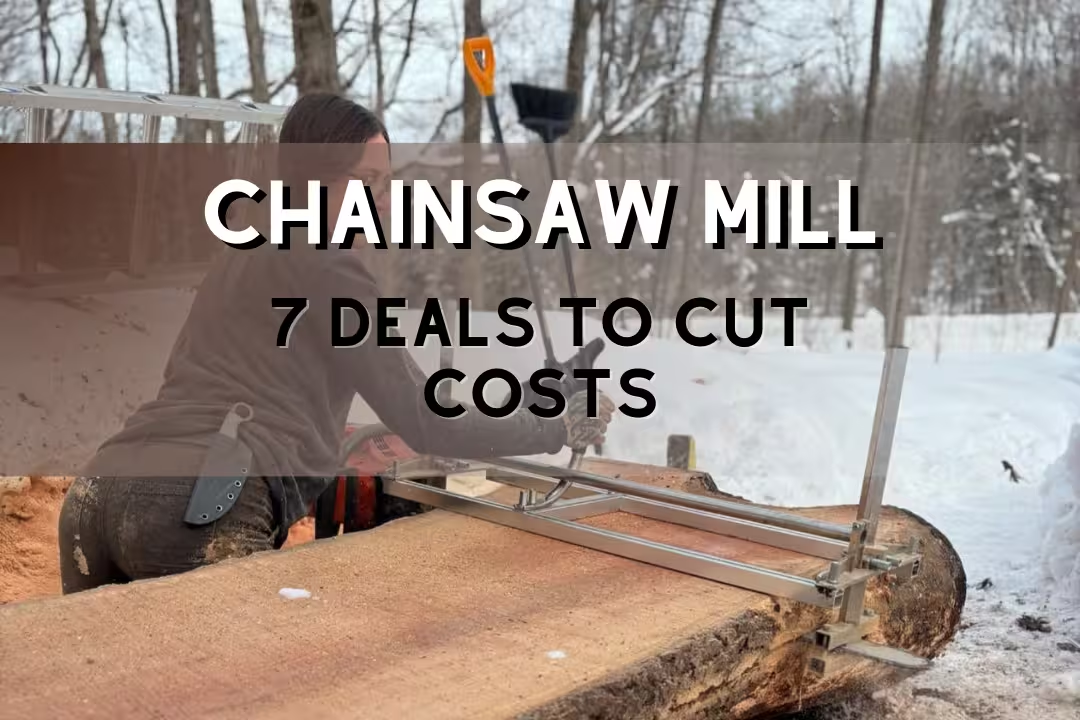
A chainsaw mill is an attachment that turns a standard chainsaw into a portable tool for milling logs into boards or slabs. It works by clamping to the bar and riding on guide rails so you can cut consistent thickness on-site, without hauling heavy logs to a stationary mill.
Table of Contents
If you’re choosing between chainsaw mills and a band sawmill, the real decision comes down to waste, surface quality, and how much physical work you’re willing to do per board. I’ll break down how a chain saw mill works, where it shines, where it struggles, and which tools make the process smoother.
What a chainsaw mill is
A chainsaw mill (also called a chain saw mill or chainsaw log mill) is a frame that attaches to your chainsaw bar to control the cut as you rip lengthwise through a log. Instead of freehand cutting, the mill gives you a stable reference so your slabs come off at a repeatable thickness.
This style of log mill chainsaw setup is popular for storm-fallen trees, yard removals, and backwoods logs where a trailer mill can’t get close. You trade speed and finish quality for portability and the ability to mill wherever the log lands.
Chainsaw log mill basics
A chainsaw log mill has two jobs: hold the saw square to the log and set the depth of cut. Most models clamp at two points on the bar, then use uprights and cross-members to set slab thickness.
The first cut needs a straight reference surface, or every board after it will copy the same bend. In the field I’ll use a ladder, an aluminum rail, or a straight 2×6 screwed into sacrificial blocks so the screws never meet the chain.
Expect the milling cut to feel different than bucking firewood: the saw stays loaded for a long time, and the handles vibrate into your palms until they feel warm and slightly numb. That’s normal with ripping, but it’s also a sign to pace yourself and keep the chain sharp.
Alaskan chainsaw mill explained
An Alaskan chainsaw mill is the classic horizontal mill frame that rides on top of the log and carries the saw through the cut. “Alaskan” gets used as a generic name, but it’s tied closely to the Granberg-style layout that clamps to the bar and uses adjustable rails for thickness.
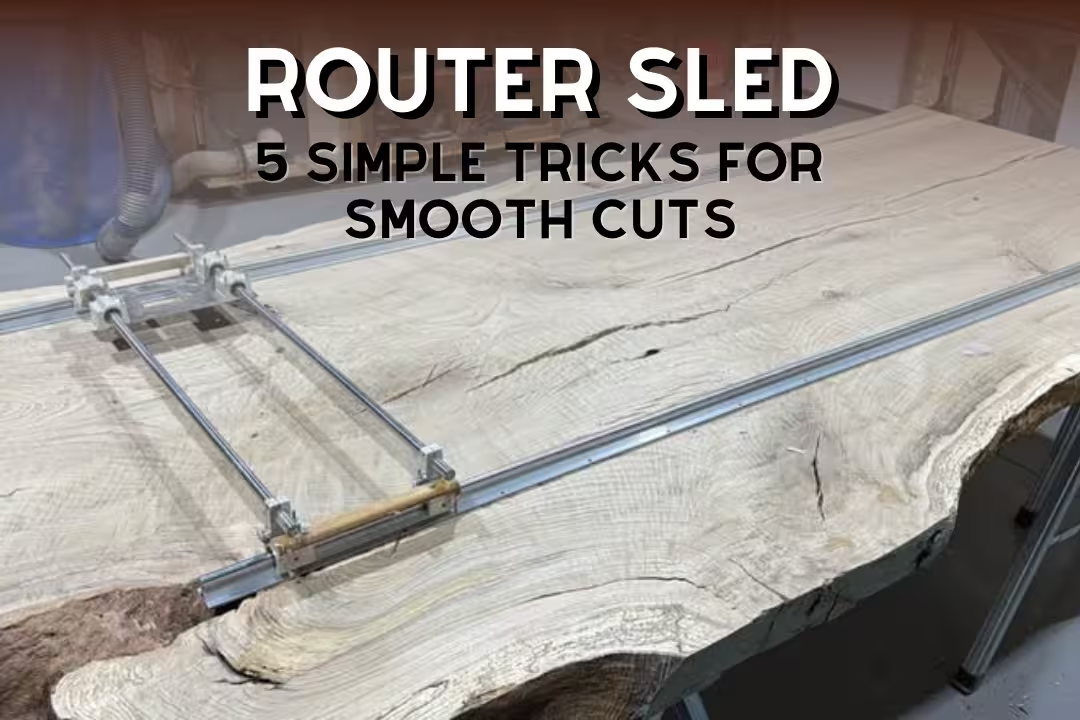
Most Alaskan-style frames shine at making slabs for tables, benches, and mantels because you can set a thick cut and keep character intact. If you’re planning to turn slabs into finished boards, plan ahead for flattening with a planer tool or a router sled, since the surface is rarely “ready” off the mill.
One common beginner mistake is running a short lightweight saw and expecting it to behave like a dedicated mill. The cut won’t just slow down—heat builds, chips stop clearing, and the bar can start to smell hot and resinous, which is your signal to back off and fix chain, rakers, and oiling.
How a chain saw mill works
A chain saw mill works by separating power and control: the chainsaw provides torque and chain speed, while the mill frame and guide system control straightness and thickness. You’re basically pushing a guided cutterhead through the log, one slab at a time.
Feed pressure matters more than most people expect. Push too hard and the saw bogs, the cut wanders, and you get chatter marks; feed too lightly and the chain polishes the wood, heat rises, and you burn time and fuel.
Guide rails and control
The guide rails create a flat plane for the mill to ride on. For the first cut, that plane is external (ladder/rail); after that, the freshly milled face becomes the reference for the next pass.
Rail stiffness is an edge case that shows up on long logs: a cheap, flexible ladder can sag in the middle, and that sag becomes a crown across your slab. If you see a gap under the rail when you sight down the length, shim it before you cut, even if it takes extra time.
Misalignment is the silent killer of good milling. If the rail isn’t parallel to the log’s pith line and you’re chasing a straight board from a tapered stem, the mill can feel like it’s “pulling” sideways, and your shoulders will pay for it by the end of the cut.
Rip chain role
A rip chain changes how the cutters score and peel fibers during a lengthwise cut. Crosscut chains will cut with enough patience, but they often leave a rougher surface and force you to work harder because the cutter geometry isn’t optimized for ripping.
Depth gauge (raker) height is where new users get in trouble. If rakers are too high, the saw makes fine dust and creeps; if they’re too low, the chain bites aggressively, chatters, and can stall in hardwood. I keep a simple raker gauge and a sharpening stone handy because touching up mid-day beats fighting a dull chain for an hour.
Pitchy species add another edge case: the chain can gum up and start feeling “slick” instead of crisp. When chips get stringy and stick to the clutch cover, I stop and clean before the bar oil port starts starving.
Adjusting thickness
Thickness comes from the mill’s upright adjustment points. Set both sides the same, then verify with a tape at the front and back of the frame so you don’t bake a wedge into every board.
Don’t set final thickness on the mill if the wood will be dried and surfaced. I’ll often mill 1/4″ to 3/8″ heavy to leave room for cup, twist, and cleanup later, referencing common sawmill lumber dimensions so the boards land on practical finished sizes.
One mistake I see is chasing perfection by micro-adjusting between every pass. Wood moves as internal tension releases, so the better move is to keep your settings consistent, stack and sticker quickly, then flatten after drying.
Chainsaw mill vs band sawmill
This comparison decides most purchases: a chainsaw mill buys you mobility at the cost of kerf waste, slower throughput, and more surfacing work. A band sawmill buys you efficiency and repeatability, but it needs space, setup time, and a bigger budget.
| Factor | Chainsaw mill | Band sawmill |
|---|---|---|
| Cut quality | Rougher surface; more planing/sanding | Smoother, more consistent |
| Kerf & yield | Wider kerf; more sawdust | Narrow kerf; better yield |
| Capacity | Limited by bar length and powerhead | Often higher; depends on mill throat |
| Portability | Very high; carry-in setup | Moderate; trailer or site setup |
| Labor | High physical effort per cut | Lower effort; faster cycle |
| Dry wood | Harder on chain/saw; slower | Handles better with correct blade |
For a detailed side-by-side with kerf figures and practical choice guidance, I like Wood-Mizer’s comparison as a baseline reference. Use it to sanity-check your expectations before buying accessories.
Cut quality
Chainsaw milling leaves a surface with tooth scallops and occasional waviness from feed pressure changes. You can feel it by dragging your fingertips across the grain; it’s slightly ridged, like corduroy, and it catches splinters if you’re careless.
A band sawmill cut is more uniform because the band is guided and tensioned, and feed rate stays steadier. If you’re building cabinetry or interior panels, that smoother starting point saves hours at the jointer and sander.
Kerf and waste
Kerf is the wood turned into sawdust. Chainsaws waste more per pass, which becomes real money on valuable logs: walnut, white oak, or wide urban-maple stems where every extra board counts.
That waste also affects drying and cleanup. More sawdust means more time brushing slabs before stacking, and if you skip it, the dust packs into pores and can stain during drying.
Log capacity
With a chainsaw mill, log width is limited by bar length and usable cutting width after the powerhead and frame take space. A “36-inch” bar doesn’t mean you’ll slab a true 36-inch face in one pass.
Band mills often handle larger diameters comfortably, and the cut doesn’t slow down as dramatically when you get into dense hardwood. If you regularly run oversized yard trees, the capacity advantage shows up fast.
Portability
A chainsaw mill wins on access. I’ve hauled a mill frame, bar, wedges, and fuel to logs that were a muddy hike from the road where no trailer would survive.
Band mills can still be mobile, but moving them takes planning: level ground, space to stage logs, and a way to load. If you don’t have tractor/forks, portability becomes more “drive there” than “carry there.”
Cost and labor
Chainsaw mills look cheaper because the attachment is a smaller purchase, especially if you already own a saw. The hidden cost is labor time: you’ll burn more hours per board, and your body feels it after a long ripping day.
Band mills cost more upfront, but they return time. If you’re producing lumber for a build where deadlines matter, time saved often beats cash saved.
Dry wood performance
Dry logs cut differently: they feel harder and “glassier,” chips get smaller, and the saw wants to drift if the chain isn’t perfect. Milling kiln-dry or dead-standing hardwood with a chainsaw is possible, but it’s slow, loud, and it eats chains.
Band mills handle dry stock better because the thin band removes less material and tracks predictably. If your main job is resawing already-dry beams into boards, a band solution is usually the calmer day.
Pros and cons of chainsaw milling
Chainsaw milling is a trade: you gain freedom of location and low barrier to entry, but you accept slower throughput and more finishing work.
Advantages of chainsaw mills
- On-site milling means you don’t have to move heavy logs before processing.
- Low startup cost if you already own a compatible chainsaw and bar.
- Oversize slabs are realistic for one-off table builds and feature pieces.
- Custom thickness is easy: set your rails and repeat the cut.
- Simple transport in a truck bed with basic tools and fuel.
A lot of people also like the control of deciding what becomes boards versus firewood right at the log. That’s a real advantage when you’re working with mixed species or hidden metal where you want to read the log slowly before committing.
Limitations to expect
The biggest limitation is physical effort. Long rips demand steady pushing, and your forearms will pump up and fatigue in a way that crosscutting rarely does.
Surface quality is the next reality. Plan on surfacing with a drum sander or planer after drying if the boards are headed for furniture or tight joinery.
Beginners often underestimate risk from binding. When a log closes on the bar mid-cut, the saw can stall instantly and jerk your posture; wedges placed early and often are the workaround that keeps both the slab and your back intact.
When to use a chainsaw mill
A chainsaw mill is the right tool when location matters more than speed. If the log is too big to move safely or too far from equipment access, milling where it sits can be the safest choice.
On-site milling jobs
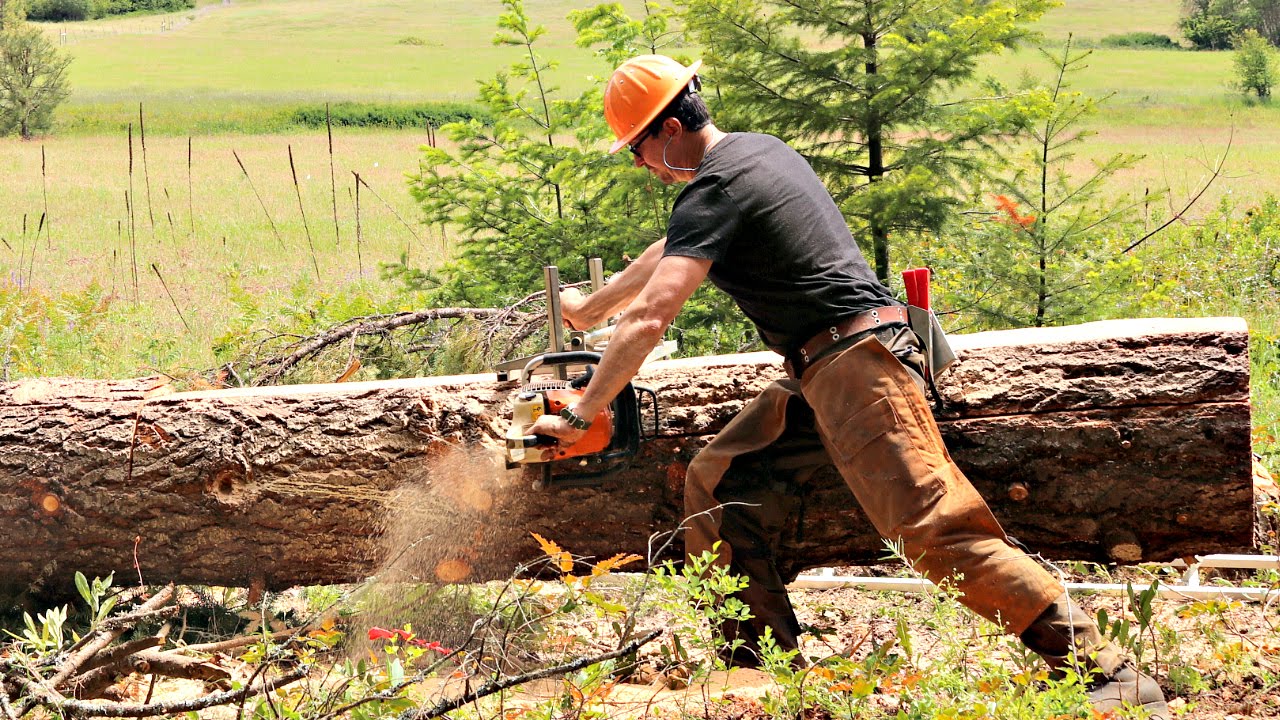
On-site milling shines after storms and removals, where you’re staring at a heavy stem on uneven ground. I’ll set the log on cribbing, level the first rail, and mill slabs that can be carried out by two people instead of dragging a full log.
Watch for embedded metal in yard trees. The pro move is a quick scan and a “sacrificial” first pass near bark; hitting a nail with a ripping chain doesn’t just dull it, it can damage the bar rail and throw sparks into dry sawdust.
Small-volume lumber
If you need a small stack of boards for a shed, bunks, or rustic furniture, chainsaw milling keeps things simple. You can rough-mill oversized stock, sticker it, and later true it up with a jointer vs planer workflow that fits your shop.
The key is setting expectations: you’re making usable lumber, not factory S4S boards. Leave extra thickness and accept that drying defects will decide the final yield.
Mobile milling use
Mobile milling with a chainsaw mill works best when you standardize your process. Same rails, same wedges, same chain type, and a repeatable stacking routine means you can show up and produce without re-learning the setup every site.
Fuel logistics matter more than people expect. Milling burns through gas quickly, and running out mid-slab is how you end up with a half-cut face that dries with ugly stain lines.
When to choose a band sawmill
Choose a band sawmill when your priorities are repeatability and throughput. If you plan to mill frequently or sell lumber, the time saved and yield gained adds up quickly.
Production and precision
Band mills make it easier to hit target thickness across many boards with less variance. That precision matters if you’ll be batch-processing lumber for cabinetry or dimensioned framing where consistent thickness keeps joinery from turning into a fight.
If you’re shopping, start with what you’ll build and how you’ll surface. A good band mill pairs well with a stable downstream setup like a contractor table saw and planer for repeatable milling-to-final parts.
Large-diameter logs
Big logs expose the upper limit of chainsaw milling fast. As width grows, you need more bar, more power, more bar oil, and more patience, and you still fight a wider kerf and heavier slabs.
A band mill’s capacity is built into the frame, so you can focus on safely handling the log instead of pushing a heavy powerhead through a long cut.
Finish-grade lumber needs
If the final product needs crisp joinery, clean glue surfaces, or minimal thickness loss during surfacing, band milling gives you a cleaner start. That matters when you’re working with expensive logs where you can’t afford to plane away a lot of thickness to remove saw marks.
For readers weighing other shop saw options, this scroll saw vs band saw guide helps clarify where a band saw fits once your lumber is already milled.
Chainsaw mill setup essentials
Good results come from a stable setup more than brute force. A chainsaw mill that’s square, tight, and fed with a sharp chain feels smooth; a loose setup feels jerky and leaves washboard surfaces.
I keep my setup kit small: rail, clamps, wedges, a flat file, scrench, extra bar oil, and a couple of sacrificial screws/blocks for the first guide. That kit saves trips back to the truck and prevents “close enough” cuts that waste a good log.
Guide rail systems
A guide system needs to be straight and stiff. Dedicated rails are faster than improvising, but even a ladder works if you shim it flat and clamp it so it can’t rack under load.
Beginner mistake: mounting the rail directly into the log face where the first slab will be your keep piece. I prefer sacrificial blocks or a temporary “top” that gets cut off, so holes and screw stains never land in the final slab.
Chainsaw bar fit
Bar fit is about more than length. You need the right bar mount pattern for your saw, enough power to pull the chain through a long rip, and a bar in good shape so the rails don’t flare and let the chain wander.
If your mill clamps near the nose, check clearance so it doesn’t interfere with the sprocket area. A subtle rub there can heat the bar tip until it smells scorched and the grease cooks out.
Rail extensions
Rail extensions help you cut longer logs without moving the guide mid-cut. The trade-off is you must keep the whole run co-linear; a small misalignment at a joint becomes a step in your slab surface.
When I join rail sections, I lay a straightedge across the seam and tighten in stages. Tighten one end fully first and you can twist the rail just enough to show up as a consistent wave in every board.
Maintenance and fuel
Milling is hard on chains and bars. Plan on sharpening more often than you think, cleaning the air filter, and checking bar oil flow every tank.
Oil starvation is a common failure point. If the bar looks dry or the chain starts turning blue at the cutters, stop immediately and clear the oil port and grooves—pushing through can ruin a bar in one session.
Recommended chainsaw mills and brands
The best mill is the one that matches your saw, log size, and how often you’ll use it. I look for rigidity in the frame, easy thickness adjustment, and clamps that don’t loosen after vibration.
Granberg and Alaskan saw mill options
Granberg’s Alaskan-style mills are popular because the layout is simple and dependable for repeated slab work. If you want the “classic” approach with lots of community knowledge and accessories, that’s a comfortable place to start, and Popular Woodworking’s chainsaw milling overview aligns with what most users experience in terms of setup and finish expectations.
One practical tip: pair an Alaskan-style mill with a bar length that matches what you actually cut most. Oversizing the bar “just in case” adds weight, increases flex, and makes the powerhead feel nose-heavy in long passes.
Budget mill attachments
Budget mills can work well if you verify frame squareness and fastener quality before the first log. I’ll often re-torque everything after the first slab because vibration can settle paint and plating, leaving bolts looser than they felt at assembly.
Watch out for soft hardware and flexy crossbars. If you see the frame “spring” when you push into the cut, you’ll get thickness variation that’s hard to plane out without losing a lot of material.
Vertical and rail-guided mills
Vertical and rail-guided options fill a niche: edging, slabbing to a controlled thickness range, or making repeatable cuts when you’ve already got a flat reference. They’re also handy when you want to break down awkward pieces into manageable stock before later surfacing with a belt sander or planer.
Problems show up when users expect a vertical mill to replace a full slabbing frame. These guides are great at certain tasks, but they can fight gravity and side-load if you rush the feed on a knotty log.
Here are popular picks worth comparing side-by-side before you buy:

Zozen Portable Sawmill
- Adjustable three size setup for versatile milling
- Fits 14 to 36 inch guide bars for a wide range of logs
- Lightweight and portable for easy transport and field work
- Solid construction for stable, accurate plank cuts
- Quick assembly and simple adjustments to save setup time
 Buy on Amazon

Zozen Mill with Guide Brackets
- Includes lumber guide brackets for improved alignment
- Compatible with 14 to 36 inch guide bars for flexible log sizes
- Portable design for jobsite mobility
- Designed for straight, consistent plank cuts
- Easy to mount and adjust for fast operation
Buy on Amazon

VEVOR Vertical Chainsaw Mill 2 to 6 inch
- Vertical design supports controlled slab thickness from 2 to 6 inch
- Cast iron build for long lasting durability and stability
- Lightweight mounting for portable field milling
- Offers precise, repeatable cuts for quality lumber
- Simple attachment and adjustment for fast setup
Buy on Amazon

Zozen 2.0 Portable Sawmill
- Comfort handle and ergonomic design for easier handling
- Adjustable three size configuration for versatile milling tasks
- Fits 14 to 36 inch guide bars for varied log sizes
- Robust frame for steady, accurate cutting
- Fast assembly and tool friendly adjustments
Buy on Amazon

VEVOR Galvanized Planking Mill 14 to 36 inch
- Galvanized steel construction resists corrosion and wear
- Supports 14 to 36 inch guide bars for wide log compatibility
- Wide cutting thickness range from 0.2 to 11.81 inch for flexible slab sizes
- Sturdy design delivers consistent, straight cuts
- Built for heavy duty milling on job sites
Buy on Amazon

VEVOR Rail Guided Mill with 9 foot Rail
- Includes 9 foot aluminum rail for long, straight guides
- Compatible with 14 to 36 inch guide bars for versatile milling
- Rail system improves cut accuracy and repeatability
- Lightweight rail and components for easier transport
- Simple assembly and secure locking for steady operation
Buy on Amazon

Vertical Portable Chainsaw Guide
- Vertical guide for controlled board and slab cutting
- Compact and portable for use in sawmills and on site
- Easy to align for straight, consistent cuts
- Durable materials for reliable, repeated use
- Simple attachment makes setup quick and intuitive
Buy on Amazon

Granberg Alaskan MKIV 36 inch Mill
- Proven Alaskan MKIV design for reliable field milling
- 36 inch capacity for large log slab cutting
- Lightweight and portable for on site use
- Precise guide system delivers straight, uniform slabs
- Easy to mount and adjust for fast operation
Buy on Amazon

Timber Tuff TMW-56 Compact Mill
- Steel construction for strength and long life
- Compact carry size for easy transport and storage
- Versatile for a variety of timber cutting applications
- Stable guide system for consistent plank thickness
- Quick setup ideal for mobile milling jobs
Buy on Amazon

VEVOR Cast Iron Vertical Mill 2 to 6 inch
- Heavy cast iron build for maximum rigidity and stability
- Adjustable cutting width from 2 to 6 inch for precise slab sizes
- Designed for vertical milling to control thickness well
- Portable attachment for field and shop use
- Easy to adjust for repeatable, accurate cuts
Buy on Amazon
Practical Notes From Real-World Use
The biggest surprise for most people is how fast conditions change mid-log. A cut can start clean, then hit reaction wood and the saw begins to pull off line; the fix is slowing your feed, adding wedges sooner, and re-checking that the mill clamps haven’t crept on the bar.
Wind and sun cause trouble too. If one face heats up and dries while you’re still milling, the surface can feel warm and slightly tacky with pitch, and the slab may start to cup before you even stack it. I’ll mill, label, and sticker quickly, then get slabs into shade.
Another issue that doesn’t show up in simple tutorials is exhaust and chip flow. On some powerheads, milling puts exhaust right into your breathing zone for minutes at a time, and the smell sticks in your clothes. Rotating your stance, using a longer pushing handle, and setting the work so you’re not boxed against brush makes the day much more tolerable.
Finally, beginners often ignore stacking. If you mill beautiful boards and then stack them without stickers or weight, you’ll watch them warp into a shape you can’t plane out without losing too much thickness. Stickers on consistent spacing, airflow, and top weight are the simple “shop trick” that protects your yield.
FAQs
What Is A Chainsaw Mill And How Does It Work?
A chainsaw mill is an attachment that converts a chainsaw into a portable sawmill by guiding the saw bar along a rail to cut slabs from logs. It clamps to a guide rail or the log and lets you make consistent depth passes until you reach the desired thickness. It is ideal for small-scale milling and remote jobs where larger sawmills are not practical.
Do I Need A Rip Chain For A Chainsaw Mill?
Yes, a rip chain is recommended for milling because it cuts along the grain and produces straighter, cleaner cuts with less resistance. Rip chains have shallower tooth angles and square-cornered cutters that reduce tear-out and heat compared with crosscut chains. Use a sharp rip chain and follow safety practices for best results.
Is An Alaskan Chainsaw Mill Worth It Compared To A Bandsawmill?
An Alaskan chainsaw mill is worth it for occasional, low-cost, and remote milling, while a bandsaw mill is better for high-volume, precision work. Chainsaw mills are portable and cheaper; bandsaw mills cut faster, produce thinner kerfs, and leave smoother boards. Choose based on how much timber you process, your budget, and the finish you need.
What Size Chainsaw Bar Do I Need For Milling Logs?
You generally need a long bar—often 20 inches or longer—so it spans the log plus the mill frame to cut full-length slabs. Bar length depends on log diameter and mill style; larger logs require 36-inch bars or multiple passes with a shorter bar. Also ensure your saw has enough power to drive a long bar and a rip chain.
Can You Mill Dry Hardwood With A Chainsaw Mill?
Yes, you can mill dry hardwood with a chainsaw mill, but it wears chains and saws faster than milling green wood. Dry hardwood causes more heat and dulling, so use sharp rip chains, slow feeds, and frequent sharpening. For valuable or large hardwoods a bandsaw mill may be more efficient and give a better finish.