


A frame labeled 8 × 10 inches normally holds an 8 × 10 picture without a mat; a mat requires a larger frame. Picture frame sizes refer to the item placed inside, not the full outside measurement.
Table of Contents
Standard Picture Frame Size Chart
The most common picture frame sizes range from 4 × 6 inches for snapshots to 24 × 36 inches for posters. Match the nominal frame size to the print for an unmatted display, or move to a larger frame when adding a mat.
Small Photo Frame Sizes
Small frames work best on desks, shelves, bedside tables, and compact wall grids. A narrow frame feels light in the hand, while a wide moulding can make a 4 × 6 photo occupy almost as much wall space as an unmatted 8 × 10.
| Picture size | Aspect ratio | Typical use | No-crop source |
|---|---|---|---|
| 2.5 × 3.5 in | 5:7 | Wallet photos | Image prepared at 5:7 |
| 3.5 × 5 in | 7:10 | Small snapshots | 3.5 × 5 print |
| 4 × 4 in | 1:1 | Square photos | Square image |
| 4 × 6 in | 3:2 | Standard snapshots | Most camera files |
| 5 × 5 in | 1:1 | Square art | Square image |
| 5 × 7 in | 5:7 | Tabletop portraits | Image cropped to 5:7 |
Medium Frame Sizes
Medium frames cover the formats most often used for portraits, certificates, downloadable art, and small posters. The familiar 8 × 10 and 11 × 14 formats don’t share the 3:2 ratio produced by many cameras, so cropping may occur.
| Picture size | Aspect ratio | Common use | Fit note |
|---|---|---|---|
| 8 × 8 in | 1:1 | Square artwork | Preserves square files |
| 8 × 10 in | 4:5 | Portrait photography | Crops a 3:2 image |
| 8.5 × 11 in | 17:22 | US Letter documents | Does not fit A4 exactly |
| 9 × 12 in | 3:4 | Drawing paper | Matches many art pads |
| 11 × 14 in | 11:14 | Portraits and prints | Common mat size |
| 11 × 17 in | 11:17 | Tabloid posters | Portrait or horizontal use |
| 12 × 16 in | 3:4 | Photos and art | Matches 4:3 images |
| 12 × 18 in | 2:3 | Photo enlargements | Matches a 4 × 6 photo |
Large and Poster Sizes
Large frames create more wall presence, but glazing weight and flex become noticeable above about 18 × 24 inches. Acrylic is often easier to lift and safer in busy rooms, while glass feels rigid and resists fine scratches.
| Print size | Aspect ratio | Typical use | Related smaller format |
|---|---|---|---|
| 16 × 20 in | 4:5 | Portraits | 8 × 10 |
| 16 × 24 in | 2:3 | Photography | 4 × 6 |
| 18 × 24 in | 3:4 | Posters | 9 × 12 |
| 20 × 24 in | 5:6 | Matted artwork | No common photo match |
| 20 × 30 in | 2:3 | Large photos | 4 × 6 |
| 24 × 30 in | 4:5 | Wall portraits | 8 × 10 |
| 24 × 36 in | 2:3 | Large posters | 4 × 6 |
| 27 × 40 in | 27:40 | Movie posters | Specialized format |
Panoramic Frame Sizes
Common panoramic dimensions include 8 × 20, 10 × 20, 10 × 30, 12 × 24, 12 × 36, and 20 × 40 inches. The word “panoramic” doesn’t indicate one fixed ratio, so measure the actual print before buying.
What Picture Frame Sizes Mean
A listed frame size usually describes the artwork or insert it accepts. It rarely describes the full footprint, and small manufacturing tolerances mean two brands carrying the same label can have different sight openings.
Artwork and Nominal Size
An 8 × 10 frame is normally built around an 8 × 10 insert. Its internal recess may be slightly larger so the picture drops into place without buckling, while the front lip hides a narrow strip around the edges.
Mat and Sight Openings
The mat opening is the window cut through the board. The sight opening is the area visible from the front after the frame lip, mat, or both cover the edges; this measurement matters when a signature or printed border sits near the paper edge.
Outside Frame Dimensions
Estimate the outside width by adding twice the visible moulding width to the nominal width, then repeat for height. An 8 × 10 frame with a one-inch visible moulding will occupy roughly 10 × 12 inches, though the moulding profile can alter that result.
Orientation and Moulding Width
Dimensions are usually written width × height. An 11 × 14 and a 14 × 11 frame describe the same rectangle, but easel backs and hanging hardware don’t always support both orientations; inspect the rear fittings before planning a horizontal display.
Matted and Unmatted Frame Sizes
Without a mat, match the frame’s nominal dimensions to the artwork. With a mat, match the frame to the mat’s outside dimensions and make the opening slightly smaller than the artwork.
Framing Without a Mat
An 8 × 10 print goes into an 8 × 10 frame for a compact, unmatted presentation. Check the sight opening before framing typography, certificates, or art with edge-to-edge detail because the lip often covers a thin border.
Framing With a Mat

The frame follows the outer mat size, not the picture size. A common arrangement uses an 8 × 10 print, an opening near 7.5 × 9.5 inches, an 11 × 14 mat, and an 11 × 14 frame.
| Artwork | Common matted frame | Approximate opening |
|---|---|---|
| 4 × 6 in | 5 × 7 or 8 × 10 in | Slightly under 4 × 6 in |
| 5 × 7 in | 8 × 10 in | Slightly under 5 × 7 in |
| 8 × 10 in | 11 × 14 in | About 7.5 × 9.5 in |
| 11 × 14 in | 16 × 20 in | About 10.5 × 13.5 in |
| 16 × 20 in | 20 × 24 in | About 15.5 × 19.5 in |
Mat Overlap and Borders
A mat commonly overlaps the artwork by 1/8 to 1/4 inch on each edge. Increase or reduce that overlap around uneven paper, signatures, edition numbers, or narrow white borders, and measure a premade mat rather than trusting its nominal label.
Borders of 1–2 inches suit small frames, 2–3 inches work around many medium prints, and large art can carry 3–5 inches. A slightly deeper bottom border often looks balanced because a perfectly centered image can appear to sag visually.
Rabbet Depth Requirements
Rabbet depth is the usable space behind the frame lip for glazing, mats, artwork, mounting board, and backing. Width and height may match perfectly while a double mat, mounted print, textile, or canvas remains too thick for the retaining tabs to close.
Aspect Ratios and Print Resolution
Aspect ratio controls whether an image fits a frame without losing content. Print resolution controls how crisp that image appears, especially when viewed at arm’s length rather than across a room.
Common Frame Aspect Ratios
| Aspect ratio | Matching print and frame sizes |
|---|---|
| 1:1 | 4 × 4, 5 × 5, 8 × 8, 10 × 10, 20 × 20 |
| 3:2 | 4 × 6, 8 × 12, 12 × 18, 16 × 24, 20 × 30, 24 × 36 |
| 4:3 | 6 × 8, 9 × 12, 12 × 16, 18 × 24 |
| 5:4 | 8 × 10, 16 × 20, 24 × 30 |
| 7:5 | 5 × 7, 10 × 14, 15 × 21 |
Cropping and Borders
A 4 × 6 photo has a 3:2 ratio, while an 8 × 10 frame has a 5:4 ratio. Filling the 8 × 10 sheet means cropping the long sides; faces, fingertips, hair, and background objects near those edges can disappear.
White borders preserve the full composition but create unused space on two sides. A mat can hide or incorporate those borders, which often looks cleaner than stretching the image and making circles, faces, and straight lines appear distorted.
No-Crop Enlargements
Enlarge a 4 × 6 file to 8 × 12, 12 × 18, 16 × 24, or 20 × 30 to retain its 3:2 composition. If you need an 8 × 10 frame, print at 8 × 12 and use a mat with a custom opening, or crop the file before printing.
Pixels and Print Quality
A 300 PPI target works well for close-viewed prints, while 150 PPI can look acceptable on larger work viewed farther away. Paper texture, sharpening, printer quality, and the source image affect the result, so pixel count isn’t the sole quality measure.
| Print size | Pixels at 300 PPI | Pixels at 150 PPI |
|---|---|---|
| 4 × 6 in | 1200 × 1800 | 600 × 900 |
| 8 × 10 in | 2400 × 3000 | 1200 × 1500 |
| 11 × 14 in | 3300 × 4200 | 1650 × 2100 |
| 12 × 18 in | 3600 × 5400 | 1800 × 2700 |
| 16 × 20 in | 4800 × 6000 | 2400 × 3000 |
| 24 × 36 in | 7200 × 10800 | 3600 × 5400 |
Frames for Common Print Types
Documents, photographs, art prints, and posters use different size systems. Measure the sheet instead of relying on labels such as certificate, office paper, or standard poster, since those terms can describe several dimensions.
US Letter Documents
US Letter measures 8.5 × 11 inches, or 215.9 × 279.4 mm. Use an 8.5 × 11 frame for a close fit or an 11 × 14 frame with a custom mat for awards, certificates, and formal documents.

Classic Eight-and-a-Half by 11 Frame
- Sized for standard certificates and documents
- Clean black finish suits home or office walls
- Helps protect important papers from everyday wear
- Simple choice for diplomas awards and photos
- Ideal for a polished single-frame display
 Buy on Amazon
A-Series Paper Sizes
A-series sheets preserve a 1:√2 ratio when folded in half. The dimensions follow the ISO 216 paper standard, and A4 is taller and narrower than US Letter.
| Paper | Millimetres | Approximate inches |
|---|---|---|
| A5 | 148 × 210 mm | 5.83 × 8.27 in |
| A4 | 210 × 297 mm | 8.27 × 11.69 in |
| A3 | 297 × 420 mm | 11.69 × 16.54 in |
| A2 | 420 × 594 mm | 16.54 × 23.39 in |
| A1 | 594 × 841 mm | 23.39 × 33.11 in |
| A0 | 841 × 1189 mm | 33.11 × 46.81 in |
An untrimmed A4 sheet won’t fit an 8.5 × 11 frame because it is about 0.69 inch taller. Use an A4-specific frame or a larger standard frame with an A4 opening rather than bending or trimming the document.
Tabloid and Ledger
Tabloid measures 11 × 17 inches in upright orientation; Ledger describes the same sheet placed horizontally. This format is common for menus, event notices, office graphics, and small informational posters.

Sleek 11 by 17 Poster Frame
- Fits 11 by 17 posters prints and artwork
- Black border gives graphic art a finished appearance
- Great for vertical or horizontal wall displays
- A practical size for event posters and prints
- Helps make favorite artwork look presentation-ready
Buy on Amazon
Photos and Art Prints
An 11 × 14 print fits an 11 × 14 frame without a mat, while a 16 × 20 frame provides room for a mat. For a 16 × 20 print, a 20 × 24 frame is a common matted combination, but verify the actual opening before ordering.

Everyday 11 by 14 Photo Frame
- Fits popular 11 by 14 photo and print sizes
- Black finish complements many decorating styles
- Works well for portraits artwork and certificates
- Gives a single image a neat finished edge
- Versatile choice for home or office walls
Buy on Amazon

20 by 24 Frame with 16 by 20 Mat
- Large 20 by 24 frame makes a strong wall statement
- Mat opening is sized for 16 by 20 artwork
- Black finish creates clean contrast around prints
- Adds a gallery-inspired look to posters and photos
- Ideal for elevating a favorite large image
Buy on Amazon
Standard Poster Sizes
Frequently stocked poster sizes include 11 × 17, 12 × 18, 18 × 24, 24 × 36, and 27 × 40 inches. “Standard poster” has no single universal dimension, and older theatrical prints may vary after trimming or previous mounting.
- 11 × 17 inches: office signs and event posters
- 12 × 18 inches: photographic and concert prints
- 18 × 24 inches: medium promotional posters
- 24 × 36 inches: common large retail posters
- 27 × 40 inches: many theatrical one-sheet posters
How to Measure for a Frame
Measure the artwork itself, mark everything that must remain visible, and account for the full thickness of the framing package. Record every dimension before shopping, since packaging terms aren’t a reliable substitute for measurements.
Measure the Artwork

Remove the item from its old frame and place it on a clean, flat surface. Use a rigid steel ruler where possible, measure to the nearest 1/16 inch for custom work, and record width before height.
Mark the Visible Area
Identify signatures, deckled paper edges, embossed seals, handwritten notes, and printed borders that can’t be covered. A translucent paper template reveals the future opening without touching the art; seeing a signature clipped by a quarter inch is far easier to fix before cutting the mat.
Select Mat Dimensions
Subtract about 1/4 to 1/2 inch from the artwork’s total width and height to create the opening, producing a 1/8- to 1/4-inch overlap per edge. Pick an outside mat size that fits a stocked frame and leaves visually even borders.
Confirm Frame Dimensions
Check the nominal size, sight opening, outside footprint, moulding width, and hanging orientation. Measure nearby switches, shelves, trim, and furniture; profiles made from thin wood occupy less wall area than broad decorative mouldings.
Check Package Thickness
Add the thickness of glazing, mats, artwork, mounting board, and backing. Pressing an overfilled package closed can bow the backing, crack glass, leave pressure marks, or force flexible tabs to spring out.
Practical Notes From Real-World Use
Premade frames often feel loose before the backing is fitted, and a faint rattle doesn’t always mean the size is wrong. Small acid-free spacers or archival corner mounts can stabilize the art without packing the recess with acidic cardboard.
Acrylic attracts dust with a dry, static pull and can squeak softly under a cloth, so use a clean microfiber cloth and acrylic-safe cleaner. Glass feels colder and heavier at the same size; support large panes from underneath rather than lifting by the top rail.
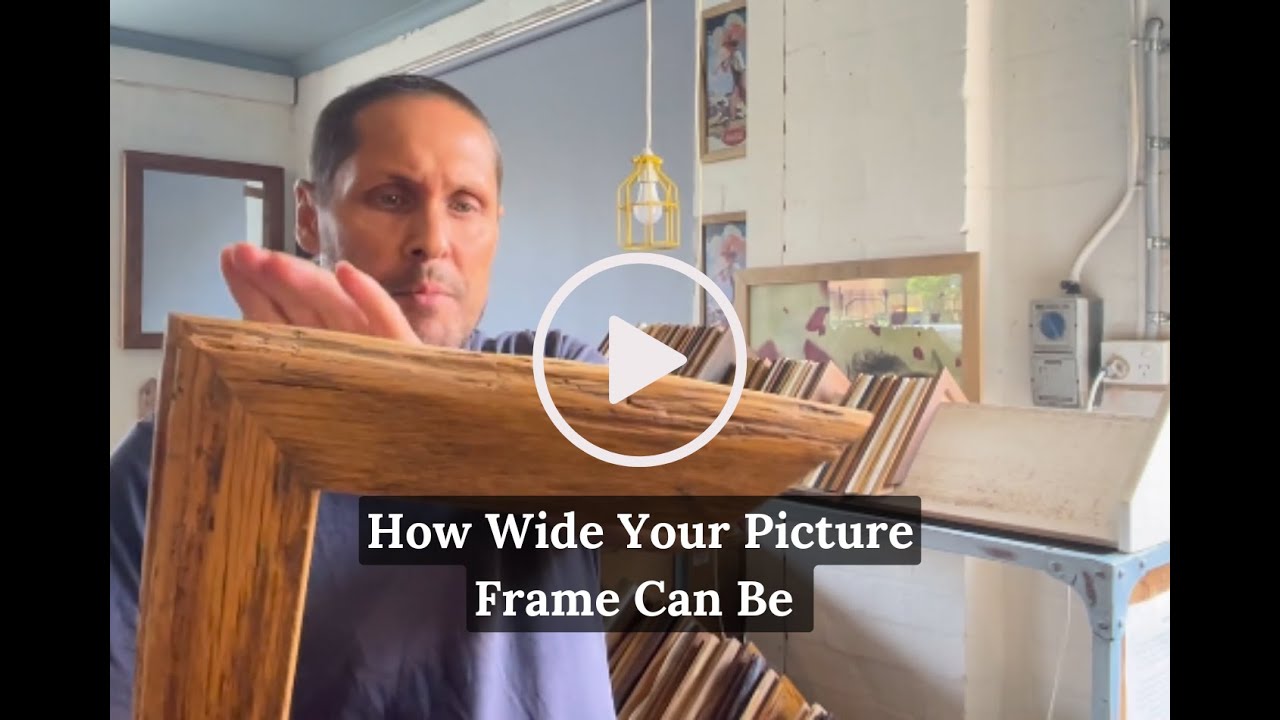
Standard vs. Custom Frames
Standard frames suit common dimensions and straightforward displays, while custom frames solve unusual sizes, thick objects, and preservation needs. A larger stock frame paired with a custom-cut mat often offers the best balance between fit and cost.
When Standard Frames Work
Choose a standard frame when the art matches a stocked size, minor edge coverage is acceptable, and the package is thin. Replacement mats, glazing, and backing are easier to find for common formats.
When Custom Frames Work
Custom framing fits irregular paper, uncommon dimensions, thick canvases, textiles, and objects. It also lets you preserve signatures, deckled edges, and intentional borders that a premade mat would cover.
Custom Mat Alternative
Place unusual flat artwork in the next practical standard frame and order a custom-cut mat. Avoid borders that become visibly narrow on one side; an off-center opening looks accidental unless the asymmetry clearly supports the composition.
Frame Cost Factors
Cost rises with frame perimeter, moulding width, glazing type, mat layers, mounting method, labor, and shipping size. Solid wood profiles tend to cost and weigh more than plastic or medium-density fiberboard trim, though finish quality varies widely.
Glazing and Materials
Glass resists scratching and remains rigid, but it is heavy and breakable. Acrylic weighs less and resists impact, making it useful for large posters, shipped art, children’s rooms, and high-traffic halls; its trade-offs are static, flex, and easier scratching.
Archival Mounting Options
Photo corners and reversible paper hinges protect valuable work better than pressure-sensitive tape or permanent dry mounting. The Library of Congress matting guidance recommends preservation-quality materials and mounting methods that avoid permanent alteration.
Acid-free alpha-cellulose mats suit many projects, while cotton-rag board provides a higher preservation standard. Keep valuable paper from direct contact with ordinary glass, since condensation and surface adhesion can stain or tear the image.
Wall Displays and Sizing Mistakes
Size a wall display by its complete outside footprint, including moulding and gaps. The common failures are buying from nominal dimensions alone, hanging an arrangement too high, and discovering that wide frames make a planned grid exceed the available wall.
Sofa and Console Sizing
A framed arrangement spanning about two-thirds to three-quarters of the furniture width often looks balanced. Over a 72-inch sofa, start with a total display width near 48–54 inches, then adjust for lamps, side tables, and the room’s open space.
Hanging Height and Spacing
A center height around 57–60 inches from the floor is a useful starting point for artwork viewed while standing. Over furniture, a lower edge 6–12 inches above the surface usually keeps the frame visually connected rather than floating near the ceiling.
Leave about 2–3 inches between frames in a compact group. Cut paper templates to the outside frame dimensions and tape them to the wall first; this catches conflicts with outlets, chair rails, and doors before holes are drilled.
Gallery Wall Layouts
Uniform grids work well with repeated 8 × 10, 10 × 10, or 11 × 14 frames. Measure the group as one large rectangle, including every gap, and align the outside edges rather than trying to level each image independently.
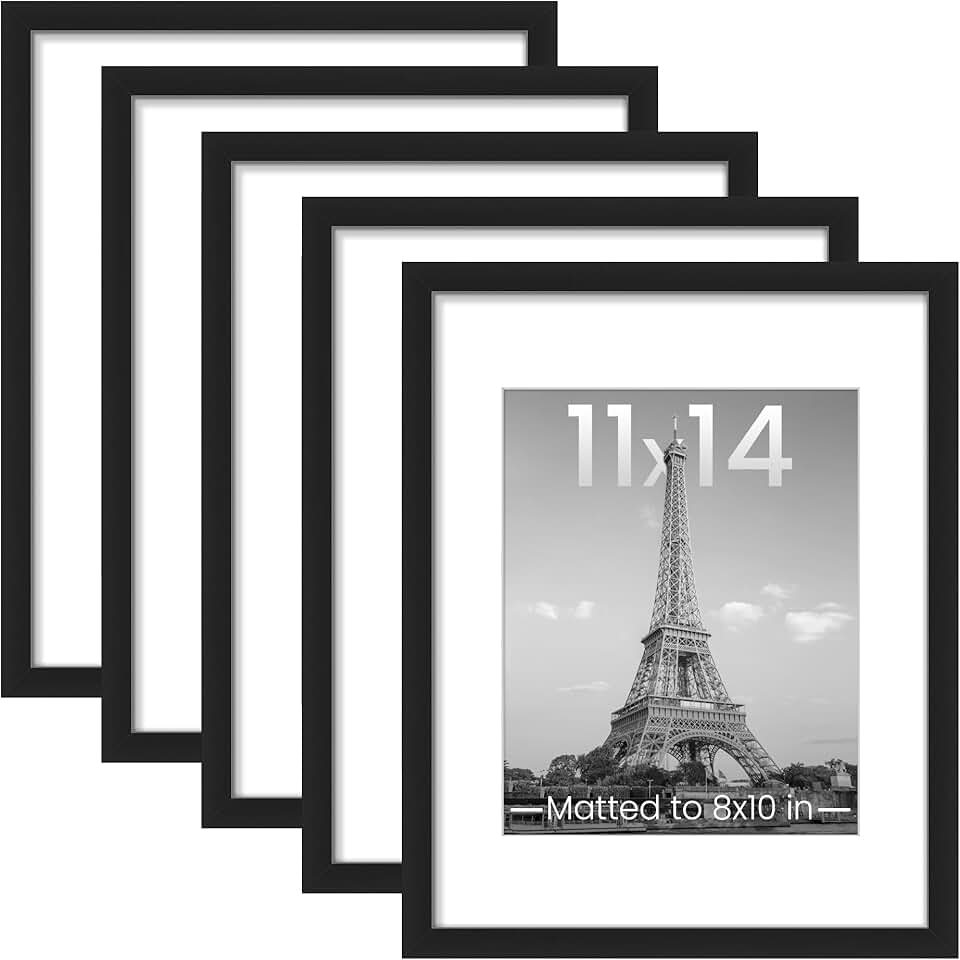
Five-Piece 11 by 14 Gallery Set
- Five matching frames create a coordinated gallery wall
- Fits 11 by 14 photos prints or artwork
- Black finish gives displays a clean modern look
- Great for arranging family photos or art collections
- Helps keep wall decor visually consistent
Buy on Amazon
Mixed and Collage Displays
Build a mixed display around one anchor, such as a 16 × 20 frame, then add two 11 × 14 frames and several 5 × 7 or 8 × 10 pieces. Keep frame color, mat color, spacing, or image theme consistent so the variation appears deliberate.
Collage frames require extra care because the outside label doesn’t reveal every opening size. Measure each window before trimming photographs, and copy irreplaceable originals instead of cutting them to fit small or unusually shaped openings.
Frame Sizing Mistakes
The most common beginner mistake is ordering from the outside frame dimensions rather than the artwork size. Another is assuming an advertised 8 × 10 mat opening measures exactly 8 × 10, when it may be closer to 7.5 × 9.5 inches.
- Measure the artwork, not the old frame’s outside edge.
- Check the actual mat opening and sight opening.
- Don’t treat A4 and US Letter as interchangeable.
- Preview aspect-ratio cropping before ordering a print.
- Measure canvas and object thickness, not just the front face.
- Confirm usable rabbet depth after glazing and backing are fitted.
- Account for wide moulding in the total wall footprint.
- Verify that hanging hardware supports the chosen orientation.
- Use acrylic where broken glass or high weight presents a risk.
Before buying, write down artwork width, artwork height, required visible area, package thickness, mat opening, frame size, moulding width, and estimated outside dimensions. That short checklist prevents nearly every costly frame sizing error.
FAQs
What Are The Most Common Picture Frame Sizes?
The most common picture frame sizes include 4 × 6, 5 × 7, 8 × 10, 8.5 × 11, 11 × 14, 16 × 20, and 18 × 24 inches. These sizes fit popular photo prints, certificates, posters, and artwork. Frames are usually labeled by the artwork or photo size they hold, not their outer measurements.
Is Picture Frame Size Based On The Opening Or Outside Dimensions?
Picture frame size usually refers to the opening size, meaning the artwork or photo size the frame is made to hold. The outside dimensions are larger because they include the frame border. Always check the product description if you need exact wall space measurements or are fitting a frame into a specific location.
What Size Frame Do I Need For An 8 × 10 Photo With A Mat?
Use an 11 × 14 frame with an 8 × 10 mat opening for an 8 × 10 photo. This combination creates a border around the image and gives it a more polished appearance. Choose a mat labeled for an 8 × 10 photo, and confirm that its opening slightly overlaps the photo edges.
What Size Frame Fits An 8.5 × 11 Document?
An 8.5 × 11 frame fits a standard letter-size document directly. It is a common choice for certificates, diplomas, printed photos, and office documents. For a more decorative display, use an 11 × 14 frame with a mat that has an 8.5 × 11 opening.
Can A4 Paper Fit In An 8.5 × 11 Frame?
A4 paper can fit inside an 8.5 × 11 frame, but it will not fit perfectly because A4 measures 8.27 × 11.69 inches. The paper is slightly narrower and taller than letter size. Use an A4 frame for the cleanest fit, or use a mat to hide small gaps and support the paper.
Affiliate Disclosure: Some links in this post are affiliate links. If you make a purchase through these links, we may earn a small commission at no extra cost to you. We only recommend products we genuinely believe in.

