

Medium Density Fiberboard Trim Guide: Uses, Pros, Cons, Cost, and Alternatives

Table of Contents
Medium density fiberboard trim is paint-grade interior molding made from compressed wood fibers, resin, and wax. It gives baseboards, casing, crown molding, wainscoting, and board and batten a smooth painted finish, but it can swell when water reaches cut edges or damaged corners.
What Is Medium Density Fiberboard Trim?

Medium density fiberboard trim, often called MDF trim, is engineered wood trim made for painted interior work. Manufacturers refine wood into fibers, blend those fibers with resin and wax, then press the mat with heat and pressure until it forms a dense, uniform board; the USDA Forest Products Laboratory Wood Handbook describes this family of wood-based composite panels in detail.
Material and composition
MDF trim has no grain direction, knots, pitch pockets, or voids like natural wood, so it mills into crisp baseboard, casing, crown, chair rail, and panel molding profiles. The surface feels smooth and slightly chalky under bare fingers, and that uniform face is why paint lays down flatter on MDF than on knotty pine.
MDF density range
MDF density commonly falls around 600–800 kg/m³, or about 37–50 lb/ft³, depending on the grade and maker. High density fiberboard is usually denser than that, while medium density overlay plywood is a different product with a plywood core and resin-treated face.
Common trim uses include MDF baseboard, door casing, window casing, crown molding, wainscoting, board and batten, built-in trim, and decorative wall paneling. For a broader material background, see our guide to engineered wood.
Paint-grade finish is the main reason to choose medium density fiberboard trim. Raw MDF needs primer, while primed MDF trim still needs sealed cut ends because those exposed fibers drink primer faster than the factory-coated face.
MDF vs similar materials is simple at first glance: MDF is smooth and affordable for dry painted interiors, solid wood is tougher, PVC handles water better, high density fiberboard is harder and panel-focused, and medium density overlay plywood works better for painted panels than molded interior trim.
Where MDF Trim Works and Fails

MDF trim works best in dry interior rooms where paint finish, straight profiles, and cost matter more than water resistance. It fails fastest where water, impact, pet bowls, wet mops, or exterior weather touch unsealed edges.
Interior baseboards
Interior baseboards are the most common use for medium density fiberboard trim. MDF baseboard suits bedrooms, living rooms, dining rooms, offices, dry hallways, and finished basements with steady humidity; if you’re planning profiles and heights, our baseboards guide helps with sizing and style choices.
- Common MDF baseboard heights include 3 1/4 in, 4 1/4 in, 5 1/4 in, and 7 1/4 in.
- Common trim lengths include 8 ft, 12 ft, and 16 ft boards.
- Common trim thicknesses include 1/2 in, 5/8 in, and 3/4 in.
- Long, straight MDF runs reduce joints in open rooms and hallways.
- Pre-primed MDF saves time, but every cut edge still needs sealing.
Bathrooms and laundry rooms
Bathrooms and laundry rooms are risk zones for standard MDF. A powder room can be acceptable if the trim is fully primed, painted, and caulked, but baseboards near showers, tubs, utility sinks, washing machines, and damp floors should usually be PVC, tile, sealed pine, or another water-tolerant material.
Door and window casing performs well in dry rooms, but sweaty windows can stain and swell MDF if condensation drips into the lower corners. I seal the bottom cuts before the casing goes up because that joint often feels cool and damp in winter, especially on older double-hung windows.
Crown molding made from MDF stays straighter than many softwood profiles and paints cleanly, but it can feel surprisingly heavy overhead. Use adhesive plus finish nails on long crown runs, and support the piece well so the lower edge doesn’t chip while you’re wrestling it into position.
Wainscoting and board batten projects are ideal uses for MDF wall trim because the smooth face creates a clean, modern painted wall. Seal the bottom edge near hard flooring because mop water can wick up through the cut end before you see surface damage.
Built-ins and millwork can use MDF trim around painted bookshelves, closet systems, fireplace surrounds in dry spaces, and cabinet details. For exposed shelves or cabinet boxes, compare MDF with cabinet grade plywood, since plywood holds screws better and handles load-bearing joinery with less edge crumbling.
Exterior trim limits are strict for standard MDF. Rain, snow, sun exposure, and freeze-thaw cycling break down exposed fiberboard, so use PVC, fiber cement, cedar, exterior-rated engineered trim, or exterior-grade panel products instead.
High-impact areas expose MDF’s softer corners. Mudrooms, garages, stair landings, commercial hallways, and kids’ playrooms often need poplar, finger-jointed pine, PVC, or hardwood because MDF corners can crush into a dull, fuzzy dent after one hard furniture hit.
MDF Trim Pros and Cons
MDF trim pros center on price, smooth paint, straightness, and profile consistency. The main cons are moisture swelling, weaker edges, fine dust, lower screw holding, and poor performance in wet or impact-prone locations.
Advantages of MDF trim
Advantages of MDF trim show up during layout and finishing. Boards are usually straight, profiles match from piece to piece, long runs reduce seams, and the primered face doesn’t telegraph grain lines through semi-gloss paint the way some pine does.
- Lower material cost than most hardwood, poplar, and PVC trim.
- Smooth paint-grade face with no knots or mineral streaks.
- Stable profiles that resist twisting better than many solid wood boards.
- Wide availability in baseboard, casing, crown, chair rail, shoe, and panel molding.
- Good choice for board and batten, wainscoting, and other painted wall treatments.
Disadvantages of MDF trim
Disadvantages of MDF trim matter most after installation. Moisture can swell cut ends, nail holes can mushroom, outside corners dent more easily than wood, and sanding too hard can raise a fuzzy texture that paint makes more visible.
Moisture weaknesses start at the bottom edge, cut ends, nail holes, and damaged corners. A beginner mistake is painting only the visible face; the workaround is to prime cuts before installation, then paint and caulk after fastening.
Edge durability is lower than poplar or hardwood because MDF is fiber-based all the way through. If a room has tight outside corners near furniture paths, use wood corner blocks, a tougher trim material, or a profile with a small radius instead of a sharp square edge.
Paintability and stability are MDF’s strengths. The board has no seasonal grain movement like solid wood, so long painted runs stay flatter, but that stability doesn’t make standard MDF waterproof.
MDF Trim vs Other Materials
MDF trim compares best against other paint-grade options, not stain-grade hardwood. Choose the material by room exposure, finish type, impact risk, fastener needs, and whether the trim is molded profile or flat panel work.
| Material | Best use | Main drawback |
|---|---|---|
| Medium density fiberboard trim | Dry interior painted baseboards, casing, crown, board and batten | Swells when water reaches raw edges |
| Solid pine trim | Painted or stained rooms needing better edge strength | Knots, grain, and warping can need extra prep |
| Finger-jointed pine | Paint-grade trim near doors, windows, and moderate-use areas | Joints can show through poor paint work |
| Poplar and hardwood | Premium painted trim, stained trim, built-ins, high-touch areas | Higher material cost |
| PVC trim | Bathrooms, laundry rooms, exterior trim, wet floor areas | Moves more with temperature and needs compatible products |
| High density fiberboard | Flooring cores, door skins, cabinet backs, dense panels | Less common as decorative molding |
| Medium density overlay plywood | Exterior signs, painted panels, concrete forms, smooth panel faces | Panel product, not typical baseboard or crown molding |
High density fiberboard
High density fiberboard, or HDF, is compressed to a higher density than MDF, often above 800 kg/m³. It is harder and more wear-resistant in panel uses, but density alone doesn’t make it waterproof, and it’s less common as decorative trim molding; learn more in our high density fiberboard guide.
Medium density overlay plywood
Medium density overlay plywood, or MDO plywood, has a plywood core with a resin-impregnated fiber overlay bonded to one or both faces. It suits painted exterior panels, signs, and forms better than molded baseboard or casing; our full guide to medium density overlay plywood explains where it beats MDF.
Solid pine trim can be stained, nails better, and handles corners better than MDF, but it may twist, show knots, or bleed resin under paint. MDF is usually cleaner for budget-friendly painted rooms where water and abuse are low.
Finger-jointed pine is a strong middle choice for paint-grade trim. It costs more than many MDF profiles, but the real wood fibers hold fasteners better and tolerate small moisture events better than standard MDF.
Poplar and hardwood fit premium painted millwork, historic trim, and stain-grade work. Poplar costs more than MDF, but it machines crisply, holds sharp outside corners, and repairs more cleanly after dents; see our poplar wood guide for details.
PVC trim is the safer pick for wet bathrooms, laundry rooms, exterior doors, and exterior trim. The trade-off is movement: PVC expands and contracts more with temperature, so long runs need the right fasteners, adhesive, paint color, and expansion gaps.
Best material by use: choose MDF for dry painted interiors, finger-jointed pine for better durability on a budget, poplar for premium painted trim, hardwood for stained trim, PVC for water, HDF for dense panel parts, and MDO plywood for smooth painted panels.
MDF Trim Cost and Buying Tips
MDF trim cost is usually lower than solid wood, poplar, hardwood, and PVC trim. Many MDF baseboard and casing profiles fall around $0.80–$3.00 per linear foot for material, with height, thickness, profile detail, primer, grade, brand, and region driving the final number.
Cost per linear foot
Cost per foot should include waste, not just shelf price. Finger-jointed pine often runs about $1.50–$4.00 per linear foot, hardwood trim often runs $3.00–$10.00+ per linear foot, and PVC trim often runs $2.00–$6.00+ per linear foot.
What to inspect
Inspect MDF trim before you load it because crushed corners and swollen ends are hard to hide on visible runs. Run a hand down the face; dents feel like shallow bruises under the primer, and chipped profiles catch your fingertip before your eye catches them.
- Measure every wall and opening, then add 10%–15% for waste, miters, offcuts, and mistakes.
- Buy longer lengths for open runs so you reduce scarf joints.
- Confirm whether the product is primed MDF, raw MDF, moisture-resistant MDF, flexible MDF, or ultralight MDF.
- Check height, thickness, profile name, edge quality, primer coverage, and straightness.
- Reject trim with crushed corners if those corners will land in visible spots.
Labor and waste can exceed the trim cost, especially with crown molding, stairs, wainscoting grids, built-ins, and rooms with many corners. For complex crown or board and batten layouts, waste can pass 15% because pattern spacing and miter direction limit how scraps can be reused.
Sizes and profiles should match the room scale. A 7 1/4 in MDF baseboard can look balanced in rooms with taller ceilings, while 3 1/4 in or 4 1/4 in profiles often fit smaller bedrooms and offices.
Primed vs raw MDF affects prep time. Primed MDF saves sanding and sealing on the face, while raw MDF takes more primer and often raises fibers on edges after the first coat.
DIY trim kits can speed up small accent walls because pieces arrive pre-cut for layout-friendly projects. A kit makes sense for dry interior board and batten or wainscoting-style walls, not shower areas, exterior trim, or structural framing.

Board and Batten Trim Kit
- Pre-cut MDF trim simplifies wall upgrades
- paintable surface matches any room style
- creates a clean board and batten look
- great for accent walls and wainscoting projects
- ideal for living rooms, bedrooms, and offices
 Buy on Amazon
How to Cut and Install MDF Trim
Cutting MDF trim takes sharp blades, full board support, and dust control. Installing it takes the right nail gauge, careful joint work, sealed cuts, and light handling because edges bruise faster than solid wood.
Recommended tools
Recommended tools include a miter saw, fine-tooth carbide blade, tape measure, speed square, pencil, clamps, stud finder, finish nailer, brad nailer, caulk gun, dust collection, respirator, safety glasses, and hearing protection. A coping saw or jigsaw helps with inside corners and odd profiles.
Cutting MDF trim
Cutting MDF cleanly usually means using an 80–100 tooth carbide blade on a 10 in or 12 in miter saw. Don’t force the saw; a slow, steady cut leaves a cleaner edge and avoids the hot, burnt-fiber smell that shows up with a dull blade.
Dust and safety deserve real attention because MDF dust is fine, pale, and flour-like; it hangs in the air and leaves a dry grit in your nose and throat. Use extraction, ventilation, eye protection, and a rated respirator; OSHA wood dust guidance explains why airborne wood dust needs control.
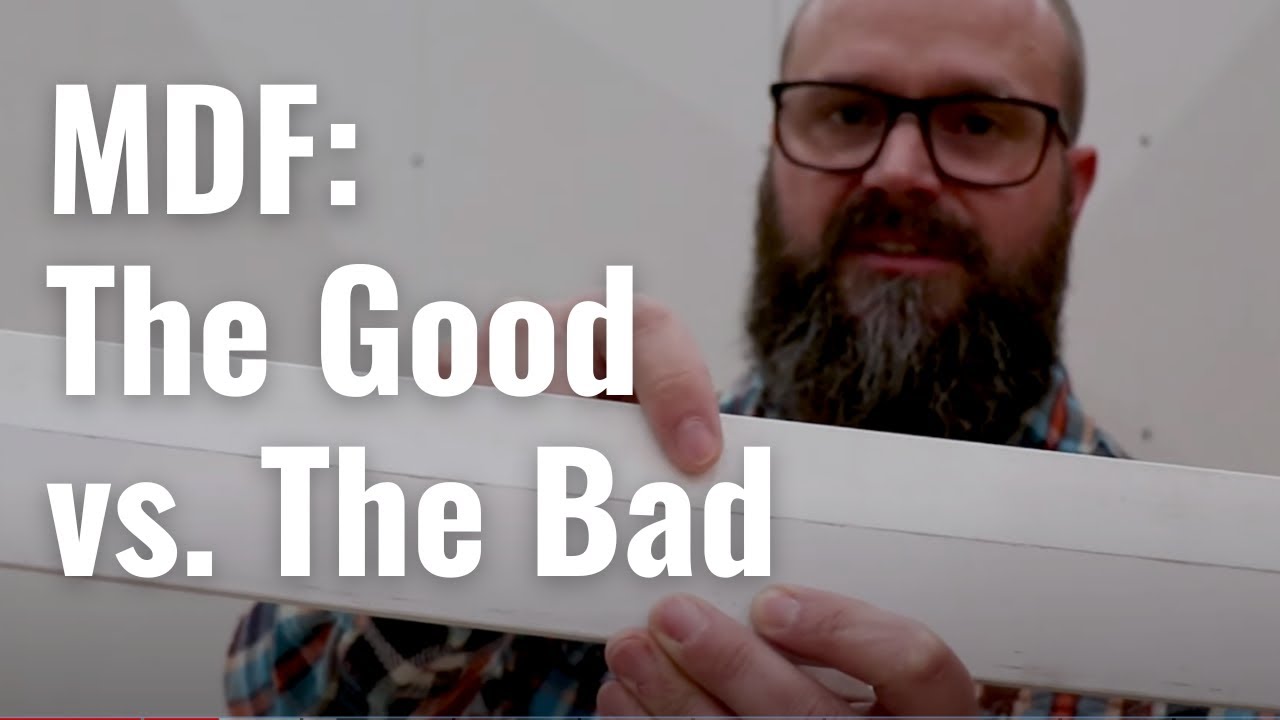
Nails and fasteners should match the trim size. Use 15-gauge or 16-gauge finish nails for larger baseboards, casing, and crown; use 18-gauge brad nails for small molding, and avoid nailing too close to ends because MDF can split or flare.
Adhesive use helps on long crown runs, wavy walls, and spots where studs are hard to hit. Use it sparingly because heavy beads can hold trim proud of the wall and make the top caulk line wider than planned.
Corner and scarf joints need careful layout. Cope inside corners when walls are out of square, miter outside corners with light handling, and use scarf joints rather than square butt joints on long runs so the seam disappears after filler and paint.
Wall and floor fit matters because MDF won’t magically hide crooked drywall or dips in flooring. Scribe, shim, or split the difference, then caulk the top edge; don’t press raw MDF tight against damp concrete or wet tile transitions.
How to Prime, Paint, and Seal MDF
Priming MDF trim protects the vulnerable fibers and creates an even paint sheen. Factory primer covers the face, but cut ends, nail repairs, sanded spots, and raw backs can absorb finish unevenly.
Priming cut edges
Priming cut edges is the step beginners skip most often. Brush primer into every end cut before installation when possible, then hit scarf joints, coped cuts, and exposed bottom edges again after fitting.
Filling nail holes
Filling nail holes takes a light touch because MDF fibers can rise around fasteners. Use lightweight spackle, wood filler, or painter’s putty rated for painted trim, then sand smooth after it dries.
Sanding MDF trim works best with 180–220 grit for final smoothing. Heavy sanding rounds profiles and creates fuzzy fibers, so sand just enough that the filled nail hole feels flat under your fingertip.
Caulking seams hides small gaps between trim and wall, not bad cuts between trim pieces. Use paintable acrylic latex caulk on wall lines, and use filler or glue-supported joinery on scarf and miter joints.
Paint finish options usually include satin, semi-gloss, and gloss interior trim paint. Semi-gloss is common for MDF baseboards and casing because it wipes cleaner than flat paint without making every drywall ripple glare under side light.
Moisture-resistant MDF performs better in humid interior settings, but it isn’t waterproof. Use it only where the maker rates it for the room, and still prime, paint, caulk, and seal cut ends.
Common Failures and Prevention
Common MDF failures include swollen bottom edges, raised nail holes, fuzzy cuts, dented corners, open joints, and air-quality concerns during cutting. Most failures start from skipped sealing, rushed fastening, dull blades, or using MDF where water or impact calls for another material.
Swollen bottom edges
Swollen bottom edges happen when MDF wicks water from wet mopping, pet bowls, bathroom floors, laundry leaks, or slab moisture. Prevent it by sealing bottom cuts, painting thoroughly, keeping caulk intact, and switching to PVC or tile base in splash-prone spots.
Formaldehyde and air quality
Formaldehyde and air quality concerns relate to the resins used in some composite wood products. Check labels for EPA TSCA Title VI, CARB Phase 2, NAF, or ULEF claims, and review the EPA formaldehyde standards if indoor emissions matter for the project.
Raised nail holes come from fibers compressing and lifting around fasteners. Reduce the problem by adjusting nailer pressure on scrap first, using the right gauge, nailing into studs where you can, filling lightly, and sanding after the filler fully dries.
Fuzzy cut edges come from dull blades, raw MDF absorbing primer, or aggressive sanding. Seal the edge, let primer dry, sand lightly with 180–220 grit, then apply finish paint instead of trying to grind the edge smooth in one pass.
Dented corners are common on exposed outside corners and stair landings. Use poplar, hardwood, finger-jointed pine, corner blocks, or a rounded profile where carts, vacuums, chairs, or kids’ toys will hit the trim.
Open joints usually trace back to poor cuts, unsquare walls, weak fastening, or trim installed under stress. Dry-fit first, cope difficult inside corners, use scarf joints on long runs, and glue only where it helps the joint stay aligned.
Practical notes from real-world use: MDF rewards slow prep more than force. If a cut edge feels soft and hairy after the first primer coat, stop sanding hard, add one more sealing coat, then sand lightly; that saves the profile better than chasing a fuzzy edge with coarse paper.
Beginner mistakes usually look small at installation and large after paint. The biggest ones are skipping edge primer, overdriving nails, using MDF beside wet floors, buying dented boards, and relying on caulk to fix wide miters; the fix is careful material choice, scrap testing, sealed cuts, and dry-fitting before fastening.
FAQs
Is Medium Density Fiberboard Trim Good For Baseboards?
Yes, MDF trim is a good choice for baseboards in many homes. It is smooth, easy to paint, and usually more affordable than solid wood. It works especially well in dry, interior spaces where you want a clean finished look.
What Are The Disadvantages Of MDF Trim?
MDF trim is less moisture-resistant than solid wood and can swell or break down if it gets wet. It is also heavier and can dent more easily at edges and corners. In very humid areas or rooms with leaks, a more water-resistant material is usually better.
Is MDF Trim Better Than Wood Trim?
MDF trim is better than wood trim for some projects, but not all of them. It is cheaper, more uniform, and easier to paint, while wood is stronger and more durable in wet or high-wear areas. The best choice depends on your room, budget, and finish preference.
Can MDF Trim Be Used In Bathrooms?
MDF trim can be used in bathrooms only if the space stays dry and well-ventilated. It is not the best option for areas that get splashed often, since moisture can cause swelling and damage. For bathrooms, moisture-resistant MDF or PVC trim is usually a safer choice.
What Is The Difference Between MDF And High Density Fiberboard?
MDF and high density fiberboard are different materials with different density levels and uses. MDF is softer and easier to cut, while HDF is denser, harder, and stronger. HDF is often used for flooring and panels, while MDF is more common for trim, cabinets, and painted finishes.
Affiliate Disclosure: Some links in this post are affiliate links. If you make a purchase through these links, we may earn a small commission at no extra cost to you. We only recommend products we genuinely believe in.