

Wood Turning Blanks Buying Guide: Types, Sizes, and Species

Wood turning blanks are prepared blocks, squares, rounds, or slabs sized and oriented for shaping on a wood lathe. Choose one by project type, usable dimensions, grain direction, moisture condition, defects, species, and delivered cost.
Bowl blanks usually carry grain across the lathe axis, while spindle and pen blanks carry grain along it. This guide explains how to buy, inspect, cut, dry, mount, and turn the stock safely.
Table of Contents
What Are Wood Turning Blanks?
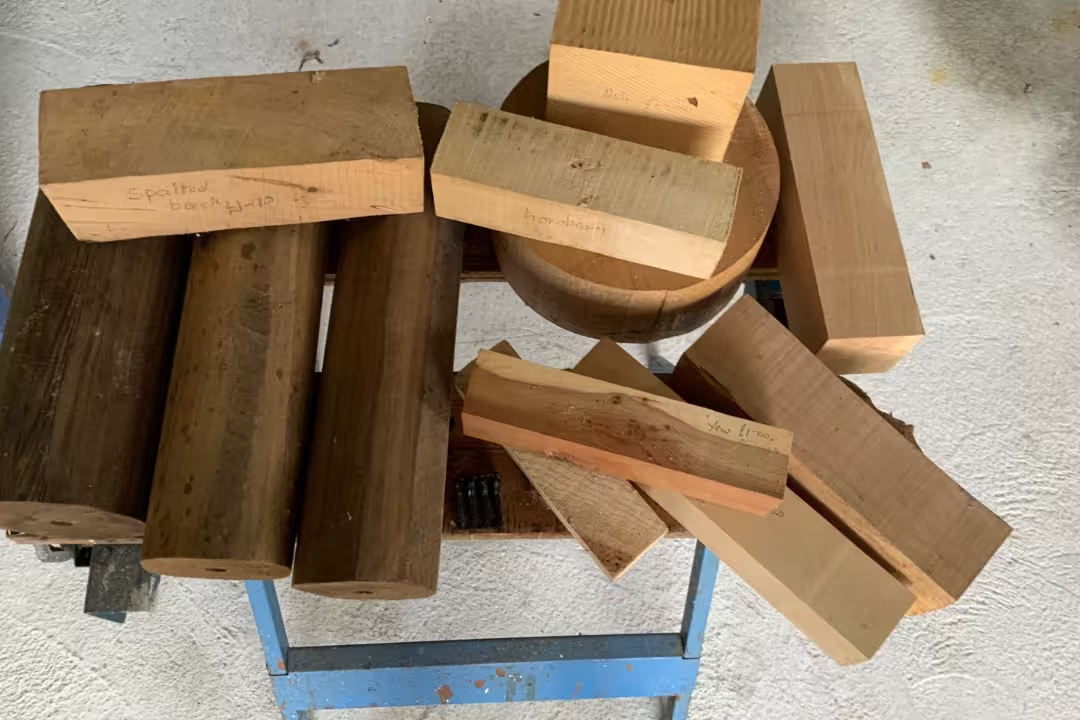
A turning blank is wood prepared with enough material, suitable grain placement, and a practical shape for lathe work. Retailers may call the same material turning stock, wood lathe blanks, turning squares, bowl stock, or project blanks.
Blank Shapes and Uses
Squares are easy to measure and clamp, cylinders require less roughing, and slabs suit bowls or platters. A chainsawn half-log may also qualify as a green bowl blank once its pith, checked ends, and unstable bark have been removed.
- Square or round bowl stock: bowls, platters, and shallow dishes.
- Long turning squares: handles, legs, mills, candlesticks, and finials.
- Small squares: pens, stoppers, pulls, ornaments, and chess pieces.
- Deep blocks: hollow forms, boxes, urns, and end-grain vessels.
- Burl or crotch blocks: decorative vessels where voids form part of the design.
Grain Orientation Basics
Grain direction controls cutting behavior and structural strength. Conventional spindle work aligns grain parallel to the lathe bed, while a side-grain bowl places the fibers across the rotational axis; study common wood grain patterns before cutting figured logs.
Bowl versus spindle blanks: a spindle blank with cross-grain can snap at a narrow bead, handle neck, or finial. A bowl blank cut with the pith inside may split radially, sometimes opening with a sharp click while the blank is stationary between turning sessions.
| Blank | Normal grain direction | Common shape | Main risk |
|---|---|---|---|
| Bowl | Across lathe axis | Square or round slab | Pith cracks and warping |
| Spindle | Along lathe axis | Long square | Short-grain breakage |
| Pen | Usually along its length | Small square | Drilling blowout |
| Hollow form | Across or along axis | Deep block or log section | Hidden voids and bark |
Choose Blanks by Project Type
Choose a blank from the finished dimensions backward, leaving material for rounding, mounting, truing, sanding, and parting. The smallest measured cross-section—not the advertised nominal size—sets the usable diameter.
Project and Size Selector
The figures below are buying baselines rather than fixed rules. Irregular, checked, or green stock needs a larger waste allowance because drying movement and initial truing consume extra wood.
| Blank type | Common dimensions | Typical projects | Suggested allowance |
|---|---|---|---|
| Bowl | 4 × 4 × 2 to 10 × 10 × 3 in. | Bowls and platters | ½–1 in. extra diameter |
| Spindle | 1½–3 in. square; varied length | Handles, legs, mills | ¼ in. width; 1–2 in. length |
| Pen | About ¾ × ¾ × 5 in. | Standard pen kits | Match tube, bit, and trim method |
| Bottle stopper | About 1½ square × 2½–3 in. | Stoppers and pulls | Allow for chucking tenon |
| Hollow form | Project dependent | Vessels and urns | Extra wall and mounting stock |
Bowl Blanks
Buy bowl stock about ½–1 inch wider than the intended finished diameter when the blank is sound and dry. Increase that margin for green or checked wood, since the corners, faces, tenon, foot, and drying distortion all reduce yield.
Spindle blanks: add at least 1–2 inches for drive-center marks, chuck tenons, parting cuts, and end checks. Straight grain matters most near narrow functional sections, while a slight bow can remove surprising amounts of diameter during roughing.
Pen blanks: ¾ × ¾ × 5 inches fits many kits, but larger tubes may need ⅞-inch stock or extra length. Check the tube, bushing, drill-bit diameter, and barrel-trimming method before buying; drilling a costly blank first is a common beginner error.
Bottle-stopper blanks: stock around 1½ inches square and 2½–3 inches long suits many stopper kits. Hardware dimensions still control the choice, particularly where a threaded mandrel or chucking tenon uses part of the length.
Hollow-form blanks: allow enough diameter for the exterior curve and enough depth for a stable mounting point. Burl, crotch, and branch-junction stock can reveal hollow bark seams after the first few cuts, so reduce speed and reassess every exposed void; see how a tree burl develops before choosing one for a vessel.
Compare Blank Moisture Conditions

Green blanks cut easily but move and crack; dried blanks offer greater dimensional stability; stabilized stock works best for small decorative projects. Moisture labels aren’t interchangeable because blank thickness, species, meter type, storage climate, and measuring depth affect the reading.
Green Blanks
Fresh wood produces cool, ribbon-like shavings that can land wet against the forearm and cling to the lathe bed. Its low cutting resistance makes large forms pleasant to rough, but shrinkage and checking make it unsuitable for dimensionally stable one-session work.
Turn green wood as a deliberately warped finished piece or use a twice-turned process. Mold may form under wet shavings, and steel tool rests can develop dark stains where tannin-rich species such as walnut contact damp metal.
Rough-Bowl Drying
A useful starting rule leaves the rough wall at about 10% of bowl diameter, so a 10-inch bowl retains roughly a 1-inch wall. Species, rim shape, grain placement, initial moisture, and local humidity can require more material.
Seal end-grain-heavy areas and dry the bowl slowly in a paper bag, controlled cabinet, or ventilated stack. Weighing it weekly gives better evidence than waiting an arbitrary number of months; when repeated readings stop falling, moisture loss has slowed substantially.
Air-dried blanks: a dry-feeling exterior doesn’t prove that the center of a thick block has equilibrated. Ask for moisture readings, drying time, storage conditions, and whether the reading came from the surface or core.
Kiln-dried blanks: these are practical for projects that need stable final dimensions, but a kiln can’t erase old checks, honeycombing, or internal stress. Indoor wood often settles near 6–10% moisture in many climates, with humid workshops stabilizing higher; the USDA Wood Handbook explains moisture movement and shrinkage in depth.
For more detail on schedules and defects, compare the blank’s description with this guide to kiln-dried wood. A meter reading remains an estimate, particularly on dense, oily, unusually thick, or temperature-cold stock.
Stabilized wood blanks: cured resin reinforces porous or lightly punky material and creates a dense, polishable surface. Stabilization adds weight and drilling heat, and it can’t make a deeply cracked piece safe; use sharp bits, frequent chip clearing, and light sanding pressure.
Resin-hybrid blanks: mixed wood-and-resin stock often changes cutting resistance each time the edge crosses the material boundary. Keep the cutter sharp and supported, avoid heat buildup, and use dust extraction because fine resin dust hangs in the air longer than coarse shavings.
| Condition | Best use | Main benefit | Main limitation |
|---|---|---|---|
| Green | Rough bowls and organic forms | Easy cutting | Large movement |
| Air-dried | Bowls and spindles | Natural seasoning | Core may remain wet |
| Kiln-dried | Final-size work | More predictable moisture | Possible internal drying defects |
| Stabilized | Pens and handles | Hard, polishable surface | Cost and heat |
| Resin hybrid | Decorative small work | Color and contrast | Mixed cutting behavior |
Choose Domestic or Exotic Woods
Walnut, cherry, and maple offer predictable results and broad availability, while exotic woods provide bold color or grain at a higher material, tool-wear, and dust-control cost. Species hardness helps comparison, but grain structure, oil, silica, dryness, and figure often affect turning more.
Walnut, Cherry, and Maple
Walnut wood turns with moderate resistance and displays dark heartwood against pale sapwood. Its approximate Janka hardness is 1,010 lbf, making it friendly for bowls, handles, boxes, and finials, though fine end checks may hide in dark grain.
Cherry wood has an approximate Janka hardness of 950 lbf and cuts cleanly with sharp tools. Its warm color darkens after light exposure, while overheated sanding can glaze the surface and make finish absorption uneven.
Hard maple measures about 1,450 lbf on the Janka scale and takes dyes well. Curly, quilted, and bird’s-eye figure can tear where grain reverses, so a shear cut and freshly sharpened edge leave a smoother, almost silky surface than aggressive scraping.
Olive, Purpleheart, and Bubinga
Olive wood offers swirling brown lines and a faint, sweet scent during cutting. Its irregular grain can move or check, while natural oil may weaken some glue and finish bonds; wipe bonding surfaces with a suitable solvent immediately before assembly.
Purpleheart measures about 2,520 lbf and needs sharp edges with controlled sanding heat. Fresh cuts may look muted before oxidation changes the color, and excess heat can turn the surface muddy brown.
Bubinga, around 2,410 lbf, can take a crisp polish but often has interlocked grain. Confirm the exact botanical species and trade documents because commercial names vary and some Guibourtia species are regulated.
Zebrawood and jatoba: zebrawood’s striped pattern rewards deliberate alignment, yet its interlocked grain tears readily. Jatoba, around 2,690 lbf, feels noticeably resistant under a drill bit; clear chips often and let the bit cool rather than forcing it through a pen blank.
Figure and turning difficulty: hardness numbers don’t measure grain reversal, bark seams, or decayed fibers. Spalted wood may look striking but become soft enough for a fingernail to dent, while sound curly figure can remain strong yet prone to tear-out.
Exotic wood safety: use source extraction and a well-fitted respirator rather than relying on a face shield for dust control. Sensitization can develop after repeated exposure, and oily dust left on skin may cause itching or redness; wash with soap instead of compressed air.
CITES and sustainability: verify botanical names, origin, seller documentation, and import rules before buying regulated species across borders. Search the official CITES species checklist, since a common trade name may cover several species with different controls.
Wood Turning Blanks to Buy
Buy wood turning blanks only after verifying actual dimensions, quantity, species, moisture condition, and whether photographs show the exact pieces. Product labels such as “premium,” “dry,” and “exotic” aren’t standardized material grades.
Bowl Turning Blanks
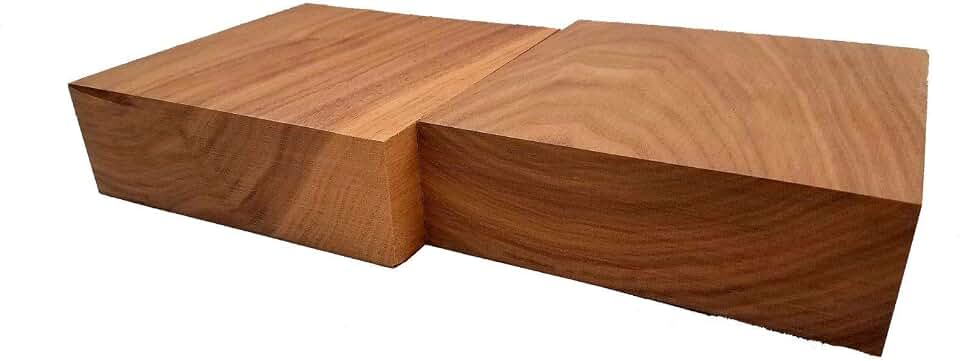
This two-piece walnut pack is intended for small bowls and platters. A six-inch square can’t yield a full six-inch finished bowl after rounding and truing, so plan a smaller finished diameter and inspect the corners for shipping damage.
Black Walnut Bowl Blanks
- Two thick walnut bowl blanks
- Six-inch square turning stock
- Two-inch thickness supports bowl forms
- Rich grain for attractive finishes
- Ideal for small bowls and platters
 Buy on Amazon
Spindle and Handle Blanks
Walnut squares suit handles and finials where dark color is wanted. Check the actual cross-section, straightness, grain direction, and available length after removing any end checks.

Black Walnut Turning Squares
- Rich dark walnut color
- Four square blanks included
- Sized for small turning projects
- Suitable for handles and finials
- Easy stock for custom lathe work
Buy on Amazon
The mixed domestic pack lets a turner compare maple, walnut, and cherry in the same project class. Its 18-inch length gives useful room for tool handles or furniture components, though longer stock may carry a higher shipping cost.

Maple Walnut Cherry Turning Pack
- Six long turning blanks
- Includes maple walnut and cherry
- Generous 18-inch blank length
- Ideal for spindle turning projects
- Lets turners compare popular hardwoods
Buy on Amazon
These two-inch maple squares provide repeatable stock for handles, ornaments, and short spindle projects. Light maple shows dirty chuck marks and torn fibers clearly, which makes it useful for practicing clean tool presentation.

Maple Square Turning Blanks
- Eight maple square blanks
- Consistent 2-inch square profile
- Eight-inch length for spindle work
- Suitable for carving and turning
- Light wood accepts stains and finishes
Buy on Amazon
The cherry squares offer 12-inch stock for handles and decorative spindle work. Measure the shortest piece and inspect both ends under side lighting because fine cherry checks can blend into its warm grain.

Cherry Turning Blank Squares
- Four cherry hardwood blanks
- Long 12-inch square stock
- Warm color deepens with finishing
- Ideal for spindle turning projects
- Useful for handles and decorative work
Buy on Amazon
Pen turning blanks: compare packs by tube compatibility, guaranteed species, actual size, duplicates, moisture, and price per usable piece. Dense blanks need a sharp bit, slow feed, frequent chip clearing, and sacrificial backing to reduce exit blowout.
This ten-piece olive set gives varied swirling grain for standard and larger pen kits. Dry-fit the blank against the tube before cutting because irregular checks near one end may reduce the usable barrel length.

Olive Wood Pen Blank Set
- Ten solid olive wood blanks
- Distinctive natural grain patterns
- Sized for pen turning
- Fits seven millimeter and larger kits
- Includes certificates of origin
Buy on Amazon
The five-piece olive pack suits buyers who need fewer blanks or want to test the species before ordering volume. Match each grain pattern across a two-barrel pen before crosscutting so the completed barrels retain visual continuity.

Olive Wood Pen Blanks
- Five olive wood blanks
- Natural grain makes each piece unique
- Sized for pen turning projects
- Suitable for small instruments and crafts
- Solid square stock for lathe shaping
Buy on Amazon
This mixed set includes walnut, purpleheart, zebrawood, cherry, and bubinga. Expect different drilling resistance and sanding behavior from piece to piece; a setting that works on cherry may overheat a dense exotic blank.

Exotic Wood Pen Blank Mix
- Ten hardwood pen blanks
- Includes five contrasting wood species
- Walnut purpleheart zebrawood cherry and bubinga
- Ready for lathe pen projects
- Great variety for custom gifts
Buy on Amazon
The 12-piece assortment lists bloodwood, Mexican ebony, jatoba, and maple, with three blanks per wood type. Confirm dimensions against the chosen kit, particularly for wide tubes that leave a thin drilled wall.

12-Pack Exotic Pen Blanks
- Twelve blanks in four wood types
- Includes bloodwood Mexican ebony jatoba and maple
- Three blanks of each species
- Sized for standard pen turning
- Adds bold color and contrast
Buy on Amazon
The 50-piece pack fits production, classes, and repeated drilling practice. Ask whether the assortment guarantees equal species counts, since a low pack price loses value if many pieces are duplicates, undersized, or visually plain.
50-Piece Exotic Pen Blank Set
- Large 50-piece pen blank supply
- Mixed selection of five wood species
- Compact size for pen turning
- Hardwood stock for repeated projects
- Useful for makers and workshops
Buy on Amazon
Individual versus bulk packs: individual blanks make sense when figure, color, or exact dimensions matter. Bulk packs lower practice cost, but unidentified species, repeated grain, hidden defects, and inconsistent machining behavior can reduce their apparent value.
Product specification checklist: verify actual length, minimum cross-section, quantity, botanical species, moisture condition, wax coating, sapwood allowance, photograph type, size tolerance, defect policy, return terms, and delivered cost. Save the listing before ordering in case its description changes.
- Confirm every dimension in inches or millimeters.
- Check whether photographs show the exact blank or a sample.
- Look for repeated reports of cracks, warp, wrong species, or short counts.
- Ask whether wax is included in the stated dimensions.
- Verify that all advertised species are guaranteed in mixed packs.
- Add shipping, tax, and unusable pieces to the comparison.
Inspect, Size, and Price Blanks
Measure the smallest usable dimensions, subtract defects and mounting waste, and compare delivered cost per successful project. A cheap pack becomes expensive when checks, bow, sapwood, or poor grain placement make several blanks unusable.
Actual Dimensions and Yield
Measure length, width, and thickness at several points with calipers or a rule. Mark the largest circle on bowl stock; a nominal six-inch square that measures 5⅞ inches at one edge cannot provide a true six-inch cylinder.
For rectangular stock, board feet equal thickness × width × length in inches ÷ 144. A 6 × 6 × 2-inch blank contains 0.5 board foot before corners, checks, tenons, and truing waste are removed.
Oversize and Waste Allowances
Allow ½–1 inch of extra bowl diameter, ¼ inch or more in a spindle’s square dimension, and 1–2 inches of spindle length. Natural-edge and hollow forms need extra stock where bark removal, voids, or an uneven chainsaw cut may consume the planned profile.
Grain and defect checks: reject open cracks, loose bark, soft rot, severe bow, insect galleries, questionable glue joints, or metal-contaminated reclaimed wood. Tap a dry blank and listen for a clear, consistent note; a dull change can indicate a hidden split, though this test isn’t conclusive.
Wax-hidden end checks: rotate the blank under strong side lighting and look for thin shadows or ridges in the coating. With the seller’s permission, scrape a small patch or trim the end; wax slows moisture loss but can hide a crack that extends far beyond its visible tip.
Seller claims and photos: ask whether the image represents the exact item, one sample, or a mixed lot. A dramatic photographed face doesn’t show the opposite side, and figure near the exterior may disappear after the blank is rounded.
Cost per usable blank: divide the delivered order total by the number of pieces large and sound enough for the intended kit. If a $40 delivered pack contains ten blanks but two fail inspection, the usable cost is $5 each rather than $4.
Board-foot and delivered cost: turning stock costs more than rough lumber because sellers crosscut, dry, seal, grade, and sometimes photograph each piece. Compare that processing premium with your own saw time, blade wear, storage space, and expected defect loss.
Typical price ranges: domestic pen blanks often list around $1–$4 each, common exotic pen blanks around $3–$15, and small domestic spindle blanks around $5–$25. Small and medium bowl blanks commonly run from $10 to $80 or more, while figured burl, stabilization, and resin casting can raise the amount sharply.
These bands are comparison benchmarks, not fixed quotes. Species scarcity, dimensions, figure, drying, shipping distance, and individual photography change the final amount, so record the date and delivered total when comparing sellers.
Practical Notes From Real-World Use
A blank’s first few tool passes often reveal more than its product description. Clean shavings and a steady sound suggest sound fibers, while sudden dusty patches, rhythmic clicking, or a dark line growing wider can signal rot or cracking.
Beginners often center a bowl on the geometric middle without checking grain or defects. Shifting the center by half an inch can remove the pith, preserve better figure, place sapwood evenly, or move a bark pocket outside the finished rim.
Don’t cut every bulk pen blank to final barrel length at once. Drill one test piece from each species first because dense woods may wander, brittle stock may blow out, and oily species may need a different glue preparation.
A freshly rough-turned green bowl can feel cold and slightly clammy, while its wet shavings bend instead of snapping. Sweep them from cast-iron surfaces before stopping for the day, since trapped moisture and tannins can leave black marks or rust overnight.
For questionable figured stock, wrap the exterior temporarily with stretch film while mounting and making initial low-speed cuts, then remove it before normal turning. This isn’t a structural repair; it only helps contain loose surface fragments during the earliest inspection passes.
Make Blanks From Logs and Lumber
Sound logs and straight-grained lumber can become turning blanks after defective ends, pith, unstable bark, and embedded objects are removed. Cut oversize, seal exposed end grain soon after cutting, and support round material so it can’t roll into a saw blade.
Cutting Bowl Blanks
For a common side-grain bowl, split or saw the log lengthwise and place the bowl profile in one half. Move the layout away from the pith and checked ends, then choose between a conventional rim, natural edge, flatsawn pattern, or quartersawn appearance.
A cardboard circle or plywood disc helps locate the best yield before chainsaw or bandsaw cutting. Rotate the template to retain crotch feather, avoid bark seams, or balance sapwood on both sides of the planned bowl.
Cutting Spindle Blanks
Rip spindle stock so fibers travel along its length, especially for tool handles, legs, and narrow stems. Follow the grain rather than the board’s edge when possible, since diagonal short grain can create a weak neck that breaks under a catch.
Pith and grain placement: remove the pith from ordinary bowl blanks because radial checks often start there. Pith-centered vessels can be turned intentionally, but they demand a design that accepts movement and a close inspection schedule during drying.
Firewood suitability: straight-grained firewood works if it remains sound, large enough after defect removal, and free from nails, wire, stones, and deep insect damage. Avoid unknown treated wood and pieces stained by chemical contamination.
End sealing and storage: coat fresh end grain with wax-emulsion sealer or another coating made to slow moisture loss. Label species and cutting date, keep blanks off concrete, and permit side-grain airflow without exposing them to direct sun or strong heat.
Drying and crack prevention: sealing slows rapid end loss but doesn’t repair existing checks. Cut past visible cracks before storage, keep the pith out, and inspect the stack often because a small split may lengthen during a warm, dry week.
Safe bandsaw support: never set a round log loose on a flat table. Create a flat with a chainsaw, secure the log in a cradle or sled, and keep the support between the wood and table throughout the cut so the blade can’t grab and roll it.
Mount and Turn Blanks Safely
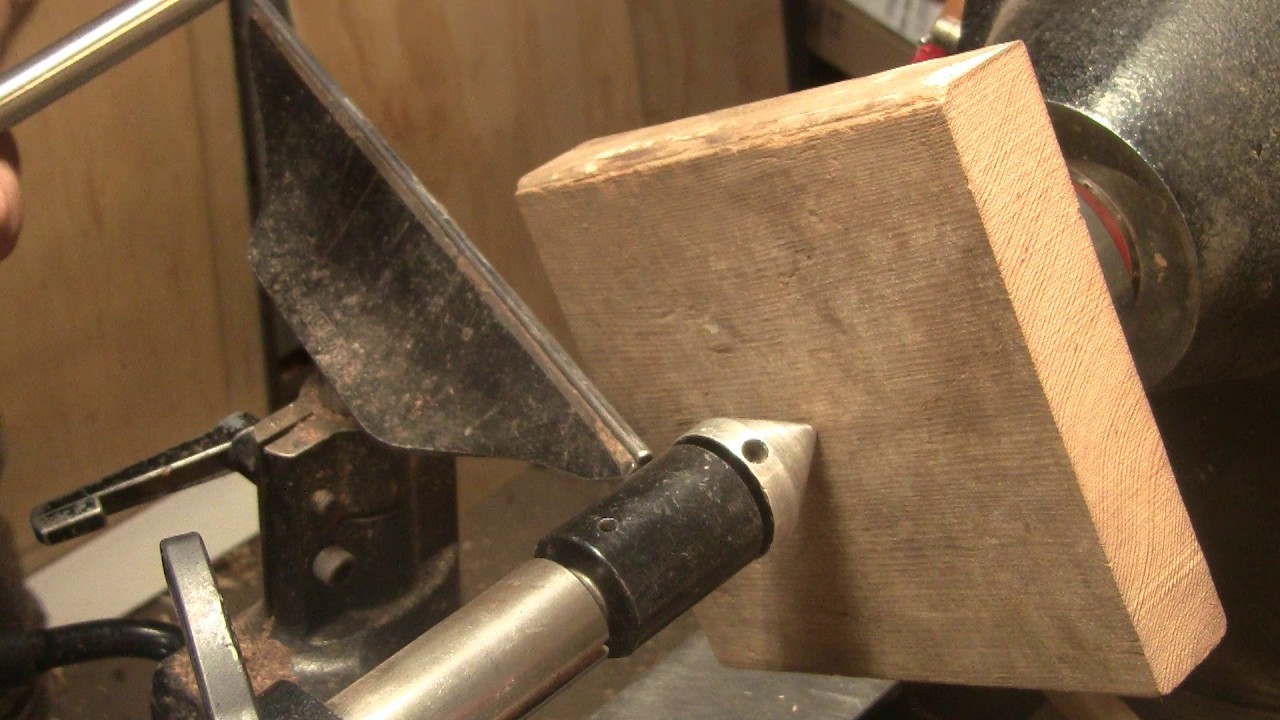
Inspect the blank, use a suitable mounting method, check hand-turned clearance, and start at the lowest practical speed. Stand outside the projected path of the work during startup because hidden cracks, loose bark, and poor mountings can release fragments without warning.
Mounting and Clearance
Match the faceplate, screws, chuck jaws, centers, and lathe capacity to the blank. Faceplate screws need sound wood of adequate depth, while chuck tenons and recesses must fit the jaw profile rather than merely touching at one narrow edge.
Rotate the mounted piece by hand through a full revolution before switching on the lathe. Check the tool rest, bed, motor housing, and banjo clearance, then lock every adjustment and remove the chuck key or tommy bar.
Speed and Balance
A common guideline multiplies blank diameter in inches by RPM to produce roughly 6,000–9,000. Under that guideline, a balanced six-inch blank corresponds to about 1,000–1,500 RPM, but an irregular or cracked piece should run far slower.
Treat the formula as an upper reference, never a guarantee. Lathe condition, mounting security, natural edges, voids, bark, tool reach, operator skill, and vibration may call for a much lower safe working speed.
Startup line of fire: stand beside the rotational plane rather than directly in front of the blank. Start low, listen for clicking, watch the mounting point, and stop immediately if vibration makes the lathe walk or the blank shifts on its mount.
Reinspection during turning: stop the lathe after roughing reveals fresh surfaces. Probe bark inclusions, inspect cracks under side lighting, tighten approved mounting hardware with the machine off, and discard stock whose structure can’t support continued rotation.
PPE and dust control: wear impact-rated eye protection under a full face shield, secure hair, and remove gloves, jewelry, drawstrings, and loose sleeves. Use source extraction and a fitted respirator for sanding or exotic species; the American Association of Woodturners safety resources provide further shop guidance.
The best wood turning blank is large enough after defects and mounting waste, oriented correctly for the project, and dry enough for the intended process. Measure first, inspect again after roughing, and treat any growing crack, loose inclusion, or unexplained vibration as a reason to stop.
FAQs
What Wood Is Best For Woodturning?
Hardwoods such as maple, cherry, walnut, and ash are among the best woods for woodturning because they cut cleanly and finish well. Beginners often find straight-grained maple and cherry easy to shape. Avoid wood with cracks, rot, hidden metal, or excessive knots unless you have experience handling it safely.
What Size Turning Blank Do I Need?
The turning blank should be slightly larger than the finished item in every direction. For example, a 10-inch bowl usually needs a blank at least 10 inches wide and 2 inches thick. Leave extra material for truing the wood, mounting it securely, and refining the final shape on the lathe.
Can Green Wood Be Used For Turning?
Green wood can be used for turning and is often easier to cut than dry wood. It is commonly rough-turned into a thicker bowl or vessel, then dried slowly before final turning. Expect movement and possible cracking as it dries, so allow extra wall thickness and seal the end grain.
What Is The Difference Between A Bowl Blank And A Spindle Blank?
A bowl blank is cut so the grain runs across the face, while a spindle blank has grain running along its length. Bowl blanks are used for bowls, platters, and hollow forms. Spindle blanks are better for items such as pens, tool handles, table legs, and candlesticks.
Why Are Wood Turning Blanks Sealed With Wax?
Wood turning blanks are sealed with wax to slow moisture loss and reduce drying cracks. The wax is usually applied to end grain because moisture escapes fastest there. Sealing is especially useful for green or freshly cut wood that will be stored before turning.
Affiliate Disclosure: Some links in this post are affiliate links. If you make a purchase through these links, we may earn a small commission at no extra cost to you. We only recommend products we genuinely believe in.