

Table of Contents
Maple wood is a pale, fine-grained hardwood from Acer trees, used for furniture, cabinets, flooring, cutting boards, butcher blocks, maple plywood, maple lumber, and veneer. It is sold mainly as hard maple, soft maple, figured maple, solid maple wood boards, and engineered maple plywood.
Best quick answer: choose hard maple for wear, soft maple for paint-grade work and easier machining, and maple plywood for stable cabinet panels or shelves.
What Is Maple Wood? Quick Answer

Maple wood comes from trees in the Acer genus, part of the Sapindaceae family. Maple is a hardwood because Acer trees are deciduous angiosperms, not because every maple board feels equally hard under a saw blade.
- Acer hardwood definition: maple is botanical hardwood, including both hard maple and soft maple.
- Hard or soft: hard maple is denser and more wear-resistant; soft maple is easier to machine and often costs less.
- Best uses snapshot: furniture, cabinets, flooring, cutting boards, butcher blocks, instruments, veneer, trim, and maple plywood panels.
- Common mistake: beginners assume “soft maple” is softwood. It isn’t; it is still hardwood, just softer than hard maple.
Key takeaway: maple’s value comes from its smooth texture, pale color, domestic availability, and project flexibility. For a broader hardwood context, see our guide to types of hardwood.
Acer Hardwood Definition
Acer wood includes sugar maple, black maple, red maple, silver maple, bigleaf maple, box elder, Norway maple, striped maple, and many ornamental species. The USDA PLANTS Database lists Acer as a widely distributed genus, and commercial North American lumber yards usually simplify that diversity into hard maple and soft maple.
In the hand, freshly surfaced maple feels smooth and almost waxy compared with open-grained oak. A sharp plane leaves pale, tight curls, and hard maple often gives off a faintly sweet, warm smell when a router bit starts to heat the edge.
Solid Maple vs Plywood
Solid maple means boards cut from maple logs; maple plywood means thin maple veneer faces bonded to a core. Use solid maple for exposed edges, legs, cutting boards, butcher blocks, and shaped parts; use maple plywood for stable cabinet boxes, shelving, built-ins, and large flat panels.
| Maple Form | Best Use | Main Risk | Pro Workaround |
|---|---|---|---|
| Hard maple lumber | Flooring, cutting boards, tabletops | Burn marks and blotchy stain | Sharp carbide, steady feed, test finishes |
| Soft maple lumber | Painted cabinets, trim, furniture frames | Supplier labeling confusion | Ask species or hard/soft category before buying |
| Maple wood boards | Small shelves, hobby projects, face frames | Higher cost per board foot | Compare S4S board price with dealer lumber |
| Maple plywood | Cabinet boxes, drawer parts, panels | Sand-through on thin veneer | Use light sanding and finish samples |
Maple Wood Properties and Hardness

Maple wood characteristics include a fine, even texture, pale sapwood, light reddish-brown heartwood, strong screw holding, high indoor wear resistance, and moderate to high movement with humidity. Hard maple has a Janka hardness of about 1,450 lbf, while common soft maple species often range from about 700 to 950 lbf.
Color and appearance drive many buying decisions. Search data shows strong interest in maple wood color, and the short answer is simple: maple is usually creamy white to pale yellow, with heartwood that can shift into light brown, reddish brown, gray-brown mineral streaks, or ambrosia streaking.
Key takeaway: maple is wear-resistant indoors, not rot-resistant outdoors. If you need a deeper breakdown of Janka numbers, compare species with our wood hardness scale.
Janka Hardness Values
Janka hardness measures dent resistance, so it matters for flooring, worktops, cabinet doors, and cutting boards. The USDA Wood Handbook gives hard maple high strength and shrinkage values, while species databases such as The Wood Database report common Janka values used by wood buyers.
| Wood Species | Approx. Janka Hardness | Project Meaning |
|---|---|---|
| Hard maple | 1,450 lbf | Excellent for high-wear indoor surfaces |
| White oak | 1,360 lbf | Strong flooring and furniture wood |
| Red oak | 1,290 lbf | Dents more easily than hard maple |
| Yellow birch | 1,260 lbf | Good cabinet and furniture comparison |
| Black walnut | 1,010 lbf | Softer but darker and easier to finish |
| Red maple | 950 lbf | Useful soft maple for cabinets and furniture |
| Cherry | 950 lbf | Softer, warmer, and easier to stain |
| Bigleaf maple | 850 lbf | Often valued for quilted figure |
| Silver maple | 700 lbf | Lighter, softer, easier to machine |
| Eastern white pine | 380 lbf | Much softer and more dent-prone |
Density and weight change how maple behaves in the shop. Hard maple averages about 44 lb/ft³, or 705 kg/m³, so a stack of 8/4 hard maple feels heavy fast; soft maple often falls near 33–38 lb/ft³, which makes long trim runs and cabinet parts easier to carry, mill, and install.
Movement, Moisture, and Workability
Maple movement is the hidden issue behind many failed tabletops, cabinet doors, and floors. Hard maple shrinkage is about 4.8% radial, 9.9% tangential, and 14.7% volumetric, so wide panels need proper joinery, balanced finishing, and room to expand across the grain.
Indoor moisture targets matter before cutting joinery. For furniture and cabinets, maple usually behaves best around 6%–8% moisture content; for general interior use, 6%–10% may work depending on climate, heated air, and seasonal humidity swings.
Workability trade-off: hard maple machines cleanly with sharp tools, but it burns when feed speed drops or tooling gets dull. The scorch mark has a toasted-sugar smell and a glassy brown edge that can take far more sanding than expected.
Beginner mistake: sanding maple too fine before staining can polish the surface and make color absorption worse. Stop near 180 or 220 grit for many clear finishes, then test the exact finish on offcuts from the same board or plywood sheet.
Hard Maple vs Soft Maple

Hard maple vs soft maple is a commercial lumber distinction, not a botanical hardwood-versus-softwood distinction. Both are hardwoods, but hard maple is denser and more wear-resistant, while soft maple is usually cheaper, lighter, and easier to machine.
Commercial category difference: hard maple usually means sugar maple, Acer saccharum, with black maple, Acer nigrum, sometimes included. Soft maple may include red maple, silver maple, bigleaf maple, box elder, and regional species that don’t all perform the same way.
- Choose hard maple for flooring, cutting boards, butcher blocks, tabletops, workbenches, and high-wear cabinet doors.
- Choose soft maple for painted cabinets, trim, moulding, furniture frames, drawer parts, and budget-conscious hardwood projects.
- Check supplier labels because color-sorted soft maple can look close to hard maple.
- Ask for species if the project depends on hardness, density, or matching.
Key takeaway: hard maple is the stronger performance choice; soft maple is often the smarter production choice. For the species side of the comparison, see black maple and silver maple.
| Attribute | Hard Maple | Soft Maple |
|---|---|---|
| Main species | Acer saccharum, Acer nigrum | Acer rubrum, Acer saccharinum, Acer macrophyllum, Acer negundo |
| Janka hardness | About 1,450 lbf | About 700–950 lbf common range |
| Dried weight | About 44 lb/ft³ | Often about 33–38 lb/ft³ |
| Cost | Higher | Lower |
| Workability | Harder on tools, burns faster | Easier to machine |
| Best project fit | Floors, butcher blocks, cutting boards | Painted cabinets, trim, furniture parts |
| Outdoor durability | Poor without full protection | Poor without full protection |
Supplier labeling issues cause real problems. If a dealer lists “maple” without hard or soft, don’t guess from color alone; ask whether it is sugar maple, red maple, silver maple, bigleaf maple, or a mixed soft maple pack.
Figured Maple Varieties
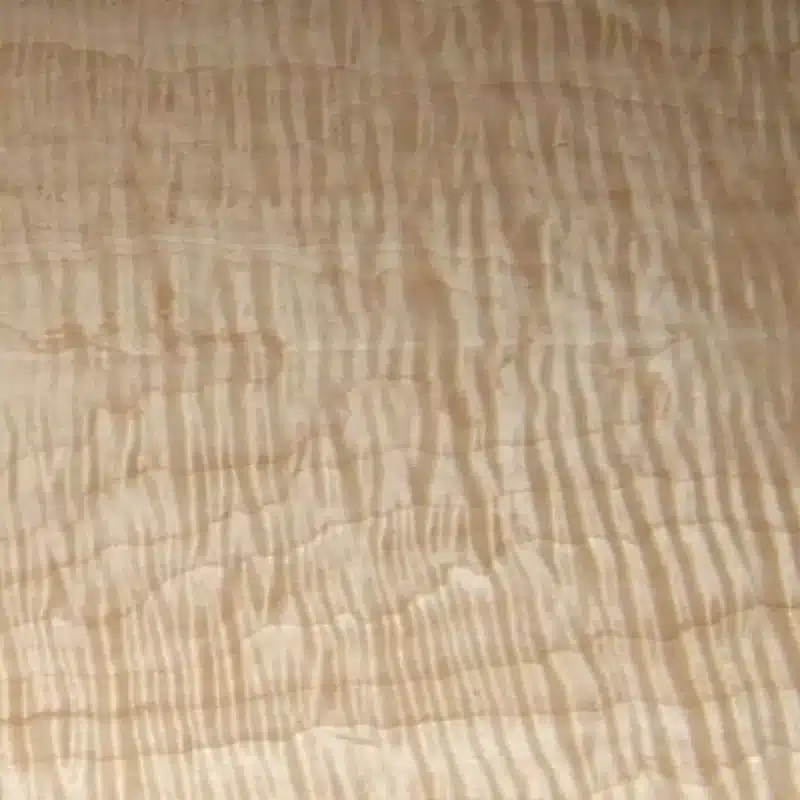
Figured maple describes visual grain effects, not one species. Curly maple, flame maple, tiger maple, birdseye maple, quilted maple, ambrosia maple, and spalted maple can appear in different Acer species and carry very different prices.
Figure vs species matters because a curly soft maple board may look dramatic but dent more easily than plain hard maple. Buyers often pay for figure intensity, board size, color, clarity, and suitability for veneer, musical instruments, or show furniture.
Key takeaway: buy figured maple by photographed board, not by name alone. Start with our guides to curly maple, birdseye maple, tiger maple, and quilted maple.
Curly, Birdseye, and Quilted Maple
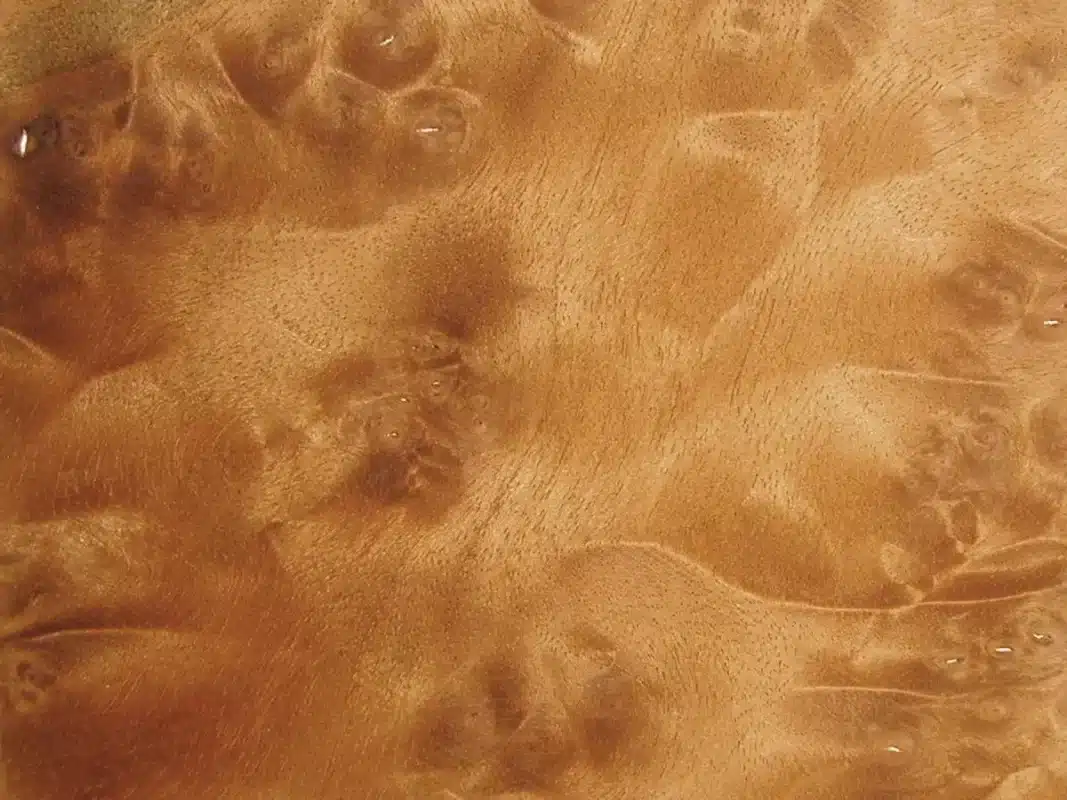
Curly maple shows rolling bands that flash as the board moves under light. That shimmer, called chatoyance, is why flame maple and tiger maple show up on guitar tops, violin backs, drawer fronts, jewelry boxes, and veneer panels.
Birdseye maple has small eye-like figure, often linked with hard maple. It looks stunning on a birds eye maple table or instrument back, but each “eye” can tear under dull planer knives, so light passes and sharp tooling matter.
Quilted maple is often associated with bigleaf maple and can be graded by intensity, with terms like 5A quilted maple used in instrument markets. Blue quilted maple usually means dyed or finished figured maple, not a naturally blue species.
Ambrosia vs Spalted Maple
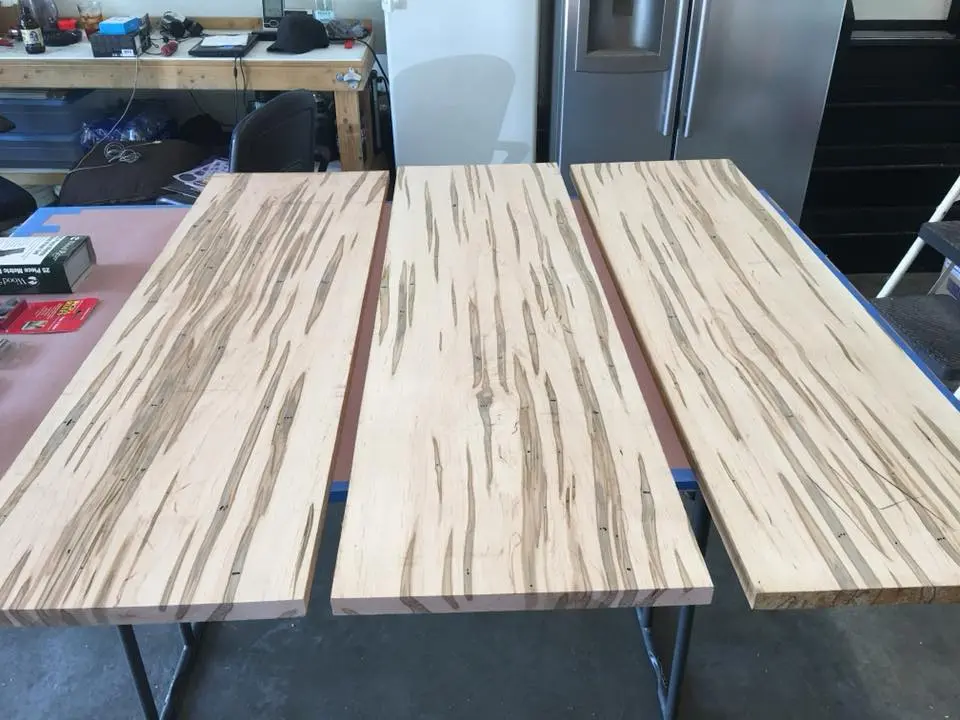
Ambrosia maple gets its gray, brown, and sometimes greenish streaks from ambrosia beetle activity and associated staining. Spalted maple gets dark zone lines and color from fungal activity before decay goes too far.
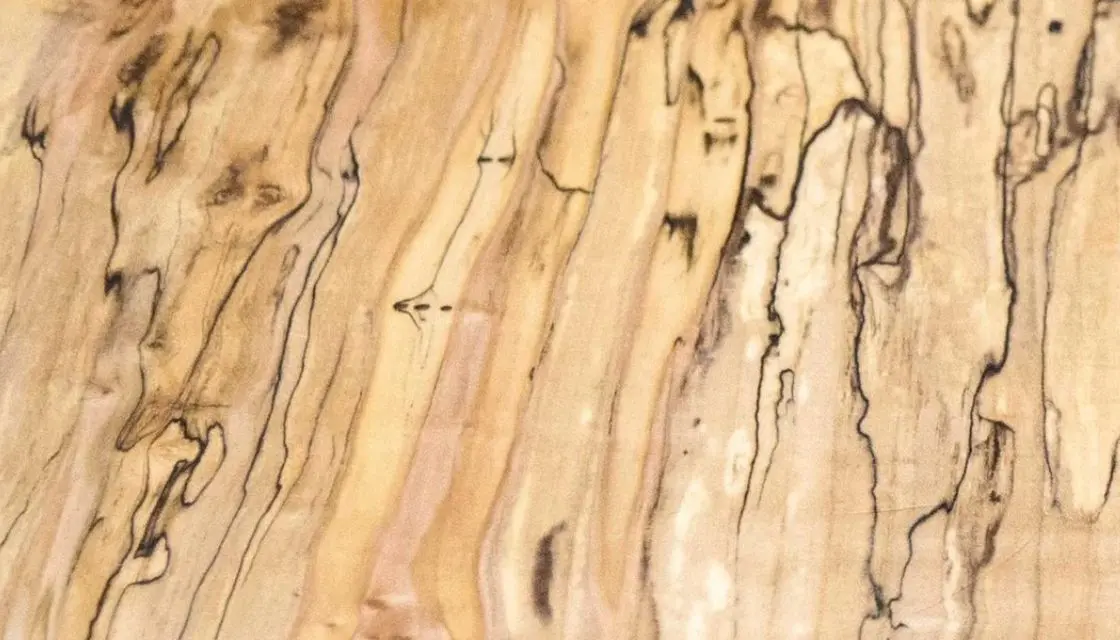
Ambrosia vs spalted maple comes down to cause and structure. Ambrosia boards can remain sound around streaks; spalted maple may contain soft or punky zones, so press a fingernail into suspicious areas and avoid weak stock for legs, rails, or cutting boards.
Finishing figured maple rewards testing. Dyes can pop curl, shellac can add warmth, and waterborne topcoats keep color lighter; heavy pigment stain often muddies figure and settles unevenly in end-grain pockets.
Related reading: compare ambrosia maple, spalted maple, flame maple, and striped maple before paying a premium.
Maple Lumber and Wood Boards
Maple lumber is sold rough, surfaced, or dimensioned into maple wood boards. Rough boards give the best control and value if you have a jointer and planer; S4S maple boards cost more but save setup time for small projects.
Common thicknesses include 4/4, 5/4, 6/4, and 8/4 rough stock. After surfacing, 4/4 often finishes near 13/16 inch, 5/4 near 1 1/16 inch, 6/4 near 1 5/16 inch, and 8/4 near 1 3/4 inch.
Key takeaway: buy maple boards by project needs, not by the prettiest face in the rack. Check twist, cup, bow, end checks, splits, sticker stain, mineral streak, worm holes, ambrosia streaking, and moisture content before the board reaches your cart.
Rough, Surfaced, and S4S Maple
Rough maple lumber gives you extra thickness for flattening, which helps when boards have slight cup or wind. Surfaced maple, listed as S2S, S3S, or S4S, saves labor but leaves less material for correcting movement after acclimation.
- S2S: surfaced two sides, usually planed faces with rough edges.
- S3S: surfaced two faces and one straight-line ripped edge.
- S4S: surfaced four sides, ready for smaller projects with minimal milling.
- Kiln-dried maple: preferred for interior furniture, cabinets, and panels.
- Project boards: convenient but often costly per board foot.
- Butcher block panels: fast for counters and worktops, but movement and sealing still matter.
Board-Foot Formula
Board-foot math prevents sticker shock at the lumber counter. The formula is thickness in inches × width in inches × length in feet ÷ 12 = board feet; a 4/4 board that is 8 inches wide and 8 feet long equals 1 × 8 × 8 ÷ 12, or 5.33 board feet.
| Item to Check | Why It Matters | Fast Shop Test |
|---|---|---|
| Moisture content | Prevents gaps, cupping, and glue failure | Use a meter and compare to room target |
| Twist | Wastes thickness during flattening | Sight down the board or use winding sticks |
| End checks | Reduce usable length | Mark checks before calculating yield |
| Hard vs soft label | Affects hardness and price | Ask the supplier, don’t rely on color |
| Color sorting | Affects cabinet and panel matching | Lay boards side by side in daylight |
Buying note: big-box maple wood boards are useful for weekend shelves or small repairs, but a hardwood dealer usually gives better value for tables, cabinets, and large runs. For furniture-specific planning, see wood for furniture.
Maple Plywood
Maple plywood is an engineered panel with maple veneer faces over a core. It is common in cabinets, shelving, built-ins, drawer boxes, furniture panels, and architectural millwork because it stays flatter than wide solid maple boards.
Common sheet sizes include 4 ft × 8 ft panels in 1/4 inch, 1/2 inch, and 3/4 inch nominal thicknesses. A 3/4-inch 4×8 maple plywood sheet often ranges from $80–$200+ depending on core, face grade, veneer thickness, supplier, and region.
Key takeaway: choose maple plywood by face grade, core type, flatness, veneer thickness, edge treatment, and emissions compliance. Thin face veneers can sand through in seconds, so treat maple plywood like a finished surface, not like solid lumber.
Maple Veneer Construction and Core Types
Veneer core plywood is lighter and often holds screws better at the edge than MDF or particleboard core. MDF core maple plywood is flatter and smoother, while particleboard core is economical and flat but heavier and less forgiving around moisture.
| Core Type | Strength | Best Use | Main Risk |
|---|---|---|---|
| Veneer core | Good strength-to-weight | Cabinet boxes, shelves, built-ins | Can have core voids in lower grades |
| MDF core | Very flat surface | Veneered doors, panels, high-end interiors | Heavy and weaker screw holding at edges |
| Particleboard core | Flat and economical | Budget cabinet interiors | Edge swelling if moisture reaches core |
| Combination core | Balanced performance | Cabinet work needing flatness and strength | Cost varies widely |
| Lumber core | Good stiffness | Long shelves and specialty panels | Less common in retail supply |
Grades, Compliance, and Sand-Through Risks
Face and back grades such as A-1, A-2, or B-2 describe veneer quality, but grading systems vary by supplier and product line. The Decorative Hardwoods Association explains hardwood plywood grading and construction used across the cabinet panel market.
Emissions compliance matters for indoor cabinets and built-ins. In the United States, composite wood products must meet EPA TSCA Title VI formaldehyde standards; California buyers also see CARB Phase 2 language on compliant plywood.
Common mistake: sanding prefinished maple plywood edges and faces too aggressively can expose the substrate or leave shiny witness spots. Use edge banding, sharp blades, light sanding, and a fresh 180–220 grit pass only where needed.
Maple Grades, Cuts, and Pricing
Maple grades describe usable clear cuttings more than perfect color. FAS, F1F, Select, No. 1 Common, and No. 2 Common can all be useful if you match the grade to part size, defect tolerance, and finish plan.
White vs brown maple is a buying issue separate from strength. White hard maple or sap maple costs more when cabinet doors need a pale, uniform look; brown maple, mineral streaks, and character boards may be better value for stained, painted, or rustic work.
Key takeaway: select by project, not just grade. A lower-grade board can yield excellent drawer parts, face frames, cutting board strips, or small furniture components if you can cut around defects.
NHLA Lumber Grades and Cuts
NHLA grades are widely used in North American hardwood lumber. The NHLA Rules focus on clear cutting yield, so a board can meet grade while still showing color variation that matters on visible maple cabinets.
- FAS: high-grade hardwood with large clear cuttings for furniture, doors, and wide parts.
- Select: useful for narrower parts and one clear face requirements.
- No. 1 Common: strong value for cabinets, drawer parts, and smaller components.
- Plain-sawn maple: most common and cost-effective.
- Rift or quarter-sawn maple: straighter grain, less common than rift or quarter-sawn oak.
- Figured maple: usually separated and priced above standard lumber.
Maple Lumber, Plywood, and Figured Maple Prices
Maple wood price changes by region, grade, thickness, width, length, color sorting, figure, kiln drying, surfacing, and retail channel. Soft maple lumber often runs $3–$8+ per board foot, hard maple $5–$12+ per board foot, and figured maple $10–$30+ per board foot with premium pieces higher.
Maple plywood price depends heavily on core and veneer quality. A 3/4-inch 4×8 maple plywood sheet often lands around $80–$200+, while prefinished maple plywood costs more but can save hours of sanding, spraying, and cleanup on cabinet interiors.
Retail vs dealer buying affects real project cost. A short S4S maple board may feel cheap at the register, but the per-board-foot price can be far higher than rough or S3S maple lumber from a hardwood dealer.
Working and Finishing Maple Wood
Working maple wood rewards sharp tools and punishes dull edges. Hard maple cuts cleanly, but slow feed rates, dirty blades, or overheated router bits leave dark burn marks that smell smoky and feel slick under sandpaper.
Finishing maple wood needs testing because maple blotches with many pigment stains. Clear waterborne finishes keep maple pale, oil-based finishes warm it toward amber, dyes color it more evenly, and gel stains reduce blotch by sitting closer to the surface.
Key takeaway: treat maple as dense, closed-grain wood. Cut with sharp carbide, glue freshly milled surfaces, pre-drill near ends, sand evenly, and never commit to a dark stain without a sample board.

Cutting, Gluing, Turning, and Carving
Cutting maple works best with a clean, sharp, high-tooth-count blade for crosscuts and a rip blade that clears chips efficiently. Figured maple needs light passes because reversing grain can tear out suddenly, leaving fuzzy ridges that catch your fingertip.
Gluing maple works well when surfaces are freshly milled and not burnished. Dense hard maple can resist glue penetration on polished joints, so avoid over-sanding glue faces and use firm, even clamping pressure rather than crushing the joint.
Turning and carving show the hard-soft trade-off. Hard maple turns crisp beads and coves, but hand carving can feel stubborn; soft maple cuts with less resistance and is often better for handles, moulding, and carved details.
Why Maple Blotches and How to Finish It
Maple blotches because density and grain structure absorb pigment unevenly. Dark stain on maple often needs dye, washcoat, sealer, toner, or glaze rather than one heavy coat wiped straight onto raw wood.
- Sand evenly through grits without skipping.
- Stop at 180–220 grit for many clear finishes and test on offcuts.
- Use waterborne finish for a pale natural look.
- Use dye stain for more even color than pigment stain.
- Use gel stain when you need surface color with less blotch.
- Add toner when dark maple must match a sample.
- Seal end grain on panels, countertops, and butcher blocks.
Dark stain workflow: dye first, seal lightly, adjust with toner, then topcoat. This schedule gives more control than flooding maple with dark pigment stain, which often creates cloudy patches around denser grain.
Maple Wood Uses
Maple wood uses include furniture, tables, cabinets, cutting boards, butcher blocks, musical instruments, sports flooring, bowling alleys, tool handles, veneer, drawer boxes, trim, millwork, and historic household objects. Hard maple is chosen for wear; soft maple is chosen for machining value.
Key takeaway: hard maple is best where dents, abrasion, and compression matter; soft maple is best where paint, shaping, and cost matter. For food-prep choices, compare maple with other options in our guide to the best cutting board wood.
Furniture, Cabinets, Flooring, and Butcher Blocks
Maple furniture works well for tables, chairs, dressers, desks, beds, shelves, and workbenches. The fine grain suits modern furniture, while figured maple creates dramatic drawer fronts, table panels, and accents.
Maple cabinets are common because the wood is smooth, durable, and easy to paint when properly prepared. Soft maple is common for painted doors and face frames; hard maple is better for natural-finish cabinet fronts that need more dent resistance.
Hard maple flooring performs well in homes, gym floors, dance floors, and sports courts. Its 1,450 lbf Janka hardness beats red oak, but the pale, fine grain can show scratches, grit trails, and sanding marks more clearly than oak.
Hard maple cutting boards are popular because the wood is dense, closed-grained, and durable. End-grain maple butcher blocks feel slightly cushioned under a knife compared with face-grain boards, but they need regular oiling and should never go in a dishwasher.
Instruments, Sports Flooring, and Tool Handles
Musical instrument makers use maple for violin backs and sides, guitar necks, guitar tops, drum shells, piano actions, and bass bodies. Figured maple catches stage light beautifully, which is why flame, quilted, and birdseye sets are prized.
Rock maple earned its reputation in bowling alleys, gym floors, workbenches, dowels, axe handle wood, and tool handles because it resists abrasion and impact. It isn’t magic, though; it still moves with humidity and can split if fasteners are driven near ends without pre-drilling.
Historic maple applications grew from availability and performance. Indigenous peoples used maple trees for sap and practical objects, and later furniture makers relied on sugar maple timber for durable household pieces, floors, and work surfaces.
Maple Cabinets and Flooring
Maple cabinets and maple flooring both benefit from hardness, smooth grain, and a clean pale look. The trade-off is that maple shows finishing mistakes, scratch contrast, and color mismatch more readily than open-grained woods.
Key takeaway: use soft maple for painted cabinet parts, hard maple for durable natural doors, maple plywood for cabinet boxes, and hard maple flooring where dent resistance matters more than easy staining.
- Painted maple cabinets: smooth surface, crisp profiles, good value with soft maple.
- Natural maple cabinets: pale, modern look, but color sorting matters.
- Maple plywood boxes: stable, efficient, and common for cabinet interiors.
- Drawer boxes: prefinished maple plywood saves finishing labor.
- Hard maple flooring: strong wear surface, harder to stain evenly than oak.
- Gym and dance floors: valued for abrasion resistance and stiffness.
- Scratch visibility: pale wood and fine grain reveal grit marks.
- Maintenance needs: use mats, dust control, felt pads, and humidity management.
Color matching is the cabinet issue people underestimate. One maple door can look creamy white while the next has brown heartwood or gray mineral streaks; lay parts together before finishing and keep doors from the same batch grouped by room elevation.
Flooring caution: maple must acclimate before installation. If hard maple flooring is installed dry into a humid room, boards swell; if installed too wet into heated winter air, gaps open and finish lines can crack.
Maple Wood Comparisons
Maple comparisons usually come down to hardness, grain, stainability, cost, color, and project use. Hard maple is harder than red oak, cherry, walnut, birch, and pine, but it is harder to stain evenly than many of them.
Key takeaway: choose maple for pale color and wear resistance; choose oak for open grain and easier staining; choose walnut for dark luxury; choose cherry for warm aging; choose pine for low cost and rustic softness.
Maple vs Oak, Birch, and Cherry
Maple vs oak is a grain and finish choice as much as a hardness choice. Maple has fine, subtle grain and a clean modern look; oak has open pores, bold grain, and usually accepts stain more evenly.
Maple vs birch can be tricky because yellow birch can resemble maple and reaches about 1,260 lbf Janka. Birch plywood may cost less, while maple plywood is often chosen for a cleaner, paler face veneer.
Maple vs cherry favors maple for hardness and cherry for warm color and easier finishing. Cherry darkens strongly with age, while maple shifts more gently from pale cream toward golden amber under light and clear finish.
Maple vs Walnut, Pine, and Beech
Maple vs walnut is light versus dark. Walnut is naturally rich and easier to finish dark; hard maple is harder, paler, and better for Scandinavian, modern, or high-contrast furniture designs.
Maple vs pine is hardwood durability versus softwood affordability. Eastern white pine sits around 380 lbf Janka, so it dents far more easily than maple, but it is easier to cut, lighter to carry, and friendlier for rustic paint projects.
Maple vs beech can be close in utilitarian use. Both suit work surfaces and chairs, but maple usually gives a paler, cleaner North American look, while beech often shows pinkish tones and different availability by region.
| Comparison | Maple Advantage | Other Wood Advantage |
|---|---|---|
| Maple vs oak | Finer grain, harder than red oak | Oak stains easier and has bolder grain |
| Maple vs birch | Premium pale cabinet look | Birch can cost less |
| Maple vs cherry | Harder and lighter | Cherry ages warmer and stains easier |
| Maple vs walnut | Harder and brighter | Walnut is naturally dark and rich |
| Maple vs pine | Far more dent-resistant | Pine is cheaper and easier to work |
| Maple vs beech | Cleaner pale look in North America | Beech can be economical for utility parts |
Appearance detail: maple is diffuse-porous, meaning its small pores are spread evenly through the growth ring. For visual planning, compare light-colored wood, wood grain pattern, and wood colors.
Choosing Maple Wood by Project
Choose maple wood by performance, appearance, budget, and fabrication method. Use hard maple for durability, soft maple for cost and machining, maple plywood for stable panels, and figured maple when decorative impact matters most.
Key takeaway: the right maple is project-specific. Don’t buy white hard maple for hidden painted parts, and don’t use soft maple where a cutting board, gym floor, or workbench needs maximum wear resistance.
| Project | Recommended Maple Type | Reason |
|---|---|---|
| Cutting board | Hard maple | Dense, closed grain, durable |
| Butcher block | Hard maple | Strong wear resistance |
| Clear-finish cabinets | Hard maple or white soft maple | Pale appearance and smooth grain |
| Painted cabinets | Soft maple | Cost-effective and smooth |
| Cabinet boxes | Maple plywood | Stable sheet material |
| Flooring | Hard maple | High Janka hardness |
| Trim and moulding | Soft maple | Easier machining |
| Furniture frame | Soft maple or hard maple | Depends on wear and budget |
| Tabletop | Hard maple | Better dent resistance |
| Decorative panel | Figured maple veneer | Visual impact |
| Outdoor furniture | Usually avoid maple | Low rot resistance |
- Ask: is this hard maple or soft maple?
- Ask: what species is included in the pack?
- Ask: is it kiln dried, and what is the moisture content?
- Ask: is it rough, S2S, S3S, or S4S?
- Ask: what grade and color sort does it carry?
- Ask: are boards random width and length?
- Ask: is the plywood veneer core, MDF core, particleboard core, or combination core?
- Ask: does the plywood meet CARB Phase 2 or TSCA Title VI?
Outdoor caution: maple is not waterproof and is not a good ground-contact wood. If you use it outside for a temporary or protected piece, seal every face and edge, keep it off wet surfaces, and expect maintenance.
Species note: maple trees also grow beyond North America, including Europe and Asia. For tree-level background, see types of maple trees and Norway maple.
Maple Problems and Misconceptions
Maple problems usually come from wrong material choice, moisture errors, dull tooling, or a rushed finish schedule. The wood is reliable indoors, but it isn’t waterproof, stain-friendly, movement-free, or immune to beginner mistakes.
Key takeaway: the biggest maple failures are soft maple confusion, stain blotching, machining burn marks, wood movement, plywood edge swelling, cutting board cracks, color mismatch, and skipped acclimation.
Practical Notes From Real-World Use
Real shop friction shows up fast with maple. A router bit that cut cherry cleanly can burn hard maple in one slow pass, leaving a brown stripe that feels slick and needs scraping before sanding will touch it.
What didn’t work: dark pigment stain wiped directly on hard maple often turns patchy, with muddy clouds near end grain and pale islands across dense grain. A better fix is dye, a thin sealer, toner for color control, then a clear topcoat.
Edge cases: prefinished maple plywood can look perfect until a shelf edge swells from one unsealed sink-base leak. Seal exposed plywood edges, use edge banding, and keep particleboard-core panels away from wet areas.
Common beginner mistake: building a wide solid maple tabletop from boards that haven’t acclimated. Let boards sit stickered in the shop, check moisture, flatten in stages, and allow seasonal movement in the base attachment.
Failure Modes and Fixes
| Problem | Likely Cause | Prevention | Fix |
|---|---|---|---|
| Blotchy stain | Uneven pigment absorption | Use dye, sealer, toner, samples | Strip or sand back, reseal, tone color |
| Burn marks | Dull blade or slow feed | Sharp carbide, clean tooling, steady feed | Scrape before sanding |
| Panel cupping | Moisture imbalance | Acclimate, balance finish, proper joinery | Stabilize humidity, flatten if possible |
| Flooring gaps | Poor acclimation | Match wood MC to site conditions | Control humidity, repair after seasonal cycle |
| Plywood edge swelling | Water reached core | Seal edges and use proper core | Dry, sand, seal, or replace damaged panel |
| Cutting board cracks | Dishwasher, soaking, uneven drying | Hand wash, dry upright, oil regularly | Re-glue if safe; replace if split through |
| Color mismatch | Sapwood, heartwood, mineral streak, aging | Sort parts before assembly | Tone finish or reassign parts |
Soft maple misconception: soft maple is still hardwood. The word “soft” only means the lumber group is softer than hard maple, not that it behaves like pine or other softwoods.
Water misconception: maple is wear-resistant indoors but not rot-resistant outdoors. Rain, trapped moisture, soil contact, and unsealed end grain can cause discoloration, decay, checking, or plywood delamination.
Sustainable Maple Sourcing
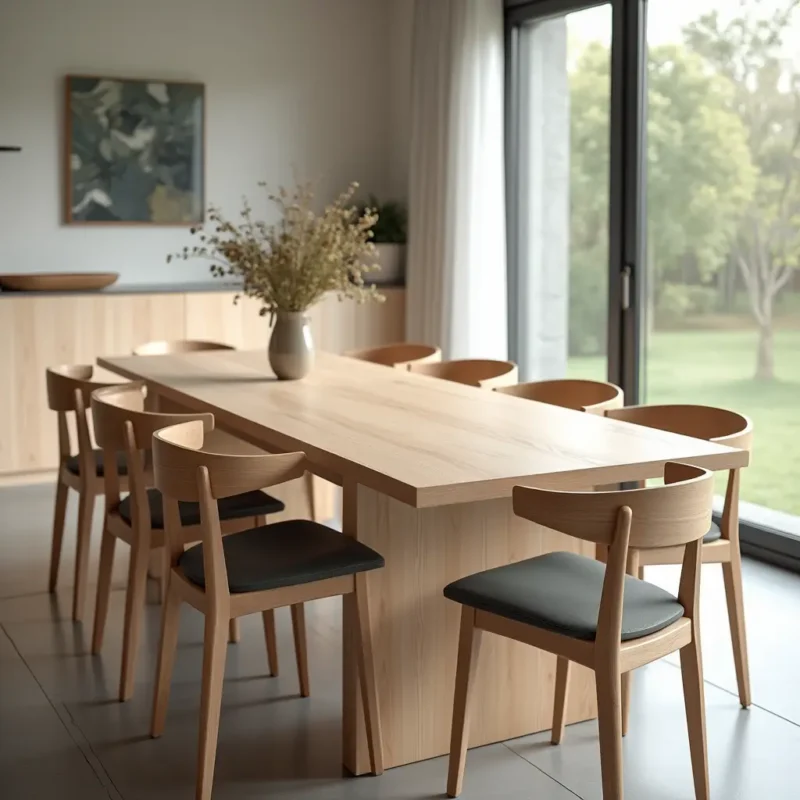
Sustainable maple wood is widely available in North America, especially across the northeastern United States and Canada. Domestic maple can be a responsible choice when harvested through managed forestry, verified supply chains, and compliant plywood manufacturing.
Key takeaway: don’t assume every domestic board is automatically responsible. Ask about local sourcing, forest certification, kiln efficiency, waste use, plywood emissions compliance, and whether soft maple can meet the project need without overbuying premium white hard maple.
- North American supply: sugar maple, red maple, and soft maple groups are common commercial hardwood resources.
- Global Acer distribution: maple species occur in North America, Europe, and Asia, but lumber markets vary by region.
- FSC and PEFC: useful chain-of-custody certifications for buyers who need verified sourcing.
- Responsible forestry: favors regeneration, habitat care, harvest planning, and full log use.
- Local lumber sources: can reduce transport distance and support regional mills.
- CARB Phase 2 and TSCA Title VI: relevant for maple plywood emissions compliance.
- Low-VOC adhesives: useful for cabinets, built-ins, and occupied interiors.
- Domestic wood benefits: reliable supply, familiar grading, and fewer exotic-sourcing concerns.
Certification checks are simple but often skipped. Look for credible programs such as FSC or PEFC, then confirm the invoice or product label supports the claim.
Final answer: maple wood is a strong, pale, versatile hardwood best used indoors. Pick hard maple for wear, soft maple for value and paint, maple plywood for stable panels, and figured maple for decorative work where the grain is the feature.
FAQs
Is Maple Wood A Hardwood?
Yes, maple wood is a hardwood. It comes from a deciduous tree, which is the main reason it is classified as hardwood rather than softwood.
What Is The Difference Between Hard Maple And Soft Maple?
Hard maple is denser and more durable than soft maple. Soft maple is easier to cut and work with, but it is usually a little less resistant to dents and wear.
Does Maple Wood Stain Well?
Maple wood can be tricky to stain evenly. Its tight grain often causes blotching, so using a pre-stain conditioner or gel stain usually gives better results.
Is Maple Plywood Good For Cabinets?
Yes, maple plywood is a very good choice for cabinets. It is strong, stable, and has a clean look that works well for both painted and clear-finished cabinetry.
Is Maple Wood Better Than Oak?
Neither wood is always better; it depends on the project. Maple is smoother and more subtle in appearance, while oak is more open-grained and often preferred for its classic character.
Affiliate Disclosure: Some links in this post are affiliate links. If you make a purchase through these links, we may earn a small commission at no extra cost to you. We only recommend products we genuinely believe in.