

Sassafras wood is lightweight hardwood lumber from Sassafras albidum, a deciduous tree native to eastern North America. Its coarse grain, spicy scent, easy machining, and decay-resistant heartwood suit furniture, millwork, carving, posts, and carefully built outdoor projects.
At about 630 lbf Janka, sassafras is softer than oak, ash, or walnut, so buyers must balance low weight and workability against dents, surface wear, and limited structural data.
Table of Contents
What Is Sassafras Wood?
Sassafras wood is hardwood in the botanical sense because it comes from a flowering broadleaf tree. “Hardwood” doesn’t mean the lumber is physically hard; sassafras is relatively soft and light compared with many familiar cabinet woods.
Sassafras albidum Identity
North American lumber sold as sassafras normally comes from Sassafras albidum, a member of the Lauraceae, or laurel, family. Common names include common sassafras, white sassafras, and red sassafras; technical values in this guide refer only to this species.
Like other hardwood trees, sassafras loses its leaves seasonally. Its leaves may be unlobed, mitten-shaped, or three-lobed on one tree, while its roots can send up suckers that form dense colonies.
Native Range and Tree Size
Eastern North America is the species’ native range. The USDA PLANTS profile records it across much of the eastern and central United States, with its range extending into southern Canada.
Mature trees commonly reach about 50–65 feet tall with trunks around 2–3 feet in diameter under favorable conditions. Forest-grown trunks tend to yield straighter sawlogs than open-grown trees, which often divide into low branches and produce knotty boards.
Heartwood and Sapwood. Heartwood ranges from pale tan to medium brown and often gains warmer amber tones with age. The narrow sapwood is usually cream, pale yellow, or nearly white, creating a sharp border that matters for appearance and outdoor durability.
Freshly planed stock looks lighter than finished or aged stock. Applying oil brings out a honey-brown cast within seconds, while pale sapwood remains conspicuous; this color split can look intentional in rustic furniture but distracting in a matched cabinet front.
Grain, Texture, and Aroma. Sassafras is ring porous, usually straight grained, and medium to coarse textured. Flat-sawn faces show rolling growth-ring arches, while quarter-sawn faces display quieter vertical lines similar to restrained ash or chestnut.
Fresh cuts release a spicy root-beer scent that’s easiest to notice at the saw or planer. The aroma fades as boards age, and smell alone can’t confirm identity; end-grain anatomy, source records, color, and growth-ring structure provide better evidence together.
Species and Lookalikes. Australian sassafras, Atherosperma moschatum, is a different species with different physical values. “Blackheart sassafras” usually refers to dark-streaked Australian material, while California bay or Oregon myrtle is Umbellularia californica, not North American sassafras.
Ash and chestnut can resemble sassafras because all three have prominent earlywood pores. Sassafras usually feels lighter than ash, gives off its characteristic scent when freshly cut, and lacks the large rays that help identify white oak.
Sassafras Wood Properties
Sassafras wood properties place it among lightweight, relatively soft hardwoods with moderate strength and manageable seasonal movement. Published figures are species averages rather than design values for a particular board.
Property Table
The following values for Sassafras albidum align with the species data summarized by The Wood Database. Moisture, growth rate, defects, grain angle, and test method can shift individual results.
| Property | Typical value | Practical meaning |
|---|---|---|
| Average dried weight | 31 lb/ft³ (495 kg/m³) | Light for hardwood furniture and exterior components |
| Basic specific gravity | About 0.42 | Relatively low-density hardwood |
| Specific gravity at 12% MC | About 0.50 | Useful for weight comparisons |
| Janka hardness | 630 lbf (2,800 N) | Machines easily but dents under concentrated loads |
| Modulus of rupture | About 9,000 psi (62.1 MPa) | Moderate average bending strength |
| Modulus of elasticity | About 1.18 million psi (8.14 GPa) | Less stiff than oak or ash |
| Crushing strength | About 4,760 psi (32.8 MPa) | Can compress around hardware and clamp points |
| Radial shrinkage | About 4.0% | Moderate movement across quarter-sawn faces |
| Tangential shrinkage | About 6.2% | Moderate movement across flat-sawn faces |
| Volumetric shrinkage | About 10.3% | Manageable after sound drying |
| T/R ratio | About 1.6 | Fairly balanced shrinkage behavior |
Weight and Density
At roughly 31 pounds per cubic foot, dry sassafras is easier to carry, position, and hang than white oak or white ash. That weight difference becomes noticeable while lifting a wide cabinet side or moving an outdoor chair with one hand.
Lower density also means cutters meet less resistance, yet screw threads have less dense fiber to grip. Compare related values in this guide to the density of wood before substituting sassafras for a heavier species.
Hardness and Dent Resistance. A 630 lbf Janka rating makes sassafras harder than eastern white pine but far softer than white oak, white ash, or hard maple. Chair legs, dropped tools, pet claws, and clamp jaws can leave visible depressions.
Use broad cauls, padded clamp faces, furniture glides, and coasters on finished work. A film finish can resist scratches and spills, but it can’t turn soft underlying fiber into a high-hardness surface; the site’s wood hardness scale provides wider context.
Strength and Structural Limits. Sassafras has moderate average bending and compression values, yet ungraded specialty lumber shouldn’t be selected for joists, beams, deck framing, structural stairs, or guardrails from species averages alone.
Load-bearing work needs recognized design values, an applicable lumber grade, correct moisture assumptions, code acceptance, and engineering where required. Knots, checks, slope of grain, decay, and insect galleries may reduce one board’s strength far below a published average.
Shrinkage and Stability. Radial shrinkage near 4.0%, tangential shrinkage near 6.2%, and a T/R ratio around 1.6 indicate fairly balanced movement. Sassafras often stays flatter than less balanced species after proper drying, but it still moves seasonally across its width.
Attach tabletops with slotted clips, build frame-and-panel doors with floating panels, and leave expansion room around solid flooring. Gluing a wide solid top rigidly across its grain can cause cracks or pulled fasteners during a dry heating season.
Drying and Moisture Targets. Furniture stock commonly works well at 6–8% moisture content in conditioned North American interiors, with 6–10% seen across different shop climates. Exterior lumber will settle at a higher level, so acclimate it near its service conditions.
Check several locations on both board faces with a calibrated moisture meter. End checks, sticker shadows, case hardening, and movement after the first milling pass can expose rushed drying; seal fresh ends and let partially milled boards rest before final sizing.
Durability and Outdoor Performance
Sassafras heartwood is rot resistant and is commonly rated durable to very durable against fungal decay. Outdoor success still depends on heartwood content, drainage, end-grain protection, hardware, climate, and maintenance.
Heartwood Decay Resistance
Natural extractives give mature sassafras heartwood useful resistance to decay. This trait supports its history in fence posts, boat components, gates, exterior trim, and outdoor furniture, but no durability rating promises a fixed service life.
Repeated wetting can defeat durable wood if joints stay damp. A chair rail that sheds rain may remain sound while an identical piece with an upward-facing mortise turns dark and soft around the trapped water.
Sapwood Limitations
Pale sapwood is less durable than heartwood and shouldn’t receive the same outdoor rating. Ask sellers for heartwood percentage, then remove sapwood from wet-zone parts or place it where it stays dry and easy to inspect.
This distinction matters in thin boards because one pale edge may represent a large share of the component. A clear coating slows moisture entry but won’t give sapwood the natural decay chemistry found in heartwood.
Ground Contact and Drainage. Soil contact exposes wood to persistent moisture, fungi, insects, and limited airflow. Historical post use doesn’t mean every modern sassafras board will survive equally; heartwood proportion, local soil, post orientation, and end condition change the result.
- Bevel horizontal surfaces so rain runs off.
- Keep rails, legs, and joinery above soil and mulch.
- Seal end grain more heavily than face grain.
- Add replaceable feet beneath outdoor chairs and benches.
- Leave drainage gaps behind planter liners and trim.
- Avoid upward-facing holes, grooves, and open mortises.
Exterior Fasteners. Use stainless steel or exterior-rated hot-dip galvanized hardware. Predrill near board ends and narrow edges, use washers beneath bolt heads, and stop tightening once the joint closes so the relatively soft fibers don’t crush.
Run a fastener stain test on an offcut when appearance matters. Moisture and wood extractives can produce dark marks around unsuitable metal, while a buried interior screw may corrode before the surrounding heartwood fails.
Outdoor Finish Maintenance. Coat end grain, shoulders, and hidden joint surfaces during assembly. Penetrating exterior finishes are easier to renew, while film finishes provide a thicker barrier but may peel after water enters through an unsealed joint.
Inspect exposed work each spring and after severe weather. Renew the finish when water stops beading, color fades unevenly, or fine cracks appear; sanding a peeling film back to sound edges takes far longer than refreshing a worn penetrating coat.
Working and Finishing Sassafras

Sassafras machines easily with sharp hand or machine tools, glues well on clean surfaces, and accepts many finishes. Its coarse pores, soft earlywood, occasional reversing grain, and easily bruised edges call for light cuts and controlled pressure.
Sawing and Milling
Freshly sawn sassafras offers little resistance and releases a warm, spicy smell near the blade. Support long boards on both sides of the cut because lightweight stock can vibrate, chatter, or lift against a fence more readily than dense oak.
Begin by checking for embedded metal, especially in urban-salvage logs and old fence material. Joint one reference face, let the board rest, then inspect for bow or twist before removing equal amounts from both faces.
Planing and Routing
Straight grain usually planes cleanly, while grain around knots can reverse and tear. Use sharp knives, a shallow final cut, and slower feed; a scraper or high-angle hand plane can clean isolated patches without thinning the whole board.
Routing across an unsupported edge can leave fuzzy fibers or break out the far corner. Make a light climb cut only where your equipment and skill permit it, back up cross-grain exits with scrap, and take the final pass after removing most waste.
Sanding Open Grain. Start at 80 or 100 grit only when machining marks require it, then move through 120, 150, and often 180 grit. Heavy pressure erodes softer earlywood faster, producing a rippled surface that becomes obvious under side lighting.
Vacuum the deep earlywood pores rather than wiping dust across them. Stop sanding sharp edges early; two careless passes with a soft pad can turn a crisp cabinet corner into an uneven pale line after staining.
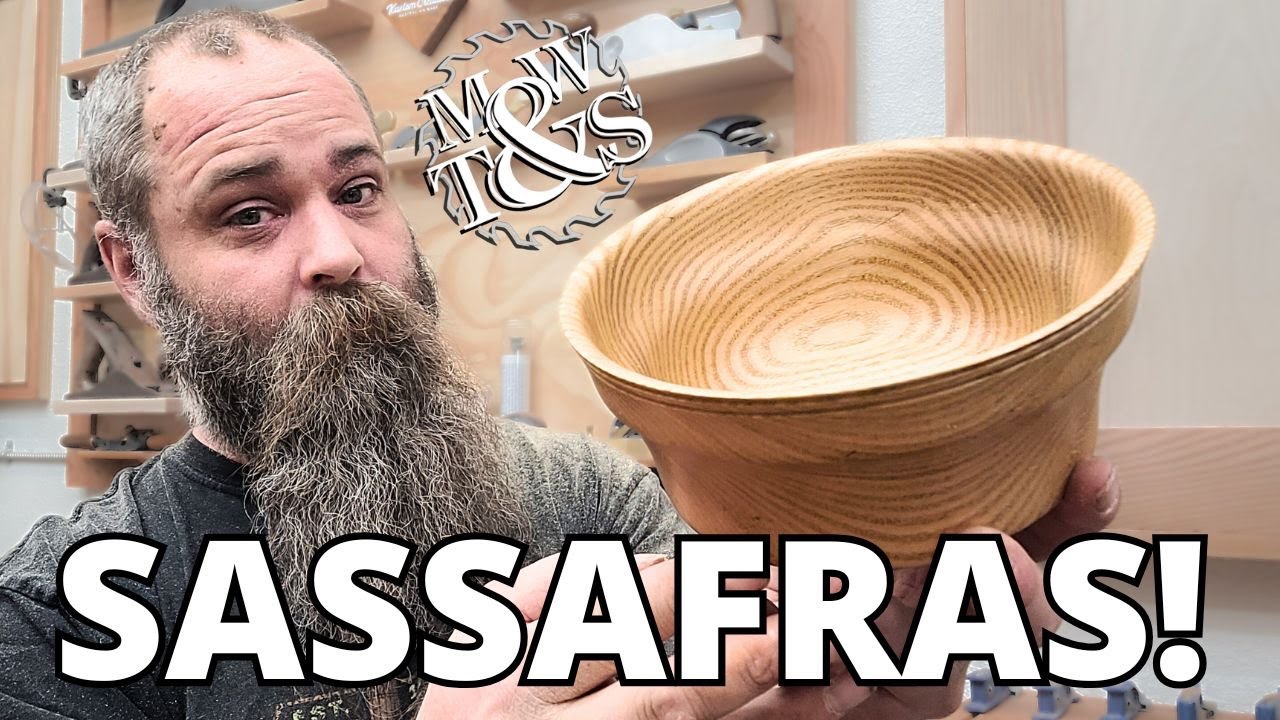
Drilling and Fastening. Sassafras drills and nails readily, but pilot holes reduce splitting near ends and protect narrow parts. Match the pilot diameter to the screw’s root, add a clearance hole through the top piece, and avoid driving heads below the surface.
Large washers or metal plates spread force across soft fiber. A screw that feels suddenly loose has often crushed its surrounding wood; moving to a longer screw into sound material works better than overtightening the damaged hole.
Gluing and Clamping. Freshly prepared surfaces usually bond well with common woodworking adhesives. Vacuum dust from pores, apply enough glue to wet both sides of a thirsty joint, and select an adhesive rated for the project’s moisture exposure.
Use moderate clamp pressure and wide cauls. Excess force can bruise faces, bow panels, or squeeze too much adhesive from a joint; a thin, continuous bead along the joint is a better signal than deeply dented clamp pads.
Turning and Carving. Low hardness makes sassafras pleasant under sharp carving tools, with a crisp spicy odor rising from fresh curls. Coarse grain can crumble at thin beads, bowl rims, and short-grain details, so keep bevel support close to the cut.
Carvers who need tiny facial features or delicate lettering may prefer basswood or another close-grained species. Sassafras works better for broad relief, bowls, boxes, handles, and architectural shapes where its open grain remains part of the design.
Clear Finishes and Stains. Oil-based varnish and oil deepen amber-brown color, while water-based coatings keep the surface closer to its freshly sanded shade. Shellac, lacquer, and compatible varnish also work, subject to the product’s use and exposure rating.
Make a sample from the same board because sapwood, heartwood, and earlywood pores absorb color differently. A washcoat can reduce uneven staining, while a pigmented glaze accentuates the grain described in this guide to wood grain patterns.
Pore Filling. Use grain filler when a glass-smooth tabletop, glossy panel, or instrument-like surface is the goal. Filling isn’t needed for matte, rustic, or open-pore finishes, and it serves a different purpose from conditioner or a stain-controlling washcoat.
Push filler across the grain so it packs the pores, then remove the surplus before it hardens into a thick film. Dark filler adds visible contrast; filler close to the heartwood color produces a calmer, smoother face.
Practical Notes From Real-World Use. Sassafras often feels cooperative at the machines yet shows handling damage later. Mill vulnerable edges last, store finished parts on clean padded stickers, and place clamp blocks before glue makes the assembly slippery.
Useful woodworking and dust-control products can help with cleaner shop results.
Common Uses and Project Fit
Common sassafras wood uses include furniture, cabinets, exterior seating, fence posts, millwork, small boats, turning, carving, and character flooring. It fits projects that value low weight, easy machining, warm color, and durable heartwood more than impact resistance.
Furniture and Cabinetry
Sassafras works well for lightweight casework, chests, shelves, occasional tables, cabinets, and rustic furniture. Its grain adds visual movement without the weight of oak, and broad panels remain manageable during dry fitting and installation.
Tabletops and chair parts need protection from concentrated loads. Add harder wood at drawer runners, use broad feet beneath legs, and choose hardware with generous bearing surfaces; see other furniture wood choices where heavy wear is expected.
Outdoor Furniture and Gardens
Heartwood suits benches, chairs, gates, arbors, and ventilated garden structures. Build feet that can be replaced, slope exposed rails, and keep planter soil behind a waterproof liner with open drainage beneath it.
Beginners often rely on finish rather than construction details. Water eventually finds end grain, screw holes, and moving joints, so a well-drained unfinished heartwood assembly may outlast a poorly drained piece covered in an expensive film.
Fence Posts. Sassafras heartwood has a long history in agricultural posts. Results vary with heartwood percentage, soil moisture, local organisms, post diameter, and whether the upper end sheds water, so no fixed lifespan applies across sites.
Remove bark, reject sapwood-heavy or decayed material, and avoid placing a shoulder or notch at soil level. That transition zone cycles between wet and dry and often fails before the deeply buried portion.
Small Boats. Low weight and decay-resistant heartwood have supported historical and specialty boat uses. Select straight, clear stock and match the adhesive, coating, fasteners, scantlings, and joinery to a proven design rather than treating sassafras as a universal marine substitute.
Boat parts face persistent moisture cycling and concentrated loads. Sapwood, hidden checks, wide grain deviation, and corroding hardware can erase the species’ durability advantage, particularly where inspection after assembly becomes difficult.
Millwork and Interior Trim. Paneling, molding, doors, trim, and decorative beams benefit from sassafras’s low weight and coarse figure. Long trim is easier to lift overhead, though lightweight boards need support during routing to prevent chatter.
Allow broad solid panels to move inside frames and across wall systems. Rigidly fastening every edge can split a panel or open joints as indoor humidity changes.
Turning, Carving, and Crafts. Bowls, boxes, handles, ornaments, and broad relief carving suit the wood’s easy cutting action. Inspect turning blanks for end checks and dry them gradually; a tiny check in a wet blank can open dramatically as the wall becomes thin.
Keep profiles substantial where grain runs across narrow details. The coarse pores produce a tactile surface—tiny grooves remain visible and can be felt beneath a fingertip—unless filler and several finish coats level them.
Character Flooring. Sassafras flooring offers warm color and bold grain, but its 630 lbf Janka rating means dents and wear develop faster than on oak, maple, ash, or hickory. It suits owners who accept marks as part of an aged floor.
Use entry mats, felt pads, wide furniture cups, and careful grit control. Large dogs, high heels, rolling office chairs, and heavy appliances can compress the surface through a finish that still looks intact.
Firewood. Seasoned sassafras ignites readily and is often estimated around 18–20 million BTU per cord, subject to density and moisture variation. It provides moderate heat rather than the long, dense burn associated with oak or hickory.
Burn only seasoned untreated wood in a suitable appliance. Painted boards, glued assemblies, preservative-treated scraps, and shop waste with unknown contamination don’t belong in a stove or cooking fire.
When to Choose Sassafras. Select it when low weight, easy machining, coarse hardwood grain, warm brown color, or naturally durable heartwood fits the project. Local supply can also reduce freight and make wide regional boards more practical than nationally traded species.
It’s particularly useful for movable outdoor furniture, decorative millwork, rustic casework, broad carving, and pieces where lightness matters. Buy enough matching material at once because color and availability can vary between regional batches.
When to Choose Another Wood. Use a harder species for commercial worktops, heavy-wear floors, stair treads, or furniture expected to remain dent-free. Choose graded structural lumber for code-regulated framing and close-grained stock for very fine carving.
White oak suits hard-wearing exterior joinery, ash handles impact better, walnut offers deeper natural color, and black locust wood is a strong option for demanding ground-contact work where suitable stock is available.
How Sassafras Compares
Sassafras is lighter and softer than white oak, white ash, and black walnut. It machines more easily, offers better natural heartwood durability than ash or eastern white pine, and carries a bold ring-porous grain without oak’s weight.
Wood Comparison Table
| Wood | Janka hardness | Dried weight | Outdoor trait | Common project fit |
|---|---|---|---|---|
| Sassafras | 630 lbf | 31 lb/ft³ | Durable heartwood | Light furniture, trim, carving, outdoor work |
| White oak | 1,360 lbf | 47 lb/ft³ | Durable heartwood | Flooring, furniture, exterior joinery |
| White ash | 1,320 lbf | 42 lb/ft³ | Poor natural decay resistance | Handles, bending, furniture, sports goods |
| Black walnut | 1,010 lbf | 38 lb/ft³ | Moderately durable heartwood | Premium furniture and cabinetry |
| Eastern white pine | 380 lbf | 25 lb/ft³ | Low to moderate resistance | Light construction, trim, painted furniture |
| Eastern red cedar | 900 lbf | 33 lb/ft³ | Durable aromatic heartwood | Closets, chests, outdoor components |
| American chestnut | 540 lbf | 30 lb/ft³ | Durable heartwood | Reclaimed furniture, trim, restoration |
Versus White Oak
White oak is more than twice as hard as sassafras by Janka rating and weighs about 16 lb/ft³ more. It handles abrasion, chair legs, and demanding exterior joinery better, while sassafras is easier to lift, cut, carve, and move.
Both have ring-porous grain and decay-resistant heartwood, but oak’s large rays and plugged tyloses aid identification and certain moisture-exposed uses. Choose sassafras where lower mass matters more than severe wear resistance.
Versus White Ash. Ash is roughly twice as hard, stiffer, and better at absorbing shock. Those traits suit handles, bent parts, and sports equipment, but ash has poor natural decay resistance and needs protection outdoors.
Sassafras offers a similar bold grain at lower weight with better heartwood durability. It won’t match ash where thin components must resist impact or repeated flexing.
Versus Black Walnut. Walnut is harder, somewhat heavier, darker, and more familiar in premium furniture markets. Sassafras gives a warm brown surface with stronger pore contrast and less weight, often at a lower regional price.
Walnut remains the better choice where rich chocolate color, resale familiarity, and added dent resistance matter. Read the full walnut wood guide before making a color-based substitution.
Versus Eastern White Pine. Sassafras is a hardwood and pine is a softwood, yet both are lightweight and easy to machine. Sassafras is harder at about 630 lbf versus roughly 380 lbf and displays ring-porous hardwood grain rather than pine’s resinous texture.
Pine is easier to source in standard construction sizes and often costs less. Sassafras provides more natural heartwood durability and a furniture-grade hardwood appearance where those benefits justify specialty sourcing.
Versus Cedar and Chestnut. Eastern red cedar shares aromatic character and useful heartwood durability, but its reddish-purple color, knots, and scent differ sharply. American chestnut resembles sassafras in weight, coarse grain, hardness, and historic decay-resistant uses.
Much modern chestnut stock is reclaimed, which raises the chance of hidden nails and weathered defects. Sassafras may be easier to obtain from regional sawmills, while cedar is more consistently sold for closets and selected outdoor applications.
Sassafras Wood Safety
Sassafras can be worked safely with effective dust collection, eye protection, and a fitted particulate respirator. Lumber dust, root bark, essential oil, safrole, and cooking smoke are separate exposure issues and shouldn’t be treated as chemically identical.
Wood Dust and Sensitization
Sawing, routing, and sanding create fine inhalable dust. Sassafras dust has been reported as a possible sensitizer, with respiratory irritation, skin effects, or nausea reported in susceptible people; individual reactions differ.
Stop work and leave the dusty area if wheezing, unusual coughing, rash, dizziness, or nausea appears. Persistent or serious symptoms need medical attention, and repeated exposure after a reaction may produce a stronger response.
Dust Controls and PPE
Capture dust at the tool with local extraction rather than relying on room filtration alone. Wear sealed eye protection during dusty operations and a properly fitted particulate respirator suited to the exposure and local workplace rules.
- Connect extraction to sanders, saws, routers, and planers.
- Use a fitted particulate respirator during sanding and cleanup.
- Vacuum surfaces instead of blowing dust around the shop.
- Wash exposed skin and change dusty clothing after work.
- Keep dust away from living spaces, food, and heating equipment.
Lumber, Root Bark, and Oil. Sassafras lumber isn’t interchangeable with leaves, root bark, extracts, or essential oil. Chemical concentration and exposure routes differ, so claims about tea, flavoring, or concentrated oil can’t be transferred directly to a cabinet board.
Keep botanical products away from the shop, where they can pick up abrasive dust, lubricants, finishes, or metal particles. Never treat lumber-store identification as proof that a plant-derived product is suitable for ingestion.
Safrole and FDA Regulation. Safrole is strongly associated with sassafras root bark and oil. Under 21 CFR § 189.180, the US Food and Drug Administration prohibits safrole as a food additive.
That food rule doesn’t mean every use of solid sassafras lumber is prohibited. It does mean food, extract, smoke, and ingestion claims need evidence tied to the exact material and exposure rather than a broad statement that all sassafras is safe or toxic.
Cutting Boards and Food Contact. Sassafras has coarse open pores, may trigger sensitivity, and lacks the broad food-contact familiarity of maple. Don’t make a cutting board from unidentified, treated, stained, contaminated, or poorly dried lumber.
Anyone choosing it for incidental food contact should use clean, correctly identified stock and a coating whose manufacturer permits that cured use. A “natural” finish label alone doesn’t establish food-contact suitability or cure time.
Food-Smoking Cautions. Guidance on sassafras cooking smoke is inconsistent, while safrole-related concerns require a caution-led approach. Ordinary boards, root bark, leaves, shop scraps, and culinary smoking products aren’t interchangeable.
Use only material made and labeled for culinary smoking when authoritative food-safety guidance and the smoker manufacturer permit it. Never smoke food with root bark, treated lumber, painted wood, plywood, MDF, glued scraps, moldy wood, or unidentified pieces.
Buying Sassafras Lumber Responsibly

Sassafras lumber is a regional specialty hardwood sold as rough boards, surfaced boards, slabs, project packs, and turning blanks. Compare delivered cost per usable board foot, confirmed species, moisture, heartwood percentage, dimensions, defects, and traceability.
Available Lumber Forms
Common forms include rough-sawn lumber, S2S or S4S boards, live-edge slabs, carving blocks, bowl blanks, turning squares, project packs, locally cut posts, and occasional veneer. Wide, thick, clear, or figured pieces appear less consistently.
Project packs simplify ordering but may contain short pieces, narrow widths, sapwood, or a stated defect allowance. Individually photographed stock costs more in many shops but lets buyers judge color, checks, knots, wane, and grain before shipping.
Seller Questions and Inspection
Ask whether the stock is confirmed as Sassafras albidum, kiln dried or air dried, and measured for moisture. Confirm whether listed dimensions are rough, nominal, or finished and whether pricing applies per piece, pack, linear foot, or board foot.
- What percentage of each board is heartwood?
- What grade or defect allowance applies?
- Are checks, cup, twist, wane, knots, or insect holes included?
- Are board widths fixed, random, or measured at the narrow face?
- Does the seller calculate from nominal or actual dimensions?
- What packing, handling, minimum-order, and freight charges apply?
- Can the seller provide harvest and chain-of-custody records?
Board-Foot Formula. Calculate board feet as thickness in inches × width in inches × length in feet ÷ 12. A 1-inch-thick board measuring 8 inches wide and 8 feet long contains about 5.33 board feet.
1 inch × 8 inches × 8 feet ÷ 12 = 5.33 board feet.
Board-foot calculation example
Sellers often bill rough stock from nominal thickness, not the thickness remaining after surfacing. Compare cost per usable board foot after allowing for sapwood removal, defects, end checks, jointing, and final thickness.
Rough Versus Surfaced. Rough 4/4 lumber is nominally one inch thick before surfacing and may finish near 13/16 inch, subject to the supplier and cleanup required. Deep saw marks, cup, or twist can reduce that result further.
Buy 5/4 or thicker rough material if the finished component must remain a full inch. S2S means two faces have been surfaced; S3S and S4S add straightened or surfaced edges, though exact seller definitions can differ.
Moisture and Usable Yield. Test several boards rather than one convenient face near the end of a stack. A dry outer shell can hide a wetter core, while readings near knots, metal, or wet stickers may mislead some meters.
Plan extra material for color matching and defects. Ten board feet purchased may produce much less than ten board feet of finished parts after straightening edges, trimming checks, removing sapwood, and matching grain across doors.
Prices and Delivered Cost. A useful specialty-retail planning range is about $6–$14 or more per board foot. Wide, thick, clear, figured, or individually selected boards may cost more, while local sawmill stock can fall below this range.
Freight can make the cheapest listed board the costliest choice. Divide the full invoice—lumber, milling, packing, minimum charges, tax, and shipping—by estimated usable board feet, then compare that result with a local substitute.
Supply and Conservation. Sassafras is widespread across much of eastern North America and isn’t normally treated as a rare commercial species. Local abundance alone doesn’t prove responsible harvest, legal origin, or sound forest management.
Urban-salvage and storm-felled wood can reduce transport and recover useful logs. Scan such material for nails, wire, bullets, pesticide exposure, insects, and internal decay before sawing; blue-black streaks may signal hidden iron.
Certification and Traceability. FSC, PEFC, and SFI claims apply to documented supply chains, not automatically to every board of a named species. Ask for certificate numbers, claim wording, invoices, and chain-of-custody records when certification affects purchasing requirements.
Small local mills may lack formal certification while still supplying legally recovered or carefully managed timber. In that case, request the harvest location, landowner permission, log source, milling date, and drying records rather than accepting a vague “sustainable” label.
Legal Trade Checks. Check current national rules and the CITES species checklist before cross-border trade. CITES is a trade-control system, not a certification scheme, so “CITES certified” is inaccurate wording.
Domestic buyers should focus on verified species, legal harvest, provenance, transport restrictions, and seller records. Cross-border buyers also need correct scientific names, customs declarations, phytosanitary paperwork where required, and compliance with destination-country timber laws.
FAQs
Affiliate Disclosure: Some links in this post are affiliate links. If you make a purchase through these links, we may earn a small commission at no extra cost to you. We only recommend products we genuinely believe in.