
Magnolia Wood Guide: Properties, Uses, and Project Suitability

Magnolia wood is hardwood lumber from flowering trees in the Magnolia genus. Southern magnolia is moderately hard at about 1,020 lbf on the Janka scale, machines smoothly, and works best for furniture, cabinetry, veneer, turning, and other protected interior projects.
Table of Contents
What Is Magnolia Wood?
Magnolia is botanically a hardwood because it comes from a broadleaf flowering tree. The label describes the tree’s biology rather than its resistance to dents, decay, or wear.
Botanical Classification
Magnolias belong to the Magnolia genus in the Magnoliaceae family. They are angiosperms, which separates their lumber from softwoods produced by cone-bearing trees such as pine, cedar, and spruce.
The hardwood label can mislead beginners. Balsa is also a hardwood, while some softwoods are physically harder than lighter hardwoods; our guide to types of hardwood explains this naming difference in greater depth.
Magnolia Species
The name magnolia lumber may cover several species, including Southern magnolia, sweetbay magnolia, cucumbertree, and umbrella magnolia. Their density, color, drying behavior, and strength aren’t identical, so figures from one species shouldn’t be assigned to an unidentified board.
- Southern magnolia: Magnolia grandiflora
- Sweetbay magnolia: Magnolia virginiana
- Cucumbertree: Magnolia acuminata
- Umbrella magnolia: Magnolia tripetala
Cucumbertree lumber is sometimes grouped commercially with yellow-poplar or called cucumber magnolia. Ask for the scientific name whenever a project depends on predictable performance, matching color, or published engineering values.
Southern Magnolia Profile
Southern magnolia, Magnolia grandiflora, is an evergreen broadleaf native to the southeastern United States. The USDA Plants Database records its native distribution, while its glossy leaves and large white flowers make the living tree far more familiar than its regionally traded lumber.
Properties also vary within one tree. Fast-grown wood, branch sections, juvenile material, reaction wood, and boards cut near the pith can behave differently from straight-grained trunk lumber, so published averages remain selection guides rather than guarantees.
Magnolia Wood Properties and Hardness
Southern magnolia is a medium-weight hardwood with moderate bending strength, stiffness, and dent resistance. Its 1,020 lbf Janka rating places it near black walnut and black cherry but below red oak and hard maple.
Technical Data Table
The following values apply to Southern magnolia, Magnolia grandiflora. They are reference averages compiled for clear wood; knots, grain direction, moisture, and defects can reduce the performance of an individual board.
| Property | Southern magnolia figure | Practical meaning |
|---|---|---|
| Average dried weight | 35 lb/ft³ or 560 kg/m³ | Medium-weight domestic hardwood |
| Basic specific gravity | Approximately 0.46 | Moderate density based on oven-dry weight and green volume |
| Specific gravity at 12% moisture | Approximately 0.56 | Useful for comparing conditioned lumber |
| Janka hardness | 1,020 lbf or 4,540 N | Moderate resistance to indentation |
| Modulus of rupture | 11,200 psi or 77.2 MPa | Moderate bending strength |
| Modulus of elasticity | 1.40 million psi or 9.66 GPa | Moderate stiffness |
| Crushing strength | 5,330 psi or 36.8 MPa | Moderate compression strength |
| Radial shrinkage | 5.4% | Green-to-oven-dry movement across growth rings |
| Tangential shrinkage | 6.6% | Green-to-oven-dry movement parallel to growth rings |
| Volumetric shrinkage | 12.3% | Total volume change during full drying |
| Tangential/radial ratio | Approximately 1.2 | Relatively balanced shrinkage |
| Natural durability | Non-durable to perishable | Best kept dry and protected |
The numerical profile aligns with the species data reported by The Wood Database. For broader comparisons, review our wood density guide.
Janka Hardness
The Janka test measures the force needed to press a steel ball halfway into wood. At approximately 1,020 lbf, Southern magnolia resists dents better than yellow-poplar at 540 lbf, yet less effectively than red oak at 1,290 lbf or hard maple at 1,450 lbf.
| Wood species | Approximate Janka hardness | Relative dent resistance |
|---|---|---|
| Eastern white pine | 380 lbf | Low |
| Yellow-poplar | 540 lbf | Low to moderate |
| Black cherry | 950 lbf | Moderate |
| Black walnut | 1,010 lbf | Moderate |
| Southern magnolia | 1,020 lbf | Moderate |
| Red oak | 1,290 lbf | Moderate to high |
| Hard maple | 1,450 lbf | High |
Janka hardness doesn’t measure rot resistance, stiffness, seasonal movement, or screw holding. Treat it as one selection factor, especially for flooring and tabletops; the wood hardness scale provides more comparative figures.
Strength and Density
At about 35 lb/ft³ when dried, magnolia feels substantial without excessive weight. A wide board lifts more easily than hard maple of equal size, yet it doesn’t have the soft, easily bruised feel of yellow-poplar.
Its moderate bending and compression values suit cabinet parts, shelves with sensible spans, table aprons, and furniture frames. Long shelves still need edging, a center support, or added thickness because the species isn’t exceptionally stiff.
Shrinkage and Stability
A tangential-to-radial ratio near 1.2 is favorable and suggests balanced shrinkage. It doesn’t prevent cup or twist in boards containing pith, reaction wood, uneven grain, or large moisture differences.
Wide solid panels still need room for seasonal movement. Use elongated screw holes, tabletop fasteners, frame-and-panel construction, or floating buttons rather than fastening a broad top rigidly across its grain.
Color, Grain, and Appearance
Magnolia wood usually combines pale sapwood, light-to-medium brown heartwood, fine texture, and restrained grain. Dark gray, green, purple, or nearly black streaks can make individual boards look far less uniform than a small sample suggests.
Heartwood and Sapwood
The sapwood commonly appears creamy white to pale yellow. Heartwood ranges from yellowish brown to medium brown, and the boundary between the two may be faint or sharply visible.
Freshly cut surfaces can look cooler or greener before oxidation and finish alter them. Match boards after wiping them with mineral spirits, which gives a temporary preview without committing to a coating.
Grain and Texture
Most boards show straight grain and a fine, even texture. Interlocked grain occurs around branches, crotches, and stressed growth, where reflected light may reveal ribbon-like changes and cutters can lift fibers in opposing directions.
The grain feels smooth after proper planing and sanding, with less open-pore texture than oak. This surface makes magnolia useful for paint, veneer, carved details, and understated furniture.
Color Variation
Don’t order magnolia expecting uniform white lumber. Mineral-like streaks, heartwood bands, sticker marks, oxidation, and fungal discoloration can produce visible contrast across glued panels.
Lay every board face-up under the same lighting before jointing. Number the sequence with chalk, then arrange the grain and color so changes look intentional rather than like a misplaced strip.
Finished Appearance
Water-based clear coats keep magnolia relatively pale, while oil-based coatings add amber warmth and strengthen brown or greenish tones. A freshly coated surface often shifts from chalky cream to a soft honey color within seconds.
Choose magnolia for calm grain and smooth texture rather than dramatic figure. Readers comparing pale species can also review our guide to light-colored wood.
Working, Drying, and Finishing Magnolia

Magnolia usually cuts, glues, turns, carves, and finishes well, but interlocked grain and uneven moisture can cause tear-out or movement. Sharp cutters, staged milling, moisture checks, and finish samples prevent most avoidable failures.
Cutting and Planing
Standard carbide tools cut magnolia cleanly, and its moderate density creates less resistance than hard maple. A well-tuned plane leaves a silky surface, while a dull edge produces fuzzy fibers and torn pockets around changing grain.
- Use sharp carbide knives or freshly honed hand tools.
- Take light final passes rather than removing full depth at once.
- Skew the plane or board where grain changes direction.
- Reduce feed speed near crotch or figured grain.
- Finish stubborn areas with a card scraper or fine abrasive.
A common beginner mistake is repeatedly planing a torn patch, which makes the board thinner without fixing the grain direction. Stop early and use a scraper once the cutter starts leaving a rough, woolly depression.
Gluing and Fastening
Clean, freshly prepared magnolia bonds well with PVA wood glue. Joint edges should meet without clamp pressure; forcing a bowed joint closed can store stress that later opens the seam or distorts the panel.
Predrill screws near ends and narrow edges, particularly in dry stock. Use mortise-and-tenon joints, dowels, biscuits, or loose tenons for furniture loads rather than asking screws alone to resist racking.
Turning and Carving
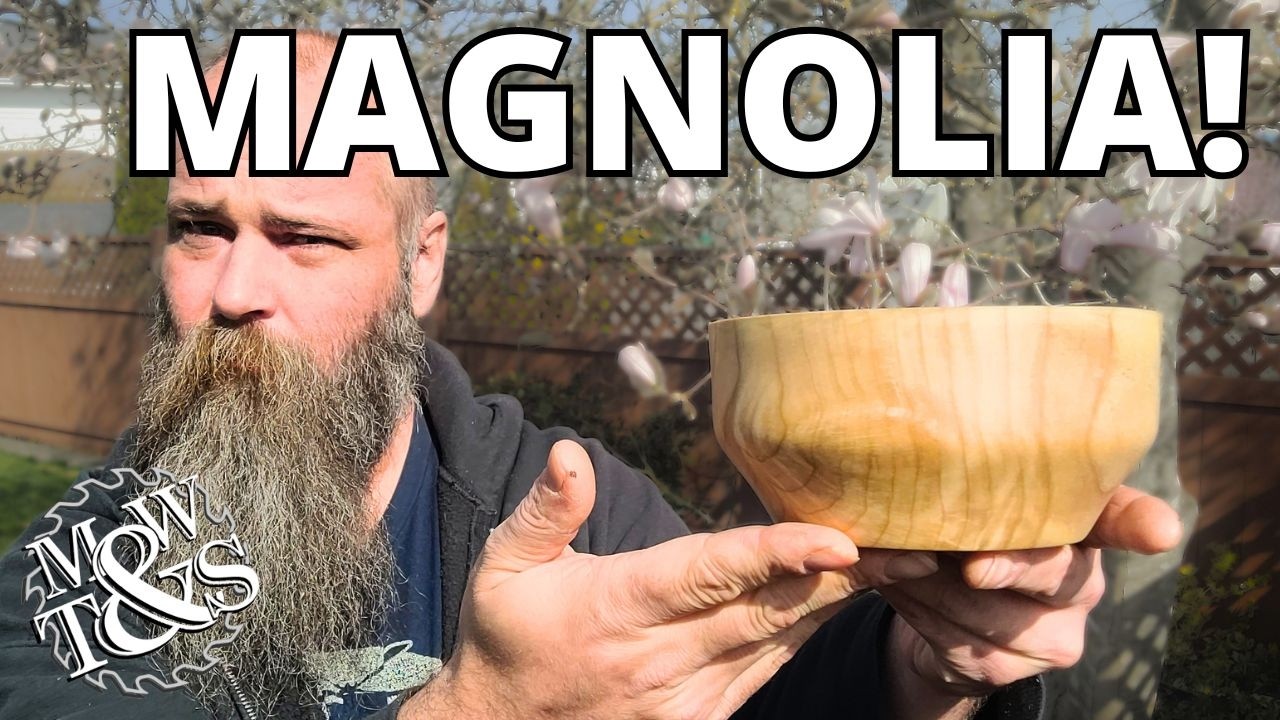
Magnolia’s fine texture supports bowls, spindles, handles, ornaments, and shallow relief carving. Sharp gouges produce soft ribbons from green wood, while dull tools leave a fuzzy end grain that takes far longer to sand.
Rough-turn green bowls with walls near 10% of the bowl diameter, seal the end-grain zones, and allow extra thickness for distortion. A 10-inch bowl blank, for example, can be left near 1 inch thick before controlled drying.
These products may support turning and milling tasks.
Moisture and Drying
Furniture lumber should reach the moisture level expected inside its destination, often 6% to 9% in conditioned buildings. Humid coastal or unconditioned spaces may settle at a higher equilibrium moisture content.
A “kiln-dried” label doesn’t prove that every board is ready. Test both faces, each end, and the middle of longer boards with a calibrated moisture meter; thick stock may have a dry shell around a wetter core.
The USDA Wood Handbook explains moisture relationships, shrinkage, drying, and dimensional change. Pin-meter readings require the correct species correction and temperature setting when the instrument provides them.
Defects and Acclimation
Drying defects include end checks, surface checks, cup, bow, twist, sticker stain, honeycombing, and case hardening. Thick slabs deserve extra scrutiny because a dry face can conceal internal checking or a wet center.
- Stack boards flat on dry, evenly spaced stickers.
- Keep the pile off concrete, rain, and direct sunlight.
- Add restrained weight across the top layer.
- Rough-mill parts slightly oversize.
- Let the parts rest for at least several days.
- Check for movement before final milling.
Practical field note: internal stress often appears immediately after ripping. If two halves curve apart like opening parentheses, stop cutting final-width parts and let the rough pieces settle before deciding whether they remain usable.
Staining and Blotching
Magnolia can absorb pigment stain unevenly, particularly across changing heartwood and sapwood. Test the full schedule on an offcut containing the same color boundaries found in the project.
Sand all parts through the same grit, remove dust, and compare bare stain against a thin washcoat or conditioner. Dye often colors fine-textured wood more evenly than heavy pigment stain, while oversanding can burnish fibers and weaken absorption.
Clear Coats and Paint
Water-based polyurethane, lacquer, shellac, hardwax oil, wiping varnish, and oil-based polyurethane can all work. Pick the coating by desired color, repair needs, chemical resistance, and expected wear rather than by species alone.
For paint, fill dents and torn grain before priming. Dark streaks or discoloration may bleed through ordinary primer, so apply a stain-blocking sealer to suspect areas and test the topcoat after it cures.
A moisture meter can catch hidden differences before final assembly.
Magnolia Wood Uses and Limitations
Magnolia is best suited to furniture, cabinetry, millwork, veneer, turning, carving, and protected utility projects. Its main limits are inconsistent supply, variable color, moderate dent resistance, and poor natural decay resistance.
Furniture and Cabinetry
Suitable applications include cabinet components, drawer sides, shelving, interior doors, painted furniture, table bases, and decorative panels. Its smooth texture accepts paint cleanly and works well where strong grain isn’t part of the design.
Magnolia can serve for tabletops, but keys, ceramic dishes, and concentrated furniture loads may leave dents sooner than they would on hard maple. Use coasters, protective pads, and a wear-resistant topcoat for hard-used surfaces.
Project planning should weigh hardness, stability, appearance, repairability, and supply together. Our guide to wood for furniture compares those factors across more familiar species.
Veneer and Millwork
Magnolia has been used for veneer, plywood, interior trim, boxes, crates, and utility millwork. Its fine texture and easy machining suit profiles that need clean painted edges without oak’s open pores.
Veneer offers stable visual coverage with less scarce material, but the substrate and adhesive must fit the project environment. Balance a panel with compatible veneer on both faces to reduce warping.
Turning and Crafts
Bowls, vases, boxes, ornaments, carved panels, handles, and spindles are practical uses. Selected turning blanks often carry a higher effective cost per board foot because the seller has cut, dried, graded, photographed, and handled each piece separately.
Green blanks should be sealed and dried slowly. Don’t leave the pith inside a bowl blank, since radial checks commonly begin there and can split an otherwise useful turning.
Flooring
Magnolia can serve in low- or moderate-traffic flooring, but it isn’t a common flooring species. Its 1,020 lbf hardness gives moderate wear resistance, below red oak and hard maple.
Limited supply makes replacement boards difficult to match by color and width. High heels, pet claws, grit, and narrow furniture feet can leave dents, so use broad pads and control tracked-in abrasive dirt.
Cutting Boards
Sound, correctly dried, uncontaminated magnolia may be considered for cutting boards, but the species name alone doesn’t establish food-contact suitability. Source, condition, adhesive, construction, sanitation, and finish all matter.
- Use tight, sound wood without decay or soft areas.
- Avoid spalted, treated, coated, or unidentified salvage lumber.
- Choose a water-resistant adhesive rated for the intended use.
- Remove open checks that can trap food residue.
- Use a food-contact finish and allow it to cure fully.
Edge-grain and end-grain construction affect wear and movement more than marketing labels do. Avoid wide, poorly dried pieces that can split after repeated wetting and drying.
Firewood
Magnolia can be burned after seasoning to approximately 20% moisture or lower. Its moderate density provides less sustained heat than denser firewoods such as oak or hickory.
Wet magnolia can hiss, steam, smoke, and leave dark deposits as energy is spent boiling water rather than warming the room. Never burn painted, glued, pressure-treated, or chemically contaminated scraps.
Durability and Outdoor Suitability
Southern magnolia is rated non-durable to perishable against decay, so untreated lumber is a poor choice for ground contact or persistent weather exposure. Coatings slow moisture entry but don’t make the wood naturally rot-resistant.
Decay Resistance
Decay fungi become a threat when wood stays damp and receives oxygen. Magnolia performs best where building details keep it clean, ventilated, and dry.
Don’t use untreated magnolia for fence posts, deck framing, garden-bed contact, exposed structural members, or permanently wet furniture. Sapwood may also be vulnerable to insect damage, especially when stored damp.
Outdoor Failure Risks
End grain drinks water much faster than a finished face. A rail can look dry on top while water remains inside an unsealed joint, creating a hidden decay pocket around screws or dowels.
- Horizontal surfaces retain rain and wet debris.
- End grain wicks moisture through exposed fibers.
- Fastener holes provide paths beneath coatings.
- Rigid film finishes crack as wood moves.
- Shade and poor airflow slow drying.
- Soil contact maintains fungal growth conditions.
Beginners often coat only visible faces. Seal backs, bottoms, end grain, joints, and drilled holes too, since uneven moisture exchange can trigger movement before decay becomes visible.
Protected Exterior Use
Magnolia can function beneath a deep roof overhang or inside a screened porch if it remains out of ground contact. Use sloped surfaces, drainage gaps, sealed end grain, corrosion-resistant fasteners, and renewable exterior coatings.
Inspect joints and horizontal edges at least once a year. Recoat before the film becomes brittle or cracked; once moisture enters behind a failed coating, drying can take much longer than wetting.
Durable Alternatives
White oak, black locust, western red cedar, bald cypress, redwood, teak, and correctly rated pressure-treated lumber are safer choices for repeated exposure. Match the species to structural demands, local insects, finish plans, and ground-contact risk.
Red oak isn’t a direct outdoor substitute for white oak. White oak’s vessel structure offers much better moisture resistance, while red oak readily carries liquid through its open pores.
Magnolia Versus Other Woods

Magnolia is harder than yellow-poplar, close to walnut in Janka hardness, and softer than red oak or hard maple. Similar hardness figures don’t mean two woods share the same stiffness, appearance, durability, price, or availability.
Magnolia vs Poplar
| Factor | Southern magnolia | Yellow-poplar |
|---|---|---|
| Janka hardness | About 1,020 lbf | About 540 lbf |
| Availability | Regional and inconsistent | Widely stocked |
| Color | Pale to brown with dark or colored streaks | Cream to yellow-green with occasional mineral streaks |
| Common role | Furniture, veneer, turning, interior work | Paint-grade trim, frames, and utility work |
| Machining | Easy with possible interlocked grain | Easy but may leave fuzzy surfaces |
Magnolia and yellow-poplar are different botanical woods. Magnolia provides greater dent resistance, while yellow-poplar usually costs less and is easier to replace; see our complete poplar wood profile.
Magnolia vs Oak
Red oak is harder at roughly 1,290 lbf and has coarse, prominent pores. Magnolia’s finer grain takes paint more smoothly and creates a quieter visual surface.
Oak remains easier to buy in matched quantities, standard grades, and flooring dimensions. Magnolia may suit a distinctive interior project, but replacement stock can be hard to find years later.
Magnolia vs Maple
Hard maple reaches approximately 1,450 lbf, giving it better resistance to concentrated dents. Magnolia cuts with less resistance and is less prone to the brown burn marks that appear when maple meets a dull blade or slow router pass.
Choose hard maple for heavy-use counters, floors, and work surfaces. Choose magnolia when easier machining, regional character, moderate hardness, or variable streaked color matters more; our maple wood guide covers the alternative in detail.
Magnolia vs Walnut
Southern magnolia and black walnut have almost identical Janka figures at about 1,020 and 1,010 lbf. Their visual character differs sharply: walnut offers recognized dark-brown heartwood, while magnolia ranges from pale cream to irregular brown and colored streaks.
Walnut usually commands premium furniture demand and is stocked more predictably by hardwood dealers. Magnolia’s value depends heavily on region, width, drying quality, and whether buyers want its less familiar appearance.
Buying Magnolia Lumber Safely
Buy magnolia by verified species, measured moisture, actual dimensions, grade, and delivered usable cost. A cheap rough board can become expensive after shipping, surfacing, checks, distortion, and color-matching waste are counted.
Species and Drying Questions
Ask for the scientific species name instead of accepting “magnolia” alone. Request the drying method, measured moisture range, storage conditions, and whether the reading came from the board’s surface or its freshly exposed core.
- Is this Magnolia grandiflora or another species?
- Was it air dried, kiln dried, or both?
- What moisture range was measured across the batch?
- Are photographs representative or tied to the exact board?
- Can checked or badly distorted pieces be returned?
Air-dried lumber can work well after indoor conditioning, while kiln-dried stock can still be too wet or stressed. The label matters less than verified moisture and the board’s response during staged milling.
Lumber Types and Dimensions
Magnolia may be sold as rough lumber, S2S, S3S, S4S boards, veneer, slabs, project packs, or turning blanks. Surfaced stock costs more but reveals grain and defects that rough faces can conceal.
Hardwood thickness is commonly stated in quarters. Rough 4/4 lumber starts near 1 inch thick but often finishes around 13/16 inch or less after flattening; cupped stock can yield much less.
| Seller term | Meaning | Buying concern |
|---|---|---|
| Rough | Unsurfaced faces and edges | Needs full milling allowance |
| S2S | Two faces surfaced | Edges may remain rough |
| S3S | Two faces and one edge surfaced | One edge still needs ripping |
| S4S | All faces and edges surfaced | Actual dimensions are below nominal size |
| Turning blank | Cut block selected for turning | High effective board-foot price |
| Slab | Wide, often live-edge piece | Core moisture and cracks need close inspection |
Board-Foot Calculation
A board foot equals a volume measuring 1 inch thick, 12 inches wide, and 12 inches long. Use this standard formula: thickness in inches × width in inches × length in feet ÷ 12.
Board feet = thickness in inches × width in inches × length in feet ÷ 12
Standard hardwood lumber calculation
A rough board measuring 1 inch × 8 inches × 8 feet contains approximately 5.33 board feet: 1 × 8 × 8 ÷ 12 = 5.33. Confirm whether the seller bills nominal rough thickness or actual surfaced thickness.
Slabs and project blanks may be sold by the piece rather than by volume. Convert them to board feet for comparison, but account for tapered edges, bark, cracks, and unusable pith.
Price and Delivered Cost
Specialty rough magnolia often falls in the mid-single digits to low teens per board foot, with major variation by species, thickness, grade, region, and seller. Wide clear boards, figured pieces, slabs, and dried turning blanks can cost far more by usable volume.
Check live listings before ordering because regional inventory changes. Add surfacing, straight-line ripping, crating, freight, oversize surcharges, minimum orders, and estimated waste before comparing two suppliers.
Usable material cost = total delivered price ÷ usable board feet after defects and milling
Practical buying-cost formula
For example, a $160 delivered order that yields 12 usable board feet costs $13.33 per usable foot, regardless of the lower advertised lumber rate. This calculation exposes losses from checks, pith, cup, and unwanted color.
Board Inspection Checklist
Inspect both faces, both edges, and both ends under good light. Sight down the board’s length to spot bow and twist, then place a straightedge across its width to reveal hidden cup.
- End checks and surface checks
- Bow, cup, twist, and uneven thickness
- Pith, bark inclusions, and unstable knots
- Insect holes or soft, punky fibers
- Sticker stain and fungal discoloration
- Heartwood and sapwood mismatch
- Moisture differences along the board
- Embedded metal in slabs or urban salvage
- Cracks extending from crotches
- Wet cores in thick stock
Dark streaks aren’t automatically defects, but they can disrupt a pale panel. Request exact-board photographs with a tape measure, both ends visible, and the surface lightly misted or wiped to preview finished color.
Sustainable Sourcing
Sustainability claims must identify the species and source. Check the named species against the CITES Appendices, then favor documented domestic lumber, reputable local mills, FSC-certified stock where available, storm recovery, or managed urban-log programs.
Salvage reduces waste but doesn’t guarantee sound dry lumber. Urban trees may contain decay, chemical contamination, nails, fencing, eye bolts, or decades-old wire hidden beneath fully grown-over bark.
Dust and Salvage Safety
Treat magnolia dust as an eye and respiratory irritant. Use effective dust extraction, shop ventilation, eye protection, hearing protection, and a properly fitted respirator; stop skin exposure if redness or itching develops.
Traditional uses of magnolia bark or flowers don’t make sawdust safe to inhale. Fine sanding dust hangs in a still beam of light and settles inside open drawers, machine housings, clothing, and lungs.
Scan urban logs with a metal detector before sawing. A buried nail can break teeth, damage a blade, throw fragments, and turn an attractive free log into an expensive safety incident.
Reject salvage from industrial sites, treated structures, flood-contaminated areas, or trees with extensive soft decay. Safe sourcing, verified moisture, staged milling, and realistic project selection make magnolia lumber a rewarding interior wood rather than an avoidable repair problem.
FAQs
Is Magnolia Wood A Hardwood Or A Softwood?
Magnolia is a hardwood because it comes from a flowering broadleaf tree, not a conifer. However, it is relatively soft compared with many common hardwoods, making it easy to cut, shape, and sand. Its working properties are similar to poplar in many woodworking projects.
How Hard Is Magnolia Wood Compared With Oak?
Magnolia wood is much softer than oak. Magnolia typically has a Janka hardness around 1,000 pounds-force, while red oak is about 1,290 and white oak is about 1,360. It dents more easily than oak, but its softer texture makes it easier to machine and carve.
Is Magnolia Wood Good For Furniture?
Magnolia wood is good for indoor furniture, especially painted pieces, cabinets, shelves, and light-duty tables. It has a fine, even texture and is easy to work with hand or power tools. Because it can dent under heavy use, protect high-wear surfaces with a durable finish.
Can Magnolia Wood Be Used Outside?
Magnolia wood is not a good choice for outdoor use unless it is carefully sealed and regularly maintained. It has limited natural resistance to moisture, rot, and insects. For decks, garden furniture, or exposed trim, choose a more durable species such as cedar, white oak, teak, or pressure-treated lumber.
How Much Is Magnolia Lumber Worth?
Magnolia lumber usually costs less than premium hardwoods, but prices vary by region, grade, thickness, and whether the boards are kiln-dried. Expect it to be priced similarly to poplar or other utility hardwoods in many markets. Contact local sawmills and hardwood dealers for current board-foot pricing.
Affiliate Disclosure: Some links in this post are affiliate links. If you make a purchase through these links, we may earn a small commission at no extra cost to you. We only recommend products we genuinely believe in.