
Density of Wood Guide: Average Values, Chart, and Formula

Wood has no fixed density: air-dried species commonly range from about 150 kg/m³ for balsa to more than 1,200 kg/m³ for dense tropical hardwoods. Many construction and furniture woods fall between 400 and 800 kg/m³, but species, moisture, growth, and test method can shift the result.
Table of Contents
What Is the Density of Wood?
The density of wood is its mass divided by its volume. A quoted value is useful only when the species and moisture condition are known because water changes mass and can also change dimensions.
Direct Range and Average
The practical air-dry range runs from roughly 100–250 kg/m³ for balsa to more than 1,200 kg/m³ for woods such as lignum vitae. Exceptionally heavy samples can exceed 1,300 kg/m³, while many familiar woods sit near 400–800 kg/m³.
There’s no scientifically valid universal average density of wood. For early design estimates, 600 kg/m³ is a workable midpoint for mixed common lumber, but it shouldn’t control structural loads, freight charges, or machine settings.
Mass-to-Volume Formula
The mass density of wood follows ρ = m ÷ V, where ρ is density, m is mass, and V is volume. Mass must be measured for the same physical sample whose dimensions produce the volume.
Units and conversions: 1 g/cm³ equals 1,000 kg/m³ and about 62.43 lb/ft³. One lb/ft³ equals about 16.02 kg/m³, so 44 lb/ft³ converts to roughly 705 kg/m³.
- kg/m³ is common in engineering and product data.
- g/cm³ is convenient for small laboratory samples.
- lb/ft³ is common in North American lumber references.
- One cubic meter means a volume measuring 1 m × 1 m × 1 m.
Wood Density Chart
This wood density chart gives representative air-dried values, commonly near 12% moisture content. Individual boards can differ enough to affect shipping, lifting, machining, and finished-product weight.
Light and Medium Woods
| Wood | Density, kg/m³ | Approx. lb/ft³ | Practical note |
|---|---|---|---|
| Balsa | 100–250 | 6–16 | A botanical hardwood with very low density |
| Western red cedar | 350–390 | 22–24 | Light and dimensionally stable |
| Basswood | 400–420 | 25–26 | Fine texture and low cutting resistance |
| Sitka spruce | 400–450 | 25–28 | High stiffness for its weight |
| Poplar or tulipwood | 430–470 | 27–29 | Relatively light hardwood |
| Douglas fir | 500–550 | 31–34 | Varies with grade and growth |
| Bigleaf maple | About 545 | About 34 | Lighter than hard maple |
Balsa can feel almost foam-like in the hand; a large block produces little downward pull at the wrist. See the guide to the lightest wood for other low-mass species and the limits of ranking variable natural material.
Oak, Ash, and Hardwoods
Hardwood density isn’t a grade or a guarantee of hardness. Hardwood is a botanical category covering flowering trees, which is why it includes featherlight balsa and water-sinking tropical species.
| Hardwood | Density, kg/m³ | Approx. lb/ft³ |
|---|---|---|
| Silver maple | About 530 | 33 |
| Red maple | About 610 | 38 |
| Black walnut | About 610 | 38 |
| White ash | About 670 | 42 |
| Teak | 650–670 | 41 |
| Yellow birch | About 690 | 43 |
| Northern red oak | About 700 | 44 |
| Hard or sugar maple | 700–710 | 44 |
| American beech | 710–720 | 45 |
| White oak | 750–760 | 47 |
| Hickory | 800–850 | 50–53 |
| Gaboon ebony | 950–1,000 | 59–62 |
| Macassar ebony | 1,050–1,120 | 66–70 |
| Lignum vitae | 1,200–1,300 | 75–81 |
Ash wood density commonly sits near 650–690 kg/m³ air-dry, depending on species and source. If a sample of oak has a density of 807 kilograms per cubic meter, it’s plausible for dense oak, but it shouldn’t replace a broader species average.
Maple wood density depends on the maple species. Hard or sugar maple averages about 705 kg/m³, red maple about 610 kg/m³, silver maple about 530 kg/m³, and bigleaf maple about 545 kg/m³; the maple wood guide explains the species differences.
Ebony and lignum vitae sit near the heavy end of the chart. Ebony feels cold and unusually weighty for its size, while many lignum vitae samples exceed freshwater density; read more about lignum vitae and its resin-rich structure.
These figures align with representative average dried weights compiled in The Wood Database. Treat them as comparison values rather than guaranteed specifications.
Why Wood Densities Vary
Wood densities vary because wood is porous, moisture-sensitive biological material rather than a uniform solid. Cell anatomy, water, growth position, resin, defects, and measurement basis can all change the reported number.
Bulk and Cell-Wall Density
The solid wood cell-wall substance is close to 1,500 kg/m³. Bulk wood is lighter because its tube-like cells contain open lumens filled with air or water; thick walls and small lumens tend to produce high-density wood.
A clean end-grain cut makes this structure visible. Earlywood often appears pale and open, while denser latewood forms darker, firmer bands that offer more resistance beneath a sharp blade.
Green, Air-Dry, and Oven-Dry
Green density uses green mass and green volume, so the result includes water still held in the tree. Air-dry density uses wood equilibrated with ambient air, while oven-dry density uses dried mass and a stated dry-volume basis.
Basic density usually means oven-dry mass divided by green or fully swollen volume. It’s useful in forestry and pulp work, but it will differ from an air-dried commercial value for the same piece.
Moisture content on an oven-dry basis equals [(wet mass − oven-dry mass) ÷ oven-dry mass] × 100. A piece weighing 560 g wet and 500 g oven-dry has 12% moisture content.
The fiber saturation point commonly lies near 25–30% moisture content. Below it, moisture changes mass and dimensions; above it, added free water raises mass far more than it changes external size.
Tree position creates further variation through heartwood, sapwood, earlywood, latewood, juvenile wood, reaction wood, and extractives. Climate and ring growth also matter, though faster growth doesn’t affect every species in the same direction.
The USDA Wood Handbook documents moisture, specific gravity, and natural variation across commercial species. Its data also shows why one board shouldn’t define an entire species.
Density versus specific gravity: density carries units, while specific gravity is dimensionless and compares material with water. A wood-specific-gravity value remains incomplete until its mass and volume basis are stated.
MDF and Engineered Wood Density
The density of MDF wood commonly ranges from 600–800 kg/m³, while plywood, particleboard, OSB, HDF, and hardboard occupy overlapping ranges. Product construction and pressing matter more than the name printed on the panel.
Medium-Density Fiberboard
Standard MDF often measures around 700–750 kg/m³. Grade, panel thickness, fiber source, resin, pressing pressure, and moisture-resistant or fire-resistant additives can move it below or above that band.
“Medium-density” is a product classification, not one universal material constant. MDF feels uniformly heavy when lifted, yet its smooth faces are often denser than the softer, fuzzier core exposed by a saw cut.
Plywood and Baltic Birch
Plywood density commonly spans 450–750 kg/m³. Baltic birch often falls near 650–750 kg/m³ because it uses many relatively dense birch veneers, while softwood and mixed-core sheets can be much lighter.
Particleboard usually ranges from 600–750 kg/m³, while OSB often measures about 600–680 kg/m³. Both can have dense pressed faces and a lighter core, so a thin face sample can overstate whole-panel density.
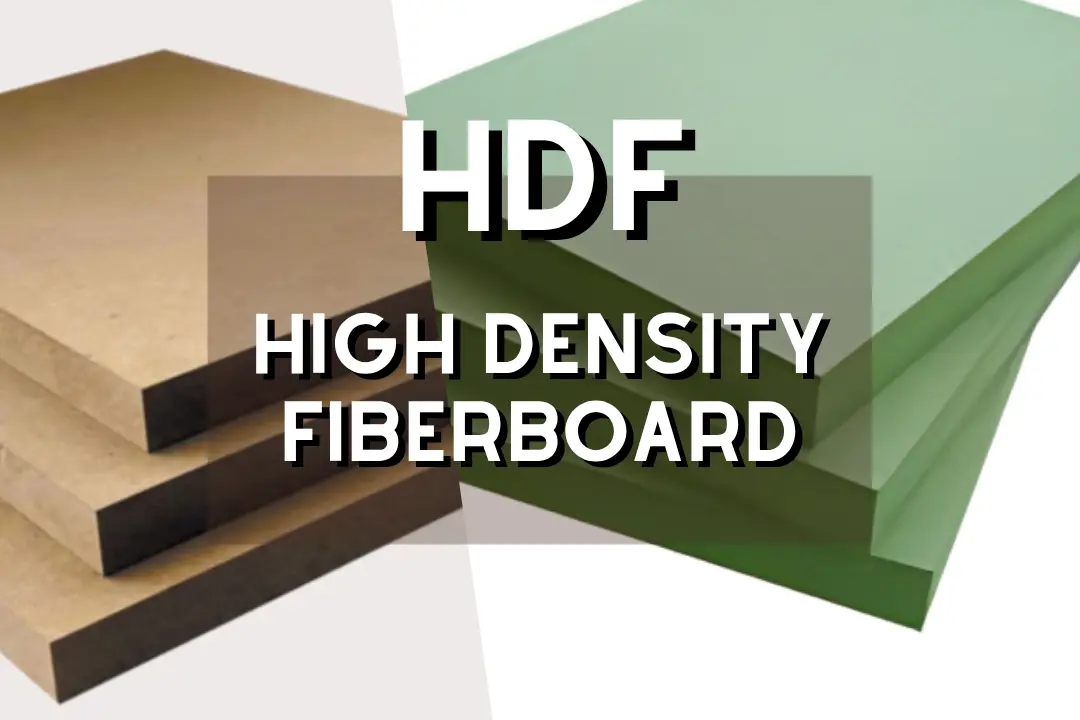
HDF and hardboard commonly exceed 800 kg/m³, and some hardboard reaches or passes 900 kg/m³. The high-density fiberboard guide covers its pressing, applications, and machining behavior.
Face-to-core variation matters in MDF, particleboard, and OSB. Test a full-thickness sample with enough surface area to represent the panel rather than peeling off a convenient outer piece.
Calculate Mass Density of Wood

Calculate wood density by dividing the sample’s measured mass by volume. Keep all measurements in compatible units and report the sample’s moisture condition beside the result.
Rectangular Sample Method
- Condition the sample and record its moisture content.
- Measure length, width, and thickness at several points.
- Convert dimensions to meters.
- Calculate volume: length × width × thickness.
- Weigh the same sample in kilograms.
- Divide mass by volume to obtain kg/m³.
Worked Metric Example
A sample measures 300 × 100 × 18 mm, or 0.300 × 0.100 × 0.018 m. Its volume is 0.00054 m³; at a mass of 0.378 kg, density is 0.378 ÷ 0.00054 = 700 kg/m³.
Cubic-meter wood weight follows mass = density × volume. One cubic meter of 700 kg/m³ wood has a mass of 700 kg, while 0.25 m³ has a mass of 175 kg.
Board-foot weight equals density in lb/ft³ divided by 12 because one board foot is 1/12 ft³. Hard maple at 44 lb/ft³ weighs about 3.67 lb per board foot before finishes, glue, or hardware.
Plywood sheet weight equals length × width × thickness × density. An 8 × 4 ft sheet of 18 mm plywood at 650 kg/m³ weighs about 35 kg; a 12 mm sheet weighs about 23 kg, while 10 mm material weighs about 19 kg at the same density.
Sheet dimensions and measured thickness often vary, so the plywood weight chart should be treated as an estimate. Adhesive, veneer species, repairs, and core voids account for noticeable product-to-product differences.
Irregular sample volume can be estimated by water displacement, but untreated wood absorbs water, traps bubbles, floats, and begins swelling. Coat it with a thin wax layer, correct for the wax volume, remove bubbles, and finish the reading quickly.

Measure Wood Density Accurately
Accurate density testing requires controlled moisture, representative dimensions, and instruments suited to the sample. Small errors in the thickness of a thin board can produce a surprisingly large density error.
Conditioning and Moisture
Record the species or panel type, source, temperature, relative humidity, moisture content, and whether the sample is green, air-dried, kiln-dried, or oven-dried. A common laboratory climate is about 20°C and 65% relative humidity, subject to the chosen standard.
Oven-dry testing commonly dries samples near 103 ± 2°C until repeated weighings stop changing. Don’t place finished, treated, resin-rich, or unknown material in a domestic food oven because fumes and fire risk may be present.
Scale and Caliper Accuracy
Choose a scale whose resolution matches the sample. A 1 g kitchen scale may work for a large panel offcut but can produce a severe percentage error with a tiny balsa piece weighing only a few grams.
Measure thickness in several locations using calipers or a micrometer. Pressing hard on soft balsa or MDF edges compresses the surface and gives a falsely small volume, which makes the calculated density too high.
Displacement test errors include trapped bubbles, water uptake, floating, wax thickness, and meniscus misreading. Dry-media displacement or a geometric estimate is often cleaner for porous pieces; 3D scanning suits valuable irregular samples.
Coatings, voids, and fasteners need a declared treatment. Remove screws and bark where possible, account for finish and wax, and decide whether internal voids belong in the product’s bulk volume.
ASTM, ISO, and EN methods don’t always use identical specimen preparation or density bases. ASTM D2395 covers density and specific gravity of wood and wood-based materials; ISO 13061-2 addresses solid wood, while EN 323 covers wood-based panels.
Comparing published values requires matching species, moisture state, mass basis, volume basis, and units. Generic tables suit early estimates, while supplier technical sheets should control purchasing, fabrication, shipping, and compliance work.
How Density Affects Wood
Density affects buoyancy, handling, machining, fastening, finishing, sound, insulation, and transport cost. It often correlates with hardness and strength, but it can’t predict performance by itself.
Floating Versus Sinking
Dry wood below about 1,000 kg/m³ usually floats in freshwater. Lignum vitae, some ebony, black ironwood, and snakewood can sink, though trapped air, moisture uptake, shape, coatings, grain orientation, and salinity change the observation.
Saltwater is denser than freshwater, so it supplies slightly more buoyant force. A borderline sample may float higher in seawater, while prolonged soaking can replace air in open pores and reduce buoyancy.
Weight and Handling
At equal dimensions, denser material weighs more. Heavy MDF doors need suitable hinges and fixings, while a dense worktop creates greater lifting strain and places more load on cabinets, walls, vehicles, and shipping pallets.
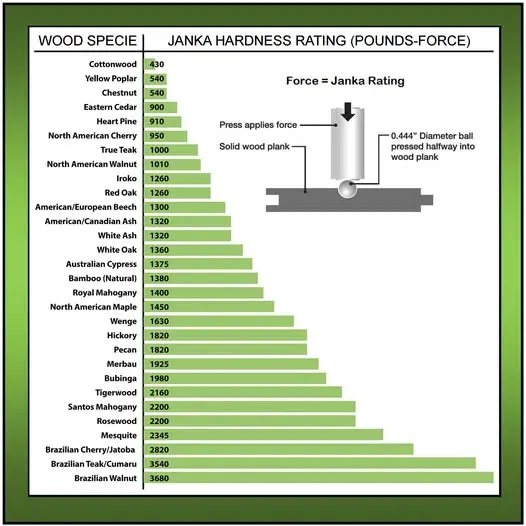
Density, hardness, and strength are separate properties. Janka hardness measures indentation resistance, modulus of rupture measures bending failure, and modulus of elasticity measures resistance to elastic bending; compare them using the wood hardness scale.
Machining dense wood often requires sharper carbide cutters, smaller cuts, firm workholding, and slower feed adjustment. Heat or a sharp burnt smell at the cut usually signals a dull edge, excess rubbing, or a feed rate that’s too slow.
Fastening needs care: dense hardwood can grip screws well but may split without correctly sized pilot holes. MDF edges can crumble around screws despite the panel’s high bulk density, so use confirmat screws, inserts, or face fastening where the design permits.
Finishing and adhesion depend on porosity, oil, extractives, and surface preparation. Low-density wood can drink in stain unevenly, MDF cut edges need extra sealer, and oily dense wood may require a freshly prepared surface and compatible adhesive.
Acoustics and insulation depend on density alongside stiffness, damping, grain direction, and moisture. Instrument makers value stiffness-to-weight ratio rather than weight alone, while low-density wood often transfers heat more slowly because it contains more air space.
Material cost doesn’t rise in a simple line with density. Dense imported woods may cost more through slow growth, limited supply, freight, sustainability controls, and tool wear; MDF may be inexpensive per panel yet costly to carry and mount.
Hands-On Density Comparison
A hands-on comparison reveals how strongly equal-volume materials differ in weight and surface behavior. This practical test works best with balsa, MDF, Baltic birch plywood, and dense hardwood conditioned in the same room.
Equal-Volume Test Setup
- Condition every sample together for several days.
- Cut or mark pieces with the same target volume.
- Measure each dimension at several points.
- Weigh each sample on the same scale.
- Calculate density and record the moisture condition.
- Compare edge texture, cutting resistance, and balance in the hand.
Real-world lesson: advertised dimensions can differ from measured dimensions, especially after sanding. Use actual measurements rather than package dimensions, and don’t treat a retailer’s species label as laboratory confirmation.
Low-Density Balsa Sample
A balsa sample should feel almost improbably light beside equal-volume MDF. Its soft surface dents under a fingernail, so use light caliper pressure and a scale with fine resolution; the balsa wood profile covers its structure and uses.
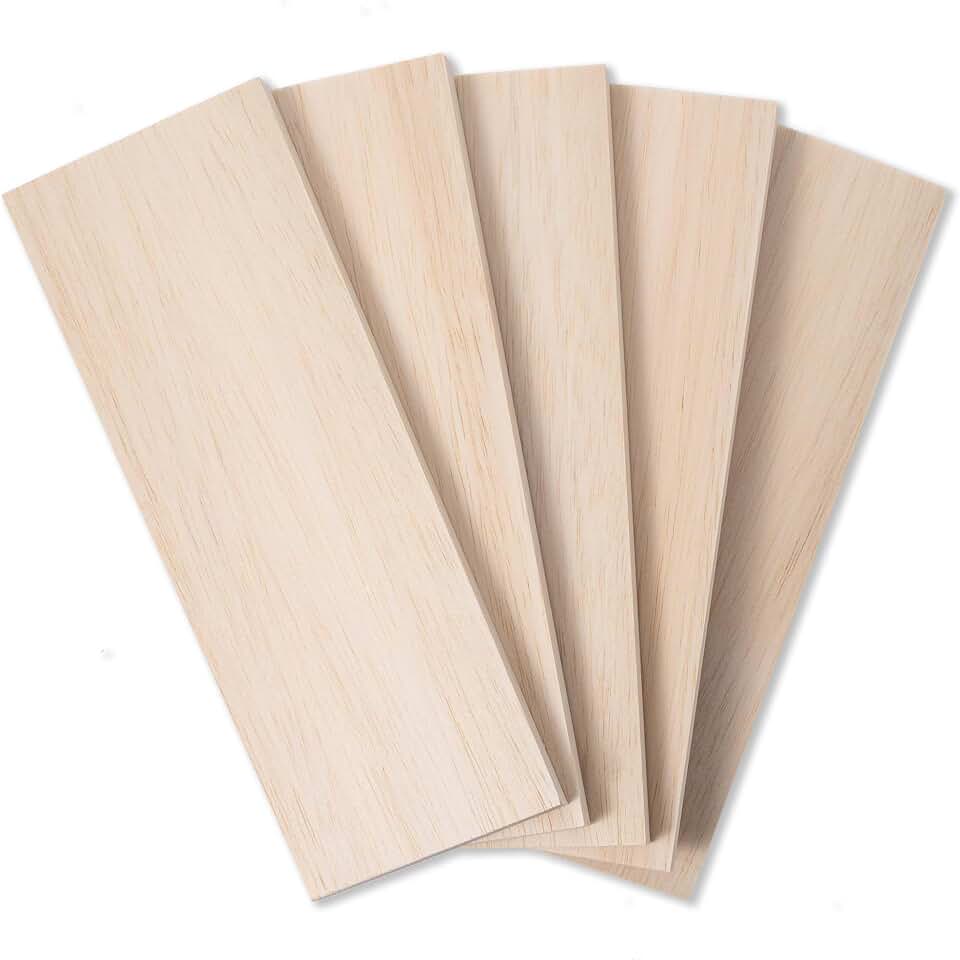
Thick Balsa Wood Sheets
- Lightweight balsa wood sample
- Half-inch thickness for sturdy projects
- Unfinished surface accepts paint and glue
- Useful for comparing low wood density
- Five boards for crafts and models
 Buy on Amazon
MDF panel sample: expect a smooth, cool face, a dusty cut edge, and much more wrist load than balsa. Test a full-thickness piece because the compressed faces don’t represent the lower-density core.

Smooth MDF Craft Boards
- Medium-density fiberboard panels
- Smooth unfinished faces for finishing
- Sanded edges save prep time
- Quarter-inch thickness suits many projects
- Eight-pack for consistent material testing
Buy on Amazon
Birch plywood sample: inspect the edge for ply count, glue lines, patches, and hidden voids. Baltic birch often feels rigid and substantial, but its cross-laminated construction means density alone doesn’t explain stiffness or screw holding.

Baltic Birch Plywood Panels
- Baltic birch plywood construction
- Half-inch thickness for rigid builds
- B BB grade faces for clean projects
- Suitable for laser and CNC cutting
- Helpful for comparing engineered wood density
Buy on Amazon
Dense hardwood sample: ebony produces a strong downward pull despite its compact size, and a sharp edge can feel glassy after fine sanding. Pre-drill screw holes and control heat during cutting because splitting and scorching are common beginner mistakes.

Dense Ebony Lumber Blocks
- Dense hardwood lumber for comparison
- Natural dark ebony grain
- Compact blocks for detailed work
- Suitable for inlay and handle projects
- Ten pieces for small woodworking tasks
Buy on Amazon
The most useful result isn’t a winner but a repeatable comparison. Match moisture conditions, measure actual volume, retain your raw figures, and use manufacturer data whenever density affects loading, freight, hardware selection, or regulated work.
FAQs
What Is The Average Density Of Wood In Kg/M³?
The average density of wood is about 500 to 700 kg/m³ when dry, although species vary widely. Light softwoods such as cedar may be near 350 kg/m³, while dense hardwoods such as oak can exceed 750 kg/m³. Density is usually measured at a stated moisture content, often 12%.
How Does Moisture Content Affect Wood Density?
The density of wood increases as its moisture content rises because water adds weight to the same volume. Green or freshly cut wood can be much heavier than kiln-dried wood. For accurate comparisons, use density values measured at the same moisture level, commonly 12% for furniture and building timber.
Is Hardwood Always Denser Than Softwood?
No, hardwood is not always denser than softwood. Hardwood and softwood describe tree types rather than weight or strength, so there is considerable overlap. Balsa is a hardwood but very light, while some softwoods, including yew, can be comparatively dense. Check the specific species and moisture content instead.
What Is The Density Of MDF Compared With Plywood?
MDF is generally denser and more uniform than plywood. Typical MDF ranges from about 600 to 800 kg/m³, while plywood often ranges from 450 to 700 kg/m³ depending on its veneers and adhesive. MDF is heavy for its size but has weaker screw-holding at edges and less moisture resistance unless it is specially made.
How Do You Calculate The Density Of A Wood Sample?
Calculate wood density by dividing the sample’s mass by its volume. Weigh the piece in kilograms, measure its length, width, and thickness in metres, then multiply those dimensions to find cubic metres. Use the formula density = mass ÷ volume, and record the wood’s moisture content because it changes the result.
Affiliate Disclosure: Some links in this post are affiliate links. If you make a purchase through these links, we may earn a small commission at no extra cost to you. We only recommend products we genuinely believe in.