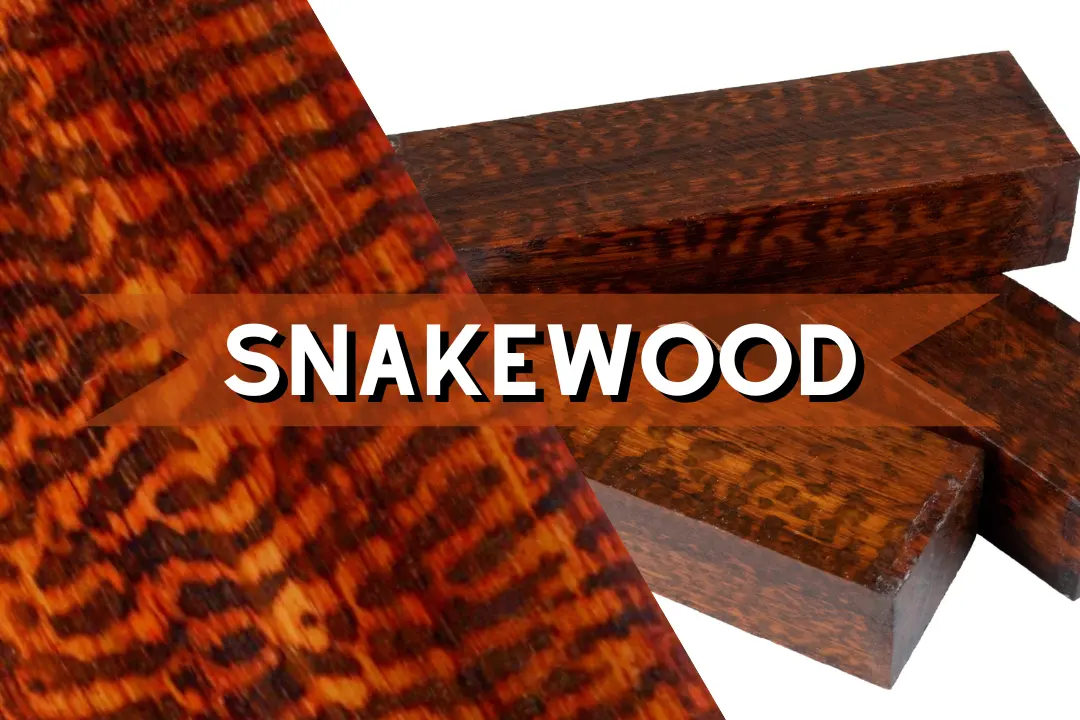

Snakewood is a rare South American hardwood, usually Brosimum guianense, known for reddish-brown heartwood with dark snakeskin-like markings, extreme density, and luxury small-project use. It’s prized for knife handles, pen blanks, cue accents, violin bows, inlay, and jewelry, but it cracks easily when buyers or makers rush drying, drilling, or sanding.
Table of Contents
What Is Snakewood?

Snakewood is a dense exotic hardwood named for the dark, broken markings that can look like snakeskin on a reddish-brown background. In shops, the best pieces feel cold and heavy in the hand, almost like polished stone, and the figured surface flashes from orange-brown to dark chocolate as you turn it under a bench light.
Brosimum guianense Identity
Brosimum guianense is the main scientific name used for true snakewood in woodworking and botanical references. Kew’s Plants of the World Online lists the accepted botanical record for Brosimum guianense, which helps separate genuine snakewood hardwood from unrelated “snake wood” decor, terrarium branches, or driftwood sold under broad retail names.
Piratinera guianensis Synonym
Piratinera guianensis appears often in older wood books, supplier listings, and instrument-making notes. If a seller uses that synonym, confirm the piece is still the South American hardwood known as snakewood, letterwood, or amourette bois, not African snake wood or a similarly named decorative species.
Moraceae Family
Moraceae is the botanical family for snakewood, the same broad family that includes mulberry and fig relatives. That family link doesn’t mean it works like those woods at the bench; snakewood is much harder, denser, smaller in usable yield, and far less forgiving under a drill bit.
South American Range
Northern South America is the natural home of snakewood, with trade material commonly associated with Guyana, Suriname, French Guiana, Brazil, and nearby Amazonian regions. This range matters when buying because country-of-origin details can help you judge traceability, legality, and whether a supplier actually knows the wood they’re selling.
Snakewood Meaning
Snakewood meaning in woodworking refers to the figured heartwood of Brosimum guianense, not a category of wood used for snakes. The name comes from the mottled figure, and the mistake beginners make is buying reptile driftwood or plain “snake wood” listings when they meant dense tropical hardwood for woodworking.
How To Identify Snakewood
Real snakewood usually combines reddish-brown heartwood, dark irregular flecks, a very dense feel, fine texture, and small blank sizes. A piece can still be genuine with weak figure, but highly figured snakewood is the material most buyers expect when paying premium prices.
Color and Figure
Snakewood color ranges from orange-brown and reddish brown to deeper brown, with dark brown or black patches scattered like scales. The boldest figure rarely runs evenly through a large billet, so one face may look dramatic while the cut edge turns plainer after shaping.
Heartwood vs Sapwood
Heartwood carries the value because it shows the darker color and snakeskin figure. Sapwood is paler, often cream or yellowish, and it reduces yield for knife scales, pens, and cue accents where buyers expect strong contrast across the visible face.
Grain and Texture
Fine texture is one of the easiest clues once the wood is in your hand. The grain may be straight, slightly interlocked, or irregular in figured stock, but the surface doesn’t feel open-pored like oak; after sanding, it can become slick and glassy before any finish touches it.
Genuine Snakewood Clues
Genuine clues include high weight for size, dark mottling on reddish heartwood, tiny pores, and wax-sealed ends on better blanks. A practical test is scale weight: a small pen blank feels surprisingly heavy, and when tapped on the bench it gives a sharp, hard click instead of the dull knock of softer craft wood.
Snakewood Lookalikes
Lookalikes include bocote, cocobolo, bloodwood with dark streaks, dyed blanks, and unrelated woods sold as “snake wood.” Bocote has bolder line striping, cocobolo often feels oilier and shows rosewood streaking, and blue wood or reptile driftwood listings don’t match snakewood’s fine, heavy hardwood character.
Snakewood Hardness and Density
Snakewood hardness is about 3,800 lbf on the Janka scale, which makes it much harder than maple, oak, and walnut. Its weight, specific gravity, and strength place it among very dense hardwoods, though it isn’t the single densest wood listed in global comparisons such as buloke, lignum vitae, or some ironwoods.
Janka Hardness: 3,800 lbf
3,800 lbf, or about 16,900 N, is the commonly cited snakewood Janka hardness. That number explains why small edges chip under dull tools and why a sanding drum can heat the surface fast enough to create the faint burnt-sugar smell that warns you to stop and let the blank cool.
Density and Weight
Average dried weight is about 75 lb/ft³, or 1,210 kg/m³, based on widely cited wood property references such as The Wood Database. If you compare densities often, our guide to density of wood gives helpful context for why snakewood feels so compact beside teak, acacia wood, cedar, maple, or walnut.
Specific Gravity Data
Specific gravity is roughly 0.99 basic and about 1.21 at 12% moisture content. In practical terms, snakewood blanks can feel close to water-sinking dense, so a “small” piece may add more weight to a knife handle or cue accent than a beginner expects.
Strength Properties
Strength values commonly cited for snakewood include a modulus of rupture near 26,990 lbf/in², elastic modulus around 3,364,000 lbf/in², and crushing strength about 20,270 lbf/in². These numbers show high strength, yet they don’t cancel the real bench problem: dense, brittle edges can still fracture when unsupported.
Shrinkage Figures
Shrinkage figures are about 4.7% radial, 6.0% tangential, 12.4% volumetric, with a T/R ratio near 1.3. The ratio doesn’t look extreme on paper, but snakewood still checks because dense stock releases internal stress slowly and small, figured pieces rarely dry with perfect balance.
Snakewood vs Maple

Snakewood vs maple is not a close hardness match: snakewood is about 3,800 lbf, while hard maple is around 1,450 lbf. Maple makes sense for furniture, cutting boards, and shop fixtures; snakewood suits small premium pieces where appearance and polish justify tool wear and material cost.
| Property | Snakewood | Hard Maple | Shop Meaning |
|---|---|---|---|
| Janka hardness | 3,800 lbf | 1,450 lbf | Snakewood dulls tools faster |
| Average dried weight | 75 lb/ft³ | About 44 lb/ft³ | Snakewood feels much heavier |
| Best project scale | Small luxury parts | Furniture and utility work | Use each wood where it fits |
| Beginner risk | Checking, heat cracks, chipping | Burning, blotching, tearout | Snakewood needs slower machining |
Hardness context helps prevent expensive mistakes. For a wider ranking of dense woods and Janka numbers, compare snakewood with entries in our wood hardness scale and hardest wood guide.
Why Snakewood Is Expensive
Snakewood price is high because dramatic figure is rare, usable pieces are small, drying defects are common, and demand stays strong for luxury craft and instrument work. The fair way to judge snakewood cost is by usable volume, not by the outside dimensions printed on a listing.
Rare Figured Material
Figured snakewood costs more than plain stock because the snakeskin pattern isn’t present in every tree, log, board, or blank. A seller may have real snakewood lumber with weak figure, but it won’t command the same price as a crack-free billet with dark patterning across all four faces.
Small Usable Boards
Small boards are normal with snakewood because clear, figured heartwood sections are limited. Large furniture-size boards are uncommon, so suppliers often cut the wood into pen blanks, knife scales, turning squares, cue billets, and small craft pieces where yield makes financial sense.
Checking and Waste
Checking waste can erase the bargain in a cheap blank. A 6-inch piece with half-inch end checks on both ends may leave only 5 inches of safe material, and a hairline crack that appears after drilling can turn a premium pen blank into scrap.
Price by Volume
Price by volume is the professional comparison method for snakewood blanks for sale. Divide the price by length × width × thickness, then subtract visible defects, sapwood, pith, and checked ends; this gives a truer cost than comparing two pieces by listing title alone.
Costly Wood Comparisons
Costly wood comparisons can be misleading because ebony, cocobolo, macassar ebony, lignum vitae, and snakewood are sold in different sizes and grades. For full furniture, other premium hardwoods may be more practical; our guide to wood for furniture explains why stability, board size, and availability matter as much as beauty.
African Blackwood Cost
African blackwood cost often comes up beside snakewood because both are dense, premium, and favored for small luxury parts. African blackwood may be easier to source for some instrument or turning sizes, while snakewood usually wins on visual drama; compare material behavior in our blackwood guide before choosing.
Snakewood Uses and Project Fit
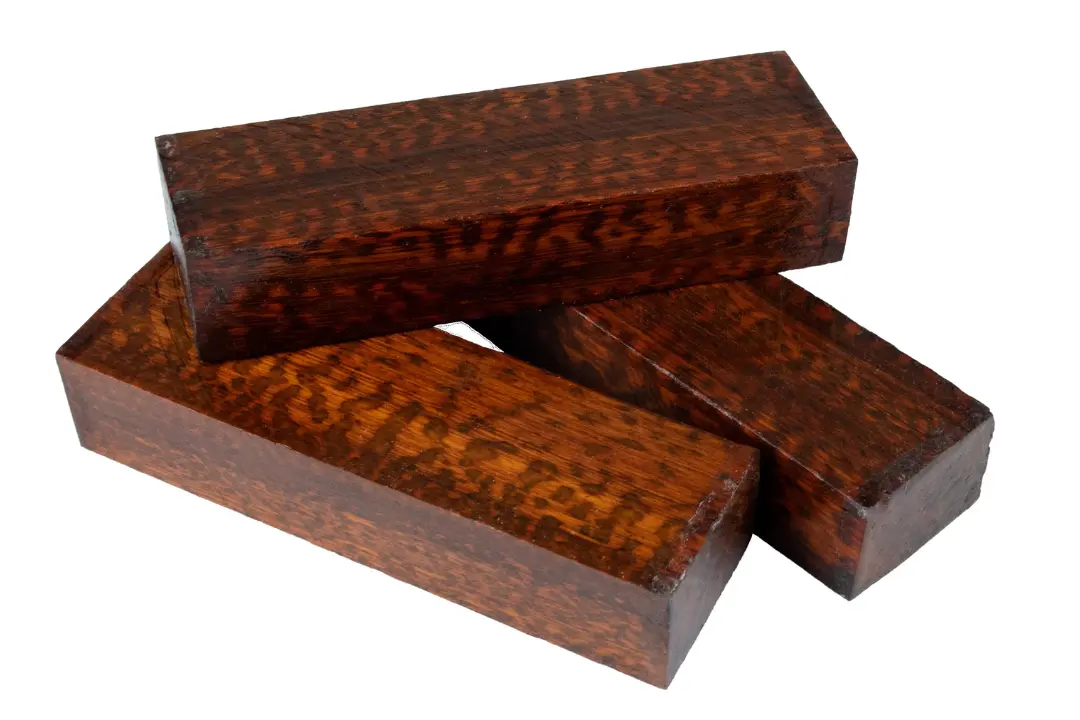
Snakewood uses fit small premium projects better than large utility builds. It shines where a maker can show the figure, keep the part compact, and avoid long unsupported edges that invite cracks.
Knife Handles
Knife handles are a strong fit when the scales are dry, crack-free, and thick enough for final shaping. The common beginner mistake is drilling pin holes too fast; use sharp bits, back up the exit side, and let the bit clear chips so heat doesn’t start a split.
Pen Blanks
Pen blanks make sense because they use small, highly figured pieces and show the polish well. Drill slowly, avoid aggressive barrel trimming, and consider a CA glue finish because the slick surface can make thin oil finishes look uneven if the blank wasn’t sanded fresh.
Pool Cue Accents
Pool cue accents use snakewood for visual impact rather than full-length economy. Cue builders must account for weight and brittleness, so snakewood often appears as points, rings, sleeves, or decorative sections rather than a whole cue body.
Violin Bows
Violin bows and related fittings are specialist uses where density, balance, and polish matter. Snakewood has a long association with bow making, but instrument-grade stock must be straighter, cleaner, and more stable than ordinary craft blanks.
Inlay and Jewelry
Inlay and jewelry use snakewood’s figure efficiently because even offcuts can become rings, beads, box details, chess pieces, or walking-stick accents. Thin inlay needs support during cutting because brittle corners can chip before you ever reach final sanding.
Furniture Limitations
Furniture limitations are severe: cost, board size, weight, and checking risk make full snakewood furniture impractical. Use it as veneer, edge banding, pulls, plugs, inlay, or small accents instead of trying to build a tabletop from rare, unstable pieces.
Working and Finishing Snakewood
Working snakewood rewards patience and punishes heat. Sharp carbide, light cuts, fresh abrasives, stable humidity, and gentle clamping reduce most failures, while forcing tools through the blank creates chips, burn marks, and sudden checks.
Cutting and Shaping
Cutting snakewood needs sharp teeth, slow feed, and solid support close to the cut. I prefer to leave extra length at both ends because the first cut often reveals tiny end checks that weren’t visible under wax.
Drilling and Routing
Drilling slowly matters more than bit speed charts suggest. Back out often, clear powdery chips, and stop if the blank turns hot to the touch; that warmth can travel ahead of the bit and open a hairline crack along the grain.
Turning Snakewood
Turning snakewood works well for pens, beads, bottle stoppers, chess pieces, and small handles. Use light cuts and keep tools sharp enough to shave, not scrape, because scraping loads the surface with heat and can make the blank click or ping as a crack opens.
Sanding and Polishing
Sanding snakewood should feel controlled, not rushed. Progress through fine grits, use fresh paper, and pause when the wood smells sharp or scorched; finished well, the surface develops a deep, glassy luster before wax, shellac, lacquer, oil, epoxy, or CA finish is applied.
Gluing Snakewood
Gluing snakewood works best on freshly sanded surfaces because dense wood can burnish slick under blades and abrasives. Epoxy is often the safer choice for knife scales, mixed-material handles, and repairs; clamp firmly, but don’t crush small brittle parts trying to squeeze out every line of glue.
Drying and Storage
Drying snakewood is where many expensive blanks fail before the project starts. Store blanks indoors, away from direct sun and heater airflow, leave waxed ends intact until machining, and let new stock acclimate for days rather than cutting it the hour it arrives.
Checking Prevention
Checking prevention starts with oversized cuts, slow drilling, cool sanding, sealed ends, and humidity control. Stabilization can help some porous or cracked-prone small blanks, but snakewood’s density limits penetration, so don’t treat stabilization as a guarantee.
- Use carbide or freshly sharpened high-speed steel tools for clean cuts.
- Make light passes instead of trying to remove material in one heavy cut.
- Support the exit side during drilling to reduce blowout.
- Stop sanding when the blank feels hot under your fingertip.
- Cut away checked ends before final layout, not after shaping.
Buying Snakewood Blanks or Lumber
Buying snakewood is safest when you judge the exact piece, not a generic stock photo. The best listings show all faces, clear dimensions, moisture or drying notes, and whether the ends are sealed.
What To Look For

Look for strong dark mottling, reddish-brown heartwood, minimal sapwood, clean faces, sealed ends, and dimensions that leave waste allowance. For knife scales, inspect both sides; for pen blanks, check the end grain because short checks there often widen during drilling.
What To Avoid
Avoid stock with open end checks, face cracks, pith-centered grain, vague species labels, heavy sapwood, or a price that seems too low for heavily figured material. Cheap snakewood may still be useful for inlay, but it can be poor value for handles, cue work, or pens if half the blank is unusable.
Seller Questions
Ask sellers whether the wood is genuine Brosimum guianense, dry or green, wax sealed, photographed as the exact piece, and checked under bright light. Also ask if the blank is graded for turning, knife scales, cue work, or instrument use because each project tolerates different defects.
- Confirm species name, not just “exotic wood.”
- Request photos of all faces and both ends.
- Calculate price per cubic inch before buying.
- Subtract checked, sapwood-heavy, or pithy sections from usable volume.
- Match the blank size to the project before paying for figure you’ll cut away.
Snakewood Blanks for Sale
Snakewood blanks for sale are often listed as pen blanks, turning blanks, knife scales, small billets, cue stock, or craft wood. Good listings price the piece according to size, figure, dryness, and condition, while weak listings hide defects with one glossy front-facing photo.
Small Project Materials
Small materials are the sensible entry point because they let you test snakewood without paying for a rare board. These snakewood craft wood examples are best treated as starting points for handles, pens, inlay, or repairs, then inspected carefully before machining.

Premium Snakewood
- Striking exotic hardwood with dramatic grain
- dense and durable for fine projects
- ideal for turning, carving, and inlays
- naturally rich color and unique character
- a standout choice for crafts and collectibles
 Buy on Amazon

Snakewood Blank
- Compact wood blank for specialty projects
- dense material offers excellent detail work
- suitable for handles, pens, and small crafts
- attractive natural grain and color
- ready for shaping, sanding, and finishing
Buy on Amazon

Snakewood Craft Part
- Natural snakewood piece for custom work
- suited for handles, beads, and small accessories
- dense wood offers a premium feel
- great for makers and DIY projects
- polished look with distinctive grain
Buy on Amazon
Snakewood Spare Part
- Natural snakewood stock for small projects
- ideal for handles, beads, and repairs
- dense build supports precise shaping
- unique grain adds visual appeal
- a versatile choice for custom craft work
Buy on Amazon
Field-use note: order slightly larger than your final dimensions, especially for knife handles and pen blanks. The difference between success and scrap is often one extra eighth of an inch that lets you trim away a hidden check after the first cut exposes it.
Safety, Sustainability, and Comparisons
Snakewood safety means controlling fine dust, and snakewood sustainability means checking legality and source claims before buying. It isn’t enough for a piece to look beautiful; dense exotic hardwoods deserve careful handling, clean documentation, and realistic project choices.
Dust and Toxicity
Snakewood dust can irritate skin, eyes, nose, and lungs in sensitive users. OSHA treats wood dust as a workplace hazard because fine particles can affect breathing and cleanup practices; see OSHA wood dust guidance before sanding dense exotic hardwoods in a small shop.
PPE and Ventilation
PPE matters most during sanding, turning, routing, and drilling because these steps create fine airborne dust. Use dust collection, a properly fitted respirator, eye protection, and gloves if wood dust makes your skin itch; wipe surfaces afterward because snakewood dust feels gritty and reddish-brown on fingertips.
CITES Status
Snakewood CITES status is commonly described by wood references as not listed in CITES appendices, but buyers should check before import or export because rules can change by country and shipment type. Use official trade tools such as the Species+ CITES database for verification, then keep supplier invoices with the scientific name.
Responsible Sourcing
Responsible sourcing means asking for country of origin, legal harvest claims, import paperwork where relevant, and clear species labeling. High-value figured hardwoods can encourage wasteful cutting, so favor suppliers that sell graded offcuts, small blanks, and documented stock rather than vague “rare exotic” lots.
Snakewood vs Ebony
Snakewood vs ebony comes down to figure, color, and project role. Snakewood gives reddish snakeskin figure, while ebony wood gives black or dark brown uniformity for fingerboards, keys, fittings, and luxury accents.
Snakewood vs Cocobolo
Snakewood vs cocobolo is a choice between mottled figure and oily rosewood character. Cocobolo often shows orange, red, and dark streaks and may be easier to find in larger pieces; compare its behavior in our cocobolo wood guide before using it for handles or accents.
Snakewood vs Bocote
Snakewood vs bocote often confuses buyers because both can show bold dark patterning. Bocote usually has sweeping black lines and is more available for knife scales, while snakewood has broken mottling and a higher luxury rarity perception; see our bocote wood profile for bocote wood hardness and use notes.
Barauna Wood Confusion
Barauna wood is a separate search and buying confusion point, not a reliable substitute name for snakewood. If a seller blends barauna, African snake wood, letterwood, and snakewood in one listing, ask for the scientific name and photos of the exact piece before paying premium snakewood prices.
FAQs
What Is Snakewood Used For?
Snakewood is used for small, high-end items that need extreme density and a striking decorative grain. It is popular for knife handles, bows, walking sticks, tool handles, musical instrument parts, and luxury turning projects.
Why Is Snakewood So Expensive?
Snakewood is expensive because it is rare, difficult to harvest, and hard to work with. Its slow growth, limited supply, and high demand from specialty makers also push the price up.
How Hard Is Snakewood Compared With Maple?
Snakewood is much harder and denser than maple. In practical terms, it is significantly more resistant to dents and wear, while maple is easier to cut, sand, and shape.
Is Snakewood Toxic To Work With?
Snakewood can cause irritation for some people when cut or sanded. It is best to wear a dust mask, use good ventilation, and avoid skin contact with the dust if you are sensitive.
Is Snakewood Endangered Or CITES Listed?
Snakewood is not generally listed under CITES, but availability can still be limited in some regions. Because trade rules and conservation status can change, it is smart to check current local and international regulations before buying or exporting it.
Affiliate Disclosure: Some links in this post are affiliate links. If you make a purchase through these links, we may earn a small commission at no extra cost to you. We only recommend products we genuinely believe in.