

Madrone most often means Pacific madrone (Arbutus menziesii), a broadleaf evergreen native to western North America with peeling red-orange bark, glossy leaves, white flowers, and red fruit. This guide covers madrone tree identification, ecology, care, disease diagnosis, propagation, berries, conservation, and the practical behavior of madrone wood.
Table of Contents
What Is Madrone?
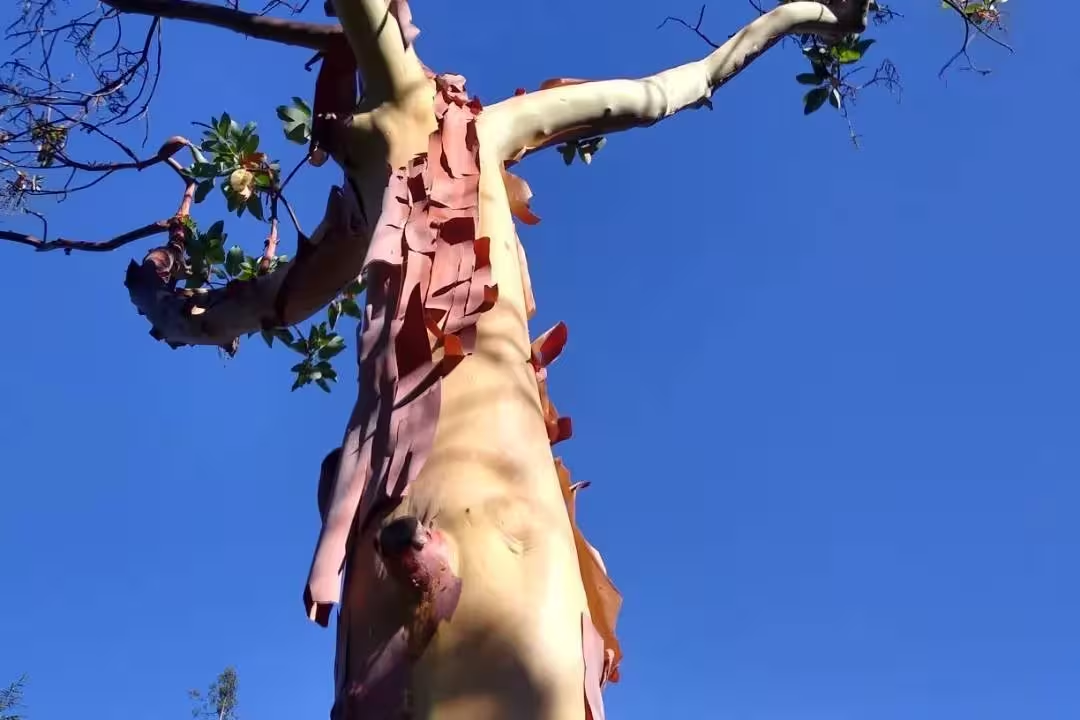
A Pacific madrone is an evergreen hardwood tree in the heath family, Ericaceae. The name “madrone” can describe several Arbutus species, but along the Pacific Coast it nearly always refers to Arbutus menziesii.
Pacific Madrone Definition
Pacific madrone grows as a single-trunk or multi-trunk tree with a broad, irregular crown. Mature trees commonly reach 30 to 80 feet, while sheltered forest specimens can grow taller; exposure, soil depth, competition, and summer moisture all influence how tall a tree becomes.
Unlike neighboring Douglas-firs and other conifers, madrone keeps broad evergreen leaves. Its smooth bark feels cool and firm beneath the fingertips, while loose outer layers feel dry and papery before curling from the trunk.
Madrone, Madrona, and Arbutus
Madrone, madrona, and arbutus are regional names for the same Pacific Coast species. Madrone is common in Oregon and California, madrona tree is familiar in Washington, and many people in British Columbia simply call it arbutus.
| Name | Typical regional use | Usual meaning |
|---|---|---|
| Madrone | Oregon and California | Arbutus menziesii |
| Madrona or Pacific madrona | Washington | Arbutus menziesii |
| Arbutus | British Columbia | Arbutus menziesii |
| Texas or Arizona madrone | Southwestern United States | Arbutus xalapensis |
Taxonomy and related species: Pacific madrone belongs to Plantae, Ericales, Ericaceae, Arbutus, and the species menziesii. Its relatives include blueberries, rhododendrons, manzanitas, Mediterranean strawberry trees, and Texas madrone; the species name honors naturalist Archibald Menzies.
Madrone Tree Identification

Identify a madrone tree by combining its evergreen leaves, peeling red-orange bark, white urn-shaped flowers, and rough red fruit. Bark color alone isn’t enough because manzanita and ornamental strawberry trees can look similar.
Form, Height, and Crown
Open-grown trees often develop a wide sculptural crown with twisting limbs and several trunks. Trees growing through a forest canopy tend to have taller, cleaner stems and foliage concentrated near the top.
Peeling red bark: Young bark may look green or chartreuse before turning copper, cinnamon, orange, or deep red. Thin outer sheets peel naturally and expose smooth younger bark; older bases can become dark, checked, and rough without indicating disease.
Evergreen leaves: Leaves are alternately arranged, oval to elliptic, thick, and glossy dark green above. The paler underside and leathery feel help separate them from many deciduous trees, yet older leaves still yellow and drop during seasonal renewal.
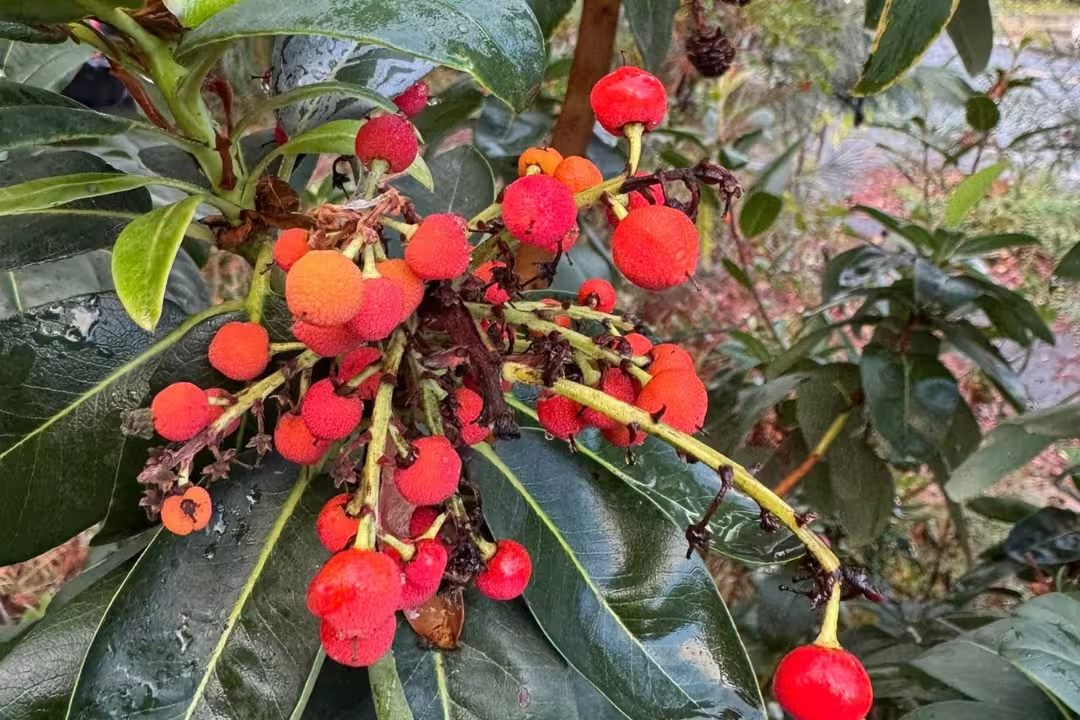
Flowers and berries: Spring flowers hang in cream-white clusters, with each bloom shaped like a tiny upside-down urn. Orange-red fruit follows in late summer or fall; it feels granular or finely bumpy rather than smooth.
Quick Identification Checklist
- Broad, leathery leaves that remain green through winter
- Smooth orange, copper, or red upper bark
- Thin bark peeling in papery curls or flakes
- Clusters of white urn-shaped spring flowers
- Rough-textured orange or red fall berries
- Twisting limbs and an irregular mature crown
- Natural occurrence in dry Pacific Coast woodland
Madrone vs. manzanita: Madrone normally becomes a much larger tree and carries larger leaves and berry clusters. Manzanitas in the genus Arctostaphylos are commonly shrubs or small trees; see this field comparison of the manzanita tree.
Strawberry tree lookalikes: Mediterranean Arbutus unedo and ornamental Arbutus ‘Marina’ also have peeling bark, urn-shaped flowers, and red fruit. Nursery plants are often smaller and more tolerant of irrigated gardens, so check the label, native range, mature form, and leaf details rather than trusting bark color.
| Feature | Pacific madrone | Manzanita | Strawberry tree |
|---|---|---|---|
| Typical form | Medium to large tree | Shrub or small tree | Small to medium ornamental tree |
| Native area | Western North America | Mostly western North America | Mediterranean region |
| Fruit | Small, rough orange-red berries | Smaller dry drupes | Larger, knobbly red fruit |
| Garden response | Root-sensitive | Varies by species | Often adaptable to cultivation |
Range, Habitat, and Ecology

Pacific madrone is native from southwestern British Columbia through Washington and Oregon into California. It favors well-drained slopes, bluffs, rocky ground, woodland edges, and mixed forests with wet winters and comparatively dry summers.
Native Range and Habitat
Native range: Distribution becomes scattered near its northern and southern limits rather than ending at one sharp boundary. The Oregon State University profile describes Pacific madrone’s form, range, and identification features.
Habitat and climate: Madrone performs well on gravelly, rocky, or shallow soils where water moves away from roots. A fertile lawn that receives frequent summer irrigation may be less suitable than a dry slope with lean soil because persistent crown moisture raises disease pressure.
Companion plant communities: Depending on location, associates include Douglas-fir, tanoak, coast live oak, Garry oak, Pacific wax myrtle, and manzanita. Related regional hardwoods include Oregon oak and California black oak.
Wildlife, Habitat, and Fire Response
Pollinators and wildlife: Bees visit the spring flower clusters, while robins, thrushes, waxwings, band-tailed pigeons, and mammals eat ripe fruit. Actual use changes with region, crop size, migration timing, and the availability of other food.
Habitat structure: A mature crown supplies perches and cover, while cavities and dead sections can shelter insects or nesting animals. Dead limbs over roads, roofs, or play areas still need a risk assessment; habitat value doesn’t cancel the danger of a failing branch.
Fire response: Thin bark leaves the trunk open to severe heating, and a strong fire may kill the crown. Established trees can resprout from the root crown or basal burl after top-kill, though survival varies with fire intensity, tree condition, and earlier drought stress, as documented in the USDA Fire Effects Information System.
Growing and Propagating Madrone
Grow madrone in sun, open shade, and fast-draining soil, then reduce irrigation after establishment. Small plants usually survive planting better than large specimens because madrone roots react poorly to disturbance, saturation, and abrupt soil changes.
Site Selection, Planting, and Care
Site selection: Choose ground with no standing winter water and enough space for a broad crown. Keep the tree away from future trenches, retaining-wall work, compacted parking areas, and irrigated turf that would force repeated disturbance around its roots.
Planting small trees: Set the root flare at or slightly above finished grade without tearing the root ball apart. Backfill with the excavated soil, water it into contact with the roots, and spread surface mulch several inches away from the trunk.
- Select a small, healthy container plant with no circling woody roots.
- Dig a broad hole no deeper than the measured root ball.
- Lift the plant by its container or root ball, never by the trunk.
- Place the upper root flare at finished soil level.
- Backfill without adding a rich amended pocket.
- Water deeply, let the soil drain, and add shallow surface mulch.
- Stake only on exposed sites and remove supports after stability develops.
Establishment watering: Water deeply during the first dry seasons, then let the upper soil begin drying before the next application. Frequent shallow watering keeps the crown damp and trains roots near the surface; a slow basin outside the trunk zone works better than a sprinkler striking the bark.
Soil, mulch, and fertilizer: Drainage matters more than rich soil. Don’t bury the flare beneath compost or a thick mulch mound, and don’t use heavy nitrogen feeding to treat weak growth before checking roots, drainage, and planting depth.
Pruning mature trees: Remove dead, broken, rubbing, or hazardous limbs selectively. Topping leaves large wounds and dense sprouts, while an oversized cut exposes pale, moist wood that can crack around the edge and become an entry point for decay.
Transplanting limitations: Established wild seedlings often fail after digging because fine feeder roots extend beyond the small soil plug people can carry. Moving soil can also disrupt fungal partners; planting a young nursery tree or sowing seed is usually more successful.
Growing From Seed and Cutting Care
Growing from seed: Collect ripe fruit only with permission, remove the pulp, and use a moist chilling treatment suited to the seed source. Sow in an airy, free-draining medium and keep it evenly damp rather than waterlogged.
Seedling and cutting care: Young roots are easy to bruise, so reduce repotting and move seedlings to permanent positions while small. Harden them gradually to sun; tender leaves can become hot and limp within hours when a shaded seedling is placed directly in exposed summer light.
Cuttings have inconsistent rooting compared with seed. Juvenile shoots, controlled humidity, bottom heat, correct timing, and rooting hormone can improve results, but enclosed propagation spaces also invite rot when condensation stays on leaves.
Madrone Problems and Diagnosis
Peeling bark and some yellow leaf drop are normal madrone traits. Rapid canopy thinning, black shoots, sunken lesions, bleeding bark, basal decay, or whole branches dying call for closer inspection because several stresses can produce similar symptoms.
Normal Seasonal Shedding and Dead Tree Warning Signs
Normal seasonal shedding: Healthy trunks release thin red-orange curls that may collect like crisp paper around the base. Older leaves can turn yellow or brown before dropping, especially when new leaves are developing.
Dead tree warning signs: A tree isn’t confirmed dead from one bare twig. Check several crown areas for living buds, flexible twigs, and a thin green cambium beneath a tiny test scrape; avoid cutting deeply into the decorative trunk merely to perform this check.
Symptom Diagnosis Table
| Observed symptom | Possible cause | Useful next step |
|---|---|---|
| Scattered leaf spots | Foliage disease or weather injury | Photograph both leaf surfaces and track whether new growth remains healthy |
| Black flowers and shoot tips | Blight or cold injury | Inspect where dead and living tissue meet |
| Sunken bark with dead growth beyond it | Canker | Limit injury and request an arborist inspection |
| Sparse crown with wet soil | Root or crown rot | Check drainage, irrigation, root flare, and crown tissue |
| Brown leaf margins after heat | Drought or heat scorch | Check soil moisture below the surface before watering |
| Conks, cavities, or loose structural roots | Advanced decay | Restrict access and arrange a tree-risk assessment |
Leaf spots and blight: Wet weather can make brown or black spots, blotches, dead flowers, and blackened shoots more visible. Spraying without a diagnosis wastes material and may miss the actual problem, such as drainage stress or earlier frost damage.
Cankers and branch dieback: Look for cracked, dark, or sunken bark and dead tissue beyond a lesion. Drought, construction injury, root damage, and poor drainage often weaken the tree before canker organisms spread through a twig or limb.
Root and crown rot: Several Phytophthora species damage roots in wet soil. Sparse foliage, short shoots, wilt, and dark crown tissue may follow, but adding water to a wilting tree can worsen rot if the root zone is already saturated.
Sudden oak death: Pacific madrone can be affected by Phytophthora ramorum, yet symptoms alone don’t confirm that pathogen. The Pacific Northwest disease handbook details multiple madrone disorders that can resemble one another.
Drought and heat stress: Seasonal drought tolerance doesn’t make madrone immune to prolonged heat. Scorched margins, smaller leaves, reduced growth, and branch dieback can appear after severe dry periods, particularly where roots were cut or soil became compacted.
Professional diagnosis: Ask a qualified arborist to inspect large trees near occupied areas. A plant diagnostic laboratory may need leaves, shoots, bark, roots, or soil collected under its instructions; moving samples from regulated disease areas may be restricted.
Berries, Culture, and Conservation
Madrone berries have documented human uses and are not commonly classified as poisonous, but they’re dry, seedy, and mildly astringent rather than a major commercial fruit. Accurate identification, moderate sampling, lawful collection, and respect for living cultural practices matter.
Berry Edibility and Safety
Berry edibility: Historical accounts describe fresh, dried, cooked, and processed use, with preparation differing between communities. The ripe flesh can feel mealy across the tongue and contains numerous small seeds, so trying a small amount is more sensible than eating a large serving.
- Confirm the tree’s identity from several features, not fruit alone.
- Avoid roadside fruit and trees exposed to pesticides or contaminated runoff.
- Try only a small amount of any unfamiliar wild food.
- Leave spoiled, moldy, or fermented fruit untouched.
- Obtain permission before collecting on private, tribal, or public land.
Indigenous Cultural Importance
Indigenous relationships with madrone include place-based food, fuel, material, medicinal, and cultural uses documented by individual nations. These practices shouldn’t be compressed into one universal account because preparation, language, meaning, and stewardship differ among living communities.
Lawful, limited harvesting: Birds and mammals depend on the fruit, while fallen wood and cavities support habitat. Take only a small permitted share, never cut burls from living trunks, and don’t remove logs, branches, or plants from parks and protected areas without written authorization.
Tree removal regulations: No single rule protects every madrone across its range, but city, county, state, provincial, tribal, and development-site regulations may cover mature or landmark trees. Check permits before pruning heavily, disturbing protected roots, or arranging removal.
Madrone Wood Properties and Uses
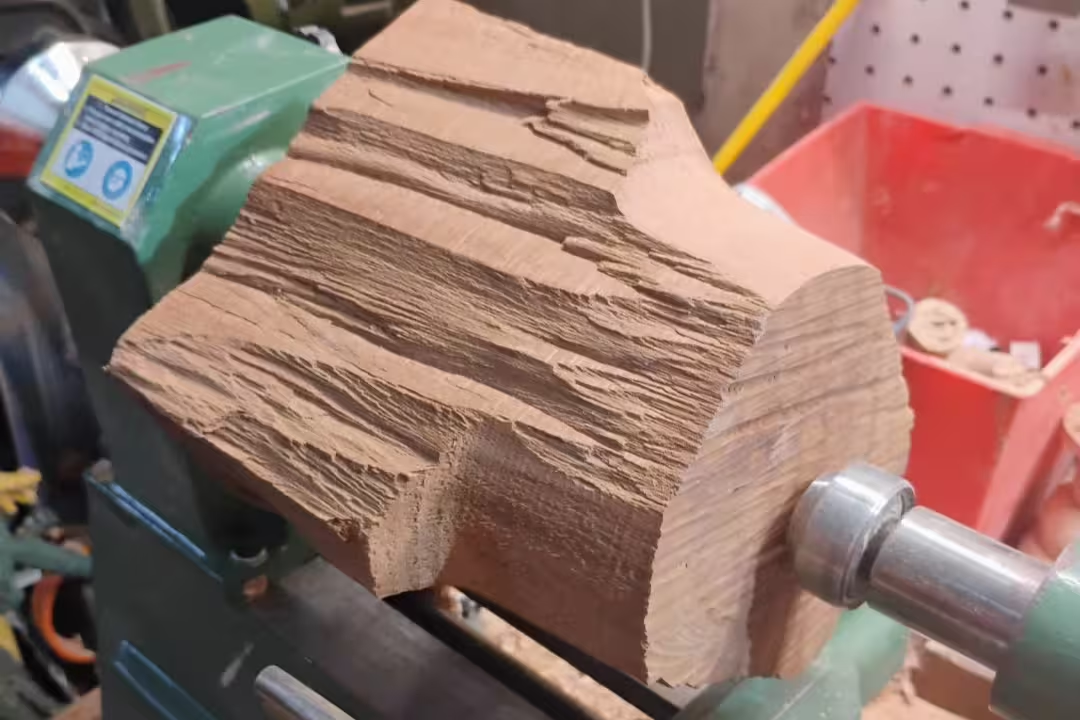
Madrone wood is a dense, fine-textured hardwood used for furniture, turnings, cabinetry, flooring, veneer, carving, and firewood. Its hardness is useful, but high shrinkage makes careful drying and moisture control far more significant than with easier commercial hardwoods.
Appearance, Engineering Properties, and Workability
Appearance and grain: Freshly milled wood ranges from pale tan and pink to salmon or light reddish brown, then often deepens under finish. The diffuse-porous grain can look straight and calm, while crotch, burl, and irregular sections produce swirling figure; compare these structures in this guide to wood grain patterns.
| Engineering property | Approximate reference value | Practical meaning |
|---|---|---|
| Average dried weight | 40 lb/ft³ or 640 kg/m³ | Dense boards and heavy firewood |
| Specific gravity | About 0.58 at 12% moisture | Moderately high density |
| Janka hardness | About 1,460 lbf | Good dent resistance |
| Modulus of rupture | About 10,400 psi | Bending strength of clear test pieces |
| Modulus of elasticity | About 1.2 million psi | Moderate stiffness |
| Crushing strength | About 6,500 psi | Resistance to compression parallel to grain |
| Radial shrinkage | About 5.5–6% | Movement across growth rings |
| Tangential shrinkage | About 12% | High movement along growth-ring tangents |
| Volumetric shrinkage | About 18% | Large total change from green to dry |
Published values describe clear test specimens under stated moisture conditions; an individual board with knots, slope of grain, checks, or reaction wood can behave differently. Figures align with the technical ranges compiled by The Wood Database Pacific madrone profile.
Hardness and workability: A Janka value near 1,460 lbf places madrone above many familiar domestic hardwoods in dent resistance. Sharp cutters leave a smooth, almost polished surface, but dull edges can burn the wood and irregular grain may tear near reversing fibers; the wood hardness scale adds comparison points.
Predrill for screws and nails because dense dry stock can split near board ends. Light cuts, clean abrasives, and removing dust between grits limit dark burn marks that become obvious under clear finish.
Drying, Durability, Uses, and Pricing
Drying and stability: Madrone’s large tangential shrinkage relative to radial shrinkage promotes cupping, twisting, checking, collapse, and internal honeycombing. Seal log and board ends soon after cutting, stack boards on aligned stickers, add top weight, and begin with a gentle drying schedule.
Practical notes from real-world use: A green turning blank cuts in long damp ribbons and can feel cool from released moisture, yet a thin bowl may distort overnight. Leave walls evenly thick, seal or bag the rough turning, and plan a second turning after moisture equalizes rather than forcing it to remain perfectly round.
A pinless meter can misread thick or irregular pieces, while pin readings change with temperature and species correction. Take several readings from freshly exposed interior wood, then let indoor stock acclimate before final milling and joinery.
Durability and storage: Madrone isn’t a preferred ground-contact wood and shouldn’t be treated like western red cedar or black locust wood. Store lumber dry, raised, stickered, and protected from rain while allowing airflow; wet sapwood can stain or decay quickly.
Furniture, turning, and carving: Properly seasoned boards suit tables, chairs, cabinets, drawer fronts, boxes, handles, bowls, and sculpture. Allow seasonal movement in wide panels and orient unstable figure where minor distortion won’t pull doors or joints out of alignment.
Flooring and veneer: Hardness supports flooring use, but installation moisture must match the building. Figured veneer spreads scarce burl or crotch material across a larger surface, while a balanced backing veneer reduces panel warp.
Madrone firewood performance: Dry madrone is dense, slow-burning, and capable of strong heat output. Green rounds hiss, steam at the ends, and spend firebox energy evaporating water; split pieces and test the freshly exposed face for a reading below roughly 20% moisture before burning.
Lumber availability and pricing: Madrone lumber appears mainly through Pacific Coast sawmills, urban salvage operations, specialty dealers, and turning suppliers. Price varies by moisture condition, thickness, width, surfacing, grade, figure, defects, salvage source, and shipping distance, so one national price would mislead buyers.
Board-foot price comparisons: One board foot equals 144 cubic inches. Calculate thickness in inches × width in inches × length in feet ÷ 12, then compare quotes only after confirming whether stock is green or kiln-dried, rough or surfaced, and priced before or after defect deductions.
| Quote detail | What to confirm | Why it changes value |
|---|---|---|
| Moisture condition | Green, air-dried, or kiln-dried | Drying loss and risk are included differently |
| Dimensions | Nominal or measured thickness and width | Surfacing removes saleable volume |
| Grade | Clear, character, turning, or figured | Checks and knots reduce usable yield |
| Quantity | Single board or volume purchase | Small specialty pieces often cost more per board foot |
| Delivery | Pickup, freight, or parcel shipment | Dense wood is costly to transport |
Cord size and pricing: A full stacked cord occupies 128 cubic feet, commonly arranged 4 × 4 × 8 feet. A face cord or rick has no complete volume without the piece length, so ask for stacked dimensions, species mix, moisture condition, delivery, stacking, taxes, location, and the date of the quote.
Further Reading
Readers studying Pacific madrone forestry can use a focused reference alongside regional flora, extension disease guides, and local regulations. Field references help connect bark, crown form, habitat, and seasonal fruit with what appears on a particular site.
Pacific Madrone Forestry Reference
This forestry reference offers further material on Pacific madrone characteristics, ecology, identification, and habitat.

Pacific Madrone Guide
- Focused reference on Pacific madrone characteristics
- Explores the ecology of this distinctive tree
- Useful for forestry and natural resource study
- Supports identification and habitat understanding
- A valuable resource for tree enthusiasts
 Buy on Amazon
FAQs
Are Madrone And Madrona The Same Tree?
Yes, madrone and madrona are common names for the same group of evergreen trees, especially Arbutus menziesii. Madrona is used more often in parts of the Pacific Northwest, while madrone is common in California and elsewhere. Regional naming varies, but both usually describe the tree with smooth reddish bark and twisting branches.
Why Does Madrone Bark Peel?
Madrone bark peels because the tree naturally sheds older outer bark as its trunk expands. The process reveals smooth new bark in shades of cinnamon, orange, and green, giving mature trees their distinctive appearance. Peeling is usually healthy, though sudden damage, dieback, or leaf loss may signal stress from drought, root disturbance, or disease.
Where Do Madrone Trees Grow?
Madrone trees grow naturally along the western coast of North America, from British Columbia through California. They favor mild climates, well-drained slopes, open woodlands, and rocky soils, often near oaks, pines, or Douglas firs. They can be difficult to transplant, so established native trees are generally best protected where they already grow.
Are Madrone Berries Edible?
Yes, madrone berries are edible, although their dry, gritty texture and mild flavor are not appealing to everyone. The small red-orange fruits can be eaten fresh in modest amounts or used in jams, drinks, and baked goods. Correctly identify the tree first, and avoid eating fruits exposed to pesticides or growing beside polluted roads.
Is Madrone Wood Good For Firewood?
Madrone wood is excellent firewood because it is dense, burns hot, and produces long-lasting coals when properly seasoned. Its high density makes it harder to split and slower to dry than many common woods. Let it season thoroughly in a dry, ventilated place, and use only legally obtained wood rather than cutting living or protected trees.
Affiliate Disclosure: Some links in this post are affiliate links. If you make a purchase through these links, we may earn a small commission at no extra cost to you. We only recommend products we genuinely believe in.