What Is the Hardest Wood in the World? A Definitive Guide

Australian buloke (Allocasuarina luehmannii) is generally considered the hardest wood in the world, with a widely published Janka rating of about 5,060 pounds-force, or 22.5 kilonewtons. That answer applies to natural wood measured for indentation resistance; it doesn’t mean buloke leads in strength, toughness, stiffness, or decay resistance.
Table of Contents
Australian Buloke: The Hardest Wood in the World
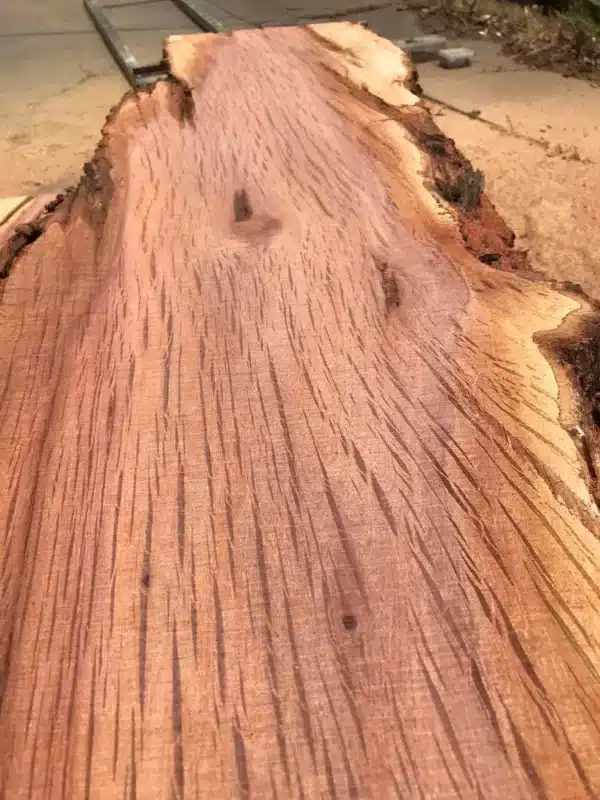
Quick answer: Australian buloke is the most widely cited answer to “what is the hardest wood in the world?” Its record rests on a representative Janka side-hardness value, not on one universal test covering every tree, grain direction, and moisture condition.
- Common name: Australian buloke, buloke, or bull oak
- Scientific name: Allocasuarina luehmannii
- Published Janka rating: about 5,060 lbf
- Metric equivalent: about 22,508 N, commonly rounded to 22.5 kN
- Native range: dry inland districts of eastern and southern Australia
- Record category: natural wood tested for indentation resistance
5,060 lbf Rating and Botanical Identity
The 5,060 lbf rating means a test machine needed roughly that much force to press a standard steel ball halfway into a prepared specimen. Converting with 1 lbf equal to about 4.448 N gives 22,508 N. Rounded figures are more honest because wood properties vary naturally.
Buloke belongs to the Casuarinaceae family, not the Fagaceae family that contains true oaks. “Bull oak” can mislead buyers, so invoices and species descriptions should show Allocasuarina luehmannii. The accepted botanical identity can be checked through the Kew Plants of the World Online database.
The species grows in dry Australian woodland, often under slow-growing conditions. The Atlas of Living Australia records occurrences across inland parts of eastern and southern Australia. A full identification, appearance, and workability profile is available in our Australian buloke guide.
Physical Characteristics, Uses, and Availability
Australian buloke is an exceptionally dense wood with a fine texture and brown to reddish-brown color. Darker lines and irregular grain may appear. A dry piece feels unusually heavy for its size, while tapping two pieces together produces a sharp, glassy click rather than the hollow note heard from light timber.
Its hardness comes from a compact cellular structure, thick cell walls, high density, and limited open pore space. Density alone doesn’t explain the complete result. Grain angle, extractives, latewood proportion, growth conditions, and specimen moisture also change how the steel ball meets resistance.
Traditional and small-scale uses include posts, tool handles, turned pieces, decorative objects, and compact wear components. Its record rating doesn’t make it a sensible mass-market floor. Usable boards are scarce, dimensions can be limited, and irregular grain raises drying and machining losses.
Beginners often buy a small blank and expect it to cut like oak. The first warning is usually a high-pitched saw note, followed by heat, dark burn marks, and a cutter that loses its clean edge. Sharp carbide, shallow cuts, pilot holes, and test pieces prevent much of that damage.
Key takeaways: Australian buloke is the leading published Janka answer, but 5,060 lbf is a representative value rather than a fixed value for every board. Its scarcity and difficult workability matter more to most projects than its record position.
What “Hardest Wood” Actually Means
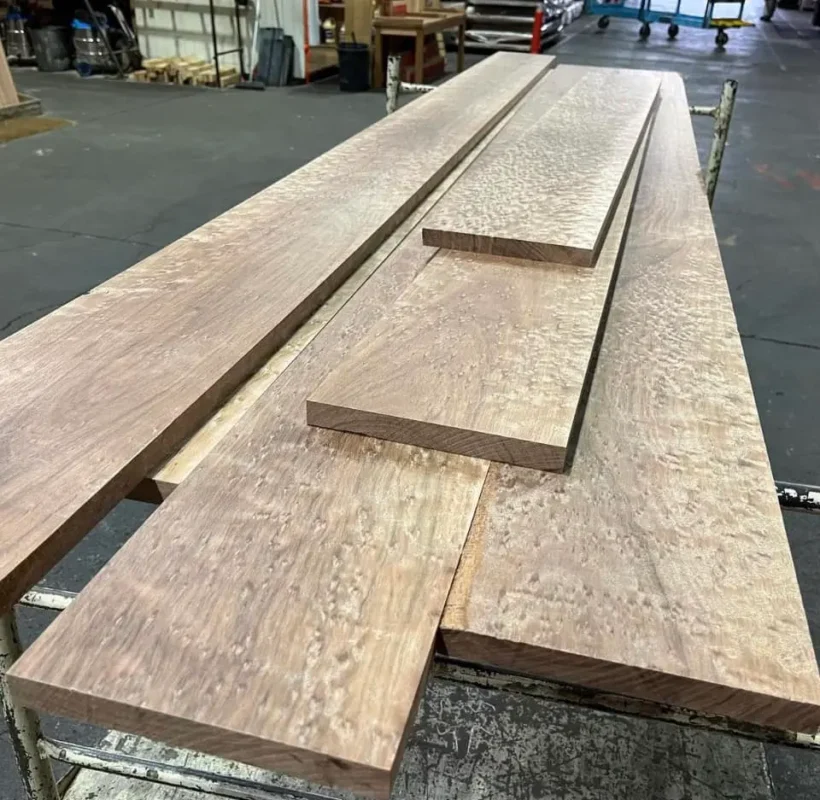
In wood science, hardness means resistance to localized indentation, denting, and wear. It doesn’t describe every mechanical property, so “hardest,” “strongest,” “densest,” and “most durable” shouldn’t be used as synonyms.
- Hardness predicts resistance to a concentrated surface load.
- Strength describes resistance to bending, crushing, tension, or shear failure.
- Stiffness describes resistance to elastic bending.
- Toughness measures how much impact energy wood absorbs before breaking.
- Density measures mass per unit volume.
- Natural durability concerns decay, insects, and other biological hazards.
Indentation Resistance Versus Strength
Indentation resistance matters when chair legs, shoe heels, dropped tools, or machine parts concentrate force on a small area. A high Janka value can reduce dents, yet the same board may check at an end, split beside a screw, or move enough to open a flooring gap.
Strength uses measurements such as modulus of rupture, compression parallel to grain, tension, and shear. Tool handles also need shock resistance and straight grain. That’s why hickory often performs better in handles than a harder but more brittle exotic species.
Stiffness is represented by modulus of elasticity. A stiff beam bends less under load, while a hard tabletop resists dents. The two properties often rise with density, but their rankings can differ. Our wood hardness scale explains how Janka figures fit into broader material selection.
Density, Toughness, Durability, Grain, and Moisture
Dense woods are often hard because more cell-wall material occupies a given volume. The relationship isn’t exact. Extractives, vessel size, fiber anatomy, grain direction, and moisture alter how a surface responds beneath an indenter.
Toughness becomes obvious during impact. A tough handle gives a controlled spring and absorbs a blow; a hard, brittle piece can feel dead and unforgiving before cracking without much warning. That difference rarely appears in a Janka chart.
Natural durability concerns fungal decay and, in some classifications, termites or marine borers. Hard wood can still decay outdoors. Open joints, trapped water, end-grain exposure, and unsuitable sapwood can defeat an impressive surface-hardness rating.
Moisture softens wood, especially as moisture rises below the fiber-saturation region. Grain direction also matters because wood is anisotropic. A radial face, tangential face, and end-grain surface don’t resist the ball in exactly the same way.
| Property | What it measures | Typical metric | Does buloke automatically lead? |
|---|---|---|---|
| Hardness | Resistance to indentation | Janka load | Commonly cited leader |
| Density | Mass per volume | kg/m³ or lb/ft³ | No |
| Strength | Resistance to failure | MOR, compression, tension | Not shown by Janka |
| Stiffness | Resistance to elastic bending | MOE | Not shown by Janka |
| Toughness | Energy absorbed before fracture | Impact testing | Not shown by Janka |
| Durability | Resistance to biological deterioration | Durability class or field test | Not shown by Janka |
Key takeaways: Janka hardness predicts dent resistance, not total quality. Match strength, stiffness, toughness, movement, and biological durability to the load and exposure before choosing a species.
How the Janka Hardness Test Works
The Janka hardness test records the force needed to press an 11.28 mm steel ball into wood until half the ball’s diameter is embedded. Most popular rankings report side hardness, but specimen orientation and moisture need to match before two figures can be treated as comparable.

Test Principle, Ball Penetration, and Force Units
The steel ball has a diameter of about 0.444 inches, or 11.28 mm. Half-depth penetration is about 0.222 inches, or 5.64 mm. At that depth, the projected indentation is close to 100 mm², which supports repeatable measurement.
A testing machine applies load at a controlled rate while the specimen rests in a defined position. The operator records the force at half penetration. In U.S. references, results commonly appear in pounds-force; metric sources use newtons or kilonewtons.
A Janka value isn’t pounds per square inch. It’s normally reported as a load or force. Calling 5,060 lbf “5,060 psi” changes the physical meaning and is one of the most common errors in wood-hardness articles.
Use 1 lbf ≈ 4.448 N for conversion. Australian buloke’s common value converts as 5,060 × 4.448 ≈ 22,508 N. Reporting 22.5 kN avoids false precision.
Grain, Moisture, Standards, History, and Limitations
Side hardness tests a radial or tangential face with force applied perpendicular to the grain. End hardness applies force parallel to the grain. The values may differ substantially, yet many online charts don’t identify which orientation they use.
Conditioning matters because moisture changes cell-wall behavior. A green sample, an oven-dry sample, and one conditioned near 12% moisture aren’t interchangeable. The USDA Wood Handbook explains the broader effects of moisture and grain direction on wood properties.
ASTM D143 covers mechanical testing of small clear timber specimens. ISO 13061-12 addresses static hardness testing. Their procedures help control sample preparation, loading, and reporting, but figures copied from unrelated datasets may still lack method consistency.
Gabriel Janka developed the method in the early twentieth century by adapting indentation principles for wood. Later standards formalized specimen and loading practices. Older rankings can differ because botanical names, moisture states, equipment, and sample pools changed.
Wood remains biologically variable. Juvenile wood, reaction wood, knots, mineral deposits, grain slope, growth rate, and extraction history can shift results. A published rating is best read as a representative benchmark, not a guaranteed value for a purchased board.
Key takeaways: The Janka test uses an 11.28 mm ball pressed to half its diameter. Compare figures only after checking units, face orientation, moisture condition, botanical identity, and test method.
Alternative Wood Hardness Tests
Janka isn’t the only wood hardness test. Brinell, Monnin, and flooring-specific methods use different indenters, loads, calculations, or specimen rules, so their numerical results can’t be inserted directly into a Janka ranking.
Brinell, Monnin, and EN 1534
The Brinell method presses a hardened ball into a surface and calculates hardness from the load and indentation geometry. Wood applications may use different ball diameters, loads, and formulas from metal testing. A Brinell number isn’t a converted Janka force.
Monnin, also called Chalais-Meudon hardness, uses another indentation arrangement and has appeared in French and European wood data. Its scale may support comparisons within one dataset, but cross-scale conversion lacks the reliability needed for a world ranking.
EN 1534 measures resistance to indentation for wood flooring using a Brinell-style approach. It addresses finished-use products rather than duplicating the small-clear-specimen Janka method. Coatings, layered construction, and product thickness can affect how a flooring sample responds.
Flooring Methods and Noncomparable Ratings
A flooring product may contain a thin wear layer over plywood, compressed fiber, resin, or bamboo strands. Testing the assembled product answers a useful question about finished-floor indentation, but it doesn’t reveal the natural hardness of one botanical species.
| Method | Basic approach | Typical use | Directly comparable with Janka? |
|---|---|---|---|
| Janka | Ball pressed to half its diameter | Natural wood comparison | Only with matching Janka conditions |
| Brinell | Hardness calculated from indentation | Wood products and metals | No |
| Monnin | Loaded indentation under a separate method | European species data | No |
| EN 1534 | Brinell-style flooring indentation | Wood flooring products | No |
| Rockwell or Vickers | Depth or geometric indentation measurement | Metals and hard materials | No |
Beginners sometimes build a ranking from the largest number visible in each scale. That fails because the units and test geometry differ. The expert workaround is to keep separate comparison groups and state the standard beside every result.
Key takeaways: Brinell, Monnin, EN 1534, Rockwell, and Janka values aren’t interchangeable. Rank wood only within a shared method and closely matched specimen conditions.
Hardest Woods Ranked by Janka Hardness
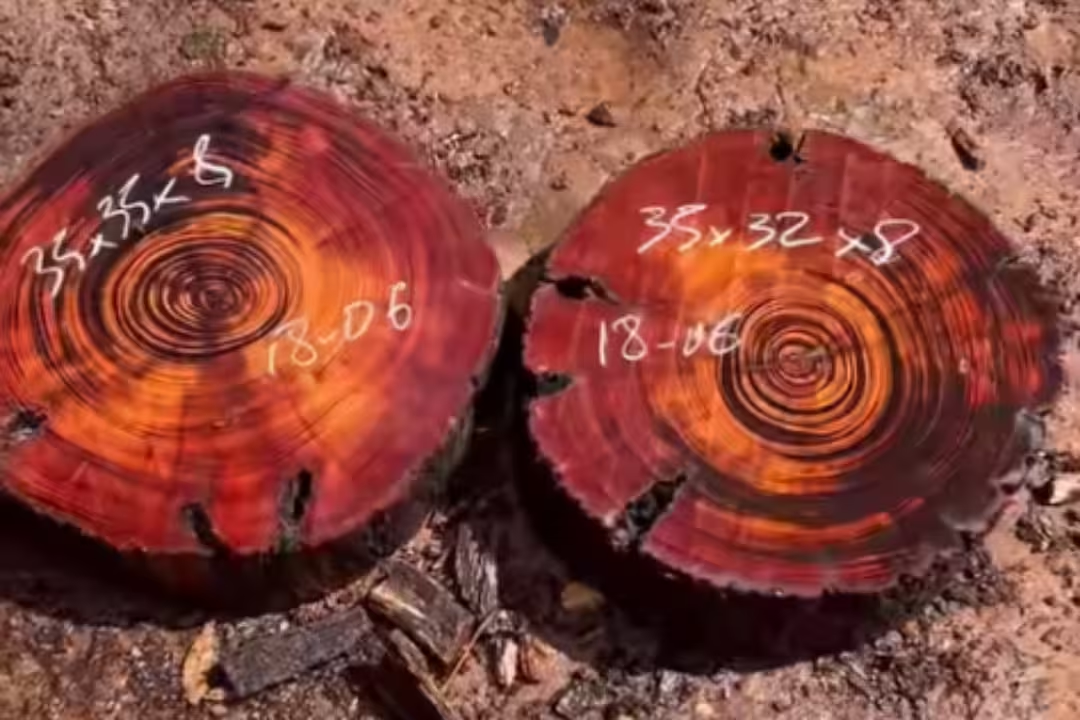
The five hardest woods in many published Janka comparisons are Australian buloke, quebracho, lignum vitae, snakewood, and African blackwood. Exact positions below buloke can change with species identification and source methodology, so the table presents an approximate comparison set rather than an immutable league table.
Top Five Hardest Woods and Exotic Benchmarks
Quebracho
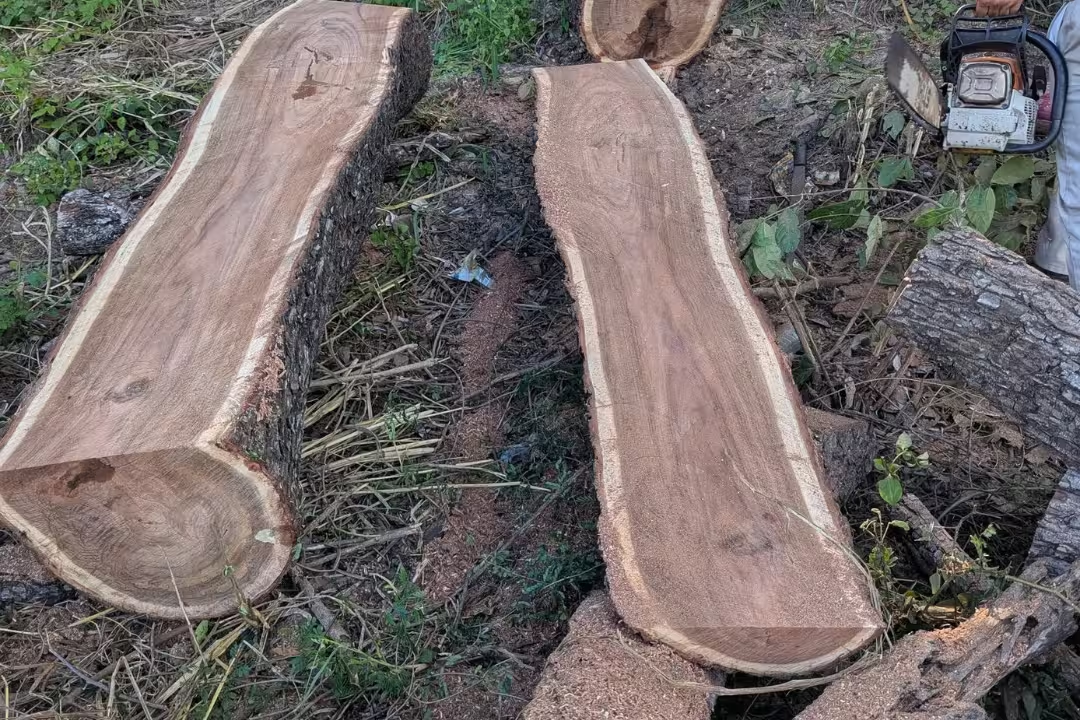
Quebracho often refers to Schinopsis species, including Schinopsis balansae and Schinopsis brasiliensis. The name’s association with “axe-breaker” reflects its reputation, but species verification matters. See our quebracho profile for the botanical distinctions.
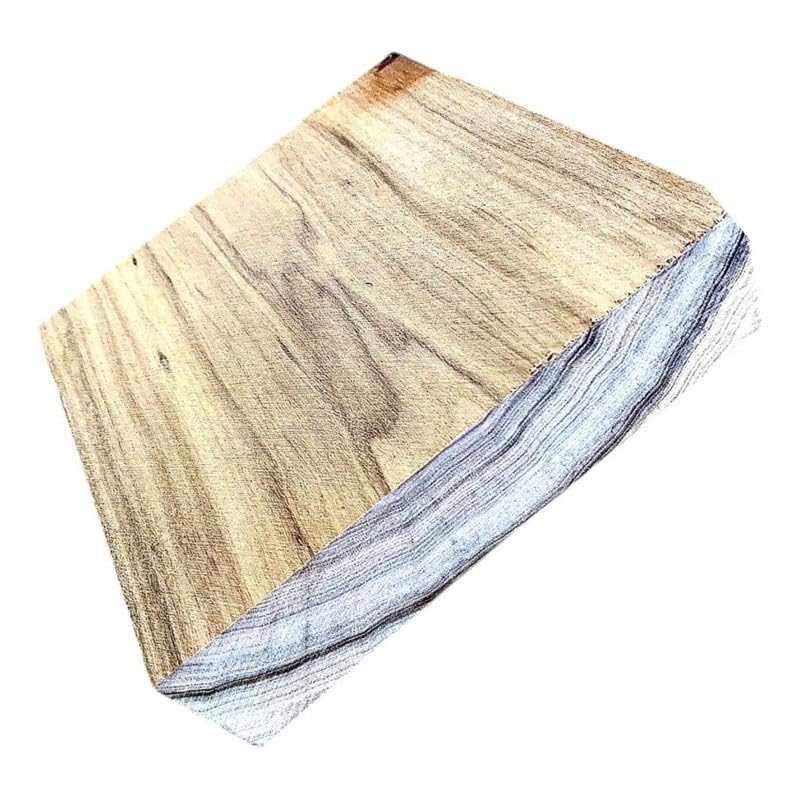
Kiln-Dried Red Quebracho Turning Blank (8×8×2 in)
- Kiln-dried Red Quebracho platter blank
- S4S surfaced on four sides for easier setup
- Approx. 8 in × 8 in × 2 in size for platter or bowl turning
- Very dense and hard wood for durable finished pieces
- Red Quebracho (Schinopsis spp.) with South American origin
 Buy on Amazon
Genuine lignum vitae
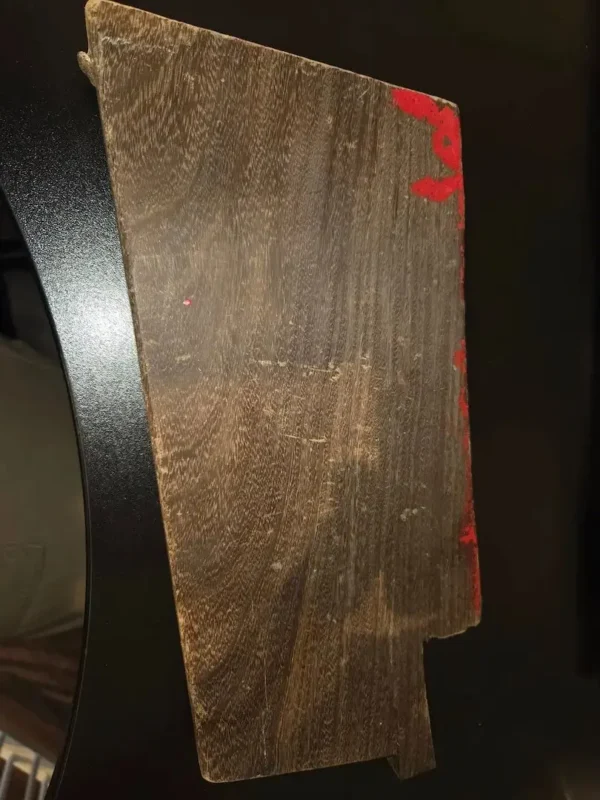
Genuine lignum vitae refers to Guaiacum officinale and Guaiacum sanctum. Its oils, density, and wear behavior made it famous for bearings and sheaves. Our lignum vitae guide covers its mechanical uses and trade controls.
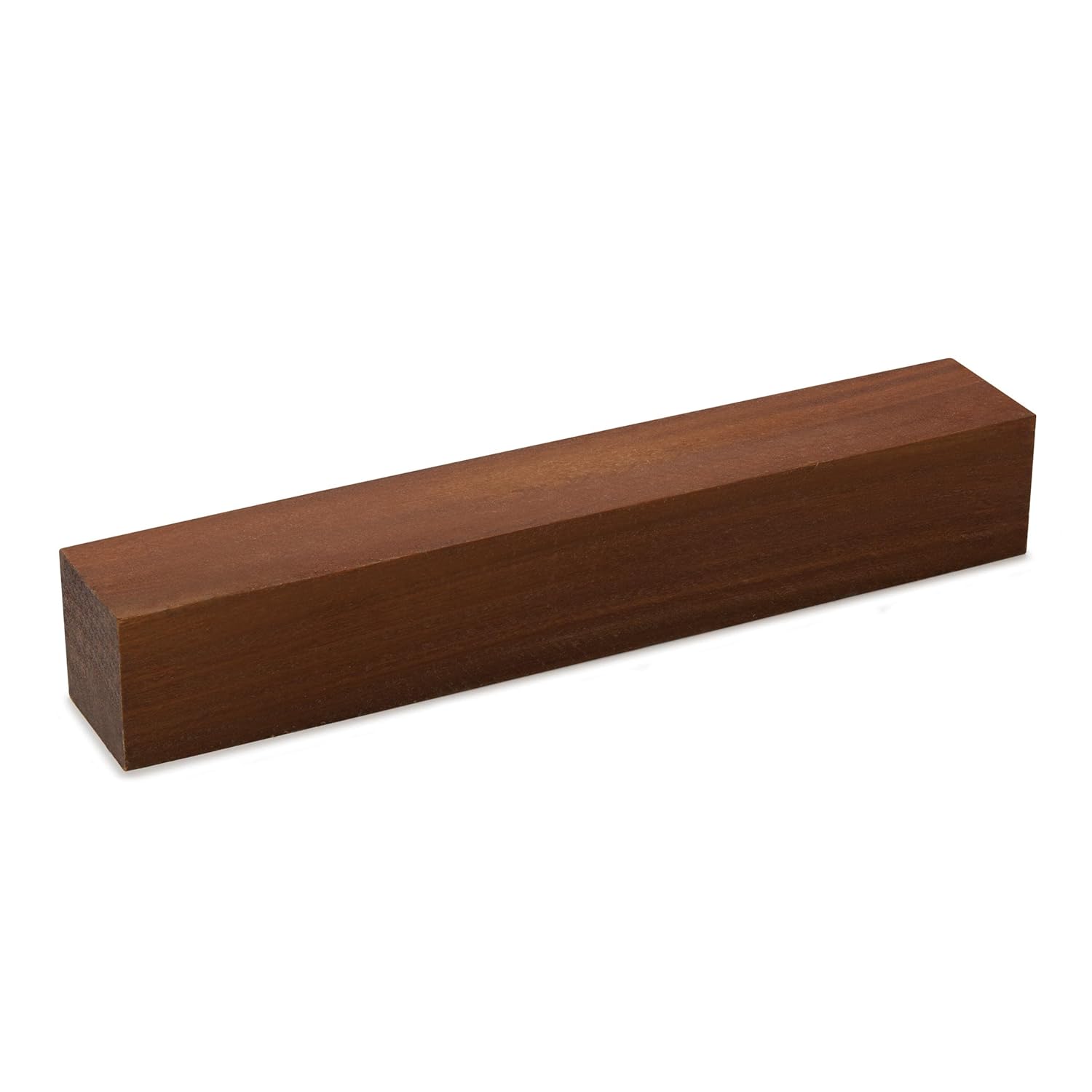
Woodcraft Lignum Vitae Turning Blank (2x2x12)
- Genuine Lignum Vitae (Guaiacum officinale) hardwood
- One solid piece sized 2 x 2 x 12 inches for turning and carving
- Known as one of the hardest and heaviest woods for durable parts
- Fine texture with interlocked grain and a naturally oily feel
- Polishes to a great finish and resists insect attack for long-lasting projects
Buy on Amazon
Snakewood
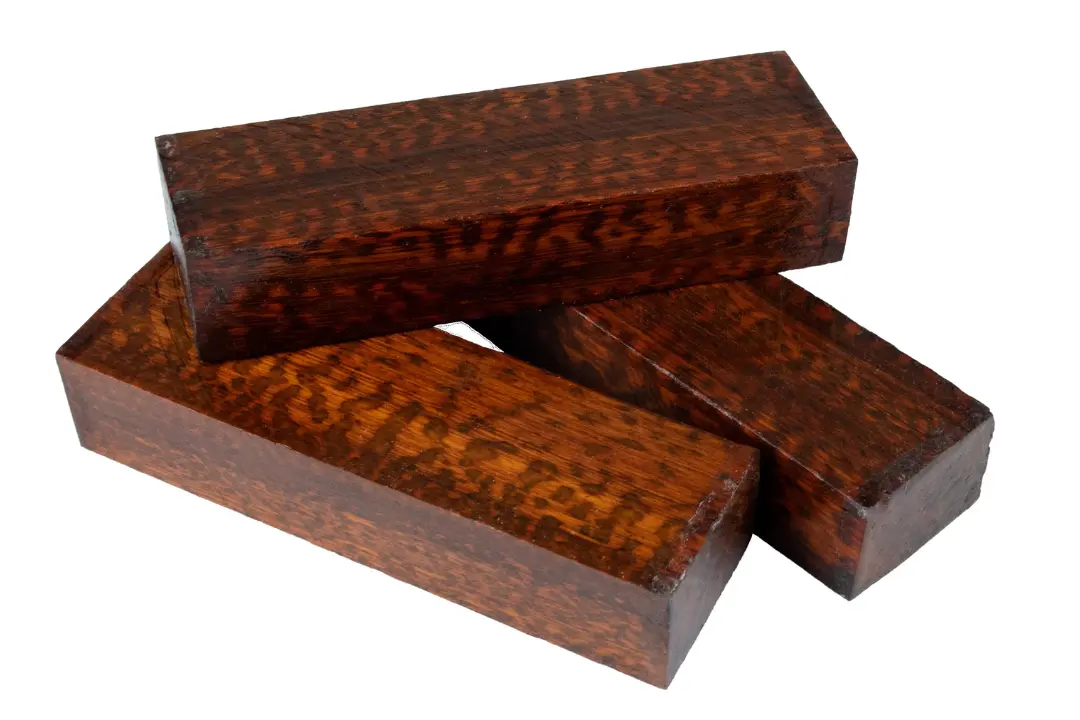
Snakewood, Brosimum guianense, combines high hardness with dramatic markings. It can check with a dry, sharp tick that appears after machining rather than during the cut. Read the snakewood profile before buying unsealed blanks.

Snakewood Pen Blank 3/4 x 3/4 x 5 (1 Pc)
- Striking snakeskin-like black markings for a premium look
- Tight grain and rich reddish/orange tones
- Machines and turns well for pen blanks and small projects
- Polishes to a smooth, high-gloss finish
- Natural wood—each piece varies and size may differ slightly
Buy on Amazon
African blackwood
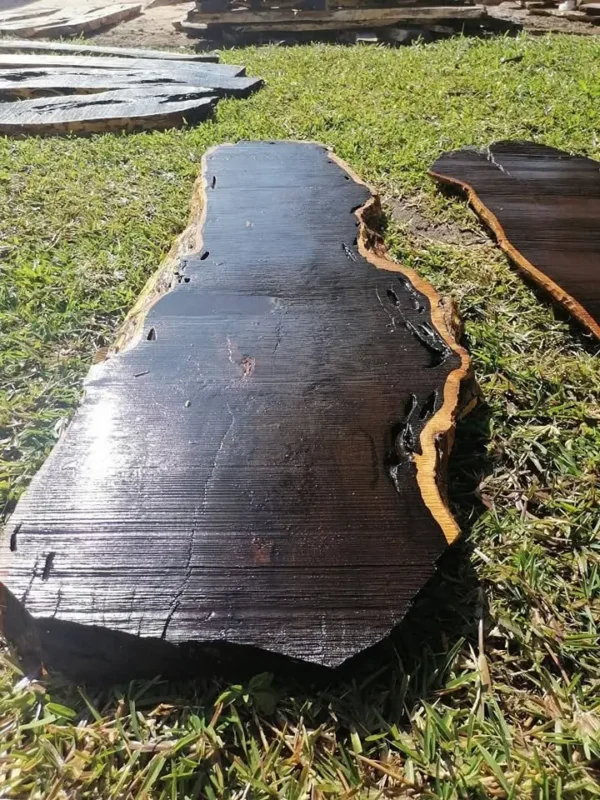
African blackwood, Dalbergia melanoxylon, is dense, fine-textured, and valued for musical instruments. Ipe and cumaru are more common in exterior construction, while ebony carries greater public recognition. None consistently exceeds the common buloke figure in Janka side hardness.

Oedema Black Ebony Knife Scale Blanks (2-Pack)
- Black ebony wood with high hardness and fine texture
- Sized about 4.72 x 1.57 x 0.39 inches per piece
- Bold natural grain for a premium look
- Unfinished blanks—easy to DIY, carve, stain, or paint
- Great for knife handles, woodworking projects, boxes, and crafts
Buy on Amazon
| Wood | Scientific identification | Approximate Janka lbf | Approximate kN | Buloke comparison |
|---|---|---|---|---|
| Australian buloke | Allocasuarina luehmannii | 5,060 | 22.5 | 100% |
| Quebracho | Schinopsis spp. | 4,570 | 20.3 | 90% |
| Genuine lignum vitae | Guaiacum spp. | 4,390 | 19.5 | 87% |
| Snakewood | Brosimum guianense | 3,800 | 16.9 | 75% |
| African blackwood | Dalbergia melanoxylon | 3,670 | 16.3 | 73% |
| Ipe | Handroanthus spp. | 3,510 | 15.6 | 69% |
| Cumaru | Dipteryx odorata | 3,330 | 14.8 | 66% |
| Gaboon ebony | Diospyros crassiflora | 3,080 | 13.7 | 61% |
Familiar Woods, Balsa, and Ranking Methodology
Oak, maple, hickory, and acacia provide more useful reference points for most buyers. Acacia is a broad commercial label covering many species, so an “acacia wood hardness scale” value without a scientific name has limited meaning.
Australian buloke is about 3.9 times harder than northern red oak at 1,290 lbf, 3.5 times harder than hard maple at 1,450 lbf, and 2.7 times harder than shagbark hickory at 1,880 lbf. Compared with 70-lbf balsa, it is over 70 times harder.
| Familiar wood | Scientific name | Approximate Janka lbf | Buloke is about |
|---|---|---|---|
| Shagbark hickory | Carya ovata | 1,880 | 2.7 times harder |
| Hard maple | Acer saccharum | 1,450 | 3.5 times harder |
| White oak | Quercus alba | 1,360 | 3.7 times harder |
| Northern red oak | Quercus rubra | 1,290 | 3.9 times harder |
| Balsa | Ochroma pyramidale | 70 | Over 70 times harder |
A responsible ranking uses the same method, side-grain orientation, similar moisture conditioning, and accepted scientific names. When those details are missing, round the values and label them approximate. A long decimal can create false certainty rather than accuracy.
For species-level details, compare our guides to African blackwood, ipe wood, cumaru wood, and ebony wood. Each has different movement, workability, supply, and legal considerations beyond its headline rating.
Key takeaways: Buloke leads the most commonly published natural-wood Janka list. Quebracho and lignum vitae follow closely, while familiar oak and maple are far easier to source and machine.
Why Hardest-Wood Rankings Disagree
Hardest-wood rankings disagree because sources mix historical reputation, trade availability, botanical names, specimen conditions, and test methods. Once those categories are separated, most apparent contradictions disappear.
Historical, Commercial, and Botanical Answers
Lignum vitae was the traditional answer because it was commercially significant and offered a rare package of hardness, density, natural oil, and wear resistance. Buloke had far less international trade visibility. Older books often described the best-known extreme wood, not every obscure species tested later.
Quebracho can mean several Schinopsis species. Lignum vitae may mean genuine Guaiacum or verawood from Bulnesia. “Ironwood” applies to unrelated trees across several continents. A ranking based only on common names can compare different organisms without showing the substitution.
Commercial availability creates another answer. A merchant may call one species the hardest wood it regularly stocks. That claim can be accurate within its catalog yet wrong as a global record. “Hardest obtainable board” and “hardest recorded natural wood” are different questions.
Specimen Variability and Category Boundaries
Two trees of one species can produce different results. Site, age, growth stress, heartwood proportion, grain, defects, and moisture all matter. Small datasets make a maximum observation look more definitive than it is. The practical answer should use a representative species value, not the hardest isolated sample.
Natural wood rankings should exclude densified timber, resin-impregnated products, laminates, wood-plastic composites, and petrified wood. Bamboo belongs to the grass family. Strand-woven bamboo may resist dents well, but manufacturing pressure and resin content contribute to the finished result.
Petrified wood is mineralized material. Densified “super wood” has had its anatomy and chemistry altered. Both may outperform natural timber under selected tests, but placing them beside unmodified buloke without category labels produces a misleading comparison.
- Hardest widely cited natural wood: Australian buloke
- Historically famous extreme wood: genuine lignum vitae
- Industrial “axe-breaker” answer: quebracho
- Hardest readily stocked wood: varies by country and merchant
- Hardest flooring product: depends on construction and test standard
- Hardest modified wood: separate manufactured-material category
Key takeaways: Rankings disagree when they answer different questions. Ask whether the claim concerns natural wood, commercial stock, one botanical species, a flooring product, or a modified material.
Hardest North American and Domestic Woods
Among widely available North American hardwoods, shagbark hickory is a leading hardness choice at about 1,880 lbf. Black locust and osage orange are also very hard, while exact regional winners depend on whether the scope includes rare species, shrubs, imported plantation trees, or commercially obtainable boards.
Hickory, Black Locust, and Osage Orange
Shagbark hickory, Carya ovata, combines hardness with excellent impact performance. That property package explains its long use in handles and sporting goods. Its grain can feel stringy under a dull plane, yet a sharp edge leaves a clean, reflective shaving.
Our hickory wood guide covers the genus, while shellbark, pignut, and other hickories have different representative values. Buyers should avoid treating “hickory” as one mechanically identical product.
Black locust, Robinia pseudoacacia, offers high hardness and strong natural decay resistance, making it useful for exterior work. Availability often comes through regional sawmills rather than national retail chains. Learn more in the black locust wood profile.
Osage orange, Maclura pomifera, is very hard, elastic, and durable. Fresh heartwood can show a striking yellow-orange color that darkens with light. Its small logs, crooked growth, and checking can limit board yield. Our osage orange guide explains those trade-offs.
Hard Maple, White Oak, and Regional Availability
Hard maple, Acer saccharum, averages about 1,450 lbf and provides a pale, close-grained surface for floors, worktops, and butcher-block-style components. White oak, Quercus alba, sits near 1,360 lbf and adds useful moisture resistance from its blocked vessels and tyloses.
| North American wood | Approximate Janka lbf | Useful traits | Common constraint |
|---|---|---|---|
| Shagbark hickory | 1,880 | Hardness and impact toughness | Color variation and difficult machining |
| Black locust | 1,700 | Hard, decay resistant, exterior capable | Irregular regional supply |
| Osage orange | 2,040 | Hard, elastic, naturally durable | Small and crooked logs |
| Hard maple | 1,450 | Fine surface and broad availability | Can burn during routing |
| White oak | 1,360 | Stable use history and moisture resistance | Hardness is moderate, not record-setting |
Regional supply often matters more than a small rating difference. Locally sawn stock reduces freight, makes replacement boards easier to obtain, and lets buyers inspect drying quality. A straight, properly dried domestic board often outperforms a rare unstable exotic in service.
Key takeaways: Osage orange can post a higher representative Janka figure than hickory, but hickory is the more familiar commercial answer. Black locust offers a valuable hardness-and-durability combination for exterior work.
Working With Extremely Hard Wood
Extremely hard wood needs sharp carbide tooling, controlled feed, pilot holes, fresh bonding surfaces, and effective dust collection. Most workshop failures come from heat, inadequate pre-drilling, burnished glue faces, hidden grain changes, or treating density as if it prevents splitting.
Cutting, Drilling, Gluing, and Finishing
Use a clean carbide blade with enough tooth clearance to remove chips. A very slow feed can be worse than a controlled, steady feed because the teeth rub rather than cut. The signs are a hot resinous smell, dark stripes, fine smoke, and a polished cut face.
Take shallow router passes and avoid trapping the cutter in a deep profile. Keep the work supported near the cut. Interlocked grain can still tear out, so climb-cut only where the machine, cutter, workholding, and operator control make that technique safe.
Pre-drill every screw hole. For very dense stock, start near the fastener’s root diameter and confirm the fit on scrap. Add a clearance hole through the top member and maintain edge distance. Wax or approved fastener lubricant can reduce driving torque, but it can also affect nearby finish or glue.
Dense wood can polish the sides of a drill hole and trap heat. Withdraw the bit often to clear chips. If the chips turn dark or the bit squeals, stop and let it cool. A snapped screw buried below the surface creates far more work than a slightly larger pilot hole.
Glue fresh, flat surfaces rather than faces glazed by sanding or a hot cutter. Remove dust and follow the adhesive maker’s guidance for oily woods. Don’t wipe every exotic wood with solvent by habit; solvent can pull extractives across the face and create a weaker boundary layer.
Use fresh abrasives and progress through the grit sequence without large jumps. Heavy pressure generates heat and glazing. On very dark wood, leftover coarse scratches appear as pale arcs under side lighting. A low-angle lamp exposes them before the finish makes them obvious.
Failure Prevention: Practical Notes From Real-World Use
The most common mistake is feeding dense stock too slowly because it feels safer. Friction rises, edges burn, and glue surfaces become polished. What works better is a sharp cutter, a firm but controlled feed, and several shallow passes. The cut should produce defined chips, not hot powder.
A second failure appears after assembly. A pilot hole that worked in oak may still be too small in buloke, ipe, or lignum vitae. The screw can twist off or split the board with a sudden crack. Test the complete fastening sequence on an offcut from the same board.
Snakewood introduces a less obvious problem: delayed checking. A blank may leave the lathe smooth, then develop a hairline crack as internal stress redistributes. Keep unused ends sealed, avoid aggressive heat, and pause between rough and final turning when the stock’s moisture history is uncertain.
Dust from many exotic woods can irritate skin, eyes, and airways or trigger sensitization. Use source extraction, sealed eye protection where needed, and a suitable respirator. The OSHA wood-dust guidance outlines exposure hazards and control methods.
| Failure | Likely cause | Practical fix |
|---|---|---|
| Dark saw marks | Dull teeth or rubbing feed rate | Clean or replace blade; use a steady feed |
| Split beside screw | Pilot hole too small or edge too close | Test pilot diameter and increase edge distance |
| Broken screw | Excessive torque | Use clearance hole, suitable pilot, and controlled driver setting |
| Glue failure | Burnished, oily, dusty, or poorly fitted face | Prepare fresh surfaces and make a sample joint |
| Tear-out | Interlocked grain | Use sharp cutters, light passes, and backing support |
| Sanding glaze | Worn abrasive and excess pressure | Change abrasive and reduce heat |
| Delayed checking | Moisture gradient or released stress | Seal ends and use staged machining |
Key takeaways: Extreme hardness magnifies small setup errors. Test cuts, pilot holes, glue bonds, and finishes on matching scrap before committing a rare board.
Hard Woods for Flooring and Decking
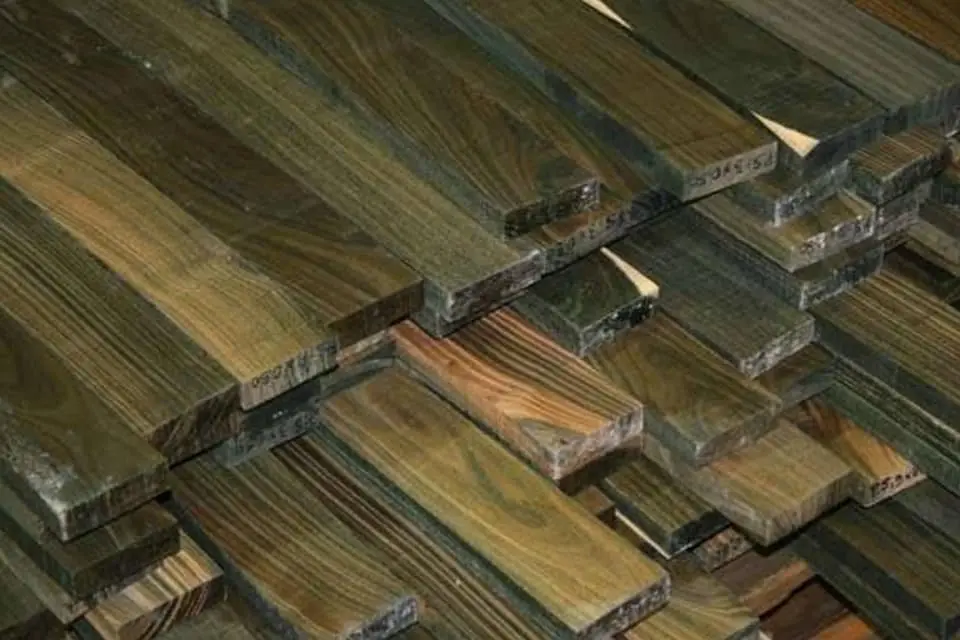
The hardest wood isn’t automatically the best wood for flooring or decking. Dent resistance is one factor; dimensional stability, moisture control, decay resistance, fasteners, finish, repairability, board supply, and installation cost often decide long-term performance.
Flooring, Decking, and Furniture
For flooring, a high Janka score can reduce heel dents and furniture impressions. It won’t stop scratches from grit, finish wear, seasonal gaps, or cupping. Wide boards amplify movement, and a leaking appliance defeats even very hard flooring.
Measure subfloor and board moisture before installation. Acclimation is a measurement process, not a fixed waiting period. Wood can sit in a room for weeks and remain too wet if it’s stacked tightly or the building hasn’t reached its normal humidity range.
Decking needs natural durability, movement control, suitable fastening, and safe surface behavior. Ipe and cumaru are commercially relevant because they combine high hardness with exterior performance, yet both demand pre-drilling and documented sourcing. Australian buloke has no comparable supply system for large decks.
Furniture makers often gain more from stable, workable wood than from a record Janka figure. Joint accuracy, glue reliability, color matching, and future repair matter. Hard maple, oak, walnut, or jatoba may provide a better balance than a scarce species that damages cutters and resists fine adjustment.
Tool Handles, Bearings, and Application Matrix
Tool handles need continuous grain, impact toughness, and controlled flexibility. Hickory remains a strong choice because it absorbs shock rather than simply resisting dents. A hard but brittle handle may transmit a harsh sting into the hand and fail near the head or shoulder.
Lignum vitae became a bearing material because its natural oils support low-friction service while its density and hardness resist wear. That history shows why engineers choose a property package, not the highest number in one column.
| Application | High-priority properties | Practical candidates | Main mistake |
|---|---|---|---|
| Residential flooring | Dent resistance, stability, repairability | Hard maple, oak, hickory, jatoba | Ignoring moisture movement |
| Exterior decking | Decay resistance, movement, fastening | Ipe, cumaru, black locust | Choosing by Janka alone |
| Furniture | Stability, joinery, finish response | Maple, oak, walnut, jatoba | Buying wood too hard to machine accurately |
| Tool handles | Toughness, grain continuity, shock absorption | Hickory | Confusing hardness with toughness |
| Mechanical bearings | Wear resistance, lubrication, compression | Documented lignum vitae | Ignoring species controls and substitutes |
| Small turned objects | Fine texture, polish, visual figure | Snakewood, African blackwood, buloke | Ignoring checks and tool wear |
Key takeaways: Select flooring and decking by service conditions, not record hardness. Stable installation, moisture control, legal supply, and repair access can outweigh a large Janka difference.
Availability, Pricing, and Responsible Exotic-Wood Sourcing
Australian buloke has irregular specialist supply, so it lacks a dependable global commodity price. Buyers should compare scientific identity, origin, dimensions, moisture, defects, certification, trade documents, freight, and expected machining loss rather than looking for one universal price per kilogram or board foot.
Pricing, Identity, and Chain of Custody
A small turning blank and a full rough board have very different unit economics. Scarce pieces may be sold individually, while freight can exceed the stock value. Checks, sapwood, short lengths, metal contamination, and drying loss change the amount of usable wood purchased.
African blackwood price per kilogram in India, for example, can’t be interpreted without form, grade, dimensions, moisture, origin, tax, shipping basis, and legal documentation. Instrument billets, logs, pen blanks, and sawn lumber aren’t interchangeable products. A low quote can signal poor identification or paperwork.
Ask suppliers to place the scientific name on the invoice. Trade names such as ironwood, ebony, quebracho, and lignum vitae can cover multiple species. Photos alone rarely prove identity because lighting, oxidation, finish, and end-grain preparation alter the visible appearance.
FSC certification can support responsible forest management and chain-of-custody verification. Buyers can check certificate details through the FSC certificate search. Certification doesn’t replace botanical identification or import documentation.
CITES, Guaiacum, Ipe, and Local Substitutes
Genuine lignum vitae in the genus Guaiacum is listed in CITES Appendix II. International shipments may need permits or certificates based on transaction type and national rules. Check the CITES Appendices at the purchase date because listings and annotations can change.
Ipe-related genera Handroanthus, Roseodendron, and Tabebuia entered Appendix II trade controls in late 2024. Importers need to confirm the listing annotation, shipment date, national implementation, and required documents. A generic “tropical hardwood” declaration may be insufficient.
Keep invoices, botanical names, harvest country, certification references, permits, and shipping records together. A chain-of-custody gap can delay a shipment or lead to seizure. Documentation should be reviewed before payment, not after the wood reaches a border inspection.
Local substitutes often reduce risk and total cost. Hickory can replace rare hard wood in handles, black locust can serve many exterior uses, and hard maple makes durable interior surfaces. Substitution works best when based on the required property mix, not color alone.
- Request the accepted scientific name.
- Record country of harvest and export.
- Confirm moisture, grade, dimensions, and defect allowance.
- Check FSC or equivalent claims in the issuing database.
- Verify CITES status at the transaction date.
- Retain permits, invoices, and chain-of-custody documents.
- Calculate freight, wastage, tool wear, and replacement supply.
- Reject vague offers for protected or unidentified timber.
Key takeaways: Scarcity makes buloke pricing quote-based and highly dependent on form and provenance. Scientific names, verified documents, and local substitutes protect both the buyer and the resource.
Myths and Common Hardness Mistakes

The most common hardness mistakes are claiming wood is harder than steel, equating hardness with strength, treating the hardest species as the best flooring, and presenting one Janka number as an exact constant. Each claim removes the test context needed for a valid comparison.
Steel, Strength, Flooring, and Ebony Myths
Myth: buloke is harder than steel. Janka force can’t be compared directly with Rockwell, Brinell, or Vickers metal hardness. Steel and wood have different structures, units, test geometries, moisture responses, and failure modes.
Myth: hardest means strongest. Hardness measures indentation resistance. Strength covers failure in bending, compression, tension, or shear. Toughness and stiffness add two more independent questions.
Myth: hardest means best flooring. A very hard board can still cup, gap, split during installation, show surface scratches, or become impossible to replace. Stable moisture conditions and correct installation often produce a better floor than chasing the highest Janka rating.
Myth: ebony is the hardest wood. Gaboon ebony is hard and dense, but its commonly published rating near 3,080 lbf sits below buloke, quebracho, lignum vitae, snakewood, African blackwood, and several other woods.
Ironwood, Bamboo, and Exact-Rating Myths
Myth: ironwood is one species. The name applies to unrelated trees, including desert ironwood, hornbeam, Australian ironbarks, and others. A valid claim needs a scientific name. Our ironwood guide explains the naming problem.
Myth: bamboo is the hardest wood. Bamboo is a grass. Strand-woven flooring can post high indentation results because strands, pressure, heat, and resin create a manufactured composite. Product results need the test standard and construction details.
Myth: Janka ratings are exact. A board isn’t a uniform industrial material. Moisture, grain, growth site, heartwood proportion, anatomy, and test setup create variation. Use rounded representative values and retain source notes.
The correct question isn’t simply “Which wood has the largest number?” It’s “Which measured property solves the actual service problem?”
Material-selection principle
Key takeaways: Hardness claims become misleading when they omit species identity, test method, orientation, moisture, or product category. Janka values support selection; they don’t replace it.
Future of Ultra-Hard Wood Materials

The future of ultra-hard wood materials lies in densification, modification, better species verification, digital traceability, and performance-based selection. Modified products may exceed natural species in selected tests, but they need separate labels and comparable methods.
Densified Wood and Modified Timber
Densified wood may use compression, partial lignin removal, heat, or resin impregnation to reduce void space and alter cell-wall behavior. The finished material can gain hardness and strength, but processing may introduce spring-back, thickness limits, resin dependence, or different moisture behavior.
Thermal and chemical modification can improve selected properties such as decay resistance or dimensional stability. Some treatments reduce toughness or change bonding performance. A product should be specified by tested service properties rather than a broad claim that it is better than natural wood.
Natural and modified materials shouldn’t share one ranking without method controls. A thin treated surface, compressed panel, and solid buloke specimen distribute load differently. Report substrate, thickness, density profile, conditioning, indenter, and loading procedure beside the test result.
Verification, Traceability, and Sustainable Material Design
Botanical verification is improving through end-grain imaging, machine learning, portable spectroscopy, anatomical databases, and DNA methods. These tools can help separate look-alike woods, though reference libraries and sample preparation still affect identification accuracy.
Digital traceability can connect species declarations with harvest location, permits, processing records, and shipment documents. The system is only as reliable as its first data entry. Independent checks remain necessary when a high-value species changes hands through several intermediaries.
Performance-based selection combines hardness with stability, durability, carbon impact, repairability, availability, worker exposure, legal provenance, and expected service life. This approach often points to a common local wood rather than a scarce record holder.
For most users asking “what is the hardest wood,” the defensible answer remains Australian buloke at about 5,060 lbf. For an actual project, the better answer may be hickory, hard maple, white oak, black locust, ipe, cumaru, or a verified modified product chosen for its full performance profile.
Final takeaways: Australian buloke is the hardest natural wood in the most widely cited Janka comparison, at roughly 22.5 kN. Treat that number as a qualified benchmark, then select wood by service conditions, workability, legal supply, and long-term performance.
FAQs
What Is The Hardest Wood In The World By Janka Rating?
Australian buloke is widely considered the hardest wood by Janka rating, at about 5,060 lbf. The Janka test measures how much force is needed to press a steel ball halfway into wood. Ratings can vary slightly by sample, moisture level, and testing source.
Is Lignum Vitae Harder Than Australian Buloke?
No, lignum vitae is generally softer than Australian buloke on the Janka scale. Lignum vitae typically rates around 4,500 lbf, while Australian buloke is often listed near 5,060 lbf. Both are exceptionally dense hardwoods, but buloke usually has the higher dent-resistance rating.
What Is The Hardest Wood In North America?
Alligator juniper is often cited as one of the hardest native North American woods, with a Janka rating near 3,580 lbf. Desert ironwood is another extremely hard North American species, usually rated around 3,260 lbf. Availability is limited, so these woods are not common choices for everyday projects.
Is Any Natural Wood Harder Than Steel?
No, natural wood is not harder than steel in the usual engineering sense. The Janka test measures wood dent resistance, while steel hardness is measured using different industrial tests. Even very dense woods can resist dents well, but steel is generally far stronger and more wear-resistant.
Is The Hardest Wood Always Best For Flooring?
No, the hardest wood is not always the best choice for flooring. Extremely hard woods resist dents, but they can be expensive, difficult to cut, and harder to install. Choose flooring based on traffic, budget, appearance, stability, and local availability as well as Janka hardness.
Affiliate Disclosure: Some links in this post are affiliate links. If you make a purchase through these links, we may earn a small commission at no extra cost to you. We only recommend products we genuinely believe in.