

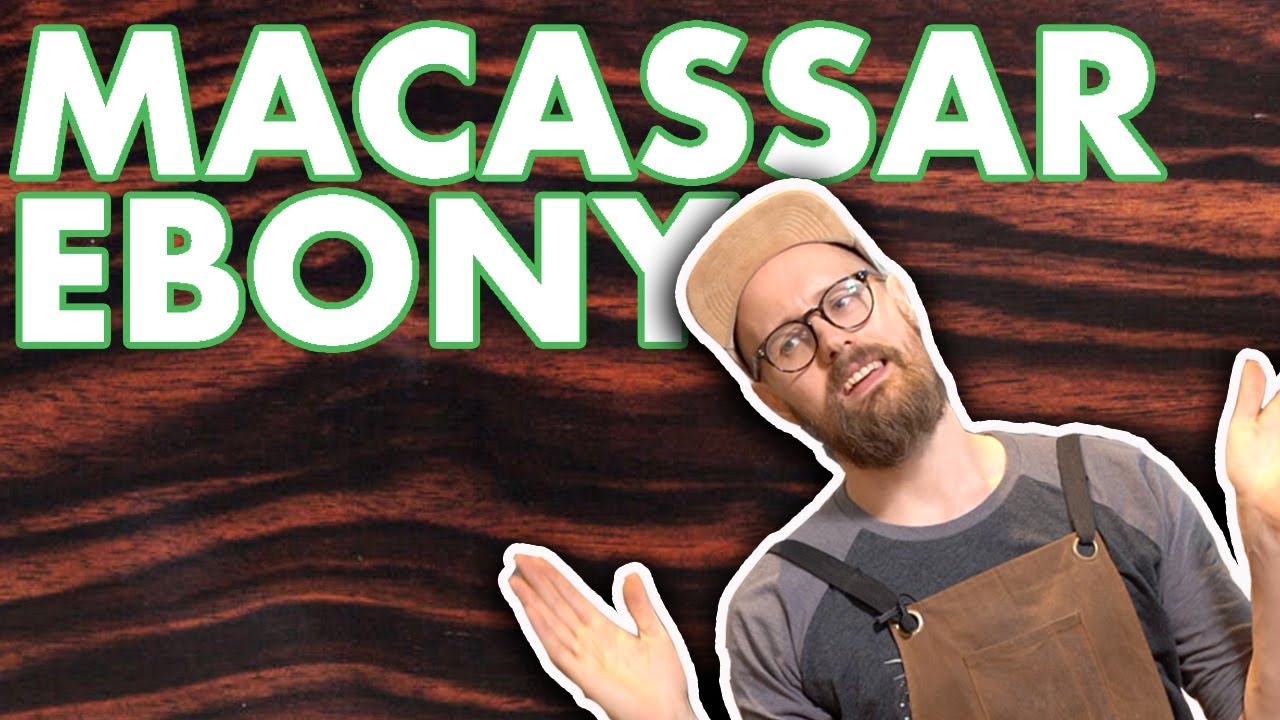
Macassar ebony is a dense, striped hardwood from the ebony wood tree Diospyros celebica, prized for dramatic black and brown bands. It differs from plain black ebony because Macassar ebony wood shows bold figure, high hardness, a smooth natural sheen, and very limited board sizes.
Table of Contents
What Is Macassar Ebony?
Macassar ebony is the trade name for the dark, streaked heartwood of Diospyros celebica, a true ebony species from Sulawesi, Indonesia. It’s used where makers want the visual drama of ebony without the flat, solid-black look associated with some other ebony species.
Ebony definition
Ebony definition refers to very dense, dark heartwood from trees in the genus Diospyros, though wood sellers often use the word loosely for any black or near-black timber. True ebony usually feels cool and heavy in the hand, and a small offcut makes a sharp, glassy tap when you set it on a bench.
Macassar ebony wood is one type of true ebony, but it isn’t the same as all-black Gaboon ebony or unrelated dark woods sold as blackwood. For a broader background on ebony species and trade names, see our guide to ebony wood.
Ebony meaning
Ebony meaning can refer to the tree, the wood, or a color name. In color language, ebony usually means a deep black or black-brown shade; in woodworking, it points to a dense hardwood with high polish potential and a premium price.
Beginner mistake: many buyers search “ebony” and assume every dark board has the same value. The safer approach is to ask for the botanical name, country of origin, board dimensions, moisture condition, and whether the material is solid lumber, veneer, or dyed substitute.
Ebony wood tree
Ebony wood tree can describe many Diospyros species, but Macassar ebony comes from Diospyros celebica. The tree grows slowly, and usable dark heartwood forms in limited widths, which is why wide, clear macassar ebony lumber is rare and costly.
Tree growth matters because ebony logs often contain checks, pale sapwood, mineral streaks, and internal stress. A board that looks perfect on one face may open hairline cracks after resawing, so serious buyers inspect both ends, tap for hidden splits, and avoid boards with fresh wax hiding end damage.
Macassar ebony origin
Macassar ebony origin is tied to Sulawesi, formerly known by many traders through the port name Makassar. The species is listed as vulnerable by the IUCN Red List, so legal sourcing and documentation matter more than they do with common domestic hardwoods.
Origin claims deserve a close look because “Macassar” sometimes appears on dyed veneer, engineered panels, or unrelated striped hardwood. Real material usually has a brown-to-black striped pattern, a dense waxy feel, and fine pores that don’t look like open-grained woods such as oak or ash.
Macassar Ebony Wood Characteristics

Macassar ebony wood is heavy, hard, fine-textured, and strongly striped. It machines like a dense tropical hardwood, but its short grain, brittleness, and oily surface make tool sharpness and finishing discipline more important than raw force.
| Characteristic | Macassar Ebony | Practical Effect |
|---|---|---|
| Botanical name | Diospyros celebica | True ebony, not a rosewood or dyed substitute |
| Typical color | Black, dark brown, reddish brown, tan streaks | Best for high-contrast accents and bookmatched panels |
| Texture | Fine and dense | Can polish to a smooth, glass-like surface |
| Workability | Difficult but predictable with sharp tools | Prone to tear-out, burning, and checking |
| Common form | Veneer, small billets, narrow boards | Large solid parts need careful selection and budgeting |
Color of ebony
Color of ebony varies by species and by tree. Macassar ebony usually shows black stripes mixed with chocolate brown, gray-brown, reddish brown, or golden tan, while black ebony tends to have a more uniform dark face.
Freshly cut surfaces can look slightly muted, then become deeper after sanding and oil or shellac. Under warm shop lights, the brown bands can glow like dark coffee; under cool LED lighting, the same veneer may read almost charcoal and gray.
Grain and figure
Grain and figure are the main reasons designers choose macassar ebony veneer over plain black ebony. Flat-sawn sheets show bold cathedral and flame patterns, while quartered material gives straighter, tighter stripes that look cleaner on modern cabinetry.
Matching matters more than people expect. If two doors come from different flitches, one can look smoky brown and the other can look nearly black, so reserve enough consecutive veneer sheets before cutting the first panel.
Ebony sheen color
Ebony sheen color usually shifts with finish type, sanding level, and light angle. A rubbed oil finish gives a soft satin glow, while film finishes can make black stripes look deeper and brown bands look richer.
Sheen control is a practical issue on large surfaces because glossy ebony shows fingerprints, sanding swirls, and glue smears fast. For furniture that gets touched daily, satin or low-gloss lacquer hides minor handling marks better than a mirror finish.
Ebony hardness
Ebony hardness is high, and Macassar ebony is commonly reported around 3,220 lbf on the Janka hardness scale by The Wood Database. That hardness helps it resist dents, but it also makes it brittle, abrasive on cutters, and unforgiving around thin edges.
Hard wood doesn’t mean trouble-free wood. Ebony can crack from stress, heat, or low humidity, so I avoid forcing screws without pilot holes and I never leave thin ebony parts sitting in direct sun on a dry bench.
Veneer, Lumber, and Workability

Macassar ebony veneer is easier to source and more stable than wide solid boards, while macassar ebony lumber is better for edges, pulls, inlays, instrument parts, and small luxury objects. The right form depends on scale, budget, durability needs, and how much movement the design can tolerate.
Macassar ebony veneer
Macassar ebony veneer gives the best visual yield because a single log can produce many thin sheets with matching figure. It works well on doors, wall panels, jewelry boxes, desktops, and drawer fronts where solid ebony would be too heavy, too unstable, or too costly.
Veneer risk: the dark stripes can telegraph glue mistakes, sand-through, and uneven substrate prep. I mark the face with low-tack tape, cut with a fresh veneer saw or knife, and use a balanced backer veneer so the panel doesn’t cup after pressing.
Useful shop products for veneer work include sharp knives, veneer tape, glue rollers, cauls, and sanding blocks.
Macassar ebony lumber
Macassar ebony lumber is usually sold as small boards, turning blanks, billets, or instrument stock rather than wide furniture boards. Expect narrow widths, short lengths, waxed ends, and a premium for dark, clean, well-striped pieces with minimal checking.
Lumber selection should start at the ends, not the face. Fine end checks can travel farther than they look, so I plan extra waste and avoid layouts that put screw holes, sharp corners, or thin tongues near checked areas.
Cutting and shaping
Cutting ebony needs sharp carbide, light passes, and steady feed pressure. The dust feels fine and dry between the fingers, stains skin gray-black, and can irritate airways, so dust collection and a fitted respirator are smart habits, not optional shop theater.
Common mistakes include routing too deep, skipping pilot holes, and sanding with worn paper that heats the surface. A better method is to climb-cut tiny sections only where grain reverses, scrape final surfaces, and pause often so the wood doesn’t smell scorched or feel hot.
Finishing behavior
Finishing behavior depends on surface prep because dense ebony doesn’t absorb finish like open-grained wood. Sand to a consistent grit, remove dark dust from pores and corners, then test finish on offcuts before touching the show face.
Finish choices that work well include shellac, lacquer, hard wax oil, and very thin wiping varnish. Oily surfaces can weaken adhesion, so I wipe with naphtha or alcohol just before finishing, then apply thin coats instead of flooding the surface.
Practical Notes From Real-World Use
Real-world use of macassar ebony rewards restraint. A full solid tabletop can look impressive on paper, but in a heated room it may move, crack, and weigh far more than the base was built to carry; veneer over a stable core often gives a cleaner result.
The best workaround is to use solid ebony only where touch and wear demand it: edging, pulls, stringing, knobs, plugs, or small shaped parts. The surface feels cool, slick, and almost stone-like after polishing, which makes small contact points feel luxurious without forcing the whole project to fight the wood’s movement.
Design pairing matters too. Macassar ebony sits well beside pale maple, holly, brass, and cream upholstery, while nearby striped woods can make the piece feel visually busy; for other high-contrast options, compare dark wood types.
Common Macassar Ebony Uses
Macassar ebony uses center on visual impact, touch quality, and dense wear surfaces. Makers choose it for fine furniture, cabinetry accents, musical instruments, knife scales, jewelry boxes, pens, and luxury objects where a little material can carry a lot of value.
Fine furniture
Fine furniture often uses macassar ebony as veneer on stable panels, paired with solid ebony edging or pulls. This method gives the dramatic striped face while reducing cracking risk, weight, and waste.
Smart construction uses panels, frames, and expansion gaps rather than trapping solid ebony across the grain. A polished ebony drawer pull feels cool and dense under the thumb, but a wide solid drawer front may curl if the shop and home humidity differ too much.
Cabinetry accents
Cabinetry accents include door fronts, floating shelves, appliance panels, toe-kick details, and wall panels. Macassar ebony veneer works best here because cabinetry needs broad, flat, stable surfaces with repeated grain matching.
Layout discipline keeps expensive veneer from looking random. I number each sheet, dry-lay the sequence, and check the room’s sightlines before cutting because a strong black stripe through one cabinet door can pull the eye away from the whole run.
Musical instruments
Musical instruments use ebony for fingerboards, bridges, pegs, tailpieces, decorative trim, and some woodwind parts. Macassar ebony can serve decorative and structural roles, but luthiers select stock carefully for straight grain, low runout, and stable seasoning.
Instrument stock has tighter demands than furniture stock. A tiny check that would disappear in a cabinet pull can become a failure point in a bridge or fingerboard, so blanks need slow acclimation and conservative machining.
Luxury objects
Luxury objects include watch boxes, pen blanks, cue parts, knife handles, inlay strips, brush handles, and small turned items. The wood’s weight gives small pieces a satisfying heft, and polished edges can feel almost like hard resin.
Small parts still need care because ebony chips at corners and can split around pins. I slightly break sharp edges, drill stepped pilot holes, and avoid aggressive press fits that can wedge the wood apart days after assembly.
Macassar Ebony vs Similar Woods
Macassar ebony is often compared with black ebony, African blackwood, and other dark hardwoods, but color alone doesn’t define performance. Species, pore structure, oil content, hardness, movement, and legal status all affect how the wood behaves in the shop and in finished work.
Black ebony
Black ebony usually means a more uniform black Diospyros species, often Gaboon ebony or related trade material. It gives a cleaner black surface than Macassar ebony, but clear black stock can be rarer, more expensive, and harder to verify.
Visual choice is the key difference. Pick black ebony for piano keys, fingerboards, or minimalist inlay; pick Macassar ebony when the project needs movement, stripes, and a warmer black-brown tone.
Dalbergia melanoxylon
Dalbergia melanoxylon is African blackwood, not true ebony. It belongs to the rosewood group, has very dark heartwood, and is famous for woodwind instruments because it machines to fine tolerances and holds detail well.
Trade confusion happens because African blackwood can look black enough to be called ebony in casual sales. For species-level detail, compare our guide to African blackwood.
African blackwood
African blackwood is extremely dense, fine-textured, and oily, with a dark purple-black to brown-black color. It often costs less than the cleanest black ebony, but it can still be expensive in instrument-grade billets.
Workability difference shows at the tool edge. African blackwood can feel slightly waxier and more rosewood-like, while Macassar ebony tends to chip more sharply at fragile corners and shows bold striping that limits invisible repairs.
Black tree wood
Black tree wood is a casual search term, not a reliable wood name. It may point to ebony, African blackwood, wenge, black palm, dyed maple, ebonized oak, or several other dark woods.
Better comparisons use known species names. For a coarse, open-grained dark alternative, see wenge wood; for dense rosewood-like color and figure, compare cocobolo.
Buying and Sourcing Tips
Buying macassar ebony starts with proof: species name, source, form, moisture condition, and seller reputation. The biggest beginner error is paying premium ebony prices for dyed, stained, or vaguely labeled dark wood.
Veneer selection
Veneer selection should focus on flitch consistency, sheet count, figure direction, and backing type. Ask whether sheets are raw, paper-backed, phenolic-backed, or already laid up on panels because each type cuts, bends, and sands differently.
- Buy consecutive sheets for doors, drawers, and panels that need matching.
- Order extra material for test cuts, repairs, and future damage.
- Check for splits, brittle edges, tape stains, and uneven thickness.
- Choose quartered veneer for cleaner stripes and flat-sawn veneer for bolder figure.
- Test finish on a scrap from the same flitch before finishing the project.
Professional workaround: photograph the full veneer layout before pressing. If a panel gets damaged later, that photo helps match stripe direction and choose the least distracting repair piece.
Lumber grading
Lumber grading for macassar ebony is less standardized than domestic hardwood grading. Sellers often price by blank quality, color, size, figure, and defect level rather than a familiar furniture-lumber grade.
Inspect closely for end checks, twist, sapwood, worm holes, and filled cracks. If the board is waxed heavily, ask for clear photos of both faces and both ends because wax can hide drying problems until the first cut.
Legal sourcing
Legal sourcing matters with ebony because many dark tropical hardwoods face pressure from overharvesting and trade restrictions. Check paperwork against the exact species, since CITES controls vary by genus and population; the official CITES Appendices are the best starting point for current trade status.
Paper trail should match the invoice, shipping label, and product listing. For cross-border purchases, avoid vague labels like “black ebony wood” with no botanical name because customs questions can cost more than the wood itself.
Sustainable alternatives
Sustainable alternatives include ebonized domestic hardwoods, dyed veneer, FSC-certified dark woods, reclaimed ebony, and dark species with better availability. None perfectly duplicate Macassar ebony’s striped figure, but many can deliver a similar mood with lower sourcing risk.
Good substitutes depend on the job. Ebonized walnut works for large furniture, dyed maple works for inlay, and dark rosewoods can suit luxury boxes; for premium cost comparisons, see our guide to the most expensive wood.
Cleaning and Care
Cleaning macassar ebony is simple if the finish is sound: remove dust gently, avoid soaking, and use a mild cleaner only when needed. The main risks are water marks, finish dulling, wax buildup, and cracks from dry storage.
How to clean it
How to clean it: use a soft dry cloth first, then a barely damp cloth for fingerprints or light grime. Wipe dry right away, especially near joints, veneer seams, inlay lines, and end grain.
Avoid harsh cleaners such as ammonia sprays, abrasive pads, silicone-heavy polishes, and wet scrubbing. If the surface feels sticky, test a mild soap solution on a hidden spot, then clean a small area and dry it before moving across the whole piece.
Polishing ebony wood
Polishing ebony wood depends on the finish, not just the wood. A lacquered cabinet needs finish-safe polish, while an oil-finished handle may need a tiny amount of compatible wax or oil rubbed thin and buffed clean.
Less is safer with ebony polish. Too much wax leaves cloudy streaks in the black bands and collects along corners, so I apply a pea-sized amount to a cloth, not the wood, then buff until the surface feels slick rather than greasy.
Moisture and storage
Moisture control protects ebony from cracks, lifted veneer, and joint stress. The USDA Forest Products Laboratory explains that wood changes dimension as moisture changes in the Wood Handbook, and dense ebony gives little warning before a fine crack appears.
Storage habits make a real difference. Keep ebony furniture away from heating vents, damp floors, and direct sun; store unused veneer flat between clean boards; and let lumber acclimate slowly before milling so fresh cuts don’t open with a faint ticking sound overnight.
FAQs
What Is Macassar Ebony Wood?
Macassar ebony wood is a dark, striped hardwood known for its dramatic black-and-brown grain pattern. It is often used for fine furniture, veneers, musical instruments, and decorative woodworking. The wood is prized for its rich appearance and luxurious finish.
Is Macassar Ebony Real Ebony?
Yes, Macassar ebony is a real ebony species. It comes from the Diospyros family, which includes true ebony woods. It is valued for both its dense structure and its striking striped appearance.
What Color Is Macassar Ebony?
Macassar ebony is typically dark brown to black with lighter brown or tan streaks. Its natural striping gives it a bold, high-contrast look. The exact color can vary depending on the board and the finish used.
How Hard Is Macassar Ebony?
Macassar ebony is extremely hard and dense. It is considered one of the harder tropical hardwoods, which makes it durable but also more difficult to cut and machine. Because of its density, it is best worked with sharp tools.
How Do You Clean Macassar Ebony Veneer?
Clean Macassar ebony veneer with a soft, dry microfiber cloth or a lightly dampened cloth. Avoid harsh cleaners, excess water, and abrasive pads that can damage the finish. For best results, wipe gently and keep the surface dry afterward.
Affiliate Disclosure: Some links in this post are affiliate links. If you make a purchase through these links, we may earn a small commission at no extra cost to you. We only recommend products we genuinely believe in.