Red Spotted Gum Guide: Eucalyptus mannifera Identification, Care, and Uses

Red spotted gum is a common name for Eucalyptus mannifera, an Australian native eucalypt also called brittle gum or snappy gum. This guide explains how to identify it, where it grows, how to care for it, and why it’s often confused with spotted gum timber species.
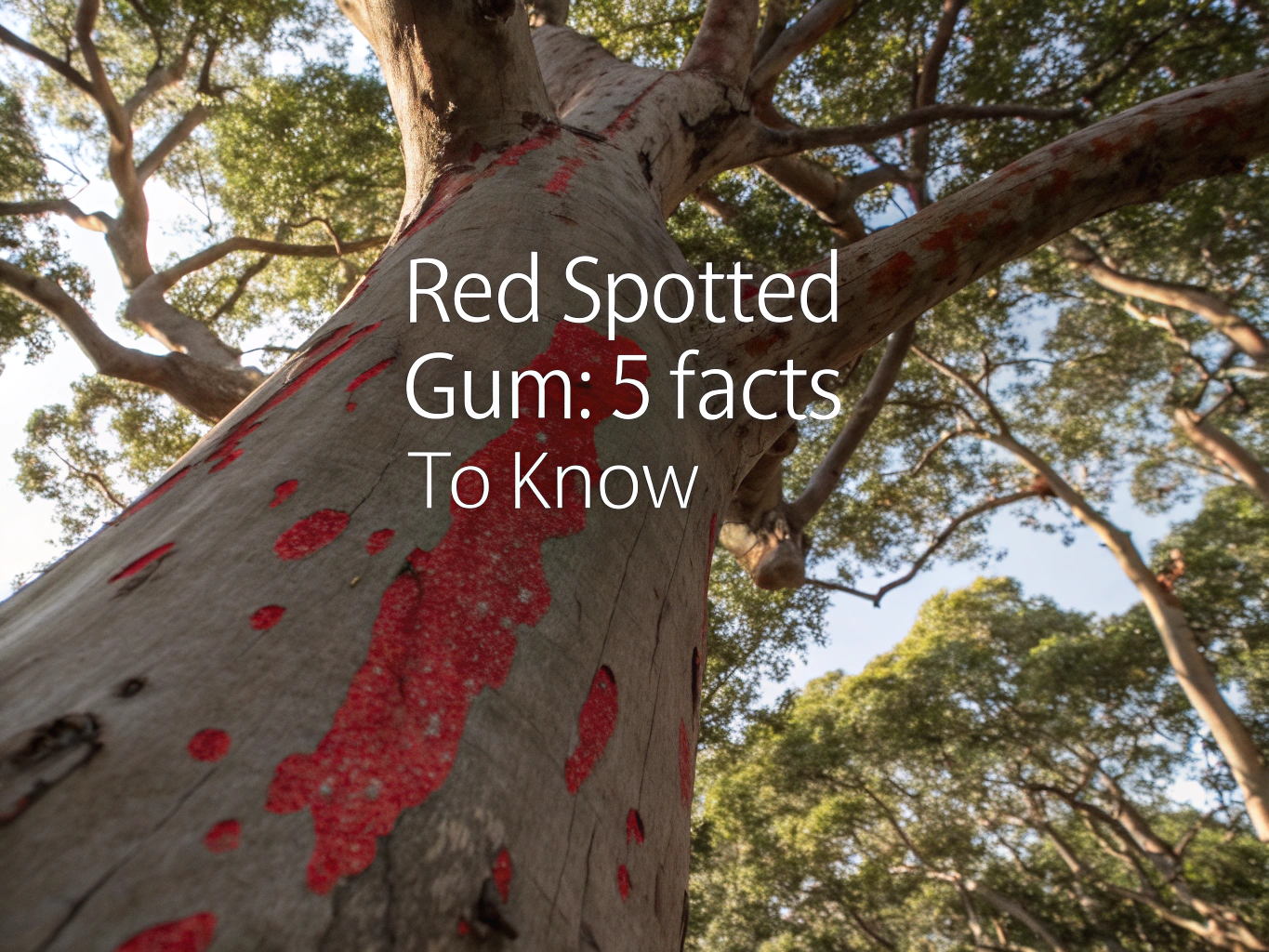
In the field, the tree stands out most when the smooth trunk feels cool and chalky under your palm, with pink-red bark patches showing through cream, grey, or white bark after shedding.
Table of Contents
What Is Red Spotted Gum?

Quick Facts
Red spotted gum is an evergreen eucalypt in the myrtle family, Myrtaceae. It’s usually a small to medium tree, often around 10–20 m tall, with smooth mottled bark, narrow adult leaves, white flowers, and small woody fruit capsules.
| Feature | Red spotted gum facts |
|---|---|
| Common name | Red spotted gum |
| Other names | Brittle gum, snappy gum |
| Scientific name | Eucalyptus mannifera |
| Common search misspelling | Eucalyptus mannifer |
| Family | Myrtaceae |
| Native range | South-eastern Australia, including NSW and ACT regions |
| Typical height | About 10–20 m, site dependent |
| Bark | Smooth, pale, often red, pink, orange, or salmon blotched |
| Flowers | White eucalyptus flowers |
| Best use | Habitat tree, shade tree for larger sites, revegetation, bark-feature planting |
| Main caution | Brittle limbs can fail under stress |
Eucalyptus mannifera Overview
Eucalyptus mannifera is a smooth-barked Australian native eucalyptus that grows naturally in dry woodland, open forest, rocky slopes, and tableland country. The red-spotted look comes from contrasting patches on the smooth trunk rather than from rough bark.
The names brittle gum and snappy gum point to a practical trait: limbs can break more readily than many beginners expect. This matters when placing the tree near driveways, paths, sheds, play spaces, or powerlines.
The term Eucalyptus mannifer is a common misspelling. The accepted botanical spelling is Eucalyptus mannifera, and using the full name helps avoid mix-ups with commercial spotted gum timber, which usually comes from Corymbia species rather than this tree.
Taxonomy and Subspecies

Scientific Classification
Red spotted gum belongs to kingdom Plantae, order Myrtales, family Myrtaceae, genus Eucalyptus, and species Eucalyptus mannifera. The Australian Plant Census is the best starting point for checking accepted names and formal botanical treatment.
Common Name Meanings
Red spotted describes the bark markings that appear as old bark sheds and fresh patches show through. Brittle gum and snappy gum refer to the tendency of branches or wood to snap, a trait that affects planting decisions more than many plant labels admit.
Recognised subspecies include subsp. mannifera, subsp. maculosa, subsp. praecox, and subsp. gullickii. Garden buyers rarely need subspecies detail, but revegetation projects should match local seed origin and local form where possible.
Subsp. maculosa is often linked with the more obvious red, pink, or salmon-blotched bark that gives red spotted gum its name. A tree can still be Eucalyptus mannifera when those patches look faint, washed out, or hidden by recent weathering.
How to Identify Red Spotted Gum
Bark Features

Red spotted gum bark is smooth, pale, and mottled. It may show white, cream, grey, pale green, pink, orange, red, or salmon patches, with the strongest colour often appearing after bark has shed in plates or flakes.
Fresh bark can feel powdery and cool, and it may leave a faint dusty feel on your fingers in dry weather. In wet light, the red patches can look richer, while harsh midday sun can bleach the contrast and make the tree harder to pick from a distance.
Leaves and Growth Habit
Adult leaves are narrow to lance-shaped and usually green, blue-green, or grey-green. Young plants and coppice regrowth may carry juvenile foliage that looks different, so don’t rely on leaf shape alone.
The tree often forms an open crown with spreading limbs and a pale trunk visible below the canopy. Botanical descriptions from sources such as NSW Flora Online are useful for checking buds, flowers, fruit, and formal identifying traits.
- Smooth bark rather than rough fibrous bark
- Pale trunk with red, pink, orange, salmon, grey, cream, or white patches
- Narrow adult leaves with a typical eucalyptus shape
- White flowers when the tree is in bloom
- Woody capsules after flowering
- Bud clusters often described in groups of seven
- Dry woodland setting, tableland slope, rocky ridge, or planted native site
- Not a timber clue: don’t assume it’s commercial spotted gum
Buds and flowers help confirm the species when bark alone isn’t enough. Flower buds are commonly described in clusters of seven, flowers are white, and fruit capsules are small, woody, and often cup-shaped, hemispherical, or conical.
Best timing depends on the feature you’re checking. Bark works year-round, juvenile leaves help on young trees and regrowth, flowers are seasonal, and fruit capsules can confirm a tree after flowering has passed.
Native Range, Habitat, and Ecology
South-Eastern Australia
Red spotted gum is native to south-eastern Australia, especially New South Wales, the Australian Capital Territory, and nearby tableland districts. Records on the Atlas of Living Australia help show its recorded distribution and occurrence patterns.
NSW and ACT Range
NSW and ACT sightings are common around dry woodland, open forest, and tableland areas, including parts of the Canberra region and Southern Tablelands. In these places, the tree often grows with other hardy woodland natives rather than lush, high-water garden plants.
Typical woodland habitats include dry sclerophyll forest, grassy woodland, rocky ridges, exposed slopes, and well-drained soils. The tree copes with poor soils once established, but it suffers when roots sit in cold, stagnant, waterlogged ground.
Flowers and wildlife make the species useful in habitat planting. White blossoms provide nectar and pollen for native bees, honeybees, beetles, flies, and nectar-feeding birds, while bark, litter, insects, and shade add habitat value over time.
For conservation provenance, seed origin matters. In restoration or Landcare work, use local seed where possible, match the subspecies or local form, and avoid introducing non-local genetics into sensitive remnant vegetation.
Good companion native plants vary by district, but similar dry woodland plantings may include local Acacia species, Bursaria spinosa, Themeda triandra, Lomandra species, and site-suited Callistemon or Melaleuca forms.
Growing Conditions and Care
Soil and Drainage
Well-drained soil is the main care requirement for red spotted gum. Sandy loam, gravelly loam, rocky soil, and low to moderate fertility sites suit it better than compacted clay that stays wet after rain.
Beginners often dig a deep planting hole and bury the root ball low, which traps water around the stem. Set the root ball level with the surrounding soil, roughen glazed hole edges, water in deeply, and backfill without adding rich compost pockets that can create a sump.
Sunlight and Climate
Full sun gives the best canopy shape and bark colour. Deep shade, narrow side passages, and dense competition from larger trees can produce a thin, leaning form with weak structure.
Young trees need establishment watering, especially through their first hot summer. Deep, slow watering trains roots down; shallow daily sprinkling keeps roots near the surface and makes the tree more prone to heat stress.
- Choose a full-sun site with room for mature height, spread, and root growth.
- Check distance from buildings, services, paths, driveways, and powerlines.
- Dig a hole no deeper than the root ball and about twice as wide.
- Place the tree with the root crown level with surrounding soil.
- Backfill with site soil, firm gently, then water slowly to settle gaps.
- Mulch the root zone, keeping mulch off the trunk.
- Stake only where wind-rock is a problem, then remove stakes once stable.
Mulching and fertilising should stay simple. Use coarse organic mulch to reduce weeds and soil temperature swings, and use low-phosphorus native fertiliser only if growth is poor and the soil test or site history supports it.
Pruning basics are conservative: remove dead, damaged, crossing, or unsafe branches, but avoid topping or heavy lopping. Hard cuts on eucalypts can trigger weak regrowth, decay pockets, and later limb failures.
Pests and stress often follow poor siting more than bad luck. Psyllids, leaf beetles, scale insects, borers, and defoliating caterpillars cause more trouble on trees weakened by drought, waterlogging, root damage, soil compaction, or mower injury.
Size, Landscape Use, and Safety
Height and Spread
Red spotted gum height commonly sits around 10–20 m, but soil depth, rainfall, exposure, and local genetics can shift the final size. It should never be treated like a small ornamental shrub or short-lived screening plant.
The canopy can become broad and open, with limbs extending well beyond the trunk line. Give it space away from roofs, fences, hard paving, septic areas, underground services, and outdoor seating zones.
Growth Rate
Growth rate is moderate to fast on a suitable site, especially when young trees receive weed control, mulch, deep watering, and browsing protection. Poor drainage, compacted fill, and dry planting weather can stall growth or kill new tubestock.
Best landscape uses include larger native gardens, parks, rural properties, paddock shade, biodiversity corridors, council reserves, and revegetation sites. It suits places where its bark, shade, leaf litter, and wildlife value can be allowed to function naturally.
Small garden limits are real. A red spotted gum near a house may look harmless as a 1 m seedling, but mature height, canopy spread, root space, and brittle limb risk can turn it into a costly removal or pruning problem.
The brittle limb risk is the main safety trade-off. Storms, high winds, drought stress, previous branch cracks, poor pruning, and root compaction can raise the chance of branch drop.
For mature trees near targets, get arborist advice before cutting large limbs. Tree risk methods used by trained arborists, including guidance from the International Society of Arboriculture, focus on targets, defects, site conditions, and likelihood of failure rather than fear alone.
Red Spotted Gum vs Similar Trees
Spotted Gum
Spotted gum usually means Corymbia maculata, Corymbia citriodora subspecies, or related Corymbia trees used for hardwood. That’s why queries about spotted gum characteristics, spotted gum hardness, or flooring often point to timber species, not Eucalyptus mannifera.
If you’re comparing timber, read our guide to eucalyptus wood for broader context. Red spotted gum is mainly discussed as a living native tree, while commercial spotted gum timber is known for dense hardwood applications such as decking, flooring, cladding, and structural use.
River Red Gum
River red gum is usually Eucalyptus camaldulensis, a larger eucalypt strongly linked with waterways, floodplains, and river flats. It shares the word “red,” but it’s not the same common name or tree as red spotted gum.
Scribbly gum can confuse field identification because it also has smooth pale bark. The key clue is scribble-like insect tracking in the bark, while red spotted gum is better known for red, pink, or salmon mottling.
Timber confusion is common because searchers may blend red gum janka hardness, spotted gum hardness, deep red furniture timber, and red spotted gum into one topic. For a closer hardwood comparison, see our blackbutt wood profile, which covers a commercial Australian timber species.
| Common name | Scientific name | Genus | Main identifying feature | Typical habitat/use | Common confusion |
|---|---|---|---|---|---|
| Red spotted gum | Eucalyptus mannifera | Eucalyptus | Smooth pale bark with red, pink, or salmon patches | Native tree, habitat planting, larger gardens | Mistaken for spotted gum timber species |
| Spotted gum | Corymbia maculata and related Corymbia species | Corymbia | Smooth spotted bark | Major Australian hardwood timber | Name sounds close to red spotted gum |
| River red gum | Eucalyptus camaldulensis | Eucalyptus | Large riverine eucalypt | Floodplains, watercourses, habitat, timber | Contains “red gum” in the name |
| Scribbly gum | Often Eucalyptus rossii or related species | Eucalyptus | Scribble-like bark markings | Native woodland tree | Another smooth-barked eucalypt |
Propagation and Nursery Availability
Seed Propagation
Eucalyptus mannifera seed is the usual propagation route. Seeds are tiny and come from mature woody capsules, so clean seed handling, shallow sowing, bright light, and steady moisture matter more than heavy fertiliser.
Common mistake: beginners keep trays too wet, then blame poor seed. Use a free-draining propagation mix, mist gently, avoid burying the seed deeply, and give seedlings airflow once they germinate.
Tubestock vs Advanced Trees
Tubestock is usually cheaper, easier to plant, and often establishes better because young roots adapt quickly to site soil. Advanced trees give faster visual impact, but they cost more, need careful watering, and can suffer transplant shock if root-bound or planted too deep.
For establishment tips, protect young trees from rabbits, kangaroos, livestock, mowers, herbicide drift, and grass competition. A tree guard, mulch ring, and weed-free zone often decide whether a seedling grows strongly or sits still for two seasons.
Local provenance seed is best for revegetation, council work, and plantings near remnant bushland. Ask native nurseries whether stock is sold as red spotted gum, brittle gum, snappy gum, Eucalyptus mannifera, or the misspelled Eucalyptus mannifer.
For native nursery sourcing, tubestock is often the practical choice for rural blocks and restoration plantings. If you’re new to small seedlings, our guide to blue gum gives useful context on related eucalypt growth habits and site fit.
Planting supplies such as guards, mulch tools, and watering gear can help young trees establish when they match the site and planting season.
Use supplies carefully: a guard that rubs the stem, mulch piled against the trunk, or a tight stake can damage a young red spotted gum faster than weather exposure.
Field Experience Insights
Real-world planting success often comes down to water timing and grass control, not pampering. The best young red spotted gums I see have a wide mulch ring, no turf pressing against the stem, and slow soaking water that leaves the soil damp below finger depth.
On exposed blocks, the leaves can feel dry and leathery by late summer, yet the tree may still be healthy if the newest tips remain firm and green. A stressed seedling feels different: wilted tips hang soft, the stem can loosen in the ground, and the root zone may smell sour if drainage has failed.
Professional workaround: don’t over-stake a young tree just because it moves in wind. A little movement builds taper; use loose, low staking only for wind-rock, then remove supports once roots hold the tree steady.
For established brittle gum near a house, I look for target zones first: where people sit, park, walk, or sleep. Deadwood above a paddock is a different risk from a cracked limb above a bedroom, and that difference should guide pruning decisions.
FAQs
What Is Red Spotted Gum?
Red spotted gum is a commonly used name for a gum tree known for its attractive bark and native Australian appearance. It is valued for its ornamental look, wildlife appeal, and hardy growth in suitable climates.
Is Red Spotted Gum The Same As Eucalyptus Mannifera?
Yes, red spotted gum is often used to refer to Eucalyptus mannifera. Common names can vary by region, but this is the botanical name most closely associated with it.
How Tall Does Red Spotted Gum Grow?
Red spotted gum usually grows into a small to medium-sized tree. In the right conditions, it can reach around 10 to 20 metres tall, though growth depends on climate, soil, and care.
Is Red Spotted Gum The Same As Spotted Gum Timber?
No, red spotted gum is not the same as spotted gum timber. Spotted gum timber usually comes from different Corymbia species and is known for its hardwood quality, while red spotted gum is mainly referred to as a tree name.
Is Red Spotted Gum Safe To Plant Near A House?
Yes, it can be safe to plant near a house if you allow enough space for the mature canopy and roots. It is best to plant it well away from foundations, pipes, and paths, especially if you want to avoid future maintenance issues.
Affiliate Disclosure: Some links in this post are affiliate links. If you make a purchase through these links, we may earn a small commission at no extra cost to you. We only recommend products we genuinely believe in.