
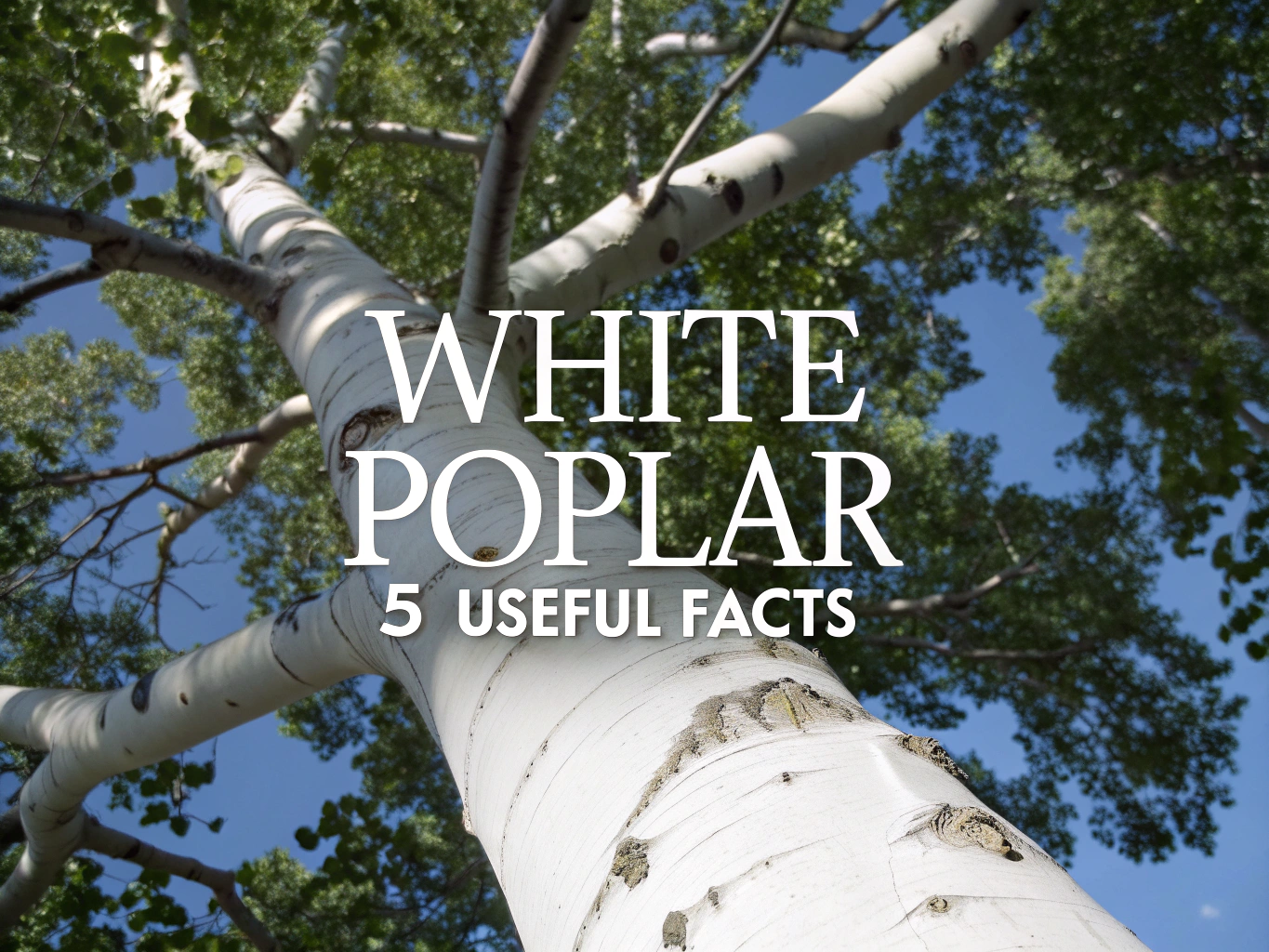

White poplar, also called silver poplar, is the deciduous tree Populus alba, recognized by lobed green leaves with densely white, felted undersides. It grows quickly and provides broad shade, but spreading roots, persistent suckers, and invasive behavior often make it unsuitable for residential planting.
Table of Contents
What Is White Poplar?

White poplar is Populus alba, a fast-growing member of the willow family. Wind turns its leaves to expose their pale undersides, making an entire crown flash silver in seconds.
Names and Taxonomy
White poplar and silver poplar are common names for the same species. Other names include silver-leaf poplar, abele, the German Weiß-Pappel, and the Spanish álamo blanco.
The accepted botanical name is Populus alba L. The “L.” credits Carl Linnaeus, while alba means white and refers to the pale shoots, bark, and leaf undersides. Kew Plants of the World Online places it in Salicaceae, the willow family.
Essential Tree Facts
| Feature | White poplar facts |
|---|---|
| Scientific name | Populus alba |
| Other main name | Silver poplar |
| Family | Salicaceae |
| Plant type | Deciduous broadleaf tree |
| Typical height | 50–80 ft (15–25 m) |
| Possible height | Near 100 ft (30 m) on favorable sites |
| Light | Full sun |
| Sex expression | Usually dioecious |
| Main identification trait | White, felted leaf undersides |
| Main planting concern | Root suckers and clonal spread |
The tree’s dimensions aren’t fixed. Moisture, climate, clone, soil volume, competition, and storm damage all influence its final height and crown width.
Reproduction and Cloning
White poplar reproduces through seed and vegetative root suckers. Most trees carry either male or female flowers, so a lone female needs compatible pollen nearby before it can produce fertile seed.
Lateral roots contain dormant buds that can grow into trunks. A grove with twenty stems may be one genetic individual, which explains why removing the largest trunk doesn’t necessarily remove the tree.
How to Identify White Poplar
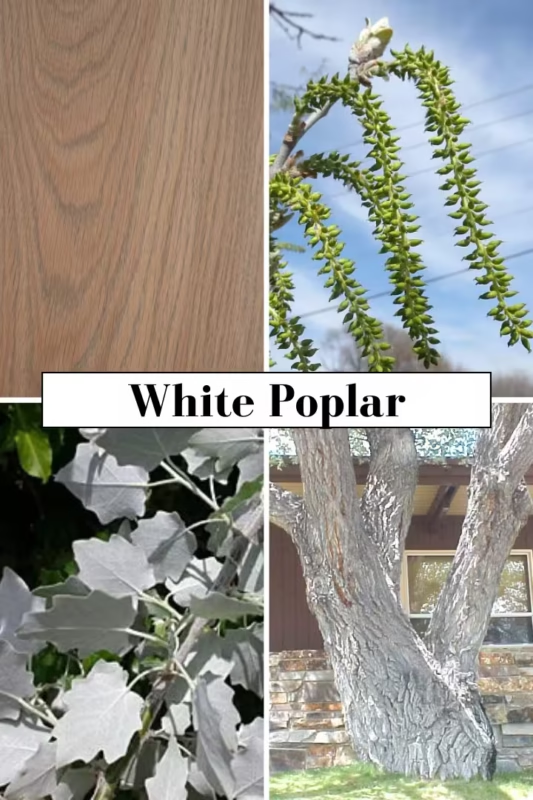
Identify white poplar by combining its silvery leaf undersides, hairy young shoots, pale upper bark, and suckering growth. One leaf isn’t always conclusive because foliage shape changes between vigorous and short shoots.
Leaves and Undersides
Leaves grow alternately and range from rounded or oval to deeply three- or five-lobed. The upper surface becomes dark green, while the lower surface carries dense white tomentum—a soft layer that feels like fine felt beneath a fingertip.
Vigorous long shoots tend to carry larger, more deeply lobed, maple-like leaves. Short shoots often produce less dramatic foliage, so compare several parts of the crown before deciding.
Bark and Trunk
Young bark is smooth, pale gray-green, or almost white, often marked with dark diamonds or irregular patches. Mature lower bark becomes dark and deeply fissured, while higher limbs may remain noticeably pale.
Twigs and Buds
Young twigs commonly have a white, woolly coating. Buds sit alternately along the shoot, but winter identification should combine twig hairiness and bark because individual traits overlap with hybrids and related poplars.
Flowers and Catkins
Flowers hang in wind-pollinated catkins during spring, often before full leaf expansion. Male catkins are commonly reddish; female catkins are greener and develop seed-bearing capsules after pollination.
Seeds and Fluff
Female trees release tiny seeds attached to cotton-like hairs. This floating material is seed fluff, not pollen; pollen comes earlier from male catkins and is much harder to see.
Crown and Suckers
An open-grown tree develops a broad, irregular crown. Nearby shoots rising from lawns, banks, or disturbed soil provide another useful clue because white poplar suckers readily from spreading roots.
Size, Range, and Habitat

White poplar commonly grows 50–80 feet tall and favors sunny, open ground with accessible moisture. It tolerates varied conditions after establishment, yet survival isn’t good performance: compacted soil, drought, and restricted roots can produce weak growth and dieback.
Height and Spread
A mature white poplar usually reaches 15–25 m, with exceptional trees nearing 30 m. Its spreading crown can occupy substantial horizontal space, making nursery labels that list only height poor guides for small-lot suitability.
Growth Rate and Lifespan
White poplar grows fastest when young, sunny, and well supplied with water. No annual figure applies everywhere; short growing seasons, root competition, genotype, and heat can change yearly extension growth considerably.
Trees can persist for many decades, but fast growth creates relatively weak wood. A tree that reaches shade-producing size quickly can later bring higher pruning costs, storm breakage, and canker entry through damaged branches.
Native and Introduced Range
The native range extends across parts of southern and central Europe, North Africa, and western to central Asia. Cultivation has moved Populus alba into North America, northern Europe, Australia, and other temperate regions, where it may become naturalized.
Light and Space
Full sun supports a dense crown and characteristic leaf color. Allow room for the canopy, lateral roots, and suckers rather than measuring only the planting-hole footprint.
Soil and Moisture
Natural sites include river valleys, floodplains, moist lowlands, and disturbed ground. Periodic floodplain moisture doesn’t mean the roots thrive indefinitely in stagnant, oxygen-poor soil; drainage still matters.
Established trees may survive dry or mildly saline conditions, but they can develop sparse crowns and dead twigs. Deep watering during establishment works better than frequent surface sprinkling, which encourages shallow rooting near turf.
Climate Tolerance
References often place the species near USDA Zones 3–8, though clone and source affect cold tolerance. Check your location through the USDA Plant Hardiness Zone Map, then account for summer heat, wind exposure, and local moisture rather than using zone alone.
Invasive Risks and Root Behavior

White poplar can become invasive because roots generate new stems and female trees disperse windborne seed. The most persistent residential issue is usually clonal root spread, not seedling production.
Why White Poplar Spreads
Root buds let the tree replace damaged stems and colonize open soil. Cutting roots, grading, mowing, or felling can remove hormonal control from the main stem and activate many dormant buds.
Regional Invasive Status
“Invasive” is a regional ecological and legal classification. White poplar may be native in one country, naturalized in another, and restricted elsewhere, so consult the Invasive Plant Atlas plus state, provincial, and municipal rules before buying or propagating it.
Surface Roots and Suckers
Poplar trees don’t rely on one simple, deep taproot. White poplar develops a broad root network that may run near the surface, especially in compacted or shallow soil, producing shoots far from the original trunk.
Landscape Conflicts
- Lawns: mowers repeatedly cut shoots without removing connected roots.
- Paving: enlarging roots can lift already vulnerable slabs and edging.
- Pipes: roots may exploit leaking joints and existing defects.
- Garden beds: suckers compete with smaller plants and complicate digging.
- Boundaries: roots and shoots can cross onto neighboring property.
- Utilities: excavation becomes harder around a dense root network.
Roots don’t deliberately attack sound foundations. The more defensible concern is limited soil volume, existing cracks, damaged drains, lightweight hardscape, and repeated sucker growth close to structures.
Why Cutting Backfires
Felling removes the crown but can leave a large, living root system supplied with stored carbohydrates. The result may be a ring or field of vigorous replacement shoots during the next growing season.
Stump grinding deals with the central stump, not every lateral root. Repeated mowing keeps sprouts short, yet it may create years of maintenance instead of full colony control.
Responsible Control
Map the colony, verify property lines, check wildlife and tree-protection laws, then plan repeated monitoring. Small systems may be excavated; large colonies near structures call for arborist-led removal and regionally approved invasive-plant advice.
Where herbicide use is legal, follow the product label and local extension instructions exactly. Application methods, active ingredients, timing, and aquatic restrictions differ, so a universal mixture rate can cause plant injury or contamination.
Growing White Poplar Responsibly
Grow white poplar only where local rules permit it and where roots can spread without entering natural habitat, hardscape, utilities, or neighboring land. Its fast growth rarely outweighs long-term sucker control on a small residential site.
Legality and Site Checks
Check invasive-species lists, municipal tree rules, nursery-shipping restrictions, and any protected-site status. Confirm the botanical name on the label because “poplar” can refer to unrelated nursery trees or timber.
Planting Suitability
A workable site needs full sun, extensive crown and root space, no nearby high-value habitat, and access for future tree work. White poplar is usually a poor choice beside lawns, drains, paving, narrow driveways, walls, or play areas.
Historical use in windbreaks and erosion-control plantings doesn’t make it one of the best trees for shade in every region. In places such as Louisiana, locally adapted, noninvasive trees often handle heat and storms with fewer root conflicts.
Propagation From Cuttings
Dormant stem cuttings can root in moist, aerated media before bud break. Each cutting produces a clone of its source, preserving the parent’s sex, foliage traits, and tendency to sucker.
A frequent beginner error is rooting cuttings before checking local restrictions. Another is planting a rooted stick directly in saturated soil, where the base feels slick and develops rot; use clean material and even moisture, not saturation.
Listings may include tools or propagation supplies, but they don’t confirm that planting Populus alba is lawful or suitable in your area.
Propagation From Seed
Fresh poplar seed needs prompt contact with moist, exposed substrate and can lose viability quickly in ordinary storage. Check harvest date, storage method, germination testing, species identity, and shipment legality before purchasing.
Seedlings vary genetically and may develop as male or female trees. A packet count doesn’t predict the number of viable plants, and seed-grown trees won’t reliably copy a named clone’s ornamental characteristics.
Long-Term Maintenance Costs
Purchase price represents a small part of ownership. Budget for establishment water, sucker removal, inspections, pruning, storm cleanup, stump work, root management, and repairs to affected beds or paving.
A narrow-lot privacy planting can become expensive once branches overhang buildings and shoots cross boundaries. Root barriers have finite depth and length; roots can pass beneath or around them, so they aren’t a permanent containment guarantee.
Practical Notes From Real-World Use
The first field sign of trouble is often a line of pencil-thin shoots across a lawn rather than damage beside the trunk. Their pale, fuzzy leaves feel soft at first, while repeated mowing leaves hard, ankle-catching stubs near the soil surface.
Before removing a mature tree, inspect at least the surrounding crown-width area for connected stems. Mark new shoots during summer, photograph their positions, and continue checks for several seasons because delayed sprouts appear after stored root reserves shift.
During identification, turn over leaves from both short and vigorous shoots. The silver underside is more dependable than leaf outline alone, particularly where gray poplar hybrids create intermediate leaf shapes.
White Poplar vs. Similar Trees
White poplar differs from similar trees through its combination of lobed leaves, white felted undersides, hairy shoots, pale bark, and clonal growth. Hybrids can blur these traits, so legal or ecological decisions may require expert botanical verification.
Silver Poplar
Silver poplar is white poplar; both names identify Populus alba. “Silver” describes the shimmering effect produced when wind flips the leaves and exposes their white undersides.
Gray Poplar
Gray poplar, Populus × canescens, is usually treated as a hybrid between white poplar and European aspen. Its underside may be grayish rather than densely white, but hybrids and backcrosses make single-leaf identification unreliable.
Quaking Aspen
Quaking aspen, Populus tremuloides, usually has rounder, finely toothed leaves without a dense white felt beneath. Its flattened petioles produce the familiar rapid trembling movement, though both species form clonal stands.
European Aspen
European aspen, Populus tremula, has rounder leaves on laterally flattened petioles and lacks the strongly white underside typical of P. alba. Gray poplar ancestry can create intermediate field specimens.
Black Poplar
Black poplar, Populus nigra, usually carries triangular to diamond-shaped leaves without dense white tomentum. Its bark becomes dark and furrowed, but the foliage lacks the green-to-silver flashing seen across a white poplar crown.
Tulip Poplar
Tulip poplar, Liriodendron tulipifera, belongs to Magnoliaceae rather than Salicaceae. It has four-lobed, flat-tipped leaves and tulip-like flowers, with no felted white underside.
Health, Ecology, and Safety
White poplar supports insects, shelter, and nesting sites, yet stressed trees may suffer cankers, leaf diseases, borers, and branch failure. Its ecological value must be weighed against invasive spread outside its native range.
Cankers and Leaf Diseases
Cankers enter through wounds or stressed tissue and may cause sunken bark, cracking, dead branches, and crown thinning. Leaf spots and rusts can cause early leaf fall, but one season of cosmetic spotting doesn’t always signal severe tree decline.
Don’t diagnose a named pathogen from appearance alone. Photograph the transition between healthy and damaged bark, retain a fresh sample, and use a local extension laboratory or arborist for species-level diagnosis.
Insect Problems
Aphids, caterpillars, and other leaf feeders may affect foliage, while borers pose a greater threat to weakened trees. Treating before identification can kill beneficial insects without addressing the actual stress, such as drought or root injury.
Branch Breakage
Fast growth produces comparatively weak wood, and included bark or poor pruning increases failure risk. Mature trees near homes, roads, parking areas, or playgrounds need periodic assessment, particularly after strong wind or ice.
Wildlife and Habitat
Leaves feed herbivorous insects, while branches and cavities provide cover or nesting space. These benefits carry more ecological weight in the native range; introduced colonies can displace local plants and simplify riparian plant communities.
Pollen and Seed Fluff
Male trees release windborne pollen, while female trees produce visible seed fluff. The cottony material can irritate eyes or collect around screens, but fluff isn’t pollen and shouldn’t be treated as the same allergy source.
People, Pets, and Utilities
Don’t assume white poplar bark, buds, or leaves are safe food or medicine for people or animals. Salicylate-related compounds may have biological effects, but that doesn’t establish safe dosage or suitability.
Call the local utility-marking service before root excavation or stump work. Underground cables and pipes may lie inside the root zone, where saws and digging tools create serious injury risks.
White Poplar Wood and Uses
White poplar wood is light, soft, easy to machine, and poorly suited to unprotected exterior use. It serves veneer, plywood cores, pulp, containers, carving, matches, and other applications where low weight matters more than hardness.
Physical Wood Properties
Reference averages from The Wood Database place dried weight near 28 lb/ft³ (440 kg/m³) and Janka hardness near 410 lbf (1,820 N). These numbers describe sample averages, not guarantees.
| Property | Reference value | Practical meaning |
|---|---|---|
| Average dried weight | 28 lb/ft³ (440 kg/m³) | Light compared with many furniture hardwoods |
| Janka hardness | 410 lbf (1,820 N) | Dents fairly easily |
| Modulus of rupture | About 8,290 lbf/in² | Modest bending strength |
| Modulus of elasticity | About 1.18 million lbf/in² | Relatively flexible |
| Radial shrinkage | About 3.1% | Moderate dimensional movement |
| Tangential shrinkage | About 7.2% | Careful drying reduces distortion |
Growth site, tree age, grain direction, defects, and moisture content alter performance. Compare these figures with the site’s wood hardness scale before choosing material for wear surfaces.
Traditional and Industrial Uses
White poplar has been used for veneer, plywood cores, pulp and paper, boxes, crates, matches, carving, and lightweight utility goods. Pale color and easy cutting suit painted or low-wear work, while poor decay resistance limits untreated outdoor use.
Woodworking Limitations
Tools cut the wood easily, but dull edges compress fibers and leave a woolly, fuzzy surface. A sharp cutter, light final pass, and fine abrasive produce a cleaner feel than aggressive sanding, which can raise soft fibers.
The wood dents under concentrated pressure and doesn’t hold fasteners like denser hardwoods. Predrill near ends, avoid overtightening screws, seal end grain, and reserve it for light-duty interior projects rather than wet or load-critical structures.
Product listings can help compare woodworking supplies, but generic “poplar” items shouldn’t be assumed to contain Populus alba.
Retail Poplar Confusion
North American retail boards labeled “poplar” commonly come from tulip tree, Liriodendron tulipifera, not white poplar. A store label such as American poplar, yellow-poplar, or primed poplar doesn’t prove Populus alba content.
Ask the seller for the botanical species and origin before buying white poplar hardwood planks, including material marketed as China white poplar. For broader timber comparisons, see this guide to poplar wood; trade names and botanical identities frequently diverge.
FAQs
Is White Poplar The Same As Silver Poplar?
Yes, white poplar and silver poplar are common names for the same tree species, Populus alba. The names refer to its pale bark and the silvery-white undersides of its leaves. It is a fast-growing deciduous tree native to parts of Europe and western Asia.
How Can You Identify A White Poplar Tree?
You can identify a white poplar by its dark green leaves with bright white, fuzzy undersides. Its bark is smooth and pale when young, becoming darker and furrowed near the base as the tree matures. White poplars also commonly produce root suckers around the trunk.
Is White Poplar Invasive?
White poplar is considered invasive in many parts of North America and other regions outside its native range. It spreads quickly through seeds and vigorous root suckers, which can form dense colonies. Check local guidance before planting it, especially near natural areas, gardens, or drainage channels.
How Far Do White Poplar Roots Spread?
White poplar roots can spread 30 to 50 feet or more from the trunk, depending on soil and moisture conditions. The tree also produces suckers from its shallow lateral roots, creating new shoots well away from the original tree. Plant it far from foundations, paths, pipes, and garden beds.
What Is White Poplar Wood Used For?
White poplar wood is mainly used for lightweight products such as boxes, pallets, crates, paper pulp, and inexpensive furniture parts. It is soft, easy to work, and relatively light in color. Because it is not highly durable outdoors, it is usually not the best choice for structural or exterior projects.
Affiliate Disclosure: Some links in this post are affiliate links. If you make a purchase through these links, we may earn a small commission at no extra cost to you. We only recommend products we genuinely believe in.