

Red alder (Alnus rubra) is a fast-growing deciduous hardwood native to western North America, valued for nitrogen fixation, wildlife habitat, restoration, furniture, cabinetry, and traditional plant preparations. Its smooth gray bark, rolled leaf edges, reddish inner bark, and small woody cones separate it from most neighboring trees.
The sections below cover red alder identification, habitat, benefits, wood properties, practical uses, and the safety limits surrounding reported medicinal uses.
Table of Contents
What Is Red Alder?
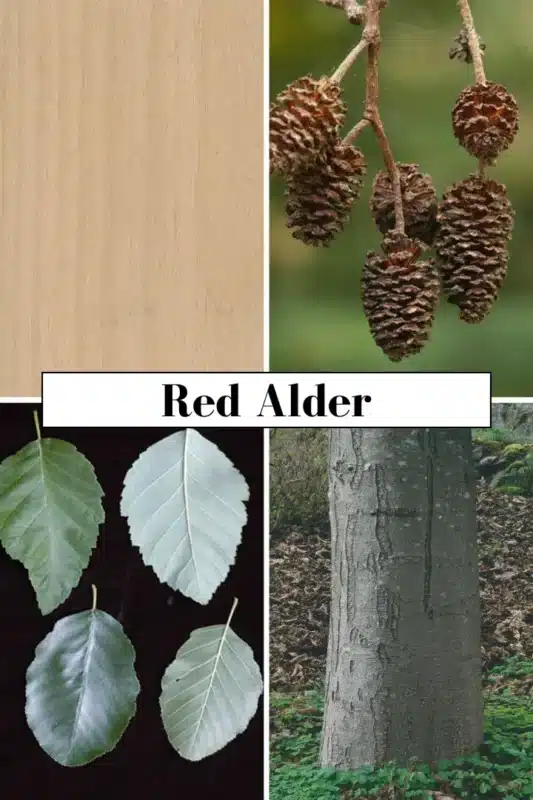
Red alder is the largest alder species native to North America. It commonly forms dense stands on moist, disturbed ground from southeastern Alaska through the Pacific Northwest and south into coastal California.
The common name refers to the red-orange inner bark and the warm color that freshly cut wood develops after exposure to air. A fresh crosscut may look pale cream at first, then shift toward soft pink or light reddish brown within minutes.
Alnus rubra Classification
Red alder Alnus rubra belongs to the birch family, Betulaceae. Its close relatives include birches, hazels, hornbeams, and other alders; accepted taxonomy can be checked through the Plants of the World Online database.
| Rank or trait | Red alder detail |
|---|---|
| Scientific name | Alnus rubra Bong. |
| Family | Betulaceae |
| Plant type | Deciduous broadleaf tree |
| Native region | Western North America |
| Typical height | 40–80 feet, with larger trees exceeding 100 feet on productive sites |
| Typical life span | About 60–100 years; some trees live longer |
| Pollination | Primarily wind pollinated |
| Fruit | Tiny winged nutlets held in woody cone-like structures |
Botanists once used the name Alnus oregona for this species, and older forestry or herbarium records may retain that synonym. Current references favor Alnus rubra, with “rubra” referring to its red coloration.
Key Red Alder Facts
Several red alder facts explain its ecological and commercial value. It grows quickly in full light, associates with nitrogen-fixing bacteria, produces abundant seed, and develops usable timber in a shorter rotation than many western hardwoods.
- It is the Pacific Northwest’s most commercially significant hardwood.
- Its roots form nodules with Frankia bacteria that convert atmospheric nitrogen into plant-accessible compounds.
- It colonizes streambanks, landslides, road cuts, burns, and harvested sites.
- It has separate male and female flowers on the same tree.
- Its cone-like fruits often remain on branches after releasing seed.
- Its pale wood accepts stains evenly when the surface is prepared correctly.
Himalayan Alder Comparison
Himalayan alder usually refers to Alnus nepalensis, a subtropical and temperate Asian species found from the Himalayas into parts of southwestern China and Southeast Asia. Like red alder, it fixes nitrogen and colonizes disturbed slopes, but it grows in a different native region and climate.
Himalayan alder often carries broader leaves with a more pointed tip, while red alder leaves commonly show tightly rolled-under margins and blunt or slightly notched bases. Geographic location remains the fastest separator: a naturally occurring wild alder in coastal Oregon is far more likely to be red alder than Himalayan alder.
Red alder also differs from European black alder, which often has rounder leaves with notched tips and favors wet soils. Comparing several features is safer than identifying an alder from leaf shape alone.
How to Identify Red Alder

Identify red alder by combining its upright form, smooth gray bark, oval leaves with rolled-under edges, hanging male catkins, and persistent woody cones. No single trait works in every season, so check bark, buds, branching, and habitat together.
Size and Form
Open-grown trees may develop broad crowns and heavy lower limbs, while forest-grown trees often have straight, clean trunks with narrow crowns. Mature specimens commonly stand 40–80 feet tall and measure 10–30 inches across, though favorable lowland sites can produce much larger trees.
Young red alders grow fast and can form crowded, nearly even-aged stands. Their trunks may lean over streams or angle toward gaps, yet the upper stem often bends upright as it reaches light.
Leaves and Bark
The leaves are usually 2–6 inches long, broadly oval, and dark green above. Their toothed margins curl under slightly, producing a firm raised rim that feels distinctive when a finger runs from the leaf base to its tip.
Leaf undersides are paler and may carry rusty hairs along the larger veins, especially on younger growth. The leaves often remain green into autumn and fall without the strong yellow display associated with many birch wood trees.
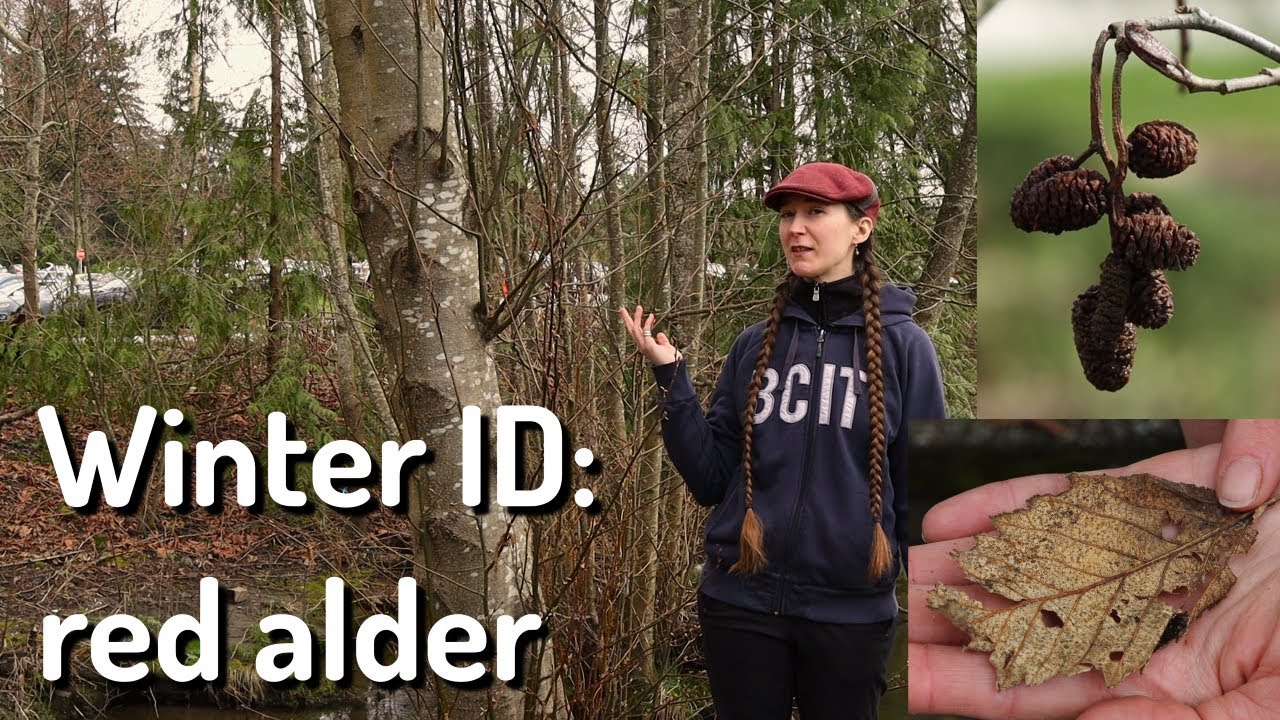
Young bark is smooth and gray, frequently mottled by white lichens. Older bark can become lightly checked but seldom develops the thick, deeply furrowed plates seen on many mature conifers.
Scraping or cutting the bark exposes pale tissue that turns orange-red as it oxidizes. Avoid damaging a living tree solely for identification; a fallen twig gives the same color-change clue without opening a wound.
Flowers and Cones
Male flowers appear in long hanging catkins, often 2–5 inches long, which release yellow pollen in late winter or early spring. Female flowers are much smaller and develop into upright, cone-like clusters.
Mature cones are roughly one-half to one inch long, brown, woody, and persistent. Seeing alder-like leaves beside clusters of miniature cones is one of the strongest field identification combinations.
Range, Habitat, and Growth
Red alder grows naturally along the Pacific side of North America, chiefly in moist lowlands and lower mountain zones. It favors open, recently disturbed sites where its light seed and fast juvenile growth provide an early advantage.
Native Range
The native range extends from southeastern Alaska and British Columbia south through Washington and Oregon into coastal California. Inland populations occur in northern Idaho and nearby areas where climate and moisture remain suitable.
Most stands occur below about 2,500 feet, but local populations climb higher in the southern part of the range. Distribution details vary with exposure, rainfall, cold-air pockets, and access to year-round soil moisture; the USDA Silvics of North America profile documents these regional patterns.
Growing Conditions
Full sun produces the strongest growth. Seedlings tolerate brief shade, but they usually lose vigor beneath a closed canopy and are eventually overtopped by longer-lived conifers.
Red alder performs well in deep, moist, well-aerated loam and alluvial soil. It tolerates seasonal flooding and poorly drained ground better than many upland hardwoods, yet roots still need oxygen; constantly stagnant water can cause weak growth and root decline.
Planting one in a small garden creates a common beginner mistake. The tree’s fast crown growth, surface roots, falling catkins, and prolific seed can conflict with paving, drains, roofs, and formal planting beds. Keep it away from structures and choose a site where leaf litter and natural regeneration can be managed.
Growth and Life Cycle
Seed production can begin when trees are only a few years old. The tiny winged seeds disperse by wind during autumn and winter, then germinate best on exposed mineral soil or thin organic layers with steady moisture.
Young trees may add several feet annually on productive sites. Height growth peaks early, slows as crowns compete, and often gives way to shade-tolerant conifers if disturbance doesn’t reopen the stand.
Cut stumps can sprout, especially when the tree is young, but red alder is less persistent through vegetative regrowth than some hardwoods. Managers usually rely on natural seedfall or planted seedlings when re-establishing a stand.
Many trees live for 60–100 years. Stem decay, wind exposure, saturated soils, and crown competition shorten life, while dominant trees on productive sites may remain sound for longer.
Red Alder Tree Benefits
Major red alder tree benefits include wildlife food, streamside cover, fast erosion control, organic matter production, and biological nitrogen fixation. These functions make the species useful in early forest succession and restoration, but dense stands can also compete with planted conifers.
Wildlife Value
Birds consume the small seeds, while deer, elk, and beavers browse twigs, leaves, or bark. Dense young stands provide cool shaded cover, and mature trees develop cavities or dead branches used by birds and small mammals.
Streamside alder canopies reduce direct summer sunlight and contribute leaves, twigs, and insects to aquatic food webs. Large fallen stems also add structural cover where channel size and wood retention permit it.
Soil Benefits
Root nodules house Frankia bacteria that perform nitrogen fixation. The resulting nitrogen enters the site through fine-root turnover, fallen foliage, dead nodules, and decomposing woody material rather than acting like an instant bagged fertilizer.
Alder litter decomposes faster than the needle litter of many neighboring conifers. That quick breakdown can raise nutrient availability, but nutrient release depends on temperature, moisture, soil organisms, and the carbon-to-nitrogen balance of surrounding material.
More nitrogen isn’t always better. In nutrient-sensitive habitats, added nitrogen may favor invasive plants or alter native plant communities, so restoration planting should match the site’s original vegetation and management goal.
Ecosystem Role
Red alder acts as a pioneer tree after floods, fires, landslides, or timber harvests. Its roots hold loose soil, its crown softens rainfall impact, and its litter starts rebuilding surface organic matter.
The species can support conifer growth by adding nitrogen, yet dense alder crowns may reduce conifer light and space. Mixed management works best when stem density, target species, and harvest timing are set from field measurements rather than the assumption that every alder improves every site.
Field experience insight: young alder is easy to underestimate. A knee-high seedling can become a head-high competitor in a few growing seasons, so early spacing costs less than cutting crowded, leaning stems later.
Practical woodland observation
Red Alder Wood and Uses

Red alder wood is a light, moderately soft hardwood with fine, even texture and a subdued grain. It machines cleanly, glues well, and accepts many finishes, making it useful for furniture, cabinet parts, moulding, turnings, and interior components.
Wood Characteristics
Freshly sawn stock starts pale and develops a warm pink-tan color after air exposure. Sapwood and heartwood show little visual separation, which helps boards produce a consistent field of color across wide cabinet panels.
Typical dry density is about 28 pounds per cubic foot, while Janka hardness is near 590 pounds-force. That places alder below hard maple and many oaks, which means tools cut it easily but dropped objects can dent the surface.
The grain is usually straight and the pores are small and evenly distributed. Compared with strongly figured woods, its quiet appearance gives stains and sprayed colors a predictable background; see the broader guide to wood grain patterns for visual comparisons.
A sharp hand plane leaves a smooth, faintly silky surface, while dull cutters can crush soft fibers around reversing grain. Sanding too aggressively with a fine grit can burnish the surface, causing stain to look lighter than expected.
Furniture and Cabinetry
Red alder furniture works best where easy machining, moderate weight, and controlled color matter more than impact resistance. Common applications include cabinet doors, drawer fronts, tables, chairs, bed frames, moulding, and veneered panels.
Its plain grain can imitate cherry wood after staining, but the two don’t wear the same way. Alder dents sooner, and its color comes largely from finish rather than the deeper natural darkening associated with cherry.
Beginners often apply dark wiping stain directly to sanded alder and get muddy blotches around end grain, glue-starved areas, and softer growth zones. A sprayed dye, thin washcoat, or conditioner followed by a gel stain provides better control; test the complete schedule on an offcut from the same board.
Pre-drill screws near board ends and avoid overtightening hardware in narrow parts. Alder holds normal cabinet fasteners well, but its softer fibers can strip if a driver clutch is set too high.
For comparisons by hardness, use, and wear, consult the furniture wood guide.
These woodworking products can help with cutting, sanding, testing stains, and applying finishes to alder projects.
Other Practical Uses
Other red alder uses include interior doors, millwork, picture frames, toys, carvings, turned objects, pallets, veneer, plywood core stock, and pulp. Fine texture also makes it suitable for painted or lacquered components where coarse pores would remain visible.
Alder has a long association with smoking food, especially Pacific salmon. Its smoke is mild and slightly sweet compared with hickory or mesquite, but only clean, untreated, dry wood should contact cooking smoke.
It performs poorly in prolonged outdoor exposure because untreated wood has low decay resistance. Paint can slow moisture entry, but it can’t make alder a dependable substitute for naturally durable or properly treated exterior lumber.
Lessons learned in practice: acclimate boards before milling, remove roughly equal material from both faces, and let newly flattened stock rest before final thicknessing. Wide alder boards can move after internal stresses are released, particularly when one face arrives wetter than the other.
Color sorting should happen under neutral light before glue-up. Two boards that look identical in a dim shop may show distinct pink, tan, or gray bands beneath a clear finish; wetting an offcut with mineral spirits offers a brief preview without committing to a coating.
Traditional Medicinal Uses
Reported red alder medicinal uses come mainly from Indigenous ethnobotanical traditions, where bark, leaves, and related preparations were used for selected skin complaints, sore areas, digestive symptoms, and other community-specific purposes. These records describe historical use; they don’t prove safety or clinical effectiveness.
Historical Uses
Ethnobotanical records describe bark washes, poultices, decoctions, and infusions used by different Pacific Northwest peoples. Reported alder tree medicinal uses vary by community, preparation method, season, and plant part, so they shouldn’t be compressed into one universal remedy.
Historical accounts include external preparations for skin irritation, sores, aches, and cleansing, plus internal preparations for certain digestive or respiratory complaints. The University of Michigan’s Native American Ethnobotany Database helps trace individual records back to documented sources.
Bark also served as a red-brown dye for fibers, baskets, skins, and other materials. Dye use and medicinal use sometimes appear beside each other in historical records, but one doesn’t confirm the safety of the other.
Plant Parts Used
The bark is the most frequently mentioned plant part, often because it contains astringent tannins and produces a strongly colored liquid. Leaves and catkins appear in some records, while charcoal or heated wood had separate practical uses.
Preparation details matter. Fresh bark, dried bark, a cool soak, a boiled decoction, and an external wash can produce very different concentrations, yet surviving summaries often omit exact quantities.
Harvesting strips around a trunk can girdle and kill the tree. Historical interest isn’t a reason to cut living bark; use documented museum or academic references rather than testing unidentified material.
Safety Considerations
Red alder preparations lack enough modern human research to establish reliable doses, drug interactions, or benefits. Don’t use the plant as a replacement for diagnosis or medical care, and don’t ingest homemade bark products based only on an online identification.
Misidentification is a risk because several alder species look similar, and bark collected near roads, industrial land, sprayed rights-of-way, or contaminated water may carry unwanted chemicals. Moldy or poorly stored plant material adds another exposure route.
Tannins and other compounds may irritate the stomach or skin, while pollen can trigger allergic symptoms in sensitive people. Pregnancy, breastfeeding, childhood, liver or kidney disease, bleeding disorders, and prescription drug use call for direct guidance from a qualified clinician or pharmacist.
For suspected poisoning, a serious skin reaction, breathing trouble, or worsening symptoms, seek urgent medical help or contact a poison control service. The safest approach is to treat traditional alder records as cultural and historical evidence, not a home dosing guide.
FAQs
What Is Red Alder Used For?
Red alder is commonly used for cabinetry, furniture, veneer, doors, and interior trim because it machines easily and finishes well. Its wood is also used for paper pulp, smoking foods, and small craft projects. In forests, red alder can help restore disturbed sites by improving soil nitrogen.
How Can You Identify A Red Alder Tree?
You can identify a red alder by its smooth gray bark, oval serrated leaves, and small woody cone-like fruits that remain on branches. The leaves often have rolled-under edges and rusty hairs along the veins. In spring, the tree produces long hanging catkins, usually before the leaves fully emerge.
Is Red Alder Wood Good For Furniture?
Yes, red alder wood is good for furniture, especially painted, stained, or medium-duty indoor pieces. It is moderately soft, stable, easy to cut, and accepts finishes evenly, giving it a warm, uniform appearance. It is less durable than hardwoods such as oak, so protect it from heavy wear and moisture.
What Are The Medicinal Uses Of Red Alder?
Red alder has been used traditionally in some Indigenous and folk practices as a wash, tea, or poultice for minor skin and digestive concerns. Scientific evidence for these uses is limited, and preparations may not be safe for everyone. Do not self-treat serious conditions; ask a qualified healthcare professional before using red alder medicinally.
What Benefits Do Red Alder Trees Provide?
Red alder trees improve soil by hosting bacteria that add nitrogen, helping other plants establish on poor or disturbed ground. They also provide shade, stabilize streambanks, store carbon, and offer food and habitat for wildlife. Their fast growth makes them valuable in restoration projects, though they need suitable moisture and space.
Affiliate Disclosure: Some links in this post are affiliate links. If you make a purchase through these links, we may earn a small commission at no extra cost to you. We only recommend products we genuinely believe in.