
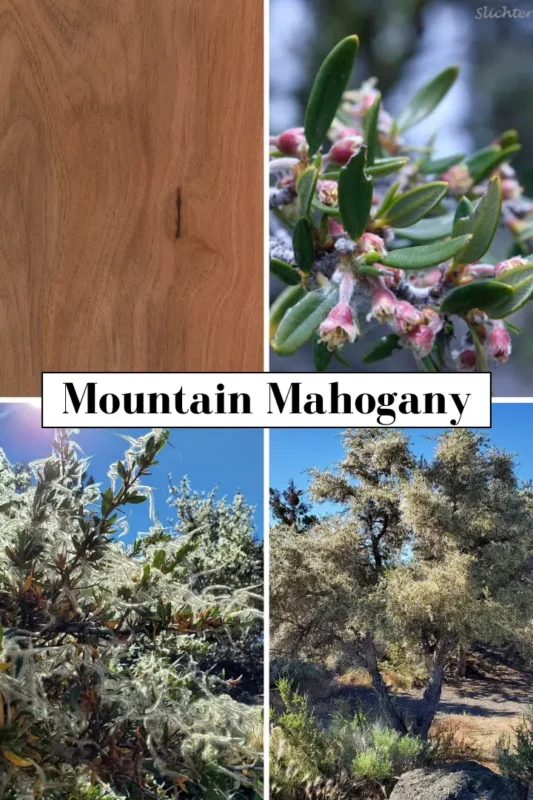
Mountain Mahogany: Identification, Species, Growing Guide and Wood Uses

Mountain mahogany is the common name for drought-adapted shrubs and small trees in the genus Cercocarpus, part of the rose family, Rosaceae. It grows mainly in western North America, produces distinctive feathery fruits, and isn’t botanically related to true mahogany.
This guide compares the main species, explains field identification and propagation, and covers the unusual properties of mountain mahogany wood.
Table of Contents
What Is Mountain Mahogany?
Genus and Plant Family
Mountain mahogany refers to several species of Cercocarpus. These western native plants belong to Rosaceae, placing them with roses, serviceberries, apples, and other rose-family plants rather than tropical mahoganies.
Taxonomic sources differ on the number and boundaries of recognized species. The Flora of North America treatment is useful because it describes the genus and its species separately instead of treating every mountain mahogany as one uniform plant.
Tree or Shrub?
Mountain mahogany can be a shrub or tree. Species, soil depth, moisture, browsing, wind exposure, and age determine whether a plant stays low and multi-stemmed or develops a substantial trunk.
Curl-leaf mountain mahogany often reaches about 10–25 feet, while old specimens on favorable sites can exceed 30 feet. Littleleaf plants may remain compact and densely branched because that form fits their rocky habitat; it doesn’t indicate poor care.
Mountain Mahogany vs. Mahogany. True mahogany belongs to Swietenia in the Meliaceae family and grows as a large tropical tree. Cercocarpus gained its common name from its dark, exceptionally hard wood, not from a close botanical relationship; see the separate guide to mahogany wood for the tropical timber.
| Feature | Mountain mahogany | True mahogany |
|---|---|---|
| Primary genus | Cercocarpus | Swietenia |
| Plant family | Rosaceae | Meliaceae |
| Native region | Western North America | Tropical Americas |
| Common form | Shrub or small tree | Large tree |
| Timber market | Rare specialty blanks | Commercial boards and veneer |
| Typical uses | Habitat, restoration, turning, small tools | Furniture, cabinets, instruments, veneer |
“Mahogany Mountain” clarification. Mahogany mountain isn’t the accepted botanical name for Cercocarpus. The reversed wording may indicate a geographic feature, trail, property, or a simple word-order variation; the plant’s established common name is mountain mahogany.
Mountain Mahogany Species Compared

Mountain mahogany species differ in leaf shape, size, range, seasonal foliage, and post-fire behavior. Identifying the species matters before choosing a landscape plant, seed treatment, restoration source, or pruning method.
Curl-Leaf Mountain Mahogany
Curl-leaf mountain mahogany, Cercocarpus ledifolius, is usually evergreen. Its narrow, leathery leaves have margins rolled downward, exposing pale or hairy undersides along the curled edges.
This species commonly occupies dry ridges, woodland openings, and rocky mountain slopes at roughly 2,000–10,000 feet, depending on latitude and local climate. The crown can feel stiff and dry in the hand, while crushed foliage may give off a faint resinous scent.
Alder-Leaf Mountain Mahogany
Alder-leaf mountain mahogany, Cercocarpus montanus, usually forms a broad shrub with wider leaves and toothed upper margins. It can be deciduous or semi-evergreen, especially where winters are cold or summer drought is severe.
Cercocarpus montanus occurs in Rocky Mountain foothills, canyons, grassland margins, and dry shrub communities. Deer and elk browse it heavily, which can leave a flat, clipped crown that beginners sometimes mistake for intentional pruning.
Birch-Leaf Mountain Mahogany. Birch leaf mountain mahogany, Cercocarpus betuloides, has broader, birch-like leaves and is associated with California chaparral, foothill woodland, dry canyons, the Southwest, and northern Baja California. It can serve as a native hedge or wildlife screen where the site matches its regional needs.
Littleleaf Mountain Mahogany. Cercocarpus intricatus carries tiny evergreen leaves on a dense network of slender branches. Its compact form suits dry rock gardens, but rich soil and frequent irrigation can produce weak shoots that lose the plant’s naturally tight structure.
Catalina Island Mountain Mahogany. Cercocarpus traskiae is a highly restricted Santa Catalina Island endemic. Its small population and conservation status make it a protected species rather than an ordinary choice for seed packets or home landscaping.
Species Comparison Table. Leaf characters provide a useful starting point, but location, flowers, fruits, and mature growth form should support the identification.
| Species | Leaf habit | Key field character | General setting |
|---|---|---|---|
| C. ledifolius | Evergreen | Narrow leaves with curled-under margins | Interior western ridges and mountains |
| C. montanus | Deciduous to semi-evergreen | Broader leaves, often toothed above | Rockies, foothills and shrublands |
| C. betuloides | Evergreen to semi-evergreen | Broad, birch-like leaves | California chaparral and foothills |
| C. intricatus | Evergreen | Tiny leaves and intricate branching | Arid rocky sites |
| C. traskiae | Evergreen | Rare island-endemic form | Santa Catalina Island |
How to Identify Mountain Mahogany

Identify mountain mahogany by combining its small drought-adapted leaves, inconspicuous flowers, plume-tailed fruits, and twisted gray or reddish-brown stems. The silvery fruit plumes are often the clearest feature from a distance.
Leaves and Growth Form
Curl-leaf leaves are narrow, leathery, and strongly rolled beneath. Alder-leaf and birch-leaf species have wider blades, while littleleaf mountain mahogany has minute foliage arranged along densely interlaced branches.
Growth form changes with the site. Wind creates low, twisted crowns; browsing produces dense hedges; deeper soil supports upright trunks. A field identification based only on height is unreliable because the same species can resemble a knee-high shrub or a small tree.
Flowers and Pollination
Mountain mahogany flowers are small and understated, without the colorful petals people associate with garden roses. Wind moves much of the pollen, so open flower structure and exposed branch positions matter more than showy blossoms.
Feathery Achenes. Each dry, one-seeded achene carries a long, hairy persistent style. The plume catches wind and twists as humidity changes, helping the fruit settle into litter, cracks, or loose surface soil.
Fresh plumes feel soft and silky when brushed with a fingertip, but the pointed achene beneath can catch on fabric or prick bare skin. A common identification mistake is calling the entire plume a seed; the actual seed sits inside the hard, narrow fruit.

Bark and Trunks. Young bark ranges from gray to reddish brown. Older stems become furrowed, dark, and twisted, with multiple trunks common after browsing, weather damage, or branching close to the ground.
Habitat, Ecology, and Fire Response
Mountain mahogany occupies dry western habitats from foothills to high mountain slopes. Its roots tolerate lean, alkaline ground, support nitrogen-fixing bacteria, and help stabilize exposed soil, yet each species responds differently to fire and browsing.
Range and Elevation
The genus is centered in western North America, including the Great Basin, Rocky Mountains, Colorado Plateau, Sierra Nevada region, California chaparral, southwestern canyons, and parts of northern Mexico.
Elevation affects cold exposure, snowpack, seed dormancy, and growth rate. A seed source collected at 8,000 feet may behave poorly on a hot low-elevation site, despite carrying the same scientific name as a local population.
Soil and Exposure
Most species favor sun and drainage. They grow on rocky slopes, limestone outcrops, canyon walls, woodland margins, and coarse mineral soils where many ornamental shrubs struggle.
Low fertility is rarely the main problem. Saturated ground is more dangerous because oxygen-poor soil damages drought-adapted roots; a wet clay depression can kill a plant that survives years of heat on a dry slope.
Nitrogen Fixation. Mountain mahogany is actinorhizal. Root nodules host Frankia bacteria that convert atmospheric nitrogen into usable compounds, with some nitrogen later entering nearby soil through root turnover, fallen leaves, and decomposition.
Wildlife and Restoration. Mule deer, elk, bighorn sheep, and livestock browse the foliage and twigs. Dense crowns offer bird cover, while extensive roots support erosion control; restoration still depends on matching species, elevation, precipitation, and seed origin to the site.
Species-Specific Fire Response. Curl-leaf mountain mahogany can be top-killed or killed by severe fire and often resprouts poorly. Alder-leaf mountain mahogany may sprout after top-kill, but results change with plant age, soil moisture, burn season, and fire intensity; the Fire Effects Information System provides species-level fire records.
Defensible-Space Considerations. Drought tolerance doesn’t equal fire survival or low flammability. Fine twigs, evergreen foliage, dead interior branches, and connected crowns can carry flame, so keep plants away from structures according to local rules and remove dead material without stripping the live crown.
How to Grow Mountain Mahogany
Grow mountain mahogany in full sun with fast-draining soil, room for mature roots, and irrigation only during establishment or prolonged drought. Species selection and seed provenance matter more than fertilizer or intensive pruning.
Climate and Site Selection
Choose a species native to, or proven in, a climate resembling your site. Dry western gardens are the easiest fit; humid regions and locations with warm, wet soil create greater root-disease risk.
Place the plant on a slope, berm, or open mineral soil if drainage is uncertain. Avoid irrigated lawns, roof-drain outlets, narrow foundation beds, and pockets where winter water sits around the root crown.
Watering and Drainage
Water a new plant deeply, then let the upper soil begin drying before watering again. Frequent surface sprinkling encourages shallow roots, while a slow soak wets the deeper root zone without keeping the crown constantly damp.
The practical check is tactile: soil several inches down should feel cool and lightly damp, not slick, sticky, or sour-smelling. Established plants need far less irrigation, though severe heat on shallow soil can still cause leaf loss.
Pruning and Spacing. Remove dead, crossing, or damaged wood with clean tools and retain the natural multi-stemmed outline. Heavy cutback can permanently disfigure slow-growing curl-leaf plants, so don’t assume every species will resprout from old wood.
Allow roughly the expected mature crown width between plants, then increase separation where defensible-space rules apply. Curl-leaf mountain mahogany often grows 10–25 feet tall and wide, with older plants becoming larger.
Seed Viability. A plume-tailed fruit may be empty or contain an undeveloped embryo. Ask for the scientific name, collection date, origin, elevation, purity percentage, and germination test; ten fruits don’t equal ten viable seedlings.
Cold-Moist Stratification. Many seed lots benefit from roughly one to three months of cold, moist treatment, but the correct period varies by species and source. Mix seeds with barely moist sterile medium, refrigerate without freezing, and inspect weekly for mold or emerging roots.
Sowing and Transplanting. Sow shallowly in a deep, free-draining container and keep the medium evenly moist rather than saturated. Move germinated seed carefully because the young root can feel surprisingly stiff yet snaps easily where it exits the achene.
- Confirm the scientific species and collection origin.
- Follow the seed lot’s recommended pretreatment.
- Use clean, barely moist stratification medium.
- Check weekly and sow once a root appears.
- Use deep pots that prevent early root crowding.
- Harden seedlings gradually before planting outside.
Germination Failures. Common causes include old seed, excessive stratification moisture, deep sowing, dry media after germination starts, crowded roots, and moving seedlings straight into hot drought conditions. If mold keeps returning, reduce moisture and increase cleanliness rather than adding more water.
Practical Notes From Real-World Use. The most reliable seedlings often come from several deep containers rather than one crowded tray. Roots separate poorly once intertwined, and delayed transplanting can turn an apparently healthy seedling into a stalled plant within days.
Buying Seeds Responsibly. A listing called “mountain mahogany” may contain C. ledifolius, C. montanus, another Cercocarpus, or mislabeled seed. Check the botanical name, legal collection status, regional fit, treatment directions, and tested germination before ordering.

Mountain Mahogany Bush Seeds
- Includes 10 mountain mahogany seeds
- Ideal for drought-tolerant landscapes
- Native-style shrub with distinctive foliage
- Suitable for sunny planting areas
- A rewarding choice for patient gardeners
 Buy on Amazon
Treat this packet as a possible seed source, not proof of species, provenance, or germination. Request missing details from the seller and don’t use an unidentified packet for ecological restoration.
Mountain Mahogany Wood and Uses
Mountain mahogany wood is a dense specialty material used mainly for turning blanks, knife scales, handles, pens, carvings, and small durable objects. Small twisted stems, checks, knots, and limited clear heartwood make conventional boards uncommon.
Color and Grain
Heartwood ranges from orange-brown and reddish brown to dark chocolate, while the sapwood is much lighter. Straight sections can show fine, even grain, but branch junctions and twisted trunks produce irregular figure and tear-out risk.
A freshly cut surface can look dusty and muted. Fine sanding and a wiped finish reveal a deep warm luster, while the wood’s weight feels unusually heavy for a small blank.
Hardness and Density
Published specialty-wood figures place dried weight near 62 pounds per cubic foot, or 995 kilograms per cubic meter, and Janka hardness near 3,200 pound-force. Treat these as approximate wood values because species identity, moisture, site, and sample size can change the result.
| Mountain mahogany wood property | Approximate value | Practical meaning |
|---|---|---|
| Dried weight | 62 lb/ft³ or 995 kg/m³ | Heavy for its dimensions |
| Janka hardness | 3,200 lbf or 14,230 N | High wear resistance and tool strain |
| Specific gravity | About 0.80 to 0.99, depending on reference basis | Dense stock with little tolerance for blunt tools |
| Commercial form | Small blanks and irregular pieces | Rarely suitable for wide furniture panels |
This reported hardness places it above many familiar furniture species, but hardness alone doesn’t make wood better. Compare its working behavior with the broader wood hardness scale and other dense woods such as manzanita wood.
Traditional and Modern Uses. Regional uses have included digging sticks, bows, tool parts, implements, fuel, and charcoal. Modern woodworkers favor pen blanks, knife scales, inlays, handles, carvings, and small turned forms where hardness and polish justify the slow machining.
Historical practices differed among Indigenous peoples and regions, so broad claims shouldn’t be assigned to every community. A responsible account names the people, place, species, and source connected with each documented use.
Workability Challenges. Dense wood dulls edges, burns during drilling or sanding, and splits around fasteners. Irregular grain tears near knots, while green rounds can form deep end checks that remove much of the usable heartwood.
Woodworking Best Practices. Use sharp carbide tooling, light cuts, low sanding pressure, and frequent pauses to release heat. Predrill every fastener hole, seal the ends of green stock, and let blanks reach stable moisture before final turning.
- Inspect both ends for checks extending beneath wax or sealer.
- Mark knots and grain reversals before cutting.
- Cut oversized blanks to allow for movement.
- Clear drill chips often to limit scorching.
- Stop sanding if the surface becomes hot to the touch.
- Wear respiratory protection and use dust extraction.
Availability and Pricing. Mountain mahogany isn’t traded like standard cabinet lumber. Local salvagers, turners, arborists, and specialty blank sellers are more likely sources, and nominal board-foot cost can hide poor yield from checks, sapwood, knots, and twisted grain.
Compare the cost per usable blank or cubic inch of sound heartwood. A cheap branch section can become expensive after trimming defects, while a smaller, dry, square blank may offer better value and less shop time.
Wood Buying Checklist. Ask for the species name, legal source, moisture content, exact dimensions, end-check depth, sapwood ratio, and clear photos of every face. Favor salvaged material and reject pieces represented as dry when waxed ends conceal wet interiors.
Conservation and Responsible Sourcing
Mountain mahogany isn’t endangered as a whole, but conservation status varies sharply among species and populations. Responsible sourcing requires legal seed collection, documented provenance, nursery propagation, and salvaged wood rather than cutting old living plants.
Species-Level Conservation
Widespread species can be locally abundant while still showing poor seedling recruitment. Drought, invasive plants, browsing, altered fire patterns, development, and slow replacement of mature stands can reduce a population without making the entire genus rare.
Catalina Island Protection
Cercocarpus traskiae is a federally endangered Santa Catalina Island plant with an extremely restricted distribution. The U.S. Fish and Wildlife Service species profile documents its protected status and conservation context.
Browsing and Fire Threats. Heavy browsing can suppress seedlings and create old stands with little replacement. Severe fire can remove curl-leaf plants that don’t resprout reliably, and recovery may take decades where viable seed and favorable establishment years are scarce.
Seed Provenance. Match collection location, elevation, rainfall pattern, and winter temperature to the planting area. Local or regionally compatible seed is especially valuable in restoration, where survival matters more than producing a seedling under protected nursery conditions.
Sustainable Wood Sourcing. Favor storm-damaged, road-clearance, fire-management, arborist, or legally salvaged stock. Old curl-leaf trunks may represent many decades of growth, so cutting a live specimen for a few small blanks carries a poor replacement trade-off.
Legal Collection. Never assume seed, branches, deadwood, or standing plants on public land are free to take. Check landowner permission, agency permits, protected-species rules, transport restrictions, and local firewood regulations before collection.
Mountain Mahogany FAQs
These concise answers address common questions about mountain mahogany care, growth, safety, wildlife use, and soil tolerance. Species and regional conditions can change the answer, so confirm the botanical name before applying care advice.
Is It Evergreen?
Some species are evergreen. Curl-leaf mountain mahogany is usually evergreen, while alder-leaf mountain mahogany can be deciduous or semi-evergreen; drought, cold, and site exposure also affect leaf retention.
How Fast Does It Grow?
Most mountain mahogany grows at a slow to moderate rate. Rocky soil, wind, browsing, and drought reduce annual growth, while extra irrigation may speed young plants but can create soft shoots and root problems if overused.
Are the Roots Invasive? The roots are extensive and drought adapted, but mountain mahogany isn’t commonly classed with aggressively surface-rooting urban trees. Leave space from foundations, drains, paving, and confined beds because mature roots still spread beyond the crown.
Is It Poisonous? Deer, elk, and livestock browse the plant, but wildlife use doesn’t prove that every part is safe for people. Don’t eat or prepare medicinal products from an unidentified species without reliable toxicological and species-specific guidance.
Do Deer Eat It? Yes. Mountain mahogany provides significant browse in many western habitats, especially when other forage is limited; protect young landscape plants with a wide cage because deer can repeatedly clip new stems.
Can It Grow in Clay? Some species tolerate clay if water drains freely. Plant on a broad mound or slope rather than digging a small amended pocket, which can hold water like a basin and leave roots in sticky, oxygen-poor soil.
FAQs
What Is Mountain Mahogany And Is It A True Mahogany?
Mountain mahogany is a drought-tolerant North American shrub or small tree, but it is not a true mahogany. It belongs to the rose family, while true mahoganies are tropical trees in the genus Swietenia. Its name comes from its dense, reddish-brown wood.
Is Mountain Mahogany A Tree Or A Shrub?
Mountain mahogany can grow as either a shrub or a small tree, depending on the species and growing conditions. Some varieties form broad, multi-stemmed shrubs, while curl-leaf mountain mahogany can develop a single trunk. Dry sites, wind, and browsing often keep plants shorter.
How Tall Does Curl-Leaf Mountain Mahogany Grow?
Curl-leaf mountain mahogany usually grows 10 to 35 feet tall, although exceptional plants can reach about 50 feet. It grows slowly and often stays smaller in harsh, dry, or windy locations. Mature plants may be equally wide or develop a narrow, upright form.
Can You Grow Mountain Mahogany From Seed?
Yes, mountain mahogany can be grown from seed, but germination may be slow and uneven. Collect ripe seeds in late summer or fall, then give them a cool, moist stratification period before planting. Use well-drained soil and avoid overwatering young seedlings.
How Hard Is Mountain Mahogany Wood?
Mountain mahogany wood is exceptionally hard, dense, and durable, often considered harder than many common hardwoods. Its close grain makes it resistant to wear, but it can be difficult to cut, drill, and shape. It is valued for small turned objects, tool handles, and firewood.
Affiliate Disclosure: Some links in this post are affiliate links. If you make a purchase through these links, we may earn a small commission at no extra cost to you. We only recommend products we genuinely believe in.