
Birch Wood Guide: Species, Properties, Uses and Buying Advice

Birch wood is a pale, fine-textured hardwood obtained from deciduous trees in the Betula genus. Its uses include furniture, birch cabinets, flooring, plywood, veneer, engraved crafts, utensils, pulp, and firewood, though hardness and durability vary by species.
Commercial yellow birch differs from lighter paper birch and gray birch, while Baltic birch describes a plywood construction rather than a tree. This guide explains those distinctions and shows how to select, finish, use, and maintain the material.
Table of Contents
What Is Birch Wood?

Birch is hardwood from broadleaf flowering trees in the Betulaceae family. Planed timber usually has pale cream or yellow sapwood, light brown to reddish heartwood, small pores, and a smooth grain that feels almost satin-like after sharp-planed surfaces receive a light sanding.
Birch Trees and Timber
The Betula genus includes many trees and shrubs across cooler parts of North America, Europe, and Asia. Timber sold simply as birch may come from yellow, sweet, paper, European, or another species, so species identification matters before comparing hardness or strength.
Yellow birch supplies a large share of North American furniture lumber. Paper birch often goes into pulp, veneer, small woodenware, decorative branches, and birch wood logs, while European species commonly supply furniture and plywood.
Why Birch Is Hardwood
Birch qualifies as a hardwood because it comes from an angiosperm: a flowering broadleaf tree with enclosed seeds. The hardwood label describes botanical anatomy, not how difficult a board is to dent or cut.
That distinction explains why a search for “birch softwood” produces conflicting answers. Birch isn’t a softwood, though paper birch is softer than hard maple and some dense tropical hardwoods; see the wider classification in this guide to types of hardwood.
Hardwood vs Physical Hardness
Physical hardness varies by species. Black birch measures about 1,470 pounds-force on the Janka scale, yellow birch about 1,260 lbf, and paper birch about 910 lbf, compared with roughly 380 lbf for eastern white pine.
Janka testing measures resistance to indentation by pressing a steel ball into a specimen. It doesn’t establish bending strength, rot resistance, waterproofness, or the quality of a finished panel; those properties need separate evidence.
Birch Species and Identification

Birch species differ in bark, mature size, density, color, hardness, and commercial value. Yellow and black birch usually produce harder furniture timber, while paper and gray birch tend to be lighter and less hard.
Species Comparison Table
| Common name | Scientific name | Typical height | Approximate Janka hardness | Common clues and uses |
|---|---|---|---|---|
| Yellow birch | Betula alleghaniensis | 65–100 ft | 1,260 lbf | Yellow-bronze bark; furniture, floors, cabinets, veneer |
| Paper birch | Betula papyrifera | 50–70 ft | 910 lbf | White peeling bark; pulp, small objects, logs |
| Black or sweet birch | Betula lenta | 50–80 ft | 1,470 lbf | Dark bark and wintergreen-scented twigs; furniture and flooring |
| Gray birch | Betula populifolia | 20–40 ft | Limited standardized data | Chalky bark, small stature; pulp and fuel |
| Silver birch | Betula pendula | 40–80 ft | About 1,210 lbf | Drooping twigs; furniture, plywood, pulp, firewood |
The figures are practical comparisons rather than promises for every board. Moisture, growing conditions, specimen quality, and test methods cause normal data variation.
Yellow Birch
Yellow birch is one of North America’s main commercial birches. Its fine texture, roughly 43 lb/ft³ dried density, and useful strength suit chairs, tables, flooring, cabinet doors, millwork, veneer, and turned parts.
Sapwood is pale, while heartwood can show warm reddish-brown streaks. Mixed-color boards may look attractive in natural furniture but create trouble when a client expects uniformly pale birch cabinets, so sort parts under neutral light before assembly.
Paper Birch
Paper birch, or Betula papyrifera, is the familiar northern North American species with mature white bark that separates into thin papery layers. It’s lighter and softer than yellow or black birch and is used for pulp, veneer, turned goods, decorative logs, and fuel.
The alternate name canoe birch reflects long-established uses of bark by Indigenous communities for canoes, roofing, containers, and other objects. Bark shouldn’t be stripped from living trees because removing enough of it can injure or kill the stem.
Black Birch Tree
A black birch tree, Betula lenta, may resemble a cherry tree more than a white-barked birch. Its young bark is dark and marked by horizontal lenticels, while a lightly scratched twig releases a sharp wintergreen scent.
Black birch wood reaches about 1,470 lbf Janka, placing it near hard maple in indentation resistance. Its density, fine texture, and reddish heartwood make it useful for floors, furniture, cabinets, veneer, and turning.
Gray Birch
Gray birch, Betula populifolia, is a small, short-lived pioneer that often colonizes sandy, dry, or disturbed ground. It may form several stems, and its chalky white or gray bark tends to peel less freely than paper birch bark.
The comparatively light wood has limited value as commercial lumber. Common outlets include pulp, fuel, and small utility pieces, making a “gray birch lumber” label less common at mainstream hardwood suppliers.
Silver Birch
Silver birch, Betula pendula, is native to Europe and parts of Asia. Mature specimens show white bark, dark fissures near the trunk base, toothed triangular leaves, and slender branchlets that hang downward.
European birch is used for furniture, plywood, flooring, turned pieces, pulp, and fuel. Its reported Janka hardness of about 1,210 lbf places it close to yellow birch, though supplier labels may combine material from more than one European species.
Identifying Birch Lumber
Planed birch lumber commonly shows small, evenly distributed pores, fine texture, subdued growth rings, and straight grain. Its color ranges from creamy white to light reddish brown, with less earlywood-to-latewood contrast than oak.
Color alone isn’t reliable because maple, alder, beech, poplar, and stained wood can look similar. Examine clean end grain with magnification, check density, and request supplier records before assigning a species to valuable stock; related visual examples appear in this wood grain guide.
Identifying Birch Trees
Birches usually have alternate simple leaves, toothed margins, male and female catkins, and horizontal bark lenticels. White bark isn’t enough for identification because paper, gray, silver, and several ornamental birches can all appear pale.
- Paper birch develops bark that peels in broad, thin strips.
- Gray birch stays smaller and often has dark triangular marks beneath branches.
- Black birch has dark bark and wintergreen-scented young twigs.
- Silver birch develops drooping branchlets and dark basal fissures.
- Yellow birch often has bronze or yellowish bark that curls in narrow strips.
Check bark, leaf shape, branching, habitat, and geographic range together. The Kew Plants of the World Online database provides accepted botanical names and distribution records for checking uncertain identifications.
Ambiguous Supplier Labels
Labels such as “birch,” “white birch,” and “European birch” don’t always name one species. A supplier may use a regional trade category, so ask for the scientific or trade species, origin, grade, drying method, and core composition where plywood is involved.
Baltic birch creates another common mix-up: it’s a plywood trade and construction category, not a separate tree. Likewise, a birch-faced panel may contain only two thin birch faces over poplar, mixed hardwood, MDF, or particleboard.
Birch Wood Properties
Birch wood properties include fine texture, moderate-to-high hardness, useful indoor strength, and low natural decay resistance. Exact values must be tied to a species rather than applied to every birch board.
Color, Grain, and Figure
Birch color usually runs from off-white and pale yellow to light golden or reddish brown. Freshly sanded pale stock can look almost luminous under side lighting, while oil finish makes the warmer heartwood lines visibly deepen within minutes.
The wood is diffuse-porous, producing fine, even grain rather than oak’s open-pore pattern. Curl, flame, and masur figure occur, but those terms describe visual effects and don’t identify one universal species; compare the broader range of wood colors.
Hardness and Density
Black birch is about 1,470 lbf Janka, yellow birch 1,260 lbf, silver birch roughly 1,210 lbf, and paper birch 910 lbf. These numbers help predict dent resistance, but density and hardness still vary within a species.
Yellow birch averages roughly 43 lb/ft³, or 690 kg/m³, when dried. Denser stock feels noticeably weighty when lifting wide boards and places greater demands on wall anchors, drawer slides, and shipping than lightweight poplar or pine.
Strength and Shrinkage
Published yellow birch data include a modulus of rupture near 16,600 psi and modulus of elasticity near 2.0 million psi. These values explain its use in chair parts and flooring, but structural calculations still require the correct species and grade.
Yellow birch shrinkage from green to oven-dry is roughly 7.3% radial, 9.5% tangential, and 16.8% volumetric. The USDA Forest Products Laboratory’s Wood Handbook explains why grain direction and moisture changes control shrinkage.
Seasonal Wood Movement
Birch expands and contracts mainly across its grain as indoor humidity changes. A wide solid top fixed rigidly to a cabinet base can split, bow, or pull fasteners loose, so use slotted attachment holes, figure-eight fasteners, or buttons that permit movement.
Measure lumber moisture before milling and let boards acclimate near their final indoor conditions. Indoor furniture stock commonly falls around 6%–10% moisture, but the suitable target depends on regional equilibrium humidity rather than one universal number.
Durability and Water Resistance
Birch isn’t waterproof and has low natural resistance to decay in wet conditions. Persistent dampness can stain the pale surface, open joints, lift plywood veneers, and allow fungal decay to develop.
A sound exterior coating slows moisture exchange but doesn’t turn birch into rot-resistant outdoor timber. Avoid it for ground contact, exposed pergolas, damp bathroom bases, and uncovered outdoor furniture where failed finish may trap water at joints.
Workability and Safety
Birch machines, glues, turns, and paints well with sharp tooling. Dull router bits leave brown burn marks with a faint scorched-sugar smell, figured grain can tear out, and screws near an end may split stock without proper pilot holes.
Fine sanding dust can irritate eyes, skin, and airways. Connect tools to extraction, wear eye protection, and use a properly fitted respirator instead of relying on an open window or loose paper mask.
Advantages and Disadvantages
| Advantages | Disadvantages |
|---|---|
| Fine, consistent texture | Low natural decay resistance |
| Useful hardness for furniture and floors | Pigment stains may become blotchy |
| Machines and turns cleanly with sharp tools | Wide solid parts need movement allowance |
| Takes paint and clear finishes well | Pale surfaces expose glue, dents, and dirt |
| Available as lumber, veneer, dowels, and plywood | “Birch plywood” can hide a low-quality core |
Real-world lesson: select the material by part rather than building everything from one form of birch. Solid lumber works well for legs and exposed edges, stable plywood suits cabinet cases, and a tougher outdoor species belongs in weather-exposed components.
Common Uses of Birch Wood
Birch wood uses range from furniture and flooring to plywood, turned toys, utensils, engraved signs, pulp, and paper. Species, grain direction, moisture, panel adhesive, and finish determine which form suits each job.
Furniture and Birch Cabinets
Yellow and black birch work well for tables, chairs, shelves, bed frames, doors, and indoor millwork. Their fine texture supports crisp joinery, though pale surfaces expose sanding scratches and dried glue under a clear coat.
Birch cabinets often combine solid face frames or door edges with plywood cases. Edge banding hides ordinary plywood cores, while clean multi-ply Baltic birch edges can remain exposed as a deliberate detail; compare other furniture woods before choosing visible parts.
Flooring and Millwork
Yellow and black birch provide enough indentation resistance for residential floors, stairs, trim, and interior millwork. Paper birch dents more readily, so it’s less suited to busy entries, homes with large dogs, or rooms where grit collects.
Floor performance also depends on board thickness, subfloor flatness, finish, indoor humidity, and maintenance. Janka numbers don’t account for gaps from dry winter air or scratches in a weak surface coating.
Veneer and Plywood
Birch’s restrained grain and pale color make it a useful decorative veneer. Plywood made with birch faces appears in cabinets, furniture, drawer boxes, speakers, jigs, shelving, and architectural panels.
A face veneer may be thin enough to sand through quickly at edges. Check veneer thickness before refinishing, and don’t assume that attractive faces indicate a void-free core or moisture-resistant adhesive.
Laser Engraving and CNC
Flat, pale birch plywood is often rated among the best wood for engraving because dark laser marks contrast clearly with the light face. Multi-ply panels also hold small details better than coarse, void-filled construction plywood.
The best wood for a laser engraver must have known glue chemistry, low core-gap risk, stable flatness, and measured thickness. A nominal 1/8-inch sheet may be close to 3 mm, and a fraction of a millimeter can alter press-fit joints or the number of cutting passes.
Run a small speed-and-power grid, maintain extraction, and follow the machine and panel manufacturers’ processing guidance. Glue pockets can flare, char, or refuse to cut, while smoke leaves a sharp burnt odor and sticky brown residue around pale edges.

Turned Objects and Toys
Fine grain lets birch produce smooth bowls, handles, spindles, toy parts, and rolling pins. Sharp turning tools cut a clean ribbon, while dull edges compress fibers and leave fuzzy bands that remain visible after finishing.
For toys, use sound dry stock, round sharp edges, and select finishes, glue, and hardware suitable for the intended age group. Avoid bark inclusions, unstable pith, loose knots, and small detachable parts in products intended for young children.
Utensils and Food Contact
Solid birch can serve in spoons, rolling pins, bowls, and some food-contact objects when it’s dry, sound, and finished for the intended use. Don’t use plywood as a cutting surface because knife wear may expose veneers and adhesive lines.
Wash by hand, wipe dry, and never leave birch utensils soaking in a sink or cycling through a dishwasher. Recoat worn surfaces with a food-contact product according to its label rather than assuming any oil or polyurethane is suitable.
Pulp and Paper
Paper birch and other birches supply fiber for pulp, paper, and related products. The paper birch name refers mainly to its thin, paper-like bark, so it wasn’t named solely because its wood enters the pulp industry.
Fiber processing gives smaller and lower-grade stems a market beyond furniture lumber. Pulp use doesn’t mean every paper birch tree can or should be harvested; ownership, habitat, local rules, and forestry plans still apply.
Solid Birch and Birch Plywood
Solid birch lumber is sawn from logs, standard birch plywood usually has birch face veneers over another core, and Baltic birch uses numerous thin birch plies. None of these products is automatically waterproof.
Solid Birch Lumber
Solid boards display natural growth rings, color shifts, knots, figure, and occasional mineral streaks. They’re preferred for legs, chair parts, molding, turned pieces, traditional joints, and exposed edges that may receive wear.
Solid stock moves much more across its width than along its length. Mill boards in stages, letting newly exposed faces rest before final sizing if the rough stock shows internal drying stress or begins to cup.
Standard Birch Plywood
Standard birch plywood often uses decorative birch faces over poplar, softwood, mixed-hardwood, MDF, or particleboard cores. This construction can be perfectly suitable for painted cabinets, but its edges and fastener performance differ from all-birch multi-ply panels.
Inspect the edge for gaps, overlaps, and core material, then ask how thick the face veneer is. A thin face leaves little room for leveling scratches or repairing dents without exposing the layer beneath.
Baltic Birch Plywood
Baltic birch plywood commonly uses many thin birch veneers, including inner plies. It’s valued for stable panels, strong exposed edges, useful screw holding, and predictable CNC machining in furniture, drawers, jigs, models, and shop fixtures.
The term doesn’t promise flawless cores or exterior glue. Panels can still contain patches and internal gaps, so check supplier specifications and learn how construction differs in this Baltic birch guide.
Grades, Cores, and Voids
B/BB, BB/BB, and similar designations primarily describe face and back appearance, including allowable patches and defects. They don’t fully define core quality, adhesive durability, emissions, flatness, or every internal void.
“Void-free” is often used loosely rather than as an absolute guarantee. Inspect exposed edges, request a core specification, and allow test cuts before committing an expensive CNC layout to an unfamiliar batch; this overview of plywood grades explains common labels.
Thickness and Panel Sizes
Birch panels are sold in nominal inch and metric thicknesses. A craft panel marketed as 1/8 inch may measure about 3 mm, while Baltic birch full sheets commonly appear near 1,525 × 1,525 mm, or roughly 5 × 5 feet.
Other dimensions are widely available, so measure every batch with calipers before drawing dados, tabs, or press-fit joints. Panel bows also affect CNC zeroing and laser focus; compare typical plywood dimensions before ordering.
Adhesives and Exposure Ratings
Birch faces don’t establish a panel’s moisture rating. Check the product standard, adhesive class, and manufacturer’s exposure or exterior rating before using plywood near sinks, in transport cases, or outside.
For indoor products sold in the United States, verify applicable composite-wood emissions documentation. The EPA composite wood standards explain TSCA Title VI requirements, though compliance doesn’t make every panel suitable for laser processing.
Baltic Birch Craft Sheets
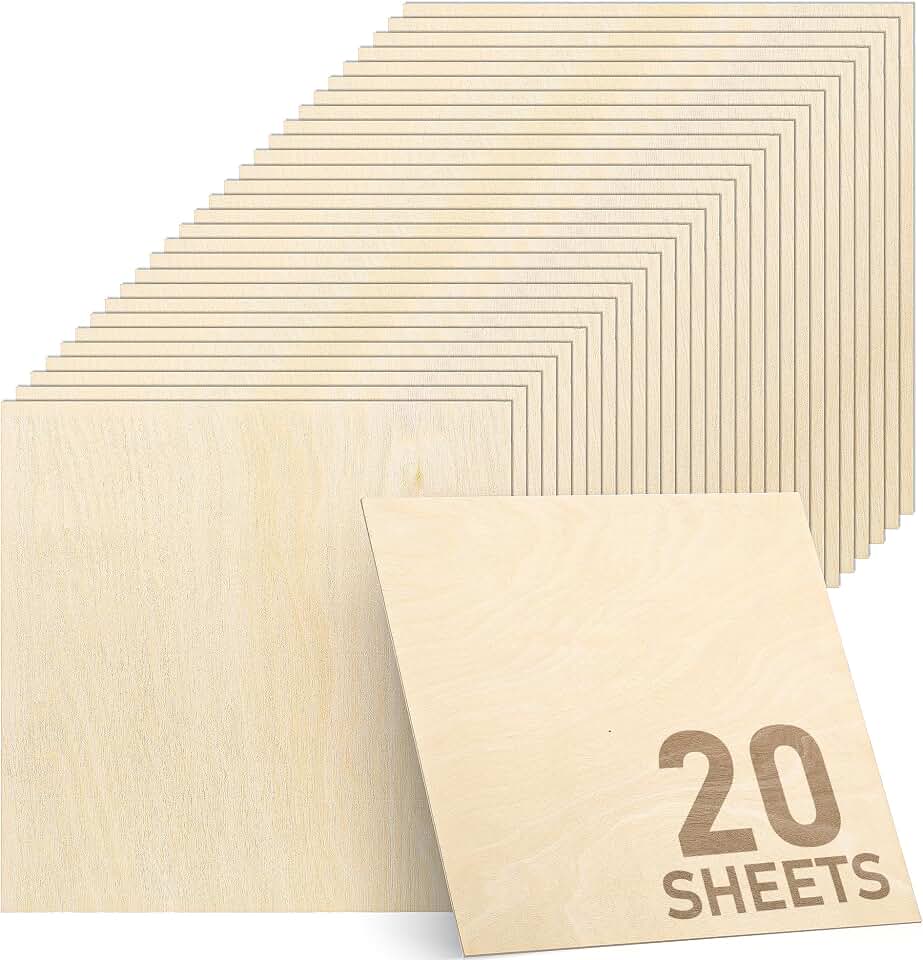
Thin craft sheets near 3 mm suit ornaments, models, layered signs, and laser work, while 1/4-inch material offers stiffer box walls, plaques, and jig parts. Verify actual dimensions, flatness, glue compatibility, and machine instructions before preparing cut files.
These Baltic birch craft sheets provide several size and thickness options for small projects.
Baltic Birch Craft Sheets
- Twenty smooth 1/8 inch plywood sheets
- Sized for detailed crafts and small projects
- Works well with laser and CNC cutting
- Great for painting engraving and model making
- FSC certified wood supports responsible sourcing
 Buy on Amazon

Baltic Birch Sheets for Crafts
- Ten unfinished 3 mm birch plywood sheets
- Large 16 by 12 inch craft-friendly size
- Suitable for laser cutting and engraving
- Smooth surface for painting and wood burning
- Ideal for models signs and DIY art
Buy on Amazon

Thick Baltic Birch Craft Board
- Sturdy 1/4 inch Baltic birch plywood
- B BB grade surface for polished projects
- Stronger alternative to basswood sheets
- Works with laser cutting CNC and engraving
- Ideal for wood burning and custom crafts
Buy on Amazon
Finishing and Maintaining Birch
Birch finishes well with clear coats and paint, but ordinary pigment stain can produce dark clouds and pale patches. Consistent sanding, complete glue removal, controlled stain application, and testing on project offcuts reduce failures.
Surface Preparation
Let lumber acclimate, then sand through a consistent sequence, often ending around 180–220 grit when the finish maker permits it. Vacuum the surface and inspect it with low side lighting, which makes cross-grain scratches appear as bright arcs.
Remove every glue patch before finishing. Wiping wet glue over a broad area can push diluted adhesive into pores, leaving a pale halo that becomes visible only after dye or stain reaches the surrounding wood.
Preventing Blotchy Stain
Birch’s diffuse-porous surface can accept pigment unevenly, particularly around grain changes and compressed sanding areas. Test the complete schedule on offcuts from the same boards because samples from another batch may absorb color differently.
A compatible conditioner or thin washcoat can reduce blotching, but it won’t remove every variation. Apply it evenly, respect recoat windows, and avoid aggressive spot sanding that changes absorption in one visible area.
Dye and Gel Stains
Dye penetrates fibers and can produce more even color than a heavy pigment stain. Gel stain stays closer to the surface, giving the operator more control on vertical parts and boards with mixed absorption.
For a dark birch color, build several thin controlled coats rather than flooding the surface once. Record dilution, sanding grit, application time, and topcoat on the sample’s back so a successful result can be repeated.
Clear Finishes and Paint
Water-based clear coats preserve the pale birch color more closely, while many oil-based products add amber warmth. Apply sample coats because the reddish heartwood can become much stronger once an oil finish wets the fibers.
Birch also accepts paint well after sanding and priming. Seal plywood edges separately because end grain and exposed plies drink in primer, leaving a rough texture unless they receive extra filling and sanding.
Indoor Care and Moisture
Keep indoor humidity reasonably stable, use coasters, and wipe spills before water reaches joints or damaged finish. Don’t leave birch utensils soaking, and repair worn cabinet edges near sinks before fibers swell and darken.
No common household coating makes birch permanently waterproof. Wax, mineral oil, and film finishes require ongoing inspection, while movement at joints can break a coating that still looks intact across broad surfaces.
Birch Wood Logs and Firewood
Seasoned birch firewood ignites readily, creates bright flames, and provides useful heat. Split birch wood logs soon after cutting because water-resistant bark can hold moisture around the inner wood and promote decay.
Birch Firewood Performance
Dry birch usually splits reasonably well, lights without much delay, and produces an active flame. Dense black or yellow birch gives more heat per stacked volume than lighter paper birch, while wet pieces hiss, darken at the ends, and leave cooler, smoky fires.
Species and moisture both matter. Published charts often place birches around 20–27 million BTU per full cord, but stove efficiency, bark proportion, stacking, and actual moisture alter usable heat.
Heat Output and Cord Size
A full cord occupies 128 cubic feet when stacked, conventionally 4 × 4 × 8 feet. A face cord isn’t an equal standardized volume unless the seller states piece length, so a 16-inch face cord contains about one-third of a full cord when other dimensions remain 4 × 8 feet.
Compare offers by stacked cubic volume, moisture, species, and delivery conditions. Loose-thrown loads contain more air than tightly stacked wood and can’t be compared directly without a recognized conversion method.
Seasoning Birch Wood Logs
Split rounds soon after felling, particularly pieces with intact bark. Stack them off soil with spaces for airflow, cover only the top, and leave the sides open rather than wrapping the entire pile in a tarp.
Drying may take 6–12 months or longer, but time isn’t proof of readiness. Large black birch splits in a humid shaded yard can stay wet long after small paper birch pieces in sun and moving air have dried.
Moisture Testing and Storage
Split a representative piece and press moisture-meter pins into the newly exposed interior face. Aim for about 20% moisture or lower before burning, checking several pieces from different sections of the stack.
The old outside face often reads artificially dry. Keep ready-to-burn wood sheltered from rain, but don’t pack damp pieces into an enclosed indoor room where they may release moisture, bark fragments, mold spores, or insects.
Burnable Birch Firewood
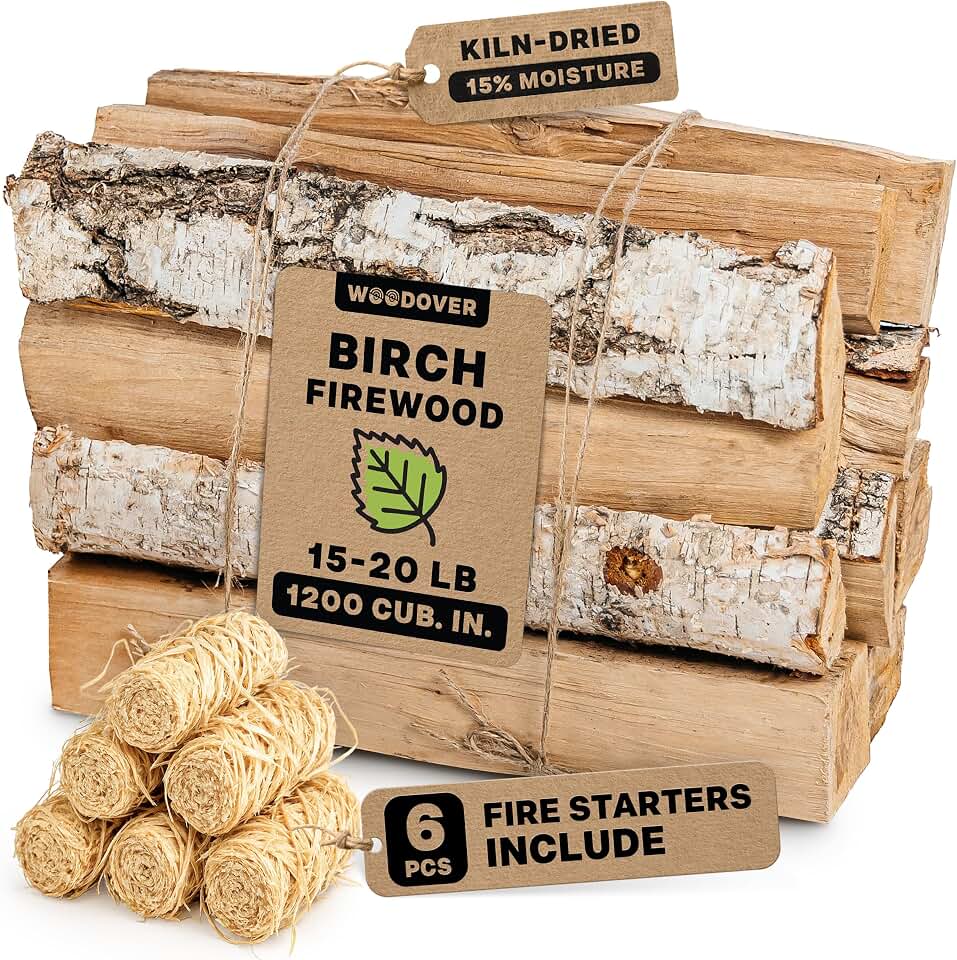
Buy firewood labeled as untreated, correctly dried, and suitable for the intended stove, fireplace, or outdoor pit. Check appliance instructions and local restrictions before use; the Cozy Birch Firewood Set is presented for burning rather than decoration.
Cozy Birch Firewood Set
- Kiln dried hardwood for dependable burning
- Includes fire starters for easy lighting
- Creates bright flames and a pleasant aroma
- Ideal for fireplaces and outdoor fire pits
- Seasoned wood helps create a cozy atmosphere
Buy on Amazon
Never burn plywood, glued furniture parts, preserved lumber, painted wood, or mystery offcuts. The EPA Burn Wise program provides guidance on dry fuel and cleaner wood-burning practices.
Decorative Logs and Safety
Decorative logs suit mantels, nonfunctional fireplaces, centerpieces, crafts, and seasonal displays. They’re not automatically firewood because they may contain excess moisture, glue, glitter, artificial snow, paint, preservatives, or insect treatments.
Inspect bark for mold, loose flakes, bore holes, and insects before bringing logs indoors. Keep decorative pieces away from open flames and hot stove surfaces unless the seller clearly identifies them as untreated burnable fuel.
These natural birch logs are intended for rustic displays and crafts, not assumed combustion.

Natural Birch Logs for Decor
- Six natural birch logs for rustic displays
- White bark adds warm woodland charm
- Ideal for fireplace decor and mantels
- Great for crafts and DIY projects
- Generous 16.5 inch length for versatile styling
Buy on Amazon

Birch Logs for Rustic Displays
- Eight natural unfinished birch logs
- White bark brings a cozy rustic accent
- Made for fireplace and mantel decor
- Useful for crafts seasonal displays and DIYs
- Generous 16.5 inch length creates visual impact
Buy on Amazon
Comparing and Buying Birch Wood
Buy birch by specification, not color or a broad trade name. Confirm species, grade, moisture, dimensions, core construction, intended exposure, certification, and waste before comparing the total project cost.
Birch vs Maple
Yellow birch and hard maple share pale color, fine texture, and a tendency to stain unevenly. Hard maple measures about 1,450 lbf Janka compared with yellow birch at roughly 1,260 lbf, giving maple greater average dent resistance.
Birch heartwood often shows stronger reddish-brown color, while maple may remain more uniformly pale. Birch plywood is widely available for cabinets and crafts; compare solid maple wood where wear and color consistency lead the decision.
Birch vs Oak
Red oak at about 1,290 lbf Janka is close to yellow birch in indentation resistance. Oak has larger pores and bold grain contrast, while birch supplies a smoother, quieter pattern for modern cabinetry and painted millwork.
White oak handles moisture better than birch because its heartwood has greater natural decay resistance and plugged vessels. For a birch pergola or uncovered bench, switching to white oak, cedar, cypress, or treated stock avoids repeated coating failures.
Birch vs Pine
Many common pines are lighter, softer, and easier to work by hand than birch. Eastern white pine is about 380 lbf Janka, making it far easier to dent than yellow or black birch.
Birch resists wear better and has a finer texture, but it weighs more and can stain unevenly. Pine may be preferable for low-cost painted furniture, lightweight shelving, and hand-tool projects where soft fibers aren’t a drawback.
Birch vs Beech
American beech measures about 1,300 lbf Janka, close to yellow birch. Both have fine texture and work well in furniture and turned parts, but beech often shows clearer ray fleck on quartered surfaces.
Both woods move appreciably with humidity and lack strong natural exterior durability. Compare beech wood where steam bending, wear resistance, and visible rays may favor it over birch.
Birch vs Basswood
Birch plywood is stiffer and more wear-resistant, while basswood is softer and easier to carve or cut with lower-output tools. Basswood suits lightweight models; birch suits stronger tabs, exposed edges, and parts held by screws.
For laser work, compare actual sheet construction rather than species alone. Glue type, ply gaps, flatness, thickness, resin pockets, and manufacturer approval may affect the cut more than the face veneer name.
Solid Lumber Checklist
- Confirm the exact species and lumber grade.
- Ask whether dimensions are rough or surfaced.
- Measure moisture and check kiln-drying records.
- Inspect bow, twist, cup, end checks, knots, and mineral streaks.
- Separate sapwood and heartwood if the project needs uniform color.
- Confirm the board-foot price and milling charges.
- Add stock for defects, grain matching, and machining loss.
Mill after inspection, not immediately after delivery. A bowed board may yield short rails but fail as a long stile, while a checked end often requires cutting several inches beyond the visible crack.
Plywood Buying Checklist
- Measure actual thickness and panel dimensions.
- Confirm face and back grade.
- Ask for core species, construction, and ply count.
- Check flatness and exposed edges for voids.
- Verify adhesive or exposure rating.
- Request applicable TSCA Title VI or CARB documentation.
- Check FSC or PEFC claims through product documentation.
- Confirm laser compatibility before cutting with a laser.
“Furniture grade” isn’t one universal technical standard. Compare written specifications across sellers, particularly for face thickness, patches, core gaps, emissions, and moisture exposure; this guide to types of plywood provides added context.
Birch Log Checklist
Separate firewood, decorative logs, craft branches, sawlogs, and turning blanks before buying. Each needs a different assessment, and a smooth white-barked decor bundle may be unsuitable for either burning or turning.
- For firewood, confirm moisture, treatment status, species, split size, and stacked volume.
- For decoration, inspect mold, insects, loose bark, coatings, diameter, and length.
- For turning, inspect checks, pith location, embedded metal, and decay beneath bark.
- For sawlogs, allow for taper, sweep, end checking, bark loss, and metal detection.
Pricing, Board Feet, and Waste
A board foot equals 144 cubic inches. Calculate it as thickness in inches × width in inches × length in feet ÷ 12; a 1-inch-thick, 8-inch-wide, 10-foot board contains about 6.67 board feet before surfacing.
Example retail planning ranges place common birch hardwood around $4–$10 or more per board foot and quality full-size birch plywood around $50 to well above $150 per sheet. Species, grade, width, thickness, surfacing, certification, origin, and freight can move costs outside those examples.
Add roughly 10%–15% waste for straightforward rectangular furniture parts. Allow 20% or more when matching color and grain, rejecting mineral streaks, cutting curves, or milling rough boards that contain checks and distortion.
Outdoor Wood Alternatives
Birch is a high-maintenance choice for wet outdoor service because its heartwood lacks strong natural decay resistance. A film finish can slow water entry, yet joints and end grain remain vulnerable after small cracks form.
Choose white oak, cedar, black locust, cypress, or appropriately treated lumber for pergolas, garden furniture, posts, and exposed structures. Match the alternative to local insects, soil contact, fastener compatibility, supply, and maintenance plans.
Certification and Responsible Sourcing
FSC, PEFC, and SFI claims can document forestry and chain-of-custody systems, but broad retailer statements don’t prove that one birch panel is certified. Check the product claim, certificate code, scope, and invoice description.
Ask for species and origin, country of manufacture, plywood core composition, and certification status. Don’t assume all pale birch is paper birch, and don’t remove bark or deadwood from land without permission and a check of habitat rules.
Firewood Transport Rules
Untreated firewood can move invasive insects and pathogens far beyond their established ranges. Follow local “buy it where you burn it” guidance, quarantine boundaries, park rules, and state or provincial transport requirements.
Kiln-dried packaging doesn’t by itself prove that a bundle meets every transport rule. Retain labels or heat-treatment documents, buy near the burn site, and never transport visibly infested birch wood logs across regulated boundaries.
FAQs
Is Birch Wood A Hardwood Or A Softwood?
Birch is a hardwood, even though it is lighter and easier to work than many dense hardwoods. It comes from a deciduous broadleaf tree rather than a conifer. Birch has a fine, even grain and moderate strength, making it useful for indoor projects, furniture, and plywood.
Is Birch Wood Good For Furniture And Cabinets?
Birch wood is a good choice for furniture and cabinets because it is strong, stable, and smooth to machine. Its pale color accepts paint well and can be stained, although stain conditioner helps prevent blotchy results. Solid birch and birch plywood are commonly used for cabinet boxes, drawers, tables, and shelving.
What Is The Difference Between Birch Plywood And Baltic Birch Plywood?
Baltic birch plywood is a premium multi-ply birch panel with more, thinner layers and few internal voids. Standard birch plywood may use fewer plies, mixed core veneers, and can vary more in quality. Baltic birch has exposed layered edges and is especially popular for drawers, jigs, laser cutting, and durable shop projects.
Is Birch Wood Waterproof Or Resistant To Rot?
Birch wood is not waterproof and has limited natural resistance to rot. It can absorb moisture, swell, stain, or decay when left outdoors or in damp conditions. Use birch mainly indoors and protect it with a suitable finish; for exterior work, choose naturally durable wood or pressure-treated lumber.
How Long Do Birch Wood Logs Take To Season?
Birch logs usually take about 6 to 12 months to season properly when split, stacked, and kept under cover with good airflow. Small splits dry faster, while large rounds and humid conditions take longer. For clean, efficient burning, confirm the firewood moisture content is below 20 percent with a moisture meter.
Affiliate Disclosure: Some links in this post are affiliate links. If you make a purchase through these links, we may earn a small commission at no extra cost to you. We only recommend products we genuinely believe in.