


The camphor tree, or camphor laurel, is a large aromatic evergreen commonly called Cinnamomum camphora, while some taxonomic authorities accept Camphora officinarum. It provides dense shade and useful aromatic wood, yet its broad crown, surface roots, toxic concentrated camphor, and invasive behavior in some warm regions make site and legal checks necessary before planting.
Article title: Camphor Tree Guide: Identification, Benefits, Uses, Care, Risks, and Removal
Meta description: Learn how to identify a camphor tree, where it grows, its benefits and uses, mature size, care needs, invasive status, toxicity, root risks, and safe removal.
Table of Contents
Camphor Tree at a Glance
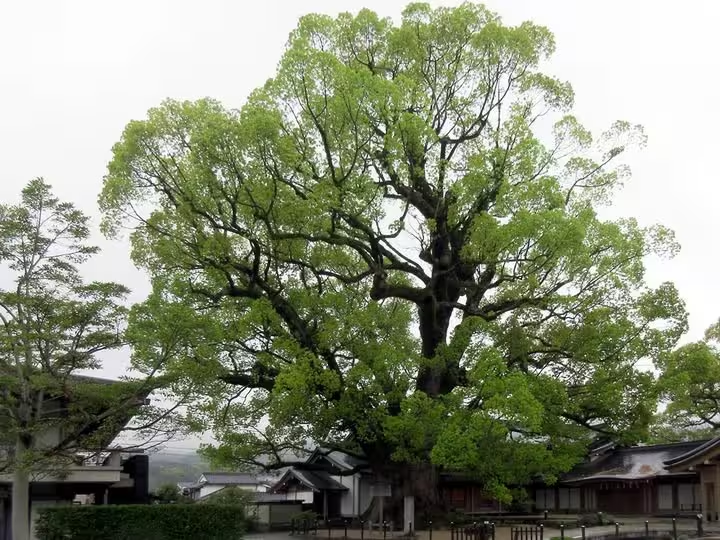
A camphor tree is a broadleaf evergreen in the laurel family, Lauraceae. Its glossy foliage, penetrating scent, broad shade canopy, and dark drupes make it recognizable, but a mature tree can occupy more space than many residential lots provide.
Botanical Names and Family
The familiar horticultural name is Cinnamomum camphora (L.) J.Presl. Kew Plants of the World Online accepts Camphora officinarum Nees and treats the older name as a synonym, which explains why labels and databases sometimes appear to disagree.
The names camphor laurel, camphorwood, and camphor tree refer to the same species. It’s related to cinnamon, bay laurel, redbay, sassafras, and many other aromatic plants, though close family ties don’t make their leaves or oils interchangeable.
Key Facts Table
| Feature | Camphor tree facts |
|---|---|
| Common names | Camphor tree, camphor laurel, camphorwood |
| Scientific names | Cinnamomum camphora; accepted by some authorities as Camphora officinarum |
| Family | Lauraceae |
| Plant type | Broadleaf evergreen tree |
| Typical landscape size | 40–60 feet tall, often equally wide |
| Potential size | 20–30 metres in favorable sites, with exceptional trees growing larger |
| Common climate range | USDA zones 9–11, often listed from zone 9b |
| Light | Full sun to partial shade |
| Leaf clues | Glossy, aromatic, usually with three strong basal veins |
| Fruit | Green drupes maturing to blue-black or black |
| Native association | Eastern and southeastern Asia |
| Invasive status | Invasive or environmentally problematic in some introduced regions |
Form and Growth Habit
A mature tree forms a rounded spreading crown supported by heavy scaffold limbs. Young specimens may have one leader, but neglected trees often develop competing trunks, low branches, and a canopy wider than the tree is tall.
Real sites reveal the scale better than nursery photographs. Standing beneath an old tree feels cool and enclosed, while dry leaves crackle underfoot and the sharp medicinal odor clings briefly to fingers after a leaf is crushed.
A 50-foot canopy can span most of a compact urban lot. Planting one beside a driveway, pool, narrow pavement opening, or overhead utility corridor commonly creates costs that far exceed the original tree purchase.
How to Identify a Camphor Tree

Identify a camphor tree by combining three leaf clues: glossy evergreen blades, three conspicuous veins near the base, and a strong camphor-like smell when a leaf is gently crushed. Confirm the result with its bark, flower clusters, and black drupes rather than relying on scent alone.
Leaves, Veins, and Scent
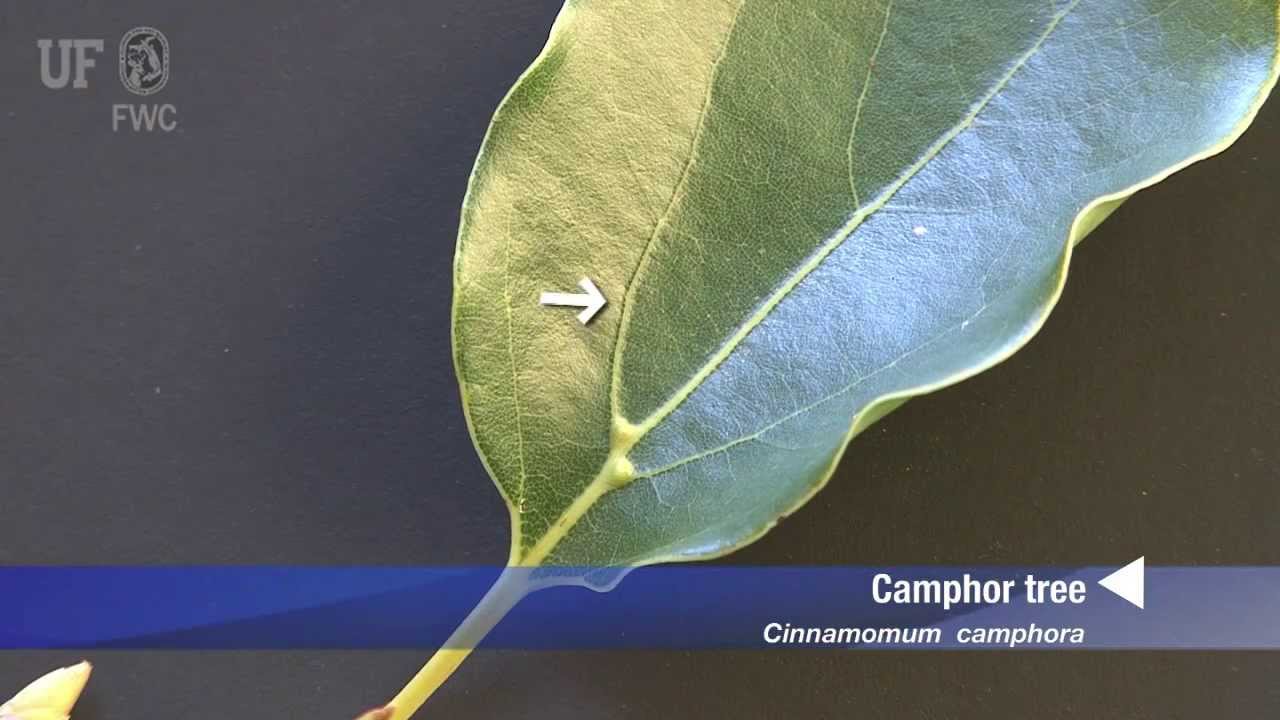
Leaves are simple, alternate, oval to elliptic, and commonly 2–4 inches long. Two side veins rise near the base beside the central midrib, creating the characteristic three-veined pattern; tiny gland-like pockets may occur where major veins meet.
New foliage can appear bronze, pink, red, or pale green before turning glossy green. A crushed blade releases a cold, penetrating aroma that people compare with menthol, eucalyptus, resin, or a medicinal chest rub; chemotype differences can alter the exact smell.
Bark and Trunk
Young bark is relatively smooth and gray-brown. With age, it becomes rough and fissured, while the trunk thickens and may divide into several broad stems; bark alone isn’t a dependable identification feature.
Flowers and Black Drupes
Small creamy or greenish-white flowers appear in branching panicles, often during spring. They’re easy to miss, but the resulting 6–10 millimetre drupes become conspicuous as they mature from green to dark blue-black or black.
The fruits resemble berries but are botanically drupes, usually containing one seed. Birds swallow the fleshy fruit and deposit seed beneath fences, trees, wires, and woodland perches, often far beyond the parent canopy.
Step-by-Step Identification
- Check for evergreen, alternate, glossy leaves with smooth or slightly wavy margins.
- Look for a central midrib and two strong veins beginning near the leaf base.
- Gently crush one leaf and check for a strong medicinal or camphoraceous scent; don’t taste it.
- Inspect young growth for bronze, pinkish, reddish, or light-green coloring.
- Look for pale flower panicles in spring or round black drupes later in the season.
- Confirm gray-brown bark and a broad, densely branched crown.
The best field confirmation combines leaves, odor, fruit, and overall form. An aromatic leaf without the expected vein pattern may belong to another member of Lauraceae.
Similar Laurel Species
Bay laurel usually stays smaller and lacks the same combination of three basal veins and penetrating camphor odor. Redbay has aromatic leaves but a different scent and vein pattern, while sassafras is deciduous and produces several distinct leaf shapes.
Cinnamon species may show similar venation because they’re close relatives. Compare the bark, scent, flowers, fruit, and mature form; one leaf photograph rarely gives a secure species identification.
Range, Invasiveness, and Restrictions
Camphor laurel is associated with eastern and southeastern Asia but has naturalized across many warm regions. It is not invasive everywhere, and its legal status varies among countries, states, counties, and local council areas.
Native and Cultivated Range
References often list southern and eastern China, Taiwan, Japan, Korea, Vietnam, and nearby areas. Centuries of cultivation and transport have blurred the line between the tree’s original wild range and places where people established it long ago.
Introduced and Naturalized Range
People planted the tree for shade, streets, aromatic wood, and camphor production. Escaped populations now occur in parts of the southeastern United States, eastern Australia, southern Africa, Pacific islands, and other tropical or subtropical areas.
Why Camphor Laurel Spreads
Mature trees produce many bird-dispersed seeds. Seedlings establish along stream corridors, roadsides, fences, forest margins, disturbed soil, and urban woodland, where dense foliage can suppress grass and young native plants.
Cutting also triggers trouble because untreated stumps may resprout from the root collar. Seed movement and vegetative regrowth mean one day of cutting rarely completes a control project.
Regional Invasive Status
Florida and other warm parts of the southeastern United States report ecological problems from naturalized camphor trees. Eastern Australia, particularly parts of New South Wales and Queensland, also treats camphor laurel as a serious environmental weed; NSW WeedWise provides region-specific identification and control guidance.
Local Laws and Restrictions
Rules may regulate sale, planting, transport, propagation, or disposal, yet a prohibition in one district doesn’t create a worldwide ban. Check a state agriculture department, extension office, biosecurity agency, invasive-plant database, or local council before moving plants or seeds.
Before Buying or Propagating
Before searching where to buy camphor, confirm that planting is legal and ecologically acceptable. Marketplace seed can be old, incorrectly identified, poorly stored, or collected from an unknown chemotype, so a packet label doesn’t prove identity or viability.
The following listings are included for purchase comparison only; don’t order seed where camphor laurel is invasive, discouraged, or restricted.
Camphor Tree Uses and Benefits
Camphor tree benefits include broad shade, evergreen screening, aromatic timber, cultural use, and the historic production of natural camphor. These benefits carry real trade-offs: concentrated products can poison people and pets, while the living tree can spread, shed fruit, and overwhelm small sites.
Traditional Camphor Extraction
Traditional producers chipped leaves, branches, roots, or wood, then used steam distillation, condensation, and purification to isolate aromatic material. Yield and composition vary by tree age, tissue, location, season, and chemotype, so backyard material doesn’t provide a predictable finished product.
Home distillation isn’t a casual craft project. Heated equipment, combustible vapors, uncertain concentrations, and contaminated waste create fire and exposure risks that aren’t present when smelling an intact leaf.
Camphor Leaves and Wood
Camphor leaves release fragrance when bruised, but claims about the benefits of camphor leaves often confuse scent with proven treatment. Don’t eat them, make unmeasured extracts, or use leaf preparations as medicine.
The wood has a lingering, spicy-medicinal scent and can show attractive grain in chests, cabinets, carvings, and interior work. Its odor may discourage some insects, but it doesn’t guarantee pest-free storage; compare its working character with other types of hardwood before selecting boards.
Landscape Benefits and Limits
A healthy tree casts deep cooling shade, filters glare, screens neighboring views, and provides perches and fruit for birds. Those same birds spread seed, and the dense canopy may leave turf thin, damp, and bare beneath it.
Older street specimens demonstrate a common design mistake: a tree selected for quick shade later presses limbs over roofs and roots against paving. Structural pruning can improve clearance, but it can’t make a 50-foot crown fit a narrow planting strip.
Medicinal and Aromatic Uses
Refined camphor appears in some correctly labeled topical products and aromatic preparations. Historical use doesn’t establish modern clinical benefit, and concentrated oil must never be treated like the faint amount encountered through ordinary contact with foliage.
Camphor basil uses belong to a different plant and shouldn’t be copied to camphor tree leaves. Similar common names and aromas don’t establish equal chemistry, edible status, dosage, or medical use.
Cultural and Ritual Uses
Camphor has a long role in Hindu and other South Asian ceremonies, where manufactured tablets may be burned. Ritual camphor is a processed commercial material, not fresh backyard foliage, and burning it requires ventilation, supervision, and a heat-resistant surface.
Chemistry and Chemotypes
Camphor is an aromatic terpene ketone with the formula C10H16O and a molar mass near 152.23 g/mol, according to PubChem. Tree oils may also contain differing proportions of 1,8-cineole, linalool, safrole, and other volatile compounds.
These profiles are called chemotypes. Seed-grown plants can differ from their parent, so odor, oil composition, and performance aren’t fixed across every Cinnamomum camphora camphor tree.
Natural Versus Synthetic Camphor
Natural camphor comes from plant distillation and refinement, while much commercial camphor is synthesized from materials such as alpha-pinene derived from turpentine. A camphor scent or label doesn’t prove tree-derived origin.
Search terms such as camphor blocks, camphor balls, a block of camphor, camphor block benefits, and “camfura” often lead to household or ritual products rather than the tree. Product composition and intended use matter more than the marketing name.
If you’re comparing a labeled commercial camphor product, read its ingredient and safety information rather than assuming every block has the same origin or intended use.
Size, Growing Conditions, and Care
A camphor tree commonly reaches 40–60 feet tall and develops a similar spread in ordinary warm-climate settings. It grows best in full sun, well-drained soil, and USDA zones around 9–11, but tolerating a site doesn’t mean the tree suits its available space.
Mature Size and Spread
Favorable tropical and subtropical sites can support heights of 20–30 metres and very broad crowns. Keep it away from narrow pavement openings, roofs, pools, septic systems, foundations, drains, and overhead utility routes; use local arboricultural guidance for setbacks.
Growth Rate Factors
Growth ranges from moderate to relatively fast in warm, irrigated, deep soil. Cold, drought, shade, compacted soil, root restriction, and competition reduce extension growth, so a fixed annual growth promise isn’t dependable.
Climate and Frost Tolerance
The species performs best in warm-temperate, subtropical, and tropical climates. Young leaves feel thin and supple and may turn limp, brown, or black after frost; established trunks survive brief cold better, yet exposed branches can still die back.
Light, Soil, and Water
Full sun supports a dense, balanced crown, while partial shade is tolerated. Deep shade often produces thin leaning growth as branches reach for brighter openings.
Camphor laurel grows in sand, loam, or clay across acidic to mildly alkaline conditions, provided drainage remains adequate. Water young trees regularly during establishment; mature trees tolerate dry spells, but prolonged drought can cause marginal scorch, leaf drop, and twig loss.
Fertilizing and Structural Pruning
Established specimens often need little fertilizer. Base applications on a soil test or diagnosed deficiency because excess nitrogen encourages long weak shoots and runoff without correcting poor drainage or inadequate root space.
Start structural pruning when branches are small. Favor a dominant leader where practical, retain well-spaced scaffold branches, remove crossing stems, and never top the crown; large limbs require a qualified arborist with suitable rigging.
Seeds and Cuttings
Propagation should occur only where planting is lawful and environmentally acceptable. Fresh seed usually performs better than old seed; remove fruit pulp before sowing, then maintain a moist, airy medium rather than saturated compost.
Germination may take weeks or months and varies with freshness, temperature, moisture, and dormancy. Semi-hardwood cuttings can preserve a selected clone, but rooting success depends on cutting maturity, humidity, medium, warmth, and hormone treatment.
Roots and Landscape Problems

Camphor trees develop extensive surface roots, dense shade, year-round leaf fall, seasonal fruit litter, and abundant volunteer seedlings. The most expensive failures occur where a young tree’s compact nursery form hides its eventual canopy and root footprint.
Surface Roots and Infrastructure
Large roots can lift pavers and curbs, create mowing hazards, and compete with lawns or shallow-rooted beds. Roots don’t automatically break sound foundations or pipes; they more often exploit leaks, existing cracks, loose backfill, and consistently moist soil.
Leaf and Fruit Litter
Evergreen doesn’t mean litter-free. Camphor trees replace leaves throughout the year, while twigs, flower parts, and black fruit collect in gutters and form slippery debris; crushed drupes may leave dark pavement stains.
Volunteer Seedlings
Check beneath fences, shrubs, utility wires, and favorite bird perches. Seedlings pull cleanly from moist ground while young, but the stem soon becomes woody and the root holds firmly enough to snap above the soil.
Canopy and Branch Risks
Wide scaffold limbs need space and sound attachments. Competing trunks, included bark, decay, large pruning wounds, and storm loading raise failure risk, but the species shouldn’t be declared universally weak without a site-specific tree assessment.
Cold and Water Stress
Drought can produce wilt, brown leaf margins, premature leaf loss, and twig dieback. Waterlogged roots may cause similar thinning, so test moisture below the surface before adding irrigation; wet soil feels cool, slick, and cohesive rather than merely dark on top.
After frost, wait until buds break before removing every brown branch. Scratching a tiny test area may reveal green tissue under the bark, but repeated cold injury signals that the site lies outside the tree’s comfortable range.
Pests and Diseases
Possible problems include scale, aphids, mites, leaf spots, root disease in wet soil, and decay behind large wounds. Sticky leaves, black sooty growth, fine webbing, sunken bark, or mushrooms near the base call for diagnosis before spraying.
Toxicity and Camphor Safety
Normal contact with a living camphor tree isn’t equivalent to swallowing concentrated camphor. Leaves, fruit, extracted oils, blocks, and tablets shouldn’t be eaten, and suspected ingestion requires urgent expert guidance rather than a home remedy.
Living Tree Exposure
Touching intact bark or briefly smelling a crushed leaf presents far less exposure than using essential oil. Wash hands after handling sap or large quantities of foliage, avoid eye contact, and never taste a leaf or black drupe to confirm identification.
Human Poisoning Risks
Swallowed camphor can cause nausea, vomiting, agitation, confusion, muscle twitching, and seizures, with symptoms sometimes developing quickly. Contact local emergency services or Poison Control after suspected ingestion; don’t induce vomiting or wait for symptoms.
Pets and Essential Oils
Keep refined blocks, tablets, oils, and treated materials away from pets. Cats and other animals may be especially sensitive to concentrated essential oils, so avoid undiluted skin application or casual diffusion and seek veterinary advice after exposure.
Fire and Smoke Safety
Camphor and camphor-containing oils are combustible. Burn labeled ritual products only on a stable, heat-resistant surface, away from curtains, paper, dry foliage, and children; stay present and ventilate the room because visible smoke and sharp vapor can irritate airways.
Managing or Removing Camphor Laurel
Small camphor laurel seedlings can be pulled, while larger trees often need professional removal and a legally labeled stump treatment to prevent regrowth. Successful control includes several follow-up checks for sprouts and bird-sown seedlings.
Pulling Seedlings and Saplings
Pull seedlings after rain or irrigation, gripping close to the soil and drawing upward steadily. Remove the root rather than snapping the stem; use a weed wrench for larger saplings if soil disturbance won’t damage desirable plants or destabilize a bank.
Larger Trees and Arborists
Mature trees near buildings, roads, fences, or utility lines require an insured, qualified arborist. Heavy wood, spreading limbs, hidden decay, and unpredictable rigging loads make piecemeal amateur cutting dangerous, while removal cost depends on access, trunk size, obstacles, disposal, and stump work.
Labeled Stump Treatments
Regional weed authorities may recommend cut-stump or basal-bark treatment for camphor laurel. Use only an herbicide labeled for the species, method, and location, observing rules for waterways and desirable vegetation; generic mixing rates can conflict with local law and product labels.
Resprouting and Follow-Up
Inspect the stump, root collar, disturbed soil, and nearby bird perches through several growing cycles. Remove soft sprouts before they become woody, collect fruiting material under local disposal rules, and mark the site so later seedlings aren’t mistaken for desirable volunteers.
Non-Invasive Alternatives
Choose replacements by climate, drainage, salt exposure, canopy space, and desired shade rather than matching appearance alone. A locally native evergreen may support regional wildlife and avoid reinvasion, but every substitute still needs a mature-size and root-space check.
Regional Replacement Examples
In the southeastern United States, possible choices include southern magnolia for large sites, sweetbay magnolia for some moist sites, native hollies at varied scales, and regionally native live oaks where ample room exists. Laurel oak offers another comparison, but its mature form and regional suitability still need review.
Eastern Australian replacements may include locally recommended lilly pillies or other indigenous canopy trees selected from council planting lists. The safest choice is the species that fits the local plant community, rainfall pattern, soil, and available width without creating a new weed problem.
FAQs
Is Camphor Laurel The Same As A Camphor Tree?
Yes, camphor laurel and camphor tree are common names for the same species, Cinnamomum camphora. This evergreen tree is native to parts of Asia and is valued for its aromatic leaves and wood. Names can vary by region, so check the botanical name when buying or identifying a tree.
How Big Does A Camphor Tree Get?
A camphor tree can grow 50 to 100 feet tall with an equally broad, spreading canopy in ideal conditions. It is a fast-growing tree when young and can become very large over several decades. Give it plenty of space away from buildings, power lines, paths, and underground services.
What Is The Camphor Tree Used For?
Camphor trees are commonly used as large shade trees and ornamental landscape specimens. Their fragrant leaves and wood have historically been used to produce camphor and scented products. In home gardens, they are mainly appreciated for dense evergreen foliage, broad shade, and resilience in warm climates.
Is A Camphor Tree Invasive Where I Live?
A camphor tree may be invasive in warm, humid regions where it can spread by seed and displace native plants. It is listed as invasive or a problem species in some parts of the southern United States, Australia, and other suitable climates. Check your local invasive-plant list or extension service before planting one.
Are Camphor Tree Leaves And Berries Poisonous?
Yes, camphor tree leaves and berries can be harmful if eaten, especially by children, pets, and livestock. The plant contains camphor and other oils that may cause stomach upset, confusion, tremors, or more serious symptoms in larger amounts. Keep fallen fruit away from pets and contact a poison professional or veterinarian after suspected ingestion.
Affiliate Disclosure: Some links in this post are affiliate links. If you make a purchase through these links, we may earn a small commission at no extra cost to you. We only recommend products we genuinely believe in.