

Alder wood is a light, relatively soft hardwood with fine grain, warm tan color, and easy machining qualities. North American lumber sold as alder usually comes from red alder, while black alder is a separate European species with similar working traits.
Table of Contents
What Is Alder Wood?
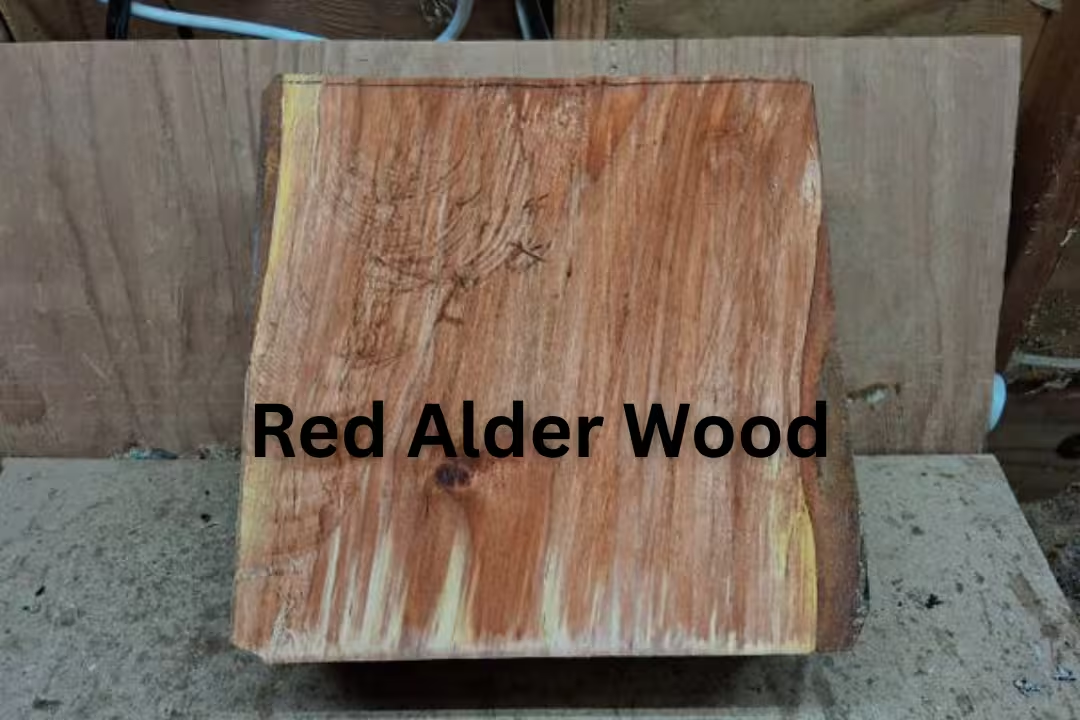
Alder tree wood comes from trees and shrubs in the genus Alnus, part of the birch family, Betulaceae. It combines low weight, modest hardness, even texture, and good workability, making it useful for cabinets, furniture, carving, millwork, crafts, and electric-guitar bodies.
Hardwood Classification and Taxonomy
Alder is a hardwood because it grows from a flowering broadleaf tree. The botanical term doesn’t promise high hardness: red alder is softer than cherry, walnut, oak, birch, and hard maple. Our guide to types of hardwood explains why density and botanical classification must be judged separately.
The genus contains many species, but commercial names can cause confusion. Red alder is Alnus rubra, while black or common alder is Alnus glutinosa. The search phrase “alnus glutinosa common alder” refers to one species, not a grade or dark-colored form of red alder.
Alder Wood Color
Alder wood color begins as pale cream, light tan, or nearly white after cutting. Oxygen soon warms the surface to pinkish tan or light reddish brown. A freshly planed board can look cool and chalky, then become noticeably peachier before the end of a workday.
Grain, pores, and texture: Alder is diffuse porous, so its small pores are distributed fairly evenly through each growth ring. The grain usually runs straight and quiet, with a smooth texture that lacks oak’s deep pore lines. Sharp plane irons leave a soft, silky surface; dull cutters produce faint woolly fibers.
Sapwood and heartwood: The boundary is often less dramatic than it is in walnut. Sapwood may appear pale cream, while mature heartwood carries warmer pink, tan, or reddish notes. Clear finish can expose board-to-board variation, so lay cabinet parts together under the shop’s finishing light before assembly.
Alder Species and Tree Identification

Red and black alder are separate species from different native regions. Leaves, bark, habitat, cones, and verified origin identify the tree more reliably than lumber color, which changes during drying and finishing.
Red Alder: Alnus rubra
Red alder, or Alnus rubra Bong., is native along the Pacific coast from southeastern Alaska and British Columbia through Washington and Oregon into coastal California. Mature trees commonly reach 50–100 feet, depending on soil, rainfall, competition, and exposure.
The species favors moist openings, stream edges, disturbed forests, and recently cleared ground. Its leaves have toothed margins and often show rolled-under edges. The name “red” comes partly from the rusty color that appears beneath scraped bark, not from uniformly red lumber. See the dedicated red alder profile for a closer species view.
alnus glutinosa common alder
Black alder, common alder, or European alder is Alnus glutinosa (L.) Gaertn. Its native range covers much of Europe and extends into western Asia and northern Africa. Plants of the World Online records its accepted botanical identity and distribution.
Range, habitat, and identification: Black alder commonly grows beside rivers, ponds, marshes, and waterlogged woodland. Rounded leaves often have a blunt or notched tip. Young leaves and shoots can feel slightly tacky between the fingers, a trait reflected by the Latin name glutinosa. Woody, cone-like female structures may stay on bare branches through winter.
| Attribute | Red alder | Black alder/common alder |
|---|---|---|
| Scientific name | Alnus rubra | Alnus glutinosa |
| Native range | Western North America | Europe, western Asia, northern Africa |
| Average dried weight | About 28 lb/ft³ (450 kg/m³) | About 33 lb/ft³ (530 kg/m³) |
| Representative Janka hardness | About 590 lbf | About 650 lbf |
| Commercial role | Cabinets, furniture, millwork, guitars | Furniture, carving, turning, specialty lumber |
| Exposed outdoor durability | Poor | Poor |
Red alder vs black alder: Black alder is slightly heavier and harder in published clear-wood tests, but neither species performs like oak or hard maple under abrasion. Finished color alone rarely proves species. Supplier documentation and geographic source offer better evidence; the separate black alder guide covers that wood in detail.
Ecology and nitrogen fixation: Both trees form root nodules with Frankia bacteria, which convert atmospheric nitrogen into forms plants can use. Red alder can establish quickly after disturbance and add nitrogen-rich leaf litter to depleted soil. Introduced black alder can spread aggressively in some North American wetlands, so ecological value depends on location.
Alder Wood Properties and Performance

Alder is lightweight and moderately stable, but it dents easily and has low natural decay resistance. Its best performance comes in protected interior parts where easy machining matters more than impact resistance or structural capacity.
Properties and Testing Context
Published wood properties usually describe small, clear specimens tested near 12% moisture content. Species, growth rate, grain direction, test method, knots, drying damage, and moisture all affect the result. The USDA Wood Handbook explains how moisture and specimen condition change wood performance.
A Janka number measures resistance to indentation; it doesn’t provide a beam design value or predict screw withdrawal by itself. Use the figures below for material comparison, then account for the actual board, joint layout, span, load, and service environment.
| Property | Red alder | Black alder | Practical meaning |
|---|---|---|---|
| Average dried weight | 28 lb/ft³ | 33 lb/ft³ | Easy to lift and machine |
| Janka hardness | 590 lbf | 650 lbf | Vulnerable to dents |
| Modulus of rupture | About 9,800 psi | About 13,050 psi | Species-specific bending reference |
| Modulus of elasticity | About 1.38 million psi | About 1.60 million psi | Black alder tests somewhat stiffer |
| Crushing strength | About 5,820 psi | About 6,700 psi | Soft fibers can compress under hardware |
| Radial shrinkage | About 4.4% | Varies by source | Movement across quartersawn width |
| Tangential shrinkage | About 7.3% | Varies by source | Movement across flatsawn width |
Hardness, Strength, and Weight
Red alder hardness is about 590 lbf on the Janka scale. That places it above eastern white pine at roughly 380 lbf and near yellow-poplar at roughly 540 lbf, but below cherry at about 950 lbf, walnut at about 1,010 lbf, and hard maple near 1,450 lbf. Compare these values in our wood hardness scale.
At roughly 28 lb/ft³, dry red alder feels pleasantly light when lifting a wide cabinet door or guitar blank. The same low density lets a dropped clamp leave a crescent-shaped dent. Place cork, plywood, or clean cauls beneath tools during assembly.
Shrinkage and dimensional movement: Red alder’s representative 4.4% radial and 7.3% tangential shrinkage describe movement from green to oven dry, not normal seasonal movement in finished furniture. Acclimate stock, use floating panels, and avoid gluing solid tops rigidly across their width.
Moisture and drying risks: Fresh alder logs discolor and deteriorate quickly, so prompt milling and controlled drying matter. Poorly dried stock can produce twisted doors, open joints, uneven drawer reveals, and finish lines where components move. For indoor work, 6–8% moisture content is common, with regional equilibrium conditions setting the actual target.
Is alder wood waterproof? No. Black alder has survived historically in permanently submerged piles because waterlogged, low-oxygen conditions suppress many decay organisms. Rain exposure creates repeated wet-and-dry cycles, a much harsher condition that encourages fungal decay. Exterior glue or clear sealer can’t turn alder into naturally durable lumber.
Pros, cons, and failure modes: Alder cuts easily, weighs little, glues well, and accepts paint. Its weak points include dents, blotchy stain, modest fastener holding, routed tearout around knots, and poor exterior durability. A common beginner mistake is treating clear-specimen strength figures as construction design values; use graded structural lumber for load-bearing work.
Working and Finishing Alder Wood
Alder machines cleanly with sharp tools and sands to a smooth surface, but soft fibers crush under excess pressure. Controlled sanding, pilot holes, light routing passes, and a tested finishing schedule prevent the most common defects.
Sawing, Routing, and Shaping
Use sharp carbide cutters and steady feed rates. Dull blades leave pale fuzz along the cut, while aggressive routing can pull chunks from grain reversals or knot edges. Make the final moulding pass light and support knotty sections with a backer board.
A shallow climb-cutting pass can clean difficult routed edges, but the cutter may pull the work forward without warning. Beginners should use conventional routing with several light passes or a router table with featherboards rather than attempting a freehand climb cut.
Drilling, fastening, and gluing: Bore pilot holes near narrow edges and board ends. A screw driven dry into end grain can split the board with a sharp click just before seating. Waxing suitable screw threads, reducing torque, and using washers beneath load-bearing hardware limit crushed fibers.
Alder bonds well with standard woodworking glue when surfaces are flat and clean. Excess clamp pressure can dent the faces or squeeze too much adhesive from a joint. Use broad cauls and enough pressure to close the seam rather than forcing glue from every edge.
Practical Notes From Real-World Use
Sanding, carving, and turning: A practical sequence is 120 grit for leveling, 150 for refinement, and 180 before many furniture finishes. Alder dust feels fine and dry on the hands, while oversanding can polish soft areas unevenly. Sand end grain one grit finer when it turns much darker than adjacent faces.
Carving tools should slice rather than press. A dull gouge compresses the pale fibers, leaving a shiny trough that rises after waterborne finish touches it. On the lathe, sharp tools and light finishing cuts reduce torn grain around knots and bark inclusions.
Does alder stain well? It can, but raw alder often absorbs penetrating stain unevenly. End grain, curl, sanding scratches, and locally porous zones turn darker. Test a full schedule on an offcut from the same board; a sample from unrelated stock may react differently.
The most reliable dark finish often uses a washcoat, dye base, glaze, and toner rather than one heavy coat of pigment stain. Gel stain offers more surface control. Pre-stain conditioner can reduce contrast, though it may also leave the final color lighter than expected.
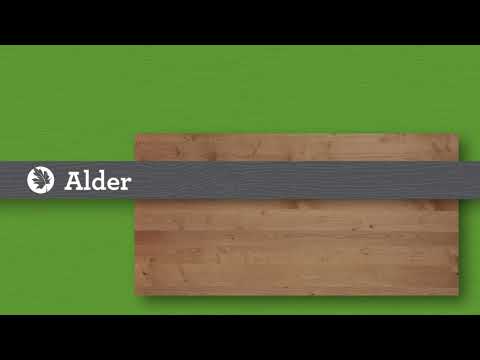
Clear, stained, and painted finishes: Waterborne polyurethane keeps alder relatively pale. Oil-based polyurethane and shellac add amber warmth, while lacquer suits fast cabinet production. Paint works well over its fine pores, but knotty alder may need a stain-blocking primer so dark knots don’t telegraph through the topcoat.
Dark alder can suggest cherry or walnut from across a room, but the imitation has limits. Alder remains softer, its grain stays subtler, and a deep scratch may reveal pale wood. Explore natural color differences in our cherry wood guide.
Dust and fire safety: Connect saws and sanders to effective extraction, wear eye protection, and use a properly fitted particulate respirator. Fine alder dust can irritate the eyes, skin, and airways. Dust clouds and packed collector waste can ignite, so keep them away from sparks, heaters, and open flames.
Alder Wood Uses and Limitations
Common alder uses include cabinets, interior doors, furniture, moulding, carving, crafts, veneer, and guitar bodies. Alder is a poor choice for exposed outdoor structures, high-wear flooring, heavy structural loads, and kitchen pieces that stay wet.
Cabinets, Millwork, and Furniture
Alder wood cabinets offer warm color, low weight, easy machining, and a choice between clear and rustic faces. Clear alder suits smooth contemporary doors; knotty alder suits lodge, farmhouse, and southwestern interiors. High-contact corners may dent, so use durable topcoats and soften exposed edges slightly.
- Cabinet doors, drawer fronts, and face frames
- Interior doors, baseboards, crown moulding, and wall panels
- Bed frames, dressers, desks, shelving, and side tables
- Turned legs, carved panels, boxes, toys, and ornaments
- Veneer, plywood cores, signs, and painted decorative work
Dining and coffee tables need extra care because alder dents readily. Felt pads beneath lamps, trivets beneath hot cookware, and a durable film finish reduce damage. Chair joinery should rely on properly fitted mortise-and-tenon or dowel joints rather than screws driven into end grain.
Guitar Bodies and Tonewood
Alder wood for guitar body construction is popular because red alder offers moderate weight, predictable routing, broad commercial availability, and good compatibility with opaque or sunburst finishes. It has long been associated with instruments such as the Fender Stratocaster and Fender Precision Bass.
Tone descriptions such as “balanced” or “clear” remain subjective because pickups, bridge, neck, body thickness, hardware, strings, and amplification all affect the result. For a body blank, inspect weight, glue seams, knots, moisture, and routing layout rather than choosing by species name alone.
Carving, crafts, and engraving: Fine texture makes alder friendly for relief carving, pyrography, laser engraving, signs, ornaments, and small boxes. Thin blanks can cup after one face is engraved or painted. Store them flat and apply finish to both faces to slow uneven moisture exchange.
Smoking food safely: Alder smoke is mild, lightly sweet, and well suited to salmon, shellfish, poultry, pork, vegetables, and mild cheese. Chips burn quickly, chunks last longer over charcoal, pellets fit compatible appliances, and planks shield delicate food from direct heat.
Use only clean, food-grade alder sold for cooking. Never burn painted, stained, pressure-treated, glued, oily, or preservative-treated wood. Plywood, MDF, particleboard, mystery offcuts, and cabinet scraps can release unsafe contaminants. Smoke intensity also depends on airflow, fuel quantity, moisture, and cooking temperature.
Outdoor and wet uses: Untreated alder isn’t a sound choice for decking, posts, siding, garden beds, or furniture left outside. Paint can slow moisture entry but won’t prevent decay after joints crack or end grain becomes exposed. Continuous submersion history for black alder doesn’t translate to wet-and-dry weather exposure.
Flooring and structural limits: Pet claws, high heels, chair legs, and dropped objects mark alder floors more easily than oak or maple. Alder also lacks standard construction design values for use as ordinary framing. Don’t substitute it for graded joists, beams, or deck members without engineering approval.
Cutting boards and kitchenware: Clean alder can serve in dry serving pieces, but its softness and low decay resistance make it less attractive for deeply scored boards that are washed often. If used, choose untreated stock, apply a food-contact finish, avoid soaking, and dry the piece upright after washing.
Alder Compared With Other Woods
Alder beats harder woods on low weight, carving ease, and tool friendliness, but loses on dent resistance and outdoor durability. The right comparison depends on finish, wear, appearance, local supply, and the amount of usable lumber left after defects are removed.
Alder vs Pine and Poplar
Alder vs pine: Alder is a botanical hardwood, yet that doesn’t mean every alder board is harder than every pine species. Alder usually has finer, more even texture and no prominent resin canals. Pine is often cheaper in construction sizes, while both woods can become blotchy under penetrating stain.
Alder vs poplar: Red alder at about 590 lbf is close to yellow-poplar near 540 lbf. Alder often has warmer natural color suitable for clear finishes. Poplar frequently carries green, purple, or brown mineral streaks and is commonly painted. Read the full poplar wood comparison before choosing.
Alder vs Cherry and Walnut
Cherry and walnut are harder, richer in natural color, and more resistant to routine dents. Cherry develops a deeper patina with light exposure, while walnut begins much darker. Stained alder can copy a broad color impression at lower material cost, but it won’t reproduce their grain, hardness, or aging.
Alder vs maple and birch: Hard maple near 1,450 lbf and many birches resist abrasion far better. Alder maple comparisons favor alder for carving, low weight, and easier machining; maple fits worktops and high-wear surfaces. Birch and alder can both blotch, so test stains before finishing assembled cabinets.
Alder vs oak: Oak has stronger grain, deeper pores, higher hardness, and better wear performance. Alder and oak can share a warm stained palette, but alder won’t gain oak’s texture or dent resistance. Oak also holds fasteners more firmly, while alder is lighter and easier to shape.
| Project need | Good choice | Reason |
|---|---|---|
| Light painted cabinets | Alder or poplar | Easy machining and smooth paint surface |
| Rustic stained doors | Knotty alder | Knots provide intentional character |
| High-wear worktop | Hard maple | Much greater dent resistance |
| Natural dark furniture | Walnut | Color runs through the wood |
| Prominent grain | Oak | Large pores and visible growth rings |
| Carving or light guitar body | Red alder | Low weight and easy cutting |
Choosing wood by project: Select alder for protected interior work, moderate wear, shaped parts, paint, and controlled stain schedules. Choose harder lumber for floors and worktops, decay-resistant species for weather exposure, and graded structural material for load-bearing construction. Our guide to furniture woods compares further options.
Buying Alder Lumber
Buy alder lumber by verified species, grade, moisture, thickness, usable yield, and delivered cost. A low board-foot quote can become expensive after surfacing, shipping, end checks, open knots, color mismatch, and milling waste are counted.
Clear vs Knotty Alder
Clear alder suits uninterrupted cabinet faces, modern furniture, stained doors, guitar blanks, and fine millwork. Wide, long, color-matched boards with clear faces cost more because fewer logs yield them. Ask whether the grade applies to one face, both faces, or a defined cutting area.
Knotty alder is an intentional character grade rather than failed clear stock. Buyers use it for rustic doors, mantels, cabinets, furniture, and paneling. Confirm whether knots are tight, open, filled, or stabilized. Open knots may need tinted epoxy and backing before machining.
Grades, Surfacing, and Dimensions
Surfacing changes size. Rough lumber retains saw texture and gives the buyer more control over flattening. S2S usually means two surfaced faces, S3S adds one straight edge, and S4S has four surfaced sides. Dealer definitions can differ, so request actual finished dimensions.
4/4, 5/4, and 8/4 lumber: Rough 4/4 stock is nominally about 1 inch before drying and planing, then finishes thinner. Choose 5/4 when a true finished inch is needed. Use 8/4 for legs, deep carving, turning blanks, thick benches, and laminated guitar-body layouts requiring extra milling room.
Moisture and board inspection: Check several spots with a calibrated meter, including the center area and both ends. Look along each edge for bow and twist, then sight across the face for cup. Dark end checks can travel farther than they first appear, so allow trimming room.
Indoor furniture stock often targets 6–8% moisture content, but the correct reading follows local equilibrium conditions. Let boards acclimate before final milling. Removing equal amounts from both faces and pausing between rough and final sizing gives internal stress time to show itself.
Board feet and usable yield: Calculate board feet as thickness in inches × width in inches × length in feet ÷ 12. A 1-inch × 8-inch × 8-foot board contains about 5.33 board feet. That figure doesn’t subtract knots, checks, planer loss, sapwood variation, or crosscut waste.
Alder wood price factors: Species, region, grade, color sorting, width, length, thickness, drying, surfacing, shipping, and minimum-order fees all affect cost. Red alder is often economical near Pacific Northwest supply chains. Black alder may carry specialty-import and freight costs in North America.
- Confirm whether the lumber is red alder or black alder.
- Check clear, knotty, or character-grade rules.
- Request actual surfaced thickness and width.
- Measure moisture content rather than trusting a label alone.
- Inspect for twist, cup, bow, checks, stains, and loose knots.
- Calculate waste before comparing board-foot quotations.
- Ask about color sorting and shipped-lumber return policies.
- Request chain-of-custody documents if certification matters.
Buying checklist and certification: FSC or PEFC documentation can support responsible purchasing, but a logo claim should match valid chain-of-custody paperwork. The FSC certificate search lets buyers check certificate status. Regional sourcing, harvest method, shipping distance, processing yield, and product lifespan also shape environmental impact.
Alder Products by Application
Alder products aren’t interchangeable: cooking fuel must be clean and food-grade, while craft boards need verified dimensions, solid-wood construction, low moisture, and flatness. Select the product format around the equipment or project rather than buying by the word “alder” alone.
Smoking Chips, Chunks, Pellets, Planks
Choose smoking wood by burn time and cooker type: chips suit shorter smoke sessions, chunks work well with charcoal, pellets require compatible equipment, and planks support fish or vegetables above direct heat.
These alder smoking products cover common formats for grills, smokers, pellet cookers, and plank cooking.

Camerons Alder Smoking Chunks
- Natural alder wood delivers mild smoky flavor
- Large kiln-dried chunks burn steadily
- Ideal for smoking meat fish and poultry
- Generous box provides plenty of fuel
- Easy addition to grills and smokers
 Buy on Amazon

Camerons Coarse Alder Smoking Chips
- Coarse alder chips create delicate smoke
- Adds gentle flavor without overpowering food
- Great for seafood poultry and vegetables
- All-natural wood contains no additives
- Compact two pound bag stores easily
Buy on Amazon

Bear Mountain Alder BBQ Pellets
- All-natural hardwood pellets for outdoor cooking
- Alder provides a sweet delicate smoke
- Works for smoking grilling and barbecue
- Pairs beautifully with fish poultry and pork
- Large 20 pound bag supports long sessions
Buy on Amazon

Camerons Alder Grilling Planks 8 Pack
- Natural alder planks add gentle smoky flavor
- Designed for grilling salmon and other fish
- Also great for pork vegetables and more
- Helps keep delicate foods moist on the grill
- Eight pack is ready for entertaining
Buy on Amazon
Don’t soak chips automatically. Wet chips often steam before smoldering and may produce dirty, pale smoke when airflow is restricted. Start with a small dry quantity, maintain clean combustion, and add more only if the food needs a stronger smoke profile.
Craft and Woodworking Boards
Small alder boards work well for stain samples, laser testing, pyrography, carved signs, ornaments, boxes, and repairs. Check whether a listing supplies solid alder rather than alder veneer over composite material, then compare actual dimensions with the project’s finished size.
These craft board options provide manageable stock for engraving, carving, painting, woodburning, and small woodworking projects.

Pure Alder Craft Planks 2 Pack
- Pure unfinished alder hardwood for crafting
- Thin boards work well with laser engraving
- Smooth blanks suit gifts and custom projects
- Ideal for painting staining and woodburning
- Two pack gives versatile creative material
Buy on Amazon

Alder Hardwood Boards 4 Pack
- Solid alder boards for DIY woodworking
- Four pack offers material for multiple projects
- Useful for carving crafting and repairs
- Compact size is easy to handle
- Natural wood can be finished to suit your project
Buy on Amazon
Store thin blanks flat with stickers or light weight above them. Before engraving a final piece, run a grid test on scrap from the same pack because density and moisture change burn depth. Sand away smoke residue before applying a pale clear finish.
The practical choice is red alder for light interior furniture, cabinets, carving, and guitar bodies; knotty alder for rustic character; and certified food-grade alder for cooking smoke. Choose another species where rain, standing water, heavy abrasion, deep fastener loads, or structural duty define the project.
FAQs
Is Alder Wood A Hardwood Or Softwood?
Alder is a hardwood, although it is relatively soft compared with many other hardwood species. It comes from a deciduous broadleaf tree rather than a conifer, which is what classifies it as hardwood. Its easy workability makes it popular for furniture, cabinetry, and interior projects.
What Is Alder Wood Commonly Used For?
Alder wood is commonly used for cabinets, furniture, doors, trim, and decorative interior projects. Its smooth grain and even texture make it easy to cut, sand, and finish. It is also often used for woodturning, carving, musical instruments, and smoked-food flavoring.
Are Black Alder And Red Alder The Same Tree?
Black alder and red alder are different tree species, although both belong to the alder genus. Red alder is native to western North America and is widely used as lumber. Black alder is native to Europe, parts of Asia, and North Africa, and it is often found near wet ground.
Does Alder Wood Stain Well?
Alder wood stains well and can be finished to resemble more expensive woods such as cherry, maple, or walnut. Its fine, even texture usually accepts stain consistently. For the most uniform color, sand the surface carefully and test a wood conditioner or stain on an offcut first.
Is Alder Wood Good For Outdoor Furniture?
Alder wood is not a good choice for outdoor furniture because it has limited natural resistance to moisture, rot, and insects. It performs best in dry indoor settings. If used outside, it needs thorough sealing and regular maintenance, but naturally durable woods are usually a better long-term option.
Affiliate Disclosure: Some links in this post are affiliate links. If you make a purchase through these links, we may earn a small commission at no extra cost to you. We only recommend products we genuinely believe in.