

Yellow heart wood, conventionally written as yellowheart, is the dense Brazilian hardwood Euxylophora paraensis, prized for naturally lemon-yellow to golden heartwood. It weighs about 52 lb/ft³, has a Janka hardness near 1,790 lbf, and works best in inlays, turning, decorative furniture, boxes, and colorful accents.
Table of Contents
What Is Yellow Heart Wood?
Yellowheart is a hardwood from a flowering tree in the Rutaceae, or citrus, family. “Hardwood” describes its botanical group; it doesn’t guarantee decay resistance or make the lumber suitable for exposed outdoor construction.
Botanical Identity and Origin
Botanical identity: the accepted lumber-trade species is Euxylophora paraensis. The Kew Plants of the World Online database is a useful reference for checking accepted plant names, synonyms, and native distribution before relying on a retailer’s common-name label.
The yellowheart tree comes from tropical South America and is closely associated with Brazil, Pará, and the Amazon basin. This answers the common question “where does yellow heart wood come from?”: genuine commercial yellowheart is Brazilian in origin, rather than yellow pine, American yellowwood, or a temperate tree that happens to have yellow inner wood.
Tree size varies with site and maturity, so botanical range doesn’t predict the dimensions a dealer can supply. Long, clear boards are less common and costlier to ship than short craft pieces, spindle blanks, and narrow accent stock.
Trade Names, Yellow Heartwood, and Similar Species
Common trade names include yellowheart, Brazilian yellowheart, pau amarelo, pau setim, and amarelinho. A listing using one of these names should still state Euxylophora paraensis, since regional common names may overlap with unrelated trees.
Yellowheart and heartwood mean different things. Heartwood is the older inner portion of any tree trunk, while yellowheart is the trade name of one species; the phrase “yellow heartwood” merely describes color and can refer to many trees with yellow wood.
- American yellowwood: Cladrastis kentukea, a separate North American species.
- Osage orange: yellow-orange when fresh, then usually darkens toward brown.
- Canarywood: often contains orange, red, brown, or purple streaking.
- Yellow pine: a softwood group unrelated to Brazilian yellowheart.
- Satinwood: a trade name applied to several lustrous yellow-toned woods.
Color alone isn’t proof of species. Ask for the scientific name and origin, then use color, end-grain anatomy, weight, texture, and supplier paperwork as supporting evidence. Laboratory or expert anatomical analysis may be needed for a disputed or high-value shipment.
Yellowheart Appearance and Identification
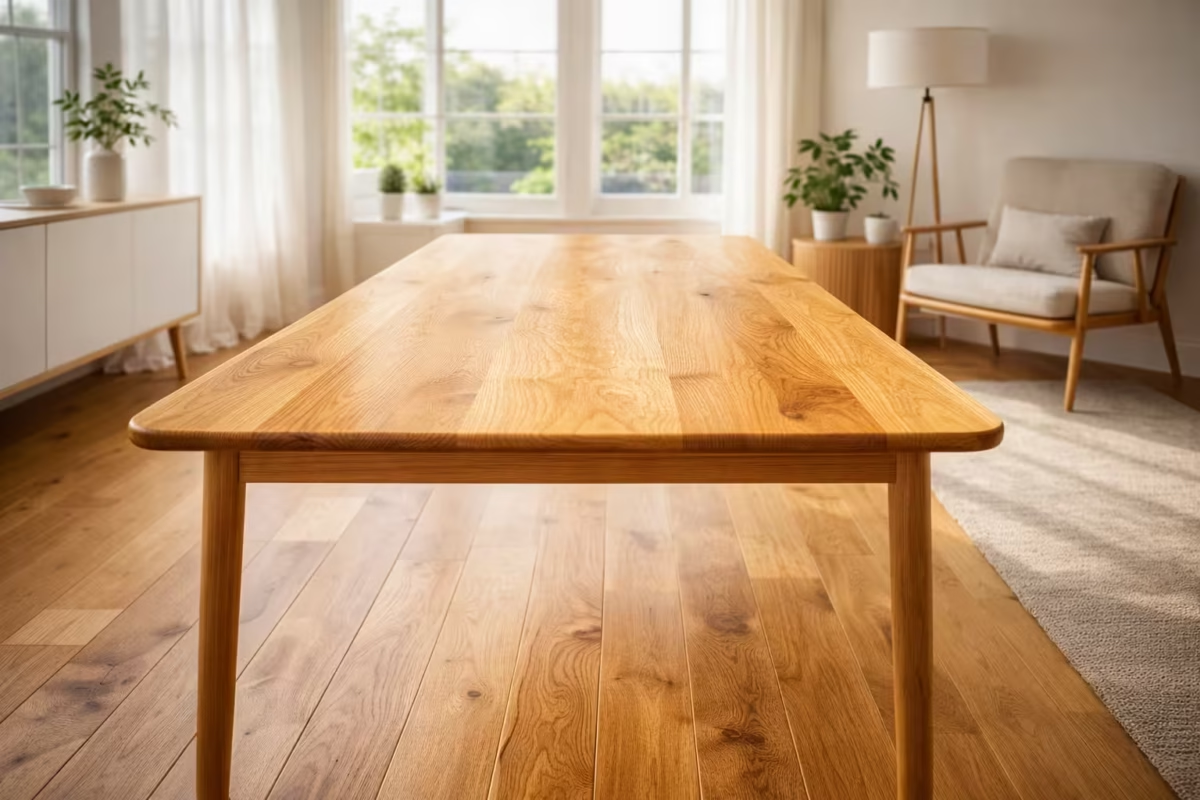
Fresh yellowheart usually shows pale lemon, clear yellow, or saturated golden heartwood. Its fine texture and strong natural color distinguish it from cream-colored maple, yet lighting and finish chemistry can change how a photograph looks.
Heartwood, Sapwood, Grain, and Luster
Heartwood color can run from cool lemon yellow to warm gold, sometimes with mineral lines or darker streaks. Sapwood is usually whitish or pale cream, creating an obvious interruption in projects that need a continuous yellow field.
Grain is often straight, but some boards contain reversing or interlocked fibers. Under angled light, a cleanly planed surface can display a soft satin sheen; rough lumber looks duller and may conceal both grain changes and small defects.
The texture feels fine and firm under a fingertip after planing. A properly scraped surface feels almost waxy, while a dull planer can leave fuzzy torn patches that catch on a cloth and appear darker after coating.
For broader visual comparisons, see this guide to natural wood colors. Compare boards under neutral daylight rather than warm indoor bulbs, which can make pale wood appear more golden than it is.
Color Variation, Aging, Photos, and Verification
Yellowheart changes color through oxidation, ultraviolet exposure, heat, and reactions with the chosen finish. Fresh lemon yellow often deepens into gold, mustard, or yellow-brown, and no clear coating can preserve the freshly cut shade forever.
Fresh, finished, and aged photos need matching lighting, camera settings, and background colors to be meaningful. A trustworthy photo set identifies whether the board was freshly planed, left unfinished, coated with oil, or covered with a water-based film.
Verify species identity before buying a large batch. Request a clear face-grain photo, an end-grain photo, the scientific name, country of origin, surfacing condition, and an explanation of how much pale sapwood the package may contain.
A practical photo check is to place a white card beside the lumber. If the card looks orange or blue in the image, the lighting or white balance is distorting the wood’s apparent color.
Yellowheart Wood Properties
Yellowheart is hard, dense, and stronger than many familiar furniture woods. Published figures describe species averages, so moisture, growth conditions, grain direction, and test methods can produce meaningful variation between boards.
Published Property Table
The following reference values align with commonly reported figures from The Wood Database yellowheart profile. Use them for species comparison and preliminary design rather than treating them as guaranteed values for purchased lumber.
| Property | Approximate published value | Practical meaning |
|---|---|---|
| Average dried weight | 52 lb/ft³ or 825 kg/m³ | Heavy for furniture, shipping, and wall-mounted work |
| Specific gravity | 0.70 basic; 0.83 at 12% MC | Dense stock that loads cutters more than maple or cherry |
| Janka hardness | 1,790 lbf or 7,960 N | Good dent resistance; predrilling and sharp tools help |
| Modulus of rupture | 19,900 psi or 137 MPa | High bending strength in clear test specimens |
| Modulus of elasticity | 2.27 million psi or 15.7 GPa | Relatively stiff under load |
| Crushing strength | 10,900 psi or 75 MPa | Strong resistance to compression parallel to grain |
| Radial shrinkage | 5.9% | Movement from pith toward bark during drying |
| Tangential shrinkage | 8.7% | Greater movement around the growth rings |
| Volumetric shrinkage | 14.7% | Total volume loss from green to oven dry |
| T/R ratio | 1.5 | Fairly balanced shrinkage, but not movement-free |
Hardness, Strength, Weight, and Wood Movement
At about 1,790 lbf Janka, yellowheart resists dents better than hard maple at roughly 1,450 lbf, white oak at 1,360 lbf, black walnut at 1,010 lbf, and black cherry at 950 lbf. It remains far below exceptionally hard woods such as ipe, often reported above 3,000 lbf.
Hardness affects machining as much as wear. A dull saw blade rubs instead of cutting cleanly, leaving a sharp toasted smell and brown scorch marks; hard fibers can also split near screw holes when a beginner skips pilot holes.
Weight adds up quickly. One theoretical dry cubic foot weighs about 52 pounds, so broad cabinet doors, thick table parts, and large turned bowls become tiring to handle and expensive to ship. Narrow accents capture the color with less mass.
A 1.5 T/R ratio suggests a reasonably balanced relationship between tangential and radial shrinkage, not zero seasonal movement. Wide panels still need floating construction, elongated screw holes, or other joints that permit movement across the grain.
Moisture content controls stability. Indoor furniture stock often falls near 6–9%, but the correct target follows the room’s expected equilibrium moisture content. Measure several points with a calibrated meter instead of relying on a fixed seven-day acclimation rule.
For a solid box lid, leave the panel free inside its frame rather than gluing every edge. A 10-inch-wide panel can move enough across seasonal humidity swings to bow the lid, crack a rigid joint, or force the miters apart.
Working and Finishing Yellowheart
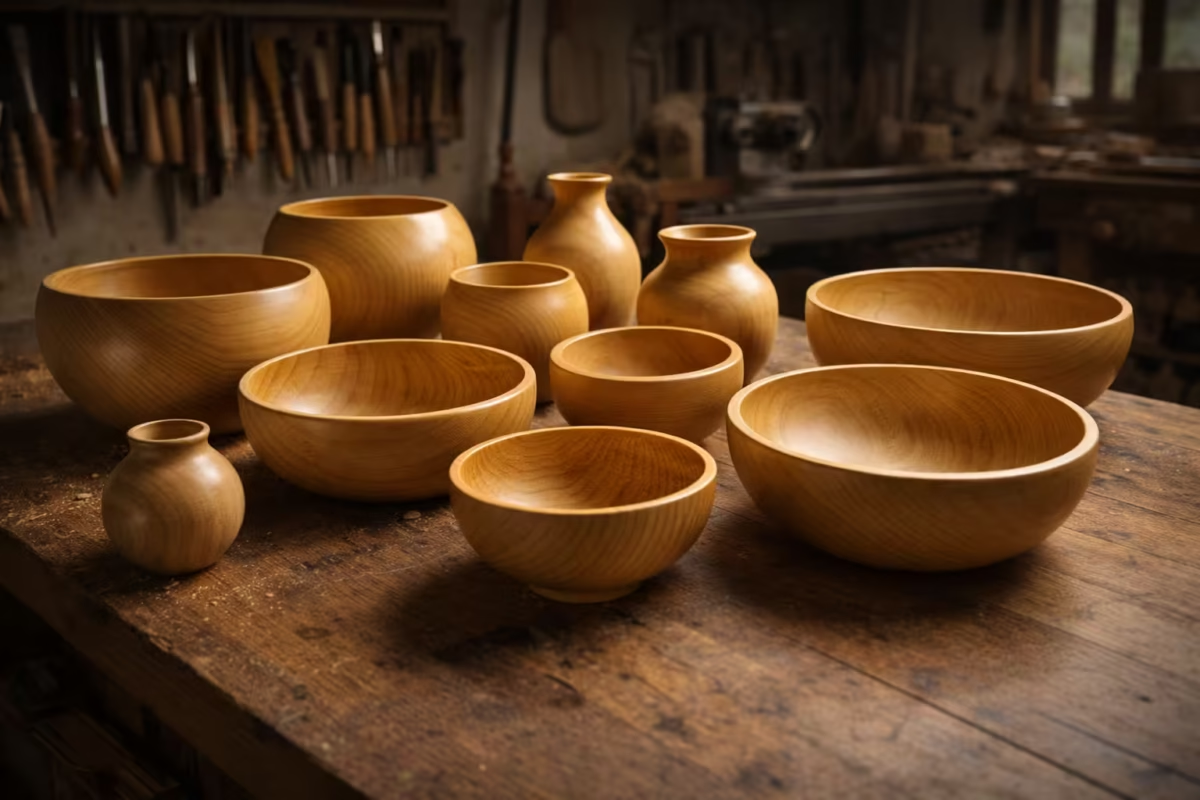
Yellowheart machines cleanly with sharp cutters, controlled feed rates, and light passes. Heat buildup, reversing grain, dense dust, and brittle edges account for most workshop failures.
Practical Notes From Real-World Use
Sawing and routing: use clean carbide cutters and keep the feed steady. Moving too slowly lets friction create dark burns, while forcing the cut can splinter narrow strips; two or three shallow router passes leave a cleaner edge than one deep pass.
Planing and tear-out: inspect both faces because grain direction can reverse halfway along a board. When the planer leaves shallow craters, switch to a light cut, helical cutterhead, high-angle hand plane, or card scraper instead of sanding away excessive thickness.
Drilling and fastening: predrill close to ends, use a backing board at the exit face, and give screw shanks clearance where they cross moving solid-wood parts. Overtightening a screw in a thin yellowheart strip can open a split before the head seats.
Gluing yellowheart: freshly prepared surfaces normally bond well with indoor PVA, waterproof-rated PVA, or epoxy selected for the assembly. Follow the adhesive maker’s open time and temperature guidance, and test mixed-species joints because an oily companion wood may cause failure.
Sanding works best through a steady sequence such as 100, 120, 150, and 180 grit. Skipping directly from coarse to fine paper leaves scratches that become dark crescents under finish, while excessive pressure can burnish the dense surface.
Yellow sanding dust readily settles in walnut, wenge, or other open-pored woods. Sand contrasting parts separately when possible, vacuum between grits, and wipe rather than blowing dust across the project.
Workshop safety matters with every wood species. The OSHA wood dust guidance describes respiratory, skin, eye, and fire hazards; use source extraction, eye and hearing protection, and a properly fitted respirator rated for fine particles.
Individual reactions vary, so don’t treat yellowheart dust as harmless. Stop work after unusual wheezing, rash, or persistent eye irritation, clean contaminated clothing, and seek medical advice for a significant reaction.

Water-Based, Oil, Film Finishes, and Testing
Water-based finishes retain a cooler, brighter yellow at first because they add less amber color. They may raise grain, so test the full sanding and coating schedule on an offcut and lightly de-nib only after the coat has cured enough.
Oil warms the color immediately, shifting lemon yellow closer to honey or gold while making the grain look deeper. Oil alone offers less abrasion and moisture protection than a well-built film coating.
Film finishes such as polyurethane, lacquer, and varnish give better resistance to abrasion and spills. Check whether the product dries water-clear or amber, since the coating’s own color can alter yellowheart before sunlight does.
UV inhibitors slow change but can’t freeze the original shade. Place finished furniture away from direct windows where practical, and avoid leaving one section covered for months because uneven exposure can create a visible color boundary.
- Prepare several offcuts from the same board to the final sanding grit.
- Label each sample before applying water-based, oil, and film options.
- Apply the manufacturer’s stated number of coats and film thickness.
- Photograph every sample beside a white card under the same light.
- Expose half of each sample to controlled daylight while covering the other half.
- Compare color, scratch resistance, and water spotting after several weeks.
This finish testing protocol reveals both the immediate ambering and the later light-driven change. Testing scraps from another board is less reliable because natural color and absorption can vary within the same shipment.
Best Uses for Yellowheart Wood
Yellowheart works best where its natural color supplies contrast without making the project needlessly heavy or costly. Inlays, marquetry, boxes, turned objects, handles, drawer fronts, and furniture accents use the species efficiently.
Inlays, Boxes, Turning, and Furniture Accents
Inlays and marquetry are among its strongest uses because a narrow strip remains visually bold beside walnut, ebony substitutes, wenge, purpleheart, maple, or padauk. Plane thin strips with support underneath, since unsupported edges can chatter or split.
Boxes and decorative objects benefit from framed or veneered yellowheart panels. This approach reduces wood movement and cost compared with a broad solid lid, while saved offcuts can become plugs, pulls, jewelry parts, or stringing.
Woodturning projects include pens, bottle stoppers, handles, spindles, small bowls, and segmented vessels. Fresh shavings come off as tight yellow curls when the tool is sharp; a dull gouge produces heat, dusty fibers, and more sanding.
Furniture and cabinet accents make better use of yellowheart than large all-yellow builds in many rooms. Edge banding, drawer fronts, handles, rails, and decorative plugs add color while keeping weight and visual intensity manageable; compare more furniture wood options before planning a full piece.
Flooring, Kitchen Projects, and Outdoor Limits
Flooring can suit yellowheart because its 1,790 lbf Janka rating offers good dent resistance. Successful floors still depend on stable moisture, accurate milling, subfloor conditions, installation method, and a suitable wear finish; hardness alone doesn’t predict complete floor performance.
Cutting-board use is conditional. Buy verified, properly dried stock from a supplier willing to address the intended food-contact use, use a suitable waterproof adhesive, and avoid assuming every imported blank carries the same handling or treatment history.
Accent strips are practical in edge-grain or end-grain boards because they supply color without making the whole board unusually heavy and hard on knives. Keep strips wide enough for sound glue joints, and reject checked or unidentified craft stock.
Outdoor use has limits because hardness and decay resistance measure different traits. Don’t substitute yellowheart for teak or ipe in ground contact based solely on tropical origin; exterior projects need drainage, sealed end grain, maintained coatings, and reliable species-specific durability information.
Yellowheart Versus Similar Woods

Yellowheart is distinctive for its relatively uniform saturated yellow, fine texture, and 1,790 lbf hardness. Canarywood, Osage orange, hard maple, purpleheart, and padauk offer different colors, sourcing options, and aging patterns.
Yellowheart Versus Canarywood, Osage Orange, and Hard Maple
Yellowheart versus canarywood: yellowheart usually presents a cleaner yellow field, while canarywood can mix yellow with orange, brown, red, and purple streaks. Choose canarywood for multicolored figure and yellowheart for a more consistent graphic accent.
Yellowheart versus Osage orange: fresh Osage orange can start yellow-orange, but it commonly becomes much darker and browner with age. Osage orange wood is a separate species with a stronger reputation for natural exterior durability and regional North American availability.
Yellowheart versus hard maple: maple is pale cream rather than lemon yellow and is easier to source in wide domestic boards. Yellowheart is harder—about 1,790 versus 1,450 lbf Janka—but usually carries higher material and shipping costs.
Yellowheart Versus Purpleheart and Padauk
Yellowheart versus purpleheart: both supply strong natural color and both change with light. Purpleheart wood moves from purple toward muted brown-purple, while yellowheart usually shifts from lemon or gold toward mustard and yellow-brown.
Yellowheart versus padauk: padauk starts orange-red and can darken considerably, while yellowheart supplies a brighter yellow contrast. Padauk’s red dust and yellowheart’s yellow dust can contaminate neighboring pores, so machine and sand the colors separately before final assembly where possible.
| Wood | Typical fresh color | Approximate Janka hardness | Main selection reason |
|---|---|---|---|
| Yellowheart | Lemon to golden yellow | 1,790 lbf | Uniform natural yellow accent |
| Canarywood | Yellow with multicolored streaks | 1,520 lbf | Varied figure and color |
| Osage orange | Yellow-orange | 2,040 lbf | Hardness and decay resistance |
| Hard maple | Pale cream | 1,450 lbf | Domestic availability and broad boards |
| Purpleheart | Purple after exposure | 2,520 lbf | Strong purple accent |
| Padauk | Orange-red | 1,970 lbf | Bright red-orange contrast |
How to Buy Yellowheart Lumber
Buy yellowheart lumber by comparing actual dimensions, moisture, surfacing, defects, usable board feet, shipping, and documentation. A cheap short blank can have a far higher effective board-foot cost than rough random-width lumber.
Stock Types, Dimensions, Grades, Cost, and Shipping
Common stock types include rough boards, surfaced lumber, fixed-size craft boards, thin inlay strips, veneer, pen blanks, spindle blanks, and bowl blanks. S2S means two surfaced faces, S3S adds one straight edge, and S4S means all four sides are surfaced.
Verify actual dimensions, quantity, kiln-dried status, moisture reading, heartwood percentage, and machining tolerance. Conventional surfaced 4/4 lumber often finishes below one inch, while a craft board advertised as ¾ inch may measure a true ¾ inch.
- Check ends for splits and wax that may conceal checks.
- Sight along each edge for bow and twist.
- Ask how much cup or thickness variation is permitted.
- Confirm whether pale sapwood counts within the stated width.
- Look for pinholes, mineral lines, wane, and planer tear-out.
- Request color matching when several boards will meet in one panel.
Board-foot formula: thickness in inches × width in inches × length in inches ÷ 144. A ¾ × 3 × 24-inch board contains 0.375 board foot, so four matching boards contain 1.5 board feet before defects, saw kerfs, and final planing reduce yield.
Effective material cost equals product price plus shipping and surfacing fees, divided by usable board feet. Record the seller’s listed price and purchase date rather than quoting one universal yellow heart wood price across rough boards, S4S craft packs, and turning blanks.
Allow 10–30% waste based on defect levels, grain matching, final dimensions, and project scale. Short inlays can use clear pieces between checks, while a long rail may render the same board uneconomical.
Shipping deserves attention because dense wood and long packages can trigger weight or oversize charges. Ask whether the ends are sealed, whether boards are wrapped against moisture, and how the seller handles impact damage; photograph the package before opening it.
Responsible Sourcing, Craft Stock, and Choosing the Right Material
Responsible sourcing requires evidence, not assumptions based on the wood’s trade status. Search Euxylophora paraensis in the CITES Species+ database, then ask the dealer for country of origin, harvest or import records, and any FSC or PEFC chain-of-custody claim.
A certification logo should be paired with a certificate code and a claim that applies to the product being sold. A species that isn’t listed under a trade restriction isn’t automatically legal, sustainable, or traceable.
Craft boards suit small work because fixed dimensions reduce milling. Twelve-inch boards fit compact boxes, inlays, segmented pieces, and knife-scale-sized parts; 24-inch stock works better for trim, edge banding, and longer laminations.
Turning blanks serve different projects. A 2 × 2 × 6-inch blank is useful for bottle stoppers, handles, short spindles, and small vessels, but it’s an inefficient way to purchase flat stock for cabinet parts.
These yellowheart product formats illustrate short craft boards, longer accent boards, and square turning stock; confirm seller, availability, dimensions, moisture condition, return terms, and delivered cost before ordering.
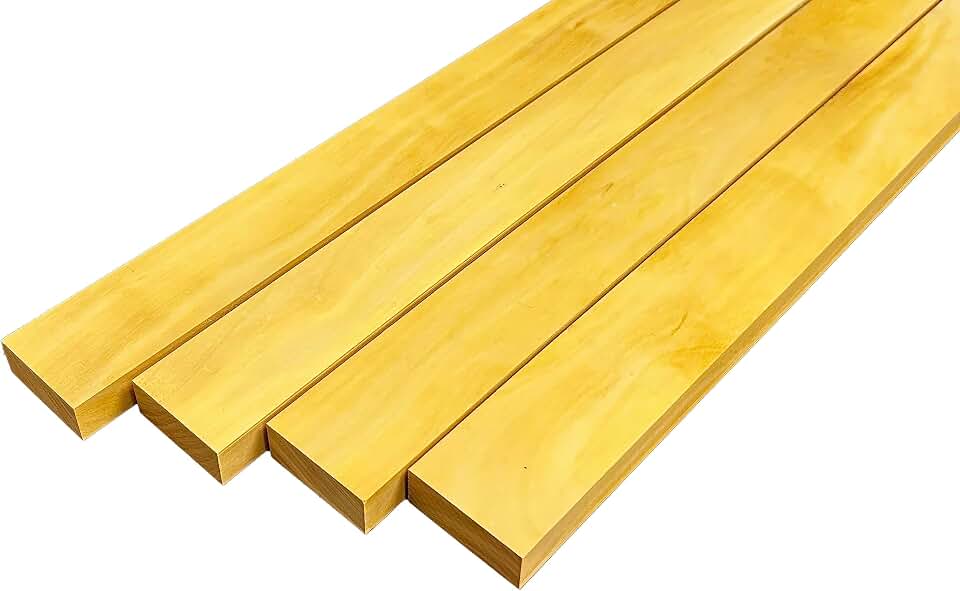
Yellowheart Lumber Boards 12 Inch
- Bright yellowheart hardwood boards
- Four pieces for compact projects
- Three quarter inch thick stock
- Twelve inch length is easy to handle
- Ideal for crafts and inlays
 Buy on Amazon
Yellowheart Lumber Boards 24 Inch
- Bright yellowheart hardwood boards
- Four matching lumber pieces
- Long twenty four inch lengths
- Three quarter inch thick stock
- Great for trim and accent work
Buy on Amazon

Yellowheart Turning Blanks
- Yellowheart hardwood turning stock
- Four square blanks included
- Two inch by two inch profile
- Six inch length for small turnings
- Ideal for pens and spindle projects
Buy on Amazon
Choose stock backward from the finished part. Add enough thickness for flattening, enough length for end checks and safe machine handling, and enough width for jointing; buy matched boards at one time when color consistency matters.
Large furniture needs lumber-yard stock rather than small online packs in most cases. Random-width rough boards usually offer a better yield, while surfaced craft pieces save setup time for small projects where convenience matters more than board-foot economy.
Save clean offcuts rather than discarding them. Yellowheart scraps remain useful for plugs, stringing, drawer pulls, jewelry, segmented turning, and repair patches, reducing demand for another full board.
Affiliate Disclosure: Some links in this post are affiliate links. If you make a purchase through these links, we may earn a small commission at no extra cost to you. We only recommend products we genuinely believe in.