
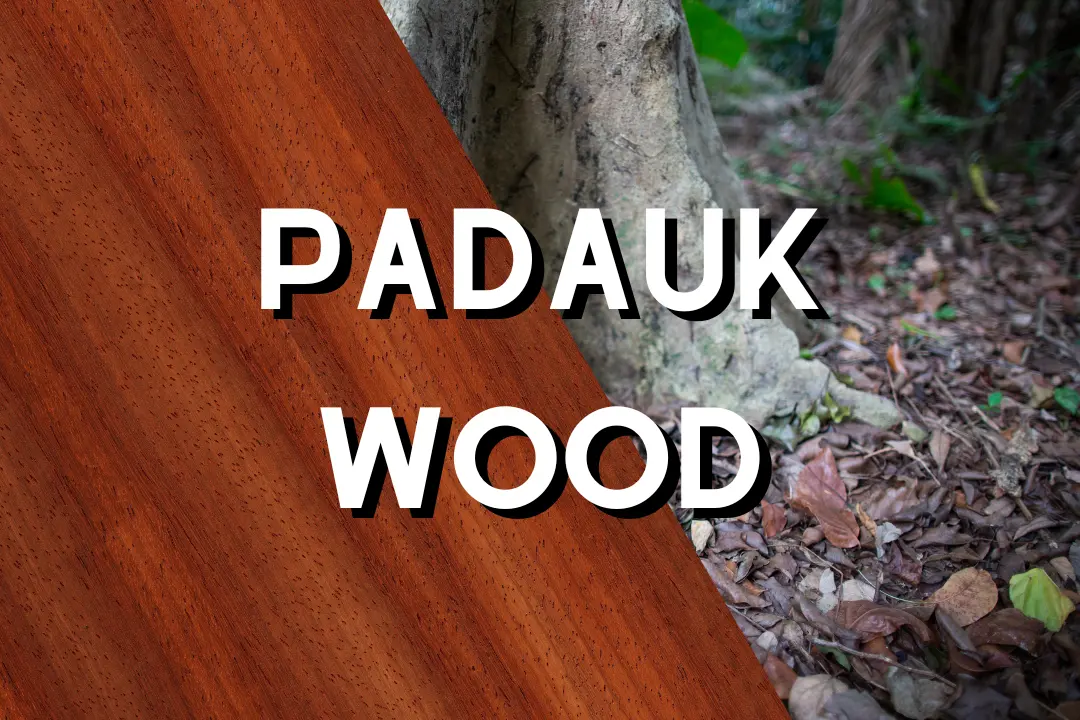
Padauk Wood: Properties, Uses, Color, Hardness, and Buying Guide

Table of Contents
Padauk wood is a dense tropical hardwood from the Pterocarpus genus, best known for its vivid orange-red heartwood, coarse open grain, and Janka hardness of about 1,970 lbf. Most woodworking references to padauk mean African padauk, usually Pterocarpus soyauxii, used for furniture, veneer, turning blanks, instruments, flooring, knife scales, and bold accent work.
Fresh padauk feels dry, hard, and slightly waxy under a sharp hand plane, and its fine orange dust has a peppery smell that clings to shirts, benches, and pale maple if you don’t control it. The main trade-offs are color darkening, dust staining, open pores, and possible irritation during sanding or turning.
What Is Padauk Wood?
Quick answer
Padauk is hardwood from tropical Pterocarpus trees, with African padauk being the most common type sold as padauk lumber in North America and Europe. It’s valued because it gives strong color without being as brittle or punishing to tools as some denser exotic hardwoods.
In a stack of rough boards, padauk stands out fast: the exposed edges show bright red-orange heartwood, while the pale sapwood looks cream or straw-colored. For a broader view of how padauk fits among hardwood species, see this guide to types of hardwood.
African padauk
African padauk usually refers to Pterocarpus soyauxii, a tropical West and Central African timber sold as boards, veneer, turning blanks, knife scales, and craft stock. Some searches spell it “African paduak,” but lumber dealers usually list it as African padauk or simply padauk.
The species is popular because it offers a practical mix of hardness, durability, color, and workability. It’s an African timber wood that can carry a full furniture build, but many builders use it as an accent strip because the color is so dominant.
Other padauk species
Padauk names vary by region, and that matters when buying. Burmese padauk, Andaman padauk, narra, and amboyna burl can come from related Pterocarpus species, but they don’t always match African padauk in density, color, price, or legal status.
Ask for the botanical name when a seller uses broad names like “red exotic wood,” “bois exotique rouge padouk,” or “padauk-type lumber.” Amboyna burl, for example, is a figured burl product, not the same thing as straight-grain padauk boards.
Specification table
The numbers below describe African padauk in typical dried woodworking stock; real boards vary with growing conditions, moisture content, and sawing. The strength data aligns with widely cited species references such as The Wood Database.
| Property | African padauk value |
|---|---|
| Common name | Padauk, African padauk |
| Botanical name | Pterocarpus soyauxii |
| Wood type | Tropical hardwood |
| Average dried weight | 47 lb/ft³ / 745 kg/m³ |
| Janka hardness | 1,970 lbf / 8,760 N |
| Specific gravity | 0.61 basic / 0.75 at 12% MC |
| Modulus of rupture | 18,510 psi / 127.6 MPa |
| Elastic modulus | 1,680,000 psi / 11.59 GPa |
| Crushing strength | 10,210 psi / 70.4 MPa |
| Radial shrinkage | 2.9% |
| Tangential shrinkage | 5.2% |
| Volumetric shrinkage | 7.6% |
| T/R ratio | 1.8 |
| Durability | Durable to very durable heartwood |
| Texture | Medium to coarse, open-pored |
| Grain | Straight to interlocked |
| Color | Orange-red, aging to reddish-brown |
| Common uses | Furniture, veneer, turning, instruments, flooring, knife scales, inlay |
Padauk Color and Grain

Fresh orange-red color
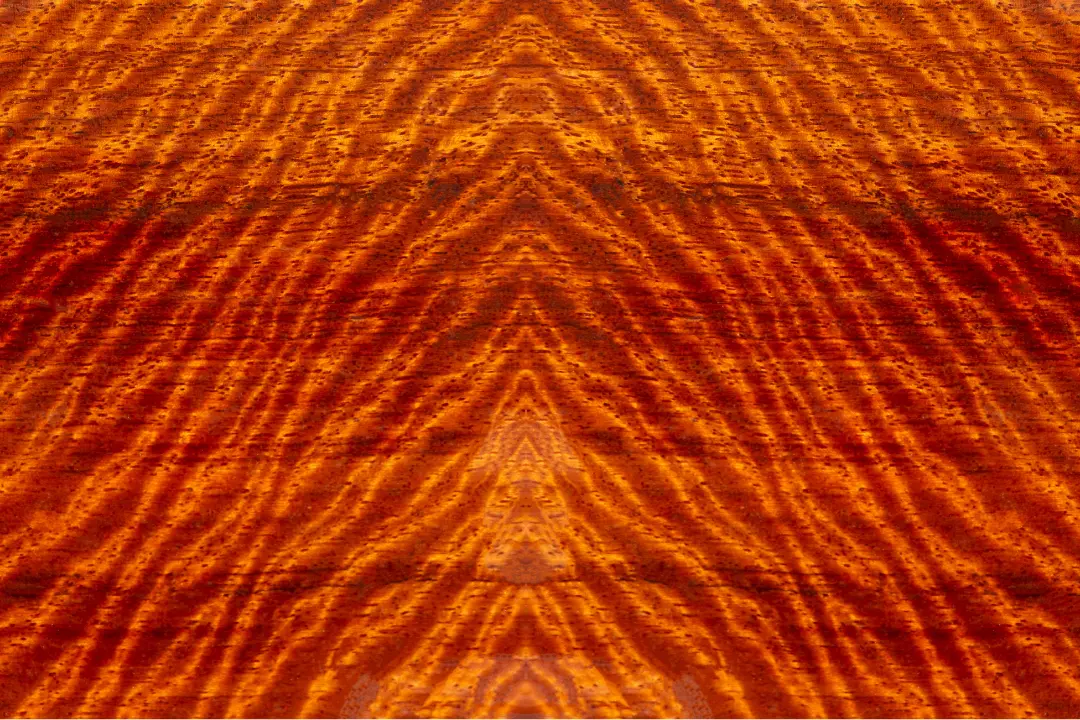
Fresh padauk color ranges from bright orange to coral red, and freshly planed boards can look almost glowing under shop lights. The color is strongest in the heartwood, which is why narrow sapwood streaks can look distracting on drawer fronts or bookmatched panels.
Right after cutting, the surface can leave a faint orange smear on your fingertips if fine dust is still in the pores. That color looks dramatic beside maple, ash, birch, ebony, wenge, walnut, and purpleheart wood, but those pale species need dust protection during sanding.
Aged reddish-brown color
Padauk darkens from orange-red to deep red, burgundy-brown, reddish-brown, or medium brown with time. This aging is normal; it doesn’t mean the board is ruined, weak, or poorly finished.
Sunlit areas change faster than shaded areas, so flooring or tabletops can show shadow marks under rugs, bowls, or hardware. If matching a customer’s existing piece, sand and finish a test strip, then place half of it in a sunny window for several days to preview the shift.
Heartwood and sapwood
Padauk heartwood carries the red-orange color and better decay resistance, while sapwood is pale cream, yellowish, or light tan. Sapwood can be attractive in rustic work, but it interrupts the clean red look most buyers expect from premium padauk boards.
For cabinet doors, box lids, and guitar sets, sort boards under neutral light before cutting. A piece that looks evenly red in a dim lumber rack may show sapwood, purple streaks, or color mismatch once it’s surfaced.
Grain and pores
Padauk grain is often straight, but interlocked or irregular grain appears often enough that you should expect it. The texture is medium to coarse, and the large open pores remain visible under thin oil or wipe-on finishes.
Run your hand across sanded padauk and you’ll feel a subtle ridged texture unless the pores are filled. That open grain gives the wood character, but it can make a glossy tabletop look uneven without pore filler.
Color-change causes
Oxidation and UV drive most padauk color change. Clear finishes slow exposure, but they don’t freeze the fresh orange-red color forever.
Oil finishes deepen padauk fast and can make the surface look warmer and darker on day one. Waterborne polyurethane adds less amber tone, while UV-resistant topcoats and shade slow darkening better than finish alone.
Hardness, Density, and Durability

Janka hardness
Padauk Janka hardness is about 1,970 lbf, which makes it harder than walnut, cherry, teak, white oak, and hard maple. That hardness helps it resist dents, but it also means blades, bits, and sandpaper wear faster than they do on softer domestic woods.
In use, padauk feels firm under tools: a sharp chisel cuts cleanly, but a dull edge skates and burnishes instead of slicing. Beginners often push harder when that happens, which raises the risk of slips, burn marks, and chipped edges.
Technical properties
Density matters because it affects weight, machining, glue pressure, and how a finished piece feels in the hand. At about 47 lb/ft³ dried, padauk is heavy enough for durable parts but still manageable for chairs, boxes, shelves, and instrument components.
The moderate shrinkage figures help explain why padauk can work well in furniture and cabinetry. It still moves across the grain, so wide tabletops need standard expansion room, breadboard planning, or proper fastener slots.
Hardness comparison
The table shows why padauk wood hardness sits in a useful middle zone: tougher than many familiar woods, but less punishing than purpleheart. If you’re comparing colorful exotics, also see bloodwood because its intense red color comes with different handling traits.
| Wood species | Approximate Janka hardness | Practical meaning |
|---|---|---|
| Cherry | 950 lbf | Easier to dent, easier to machine |
| Black walnut | 1,010 lbf | Comfortable for hand tools |
| Teak | 1,070 lbf | Moderate hardness, oily feel |
| White oak | 1,360 lbf | Strong flooring and furniture wood |
| Hard maple | 1,450 lbf | Common cutting board standard |
| Padauk | 1,970 lbf | Hard, colorful, durable accent or primary wood |
| Purpleheart | 2,520 lbf | Harder, more demanding on tools |
Wood movement
Padauk movement is moderate, with radial shrinkage near 2.9% and tangential shrinkage near 5.2%. Those numbers are friendly for a dense exotic hardwood, but they don’t cancel basic wood movement rules.
Use floating panels, slotted screw holes, figure-eight fasteners, or elongated clips where parts must move. A common beginner mistake is gluing cross-grain accents rigidly into a wide panel; the workaround is to keep inlay narrow or let the main panel expand freely.
Outdoor suitability
Padauk heartwood is rated durable to very durable against decay, so it can serve in some exterior projects. It is not waterproof, and constant wetting, trapped moisture, or ground contact can shorten service life.
Use it for covered porch furniture, exterior accents, handles, and decorative panels that shed water. Seal end grain, avoid soil contact, use corrosion-resistant fasteners, and accept that outdoor UV will dull the red much faster than indoor light.
Working and Finishing Padauk
Cutting and machining
Padauk machines well with sharp carbide blades, router bits, jointer knives, and planer inserts. It cuts cleanly, but the hardness makes dull cutters heat up, chatter, and leave dark burn lines on routed edges.
Use light passes, steady feed pressure, and dust collection at the tool. The cut edge often has a warm, spicy smell, and the orange dust can spread across a shop faster than pale sawdust because it shows on every surface.
Planing and tearout
Straight-grain padauk planes nicely, while interlocked grain can tear out in short fuzzy patches. A beginner may keep taking deeper passes to “clean it up,” but that can make the tearout wider.
Take shallow cuts, switch feed direction, use a high-angle hand plane, or finish difficult areas with a card scraper. A scraper gives padauk a crisp satin sheen without forcing torn fibers below the surface.
Sanding dust stains
Padauk sanding dust is the shop problem people remember. It stains pale woods such as maple, ash, birch, holly, and white oak, especially when dust gets rubbed into open pores during final sanding.
- Sand padauk parts separately before glue-up when the design allows it.
- Vacuum the surface between grits instead of wiping dust across pale wood.
- Seal pale woods with a light washcoat before final sanding near padauk accents.
- Avoid compressed air because it drives red dust into pores, walls, and tool housings.
- Use clean paper for pale woods after touching padauk; don’t reuse loaded abrasive.
The professional workaround is sequence control: mill and sand the red species first, clean the bench, then handle the light species. If dust still stains a maple glue-up, scrape the pale wood lightly instead of sanding the red pigment deeper.
Gluing padauk
Padauk glues well with standard woodworking glue when the surface is fresh, clean, and not glazed by dull tooling. Dry-fit first because dense hardwood parts can slide under clamp pressure.
Remove dust with a vacuum and a clean brush, then glue soon after final milling. Don’t over-clamp thin strips; starving the joint can leave a weak glue line, especially in cutting board accents or narrow laminations.
Turning blanks
Padauk turning blanks are popular for pens, handles, bottle stoppers, tool grips, spindles, bowls, and small vessels. The wood cuts cleanly on the lathe, and fresh shavings come off in bright orange curls that feel crisp and dry between your fingers.
Keep tools sharp, use dust protection during sanding, and seal end grain on stored blanks. Padauk can develop small end checks if a blank sits in dry shop air after being cut too close to final length.
Best finish options
Waterborne polyurethane is often the best finish when you want to slow ambering and keep padauk brighter for longer. Oil-based polyurethane, Danish oil, tung oil, and shellac make the grain look richer, but they usually deepen the orange-red tone right away.
Lacquer builds fast and polishes well on boxes, furniture, and instruments, while shellac works as a useful dust-locking sealer before topcoats. For more finish comparisons across exotic species, see mahogany wood because mahogany’s open grain raises similar pore-filling decisions.
Pore filling
Padauk has open pores, so a glass-smooth tabletop, cabinet door, or instrument finish usually needs pore filler. If you skip filler under a glossy topcoat, the surface can show tiny valleys that catch light at low angles.
Use a compatible filler, scrape across the grain, and test for color bleed before touching pale inlay or binding. Dark filler can make the grain look bold; clear filler keeps the surface cleaner and brighter but may need extra coats.
Toxicity and Woodshop Safety
Dust irritation risks
Padauk dust can irritate skin, eyes, nose, throat, and lungs, especially during sanding, routing, sawing, turning, and power carving. It isn’t useful to label padauk as simply safe or unsafe; the practical answer is that the finished wood is widely used, but airborne dust deserves respect.
Fine dust feels dry and gritty on sweaty forearms, and it can make some people sneeze within minutes. OSHA notes that wood dust exposure can create respiratory and other health hazards in wood operations; see OSHA wood dust guidance for workplace context.
Allergy symptoms
Possible reactions include itchy skin, watery eyes, runny nose, coughing, sneezing, throat tightness, or asthma-like breathing trouble in sensitive users. Sensitization can build over time, so a person who handled padauk once without trouble may react later.
Stop work if symptoms appear, wash exposed skin, and clean contaminated clothing. Don’t test your tolerance by sanding more; switch tasks and let the dust settle safely through collection and filtration.
Respirator and collection
Source collection matters more than sweeping afterward. Use a dust collector at the saw, planer, router table, and lathe, then wear a well-fitting respirator with high-efficiency filters when sanding or turning.
An N95 is better than nothing for short dusty tasks, but a half-mask with P100 filters seals better on long sanding sessions. If you can smell or taste the peppery dust through the mask, check the fit, cartridges, and facial seal.
Cleanup best practices
Vacuum first, then wipe; don’t blast padauk dust with compressed air. Air hoses send red powder into tool vents, open-grain pale woods, drawer slides, lungs, and finish rooms.
Use a HEPA-capable vacuum when possible, clean sanding pads often, and wash hands before touching food, finishes, or pale boards. A slightly damp microfiber cloth can lift dust, but keep it away from unfinished maple if it starts dragging red color.
Padauk Wood Uses
Furniture and cabinetry
Padauk furniture can be striking, durable, and stable when the design allows seasonal movement. It works for tables, chairs, shelves, cabinet doors, drawer fronts, trim, pulls, boxes, and decorative panels.
Large surfaces demand color planning because the bright orange surface will shift into a quieter reddish-brown. For full-piece design decisions, compare padauk with other woods for furniture before committing to a whole dining table or wall of cabinets.
Veneer and inlay
Padauk veneer gives strong color with less cost and less movement than thick lumber. It suits marquetry, decorative box lids, furniture panels, edge banding, inlay strips, and small craft work.
Veneer is also safer for designs where a full-thickness red board would overpower the piece. Use a sharp knife or veneer saw because crushed edges show as dark fuzzy lines after finish.
Turning projects
Padauk turns cleanly for pens, handles, stoppers, small bowls, tool grips, and spindle work. The color makes small projects look finished before stain, dye, or heavy decoration enters the plan.
The main mistake is sanding on the lathe without strong collection. That fine red dust rolls over the tool rest, coats your fingers, and can leave orange rings on nearby light-colored blanks.
Knife scales
Padauk knife scales are hard, attractive, and easy to shape into comfortable handles. Bookmatched scales give mirrored grain that looks much more intentional than two random red strips.
Seal the handle well because knives see sweat, water, oils, and temperature swings. Test the final grip before assembly; a glossy finish can feel slick when wet, while a rubbed oil-and-wax surface may feel warmer but needs renewal.
Guitars and instruments
Padauk guitar wood appears in backs, sides, bridges, decorative laminations, and sometimes fingerboard-style parts depending on the builder’s design. Its density, stiffness, color, and stability make it useful where tone and appearance both matter.
Instrument work magnifies every pore and color shift, so test pore filler and finish before touching a set. Orange dust can stain pale bindings, spruce tops, and maple laminations if you sand them in the same pass.
Flooring
Padauk flooring is hard enough for wear, with its 1,970 lbf Janka rating beating white oak and hard maple. It creates a dramatic floor, especially in borders, medallions, and accent strips.
Plan for uneven color change in sunny rooms. Rugs, sofas, and cabinets can block UV, leaving lighter protected patches beside darker exposed lanes.
Cutting boards
Padauk cutting boards are possible, especially with narrow accent strips, but padauk is not the most conservative food-contact choice. Its open pores, red dust, color bleed risk, and possible dust sensitivity make hard maple, walnut, and cherry easier defaults.
If you use padauk, choose clean untreated stock, sand thoroughly, vacuum well, and finish with fully cured food-contact-appropriate oil or board butter. Edge-grain or long-grain construction is easier to keep clean than end-grain if you’re worried about red dust contamination.
Project suitability table
This table gives a quick project match for padauk based on hardness, pore structure, color behavior, and shop handling. Use it as a planning guide, then test your actual board and finish.
| Project type | Suitability | Key note |
|---|---|---|
| Furniture | Excellent | Account for color darkening on large surfaces |
| Cabinetry | Excellent | Pore fill for glossy doors |
| Veneer | Excellent | Strong color with less material cost |
| Inlay | Excellent | Seal pale woods to reduce dust staining |
| Turning | Excellent | Use dust protection during sanding |
| Knife scales | Very good | Seal well against moisture |
| Flooring | Very good | Expect UV-related color variation |
| Cutting boards | Possible with caution | Better as accent strips than full boards |
| Outdoor furniture | Possible with care | Design for drainage and seal end grain |
| Ground contact | Not recommended by default | Moisture traps shorten service life |
| High-gloss tabletops | Good with pore filling | Open pores show under gloss |
| Pale-wood glue-ups | Use caution | Red dust can stain light grain |
Price and Buying Tips
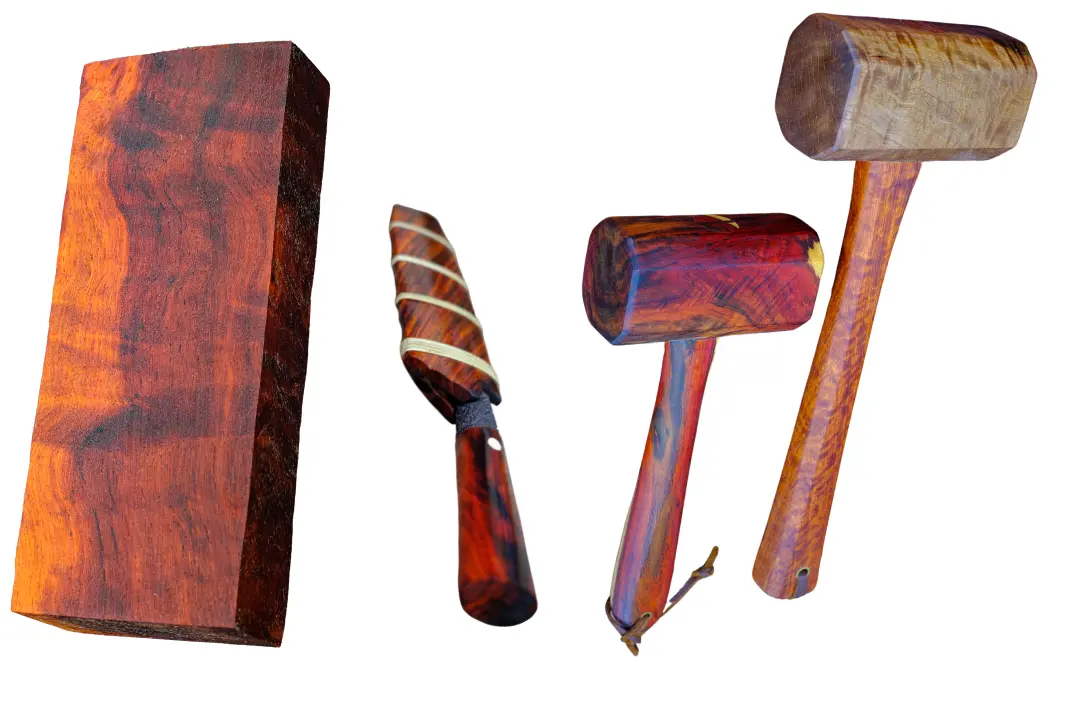
Board foot pricing
Padauk wood price usually sits in the premium exotic hardwood range. In U.S. retail lumber channels, African padauk commonly lands around $18–$35+ per board foot, with thickness, width, grade, milling, color, moisture, supplier, and shipping changing the final cost.
Small craft boards, knife scales, turning blanks, and surfaced packs often cost more per board foot than rough lumber. You pay for dimensioning and convenience, which can still make sense if you don’t own a jointer, planer, bandsaw, or dust collector.
Board foot formula
Board feet are calculated with this formula: thickness in inches × width in inches × length in inches ÷ 144. A board that is 1 inch thick × 6 inches wide × 48 inches long equals 2 board feet because 1 × 6 × 48 ÷ 144 = 2.
For rough lumber, buy extra because surfacing, end checks, sapwood, twist, and color sorting reduce usable yield. On padauk, I’d rather buy a 15–25% waste factor than force a pale sapwood edge into a red panel later.
Lumber buying terms
Buying terms change what you actually receive. Rough-sawn lumber needs milling, S2S is surfaced two sides, S3S is surfaced two sides with one straight-line-ripped edge, and kiln-dried stock has been dried to a controlled moisture level.
- 4/4 lumber is roughly one inch thick before surfacing.
- 8/4 lumber is roughly two inches thick before surfacing.
- Turning blanks are thick square or rectangular pieces for lathe work.
- Knife scales are thin matched pieces for handles and tool grips.
- Veneer is a thin sheet for decorative faces, inlay, and panels.
The beginner trap is comparing a rough 4/4 board to a surfaced craft pack by price alone. Compare usable volume, shipping, tool access, and waste before deciding what is cheaper.
What to inspect
Inspect padauk lumber for botanical name, kiln-dried status, actual dimensions, sapwood, end checks, cracks, twist, color consistency, and surfacing quality. If the seller lists only “red hardwood,” ask for clarification before buying.
Look closely at end grain and board edges because small checks can travel farther than they first appear. Freshly surfaced padauk can hide tiny cracks under bright color glare, so tilt the board under side light.
Stock by project type
Choose stock by the project rather than buying the reddest piece on the rack. Veneer works for panels and inlay, boards work for furniture and boxes, turning blanks work for lathe projects, and knife scales work for handles.
Here are padauk stock examples for veneer, boards, turning blanks, knife scales, and lumber packs.
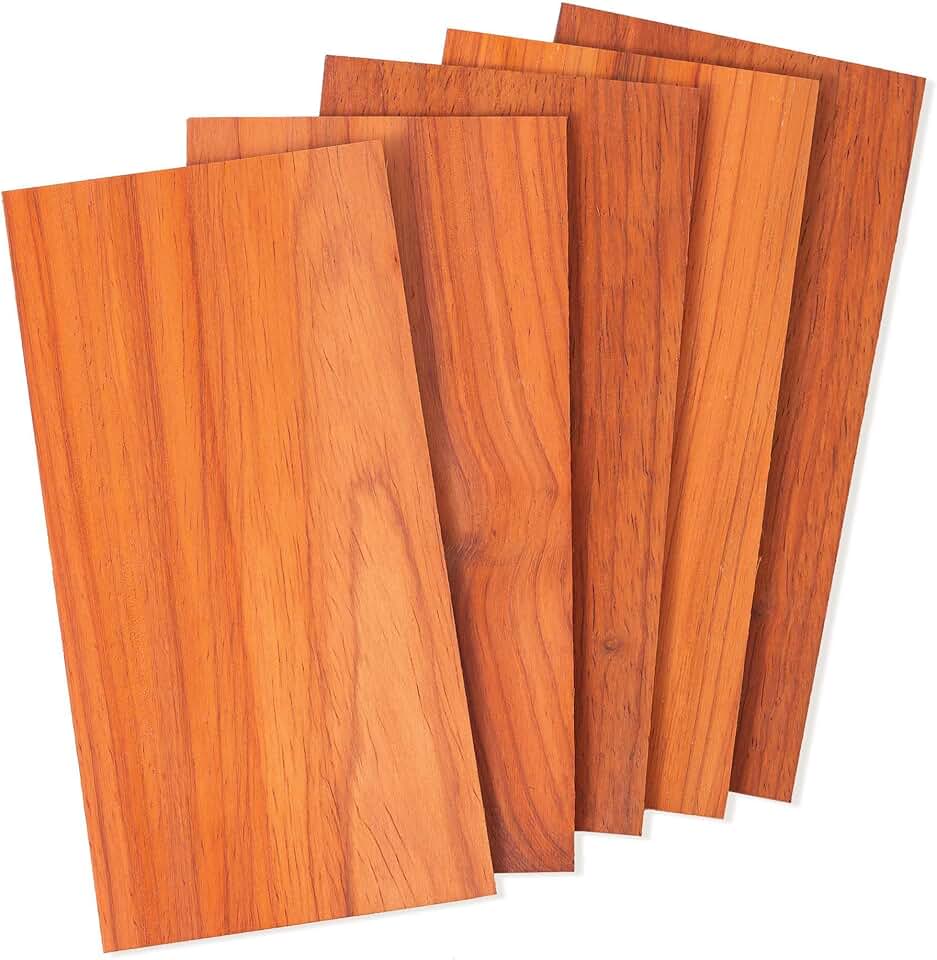
Vibrant Padauk Veneer Sheets
- Rich orange-red color adds a bold natural look
- Thin sheets are ideal for veneers and inlays
- Easy to cut for crafts and small woodworking projects
- Smooth hardwood surface works well for finishing
- Handy size for detailed creative work
 Buy on Amazon

Padauk Boards for Big Builds
- Solid padauk hardwood with striking red tone
- Thick boards offer strength for durable projects
- Great for furniture parts and shop work
- Precut size saves time on prep
- Nice option for woodworking and custom builds
Buy on Amazon

Padauk Turning Blanks
- Thick blanks are ideal for turning and shaping
- Padauk offers vivid color and attractive grain
- Sized for handles, spindles, and small parts
- Consistent pieces help with repeatable results
- Great for lathe work and custom craft projects
Buy on Amazon
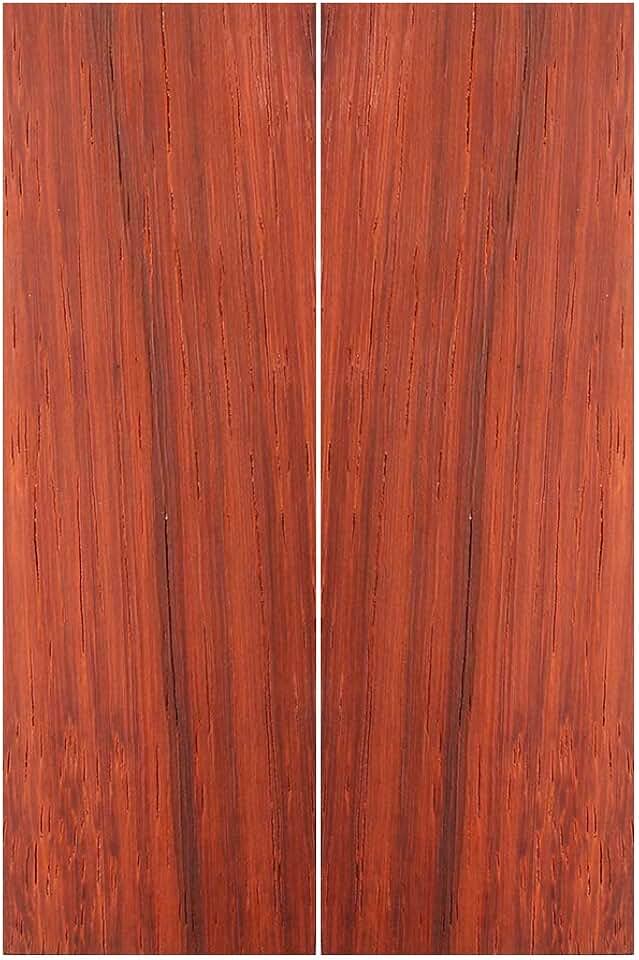
Bookmatched Knife Scales
- Bookmatched pair creates a mirrored custom look
- Natural padauk adds bold color to handles
- Sized for knives, tools, and small crafts
- Easy to shape for a comfortable grip
- Great for DIY builds and custom finishing
Buy on Amazon

Heavy-Duty Padauk Lumber Pack
- Ten-piece pack is ready for bigger projects
- Solid padauk hardwood offers strength and beauty
- Great for cutting boards and shop builds
- Precut boards help speed up planning and prep
- Reliable option for frequent woodworking use
Buy on Amazon
For repeated small work, a lumber pack saves setup time; for a single box lid, veneer may be smarter. If you’re buying rough boards, compare padauk with other premium species in this guide to the most expensive wood so the price makes sense in context.
Comparisons, Sourcing, and Pros
Padauk vs walnut
Padauk vs walnut is a contrast between bold color and quiet warmth. Padauk is harder at about 1,970 lbf, while black walnut is around 1,010 lbf, making walnut easier to plane, carve, and blend into traditional furniture.
Choose walnut for calm brown furniture and padauk for a red focal point or accent. In mixed glue-ups, padauk dust can contaminate walnut pores less visibly than maple, but the orange cast can still muddy a clean oil finish.
Padauk vs maple
Padauk vs maple is common in cutting boards, boxes, and modern furniture because orange-red and cream create sharp contrast. Padauk is harder at about 1,970 lbf, while hard maple is about 1,450 lbf.
Maple is the safer default for cutting boards because of its fine closed grain and long food-contact history. If you pair them, sand maple separately or seal it first because padauk dust leaves rust-colored freckles in pale grain.
Padauk vs oak
Padauk vs oak comes down to color, pore structure, and design language. Padauk is harder than white oak, while white oak offers strong ray fleck, a neutral tone, and a long record in furniture, flooring, and exterior joinery.
Oak’s open grain accepts filler and stain in predictable ways, while padauk brings its own color and doesn’t need dye. If you want red drama, choose padauk; if you want classic structure, white oak is easier to integrate.
Padauk vs purpleheart
Padauk vs purpleheart compares two colorful exotic hardwoods that darken with time. Padauk is about 1,970 lbf, while purpleheart is about 2,520 lbf and can feel tougher on edges, abrasives, and small router bits.
Padauk starts orange-red and shifts brownish red; purpleheart starts purple and shifts darker brown-purple. Both need dust protection, and both can overpower a design if used as large uninterrupted panels.
Padauk vs teak
Padauk vs teak is a strength-versus-oiliness comparison. Padauk is harder at about 1,970 lbf, while teak is around 1,070 lbf, but teak is more famous for outdoor and marine work because of its natural oils.
Padauk usually glues more predictably than very oily teak, while teak handles wet service with less fuss. For outdoor furniture, compare details in this teak wood guide before choosing padauk for exposed parts.
Sustainability and legality
Padauk sourcing matters because the name can cover several Pterocarpus species with different conservation and trade concerns. Buyers should ask for botanical name, origin, invoices, chain-of-custody details, and FSC or comparable documentation where available.
Before importing or selling finished goods, check whether the exact species has trade controls. The CITES species checklist is a useful verification step because some Pterocarpus relatives face restrictions, and broad “padauk” labels can create paperwork problems.
Pros and cons
Padauk is worth it when you want a hard, durable, vivid red-orange hardwood that machines well and makes small details stand out. It’s less ideal when you need stable bright color forever, low dust risk, a closed-pore surface, or the cheapest hardwood option.
| Pros | Cons |
|---|---|
| Vivid orange-red color | Color darkens over time |
| Harder than many domestic hardwoods | Dust can stain pale woods |
| Durable to very durable heartwood | Dust may irritate skin, eyes, or lungs |
| Good for furniture, turning, veneer, instruments, and inlay | Open pores may need filling for gloss |
| Machines and turns well with sharp tools | Interlocked grain can tear out |
| Available as boards, blanks, veneer, scales, and packs | Costs more than many domestic woods |
| Strong contrast with maple, walnut, ebony, and wenge | Species ID and sourcing need checking |
The best workflow is simple: buy verified stock, mill with sharp carbide, control dust from the first cut, test finish samples, and design around the eventual reddish-brown aging. That approach avoids the common beginner mistakes: assuming the color stays neon orange, sanding padauk beside maple, skipping pore filler under gloss, and treating exotic wood dust like ordinary pine dust.
FAQs
What Is Padauk Wood Used For?
Padauk wood is used for furniture, cabinets, flooring, musical instruments, and decorative projects. Its strong, stable nature and bold orange-red color make it popular for both functional and eye-catching woodworking pieces.
Is Padauk Wood Toxic?
Padauk wood is generally considered safe to use, but its dust can irritate the skin, eyes, or lungs in some people. Wearing a dust mask and using good ventilation is a smart precaution when cutting or sanding it.
Does Padauk Wood Change Color?
Yes, padauk wood changes color over time. Its bright orange-red tone usually darkens to a deeper reddish-brown as it is exposed to light and air, which is a natural aging process.
Is Padauk Good For Cutting Boards?
Padauk can be used for cutting boards, but it is not the most common choice. It is hard and durable, yet some woodworkers prefer lighter, more stable woods with fewer extractives for food-contact projects.
What Is The Best Finish For Padauk Wood?
The best finish for padauk wood is usually a clear finish that highlights its color, such as oil, polyurethane, or lacquer. If you want to slow color change, choose a finish with UV protection and avoid heavy yellowing finishes.
Affiliate Disclosure: Some links in this post are affiliate links. If you make a purchase through these links, we may earn a small commission at no extra cost to you. We only recommend products we genuinely believe in.




I was impressed by the coverage of all aspects ofAfrican Blackwood and Padauk.
Do you have write-up on Bloodwood? I haven’t heard of it till now.
I am in Telengana, a state of India. I have recently planted a few Diospyros melanoxylon, Khaya senegalensis, Sweitenia mahagoni and teak on the 2 and a half acres I have been planting for the past 8 months. Also have some Baobabs.
Thank you, Dr. Raghavan! I’m so glad you enjoyed the post and appreciated the coverage on African Blackwood and Padauk. It’s wonderful to hear about the variety of trees you’ve planted—what a meaningful and diverse selection! That sounds like a beautiful project you’re working on in Telangana.
As for Bloodwood, I’ve actually put together a detailed article on it, which you can check out here: https://glamorwood.com/types-of-wood/bloodwood/. It’s such a striking and fascinating species, and I think you’ll enjoy reading more about its unique properties. Thanks again for your thoughtful comment!