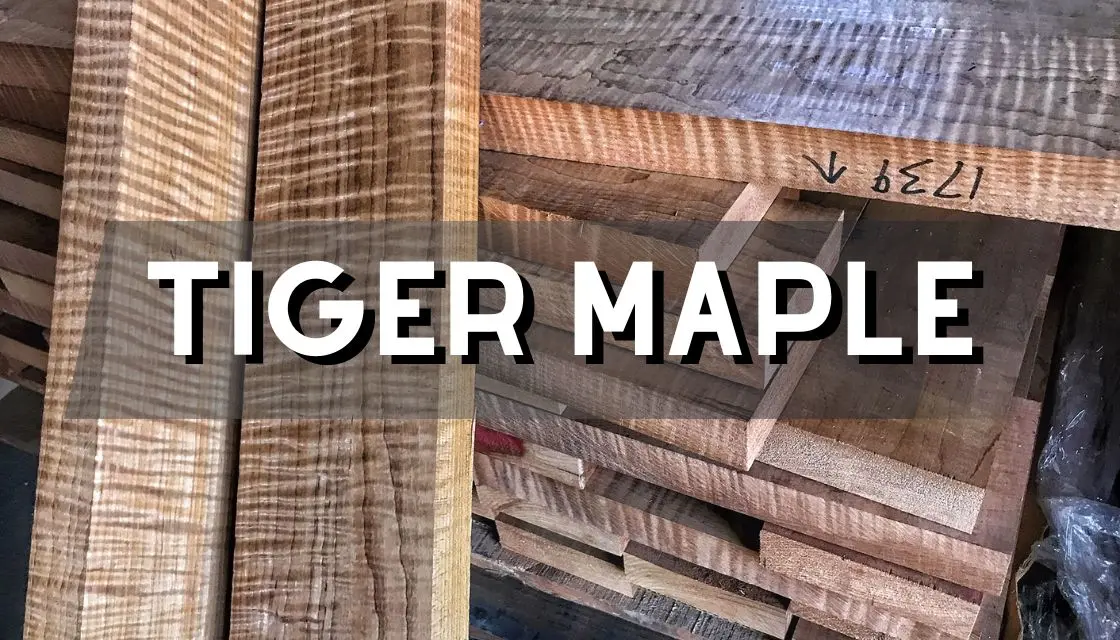


Walnut wood is a deciduous hardwood valued for its natural chocolate-brown heartwood, workable grain, and stable performance in furniture, cabinetry, veneer, turning, and decorative panels. American black walnut averages about 1,010 lbf on the Janka scale, while dark walnut wood stain is a manufactured color that can be applied to walnut or other species.
Table of Contents
Walnut Wood at a Glance

Walnut is a hardwood from deciduous trees in the Juglans genus. The name covers several species, so color, figure, availability, and price depend on the botanical identity rather than the word “walnut” alone.
Definition and Quick Facts
In North American lumberyards, “walnut” usually means American black walnut, or Juglans nigra. It combines naturally dark heartwood with moderate hardness, clean machining, and lower movement than many wide-board furniture woods.
| Quick fact | American black walnut |
|---|---|
| Botanical name | Juglans nigra |
| Wood type | Deciduous hardwood |
| Average dried weight | About 38 lb/ft³ or 610 kg/m³ |
| Janka hardness | About 1,010 lbf or 4,490 N |
| Typical texture | Medium, with visible pores |
| Main strength | Dark natural color with good workability |
| Main limitations | Premium price, pale sapwood, denting, and light-related fading |
The USDA PLANTS profile records black walnut across much of eastern and central North America. Growth site, soil, tree age, and drying practice can change the appearance and performance of an individual board.
American Black Walnut
Black walnut wood commonly ranges from medium brown to deep chocolate, with occasional gray, red, purple, or olive tones. It’s the principal commercial choice for North American furniture, cabinet doors, gunstocks, instrument parts, carving, and architectural millwork; our detailed black walnut guide covers the species in greater depth.
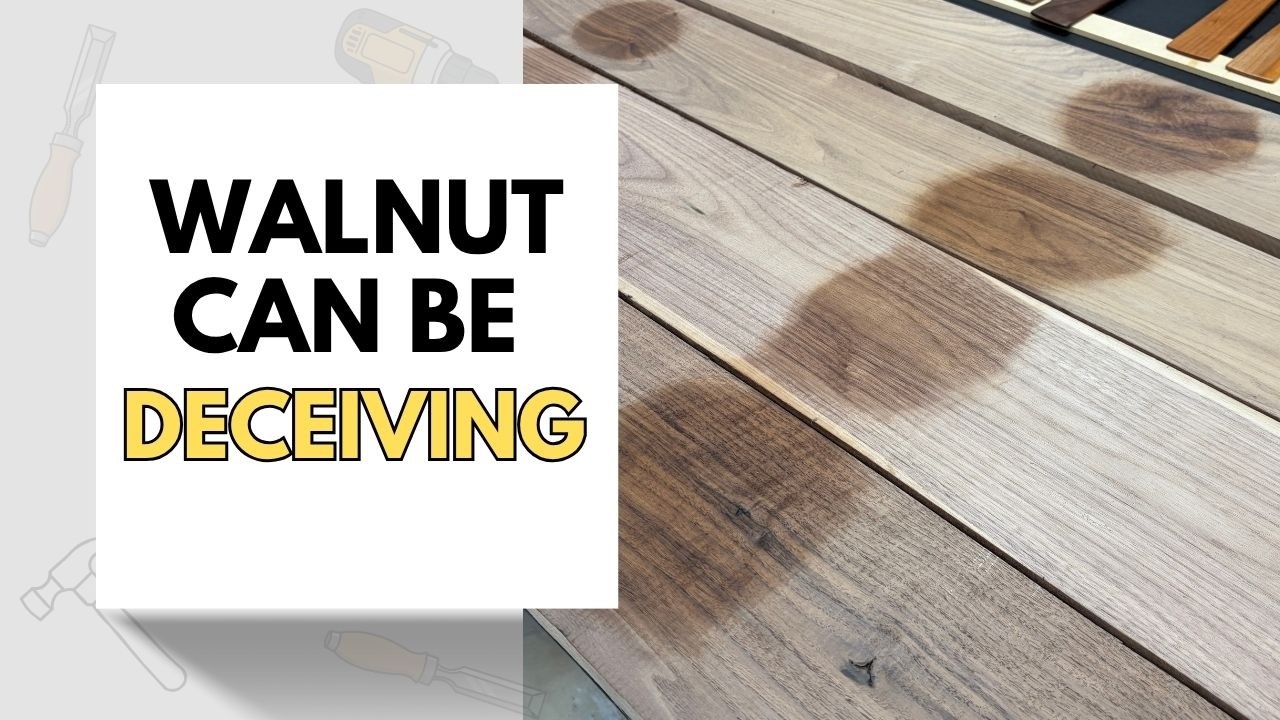
Freshly planed walnut often looks slightly dusty and muted. Wiping it with mineral spirits makes the grain flash darker for a few seconds and provides a useful preview of an oil-rich clear finish without committing to the finish.
English or European walnut, Juglans regia, is also called Persian walnut. It can look lighter and more variable than American black walnut, often mixing tan, gray-brown, chocolate, and dark streaks in the same board.
Claro walnut, Juglans hindsii, is associated with California and often reaches the market as slabs, gunstock blanks, or highly figured pieces. Curl, marbling, feather figure, and graft-line color can command substantial premiums.
Peruvian or tropical walnut may refer to Juglans neotropica or another regional species. “African walnut” can name unrelated timber, so ask for the botanical species before comparing strength, legality, or price.
Real walnut identification relies on several clues: medium-sized pores, dark heartwood, pale sapwood, moderate weight, end-grain structure, and a mild earthy smell during cutting. Color by itself proves little because stain, printed laminate, and melamine can copy walnut’s brown tone.
- Check exposed edges for continuous grain through the board.
- Look for a thin face layer over plywood, MDF, or particleboard.
- Compare face grain with end grain; printed patterns often repeat.
- Ask whether the product is solid walnut, American walnut veneer, or walnut-look laminate.
- Request the botanical name when species authenticity affects the project.
Solid wood shows end grain that matches the face structure. A real walnut veneer has genuine wood grain but only as a thin surface layer, while printed furniture film lacks wood pores and may repeat an identical knot every few feet.
Walnut Wood Color and Grain

Walnut wood color isn’t one standardized shade. Its heartwood spans gray-brown through chocolate brown, while sapwood remains cream, pale yellow, or nearly white.
Heartwood and Sapwood
Heartwood creates walnut’s familiar dark appearance and contains extractives that provide some natural decay resistance. Pale sapwood lacks the same color and durability, yet it’s still structurally useful when dry and free from defects.
Sapwood isn’t proof of low-grade lumber. FAS grading measures usable clear cuttings rather than a perfectly uniform dark face, so a high-grade board can contain visible cream sapwood.
Grain, Figure, and Burlwood
Most walnut grain runs straight, but branches, crotches, roots, and burls disrupt fiber direction. Curl catches light in moving bands, crotch figure forms a feather shape, and burlwood displays tight swirls, eyes, and irregular clusters.
Highly figured stock feels less predictable under a hand plane. The surface can shift from a smooth, glassy shaving to a rough patch within an inch because the fibers reverse direction; a card scraper often leaves a cleaner final surface than another planer pass.
Flat-sawn walnut shows broad cathedral arches and stronger width movement. Quarter-sawn stock has straighter lines, narrower growth-ring spacing across the face, and somewhat better dimensional behavior, though it’s less common and may cost more.
Steamed walnut has been exposed to heat and moisture so color migrates into the pale sapwood. Steaming can create a more uniform brown, but it may soften the lively purple, gray, and chocolate contrast found in unsteamed boards.
Ask a dealer whether stock was steamed before ordering boards for a matched set. Mixing steamed and unsteamed material can produce a visible color break after clear coating, particularly under neutral waterborne finishes.
Unlike cherry, walnut commonly becomes lighter and warmer after prolonged light exposure. Covered areas beneath bowls, monitors, and table runners can stay dark while exposed areas turn golden brown.
Move objects periodically during the first year and reduce strong window exposure with blinds or UV-filtering glass. A UV-resistant finish can slow the shift, but no clear coating freezes natural walnut at its freshly finished color.
A useful finish sample gallery should show raw wood, water-dampened wood, waterborne clear coat, oil-based polyurethane, hard-wax oil, and amber shellac under identical lighting. Approximate digital colors such as #6B4632 and #4B2E24 help with early planning, but screens, camera white balance, and individual boards prevent exact color matching.
Walnut Wood Properties and Durability
American black walnut is moderately hard and stable, rather than exceptionally hard. It handles furniture loads well but dents more readily than white oak or hard maple.
Mechanical Properties Table
| Property | Approximate value | Practical meaning |
|---|---|---|
| Average dried weight | 38 lb/ft³ / 610 kg/m³ | Moderate carrying and machining weight |
| Specific gravity | 0.51 basic / 0.55 at 12% MC | Medium-density domestic hardwood |
| Janka hardness | 1,010 lbf | Accepts dents sooner than oak or hard maple |
| Modulus of rupture | 14,600 psi | Useful bending strength for furniture components |
| Modulus of elasticity | 1.68 million psi | Moderate stiffness |
| Crushing strength | 7,580 psi | Good compression performance |
| Radial shrinkage | 5.5% | Movement across quarter-sawn faces |
| Tangential shrinkage | 7.8% | Greater movement across flat-sawn faces |
| Volumetric shrinkage | 12.8% | Total green-to-oven-dry change |
| T/R ratio | 1.4 | Relatively favorable distortion behavior |
These values align with published Black Walnut data. They’re species averages, not promises for every board; moisture content, knots, grain slope, growth conditions, and test method all change results.
Janka Hardness Comparison
| Wood | Approximate Janka hardness | Difference from walnut |
|---|---|---|
| Black cherry | 950 lbf | Slightly softer |
| Black walnut | 1,010 lbf | Baseline |
| Red oak | 1,220 lbf | About 21% harder |
| White oak | 1,360 lbf | About 35% harder |
| Hard maple | 1,450 lbf | About 44% harder |
Janka hardness measures resistance to indentation, not structural quality or seasonal movement. The wood hardness scale explains why a harder board may still warp more than a softer, properly dried board.
Density and strength make walnut comfortable to handle without giving it a lightweight or fragile feel. A finished tabletop feels substantial, while sharp tools cut it with less resistance than hard maple.
Shrinkage remains manageable because walnut’s tangential-to-radial ratio is about 1.4. That doesn’t make it movement-free: a wide, flat-sawn top still changes width as indoor humidity rises and falls.
Furniture lumber often reaches an indoor target near 6–9% moisture content, but the correct reading depends on the destination climate. Acclimation should end when meter readings stabilize near the room’s expected equilibrium moisture content, not after an arbitrary number of days.
Stack boards with spacers so air reaches both faces. Leaving walnut flat against concrete or opening a tightly wrapped shipment in a humid workshop can create a moisture imbalance that cups one face before milling begins.
Walnut isn’t waterproof. Its heartwood has useful natural decay resistance, but standing water, end-grain exposure, repeated wetting, and poorly drained exterior joints still lead to swelling, checking, finish failure, or decay. Sapwood is less resistant than heartwood.
Walnut’s main advantages are natural dark color, attractive figure, stable behavior, good gluing, and pleasant machining. Its disadvantages include premium material cost, pale sapwood, UV fading, softer flooring performance, figured-grain tear-out, and waste generated while matching visible boards.
Uses and Woodworking Performance
Walnut is good for furniture because it machines cleanly, holds joinery well, and supplies a naturally dark face without heavy stain. Its moderate hardness suits tables and cabinets, though flooring and hard-use tops collect dents sooner than harder species.
Furniture and Cabinetry
Dining tables, desks, chairs, beds, drawer fronts, shelves, and cabinet doors are standard applications. Board selection matters most on broad surfaces, where one gray-brown board beside a reddish board creates an obvious panel mismatch after finishing.
Lay boards in their final order and view them from both ends of the room before gluing. Wetting each face lightly with mineral spirits exposes color jumps and awkward cathedral patterns that dry, rough boards can hide.
Veneer and Decorative Panels
American walnut veneer places a thin genuine-wood face over plywood, MDF, or another core. It uses valuable figure efficiently and supports book-matched, slip-matched, quarter-matched, or sunburst layouts that would waste large amounts of solid timber.
Walnut-faced plywood stays flatter than a wide solid panel, making it practical for cabinet sides and door centers. Exposed edges reveal the core, screw holding differs, and deep scratches can cut through the thin face, so use solid edge lipping where wear is likely.
Walnut flooring gives rooms a warm, dark foundation but sits below red oak, white oak, and hard maple in dent resistance. Grit under shoes feels like fine sandpaper and leaves pale scratches across a dark finish, so entry mats and frequent dust removal matter.
Turning stock works well for bowls, knobs, pens, handles, and tool grips. Check blanks for pith, hidden checks, bark inclusions, and uneven moisture before mounting; cracked figured blanks can separate at speed despite looking sound on one face.
Carving walnut produces crisp details with sharp tools, yet reversing grain can chip delicate edges. Take lighter cuts near curls and feather figure, and keep the bevel supported rather than prying out a deep shaving.
Walnut is widely used for cutting and serving boards, often beside maple or cherry. Choose a food-contact finish approved by its manufacturer, allow full cure, and never soak solid wood or place it in a dishwasher; repeated wet-dry cycles can split the glue lines.
End-grain boards are gentle on knife edges but require careful block orientation and flat glue surfaces. Edge-grain boards use simpler glue-ups and less labor, making them easier for a beginner to flatten and maintain.
Walnut saws, drills, routes, sands, and turns cleanly. Figured fibers can tear under a planer, so use sharp knives, shallow cuts, a skewed feed where safe, or a card scraper for the final passes.
Dull router bits leave fuzzy edges and dark heat marks. Back up end grain, reduce cut depth, and make a light climb-cut only where the tool setup and guarding make that technique safe.
Walnut glues well with common woodworking adhesives when mating surfaces fit closely and remain free from dust or finish residue. Pre-drill screws near board ends and avoid driving fasteners into unsupported edges, where splitting can follow the grain.
Solid tabletops must move across their width. Attach bases with figure-eight fasteners, Z-clips, wooden buttons, or screws in elongated slots; rigid cross-grain fastening can hold for one season and then produce a sharp crack during a dry winter.
Wood Movement Joinery: Practical Notes From Real-World Use
A common workshop failure starts with a wide top that looks flat and feels cool and smooth after sanding. Once indoor heating lowers humidity, the top pulls against fixed screws, joints creak under load, and a hairline split appears beside the base.
The reliable workaround is to anchor the center while allowing fasteners nearer the edges to slide. On wide tabletops, leave cross-grain travel in both directions and keep aprons or breadboard ends from locking the entire panel rigidly.
Walnut Timber Boards Buying Guide
Walnut timber boards may be rough solid lumber, surfaced boards, edge-glued panels, live-edge slabs, veneer, or walnut-faced plywood. Confirm the construction, dimensions, moisture content, grade, and pricing unit before comparing offers.
Solid, Veneer, and Plywood
Solid walnut can be reshaped, refinished deeply, and joined like ordinary lumber, but it moves across the grain. Veneer and walnut plywood cover larger stable surfaces with less costly walnut, yet their thin faces limit aggressive sanding and edge repair.
An edge-glued panel is still solid wood if every strip is walnut. Plywood uses cross-laminated layers, while veneered MDF uses a fiber core; neither should be priced or represented as solid walnut throughout.
Rough, Dressed, and Surfaced Lumber
Rough lumber retains saw texture and requires flattening, jointing, and planing. Dressed lumber has one or more machined faces, commonly described as S2S, S3S, or S4S for surfaced on two, three, or four sides.
S4S stock costs more but saves setup time and reveals grain. It can still bow after milling, so check each board against a straightedge rather than assuming dressed lumber is furniture-ready.
| Rough designation | Nominal rough thickness | Common finished expectation |
|---|---|---|
| 4/4 | About 1 inch | Often around 3/4 inch after flattening |
| 5/4 | About 1 1/4 inches | Often around 1 inch |
| 6/4 | About 1 1/2 inches | Often around 1 1/4 inches |
| 8/4 | About 2 inches | Often around 1 3/4 inches |
Finished yield varies with cup, twist, saw marks, and the supplier’s original thickness. A badly cupped 4/4 board may fail to produce a flat 3/4-inch part, so buy thicker stock when final dimensions leave little margin.
Hardwood grades describe potential clear cuttings, not beauty or color consistency. The NHLA grading rules define FAS, FAS One Face, Selects, and Common grades, but buyers still need to assess sapwood, knots, checks, wane, pith, twist, and grain placement.
Measure moisture on several boards and at several points rather than accepting a single supplier reading. Pinless meters scan quickly, while insulated pins can reveal a moisture gradient between the shell and interior of thick slabs.
Choose boards for the parts you need, not for uninterrupted perfection. A lower-grade board may yield excellent short drawer fronts, while an expensive wide board with a central knot may fail as a one-piece door.
The board-foot formula is thickness in inches × width in inches × length in feet ÷ 12. A rough 1 × 8-inch board measuring 8 feet contains about 5.33 board feet.
At an illustrative rate of $14 per board foot, that board costs about $74.62 before sales tax, shipping, milling, and waste. Add roughly 15–30% for crosscuts, defects, sapwood removal, grain matching, and flattening; complex matched furniture can require more.
Hidden price factors include random versus fixed widths, S2S or S4S surfacing, kiln drying, minimum orders, long-package shipping, grade, sapwood allowance, and premiums for wide, clear, quarter-sawn, figured, or matched boards.
- Confirm whether the price is per board foot, linear foot, square foot, piece, or slab.
- Measure the actual thickness, width, and usable length.
- Inspect both faces for checks, cup, twist, knots, and epoxy-filled voids.
- Ask whether slab width includes bark, splits, or missing material.
- Check for embedded nails, wire, bullets, or staining that suggests metal.
- Request the drying method, present moisture readings, and flattening allowance.
- Confirm the return policy for internal checks or severe movement after delivery.
Dark blue-black marks can signal iron reacting with walnut tannins. Scan urban-salvaged slabs before cutting; hitting hidden steel produces a hard jolt through the saw, ruins teeth, and can throw dangerous fragments.
Project format matters: wide solid boards suit shelves and furniture parts, squares fit turning, thin sheets serve inlay and crafts, and walnut plywood supports stable panels or laser-cut work. Verify whether thin sheets are solid, veneered, or plywood before ordering.
These walnut product formats illustrate common choices for furniture parts, turning, small crafts, and laser work.
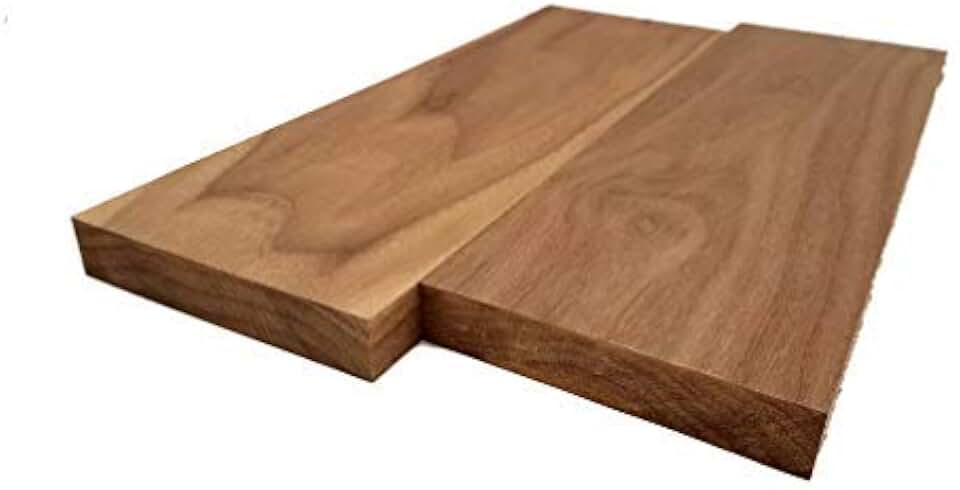
Wide Black Walnut Lumber Boards
- Two black walnut boards included
- Wide profile supports larger project parts
- Rich dark grain adds timeless warmth
- Great for shelves boxes and custom furniture
- Ready to cut shape sand and finish
 Buy on Amazon

Black Walnut Turning Squares
- Four solid black walnut blanks
- Square profile suits lathe turning projects
- Rich dark grain adds natural character
- Useful for handles knobs and small parts
- Generous 2 inch stock for shaping
Buy on Amazon

Thin Walnut Craft Wood Sheets
- Pack of five unfinished walnut sheets
- Dark wood tone elevates handmade projects
- Thin stock is easy to cut and shape
- Great for crafts inlays and small decor
- Ready for sanding staining or finishing
Buy on Amazon
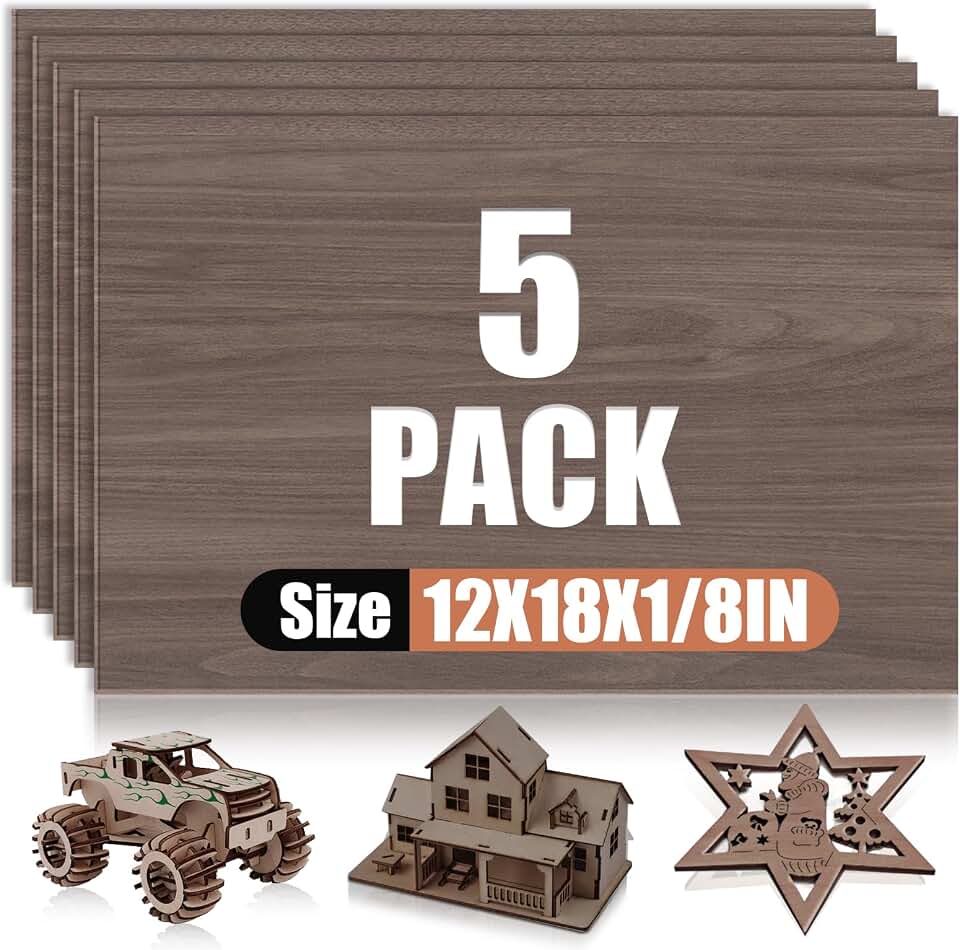
Walnut Plywood for Laser Crafts
- Five walnut plywood sheets per pack
- Thin 3 mm panels suit detailed cuts
- Designed for laser cutting and engraving
- Unfinished surface works with paint and wood burning
- Great for models signs and craft projects
Buy on Amazon
Dark Walnut Wood Stain and Finishes
Dark walnut wood stain is a manufactured deep-brown color, not a wood species. Its result changes with the substrate, sanding, application time, pigment load, topcoat, and lighting.
Stain Color Versus Species
A product labeled dark walnut may look sharply defined on open-pored oak, blotchy on pine, weak or patchy on hard maple, and nearly black on natural walnut. Manufacturer swatches can’t guarantee the finished color on your board.
Natural walnut often looks best under a clear finish because heavy pigment fills pores and flattens its chocolate, purple, and gray variation. Stain makes sense when blending sapwood, matching an older repair, or meeting a production color standard.
Should Walnut Be Stained?
Walnut usually needs no stain. Test a clear coat first on an offcut; the color often becomes much richer once finish wets the fibers, removing the pale, dry haze seen after sanding.
| Finish | Color effect | Useful application | Main trade-off |
|---|---|---|---|
| Waterborne clear coat | Neutral to cooler brown | Pale, low-amber appearance | Can raise grain |
| Oil-based polyurethane | Warm and amber | Tables and handled furniture | Odor and longer cure |
| Wiping varnish | Warm, grain-rich look | Easy thin coats | Several coats may be needed |
| Hard-wax oil | Low-build, natural look | Repairable furniture surfaces | Resistance varies by formula |
| Shellac | Warm; amber grades add more color | Sealing and decorative furniture | Limited alcohol resistance |
| Lacquer | Clear to mildly warm | Smooth production finish | Requires suitable ventilation and spray controls |
A film finish such as polyurethane provides a hard coating for wood, yet the coating can’t change walnut’s underlying Janka hardness. A heavy impact may leave the film intact while compressing the wood beneath it.
Dye penetrates fibers with less pore-mudding than many pigment stains. Toner places controlled color within or above a sealer coat, making it useful for blending pale sapwood without darkening every heartwood pore equally.
Sand the project and sample through the same sequence, usually ending near 150–180 grit when the stain maker permits. Sanding much finer can limit absorption, while skipped scratches become dark arcs after pigment settles into them.
- Prepare an offcut from the same board through the final sanding grit.
- Remove dust without leaving oily or silicone contamination.
- Stir pigment stain from the bottom rather than relying on shaking.
- Apply an even wet coat and wipe after a controlled test interval.
- Let the stain dry for the full stated time.
- Apply a compatible topcoat within its stated temperature and recoat limits.
Beginners often start on the visible face and then chase lap marks. Work on a sample first, time the wiping interval, and maintain a wet edge; on large panels, a helper can make the application timing much more consistent.
| Sample | Expected appearance | What it reveals |
|---|---|---|
| Raw walnut | Dry, muted brown | Natural grain and sanding quality |
| Water-dampened | Temporarily richer | Approximate wet look, not final color |
| Waterborne clear | Neutral brown | Natural contrast with little ambering |
| Oil-based clear | Warm chocolate brown | Stronger depth and amber tone |
| Dark walnut stain | Deep brown to near-black | Potential loss of pore and figure contrast |
Photograph finish samples under the same lamp, exposure, angle, and white balance. A low grazing angle reveals pore filling and sanding scratches, while diffuse front light gives a more accurate view of overall color.
| Finishing problem | Likely cause | Practical correction |
|---|---|---|
| Muddy grain | Too much pigment | Sand back and test dye or a clear finish |
| Pale sapwood | Natural color contrast | Use dye, toner, or planned board placement |
| Blotching | Uneven absorption | Test conditioner, washcoat, or dye |
| Cloudy topcoat | Moisture, heavy coats, or incompatibility | Check cure times and product instructions |
| Rough surface | Raised grain or trapped dust | Level lightly between approved coats |
| Uneven fading | Blocked or unequal sunlight | Rotate objects and reduce direct UV exposure |
Walnut Versus Other Hardwoods
Walnut is darker than most domestic oak and maple, softer than both, and commonly more expensive. Cherry is slightly softer and darkens with light, while walnut tends to become lighter and more golden.
Hardwood Comparison Table
| Wood | Typical natural color | Janka hardness | Useful project fit |
|---|---|---|---|
| Black walnut | Gray-brown to chocolate | 1,010 lbf | Dark furniture, cabinetry, carving |
| Red oak | Pinkish tan to brown | 1,220 lbf | Flooring and open-grain furniture |
| White oak | Tan to medium brown | 1,360 lbf | Flooring, furniture, exposed joinery |
| Hard maple | Cream to pale tan | 1,450 lbf | Hard-use tops and pale cabinetry |
| Black cherry | Pinkish brown, darkening with age | 950 lbf | Fine furniture and carved work |
| Mahogany | Reddish brown | Varies by species | Furniture, veneer, musical work |
Walnut Versus Oak
Oak resists dents better and usually costs less. Walnut supplies darker natural color and quieter pores, while quarter-sawn white oak displays bold ray fleck that walnut doesn’t reproduce.
Choose walnut for chocolate color and refined furniture grain. Choose white oak wood for busier grain, stronger dent resistance, and many flooring or high-contact applications.
Hard maple is about 44% harder by the listed Janka values and offers a pale, close-grained surface. Maple can blotch beneath dark pigment, while walnut reaches a rich brown under a simple clear coat.
Walnut-and-maple combinations create dramatic contrast, but sanding dust can contaminate pale maple pores. Finish sanding the maple with clean abrasives and vacuum carefully before applying oil or clear coat.
Cherry is slightly softer than black walnut and often machines with a similarly pleasant, controlled feel. Cherry begins pinkish or light brown and darkens under light; walnut follows the opposite tendency by fading warmer and lighter.
Both suit fine furniture, but cherry’s blotching can complicate stain work. Review the natural behavior of cherry wood before trying to force either species into the other’s color.
Mahogany varies widely because the name covers genuine mahoganies and substitute species. Its color usually leans redder than walnut, while hardness, price, trade status, and decay resistance depend on the exact botanical species.
Walnut commonly costs more than standard red oak, white oak, maple, or cherry boards of similar grade. It may still offer better project value when a naturally dark surface avoids staining, while veneer can reduce cost across large cabinet panels.
The cheapest dark wood is rarely a direct walnut substitute. Stained poplar or pine can lower material expense, but blotching, softness, pore structure, and repair behavior remain visibly different from solid walnut.
Care, Safety, and Responsible Sourcing
Walnut furniture needs gentle cleaning, controlled moisture, sunlight management, and finish-compatible repair. Machining also requires dust control, while oil-based finishing materials need fire-safe rag handling.
Cleaning Walnut Furniture
Remove grit with a soft dry cloth or a barely damp cloth, then wipe the surface dry. Standing water can seep through worn finish near joints and leave a raised, slightly rough edge that catches under a fingertip.
Avoid applying household polish before identifying the finish. Silicone products can interfere with later repairs, while alcohol can damage shellac and strong cleaners can dull lacquer or hard-wax oil.
Light scratches confined to the coating may respond to a compatible maintenance product or a new finish coat. Deep scratches need local color repair, while dents in unfinished walnut can sometimes be raised with controlled steam.
Don’t steam a finished surface without testing. Heat and moisture can turn some coatings cloudy, soften veneer adhesive, or create a pale ring larger than the original dent.
Reduce uneven fading by moving lamps, mats, books, and decorative objects every few months. Window shades and UV-filtering film slow exposure, though they won’t stop walnut’s natural color shift permanently.
Walnut Dust Safety
Walnut dust can irritate skin, eyes, and airways, and repeated exposure may sensitize some workers. Use source extraction, eye protection, hearing protection, and a properly rated respirator during sanding, routing, and turning.
OSHA woodworking guidance addresses dust, machine, noise, and fire hazards. A loose nuisance-dust mask isn’t a substitute for suitable respiratory protection during heavy machining.
Oil-soaked rags can self-heat as the finish oxidizes and may ignite without a flame. Follow the product safety data sheet; spread rags flat in a safe outdoor location or place them in an approved metal container under local disposal rules.
Keep solvent-based stain, lacquer, and finish away from ignition sources and provide suitable ventilation. Mixing products without checking recoat windows can trap solvent, wrinkle a coating, or leave a soft surface that holds fingerprints.
Black walnut tissues contain juglone and related compounds, with higher concern around roots, hulls, buds, and fresh plant material. Black walnut shavings are a recognized hazard for horses and shouldn’t be used as equine bedding.
That animal-bedding risk doesn’t mean every cured walnut table is toxic. Exposure route, concentration, material form, finish cure, and animal species all matter, so avoid broad claims about finished household objects.
Responsible sourcing starts with a confirmed species, harvest region, and chain of custody. Ask about FSC or PEFC certification, reclaimed stock, or urban-salvaged walnut rather than assuming every board has the same forestry history.
Salvaged trees can yield broad, beautiful slabs while keeping urban timber out of waste streams, but they carry a higher risk of nails, wire, internal staining, and uneven drying. Certification claims should be supported by documentation from the seller.
Walnut earns its premium through natural dark color, expressive grain, clean workability, and dependable furniture performance. Buy it by usable yield, acclimate it with moisture readings, allow solid panels to move, and test every finishing schedule on matching scrap before touching the project.
FAQs
Is Walnut Wood Expensive?
Walnut wood is generally more expensive than many common hardwoods. Its rich color, attractive grain, durability, and limited availability can increase its price. Costs vary by grade, board width, and whether you buy lumber, furniture, or veneer. For smaller projects, walnut can still be a worthwhile premium choice.
What Color Is Natural Walnut Wood?
Natural walnut wood is usually a warm medium to dark brown with occasional purplish or gray undertones. The heartwood is typically darker, while the sapwood near the outer edge is pale cream or light brown. Its color may lighten slightly with age and sunlight unless it is protected with a finish.
Is Walnut Harder Than Oak?
No, walnut is generally softer than both red oak and white oak. Walnut is still a durable hardwood that works well for furniture, cabinets, and decorative projects. Oak offers better resistance to dents and heavy wear, while walnut is often chosen for its smoother texture and richer appearance.
Should Natural Walnut Wood Be Stained?
Natural walnut wood usually does not need stain because its natural color is already rich and attractive. A clear oil, wax, or protective topcoat can enhance the grain while keeping its original appearance. Stain may be useful if you need to match existing furniture or create a darker, more uniform color.
How Can You Tell Solid Walnut From Walnut Veneer?
You can often tell solid walnut from veneer by checking the edges, end grain, and underside of the piece. Solid wood shows continuous grain and natural variation, while veneer may reveal a thin surface layer over plywood or another core. Look closely at corners, drawer edges, and drilled holes for exposed layers.
Affiliate Disclosure: Some links in this post are affiliate links. If you make a purchase through these links, we may earn a small commission at no extra cost to you. We only recommend products we genuinely believe in.