

Australian buloke is the exceptionally dense timber of Allocasuarina luehmannii, an inland Australian tree also called buloke or bull oak. Its published Janka hardness of about 5,060 lbf (22,500 N) places Australian buloke wood among the hardest commercially available woods, though individual samples and test conditions vary.
Suggested SEO title: Australian Buloke: Hardness, Wood Properties, Uses and Price
Suggested meta description: Learn why Australian buloke is exceptionally hard, how to identify and machine it, where the tree grows, and how to compare timber prices.
Table of Contents
What Is Australian Buloke?
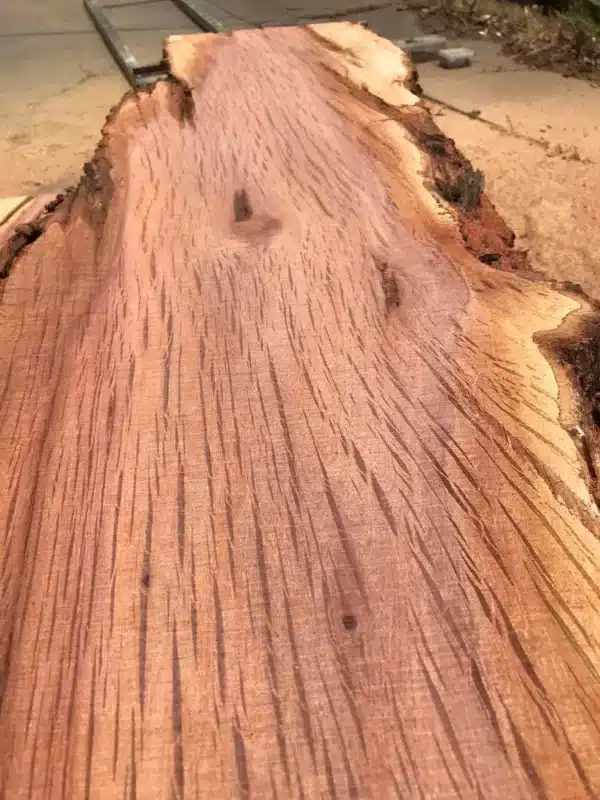
Australian buloke is an evergreen hardwood tree native to inland eastern and southeastern Australia. Woodworkers usually encounter its timber as small turning blanks, knife scales, handles, decorative pieces, or collectors’ samples rather than standardized construction boards.
Names and Taxonomy
The accepted scientific name is Allocasuarina luehmannii, in the Casuarinaceae family. Common names include Australian buloke, buloke, bull oak, and bull-oak; older botanical references may use the synonym Casuarina luehmannii.
International searches may describe the same material as kayu Australian buloke, buloke australiano, buloke australien, or buloke holz. A translated trade name doesn’t prove identity, so buyers should still request the scientific name.
Quick Species Profile
| Feature | Australian buloke profile |
|---|---|
| Scientific name | Allocasuarina luehmannii |
| Family | Casuarinaceae |
| Other names | Buloke, bull oak, bull-oak |
| Native range | Parts of Queensland, New South Wales, Victoria, and South Australia |
| Typical height | About 10–15 m (30–50 ft), varying by site |
| Dried density | About 1,210 kg/m³ or 75 lb/ft³ |
| Published Janka hardness | About 5,060 lbf or 22,500 N |
| Usual timber market | Specialty craft and turning stock |
Buloke isn’t oak. True oaks belong to the genus Quercus in the Fagaceae family. The “oak” in bull oak reflects a common-name tradition rather than a close botanical relationship, much like several unrelated Australian trees sold under broad oak labels.
Its dense, ray-rich timber can resemble some oaks at a glance, particularly on quartersawn faces. Yet its branchlets, woody cones, taxonomy, density, and end-grain anatomy separate it from true oak and from many trees loosely grouped as ironwood trees.
Australian Buloke Wood Properties
Extreme density and hardness define Australian buloke wood. Published figures describe reference specimens, not a promise for every board, since moisture, growth conditions, grain direction, and test protocol alter measured performance.
Timber Property Table
| Property | Commonly cited value | What it means in use |
|---|---|---|
| Average dried weight | 75 lb/ft³ | Small components feel unexpectedly heavy |
| Dried density | 1,210 kg/m³ | Shipping cost rises quickly |
| Basic specific gravity | 0.99 | Very dense relative to water |
| Specific gravity at 12% MC | 1.21 | Many samples can sink |
| Janka hardness | 5,060 lbf / 22,500 N | Exceptional indentation resistance |
| Modulus of rupture | 20,310 psi / 140 MPa | Reference bending strength |
| Modulus of elasticity | 2.94 million psi / 20.3 GPa | Reference stiffness |
| Crushing strength | 10,280 psi / 70.9 MPa | Resistance to compression parallel to grain |
| Radial shrinkage | 5.5% | Movement across growth rings |
| Tangential shrinkage | 9.9% | Greater movement along growth-ring arcs |
| Volumetric shrinkage | 15.8% | Total drying-related volume change |
| T/R ratio | 1.8 | Moderate differential movement |
These reference values are reported by The Wood Database. The figures should be read together: a hard surface can still check during drying, while a stiff piece can fail at a hidden bark inclusion.
Hardness vs Strength
Hardness measures indentation resistance, not every type of strength. A 5,060 lbf Janka result doesn’t mean buloke has three or four times the bending strength, impact resistance, stability, or structural capacity of common furniture woods.
Density explains the wood’s heavy feel and much of its cutting resistance. A compact blank lands on the bench with a sharp, weighty knock rather than the hollow tap of a light softwood, and freshly drilled stock can remain hot enough to feel uncomfortable through thin gloves.
Many pieces will sink because the cited specific gravity at 12% moisture content is about 1.21. Trapped air, coatings, sapwood, sample shape, and natural variation can make an individual piece float temporarily, so buoyancy isn’t a reliable species test.
Shrinkage figures show why drying history matters. The approximately 9.9% tangential and 5.5% radial values create a T/R ratio near 1.8, meaning boards can cup or distort when moisture changes unevenly. Explore the broader relationship between mass and volume in this guide to wood density.
Thick blanks can fool meters. A surface may appear dry while the center retains moisture, particularly if wax seals the ends. Let purchased stock acclimate, weigh it periodically, and take readings on a newly exposed inner face before committing it to close-tolerance joinery.
Is Australian Buloke the Hardest Wood?
One of the hardest is the defensible answer. Australian buloke is commonly cited as one of the hardest commercially available woods at about 5,060 lbf, but no single ranking accounts for every species, specimen, moisture level, or testing method.
Janka Hardness Test
The Janka hardness test records the force needed to embed an approximately 0.444-inch or 11.28 mm steel ball halfway into wood. It provides a repeatable measure of resistance to denting and wear when specimens are conditioned and tested under comparable procedures.
A side-hardness result may differ from an end-hardness result. Earlywood, latewood, grain slope, mineral deposits, defects, and moisture can also shift the reading, which is why a species number belongs on a wood hardness scale as a reference rather than an absolute constant.
Hardness Comparisons
| Wood | Approximate Janka hardness | Relative context |
|---|---|---|
| Australian buloke | 5,060 lbf | Exceptionally hard specialty timber |
| Lignum vitae | 4,390 lbf | Dense and naturally oily |
| Snakewood | 3,800 lbf | Decorative and prone to checking |
| Brazilian ebony | 3,690 lbf | Very dense dark timber |
| Ipe | 3,510 lbf | Available in larger commercial sizes |
| Hard maple | 1,450 lbf | Common furniture and flooring wood |
| White oak | 1,360 lbf | Common structural and furniture wood |
| Red oak | 1,290 lbf | Widely available interior hardwood |
Comparison values provide scale. Buloke’s published score is more than three times that of hard maple, yet this doesn’t make a buloke table three times stronger. Read the methodology and category limits behind claims about the hardest wood in the world.
Testing variables include moisture content, specimen orientation, temperature, natural density variation, and whether the sample contains defects. Published rankings may also omit untraded, protected, poorly documented, or newly tested species, making commercial availability a meaningful qualification.
The accurate claim is: “Australian buloke is commonly cited as one of the hardest commercially available woods, with a published Janka hardness of about 5,060 lbf.” Avoid describing it as unquestionably the hardest wood without naming the source, method, and comparison set.
Appearance and Wood Identification

Reddish-brown heartwood, pale sapwood, fine texture, and conspicuous medullary rays characterize Australian buloke wood. Color and figure offer useful clues, but visual inspection alone can’t confirm that an unmarked blank is Allocasuarina luehmannii.
Heartwood and Sapwood
Heartwood ranges from warm orange-brown on a freshly cut face to medium or dark reddish brown after oxidation. The paler sapwood can be yellowish or light brown and may form a sharp band around darker material.
Oil or a clear film finish deepens the brown-red tones and makes ray fleck more visible. A water-wetted test patch offers a quick preview, though finish should first be tested on an offcut because end grain can darken much more than long grain.
Grain and Texture
The wood usually has a fine, even texture, while grain can be straight, irregular, or interlocked. Under a sharp plane, cooperative grain leaves a smooth, almost glassy surface; reversing grain may instead release tiny brittle chips and torn patches.
Prominent medullary rays create lace-like lines or bright flecks, most clearly on quartersawn surfaces. This feature can resemble oak ray figure, but buloke’s far greater density, color, pore arrangement, and botanical provenance provide stronger identification evidence.
Misidentification is common when sellers use labels such as bull oak, Australian oak, or desert hardwood. Request the botanical name, source region, end-grain photographs, and chain-of-custody details; density testing and expert anatomical examination can add confidence.
- Confirm Allocasuarina luehmannii appears on the invoice or listing.
- Ask whether the photograph shows the exact piece or a representative sample.
- Compare rough, freshly cut, and finished faces rather than relying on one polished image.
- Check density only after measuring dimensions and moisture with reasonable accuracy.
- Reject identity claims based solely on reddish color or the word “buloke.”
Australian Buloke Tree and Habitat
The Australian buloke tree is an evergreen inland species commonly reaching about 10–15 m tall, though local conditions produce smaller or larger trees. It grows mainly on plains and gently undulating country across parts of four Australian states.
Tree Description
What look like thin needles are mainly jointed photosynthetic branchlets. The true leaves have been reduced to tiny scale-like teeth arranged at the nodes, a characteristic form shared with other members of Casuarinaceae.
Mature height is often reported at 10–15 m, with trunks roughly 30–60 cm in diameter under favorable conditions. Rainfall, soil depth, grazing, competition, age, and past disturbance can keep trees well below those dimensions.
Flowers and Cones
Buloke is wind pollinated, and reproductive structures develop into hard, woody cone-like bodies. These open to release small winged seeds commonly called samaras; the cones and segmented branchlets are useful field-identification features.
The native distribution covers inland parts of Queensland, New South Wales, Victoria, and South Australia. Records can be checked through the Atlas of Living Australia, which compiles occurrence and taxonomic information.
Heavy clays and clay loams are common habitat associations, particularly across Riverina and Murray–Darling plains. Buloke belongs to inland woodland and open-forest systems rather than wet coastal rainforest, and local stands reflect clearing, grazing, rainfall, weeds, and fire history.
Australian buloke growth rate is usually slow and site dependent. Seedling establishment may occur in pulses after favorable seasons, while browsing livestock, rabbits, drought, weed competition, and soil compaction can remove young plants before they become visible saplings.
Older trees produce seed and structural habitat, while regenerating age classes keep woodland populations viable. Buloke seed is also an important food source for the south-eastern red-tailed black-cockatoo in parts of its range, linking tree retention directly to fauna conservation.
Australian Buloke Uses and Woodworking

Small high-wear components suit Australian buloke better than large projects. Common uses include turning blanks, pen bodies, knife scales, tool handles, boxes, inlay, finials, ornaments, furniture accents, and wood-identification samples.
Modern Wood Uses
- Pens, finials, handles, and small vessels
- Knife scales and compact handle blocks
- Decorative boxes, inlay, and contrasting furniture details
- Carved ornaments and collectible samples
- Small turned knobs, pulls, and tool components
An Australian buloke table is possible, yet a solid full-sized top presents serious limits: exceptional weight, scarce wide boards, expensive shipping, high tool wear, movement risk, and difficulty finding a matching replacement. Veneer, edge details, drawer pulls, or inlaid panels deliver the appearance with far less mass.
Claims about traditional Aboriginal uses need region-specific cultural sources and permission where appropriate. Australia contains many distinct nations and knowledge traditions, so a broad unsourced list can misrepresent both the material and the people connected with it.
Cutting and Turning
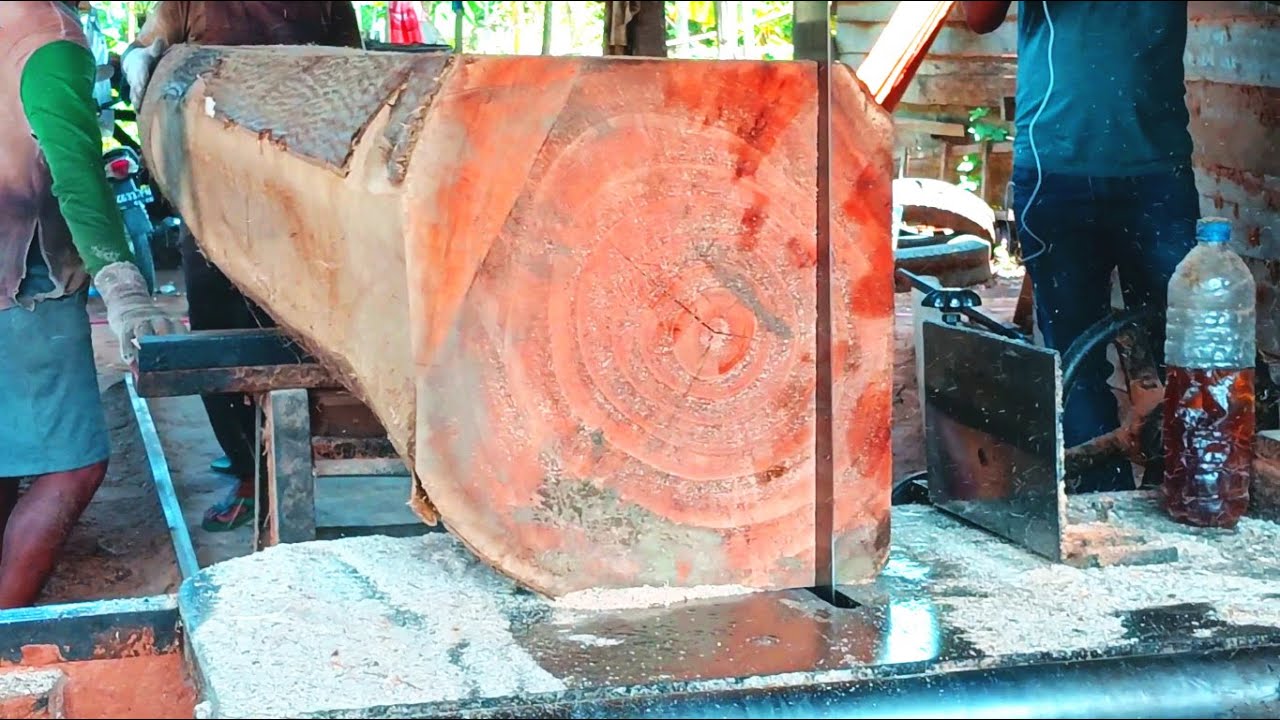
Sharp carbide tooling reduces heat and effort during sawing and turning. Use light cuts, support short stock securely, inspect grain direction, and stop when a cutter begins rubbing; forcing a dull edge produces a bitter burnt smell, dark tracks, vibration, and poor control.
Turning blanks require close inspection for end checks, bark inclusions, grain runout, and hidden cracks. Mounting pressure that seems modest on sound wood can open a hairline split, so remove wax near the ends and inspect under bright side lighting before the lathe starts.
Predrilling is standard practice. Use a pilot hole for the threaded portion and a clearance hole where the screw must pass freely. Back the exit face with scrap, clear chips often, and withdraw the bit before heat discolors the hole or softens any wax coating.
Fresh abrasives should cut clean dust rather than polish the surface. Dull paper can burnish dense wood until it feels slick while deeper scratches remain underneath; progress through sensible grits, remove every previous scratch pattern, and keep the work cool.
Finishes deepen color, often revealing warm brown-red tones and bright ray fleck. Test oil, wax, shellac, lacquer, or another film finish on an offcut because end grain, sapwood, and heat-darkened areas can absorb or color differently.
Glue joints need fresh, close-fitting surfaces free from dust, wax, and oily workshop contamination. Don’t polish a joint face to a mirror sheen; a clean machining pass followed by glue application within a short period gives the adhesive a more consistent surface.
Workshop safety matters. Use extraction, eye protection, hearing protection, guarded machinery, secure clamping, and a properly fitted particulate respirator. Wood dust can irritate skin and airways, while individual reactions differ; no special toxicity claim is needed to justify good dust control.
Real-world work exposes three recurring beginner mistakes: feeding too hard, drilling continuously without clearing chips, and assuming a waxed blank is dry. The practical workaround is to slow the process, use sharper edges, pause for cooling, and verify moisture on newly cut interior wood.
Large furniture, flooring, outdoor structures, food-contact items, and engineered structural components need application-specific evidence. High Janka hardness alone doesn’t establish dimensional stability, exterior durability, food safety, fastening performance, or a structural design value.
Product listings can be useful only when they name genuine Allocasuarina luehmannii. Check the identity and dimensions before considering these marketplace results.

Exotic Wood Pen Blank Set
- Includes 10 hardwood blanks for pen turning
- Features rich walnut purpleheart zebrawood cherrywood and bubinga tones
- Sized for many DIY pen-making projects
- Smooth hardwood stock supports detailed turning work
- Great for crafters hobbyists and handmade gifts
 Buy on Amazon
A single-item display should receive the same verification: the title isn’t proof of species, provenance, dryness, or legal origin.
Conservation and Responsible Sourcing
Species and woodland status differ. A threatened buloke woodland ecological community doesn’t automatically mean every Allocasuarina luehmannii tree, population, or old timber item carries the same conservation or legal classification.
Species vs Woodland Status
The federally listed Buloke Woodlands of the Riverina and Murray-Darling Depression Bioregions are treated as an endangered ecological community under Australian environmental law. Current listing details and conservation advice should be checked through the Australian Government threatened communities resources.
Woodland decline is linked with clearing, fragmentation, loss of mature trees, limited regeneration, grazing pressure, weeds, and altered fire patterns. Removing a dead trunk can also remove hollows, seed sources, shelter, and coarse woody habitat, so “dead” doesn’t mean ecologically valueless.
Timber Provenance
Provenance should be documented through the scientific name, source location, ownership history, harvest or salvage authority, and current seller. “Salvaged” is useful context, but the word alone doesn’t prove that collection, transport, processing, or export complied with applicable rules.
- Ask whether the stock came from legal harvest, documented salvage, old inventory, or a planted source.
- Request invoices, permits, declarations, or chain-of-custody records where relevant.
- Confirm whether collection occurred on private land, public land, roadside land, or a reserve.
- Check state rules and landowner permission before collecting standing or fallen material.
- Review destination-country import, bark, insect, and phytosanitary rules.
- Check current CITES and national trade controls before an international purchase.
Conservation checks expire. Legal classifications and import controls can change, while state rules may differ from federal rules. Save dated copies of seller documents and verify requirements with the agencies responsible for the harvest location and final destination.
Australian Buloke Wood for Sale
Australian buloke wood for sale most often appears as pen blanks, spindle blanks, knife scales, handle blocks, small slabs, short boards, bowl blanks, figured pieces, or identification samples. Long, consistently graded boards are uncommon.
Common Product Formats
Woodturning retailers, specialist Australian hardwood dealers, exotic-timber merchants, knife-making suppliers, and individual salvaged-wood sellers are the usual sources. Searches such as “buloke holz kaufen” or “buloke australiano precio” may surface international stock, but imported pieces require closer checks on identity and paperwork.
| Format | Best comparison unit | Main defect risk |
|---|---|---|
| Pen blank | Delivered price per blank | Off-center checks or insufficient finished size |
| Knife scales | Delivered price per matched pair | Warp, mismatch, hidden checking |
| Handle block | Usable cubic volume | Grain runout or end splits |
| Bowl blank | Minimum sound diameter | Internal cracks and uneven moisture |
| Short board | Delivered price per board foot | Wane, sapwood, cup, and checks |
| Irregular slab | Defect-free yield | Bark inclusions, voids, unstable edges |
A reliable listing should provide the exact dimensions, measurement units, moisture condition, drying method, visible defects, sapwood percentage, surface condition, origin, and current shipping location. Actual-item photographs are far more useful than a finished representative sample.
- Is the botanical name Allocasuarina luehmannii stated?
- Are dimensions rough-sawn or finished?
- Does the image show the exact piece?
- Is the stock green, air-dried, kiln-dried, or merely described as dry?
- Has moisture content been measured, and where?
- Are the ends waxed or sealed?
- How deep are visible checks?
- Does the seller disclose bark, voids, insect holes, or sapwood?
- What remedy applies to hidden defects?
- Are export and phytosanitary documents needed?
Price Factors
There is no universal Australian buloke wood price. Sellers usually price each piece by dimensions, figure, color, dryness, processing, scarcity, documented origin, and expected usable yield rather than against a commodity lumber schedule.
For rectangular stock, calculate board feet as thickness × width × length in inches ÷ 144. Divide the item price by that volume for the listed price per board foot, or divide the complete delivered cost by volume for a more useful comparison.
Board feet = thickness (in) × width (in) × length (in) ÷ 144. Delivered price per board foot = item price + shipping + taxes + brokerage + import fees, divided by board feet.
Standard board-foot comparison formula
For example, a rough piece measuring 2 × 4 × 18 inches contains 1 board foot. A piece measuring 1.5 × 3 × 12 inches contains 0.375 board feet, so a low per-piece price can become expensive after volume normalization.
Defect-free yield changes value. If a one-board-foot blank loses 30% to checks, sapwood, and bark inclusions, only 0.70 board feet remains usable. Divide delivered cost by 0.70 rather than by the original volume to expose the effective cost of sound wood.
Irregular turning pieces need a different method. Compare minimum sound diameter, shortest usable length, crack-free core volume, and the number of finished objects expected from each blank; gross cubic volume can exaggerate the value of a checked or tapered piece.
Shipping can dominate cost because dried buloke weighs about 1,210 kg/m³. Request a packed weight and postal quote before comparing sellers, then add GST or sales tax, customs duty, carrier brokerage, insurance, and phytosanitary charges where they apply.
A fair delivered-cost comparison records currency, date, exact dimensions, condition, usable yield, shipping origin, destination, taxes, and fees. Pen blanks should often be compared per usable blank and knife scales per matched pair, since board-foot pricing can distort very small processed products.
Beginner buying mistake: choosing the largest rough blank without accounting for cracks. A smaller, straight, dry piece with clear end-grain photographs can produce more finished work than a larger block whose wax hides deep radial checks.
FAQs
What Is Australian Buloke Wood?
Australian buloke wood is an extremely dense hardwood from the Allocasuarina luehmannii tree. It is known for its fine texture, reddish-brown color, and exceptional hardness. The wood is often used for small specialty items, turning projects, tool handles, and durable decorative pieces because it can be difficult to machine in large sizes.
Is Australian Buloke The Hardest Wood In The World?
Australian buloke is widely regarded as one of the hardest woods in the world. It is commonly listed at about 5,060 lbf on the Janka hardness scale, exceeding many familiar hardwoods. Hardness rankings can vary by sample, moisture level, and testing method, but buloke remains an unusually dense and wear-resistant timber.
Where Does The Australian Buloke Tree Grow?
The Australian buloke tree grows naturally in southeastern Australia. It is found mainly in parts of Victoria, New South Wales, and South Australia, where it tolerates dry inland conditions. The tree commonly grows in open woodland and grassland environments and has adapted well to nutrient-poor soils and limited rainfall.
How Much Does Australian Buloke Wood Cost?
Australian buloke wood is usually expensive because it is rare, dense, and sold mainly as specialty timber. Prices vary greatly by size, grade, location, and whether the wood is sold as turning blanks, slabs, or lumber. Expect to pay more than for common domestic hardwoods, especially for clear, figured, or kiln-dried pieces.
Can Australian Buloke Be Used For Furniture?
Australian buloke can be used for furniture, but it is best suited to small or high-wear components. Its extreme density makes it durable, yet it can be hard on cutting tools and challenging to glue or machine. Many woodworkers use it for accents, handles, inlays, legs, and decorative details rather than large panels.
Affiliate Disclosure: Some links in this post are affiliate links. If you make a purchase through these links, we may earn a small commission at no extra cost to you. We only recommend products we genuinely believe in.