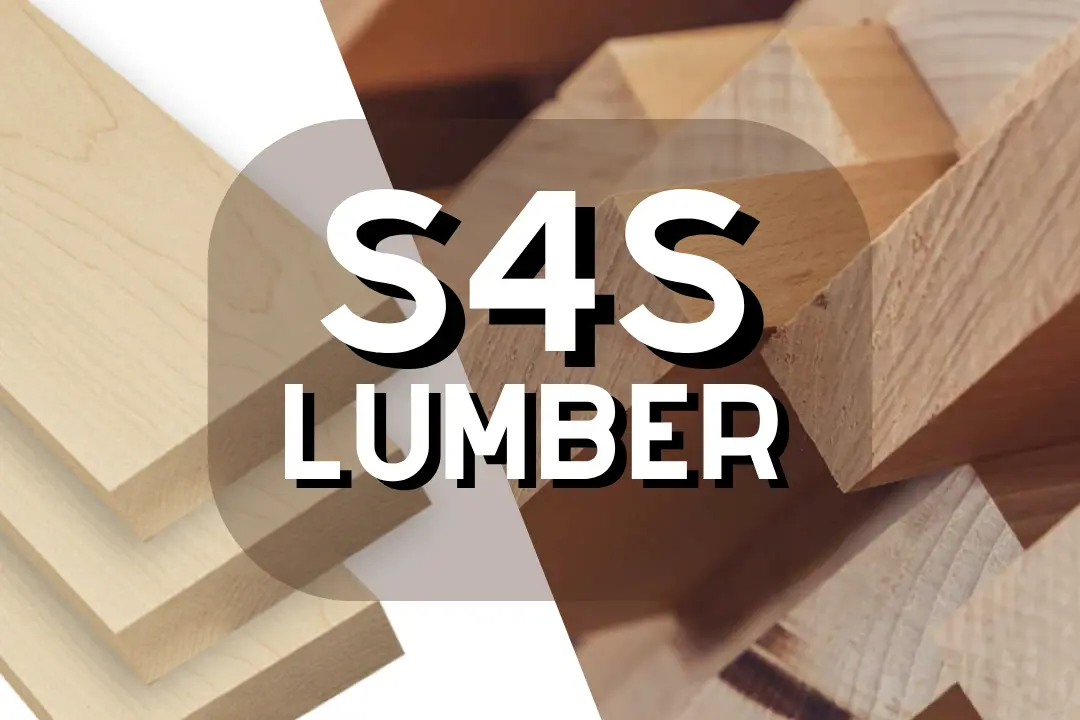

S4S lumber means wood surfaced on all four long sides: two broad faces and two narrow edges. It arrives close to a usable rectangular shape, but it may still need acclimation, dimension checks, crosscutting, sanding, and corrective milling before assembly.
S4S doesn’t mean treated, perfectly square, kiln-dried, defect-free, or ready for finish. This guide explains S4S lumber meaning, sizes, pricing, inspection, project fit, and the trade-offs against rough stock.
Table of Contents
What Is S4S Lumber?
S4S is a machining description, not a grade. The abbreviation tells you which longitudinal surfaces were milled, while the product specifications must identify species, moisture condition, dimensions, treatment, grade, and allowed defects.
S4S Lumber Meaning
S4S means surfaced four sides, also written as surfaced on four sides or S 4 S. A mill has machined both faces and both edges, removing most rough saw texture and bringing the board closer to a consistent thickness and width.
Faces, Edges, and Ends
The two wide surfaces are the faces, and the two narrow longitudinal surfaces are the edges. The ends aren’t counted, so an S4S board may still have angled, checked, waxed, or rough-cut ends that need trimming.
How S4S is milled: a typical shop sequence flattens one face, joints one edge square to that face, planes the opposite face parallel, and rips the last edge parallel. Industrial mills may complete several operations in one pass with moulders or straight-line rip equipment.
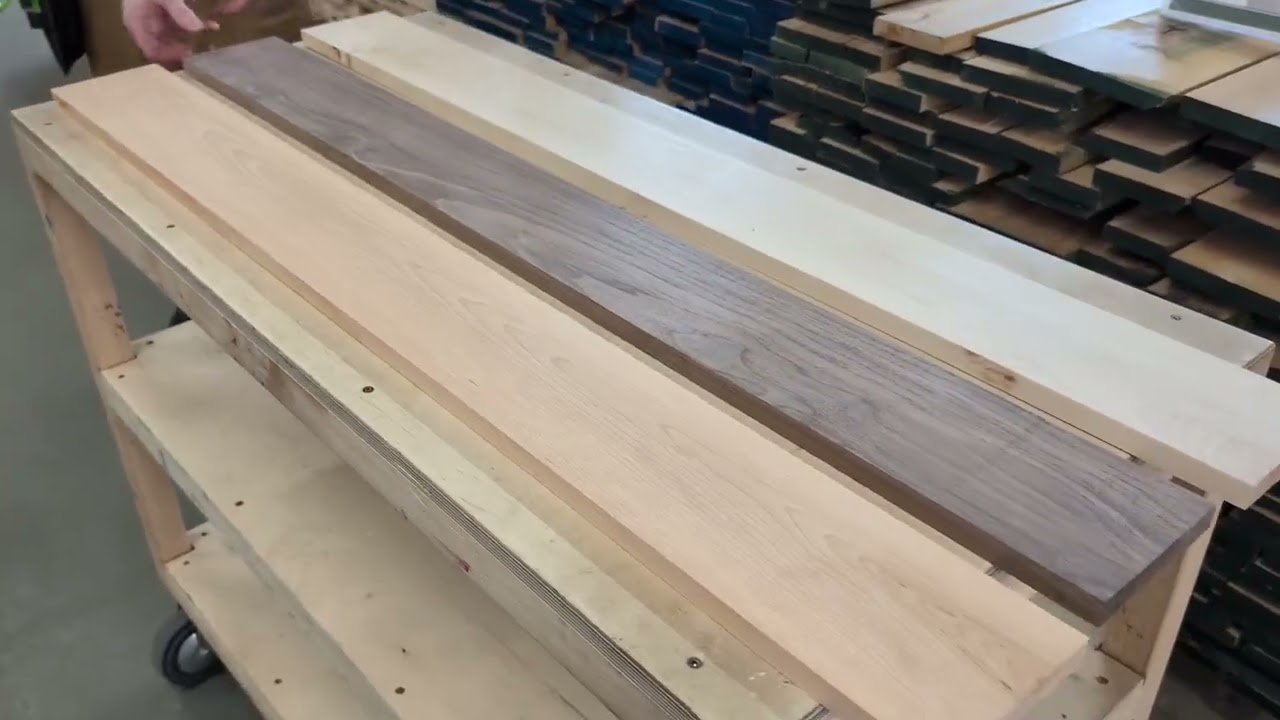
S4S does not mean treated. Pressure treatment, heat treatment, preservative treatment, and drying are separate processes. If outdoor durability or ground-contact approval matters, look for treatment tags and use-category markings rather than relying on the S4S label.
Surfacing cannot guarantee perfect flatness, parallel edges, furniture-grade squareness, a set moisture content, structural strength, or freedom from knots and checks. Wood can also move between milling and purchase as it exchanges moisture with surrounding air.
- Check treatment and drying markings separately.
- Measure actual thickness and width rather than trusting the nominal label.
- Inspect bow, cup, crook, twist, checks, and torn grain.
- Test edge squareness before panel glue-ups.
- Trim both ends before laying out finished parts.
Rough, S2S, S3S, and S4S Compared
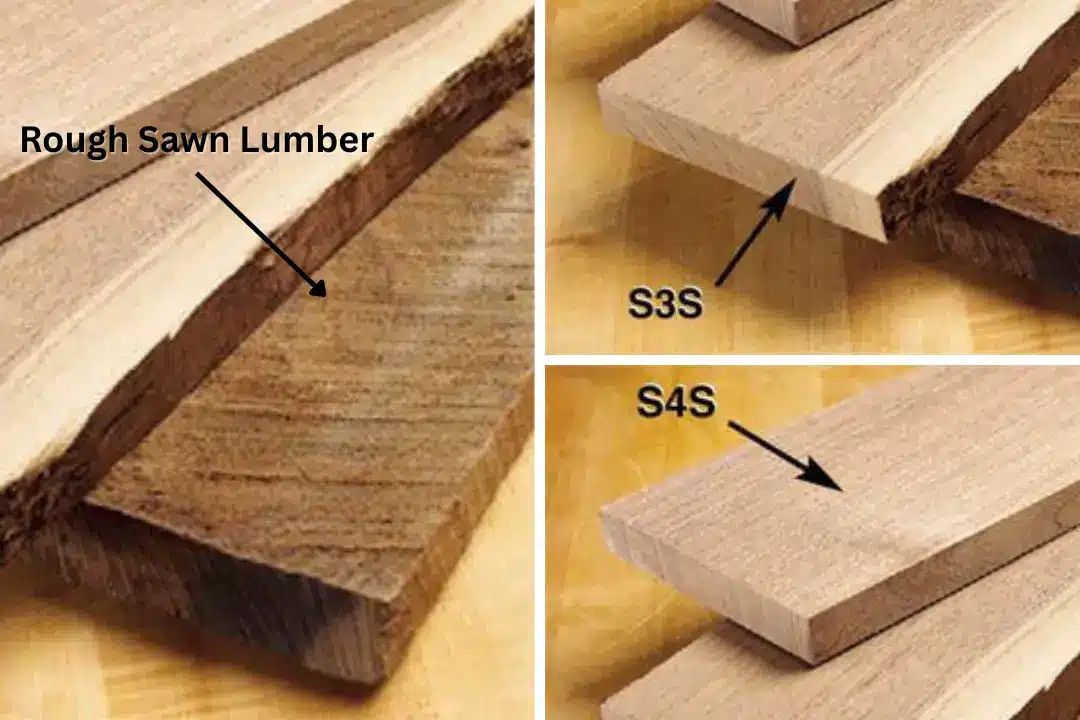
The difference between rough, S2S, S3S, and S4S stock is the number of machined faces and edges. Less surfacing preserves material and gives the builder more dimensional control; more surfacing reduces tools and setup time.
Rough-Sawn Lumber
Rough-sawn lumber retains saw marks, fuzzy fibers, and dimensional variation. Running a hand across it feels coarse and ridged, while loose fibers catch on a cloth or fingertip. It offers maximum thickness for flattening but requires milling skill and suitable machinery.
A rough board that looks thick can lose substantial material while removing cup and twist. Buying stock only 1/8 inch above the target thickness is a common beginner mistake; badly cupped pieces may never clean up at the planned size.
S2S Lumber
S2S lumber usually has both broad faces surfaced while its edges remain rough or irregular. It suits a shop that can establish straight edges with a jointer, track saw, or table-saw straight-line jig but lacks a thickness planer.
S3S lumber normally has two surfaced faces and one straight edge. That reference edge makes the stock easier to rip to width, yet terminology can vary by supplier, so confirm which three surfaces were machined.
S4S lumber has two surfaced faces and two surfaced edges. It requires the least initial milling, though cutting to final length, checking dimensions, sanding, and forming joinery still remain.
Surfacing comparison table: use the product description rather than the acronym alone if a supplier follows a different convention.
| Lumber condition | Surfaced faces | Surfaced edges | Typical work remaining |
|---|---|---|---|
| Rough | 0 | 0 | Flatten, joint, plane, rip, crosscut, sand |
| S2S | 2 | 0 | Straighten edges, rip, crosscut, sand |
| S3S | 2 | 1 | Rip final edge, crosscut, sand |
| S4S | 2 | 2 | Verify dimensions, crosscut, sand |
S4S vs dimensional lumber: S4S identifies machined surfaces, while dimensional lumber refers to standardized trade sizes commonly used for construction. A framing 2×4 may be surfaced on four sides and measure about 1 1/2 × 3 1/2 inches, while S4S hardwood can follow a different sizing system. Our guide to construction wood explains the building-stock category in more detail.
S4S Lumber Sizes and Pricing
S4S lumber sizes are often smaller than their nominal names because saw kerfs, jointing, and planing remove wood. Hardwood quarter sizing and construction trade sizing also follow different conventions, so compare exact delivered measurements.
Nominal vs Actual Dimensions

A nominal dimension identifies a trade or pre-surfacing size; an actual dimension identifies the board you receive. Familiar construction examples include 1×4 at 3/4 × 3 1/2 inches and 2×4 at 1 1/2 × 3 1/2 inches, but hardwood dealers may use other finished targets.
Construction lumber sizes follow recognized commercial patterns, yet moisture state and product class can affect the listed dimensions. The American Softwood Lumber Standard covers definitions, sizes, moisture provisions, and grade-marking principles for softwood lumber.
Hardwood Quarter Sizing
Rough hardwood thickness is commonly expressed in quarter-inch increments: 4/4 equals 1 inch, 5/4 equals 1 1/4 inches, 6/4 equals 1 1/2 inches, and 8/4 equals 2 inches before surfacing allowances.
4/4 S4S thickness often finishes near 3/4 to 13/16 inch, but that range isn’t universal. Cup, rough thickness, supplier targets, and the number of cleanup passes affect the result, so read the actual-size field before preparing a cut list. See our guide to sawmill lumber dimensions for related measuring terms.
Board-foot formula: multiply thickness in inches by width in inches by length in feet, then divide by 12. A board measuring 0.75 × 5.5 inches × 8 feet contains 2.75 board feet of actual wood volume.
0.75 × 5.5 × 8 ÷ 12 = 2.75 board feet.
Actual-volume example
Pricing units differ: sellers may charge per board foot, linear foot, square foot, piece, or package. Some hardwood yards calculate board footage from nominal rough thickness before surfacing, so ask which measurements appear on the invoice.
Total project cost includes shipping, long-item fees, waste, blade wear, milling time, dust collection, and rejected boards. A higher-priced S4S project board can cost less for a one-board shelf, while rough stock often wins when a shop processes many boards with equipment it already owns.
Is S4S Lumber Ready to Use?
S4S is ready for layout sooner, but it’s rarely ready for immediate assembly or finish. Most pieces need acclimation, inspection, final crosscutting, joinery, sanding, and edge treatment.
Remaining Cutting and Joinery
Final cutting remains because the ends aren’t part of the four surfaced sides. Trim one end square, measure from that reference, cut the part slightly long when accuracy matters, and make the final cut after confirming the fit.
Sanding S4S lumber removes planer lines, handling dents, torn grain, snipe, and mill glaze. Lightly machined boards often respond well to 120, 150, and 180 grit, though a clean surface may start at 150; follow the finish maker’s grit limit before staining.
Moisture content and markings are separate from S4S. Labels such as KD, KD-HT, and S-DRY communicate drying or heat-treatment information, while pressure-treated lumber needs its own treatment identification. Read more about kiln-dried wood.
Interior furniture stock commonly falls near 6% to 8% moisture in many heated or conditioned settings, but regional equilibrium conditions vary. The USDA’s Wood Handbook explains moisture relationships, dimensional change, drying, and other wood properties.
Practical Notes From Real-World Use
Acclimation before cutting should rely on moisture readings rather than a fixed three-day or seven-day rule. Remove airtight wrapping, place stickers between boards, and store the stock near the final room until repeated readings become stable.
Warping and internal stress can appear after ripping. A straight board sometimes pinches the blade or opens into two curved strips as tension releases; leave extra width and use staged rip cuts for narrow rails, stiles, or square strips.
Squareness and parallelism matter during glue-ups. Place two mating edges together under a bright side light; a thin glowing line or rocking feel reveals gaps that a quick glance can miss. Joint or guide-saw the edges as a paired set to cancel slight angle error.
Machine marks and snipe show clearly under raking light. Repeating ripples feel like faint washboard ridges under the fingertips, while snipe appears as a shallow depression near an end; trim affected ends or level the marks before finishing.
Eased and rounded edges are common on framing stock. These edges feel comfortable in the hand but form visible V-shaped grooves in a panel, so rip enough material from both sides to create crisp square edges before gluing.
S4S vs Rough Lumber
S4S saves setup and machine work, while rough lumber provides more control over final size, grain placement, and defect removal. The better choice depends on usable yield and equipment, not the posted price alone.
S4S Benefits
S4S benefits include predictable fixed widths, less dust, fewer shavings, lower machine requirements, and faster project setup. It works well for shelves, boxes, trim, cabinet components, craft work, prototypes, and repairs needing only a few pieces.
Limited-tool workshops gain the most. A tape, square, saw, drill, clamps, and sander can complete many projects without the floor space, noise, electrical demand, and chip collection required by a jointer and planer.
Small projects and deadlines can justify the milling premium because outsourcing one or two boards costs time and transport. Keep acclimation in the schedule; rushing a freshly delivered board into final joinery is a frequent source of later gaps.
S4S Limitations
S4S limitations include higher unit cost, reduced thickness, fewer choices in width, and less room to correct movement. A nominal 4/4 board already surfaced to 3/4 inch can’t produce a flat 3/4-inch part if it cups after delivery.
Custom dimensions and yield often favor rough stock. Extra thickness permits another flattening cycle, while wide boards let you arrange parts around knots, pith, checks, color changes, and unfavorable grain runout.
High-volume milling can make rough lumber cheaper once the shop owns the machines and can process batches efficiently. Mill all mating parts in one setup, then keep each project batch together to reduce small thickness mismatches.
How to Buy S4S Lumber
Buy S4S lumber by matching species, actual size, moisture condition, edge profile, and allowed defects to the finished parts. Inspect the stock before cutting and order extra material for defects and color matching.
Match Lumber to Projects
Indoor projects need stable moisture, consistent thickness, and straight grain in rails and stiles. Oak, maple, cherry, walnut, poplar, and many other types of hardwood are sold as S4S project boards.
Painted projects often suit poplar or paint-grade softwood. Inspect compressed grain and dents under side lighting because a glossy paint film can make shallow milling flaws more visible rather than hiding them.
Outdoor uses require decay-resistant species or properly rated treated wood; S4S alone adds no rot resistance. Teak, cedar, cypress, and white oak may suit selected applications, but exposure, ground contact, fastener corrosion, drainage, and maintenance still matter.
Food-contact uses require separate checks for species, adhesives, finish, prior chemical exposure, and traceable product history. Don’t treat a smooth planed surface as evidence that wood is safe for cutting boards or serving pieces.
Check Dimensions and Tolerances
Check exact dimensions at several points with a tape and digital caliper. Ask for thickness, width, length, dimensional tolerance, square or eased edges, and whether stock comes in fixed or random widths and lengths.
Inspect flatness and squareness by sighting down each edge, placing the board on a known-flat surface, and checking both faces with a straightedge. Press opposite corners; a rocking board often has twist that’s hard to see.
Inspect surfaces and defects for planer tracks, tear-out, dents, burn marks, sticker stains, knots, pith, splits, end checks, bark inclusions, and sapwood. Map the cut list directly on the board to see whether defects fall in waste areas.
Match species and grain before leaving the store. Wetting a small area with mineral spirits, where shop policy permits, can preview contrast and color; buy adjacent boards from the same batch because later orders rarely match exactly.
- Tape measure for length and approximate width
- Digital caliper for thickness variation
- Combination square for edge-to-face accuracy
- Straightedge for bow and cup
- Feeler gauges for measuring gaps
- Moisture meter for movement-sensitive projects
- Flashlight for raking-light surface inspection
Shipping and returns can change the value calculation. Ask about oversized-item charges, packaging, return freight, warped-board policies, minimum orders, and whether long boards can be collected locally; freight on one long board may exceed its purchase price.
Order extra stock for end trimming, hidden checks, test cuts, finish samples, color selection, and stress released during ripping. Ten percent may cover simple clear boards, while defect-prone or highly matched work can need 20% to 30%.
Where to buy S4S: check hardwood dealers, lumber stores, home-improvement retailers, woodworking suppliers, cabinet shops, local mills, and online marketplaces. Searches for “S4S lumber near me” work better when paired with the species, exact thickness, width, and length.
S4S Lumber Product Examples
These examples show common fixed-dimension S4S formats rather than universal size standards. Confirm actual delivered measurements, moisture condition, treatment status, return terms, and edge profile on the seller’s listing before ordering.
Full-Length Project Board
A full-length project board suits shelves, trim, furniture components, and larger craft work when a jointer or planer isn’t available. This example is listed at 1/2 inch thick, 6 inches wide, and 4 feet long; check whether those are exact finished dimensions.

Premium S4S Lumber Board
- Surfaced on all four sides
- Half-inch thick by 6-inch wide board
- Full 4-foot length for larger builds
- Natural plantation-grown lumber
- Ready for woodworking and finishing
 Buy on Amazon
Teak S4S Strips
Teak S4S strips suit accents, slats, models, outdoor details, and builds requiring repeated square sections. Teak feels slightly waxy or oily after fresh cutting; prepare bonding surfaces shortly before assembly and choose an adhesive rated for oily woods.

Premium Teak S4S Strips
- Eight teak lumber strips per pack
- Surfaced on all four sides
- Compact 1-inch square profile
- Each piece measures 3 feet long
- Plantation-grown natural teak
Buy on Amazon
Red oak project board: solid, non-finger-jointed stock preserves uninterrupted grain for shelves, frames, furniture, and cabinet parts. Red oak has open pores and thirsty end grain, so test stain on offcuts and use grain filler if the finish calls for a level, glassy surface. Learn more in our red oak guide.

Red Oak S4S Project Board
- Unfinished red oak hardwood
- Surfaced on all four sides
- Solid board with no finger joints
- 1-inch by 8-inch by 36-inch size
- Suitable for DIY furniture and home projects
Buy on Amazon
FAQs
What Does S4S Mean In Lumber?
S4S means “surfaced four sides,” meaning the lumber has been planed smooth on both faces and both edges. It is typically uniform in thickness and width, making it easier to measure, cut, and assemble. S4S boards are commonly used for furniture, trim, shelving, and other finished projects.
Is S4S Lumber Treated?
S4S lumber is not automatically treated, because S4S describes the board’s smooth finish rather than its chemical treatment. It may be untreated, pressure-treated, kiln-dried, or made from naturally rot-resistant wood. Check the product label or ask the supplier before using lumber outdoors or in damp areas.
Is S4S Lumber Ready To Use Without Sanding?
S4S lumber is usually ready to use without major sanding because its faces and edges have already been planed smooth. Light sanding is still recommended before staining, painting, or applying a clear finish. It also helps remove small mill marks, handling scratches, and raised wood grain.
What Is The Difference Between S2S And S4S Lumber?
S2S lumber is surfaced smooth on two faces, while S4S lumber is surfaced smooth on both faces and both edges. S2S boards often have rough or unfinished edges that you must trim or joint yourself. S4S lumber costs more but saves time for projects needing straight, finished edges.
What Does 4/4 S4S Lumber Mean?
4/4 S4S lumber began as rough stock approximately one inch thick and was surfaced smooth on all four sides. After milling, its actual finished thickness is usually about three-quarters of an inch. The “4/4” measurement refers to quarters of an inch in rough lumber sizing, not the final thickness.
Affiliate Disclosure: Some links in this post are affiliate links. If you make a purchase through these links, we may earn a small commission at no extra cost to you. We only recommend products we genuinely believe in.