

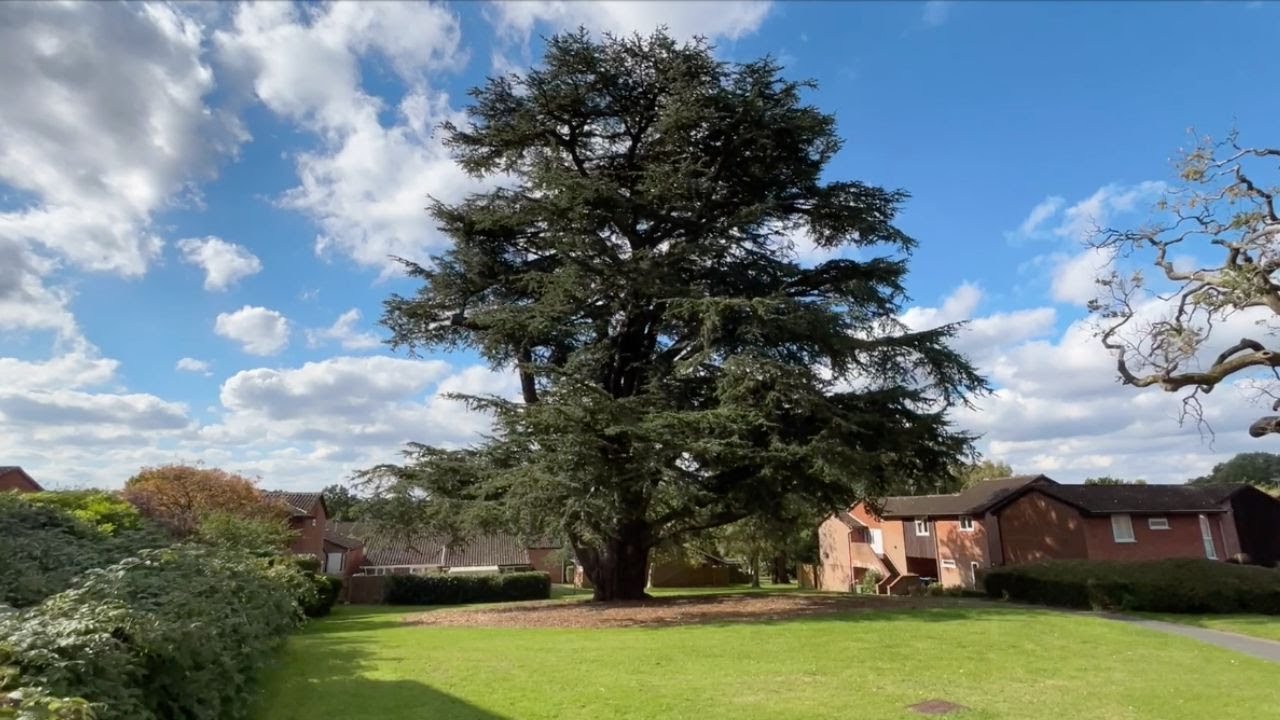
The cedar of Lebanon is Cedrus libani, a large evergreen conifer in the pine family native to mountain forests in Turkey, Lebanon, and Syria. It has clustered needles, upright barrel-shaped cones, deeply fissured bark, and a broad, tiered crown that becomes flatter as the tree ages.
This guide explains the tree’s identification, lifespan, habitat, conservation status, cultural meaning, and cultivation needs while separating measured botanical facts from traditional claims about ancient specimens.
Table of Contents
What Is the Cedar of Lebanon?
The cedar of Lebanon is a true cedar belonging to the genus Cedrus. Its accepted scientific name is Cedrus libani A.Rich., according to Kew Science.
Definition and Key Facts
Cedrus libani is an evergreen gymnosperm that produces pollen and seeds in separate cones on the same tree. Botanists call this reproductive arrangement monoecious.
| Feature | Cedar of Lebanon fact |
|---|---|
| Scientific name | Cedrus libani A.Rich. |
| Family | Pinaceae |
| Plant type | Evergreen conifer |
| Native range | Turkey, Lebanon, and Syria; Cyprus under some classifications |
| Typical wild height | About 30–40 metres on favorable sites |
| Needle length | Often about 15–35 mm |
| Seed cone length | Usually about 8–12 cm |
| Mature crown | Broad, layered, irregular, and often flat-topped |
| Formal conservation category | Vulnerable on the IUCN Red List |
| Lifespan | Many centuries; exact maximum ages remain difficult to prove |
Lebanon cedar, Lebanese cedar, and libani cedar all refer to this species. The search phrase “Lebanon Cedrus libani” points to the same tree, though the natural English order is “Cedrus libani, the cedar of Lebanon.”
Taxonomy, Common Names, and Lifespan
Taxonomic placement: The species belongs to Plantae, the conifers, order Pinales, family Pinaceae, genus Cedrus. The name libani refers to Lebanon or Mount Lebanon, while A.Rich. identifies French botanist Achille Richard as the naming authority.
Taxonomic boundaries: Authorities don’t all define the species in the same way. Cyprus cedar may appear as the separate species Cedrus brevifolia, or as a variety or subspecies of Cedrus libani. Turkish forms described under names such as stenocoma also lack universal recognition.
This disagreement changes how sources describe the native range. A narrow treatment limits C. libani to Turkey, Lebanon, and Syria, while a broader treatment includes the cedar populations of Cyprus.
Lifespan and size: Cedar of Lebanon can live for many centuries and commonly reaches about 30–40 metres in favorable wild habitat. Old trunks may exceed 2 metres in diameter, but fused stems and low branching can make circumference figures misleading.
Garden specimens are often shorter because they face compacted soil, restricted rooting space, warmer nights, or irregular moisture. A young tree may look narrow enough for a modest yard, yet its branches can eventually extend far beyond its early conical outline.
Age verification requires more than dividing trunk circumference by an assumed annual growth rate. Ancient trees may contain hollow centers, decayed wood, missing rings, or fused trunks, leaving researchers without a complete ring sequence.
Claims that a named cedar is 2,000 or 3,000 years old should be described as estimates or traditions when no published tree-ring record supports them. The safest conclusion is that the species is long-lived, while the precise oldest-tree age remains unsettled.
Cedar of Lebanon Characteristics and Identification

The most dependable identification combination is a broad tiered crown on mature trees, stiff needles clustered on short shoots, upright seed cones, and bark that becomes deeply fissured. No single trait works in every age class or growing condition.
Crown, Branches, Needles, and Bark
Crown and branching: Young trees have a pyramidal shape and a clear central leader. As the leader loses dominance, major limbs spread horizontally and form irregular platforms, producing the famous flat-topped outline associated with old Lebanese cedar trees.
The mature branches feel massive rather than feathery, with smaller growth arranged in horizontal sprays. Snow, wind exposure, crowding, and pruning can distort this form, so a narrow crown doesn’t automatically rule out Cedrus libani.
Needles and short shoots: Evergreen needles occur in dense rosettes on stubby spur shoots, while new extension shoots may carry more widely spaced needles. Individual needles commonly measure about 15–35 mm and range from deep green to waxy blue-green.
Running a hand lightly along a needle cluster produces a firm, prickly texture, unlike the soft, drooping foliage of many cypresses sold under cedar names. Wear gloves around mature shoots because the stiff needle tips can catch bare skin.
Bark and trunk: Young bark looks comparatively smooth and gray. Age brings thicker gray-brown bark divided by deep vertical and crosswise fissures; the ridges feel coarse, dry, and corky beneath the fingertips.
Cones, Seeds, and Identification Traits
Male cones: Cylindrical pollen cones occur on short shoots and become conspicuous before releasing pollen. A mature tree can leave a yellow film on nearby surfaces, and dry pollen may puff visibly when a branch moves.
Female cones: Young female cones are small and easy to miss. Fertilized cones grow upright into resinous, barrel-shaped structures commonly measuring about 8–12 cm long.
Seed cones take more than one growing season to ripen, with horticultural accounts often giving roughly 17–18 months after pollination. Mature cones break apart aloft instead of dropping whole, releasing winged seeds while the woody central axis may remain on the branch.
Beginners often identify a tree from needle color alone. Blue-green foliage also occurs in Atlas cedar selections, so check the crown, branch tips, cone position, needle arrangement, and provenance together.
| Trait | What to look for | Common identification error |
|---|---|---|
| Crown | Conical when young; broad, layered, and flatter with age | Expecting young trees to have a flat crown |
| Branches | Large limbs spreading in horizontal tiers | Using one damaged or pruned branch as evidence |
| Needles | Stiff needles in dense clusters on short shoots | Relying on blue or green color alone |
| Bark | Gray-brown and deeply fissured on old trunks | Comparing mature bark with a young nursery tree |
| Seed cones | Upright, barrel-shaped, and about 8–12 cm long | Looking for intact cones beneath the tree |
| Seeds | Winged and released as cone scales separate | Assuming empty cone axes are damaged pine cones |
Native Range, Habitat, and Ecology
Cedar of Lebanon grows naturally in eastern Mediterranean mountains, chiefly across southern and central Turkey, Lebanon, and western Syria. Its distribution consists of separate mountain populations rather than one continuous forest belt.
Turkey, Lebanon, Syria, and Cyprus
Turkey: The Taurus mountain systems support the species’ largest and most extensive natural populations. Trees may occur from roughly 500 metres to above 2,000 metres, with local limits shaped by latitude, slope direction, moisture, and winter conditions.
Lebanon: Natural stands and remnant groves occur through the Mount Lebanon ranges, often around 1,000–2,000 metres. Famous sites represent only part of Lebanon’s cedar habitat; larger protected forests include mixed-age stands with far greater conservation value than a collection of monumental trees.
Syria: Native populations are smaller and more restricted. Fragmentation raises concern because isolated stands may lose seed exchange and locally adapted genetic variation over time.
Cyprus: The Troodos Mountains support Cyprus cedar, commonly named Cedrus brevifolia. Sources that place it inside Cedrus libani include Cyprus in the species range, while sources treating it separately do not.
Elevation, Soils, Drainage, and Ecology
The natural climate has cool wet winters, frequent mountain snow, and dry summers. Elevation moderates summer heat, while winter precipitation replenishes soil moisture before the main dry season.
Cedar of Lebanon often grows over limestone and other calcareous parent material, but drainage matters more than a rigid soil label. Roots cope with rocky mountain ground where water moves away, yet they can decline in heavy soil that remains saturated.
A persistent beginner mistake is adding a shallow pocket of rich soil to a poorly drained planting hole. The pocket acts like a basin, leaving the root ball cold, slick, and sour-smelling after rain. Planting slightly high and improving drainage across a wider area works better than filling one deep hole with compost.
Natural companions vary by region and elevation and can include firs, pines, junipers, oaks, and maples. Old cedars provide vertical habitat, nest sites, shaded ground, stored carbon, and root systems that help bind mountain soils.
- Large limbs and cavities create shelter for birds and small animals.
- Needle litter alters moisture and nutrient conditions beneath the crown.
- Roots reduce surface erosion on steep slopes.
- Cones and seeds support mountain food webs.
- Ancient groves carry cultural, educational, and tourism value.
Cedar of Lebanon Versus Similar Trees
Cedar of Lebanon differs from other true cedars mainly through its mature architecture, relatively level branch tiers, and the combined appearance of its needles and cones. Cultivars and young trees overlap heavily, so reliable identification uses several traits.
Atlas, Deodar, and Cyprus Cedars
Atlas cedar: Cedrus atlantica comes from Morocco and Algeria. It often carries more ascending branches, though cultivated forms vary widely, and blue foliage alone can’t separate it from a blue-green Lebanon cedar. See the site’s detailed Atlas cedar guide for its wood and botanical traits.
Deodar cedar: Cedrus deodara is native to the western Himalayas. Its leader and young branch tips commonly droop, giving the crown a softer, pendulous outline; needles are often longer, though measurements overlap.
Cyprus cedar: Cedrus brevifolia has a restricted Cypriot range and usually shorter needles. Its status as a separate species or a form of C. libani depends on the taxonomic authority being followed.
True Versus False Cedars and Comparison Table
A true cedar belongs to genus Cedrus. Many unrelated trees carry “cedar” in their common names because their wood smells aromatic, resists decay in suitable conditions, or resembles timber historically traded as cedar.
Western red cedar is Thuja plicata, while eastern redcedar is Juniperus virginiana. Their scale-like or awl-like foliage separates them quickly from Cedrus; compare the site’s guides to western red cedar and eastern redcedar.
Spanish cedar, Cedrela odorata, is a tropical broadleaf tree in the mahogany family. It bears compound leaves rather than conifer needles, as explained in the Spanish cedar profile.
| Tree | Native region | Useful field clue | True cedar? |
|---|---|---|---|
| Cedar of Lebanon | Turkey, Lebanon, Syria | Broad tiered crown and level mature limbs | Yes |
| Atlas cedar | Morocco and Algeria | Often more ascending branches; many blue cultivars | Yes |
| Deodar cedar | Western Himalayas | Drooping leader and branch tips | Yes |
| Cyprus cedar | Cyprus | Shorter needles and restricted range | Yes, or part of C. libani in some treatments |
| Western red cedar | Western North America | Flat sprays of scale-like leaves | No |
| Eastern redcedar | Eastern North America | Juniper foliage and blue berry-like cones | No |
| Spanish cedar | Tropical Americas | Broad compound leaves | No |
Conservation Status, Threats, and Forests
Cedrus libani is listed as Vulnerable on the IUCN Red List. This category describes global extinction risk; it doesn’t mean every grove has the same population trend or level of legal protection.
IUCN Status, Threats, and Climate Change
Global versus local status: Turkey still contains substantial cedar forests, while many Lebanese and Syrian populations are smaller or fragmented. A protected grove may hold secure mature trees yet lack enough seedlings to replace them.
Historical forest loss occurred through repeated cutting, grazing, farming, settlement, fuel collection, and timber trade across many periods. Blaming one ruler or civilization hides the cumulative nature of that decline.
- Fragmentation isolates seed sources and wildlife habitat.
- Livestock and wild herbivores browse young seedlings.
- Summer drought kills shallow-rooted new growth.
- Wildfire removes seedlings and reproductive trees.
- Roads, buildings, and land conversion reduce available habitat.
- Insects and pathogens can spread through stressed stands.
- Poorly chosen planting stock may weaken local genetic adaptation.
Climate change can alter snowfall, snowmelt timing, summer soil moisture, fire exposure, and pest activity. Mountain trees face a hard limit: as suitable conditions move upslope, the available area becomes smaller near the summit.
No single disappearance date applies across the species’ full range. Outcomes depend on emissions, local topography, seedling recruitment, fire management, grazing, and the genetic responses of separate populations.
Regeneration, Restoration, and Lebanese Forests
Long-term restoration means more than counting planted seedlings. Managers must protect natural recruits, use suitable local seed sources, retain genetic diversity, control browsing, reduce fire risk, and track survival through repeated dry summers.
A common project failure appears after the first planting season: green seedlings make a strong photograph, but root loss, heat, and browsing remove many within several years. Monitoring canopy condition and natural reproduction over decades gives a more honest measure of forest recovery.
Cedars of God: Horsh Arz el-Rab, near Bsharri, forms part of the UNESCO property Ouadi Qadisha and the Forest of the Cedars of God, inscribed in 1998. It is a culturally significant remnant grove, not an untouched sample of all former Lebanese cedar forest.
Al Shouf Cedar Reserve: This protected mountain area includes major forests near Barouk, Maasser el Shouf, and Ain Zhalta–Bmohray. Published size figures can differ because some describe the core reserve while others cover broader biosphere, buffer, or transition zones.
Tannourine: Tannourine Cedars Forest Nature Reserve protects a major northern Lebanese cedar area where regeneration, pests, drought, and mountain biodiversity require continuing management. Other cedar locations include Horsh Ehden, Hadath el Jebbeh, Jaj, Bsharri, Barouk, and Maasser el Shouf.
History, Biblical Meaning, and Lebanese Symbolism
Cedar of Lebanon became culturally significant because its tall trunks produced large timbers that could move through eastern Mediterranean trade. Later religious texts, art, and Lebanon’s national flag turned the tree into a symbol of strength, permanence, and identity.
Ancient Timber, Ships, and Ritual Uses
Ancient timber uses included structural beams, roof members, doors, furniture, paneling, and monumental buildings. Freshly exposed wood has a warm resinous scent, while worked surfaces can show a pale brown to reddish tone that deepens with age.
Large dimensions, workable grain, regional availability, and natural durability made cedar valuable. Yet the wood isn’t immune to decay: trapped moisture, fungi, insects, and ground contact can damage it, a point covered more broadly in the guide to cedar wood.
Shipbuilding and trade: Phoenician coastal cities took part in the movement of mountain timber around the eastern Mediterranean. Written traditions connect cedar to ships, palaces, and temples, but they don’t prove that every component called cedar came from Cedrus libani.
Aromatic material from cedar wood and resin had ritual, storage, and preservation associations. Claims about ancient embalming oils need close botanical and chemical sourcing because translated names may refer to juniper, cedar, or mixed resinous products.
Evidence limits: Archaeological wood identification depends on preserved cellular structure, sampling, and comparison material. A literary reference can show that cedar carried cultural value, but it can’t by itself identify the species in a surviving beam or vessel.
Biblical Meaning, Solomon, and Lebanon’s Symbol
Biblical cedar meaning includes height, majesty, endurance, royal authority, prosperity, pride, and judgment. The meaning changes with context: a cedar can represent righteous flourishing in one passage and human arrogance brought low in another.
Accounts of Solomon’s building works describe timber supplied through Hiram of Tyre for royal and temple construction. This tradition links Lebanon cedar with monumental architecture, though translated ancient plant terms don’t always map perfectly onto a single modern species.
“The righteous flourish like the palm tree, and grow like a cedar in Lebanon.”
Psalm 92:12, New Revised Standard Version
The biblical cedar isn’t limited to a single idea. Psalms often use it for strength and flourishing, while prophetic writing can use towering cedars as images of kingdoms, rulers, or pride vulnerable to judgment.
Lebanon’s flag places a green cedar on the central white band between two red bands. The modern flag adopted in 1943 turned a long-standing regional symbol into a direct expression of Lebanese identity.
The cedar commonly represents longevity, steadfastness, holiness, and peace. It also appears on currency, stamps, government insignia, civic emblems, military symbols, tourism materials, art, and literature.
Cedar symbolism isn’t universal across languages. For example, translated references to cedar in Chinese may describe several aromatic or coniferous trees rather than Cedrus libani; the scientific name is needed where botanical identity matters.
Growing Cedar of Lebanon

Cedar of Lebanon grows best in full sun, open space, and freely drained soil in a climate with cool winters and no persistent summer waterlogging. Its eventual width, rather than its nursery size, should decide whether a site is suitable.
Climate, Sun, Soil, and Space
Climate and hardiness: Published guidance commonly places the species around USDA Zones 5–7 or 5–8, depending on provenance and source. The Royal Horticultural Society uses a separate hardiness scale, so its ratings shouldn’t be converted directly into USDA zones.
Local seed origin affects cold tolerance, drought response, and growth rhythm. A tree descended from a high-elevation Turkish population may respond differently from stock collected in a lower or warmer site.
Sun and drainage: Choose an open site with direct light and soil that releases excess water. Established trees tolerate seasonal dryness better than wet roots, but newly planted specimens still need deep watering while roots spread beyond the original root ball.
Check drainage before planting by observing the site after steady rain. Standing water, greasy clay, gray mottled soil, or a stale anaerobic smell signals a poor location without wider drainage work.
Growth habit: Young Lebanon cedars look upright and pyramidal. Mature trees become much broader, with long horizontal limbs that can conflict with roofs, roads, neighboring plots, and overhead utilities.
Don’t plant the tree in a narrow strip or close to foundations merely because its roots are unlikely to “attack” sound concrete. The practical problem is future branch spread, restricted rooting volume, pavement lifting, pruning damage, and difficult access around a very large trunk.
Seed Propagation, Establishment, and Common Problems
Seed propagation: Collect or obtain viable seed from cones of known origin. Cedar cones disintegrate on the tree, so intact ripe cones may be difficult to gather from the ground.
- Use fresh, well-filled seeds from a documented source.
- Soak or cold-moist stratify them according to the seed source’s propagation guidance.
- Sow in a clean, freely drained medium.
- Keep the medium evenly damp rather than saturated.
- Provide bright light and airflow after germination.
- Move seedlings gradually into sun and outdoor conditions.
- Protect young roots from heat, standing water, and rough transplanting.
Cold, moist stratification can improve germination in some seed lots, but duration varies with freshness, storage, and provenance. Beginners often leave the medium too wet; affected seeds become soft, dark, or sour-smelling before fungal growth appears.
Establishment and transplanting: Plant young trees while conditions are cool enough to limit water loss. Set the root flare at or slightly above the surrounding grade, spread circling roots where feasible, and water the full rooting area rather than pouring water against the trunk.
Large specimens can suffer severe transplant shock because a substantial share of their fine absorbing roots is lost during lifting. Smaller trees often establish faster and may catch up with oversized stock after several growing seasons.
Practical notes from real-world use: A healthy new shoot feels flexible but firm, and its needles hold an even color. Soft black roots, wet bark at the base, thinning needles, or soil that squelches underfoot point to drainage trouble rather than a simple fertilizer shortage.
Common cultivation problems include waterlogging, drought during establishment, compacted soil, root disturbance, winter injury, spider mites, needle-cast fungi, and poor placement. Yellow or brown needles are symptoms, not a diagnosis.
Check soil moisture at root depth before watering or feeding. Adding fertilizer to a tree with oxygen-starved roots can produce more salt stress, while frequent shallow watering encourages roots near the hot soil surface.
Correct structural problems while branches are young rather than cutting major limbs from an old cedar. Avoid removing the central leader without a clear reason, and never try to hold a mature Lebanon cedar within a small space through repeated topping; the resulting wounds spoil its form and invite decay.
FAQs
What Is Special About The Cedar Of Lebanon?
The cedar of Lebanon is prized for its broad, layered crown, fragrant wood, and long cultural history in the Mediterranean. It is an evergreen conifer native to the mountains of Lebanon, Syria, and Turkey. Mature trees can become large and dramatic, with horizontal branches that create a distinctive silhouette.
How Long Can A Cedar Of Lebanon Live?
A cedar of Lebanon can live for several hundred years, and exceptional trees may survive for more than 1,000 years. Growth is slow, especially in harsh mountain conditions. With deep soil, sun, and room to spread, a planted tree can become a lasting landscape feature.
How Can You Identify Cedrus Libani?
Cedrus libani is identified by its stiff blue-green to dark-green needles, which grow in dense clusters on short shoots. Its branches often form broad, flat tiers as the tree matures, while its upright cones are barrel-shaped. Young trees are more conical, so compare needles, cones, and mature branching patterns.
Is The Cedar Of Lebanon Endangered?
The cedar of Lebanon is considered vulnerable in its native range because of habitat loss, fire, grazing, and climate pressure. Protected forests and replanting programs are helping conserve remaining populations. Garden-grown trees are not generally threatened, but protecting wild cedar forests remains important.
Why Is The Cedar Tree On Lebanon’s Flag?
The cedar tree appears on Lebanon’s flag because it is a historic symbol of the country, its mountains, and its enduring cultural identity. Cedars were celebrated in ancient texts and valued for their timber. On the flag, the green cedar commonly represents resilience, longevity, and peace.
Affiliate Disclosure: Some links in this post are affiliate links. If you make a purchase through these links, we may earn a small commission at no extra cost to you. We only recommend products we genuinely believe in.