Eastern Red Cedar: Complete Tree Identification and Care Guide

Eastern red cedar (Juniperus virginiana) is a native North American evergreen juniper, not a true cedar, that typically reaches 30–65 feet tall. It offers dense wildlife cover and durable aromatic wood, yet poor siting can lead to rust problems, waterlogged roots, fire exposure, or unwanted grassland colonization.
This guide explains how to identify, plant, manage, and safely use an eastern red cedar tree, including the practical limits that short botanical profiles often miss.
Table of Contents
Eastern Red Cedar at a Glance

Eastern redcedar is a broad-conical evergreen adapted to sunny, well-drained sites across much of eastern and central North America. Forestry agencies often write “redcedar” as one word to signal that the species isn’t a botanical cedar.
| Characteristic | Eastern red cedar facts |
|---|---|
| Scientific name | Juniperus virginiana L. |
| Family | Cupressaceae, the cypress family |
| Plant type | Evergreen conifer; usually dioecious |
| Native range | Much of eastern and central North America |
| Typical height | About 30–65 feet |
| Typical spread | About 8–25 feet |
| Annual growth | Often 1–2 feet after establishment on a favorable site |
| Hardiness | Commonly listed for USDA Zones 2–9 |
| Light | Full sun preferred |
| Soil | Adaptable, including rocky, clay, sandy, and limestone-derived soils |
| Moisture | Drought tolerant after establishment; poor tolerance of prolonged saturation |
| Seed cones | Blue to blue-purple, wax-coated, and berry-like |
Scientific Name and Family
The accepted species name is Juniperus virginiana L. It belongs to Cupressaceae, which also contains cypresses, arborvitae, and several plants carrying misleading “cedar” names. A closer look at juniper wood explains the shared aromatic and structural traits.
Common Names and Spelling
Common names include eastern red cedar, eastern redcedar, red cedar, red juniper, and Virginia juniper. “Eastern red cedar” remains common in everyday writing, while the joined spelling appears in forestry and conservation references.
Plant Type and Sex. This species is an evergreen conifer and is usually dioecious, meaning male pollen cones and female seed cones grow on separate trees. Occasional exceptions occur, so sex shouldn’t be assigned from crown shape or foliage color alone.
Juniper or True Cedar. Eastern red cedar is a juniper. True cedars belong to Cedrus, such as Atlas cedar and cedar of Lebanon. Fragrant reddish heartwood explains the cedar name, but aroma doesn’t establish botanical kinship.
Southern Red Cedar Taxonomy. Coastal southern plants may be treated as Juniperus virginiana var. silicicola or as the separate species Juniperus silicicola. Taxonomic treatment varies, so regional floras and seed provenance matter more than a nursery’s abbreviated label.
Eastern Red Cedar Identification
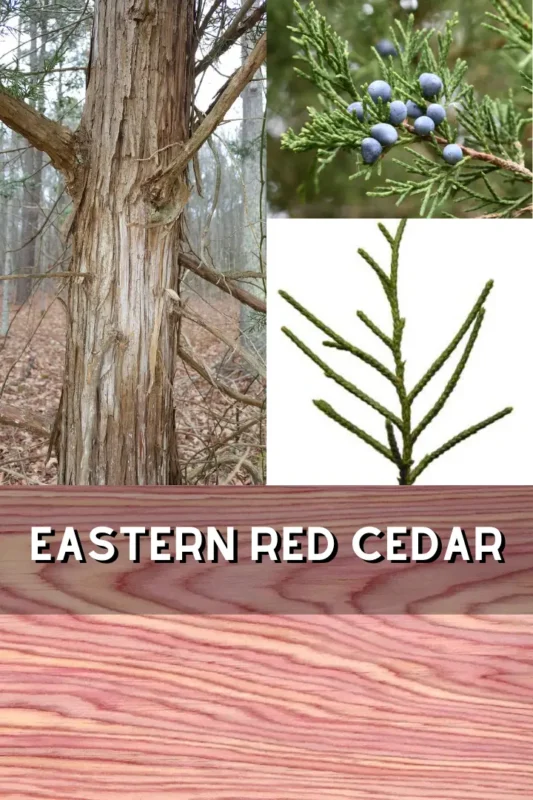
Eastern red cedar identification depends on several features together: a pyramidal or irregular evergreen crown, scale-like adult foliage, blue waxy seed cones, fibrous bark, and aromatic reddish heartwood. Whole-tree shape alone is unreliable because age, competition, wind, and pruning change the crown.
Crown Shape by Age
Young trees commonly form a narrow pyramidal crown with dense branches near the ground. Old open-grown trees become broader and less regular, while crowded woodland trees lose shaded lower limbs and develop a taller, narrower profile.
Browsing can create several leaders, and repeated shearing produces a shell of green foliage around a brown interior. Those altered forms explain why a clipped screen may look unlike a volunteer tree growing along a sunny fence line.
Adult and Juvenile Foliage
Adult leaves are small, overlapping scales pressed close to fine twigs. Juvenile growth carries sharp, spreading, awl-shaped leaves that feel prickly against a bare forearm, especially when reaching into the crown to inspect a branch.
Foliage ranges from green to blue-green and may turn bronze, olive, or brownish purple during cold weather. Uniform winter bronzing often reverses in spring; scattered dead tips or one-sided discoloration call for a closer stress inspection.
Seed and Pollen Cones. Female trees produce rounded, blue-purple seed cones with a dusty white wax coating. They’re roughly ¼ inch across and feel firm rather than juicy. Male trees carry tiny brown pollen cones, which release visible yellow pollen when tapped at the right stage.
The blue structures are commonly called berries, but they’re botanically fleshy seed cones. Cone production depends on the tree’s sex, age, available pollen, weather, and site conditions, so every eastern red cedar won’t display them.
Bark, Twigs, and Wood. Mature bark is thin, reddish to gray-brown, and peels in narrow fibrous strips. Beneath the foliage, fine twigs often appear four-angled. Freshly cut wood releases a dry, pencil-like fragrance and shows pale sapwood around red or purplish heartwood.
Similar Junipers and Cedars. Rocky Mountain juniper overlaps in appearance but occurs mainly farther west. Common juniper usually has sharper needle-like foliage and a lower habit. Northern white cedar and western red cedar have flattened sprays and different cones.
- Eastern red cedar: scale foliage, blue berry-like cones, shredding bark.
- Northern white cedar: flat fan-shaped sprays and small elongated cones.
- Common juniper: sharp needles with pale bands; often shrubby.
- Rocky Mountain juniper: similar foliage but centered in western habitats.
- Leyland cypress: fast-growing ornamental hybrid with softer, looser sprays.
Range, Growth, and Root System
Eastern red cedar grows naturally across much of eastern and central North America and commonly gains 1–2 feet yearly after establishment on a good site. Its root depth, mature size, and growth rate change with soil, water, light, provenance, and competition.
Native Range and Provenance
The native distribution extends from parts of southeastern Canada through much of the eastern United States and west into sections of the Great Plains. The USDA Plants profile supplies a county-level distribution reference, though planted trees occur beyond mapped native populations.
Seed provenance affects cold tolerance, growth timing, drought response, and crown form. A southern seed source sold in a northern region may survive yet suffer winter injury or break dormancy at an unsuitable time. Locally adapted nursery material reduces that mismatch.
Habitats and Pioneer Behavior
Natural sites include limestone glades, rocky bluffs, woodland edges, fencerows, roadsides, pastures, and abandoned fields. Birds deposit seeds beneath perches, allowing seedlings to colonize open ground where less drought-tolerant trees struggle.
This pioneer behavior doesn’t mean the tree accepts every condition. Deep shade produces thin foliage and slow decline, while saturated depressions deprive roots of oxygen. Seedlings frequently appear on dry banks because competing vegetation is sparse, not because dryness is required.
Light, Soil, and Moisture. Full sun produces the densest crown. Eastern red cedar tolerates clay, sand, shallow rock, compact subsoil, alkaline limestone soils, and some acidic sites, provided air can return to the root zone after rain. Permanently wet soil remains a poor choice.
Growth After Establishment. A landscape tree may add around 1–2 feet in height per year once roots extend beyond the original ball. The first one or two seasons can look slow because root growth takes priority. Shade, deer browsing, drought, and compacted fill can cut growth sharply.
Mature Height and Spread. Most planted trees finish around 30–65 feet tall and 8–25 feet wide. Open-grown specimens tend to be wider and densely branched; forest trees stretch upward for light. Favorable old specimens can exceed common nursery dimensions.
Lifespan and Root Architecture. Eastern red cedar can live for several centuries on undisturbed sites, but construction damage, chronic saturation, fire, trunk wounds, and restricted rooting shorten landscape life. One fixed lifespan gives a false sense of certainty.
The species doesn’t always retain a deep taproot. Porous, deep soil permits descending structural roots, while bedrock, dense clay, buried debris, or seasonal saturation directs roots outward near the surface. Container production can also leave circling roots that never develop a stable natural pattern.
Roots aren’t classed as unusually destructive, yet mature woody roots can lift weak paving or exploit existing drain and foundation defects. The better workaround is generous setback and a broad uncompacted root area, rather than relying on a claim that cedar roots stay small.
Ecological Value and Aggressive Growth
Eastern red cedar supplies valuable food, nesting cover, wind protection, and erosion control, but it can become an aggressive native colonizer in prairies and rangelands. Its value or harm depends on the ecosystem, planting density, fire history, and management goal.
Wildlife Food and Cover
Cedar waxwings, robins, bluebirds, mockingbirds, wild turkeys, and bobwhite quail eat the female cones. Seeds pass through birds and land beneath fences, utility lines, and other perches, creating recognizable rows of volunteers.
Dense evergreen branches provide winter shelter, nesting sites, and escape cover during rain and wind. A hand pushed through an old crown often meets a dry inner layer of twigs and dropped foliage, while the green outer shell blocks wind and creates a calmer sheltered pocket.
Native Insect Relationships
The tree supports native insects such as the juniper hairstreak butterfly. That ecological relationship differs from a damaging outbreak of bagworms, scales, or mites. Seeing insects on foliage doesn’t by itself justify treatment; identify the species and the level of injury first.
Screens, Windbreaks, and Erosion. Dense foliage makes the species useful for farm windbreaks, wildlife corridors, screens, and stabilization of exposed ground. A mixed planting usually survives pests and weather better than a solid wall of one species.
A single tightly packed row may close quickly, but shaded lower branches eventually thin and dead material accumulates inside. Multiple staggered rows with planned access create a more durable wind-filtering structure than an impenetrable hedge.
Native Versus Aggressive. Eastern red cedar is native across most of its natural range, so “woody encroachment” or “native species expansion” is often more accurate than invasive. Native status doesn’t prevent a plant from displacing grassland species when historic controls disappear.
Expansion Drivers and Effects. Fire suppression, abandoned fields, reduced clearing, bird dispersal, and perch-filled fence corridors help populations spread. Dense stands can reduce forage, shade prairie plants, intercept rainfall, compete for soil water, and replace habitat needed by grassland wildlife.
Fire Risk and Management. Resinous foliage burns intensely, and dead interior needles add fuel. Trees can act as ladder fuels beside taller vegetation or buildings. Landowners should use locally approved vegetation plans; prescribed burning belongs with trained crews, suitable weather, permits, and fire control resources.
Planting an Eastern Red Cedar Sapling

Plant an eastern red cedar sapling in full sun, on draining soil, with the root flare visible at finished grade. Most establishment failures arise from buried trunks, dry bare roots, circling container roots, fixed watering schedules, or spacing based on the sapling’s present size.
Site Selection and Setbacks
Check mature width, overhead wires, underground utilities, driveway clearance, drainage, wildfire exposure, and nearby apple-family hosts before digging. Leave enough room that mature foliage won’t press against siding, block sight lines, or require repeated hard pruning.
Apple, crabapple, hawthorn, serviceberry, pear, and quince plantings deserve extra review because they may participate in juniper rust cycles. Distance can lower nearby inoculum, but no short fixed setback guarantees protection because wind carries spores beyond property lines.
Nursery Stock Forms
Listings for eastern red cedar for sale may describe bare-root seedlings, plugs, container saplings, balled-and-burlapped trees, or named cultivars. Smaller stock often establishes faster because fewer roots were severed, while larger stock gives an immediate visual screen but needs more water and root inspection.
Root Flare and Depth. Pull back loose nursery soil until the first major structural roots appear. Dig no deeper than that root system and make the hole roughly two to three times the ball’s width where soil permits. Set the flare at or slightly above finished grade.
The common beginner error is treating the top of the potting mix as the trunk’s correct soil line. Nursery soil may hide several inches of stem. A buried flare often causes slow yellowing, weak growth, bark decay, and stem-girdling roots years later.
Container Root Defects. Remove the pot and inspect every side and the base. Slice or straighten woody circling roots rather than planting an intact pot-shaped mass. A glossy green crown can hide kinked roots that later constrict the trunk or leave the tree unstable.
Bare-Root Saplings. Keep exposed roots cool and damp from transport through planting. The fine roots become papery and brittle surprisingly fast in sun or wind. Spread them naturally in a wide hole, trimming only broken roots or those that can’t be positioned without bending.
Watering and Mulching. Soak the full root zone after planting, then check moisture by touch several inches down. Soil should feel cool and slightly damp, not slick or sour-smelling. Apply 2–3 inches of organic mulch while keeping it several inches away from the trunk.
Calendar watering creates avoidable losses. Sandy soil may dry quickly, while heavy clay can remain saturated beneath a dry-looking surface. Use a narrow trowel or soil probe outside the original root ball to test actual moisture before adding water.
Staking and Initial Pruning. Remove broken or dead branches, but leave healthy foliage to feed root growth. Stake only if the root ball moves or the site is exposed. Use broad flexible ties and remove supports once the roots hold the tree firmly.
Spacing by Landscape Use. Base spacing on expected mature width, not a universal number. Screens often use centers of roughly 8–15 feet, adjusted for cultivar width and closure time. Windbreak spacing should follow a regional NRCS or Extension design that accounts for rows, wind, and snow.
Closer planting provides faster closure but creates stronger competition, poor access, shaded lower foliage, and easier pest movement. Wider spacing takes longer to fill but preserves individual crown structure. Staggered rows can close visual gaps without creating a crowded single row.
Locations to Avoid. Skip waterlogged depressions, narrow foundation beds, utility corridors, high-quality prairie, and places where mature foliage would touch buildings. A cedar screen also shouldn’t block drainage swales or bury access to septic systems and utility controls.
Practical Notes From Real-World Use. The most reliable field check is simple: hold the trunk, press lightly, and watch the root ball. If the entire ball rocks after backfilling, settle soil around it with water and correct support; don’t stamp wet soil into a dense, airless plug.
Eastern Red Cedar Tree Care
Established eastern red cedar tree care centers on sun, drainage, and restrained pruning. Routine fertilizer and frequent irrigation aren’t needed on a suitable site, while attempts to force growth can create soft shoots, weak structure, or saturated roots.
Sun and Moisture
Full sun maintains dense green foliage. Increasing shade causes inner needles and lower branches to die, leaving a thin crown that won’t become full again merely through feeding. Reduce competing canopy shade where practical rather than treating a light shortage as nutrient deficiency.
New saplings need steady moisture while roots establish. Older trees tolerate drought, yet extended heat on compacted urban soil can still cause dull foliage, tip loss, and heavy cone drop. Water deeply across the root zone, then allow air to return before repeating.
Soil Testing and Fertilizer
Test soil first if growth is weak. Eastern red cedar commonly performs without fertilizer, including on rocky and relatively infertile ground. Added nitrogen won’t fix a buried flare, severed roots, waterlogging, shade, or a sprinkler that wets only one side of the root ball.
Pruning Without Bare Wood. Remove dead, broken, crossing, or hazardous branches while retaining green foliage on the remaining stem. Junipers often fail to produce new shoots from old leafless wood, so a cut behind the green shell may leave a permanent brown hole.
Repeated shearing builds a thick exterior and a dry interior. For size control, shorten selected branches back to a green lateral rather than shaving the whole surface. Sterilize tools when disease is suspected and avoid removing a large share of the live crown at once.
Drought and Waterlogging. Drought stress often causes dull color, dry tips, and brittle inner twigs. Waterlogging tends to produce thinning, weak extension growth, and progressive dieback while soil stays wet. Check below the surface because these problems can look similar from a distance.
Pests, Diseases, and Browning
An eastern red cedar turning brown may be showing normal winter color, drought, drainage failure, mites, scales, bagworms, rust-related twig injury, browsing, or mechanical damage. Diagnose the pattern and timing before spraying, watering, fertilizing, or pruning.
Cedar-Apple Rust Cycle
Cedar-apple rust is caused by Gymnosporangium juniperi-virginianae and requires both a susceptible juniper and an apple or crabapple host. Cedar trees carry woody galls; wet spring weather triggers bright orange, gelatinous horns that feel rubbery and look almost fluorescent after rain.
Spores from those horns infect susceptible apple tissue, where yellow-orange leaf spots and fruit lesions can develop. A later spore stage returns to junipers. The University of Minnesota Extension explains this two-host cycle and practical management choices.
Removing reachable galls before spring spore release can reduce local inoculum, but removing one nearby cedar won’t guarantee clean apples. Resistant apple and crabapple cultivars usually offer a stronger long-term workaround than relying on an arbitrary separation distance.
![Eastern Red Cedar [ Juniperus virginiana ] // Native Plant Profile](https://cdn.glamorwood.com/wp-content/cache/flying-press/89d9f8acb69b193ca86f31d14ea81853.jpg)
Other Juniper Rusts
Cedar-hawthorn rust and cedar-quince rust involve different host ranges and symptoms. Hawthorn, serviceberry, quince, pear, and related rose-family plants may participate. Orange material on juniper shouldn’t automatically be labeled cedar-apple rust without examining the gall and nearby alternate hosts.
Bagworms. Bagworm cases look like small spindle-shaped bundles covered with cedar fragments. Hand-pick attached bags during dormancy on reachable trees. Treatments work best while larvae are small; empty old bags don’t prove that an active population remains.
A severe infestation can strip an evergreen faster than it can replace foliage, leaving permanent dead sections. Tall crowns create spray-coverage and safety problems, so large-tree treatment belongs with a certified arborist or licensed applicator following the product label.
Spider Mites and Scale. Mites can cause fine stippling, bronzing, and occasional webbing. Juniper scales produce yellowing and branch decline. Shake a suspect branch over white paper and inspect moving specks with a hand lens, but seek confirmation before treatment.
Root Rot and Drainage. Saturated roots lose access to oxygen and become vulnerable to opportunistic pathogens. A declining tree in wet clay shouldn’t receive more irrigation simply because its foliage is brown. Check planting depth, drainage, root smell, irrigation leaks, and buried construction debris.
Browsing and Mechanical Damage. Deer browse tender saplings and rub antlers against flexible trunks. Mowers and string trimmers can remove a complete ring of bark in seconds. Keep turf away with flat mulch and inspect guards so they don’t tighten, trap moisture, or hide rodents.
Winter Bronzing or Decline. Seasonal bronzing is usually uniform on exposed foliage and improves as spring growth starts. One dead side may point to winter wind, salt, root cutting, or reflected heat. Scattered bags, webbing, galls, or crisp tips indicate a different cause.
| Observed symptom | Likely explanation | Useful next check |
|---|---|---|
| Uniform bronze color in winter | Seasonal pigment change | Watch for spring greening |
| Brown branch tips with hanging cases | Bagworms | Open a case and check for eggs or larvae |
| Fine stippling or dusty bronzing | Mites or scale | Use white paper and a hand lens |
| Thin crown in consistently wet soil | Root oxygen stress or rot | Check drainage and root flare depth |
| Bright orange horns after spring rain | Juniper rust gall | Identify gall type and alternate hosts |
| Damage limited to trunk base | Mower, trimmer, or rodent injury | Inspect the full trunk circumference |
Treatment and Arborist Guidance. Begin with the least disruptive response: correct drainage, adjust irrigation, remove reachable bagworms, or prune a confirmed dead branch. Contact a certified arborist for large-tree spraying, extensive dieback, unstable roots, hazardous limbs, or a diagnosis that remains unclear.
Propagation, Wood, and Safety
Eastern red cedar can be propagated by seed or vegetative methods, and its aromatic heartwood has long served for posts, chests, pencils, closet lining, and small wooden goods. Seeds, pollen, concentrated oil, and animal exposure require measured safety guidance rather than broad claims.
Seed Dormancy and Stratification
Fresh seed often has combined dormancy, making germination slow and uneven. A planning protocol may include cone cleaning, seed-coat treatment, roughly 30–60 days of warm moist stratification, then 90–120 days of cold moist stratification. Seed source and storage history change the response.
Beginners often discard trays after one quiet season or let stratifying seed become waterlogged. Use a damp, airy medium rather than dripping-wet material, label each lot, provide rodent protection, and allow for delayed germination instead of expecting one synchronized flush.
Volunteer Seedlings
Volunteers often emerge beneath fences, power lines, trees, and other bird perches. Move them while small and dormant, taking a broad plug around the roots. Larger volunteers may have roots extending far beyond the visible crown, making successful relocation less predictable.
Vegetative Propagation and Cultivars. Cuttings and grafting preserve selected traits such as narrow form, blue foliage, growth habit, or known sex. Seed-grown offspring vary genetically and won’t reliably duplicate a named cultivar’s shape, color, or cone production.
Aromatic Wood and Traditional Uses. The heartwood has a warm red-purple color, straight to irregular grain, and a sharp cedar-closet scent. It has been used for fence posts, pencils, chests, closet blocks, turnings, carvings, paneling, and cedar planks.
Natural decay resistance is concentrated in the heartwood; pale sapwood is less durable. This difference matters for posts, outdoor parts, and cedar wood chips exposed to damp soil. It also explains why two boards from the same log may weather at different rates.
The wood is relatively soft, so edges can crush and fasteners can split thin stock near the end grain. A sharp tool produces a clean, fragrant shaving, while dull cutters leave fuzzy fibers. Predrilling and supporting delicate parts reduce workshop breakage.
Cedar Oil Safety. Cedarwood oil may be distilled from wood and production residues, but concentrated oil isn’t interchangeable with solid wood, cedar closet blocks, or cedar chips for mulch. Don’t swallow undiluted oil or apply it directly to skin or animals without qualified guidance.
Anyone planning to buy cedar oil should verify the botanical species, dilution, intended use, and safety documentation. “Cedar oil” can describe materials derived from several unrelated trees, including junipers and true or trade-name cedars, so the label name matters.
Pollen and Allergies. Male eastern red cedars release windborne pollen and may aggravate seasonal allergies. Female trees produce the blue seed cones and aren’t the main pollen source. Nursery-grown seedlings may not reveal their sex until reproductive maturity.
Edibility, Pets, and Livestock. Wildlife eats the seed cones, but that doesn’t make unrestricted human consumption safe. Juniper species can be misidentified, and concentrated plant compounds may cause adverse effects. Don’t treat eastern red cedar cones as a direct substitute for culinary juniper berries.
Keep oils, extracts, and large quantities of plant material away from pets and livestock pending species-specific veterinary guidance. In pastures, the more common concerns are lost forage area, blocked access, dense cover, and increased fire fuel rather than a simple safe-or-toxic label.
Cultural and Conservation Uses. Eastern red cedar holds ceremonial, medicinal, material, and spiritual significance for multiple Indigenous peoples and regional communities. These traditions shouldn’t be merged into one generalized account; accurate discussion needs a named community and a tribal, museum, or peer-reviewed source.
For conservation planting, match the tree to the site’s actual goal. It can strengthen a wildlife corridor, stabilize exposed soil, or add winter cover, yet the same planting can damage prairie restoration through woody encroachment. A native species still needs active placement and long-term management.
FAQs
Is Eastern Red Cedar A True Cedar Or A Juniper?
Eastern Red Cedar is a juniper, not a true cedar. Its botanical name, Juniperus virginiana, places it in the cypress family, while true cedars belong to the Cedrus genus. Its common name comes from its fragrant, reddish heartwood. It produces berry-like cones rather than the larger cones found on true cedars.
How Fast Does An Eastern Red Cedar Tree Grow?
Eastern Red Cedar typically grows 1 to 2 feet per year in good conditions. Young trees grow fastest with full sun, well-drained soil, and regular watering during establishment. Mature trees commonly reach 30 to 50 feet tall, although growth slows as they age. Heavy shade, poor drainage, and drought can reduce growth.
Is Eastern Red Cedar Invasive Or Native?
Eastern Red Cedar is native to eastern and central North America. It can spread quickly into open fields and grasslands when fire, grazing, or regular mowing is absent. In its native range, it is usually considered an aggressive native species rather than an invasive plant. Check local guidance before planting near natural prairies.
How Far Should Eastern Red Cedar Be Planted From Apple Trees?
Plant Eastern Red Cedar at least 500 feet from apple trees, and farther is better. Eastern Red Cedar can host cedar-apple rust, a fungal disease that can infect nearby apples and crabapples. Spores may travel much farther than 500 feet in the wind, so removing nearby junipers offers the best protection for susceptible apple varieties.
Why Is My Eastern Red Cedar Turning Brown?
Eastern Red Cedar can turn brown because of drought, winter burn, poor drainage, pests, or disease. Some browning inside the tree during fall is normal as older foliage sheds. Water newly planted trees deeply during dry weather and check for damaged roots or branches. Widespread browning may indicate a serious stress problem.
Affiliate Disclosure: Some links in this post are affiliate links. If you make a purchase through these links, we may earn a small commission at no extra cost to you. We only recommend products we genuinely believe in.