

Loblolly pine (Pinus taeda) is a fast-growing evergreen conifer native to the southeastern United States, identified by long needles usually grouped in threes, prickly cones, and plated reddish-brown bark. This guide explains its identification, growth, planting, risks, uses, and differences from longleaf pine.
A loblolly pine tree can exceed 100 feet on a productive forest site, so successful planting depends on matching its mature size, roots, genetics, and moisture needs to the site rather than choosing it for fast growth alone.
Table of Contents
What Is a Loblolly Pine?
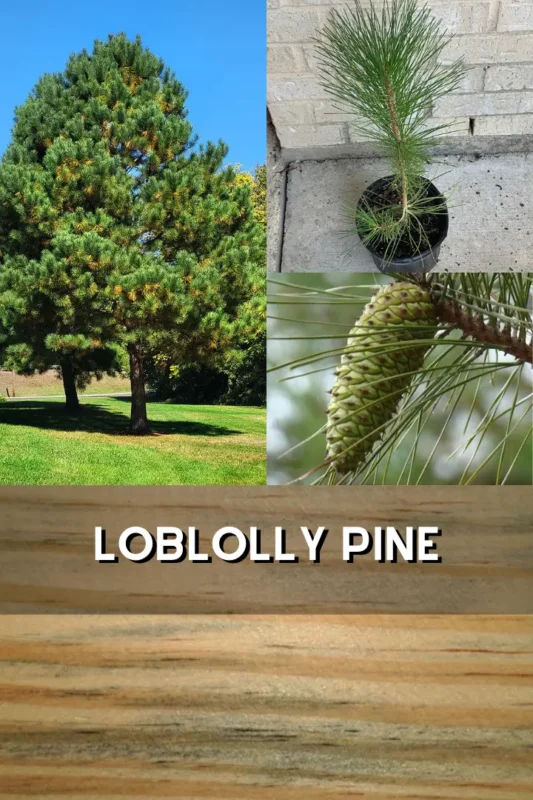
What is a loblolly pine? It is a native southeastern pine valued for timber, reforestation, wildlife cover, and large-scale screening. The species grows quickly in full sun and moist, aerated soil, but permanent saturation, dense shade, and restricted roots reduce its health and stability.
Quick Facts
| Characteristic | Loblolly pine details |
|---|---|
| Scientific name | Pinus taeda L. |
| Family | Pinaceae |
| Plant type | Evergreen conifer |
| Native region | Southeastern United States |
| Typical height | 60–90 feet; more than 100 feet on strong forest sites |
| Typical spread | 25–35 feet, sometimes wider in open ground |
| Growth rate | Often more than 24 inches annually when young |
| Hardiness | Commonly USDA Zones 6–9, subject to seed source |
| Light | Full sun |
| Needles | Usually three per fascicle, about 6–9 inches long |
| Cones | Woody, prickly, about 3–6 inches long |
| Lifespan | Often 100–200 years; exceptional trees may exceed 300 |
| Pollination | Wind-pollinated and monoecious |
| Primary uses | Lumber, plywood, pulp, poles, biomass, habitat, and reforestation |
The USDA Forest Service species account describes Pinus taeda as one of the most commercially significant trees in the southern United States. Its fast juvenile growth and broad site tolerance explain why it dominates many planted forests.
Taxonomy, Name Origin, and Arkansas State Tree Context
Taxonomy and name origin. Loblolly belongs to the genus Pinus and family Pinaceae. “Loblolly” once referred to a muddy depression or mire, reflecting the tree’s association with moist lowlands. The name doesn’t mean the species needs swamp soil; roots still require oxygen.
Arkansas state tree context. Arkansas designated the pine as its state tree in 1939 rather than naming one pine species in the statute. Loblolly is the state’s most widespread pine and is commonly associated with the designation, while shortleaf pine also has deep ecological and commercial ties there. The Arkansas Secretary of State lists the official state tree name as “pine.”
For a related wood-use perspective, see how loblolly fits within the commercial yellow pine group.
Loblolly Pine Identification

Loblolly pine identification works best when you confirm needles, cones, bark, and overall form together. Needle length alone can mislead because growing conditions, age, hybrids, and natural variation can produce atypical foliage.
Needles and Fascicles; Cones and Seeds
Needles and fascicles. Most bundles contain three slender needles, though bundles of two or four sometimes occur. Mature needles are usually 6–9 inches long, flexible, slightly twisted, and yellow-green to dark green. Rubbed foliage feels smooth along its length but lightly serrated against the grain.
Cones and seeds. Seed cones measure roughly 3–6 inches and mature during their second growing season. Each woody scale ends in a short prickle that catches bare fingertips, so gloves help when collecting cones. Winged seeds escape through the opening scales and move mainly on wind.
Male pollen cones form soft clustered cylinders and release clouds of fine yellow pollen in spring. Female structures usually develop higher in the crown, which limits self-pollination. Heavy pollen coating a vehicle or porch is normal reproduction, not proof that a tree is diseased.
Bark, Crown, Reproduction, and Identification Checklist
Bark characteristics. Young trunks have gray, scaly bark. Older bark becomes reddish brown or dark brown, breaking into broad plates divided by deep furrows. These plates feel coarse and blocky, but bark must be checked against foliage because slash, shortleaf, and other southern pines can look similar.
Crown and form. Forest-grown loblolly pines commonly have straight trunks, high crowns, and few living lower branches. Open-grown trees retain heavier limbs and develop broader, less regular crowns. Young trees look conical; mature crowns often appear rounded, open, or uneven after storms and branch loss.
- Check several fascicles for the usual three-needle pattern.
- Measure mature needles; most fall near 6–9 inches.
- Look for 3–6-inch woody cones with prickled scales.
- Confirm plated reddish-brown bark on mature trunks.
- Check whether the location falls within or near the native range.
- Use buds, cones, and foliage together where related pines overlap.
This identification checklist reduces confusion with slash pine and shortleaf pine. Natural hybrids can display intermediate traits, so a specimen that repeatedly fails the checklist may need expert or genetic confirmation.
Range, Habitat, Growth, and Lifespan

Loblolly pine grows naturally from southern New Jersey through the Atlantic and Gulf Coastal Plains to eastern Texas, extending inland through parts of Arkansas, Oklahoma, Tennessee, and nearby states. It performs best in warm, humid regions with long growing seasons.
Native Range, Habitat, Soils, and Climate
Native range. The species is strongly associated with the Coastal Plain and Piedmont. Wind-dispersed seed lets it colonize old fields, forest edges, utility corridors, and other sunny disturbed sites, often producing dense stands without deliberate planting.
Habitat and soils. Loblolly accepts clay, loam, and sandy soils when moisture and aeration remain adequate. Acidic to mildly acidic soil usually supports better growth than strongly alkaline ground. A laboratory soil test reveals pH and nutrient limits that color and texture can’t show.
Climate and hardiness. Zones 6–9 cover much of its practical planting range, yet nursery provenance changes cold tolerance and drought response. A southern coastal seed source can suffer cold injury at a northern inland site where a regionally adapted seed lot survives.
Growth Rate, Mature Size, Lifespan, and Roots
Growth rate. Young trees often add more than two feet of height per year on sunny, productive sites. This explains how long it takes for a pine tree to grow into a screen: useful visual height may develop within several seasons, but a tall screen still requires years of root establishment and crown expansion.
Shade, drought, waterlogging, compacted soil, and unmanaged grass can reduce that rate sharply. Fast-growing describes potential, not a guaranteed annual increment. Trees also slow as crowns become crowded and lower branches lose access to light.
Mature size. Landscape trees commonly reach 60–90 feet with a 25–35-foot spread. Productive forest sites can support trees taller than 100 feet. Open-grown trees often remain shorter and wider than tightly stocked forest trees.
Lifespan and milestones. Many loblolly pines live 100–200 years, while exceptional specimens approach or pass 300. Seedlings establish roots before strong height growth, pole-stage trees close the canopy and shed lower branches, and mature trees continue adding trunk diameter. A commercial harvest age is not the tree’s biological lifespan.
Roots and wind risk. A taproot may form in deep, well-drained soil, but hardpan, bedrock, compaction, and a high water table create shallower root systems. After heavy rain, a failing root plate may lift the soil like a hinged lid and leave fresh cracks on one side of the trunk.
Tall trees rooted in saturated soil face greater windthrow risk. Removing neighboring trees can also expose formerly sheltered trunks to wind. Place mature pines away from structures, septic fields, retaining walls, pavement, and utility corridors, using a site-specific arborist assessment where failure could strike people or property.
How to Plant and Grow Loblolly Pine
Plant loblolly pine in full sun, set its root collar at soil level, keep exposed roots moist, and control competing vegetation during establishment. Most failures begin with dried roots, bent roots, deep planting, poor drainage, or grass competition rather than a lack of fertilizer.
Site Selection and Planting a Seedling
Site selection. Choose ground receiving at least six hours of direct sun and enough open space for a tree exceeding 90 feet. Moist soil can suit loblolly, but standing water that smells sour or leaves gray, airless soil signals poor root-zone oxygen.
- Plant dormant bare-root stock during the locally recommended winter planting window.
- Keep seedlings cool, shaded, and sealed against drying wind until each tree enters the ground.
- Open a hole or slit deep enough to hold roots vertically without bending them upward.
- Set the root collar near the surrounding soil surface.
- Firm mineral soil against the roots without crushing the stem.
- Water the root zone thoroughly after landscape planting.
- Add 2–3 inches of mulch while leaving several inches clear around the trunk.
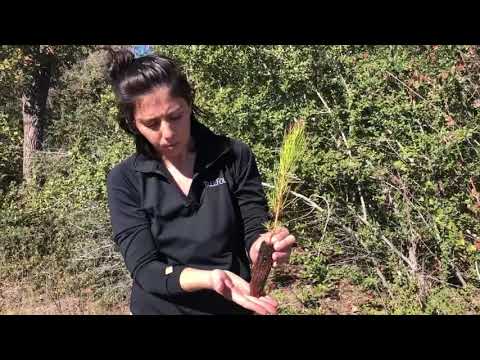
Planting a seedling. Never force long roots into a shallow slit. The resulting J-shaped root can restrict uptake and leave the stem poorly anchored. A planting bar should open a full-depth pocket, followed by firm closure from the bottom upward so hidden air spaces don’t remain.
Watering and fertilizing. Water deeply when rainfall doesn’t moisten the developing root zone, then allow oxygen to return between applications. Don’t fertilize automatically. Soil tests and growth symptoms should guide treatment because nitrogen can’t repair compacted roots, a buried collar, or chronic flooding.
Seasonal care calendar. Plant and test soil in late winter or early spring. Control grass and inspect new shoots in spring, watch drought and beetle symptoms in summer, then assess survival, storm damage, and stocking during fall and winter. Regional planting dates take priority over a national calendar.
Spacing and stocking math. Use this formula: trees per acre = 43,560 ÷ (row spacing in feet × tree spacing in feet). Tighter planting closes the canopy earlier and limits lower branches, but competition and thinning needs also arrive sooner.
| Spacing | Approximate trees per acre | Common trade-off |
|---|---|---|
| 10 × 10 feet | 436 | Wider crowns and easier access, with more branch growth |
| 8 × 8 feet | 681 | Earlier canopy closure and earlier competition |
| 6 × 10 feet | 726 | Dense initial stocking with greater thinning pressure |
Growing From Seed, Stock Sourcing, and Practical Field Notes
Growing from seed. Cold, moist stratification for roughly 30–60 days often improves or synchronizes germination, though each seed lot may differ. Keep the medium damp rather than dripping wet, sow shallowly in sterile propagation mix, and give seedlings strong light after emergence.
Damping-off often starts as a pinched dark stem at soil level before the seedling folds over. Clean containers, moving air, moderate watering, and uncrowded seedlings reduce losses. Protect the trays from rodents and birds, which can remove seeds overnight without leaving obvious damage.

Loblolly Pine Seeds 100-Pack
- One hundred Pinus taeda seeds
- Grow loblolly pines from seed
- Useful for larger planting projects
- Fast-growing evergreen species
- A practical choice for nurseries and home growers
 Buy on Amazon
Stock types and sourcing. Bare-root seedlings offer the lowest cost for large forestry projects, but their roots dry quickly. Containerized plants extend handling flexibility, while gallon stock gives a visible landscape start. Bigger stock isn’t always faster overall; a healthy small seedling can establish before a root-bound pot recovers.
| Stock type | Best use | Main risk |
|---|---|---|
| Bare-root seedling | High-volume forestry planting | Desiccation and J-rooting |
| Containerized seedling | Smaller projects or broader planting windows | Deformed or circling roots |
| Gallon tree | Visible specimen planting | Root binding, transplant shock, and shipping cost |
| Seed | Propagation and educational projects | Variable genetics and germination |

Loblolly Pine Seedlings 10-Pack
- Ten live Pinus taeda seedlings
- Fast-growing evergreen for open spaces
- Great starting quantity for home planting
- Can help establish a future screen or grove
- Offers classic loblolly pine foliage
Buy on Amazon

Loblolly Pine Trade Gallon Tree
- One large trade gallon pine plant
- Pinus taeda evergreen tree
- Potted size offers a more established start
- Fast-growing choice for open landscapes
- Can develop into a broad shade tree
Buy on Amazon
Provenance, pricing, and costs. Ask whether stock is open-pollinated, improved, control-pollinated, or clonal, and request its seed-source region. Local restoration projects may benefit more from appropriate regional genetics than maximum advertised growth. Marketplace seed without provenance records carries extra climate and disease uncertainty.
Purchase price alone hides the true establishment cost. Add site preparation, weed control, planting labor, shipping, cold storage, browse guards, replacement trees, and later maintenance. Record the quote date and divide the complete budget by surviving trees after the first growing season.
Practical notes from field use. Bare roots can turn tacky and dull within minutes in drying wind, which is why planters carry only a small working bundle. Another frequent mistake is planting into tall grass without clearing a ring; the grass steals moisture near the surface before pine roots occupy the surrounding soil.
For anyone searching “loblolly pine for sale near me,” regional forestry nurseries often provide clearer provenance and handling instructions than general marketplaces. Before delivery, confirm species, stock size, root condition, shipping season, inspection rules, genetic class, and the live-arrival policy.
Common Loblolly Pine Problems
The most common loblolly pine problems involve poor establishment, bark beetles, rust, root disease, shoot moths, browsing, and storm damage. Diagnosis should start with the pattern of injury, site moisture, recent weather, construction work, and whether nearby trees show the same symptoms.
Establishment Failures and Wildlife Damage
| Problem | Likely evidence | Workaround |
|---|---|---|
| Planted too deeply | Buried root collar and slow decline | Replant promptly at the correct level when feasible |
| J-rooting | Weak establishment or instability | Open a deeper slit and keep roots vertical |
| Root desiccation | Rapid browning after planting | Keep roots cool, moist, shaded, and covered |
| Grass competition | Slow growth despite full sun | Maintain a vegetation-free zone without injuring bark |
| Poor drainage | Yellowing, shallow roots, or windthrow | Use another site or species rather than piling soil over roots |
| Drought | Dull foliage and failed current shoots | Water the root zone deeply during establishment |
| Wrong provenance | Cold injury or weak regional performance | Buy stock matched to the planting region |
| Deer or rodents | Clipped leaders, gnawing, or stem wounds | Use correctly sized guards and monitor for constriction |
| Overcrowding | Small crowns and weak diameter growth | Assess stocking and thin with forestry guidance |
Pine tip moths, especially Nantucket pine tip moth, damage leaders and lateral shoots on young trees. Resin around buds, dead shoot tips, and forked growth are typical clues. Repeated terminal injury matters more than one damaged side shoot because it can permanently reduce stem quality.
Wildlife damage. Deer often clip the soft terminal leader, while rodents remove bark close to the soil. Guards must allow airflow and trunk expansion. A forgotten tight tube can trap moisture, hide gnawing, or constrict the stem it was meant to protect.
Beetles, Diseases, and Storm Damage
Southern pine beetle. Look for resin pitch tubes, boring dust, fading crowns, and winding S-shaped galleries beneath loose bark. Overcrowded or stressed stands face greater outbreak risk. Groups of fading trees need fast professional assessment because active infestations can spread through nearby pines.
Ips engraver beetles. Ips species often exploit drought, lightning, storm, logging, or construction stress. Their branching galleries differ from southern pine beetle galleries. Cutting or treating trees without identifying the beetle can waste time and disturb more roots during an already stressful period.
Fusiform rust. This disease produces spindle-shaped branch or stem galls, sometimes carrying bright orange spores. Oaks serve as alternate hosts. Small branch infections may be pruned correctly, but a gall surrounding the main stem weakens it and requires a condition-based risk decision.
Root diseases. Heterobasidion root disease may enter fresh stumps after thinning and cause thin crowns, root decay, grouped decline, and windthrow. Littleleaf disease is a decline complex tied to pathogens, damaged roots, erosion, compaction, and poor drainage; extra fertilizer rarely corrects the site failure.
Windthrow and storm damage. Saturated soil, severed roots, sudden exposure, dense crowns, and root decay increase failure risk. A new lean, raised root plate, or widening soil crack calls for immediate clearance of the fall zone and assessment by a qualified arborist.
Loblolly Pine vs Longleaf Pine

In a loblolly pine vs longleaf pine comparison, loblolly usually establishes and gains height faster, while longleaf has longer needles, larger cones, a grass-stage seedling form, and stronger adaptation to frequent surface fire. The right choice depends on soil, native ecosystem, fire plan, and management goal.
Comparison Table and Identification Differences
| Characteristic | Loblolly pine | Longleaf pine |
|---|---|---|
| Scientific name | Pinus taeda | Pinus palustris |
| Needle bundles | Usually 3; sometimes 2 or 4 | Usually 3 |
| Needle length | About 6–9 inches | About 8–18 inches |
| Cone length | About 3–6 inches | Often 6–10 inches |
| Early growth | Begins height growth without a prolonged grass stage | Usually passes through a grass stage |
| Fire adaptation | Young trees remain vulnerable | Strong adaptation to frequent surface fire |
| Typical site | Moist, productive lowland or upland soils | Well-drained sandy uplands and suitable flatwoods |
| Common objective | Timber, reforestation, and fast canopy development | Savanna restoration, resilience, and specialty timber |
| Longevity | Often 100–200 years | Potentially several centuries |
Needle and cone differences. Longleaf needles form conspicuous tufts at branch ends and can reach 18 inches, while loblolly needles usually stop near 9 inches. Longleaf cones also tend to be larger. Needle bundle count won’t separate them reliably because both commonly carry three needles.
Seedling growth. Loblolly seedlings move into vertical growth early. Longleaf seedlings remain close to the ground during their grass stage while building roots and shielding the bud inside dense needles. That flat, tufted form is normal and shouldn’t be mistaken for stalled growth.
Fire Adaptation, Site Goals, and Other Windbreak Pines
Fire adaptation. Longleaf is better suited to frequently burned pine savannas. Small loblolly seedlings can die under fire, though older trees gain resistance as bark thickens and crowns rise. The Longleaf Alliance explains why longleaf restoration depends on the whole fire-maintained ecosystem, not tree replacement alone.
Site and management goals. Choose loblolly for fast early establishment, commercial production, and naturally suitable moist sites. Choose longleaf for open savanna restoration, frequent prescribed fire, long-term resilience, and wildlife tied to old longleaf systems. A faster tree isn’t automatically the better ecological match.
Other pines and windbreaks. Shortleaf can fit drier inland sites, while slash pine favors warmer southern areas. Eastern white pine may make an attractive windbreak in cooler climates but can struggle with southern heat and exposed drought. Loblolly fits warm regions, though saturated roots and dense single-row planting can increase storm loss.
A dependable windbreak usually uses multiple staggered rows and, where practical, more than one adapted species. Mixed plantings reduce the chance that one pest, disease, or weather event removes the entire barrier. See Virginia pine for another regional comparison.
Loblolly Pine Benefits and Uses
Loblolly pine benefits include fast biomass accumulation, wildlife cover, old-field colonization, commercial wood, and flexible plantation management. Its drawbacks include large mature size, litter, pollen, pest exposure, and weaker suitability for fire-dependent longleaf restoration.
Wildlife, Fire, Carbon, and Forest Products
Wildlife and succession. Birds, squirrels, and small mammals eat the seeds, while trunks and crowns supply nesting and roosting structure. Loblolly readily colonizes abandoned fields. Without thinning, fire, or other disturbance, hardwoods often enter beneath the pine canopy and change the stand over time.
Fire ecology. Saplings remain vulnerable to heat, but larger trees resist low surface flames better after developing thicker bark and elevated crowns. Prescribed burning requires trained personnel, suitable weather, permits, smoke planning, and a written burn plan; it isn’t a casual yard-care technique.
Carbon and biomass. Fast growth lets planted stands accumulate biomass quickly. Carbon results vary with stand age, soil disturbance, harvest interval, product lifespan, storms, fire, and replanting. A universal carbon figure per tree would hide these large site and accounting differences.
Timber and forest products. Loblolly is one of the principal species marketed as southern yellow pine. Common products include structural lumber, plywood, veneer, utility poles, posts, pulp, paper, composite panels, pellets, and biomass fuel. Its favorable strength supports broad use as construction wood.
Planted Forests, Genetics, Genome, and Landscape Trade-Offs
Planted forest management. Typical activities include site preparation, adapted stock selection, vegetation control, thinning, pest monitoring, and regeneration after harvest. Characteristics of planted forests include even-aged trees, regular spacing, simpler structure, and planned access. Habitat quality improves when managers retain structural variety and protect streams and native understory.
Stands should be thinned from density and crown condition, not age alone. Tightly packed trees develop small crowns and slow diameter growth, while aggressive thinning can expose remaining stems to wind and encourage large branches. Basal area, product goals, disease risk, and site quality shape the timing.
Improved genetics. Seed-orchard programs select for survival, straight stems, growth, wood properties, and fusiform-rust resistance. Open-pollinated improved stock differs from control-pollinated families and clonal varieties. Genetic gains still depend on correct planting, vegetation control, and site matching.
Genome research. The loblolly pine genome contains about 22 billion base pairs—roughly seven times the size of the human genome. The loblolly pine genome study marked a major conifer-genomics milestone and supports research into growth, disease resistance, drought response, and breeding.
Landscape pros and cons. A loblolly pine provides fast evergreen screening, native habitat value, and a strong vertical form on large properties. It also drops prickly cones, pollen, needles, and small branches. Dense shade and surface-root competition make turf beneath mature crowns difficult to maintain.
Pine-needle acidity myth. Fresh needles are acidic, but that acidity declines as they decompose. Needles don’t normally turn neutral ground into strongly acidic soil by themselves. Poor grass beneath pine crowns more often results from shade, dry surface soil, root competition, and a physical mat of litter.
Once converted into boards, southern pine varies in moisture, grade, ring width, and density. The guide to pine board explains how those traits affect practical material selection.
Loblolly Pine FAQs
These loblolly pine FAQs answer the yard, growth, root, needle, moisture, and lumber questions most often asked before planting or identifying the species.
Is It a Good Yard Tree, and How Large Does It Grow?
Is it a good yard tree? It can work on a large property within its adapted range. A small lot, overhead utilities, shallow soil, poor drainage, or a location close to a home makes it a poor choice. Account for cones, pollen, needles, branches, and full mature height.
How fast does it grow? Young loblolly pines commonly gain more than two feet per year on favorable sites. Drought, shade, grass, damaged roots, unsuitable genetics, and overcrowding can cut growth sharply.
How tall does it get? Many landscape trees reach 60–90 feet, while productive forest trees can exceed 100 feet. Crown spread commonly reaches 25–35 feet and may be wider where the tree grows without competition.
Roots, Needle Shedding, Wet Soil, and Southern Yellow Pine
Are the roots invasive? “Invasive” is an imprecise description. Roots spread widely to find water and oxygen, while depth depends on drainage, soil depth, compaction, hardpan, and bedrock. Avoid placing this large tree beside pavement, septic infrastructure, foundations, or retaining walls.
Do loblollies shed needles? Yes. Evergreen doesn’t mean every needle remains forever. Older interior needles naturally turn yellow or brown and fall while newer foliage stays green. Fast crown discoloration or browning of current shoots needs diagnosis for drought, flooding, insects, disease, or root injury.
Can it grow wet? Loblolly tolerates moist ground and periodic wetness better than several southern pines. Permanently saturated, airless soil restricts roots, weakens growth, and raises windthrow risk. A tree growing near a ditch isn’t proof that it will thrive in standing water.
Is it southern yellow pine? Loblolly is one species sold within the southern yellow pine commercial group. Longleaf, slash, and shortleaf pine may also carry that lumber label, so the material name doesn’t always identify the exact botanical species.
FAQs
What Is A Loblolly Pine And How Do You Identify It?
A loblolly pine is a fast-growing native evergreen tree common across the southeastern United States. Identify it by its long needles in bundles of three, scaly reddish-brown bark, and oval cones about 3 to 6 inches long. Mature trees usually have a straight trunk and an open, rounded crown.
How Fast Does A Loblolly Pine Tree Grow?
A loblolly pine typically grows 2 to 3 feet per year when young in suitable conditions. Growth is fastest in full sun, moist well-drained soil, and warm climates. Regular watering during establishment helps, while crowded sites, drought, and poor drainage can slow development.
How Tall Do Loblolly Pines Get And How Long Do They Live?
Loblolly pines commonly reach 60 to 90 feet tall and can live 100 to 200 years. In favorable forest conditions, exceptional trees may exceed 100 feet. Yard trees may remain smaller, but they still need ample overhead clearance and room for wide roots.
Is A Loblolly Pine A Good Tree For A Yard Or Windbreak?
A loblolly pine can be a good yard or windbreak tree when you have plenty of space and a suitable warm-climate site. It grows quickly, provides year-round screening, and tolerates many soils, but it drops needles and cones and can become very large. Plant it away from buildings, power lines, and small gardens.
What Is The Difference Between Loblolly Pine And Longleaf Pine?
Loblolly pine grows faster and favors moister sites, while longleaf pine grows more slowly and is better adapted to sandy, dry soils and fire-managed landscapes. Loblolly needles are usually 6 to 9 inches long, whereas longleaf needles often reach 8 to 18 inches. Longleaf also has a distinctive grass-stage seedling phase.
Affiliate Disclosure: Some links in this post are affiliate links. If you make a purchase through these links, we may earn a small commission at no extra cost to you. We only recommend products we genuinely believe in.