


Willow acacia (Acacia salicina) is a fast-growing Australian tree with narrow, hanging phyllodes, pale flowers, and a heat-tolerant canopy that suits many low-desert Arizona yards. It commonly reaches 20–40 feet tall, needs early structural pruning, and produces enough pods and foliage to make placement near pools or paving a poor choice.
SEO title: Willow Acacia Tree: Arizona Care, Size, Pros and Cons
Meta description: Learn willow acacia size, watering, pruning, roots, litter, Arizona climate limits, common problems, alternatives, buying tips, and seed propagation.
Table of Contents
Willow Acacia Quick Facts
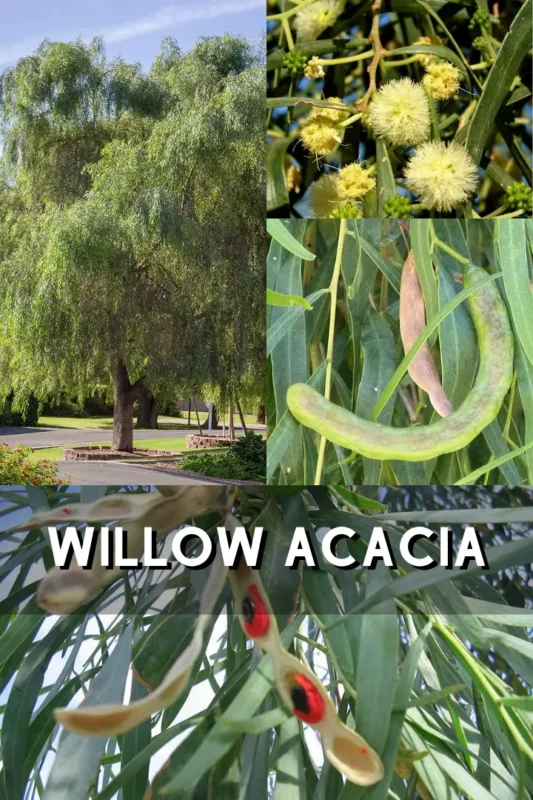
A full-grown willow acacia usually stands 20–40 feet tall and spreads 15–30 feet. Warm weather and broad, deep irrigation can produce a larger crown, so nursery labels showing one fixed maximum shouldn’t define planting clearance.
Care and Size Table
| Feature | Willow acacia details |
|---|---|
| Botanical name | Acacia salicina Lindl. |
| Other names | Willow-leaved acacia, willow wattle, cooba |
| Family | Fabaceae |
| Native range | Australia |
| Typical mature size | 20–40 feet tall and 15–30 feet wide |
| Growth rate | Fast in warm sites with suitable irrigation |
| Light | Full sun |
| Soil | Adaptable, including alkaline soil; drainage required |
| Water | Regular during establishment; deep and less frequent when mature |
| Foliage | Evergreen to semi-evergreen narrow phyllodes |
| Flowers and fruit | Cream flower heads followed by flat pods |
| Thorns | Usually thornless |
| Primary maintenance | Structural pruning, irrigation adjustment, and litter cleanup |
These dimensions are planning ranges rather than guarantees. Soil depth and water, root restriction, frost exposure, competition, and pruning all affect mature size.
Botanical Identity and Synonyms
Willow acacia is Acacia salicina, a legume-family tree rather than a botanical willow. Racosperma salicinum appears in some taxonomic treatments, while Kew Plants of the World Online provides accepted-name and distribution records.
Phyllodes, flowers, and pods: Adult foliage consists of flattened leaf stalks called phyllodes. They feel firm and slightly leathery between the fingers, unlike the softer blade of many true willow leaves. Seedlings may form compound leaves before shifting to narrow mature phyllodes.
Small cream or pale-yellow flower heads develop into flat seed pods. The dry pods become papery and brittle, making a faint rattle before they fall or split and release hard-coated seeds.
Bark, crown, and thorns: Young bark is fairly smooth and gray-brown; older bark darkens and develops shallow fissures. The crown starts narrow, then broadens through several upright limbs if nobody trains it. This species is usually unarmed, but nursery labels need checking because “acacia” covers many thorny trees.
Acacia versus true willow: True willows belong to Salix and commonly favor wetter ground. Willow acacia needs far less water once established, and it has no valid connection to willow-bark supplements. Generic acacia wood, acacia chopping boards, and acacia tree furniture may also come from entirely different species.
Willow Acacia Tree in Arizona
A willow acacia tree in Arizona fits sunny low-desert sites with broad rooting space, seasonal irrigation, and room for structural pruning. It handles Phoenix, Tucson, and Yuma heat better than moisture-loving true willows, but cold Arizona communities present a higher freeze risk.
Desert Landscape Benefits
Desert landscape benefits include quick shade, a fine-textured canopy, alkaline-soil tolerance, and lower mature water use than a true willow. Hanging phyllodes move softly during light wind, creating filtered shade rather than the dense darkness produced by some broadleaf trees.
Mature size and growth: Plan for 20–40 feet of height and 15–30 feet of width. Growth is often fast, but excessive irrigation can create long, soft shoots and heavy branch ends rather than sound structure.
Low-desert climate fit: Established trees tolerate intense sun and prolonged heat. A new root ball can still dry while nearby native soil remains damp, especially beside a west-facing wall where reflected heat feels like an open oven at late afternoon.
Frost and Heat Limits
Hard freezes cause damage ranging from brown phyllodes to dead twigs and injured young bark. Low frost pockets, exposed lots, and higher-elevation Arizona sites carry more risk than sheltered low-desert yards. Wait for spring growth to reveal live wood before removing extensive freeze damage.
Native status: Willow acacia comes from Australia, not Arizona. “Desert-adapted” describes its performance; it doesn’t make the species native or give it the same food-web value as local palo verde, mesquite, or desert willow.
Site and clearance planning: Keep the mature crown away from roofs, wires, walls, pools, and neighboring property. Narrow strips between a driveway and block wall offer too little soil volume. Planning with the container’s current width is a common beginner mistake; mark a 15–30-foot circle before planting instead.
Planting and Watering Willow Acacia

Plant willow acacia in full sun and draining soil, with the root flare visible at finished grade. Water the original root ball and surrounding ground during establishment, then widen the irrigated area as roots spread.
Soil and Drainage
Soil and drainage: Sandy, loamy, and many clay-rich desert soils can work if water doesn’t remain trapped around the crown. Caliche layers may restrict drainage and rooting depth. Test questionable ground before planting and correct the wider site rather than filling one hole with rich compost.
Planting depth: Remove loose soil from the root-ball top until the first structural roots appear. Set that flare level with or slightly above the finished soil. A buried trunk base stays damp, loses oxygen, and can decline slowly even while the upper canopy initially grows.
Dig no deeper than the measured root ball and make the hole wider than it. Correct visible circling roots, backfill mainly with site soil, and keep mulch off the bark.
Staking young trees: Stake only when the root ball moves or wind exposure prevents stability. Flexible ties should allow slight trunk movement without rubbing. Remove support once the roots hold the tree; tight nursery stakes left against the stem can hide weak taper and girdling ties.
Establishment Watering
Establishment watering must moisten both the root ball and adjacent soil. Frequency changes with season, container size, wind, soil texture, and drainage, so check several inches below the surface instead of trusting dry gravel or a fixed calendar.
Push a narrow soil probe into the ground before watering. Dry soil resists and may emerge dusty; damp soil feels cooler and clings lightly to the probe. Never drive a probe into the root ball where it could tear roots.
Mature-tree irrigation: Apply water deeply across a broad root zone, including near and beyond the canopy edge. Emitters left beside the trunk become ineffective as absorbing roots spread outward. Add or move outlets while keeping the crown from sitting in constant moisture.
- Possible underwatering: thinning foliage, scorched phyllode margins, wilting, dry soil at depth, and twig death.
- Possible overwatering: persistently wet soil, yellow foliage, sparse growth, soft shoots, and root or crown decline.
- Diagnostic warning: foliage symptoms overlap; inspect soil moisture and drainage before changing the controller.
“Drought-tolerant” never means no establishment water. Mature trees can also need deep irrigation during long periods of extreme heat, especially in shallow soil or sites surrounded by pavement.
Pruning Willow Acacia Safely
Willow acacia needs early structural pruning because fast growth can produce competing leaders, narrow unions, and long branches weighted at their ends. Small training cuts on a young tree cost less and remove less living tissue than large corrections later.
Young-Tree Structure
Young-tree structure: Select one dominant leader where the intended form allows it. Keep major scaffold branches spaced vertically and around the trunk, then shorten competing leaders gradually rather than stripping the tree in one visit.
Leaders and scaffolds: Wide branch attachments usually provide better mechanical form than narrow forks with bark trapped between stems. Temporary lower branches can help develop trunk taper, but remove them in stages before they become large.
Mature-Tree Pruning
Mature-tree pruning should address dead, rubbing, broken, or hazardous wood. Use reduction cuts to shorten long limbs without leaving stubs. Avoid lion-tailing, which strips inner growth and leaves foliage concentrated at branch tips.
Wind and branch failure: Monsoon gusts expose weak unions and end-heavy limbs. Fresh cracks may sound like a dry board snapping, while movement at a trunk fork signals a need to clear the area and arrange an arborist inspection.
Topping is damaging. It creates large wounds and clusters of fast replacement shoots attached around decay-prone cuts. If a tree has outgrown its space, replacement may be safer and cheaper than repeated mutilation.
Elevated cutting, large-limb removal, trunk cracks, sudden leaning, or work near utilities calls for a qualified arborist. The International Society of Arboriculture pruning guidance explains proper cuts and why topping creates future hazards.

Roots, Litter, and Common Problems

Willow acacia roots aren’t automatically invasive, but they can conflict with paving and leaking utilities where space or irrigation is poor. The tree also sheds phyllodes, flowers, twigs, and pods, making it more troublesome beside pools than in open desert yards.
Are Roots Invasive?
Roots follow favorable conditions such as moist, oxygenated soil. They don’t normally break into dry, intact pipes, but they can enter existing leaks or cracks. Conflict becomes more likely in narrow planting strips, poorly built pavement, compacted soil, and irrigation zones concentrated beside hardscape.
Surface roots and pavement: Frequent shallow watering concentrates roots near the soil surface. Cutting a major root during pavement repair can weaken stability or trigger decline. Root barriers can redirect some young roots, but they can’t compensate for an undersized site.
Are willow acacias messy? They can be. Narrow phyllodes slip into gravel and artificial turf, dry pods crunch under shoes, and cream flowers collect in drains. Litter feels minor in an informal yard but becomes a repeated chore around water features and spotless patios.
Volunteer seedlings: Hard seeds may germinate in irrigated beds or disturbed soil. Pull seedlings while stems remain green and flexible. Once the base turns woody, removal takes more force and may disturb nearby drip lines.
Freeze and Nutrient Stress
Freeze stress produces brown foliage, dead tips, bark injury, and delayed growth. Resist pruning immediately after cold damage because apparently dead outer twigs may protect living wood during another frost.
Yellow foliage doesn’t automatically call for fertilizer. Alkaline soil can limit micronutrient availability, while waterlogging, damaged roots, or deep planting create similar chlorosis. Check planting depth, moisture, and drainage before adding nutrients; persistent cases may need soil or tissue testing.
Root and crown decline: Constant water against the trunk, buried flare tissue, and saturated soil reduce root oxygen. Expose buried flare soil carefully, keep mulch away from bark, and seek help if large roots cross the trunk base.
Pests, cankers, and dieback: Look for exit holes, sawdust-like frass, sunken bark, cracks, gum, discolored wood, or isolated dead limbs. Identify the pest or disease before applying insecticide; wood borers often attack tissue already weakened by water or structural stress.
Sunscald and trunk damage: Sudden exposure of shaded bark can injure south- and west-facing trunk tissue. Retain some protective lower growth during staged pruning and protect trunks from string trimmers. Ordinary exterior paint isn’t suitable for bark.
Willow Acacia Pros, Cons, and Alternatives
The main willow acacia tree pros and cons are fast shade and heat tolerance balanced against pruning, litter, freeze injury, and space demands. It works in broad low-desert yards but performs poorly as a trouble-free tree squeezed between pavement and a wall.
Principal Benefits
- Fast canopy development in warm, suitable sites
- Fine-textured, willow-like foliage
- Full-sun and desert-heat tolerance
- Lower established water demand than true willows
- Good tolerance of many alkaline soils
- Usually thornless branches
- Evergreen to semi-evergreen cover in warm winters
Main drawbacks include multiple leaders, weak unions, moderate seasonal litter, volunteer seedlings, hardscape conflicts, and freeze sensitivity. Fast growth also raises future pruning costs when formative work gets postponed.
Flowers and wildlife value: Cream flower heads attract bees and other insects, while the canopy offers perching and shelter. Place flowering trees away from narrow entrances if bee activity concerns residents. Native species usually support a wider set of local insects.
Best-fit yards have full sun, broad open soil, no overhead wires, and enough distance from pools and roofs. Owners also need a deep-irrigation layout and a willingness to inspect young structure.
When to Choose Another Tree
Choose another tree for narrow side yards, frequently freezing sites, spaces directly beside pools, locations under utility lines, or projects requiring Arizona-native plants. A smaller species is often cheaper than forcing a fast-growing tree into continual size-control pruning.
Shoestring and sweet acacias: Shoestring acacia, Acacia stenophylla, has very narrow hanging phyllodes and a strongly pendulous texture. Sweet acacia, commonly Vachellia farnesiana, bears fragrant yellow flowers, compound foliage, and thorns, often forming a smaller or more shrubby plant.
Arizona native alternatives include desert willow, blue palo verde, foothill palo verde, and velvet mesquite. The latter needs ample space; this detailed mesquite tree guide explains its form and growth traits.
| Tree | Arizona native? | Typical form | Thorns | Key trade-off |
|---|---|---|---|---|
| Willow acacia Acacia salicina | No | 20–40 ft.; evergreen to semi-evergreen | Usually no | Fast shade; pruning and pod litter |
| Shoestring acacia Acacia stenophylla | No | Tall, narrow, strongly pendulous | Usually no | Useful narrow texture; verify local cold fit |
| Desert willow Chilopsis linearis | Yes | Small to medium; deciduous | No | Showy flowers; winter leaf loss |
| Blue palo verde Parkinsonia florida | Yes | Open canopy with green bark | May have spines | High habitat value; flower and pod litter |
| Velvet mesquite Prosopis velutina | Yes | Broad shade canopy | Yes | Strong habitat value; needs substantial room |
Buying and Propagating Willow Acacia
Buy willow acacia by botanical name and structure, not height alone. Healthy smaller stock with a visible flare and sound roots may establish faster than a costly boxed tree carrying circling roots or poor branch unions.
Arizona Nursery Checklist
- Confirm the label reads Acacia salicina.
- Check whether the tree has a workable central leader.
- Reject trunks with cracks, wounds, buried flares, or tight ties.
- Inspect drainage holes for thick circling roots.
- Ask whether delivery, planting, staking, irrigation work, and warranty coverage are included.
- Measure the planting area against a 15–30-foot mature spread.
Tree and installation costs vary with container size, trunk caliper, access, delivery distance, crane needs, irrigation changes, and warranty terms. A low plant price may exclude installation and aftercare, while large boxed stock demands more water and can hide established root defects.
Seed Collection and Storage
Seed collection and storage: Gather fully dry pods from a correctly identified tree. Discard moldy, damaged, or insect-marked seeds, then label the remainder with species, place, and collection date. Check transport restrictions before sending seed across borders.
Scarification and sowing: Willow acacia seeds possess a water-resistant coat. Light abrasion or a careful nick can admit moisture without cutting the embryo. A hot-water soak is another method, but prolonged boiling can kill seed. Treated seeds that swell have absorbed water.
Sow seeds shallowly in a clean, free-draining medium, keeping it damp rather than waterlogged. Warmth and bright light support germination, but newly emerged seedlings need protection from severe afternoon heat.
Seedling care: Move plants into deeper containers before roots circle tightly. Acclimate them to desert sun in stages and protect them from frost. Starting in a pot is practical; keeping willow acacia as a permanent container tree isn’t.
Practical notes from use: Seed-grown trees vary in form, and the fastest seedling isn’t always the strongest. A stem that bends loosely or divides near soil level needs early support and training, while a root spiraling around a pot wall should be corrected before planting.
Willow acacia seeds can be economical, but buyers should verify species identity, provenance, freshness, seed count, shipping rules, and seller instructions. Germination remains uncertain, and seedlings need years to provide meaningful shade.
Willow Acacia Tree Seeds
- Includes 10 Acacia salicina seeds
- Ideal for gardeners and tree enthusiasts
- Produces graceful willow-like foliage
- Pale green seed variety
- A thoughtful gift for plant lovers
 Buy on Amazon
Frequently Asked Questions
These answers cover the questions that most often determine whether willow acacia fits a residential Arizona planting site.
Arizona Yard Suitability
Is willow acacia suitable for Arizona yards? Yes, in sunny low-desert yards with enough soil volume, deep irrigation, and mature clearance. It’s less dependable in cold high-elevation communities or frost pockets.
Is it native to Arizona? No. Acacia salicina is Australian and is planted in Arizona as a desert-adapted tree.
Is willow acacia messy? It can be moderately messy because it drops narrow phyllodes, cream flowers, fine twigs, and dry seed pods. Open gravel yards tolerate this litter better than pools, drains, artificial turf, and formal patios.
Mature Height and Spread
How large does it get? A useful planning range is 20–40 feet tall and 15–30 feet wide. Irrigated, unrestricted trees may exceed nursery estimates, while frost, compacted soil, and restricted roots can keep them smaller.
Evergreen or semi-evergreen? Willow acacia is usually evergreen in warm climates but may become semi-evergreen after frost, drought, transplant shock, or root stress.
Watering after establishment: Use deep, spaced irrigation over a widening root zone rather than frequent shallow watering at the trunk. Soil texture, canopy size, heat, and rainfall determine timing, so inspect moisture below the surface.
Pruning frequency: Inspect young trees regularly and make small structural corrections as defects appear. Mature trees don’t need automatic annual pruning; schedule work according to deadwood, branch architecture, clearance, storm damage, and risk.
FAQs
Is Willow Acacia A Good Tree For Arizona Yards?
Willow acacia is a good shade tree for many Arizona yards because it handles heat, sun, and dry conditions well. Its soft, narrow leaves create a graceful look without needing frequent heavy pruning. Plant it in well-drained soil and allow enough room for its mature canopy.
How Big Does A Full-Grown Willow Acacia Get?
A full-grown willow acacia typically reaches 30 to 50 feet tall and about 20 to 30 feet wide. Size varies with watering, soil, pruning, and local growing conditions. Give the tree plenty of space away from roofs, walls, power lines, and other mature trees.
Are Willow Acacia Trees Messy?
Willow acacia trees are moderately messy because they drop small leaves, seed pods, and occasional twigs throughout the year. The debris is usually light and easier to manage than large broadleaf leaves. Regular raking or blowing keeps patios, pools, and gravel areas looking tidy.
Do Willow Acacia Trees Have Invasive Roots?
Willow acacia roots are not generally considered invasive, but they can spread widely in search of water. Avoid planting too close to foundations, pools, irrigation lines, sidewalks, or sewer pipes. Providing deep, occasional watering helps encourage a healthier root system below the soil surface.
How Fast Does A Willow Acacia Tree Grow?
Willow acacia is a moderately fast-growing tree that can grow about 2 to 3 feet per year when young. Growth is strongest with full sun, well-drained soil, and deep watering during establishment. Once established, it needs less frequent irrigation but benefits from occasional deep watering in extreme heat.
Affiliate Disclosure: Some links in this post are affiliate links. If you make a purchase through these links, we may earn a small commission at no extra cost to you. We only recommend products we genuinely believe in.