
Iroko Wood Guide: Properties, Uses, Price, and Teak Comparison

Iroko wood is a durable tropical African hardwood cut mainly from Milicia excelsa and Milicia regia. Merchants often call it African teak, but iroko isn’t true teak; it offers its own mix of golden-brown color, moderate movement, decay resistance, and practical value for furniture, worktops, exterior joinery, decking, and boats.
This guide explains iroko wood characteristics, common failures, workshop safety, responsible sourcing, iroko wood vs teak, and realistic price calculations for buying lumber.
Table of Contents
What Is Iroko Wood?
Iroko is a hardwood from tropical African trees in the Milicia genus. Its durable heartwood has a coarse texture, warm color, and useful resistance to fungi, which explains its use in demanding indoor and outdoor projects.
Definition and African Teak Name
African teak is a commercial nickname rather than a botanical identity. Iroko resembles teak in color, average density, outdoor durability, and common uses, but its grain, mineral content, chemistry, sourcing, and machining behavior differ.
Spelling variations such as iroco wood, eroko wood, ikoro wood, and aroco wood often refer to iroko in searches or informal listings. Buyers should rely on the botanical name instead of phonetic spelling, particularly when origin or trade controls matter.
Botany and Historical Names
Commercial iroko usually comes from Milicia excelsa or Milicia regia, members of the Moraceae, or mulberry, family. Older references may use Chlorophora excelsa and Chlorophora regia; the accepted names and recorded distributions can be checked through Kew Science Plants of the World Online.
African Origin and Tree Size
African iroko grows across western, central, and parts of eastern Africa. Supply may originate in Ghana, Côte d’Ivoire, Nigeria, Cameroon, the Democratic Republic of the Congo, Uganda, Tanzania, or Mozambique, so “African origin” isn’t precise enough for a purchase record.
Mature trees can reach about 100–130 feet, or 30–40 meters, with trunks around 3–5 feet, or 1–1.5 meters, across in favorable sites. Species, rainfall, soil, competition, and age create wide variation, and large tree size doesn’t mean every shipment contains wide, clear boards.
Iroko Wood Characteristics and Exterior Performance

Iroko wood characteristics include medium-to-coarse texture, straight or interlocked grain, roughly 660 kg/m³ average dried density, low published shrinkage, and durable heartwood. It performs well outside when joints drain freely, end grain receives attention, and the installation can dry after rain.
Color, Grain, and Aging
Fresh heartwood ranges from yellow and honey-gold to light tan-brown. Oxygen and light deepen it into medium brown or chocolate shades; boards that look mismatched on the rack often move closer in color after several weeks, but complete uniformity isn’t guaranteed.
The grain may be straight, irregular, or interlocked. Quarter-sawn faces can show ribbon-like stripes, while open pores remain visible beneath clear finish. Under a hand plane, reversing grain can shift from a smooth, glassy shaving to a rough patch that feels furry across the fingertips.
Density, Hardness, and Strength
Iroko wood density averages about 41 lb/ft³, or 660 kg/m³, after drying. A representative Janka hardness of 1,260 lbf places iroko above true teak by common published averages, yet hardness alone can’t predict denting, screw retention, joint strength, or outdoor life.
| Property | Representative iroko value | Practical meaning |
|---|---|---|
| Average dried weight | 41 lb/ft³ or 660 kg/m³ | Moderately heavy without feeling as dense as many decking species |
| Specific gravity | 0.55 basic; 0.66 at 12% moisture | Affects weight, machining load, and fastening |
| Janka hardness | 1,260 lbf or 5,610 N | Suitable for floors and furniture with normal wear controls |
| Modulus of rupture | 13,660 psi or 94.2 MPa | Representative bending strength, not a design value for an ungraded board |
| Modulus of elasticity | 1.57 million psi or 10.83 GPa | Indicates stiffness under bending loads |
| Crushing strength | 8,740 psi or 60.3 MPa | Useful comparative compression figure |
| Radial shrinkage | 2.8% | Movement across growth rings is relatively modest |
| Tangential shrinkage | 3.8% | Flat-sawn boards still need movement space |
| Volumetric shrinkage | 7.1% | Low-to-moderate overall drying movement |
| T/R ratio | 1.4 | Favorable average, though grain and drying quality still matter |
Published averages vary with species, growing conditions, specimen, test method, and moisture content. The figures above follow commonly cited values compiled by The Wood Database; structural work still requires graded material and project-specific calculations.
Shrinkage and Stability
Movement is moderate by hardwood standards, with published radial shrinkage near 2.8% and tangential shrinkage near 3.8% from green to oven-dry. In service, moisture swings remain capable of cupping a deck board or splitting a worktop that has been rigidly fixed across its width.
Acclimation matters more than the species reputation. Stack boards with spacers, measure moisture in several places, and let thick stock equalize before final milling; a dry face can hide a wetter core that moves after material is cut.
Mineral Deposits
Iroko stones are hard mineral or calcium-carbonate deposits found in some boards. A cutter may pass through clean grain and then strike a pale inclusion with a sharp tick, leaving a chipped edge or a sudden ridge on the machined surface.
Carbide tooling handles these deposits better than delicate fine edges, but inspection still saves time. Mark suspicious light patches, take shallow cuts, and keep a spare blade ready rather than forcing a damaged cutter through the rest of the board.
Water and Decay Resistance
Iroko isn’t waterproof. Durable heartwood resists fungal decay and many wood-boring insects, yet it still absorbs and releases moisture through faces, joints, fastener holes, and exposed end grain.
Water resistance, decay resistance, dimensional stability, and a waterproof assembly describe different things. Standing water, soil contact, blocked drainage, or permanently damp joints can defeat a naturally durable board, while good airflow can extend the service of an unfinished one.
Exterior Design and Weathering
Unfinished iroko fades from brown to silver-gray under sunlight and rain. The surface often feels slightly rough as softer tissue erodes and grain rises; this color change doesn’t, by itself, prove that decay has begun.
Exterior detailing should include drainage gaps, ventilation behind cladding, protected end grain, movement allowance, and stainless-steel fasteners in wet or coastal sites. Horizontal components face harsher exposure than vertical doors or cladding because water and debris sit on them longer.
Iroko Advantages and Limitations
Iroko’s main advantages are durable heartwood, useful strength, moderate movement, attractive color, and a price commonly below genuine teak. Its drawbacks include machining tear-out, tool-dulling deposits, dust reactions, color variation, and sourcing concerns.
Key Advantages
- Durable heartwood suits many above-ground exterior applications.
- Average density gives a useful balance between strength and manageable weight.
- Moderate shrinkage supports stable furniture, floors, doors, and worktops when stock is dry.
- Golden-brown color works with modern and traditional designs.
- Large dimensions may be available from specialist tropical-hardwood dealers.
- It often costs less than high-grade genuine teak.
- Fresh, clean surfaces usually glue and finish successfully.
Common Limitations
Interlocked grain can tear under planers, jointers, and routers. Mineral deposits dull tooling, fresh color varies between boards, open pores show through thin finishes, and outdoor surfaces turn gray without repeated UV-protective care.
Tropical sourcing also calls for closer checks than a generic species label provides. A low quote can reflect sapwood allowance, wet stock, narrow dimensions, undocumented origin, or heavy defects rather than a genuine bargain.
Real-World Failure Modes
Common field failures start with installation details rather than weak wood. Deck boards cup after wet stock dries in place, gates sag from poor bracing, worktops split around rigid screws, and exterior films peel after moisture enters through unsealed ends.
A useful workaround is to mill in stages: rough-cut oversized parts, let internal stress settle, then complete final surfacing. For wet locations, ease sharp edges, slope horizontal rails, seal hidden end grain, and leave a drainage path beneath every joint.
Heartwood Versus Sapwood
Durability claims usually apply to darker heartwood, not the pale sapwood near the outside of the log. Sapwood may be less decay resistant and more vulnerable to insects, so exterior specifications should state the permitted sapwood percentage.
Color isn’t proof of durability on its own because fresh iroko heartwood can look surprisingly yellow. Check board position, supplier grading, and species documentation rather than rejecting or accepting a piece solely by shade.
Iroko Wood vs Teak

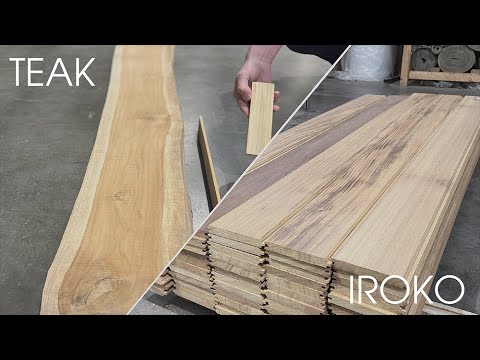
Iroko isn’t teak, but both woods offer similar average density, warm color, low movement, and good exterior service. Iroko is often harder and cheaper, while true teak has a more oily feel and a longer premium history in marine work.
Botanical Differences
True teak is Tectona grandis in the Lamiaceae family and originates in South and Southeast Asia, with plantations in other tropical areas. Iroko comes from African Milicia species in the Moraceae family; read the full teak wood guide for its separate properties.
Property Comparison Table
| Property | Iroko | True teak |
|---|---|---|
| Botanical source | Milicia excelsa or Milicia regia | Tectona grandis |
| Family | Moraceae | Lamiaceae |
| Average dried density | About 660 kg/m³ | About 655 kg/m³ |
| Janka hardness | About 1,260 lbf | About 1,070 lbf |
| Radial shrinkage | About 2.8% | About 2.6% |
| Tangential shrinkage | About 3.8% | About 5.3% |
| Volumetric shrinkage | About 7.1% | About 7.2% |
| Typical planning price | $12–$25 per board foot | $30–$60+ per board foot |
| Common machining issue | Interlocked grain and mineral deposits | Tool dulling and oily bonding surfaces |
Species averages help compare material, but they can’t account for grade, grain direction, moisture, defects, drying quality, or installation. A straight-grained teak board may machine more cleanly than reversing iroko, while a sound iroko board may outperform low-grade teak in a well-drained assembly.
Appearance and Workability
Both woods shift from honey or golden shades into deeper brown. Teak often feels waxy or slightly oily under the hand; iroko tends to feel drier and coarser, with stronger color variation and more frequent interlocked figure.
Machining trade-offs differ too. Iroko may tear out or hide hard deposits, while teak’s oils and silica can affect bonding, finishing, and edge life. Freshly machined, dust-free glue surfaces improve results with either material.
Outdoor and Marine Performance
Both species suit exterior furniture and joinery when builders manage water and movement. Teak retains a premium reputation for yacht decking, while an iroko boat deck can offer strong service at lower material cost when board selection, fastening, caulking, and drainage match the vessel specification.
Iroko is a substitute in selected applications, not an identical replacement. A marine designer may reject it where a tested scantling, class rule, bonding process, or appearance schedule names teak; casual substitution in safety-related components creates avoidable risk.
Price Comparison
Iroko usually costs less than high-grade genuine teak. A useful US rough-lumber planning range is about $12–$25 per board foot for iroko versus $30–$60 or more for teak, with wide, clear, certified, or surfaced material exceeding those figures.
Compare equal specifications: thickness, clear-face grade, width, moisture, surfacing, certification, origin, freight, and tax. A teak quote for narrow plantation boards and an iroko quote for wide FSC stock don’t form a meaningful price comparison.
Common Uses of Iroko Wood
Common iroko uses include furniture, cabinetry, floors, stairs, kitchen worktops, decking, exterior doors, boat components, turning, and carving. Success depends less on the product label than on moisture control, heartwood selection, grain orientation, and joint design.
Furniture and Cabinetry
Iroko furniture ranges from dining tables and benches to cabinets, shelves, chairs, and bed frames. Buy visible components from one batch, lay boards side by side in daylight, and wipe them with mineral spirits to preview the darker finished color before cutting.
Wide table panels need sliding fasteners or buttons that permit cross-grain movement. Breadboard ends must use movement-friendly joinery; gluing them rigidly across the full width can split the center panel during seasonal humidity changes.
Flooring and Stairs
At 1,260 lbf on the Janka scale, iroko can handle domestic flooring, stair treads, and handrails. Compare that value with other species through the wood hardness scale, while keeping in mind that finish, grit, and maintenance affect visible wear.
Flooring failures usually trace back to moisture imbalance or poor installation. Test the subfloor, acclimate the boards, leave perimeter expansion space, and avoid fitting imported stock straight from a wrapped delivery bundle.
Worktops and Countertops
Iroko worktops offer warm color and useful moisture resistance, but sink openings remain weak points. Seal every face, underside, edge, faucet hole, and cutout; the end grain around a sink darkens fast when water slips beneath an unsealed rim.
Movement-friendly fittings prevent splits. Use slotted brackets or elongated screw holes across the width, keep dishwashers and ovens from directing hot vapor at bare wood, and select a finish approved by its manufacturer for the intended kitchen use.
Decking and Exterior Joinery
Iroko decking, gates, doors, windows, cladding, and garden furniture benefit from durable heartwood. Pre-drill near board ends, use stainless-steel fasteners, leave drainage gaps, and isolate timber from masonry or soil that stays damp.
Outdoor furniture design should avoid flat ledges, tight water traps, and exposed end grain facing upward. More species and construction comparisons appear in the guide to the best outdoor furniture wood.
Boatbuilding and Marine Work
Marine uses include rails, decking components, interior joinery, trim, and selected structural parts where approved. Wet-service adhesives, joint geometry, caulking, coatings, and fasteners must suit salt exposure and repeated wet-dry cycling.
Safety-critical work needs engineering or class-rule approval rather than a broad claim that iroko is “marine grade.” Inspect mineral pockets, grain runout, hidden checks, and sapwood before assigning a board to a loaded component.
Turning and Small Crafts
Iroko turns well into bowls, handles, signs, and decorative objects when tools stay sharp. Interlocked grain can pull fibers from a bowl rim, while concealed mineral matter may produce a hard click and a bright scratch across a freshly cut surface.
Inspect every blank before mounting it, confirm sound holding points, and wear face and respiratory protection. Fine iroko dust hangs in the air after sanding and can leave the throat dry or skin itchy in susceptible users.
Working, Finishing, and Safety
Sharp carbide cutters, light passes, pilot holes, effective dust extraction, and movement-friendly joinery produce the most reliable results with iroko. Finish choice should match exposure: interior protection, easy exterior renewal, or acceptance of natural silver-gray weathering.
Sawing and Planing
Read the grain from both board edges before planing because surface figure may hide reversals. Use shallow cuts, a high cutting angle, and a slower feed; if tear-out continues, stop removing thickness and switch to a scraper or controlled sanding.
Router exits need support to prevent corner breakout. Climb-cut only where the machine, cutter, and operator setup make it safe, or leave sacrificial material at the end and trim it after profiling.
Drilling and Fastening
Pre-drill screw holes near ends, in narrow rails, and for large exterior fasteners. Match the pilot to the screw’s root diameter, add clearance through the top member, and countersink cleanly rather than driving the head hard enough to crush surface fibers.
Stainless-steel fasteners are a sound choice for exposed, wet, or coastal work. Wide tops need figure-eight fasteners, buttons, slotted holes, or elongated brackets so seasonal movement doesn’t turn each screw into a fixed stress point.
Gluing and Wood Movement
Fresh glue surfaces should be clean, dry, flat, and free of burnishing or sanding dust. Choose the adhesive by service condition and test unfamiliar systems on offcuts; no single glue fits every interior, structural, exterior, or marine assembly.
Moisture control starts before glue-up. Guidance in the USDA Wood Handbook explains how wood responds to relative humidity; use moisture readings and expected service conditions rather than a fixed acclimation period.
Sanding, Bending, and Carving
Progress through grits without large jumps, then vacuum between stages. Excessively fine sanding can polish the surface and reduce penetration, while open pores may need filler if the goal is a flat, reflective furniture finish.
Bending and carving results depend on straight grain, stock thickness, defects, moisture, and the chosen process. Test cuts on offcuts because interlocked fibers can break away in unexpected directions around carved corners or tight curves.
Interior and Exterior Finishes
Interior options include hardwax oil, drying-oil systems, varnish, lacquer, polyurethane, and wax over a compatible sealed surface. Test an offcut because finish can deepen pale yellow wood into rich amber-brown and reveal color differences that looked minor when dry.
Exterior oils are often easier to renew than thick clear films. Film coatings can look polished at first, but water entering through a joint or damaged edge may create cloudy patches and peeling that demand full preparation before recoating.
Outdoor Maintenance
Inspect by condition, not by a universal calendar. Sun, rainfall, coastal salt, horizontal orientation, finish type, and shelter determine whether maintenance is needed after months or after a much longer interval.
Recoat warning signs include fading, quick water absorption, raised grain, fine checking, or loose film. Wash away dirt and mildew, let the timber dry, remove failed coating, and follow the finish maker’s moisture and recoat limits.
Dust, Irritation, and PPE
Iroko dust can irritate eyes, skin, and airways and may trigger dermatitis or asthma-like symptoms in susceptible people. Sanding, routing, turning, planing, and compressed-air cleanup create the highest airborne exposure.
- Connect source extraction to each machine.
- Wear a properly selected particulate respirator.
- Use sealed or close-fitting eye protection during dusty work.
- Cover exposed skin if previous contact caused irritation.
- Vacuum dust instead of dry sweeping or blowing it.
- Wash exposed skin and change dusty clothing after machining.
- Seek medical care for persistent breathing, eye, or skin symptoms.
A finished object doesn’t create the same exposure as airborne machining dust. The main workshop risk comes from cutting and cleanup, though users with known sensitivities should still assess direct-contact applications carefully.
Sustainability and Responsible Sourcing
Responsible iroko sourcing requires species identification, legal-harvest records, country of origin, and traceable chain-of-custody documents. Commercial availability or absence from a restricted-trade list doesn’t prove that a board came from responsibly managed forest.
Conservation and Trade Status
Trade status, conservation risk, legal harvest, and forest certification are separate checks. Iroko is commonly reported outside the CITES appendices, but buyers handling international shipments should verify the species against the official CITES checklist at the time of trade.
No CITES listing isn’t a sustainability endorsement. National controls, export rules, forest loss, concession practices, and species-level conservation assessments can still affect whether a shipment is acceptable.
Certification and Chain of Custody
FSC certification or another credible chain-of-custody system can add traceability, provided the claim belongs to the material and the seller’s certificate remains valid. Match the invoice claim and certificate code with the FSC certificate database.
Chain of custody tracks certified material through processing and sale. A supplier displaying an FSC logo doesn’t mean every board in its warehouse carries an FSC claim, so the invoice must identify the certified product.
Supplier Documentation
Ask the supplier for the botanical species, harvest country, processing country, certification claim, certificate number, grade, moisture content, sapwood allowance, and actual dimensions. Keep those details on the invoice for commercial, architectural, or regulated work.
Photographs help with color and defects but can’t verify moisture or identity. Request end views and both faces for expensive boards, then inspect twist, cup, checks, grain reversal, mineral deposits, and drying damage on arrival.
African Teak Naming Risk
African teak is ambiguous. The name may mean iroko, but merchants have also applied it to unrelated African hardwoods, creating risks for performance specifications, customs records, conservation checks, and matching later orders.
Buy by species, not nickname. Require Milicia excelsa or Milicia regia on commercial paperwork when iroko identity affects design, compliance, or sourcing policy.
Iroko Versus Afrormosia
Afrormosia is different from iroko. Its botanical name is Pericopsis elata, and its conservation and international trade context differs, so a listing that says only “African teak” needs clarification before payment or shipment.
Species substitution can create more than a color mismatch. Density, grain, machining, legal documents, certification scope, and approved architectural specifications may all change with the actual species supplied.
Iroko Wood Price and Buying Guide
Iroko wood price commonly falls around $12–$25 per board foot for ordinary rough lumber in US retail planning, while surfaced, wide, long, matched, or specialty material may reach $20–$40 or more per board-foot equivalent. These are budgeting figures, not universal seller quotations.
Price Factors
Price changes with country, exchange rates, import costs, species, origin, certification, thickness, width, length, grade, sapwood allowance, moisture, drying method, machining, tax, and freight. Slabs, decking, worktops, boards, and turning blanks use different pricing structures.
Wide clear stock carries a premium because fewer boards meet the specification. Long lengths, matched sets, quartered figure, stable kiln drying, and low sapwood allowance also reduce yield at the mill and raise retail cost.
Planning Price Ranges
| Iroko format | Illustrative US planning range | Pricing caution |
|---|---|---|
| Ordinary rough lumber | $12–$25 per board foot | Grade, thickness, width, and moisture must match |
| Surfaced or dimensioned stock | $20–$40+ per board-foot equivalent | Milling and reduced yield are built into the price |
| Wide slabs or matched boards | Often above standard lumber range | Compare usable dimensions after defect removal |
| Turning and craft blanks | High per-unit-volume cost | Selection, cutting, drying, and fulfillment add value |
Delivered cost is the useful number. A cheaper remote board may cost more after oversized freight, residential delivery, tax, surfacing, and losses from checks or twist.
Board-Foot Formula
Board feet equal thickness in inches × width in inches × length in feet ÷ 12. Use rough dimensions for a rough-lumber quote, then confirm that the finished dimensions remain large enough after flattening and planing.
Board feet = thickness in inches × width in inches × length in feet ÷ 12.
Standard North American lumber-volume formula
Nominal 4/4 stock starts near one inch before surfacing and may finish around 3/4–7/8 inch, depending on rough thickness, cup, saw marks, and milling. Don’t plan a one-inch finished component from ordinary 4/4 boards without checking actual stock.
Cost Calculation Example
Example board: a rough piece measuring 1 inch thick, 8 inches wide, and 10 feet long contains 1 × 8 × 10 ÷ 12 = 6.67 board feet. At $18 per board foot, the lumber price is about $120 before waste, freight, tax, and milling.
With 15% waste, multiply 6.67 by 1.15 to get about 7.67 board feet. At $18 per board foot, the planned material cost becomes roughly $138.
Waste Allowance
Allow 10–20% extra for ordinary projects. Raise that allowance for exact color matching, continuous grain, narrow defect-free parts, figured stock, severe grain reversal, or boards that need heavy flattening.
Cut-list planning can reduce waste more effectively than buying one extra random board. Map each component onto photographed boards, reserve long straight pieces first, and place short parts around checks, sapwood, and mineral inclusions.
Buying Checklist
- Confirm Milicia excelsa or Milicia regia.
- Ask for harvest origin and chain-of-custody evidence.
- Check whether dimensions are nominal, rough, or finished.
- Confirm grade and permitted sapwood.
- Request moisture-content readings for thick and wide stock.
- Inspect both faces and ends for checks, cup, twist, grain reversal, and mineral deposits.
- Buy one batch when visible color matching matters.
- Add 10–20% waste, or more for strict matching.
- Compare delivered cost after tax, freight, and machining.
- Record the batch and supplier details for future matching.
Reject vague listings that provide only “African teak,” nominal dimensions, and a polished face photograph. Reliable sellers can state species, condition, dimensions, moisture range, grade, and return terms before dispatch.
Iroko Turning Project
A bowl blank offers a manageable way to test iroko’s color, interlocked grain, sanding behavior, and finish response without buying full boards. Craft blanks cost more per unit volume because cutting, selection, drying, storage, and individual fulfillment are built into the sale.
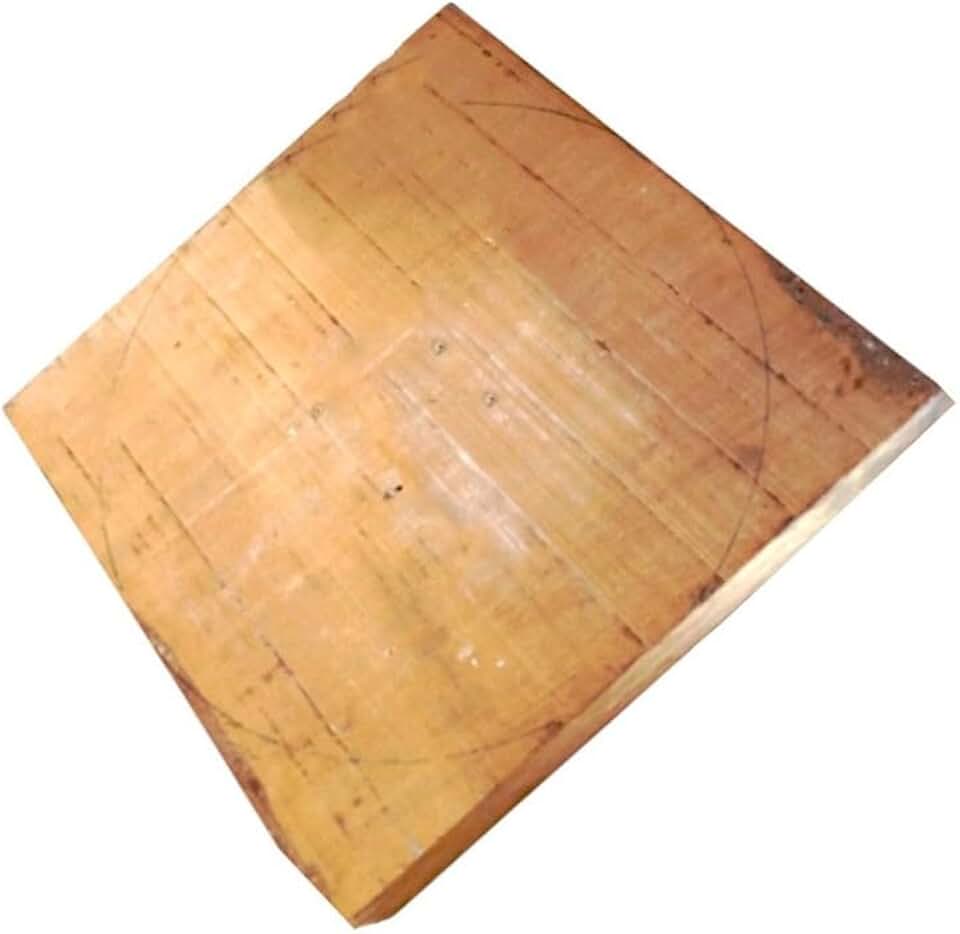
Iroko Bowl Turning Blank
- Large iroko turning blank
- Sized for bowl making
- Warm grain and natural color
- Suitable for lathe projects
- Solid hardwood for custom creations
 Buy on Amazon
FAQs
Is Iroko Wood The Same As Teak?
No, iroko wood is not the same as teak, although it is often used as a more affordable teak alternative. Iroko is an African hardwood with a similar golden-brown appearance, natural oils, and good outdoor durability. Teak generally has a finer grain, higher oil content, and a longer-established reputation for premium outdoor furniture.
Is Iroko Wood Waterproof?
No, iroko wood is not completely waterproof, but it is naturally highly water-resistant. Its natural oils and dense grain help it withstand rain, moisture, and changing weather better than many woods. For the best outdoor performance, use proper drainage, avoid standing water, and apply a suitable exterior oil or finish if desired.
What Are The Disadvantages Of Iroko Wood?
Iroko can be difficult to work with because its density and interlocking grain may blunt cutting tools. The wood can also darken or develop uneven color as it ages, especially outdoors. Some people may experience skin or respiratory irritation from iroko dust, so good ventilation and protective equipment are important during cutting or sanding.
How Long Does Iroko Last Outdoors?
Iroko can last 20 to 50 years outdoors when it is properly installed and maintained. Its natural resistance to rot, insects, and moisture makes it suitable for decking, cladding, gates, and garden furniture. Keeping it off damp ground, allowing airflow, and cleaning it regularly can help extend its service life.
Is Iroko Wood Expensive?
Iroko is moderately expensive, but it usually costs less than genuine teak. Prices vary with board grade, thickness, country of origin, and whether the timber is supplied finished or unfinished. Although it costs more than common softwoods, its durability and low maintenance needs can make it good long-term value for outdoor projects.
Affiliate Disclosure: Some links in this post are affiliate links. If you make a purchase through these links, we may earn a small commission at no extra cost to you. We only recommend products we genuinely believe in.