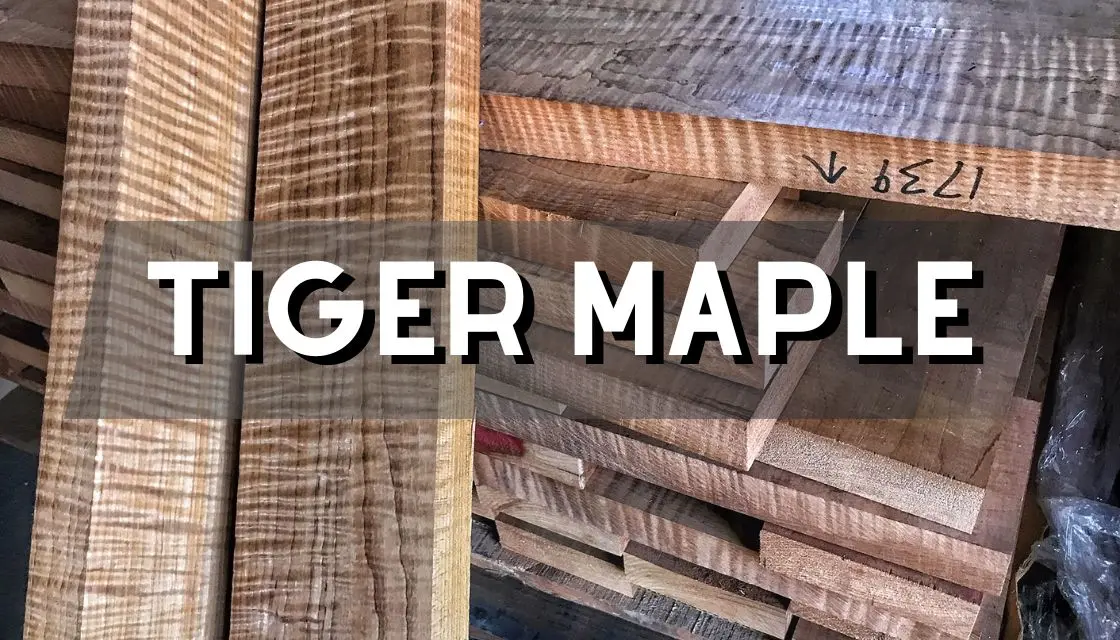


Tigerwood is a dense tropical hardwood known for its golden-red heartwood, dark tiger-like streaks, and strong resistance to wear and decay. The name usually refers to Gonçalo Alves from the Astronium genus, though sellers also apply it to unrelated striped woods.
Table of Contents
What Is Tigerwood?
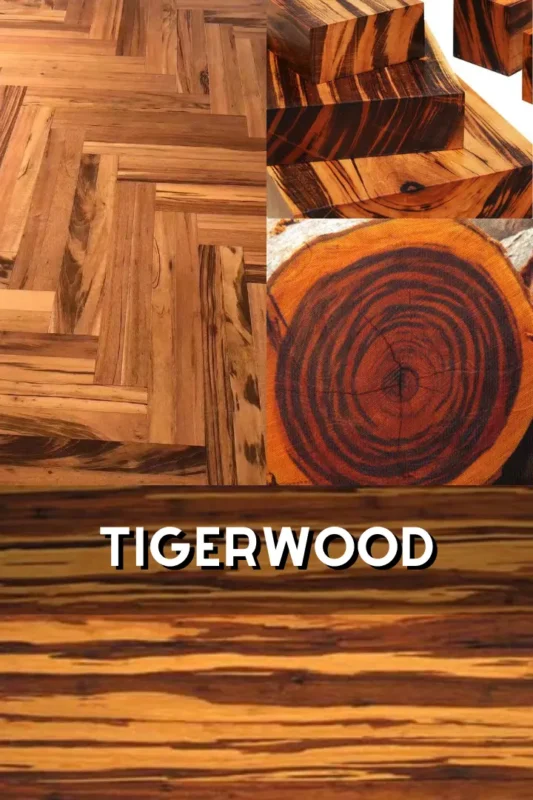
Tigerwood is real wood, but it isn’t one exact botanical species. In North American lumber markets, the name most often describes Gonçalo Alves, a dense Central and South American hardwood with irregular dark stripes across an orange, golden-brown, or reddish background.
Tigerwood Definition
The practical answer to what is tigerwood is a naturally striped hardwood used for decking, flooring, furniture, veneer, and decorative joinery. Its tiger stripe wood grain comes from contrasting pigment within the heartwood rather than paint, stain, or printed pattern.
Trade name and botanical identity. “Tigerwood” works like a commercial label, so the invoice should state a botanical name. For decking and flooring, buyers commonly receive Astronium graveolens, Astronium fraxinifolium, or closely related stock in the Anacardiaceae family.
Gonçalo Alves and Astronium species. Gonçalo Alves is the established lumber name for the wood most US suppliers sell as tigerwood. Its natural range extends through parts of Mexico, Central America, Brazil, and neighboring South American countries, but origin and species can change between shipments.
Brazilian Koa, African Tigerwood, and Zebrawood
Brazilian koa is a marketing name for Gonçalo Alves rather than true Hawaiian koa, which belongs to the genus Acacia. African tigerwood may mean Lovoa trichilioides, also called African walnut, so it shouldn’t be treated as an interchangeable exterior-decking species without technical documentation.
Tigerwood versus zebrawood. Both have dramatic stripes, but zebrawood usually means African Microberlinia brazzavillensis. Zebrawood commonly shows narrow dark bands across a pale tan field, while Gonçalo Alves has less regular black-brown marks over warmer red and orange tones.
Heartwood, sapwood, and grain. Heartwood ranges from golden orange to reddish brown. Sapwood looks pale cream, gray, or light brown and can form a sharp border. Grain may be straight, wavy, or interlocked; flatsawn boards often display broad flame-like marks, while quartersawn stock produces tighter linear striping. Our guide to wood grain patterns explains how sawing angle changes figure.
Color change and UV aging. Fresh cuts can look bright orange and deepen after exposure to air and light. Exterior boards gradually become silver-gray if left unfinished. Indoor flooring may darken around exposed areas while wood beneath rugs stays lighter, creating visible rectangles when furnishings move.
Tigerwood Wood Properties
Tigerwood wood is heavy, hard, and durable, with a commonly reported dried density near 57 pounds per cubic foot and Janka hardness near 2,170 pounds-force. These reference values describe typical Gonçalo Alves specimens, not every board sold under the trade name.
Density, Hardness, and Strength
Density: 57 lb/ft³. At that average, one board foot weighs about 4.75 pounds. An actual ¾-by-5½-inch board contains about 0.344 board feet per linear foot, making an eight-foot board roughly 13 pounds before changes in moisture, dimensions, or species are counted.
Janka hardness: 2,170 lbf. Tigerwood resists indentation better than northern red oak at roughly 1,290 lbf and hard maple near 1,450 lbf. It remains softer than cumaru and ipe, and high Janka hardness doesn’t stop abrasive grit from scratching a floor finish.
Strength and crushing values. Published Gonçalo Alves references report modulus of rupture near 18,460 psi, modulus of elasticity near 2.34 million psi, and crushing strength near 10,770 psi. The density, hardness, shrinkage, and mechanical figures can be checked against The Wood Database species profile.
| Property | Typical reference value | Practical meaning |
|---|---|---|
| Dried density | 57 lb/ft³ | Heavy handling and substantial deck dead load |
| Janka hardness | 2,170 lbf | Strong dent resistance, but not scratch-proof |
| Modulus of rupture | 18,460 psi | High bending strength for clear specimens |
| Crushing strength | 10,770 psi | Strong resistance to compression parallel to grain |
| Radial shrinkage | 4.4% | Movement across quartersawn board thickness or width |
| Tangential shrinkage | 7.6% | Greater movement across flatsawn board width |
Movement, Durability, and Workability
Shrinkage and seasonal movement. Common reference values are 4.4% radial, 7.6% tangential, and 12.3% volumetric shrinkage, with a tangential-to-radial ratio near 1.7. A hard board still swells as it gains moisture and contracts as it dries, so fixed spacing rules can’t replace job-site measurements.
Decay and weather resistance. The heartwood is commonly rated durable to very durable against fungal decay. That natural resistance doesn’t prevent UV graying, small surface checks, dirt accumulation, or mold feeding on pollen and organic debris lying on the boards.
Machining and gluing. A sharp carbide blade makes a crisp cut, but a dull cutter produces a hot, bitter smell and dark burn marks along the edge. Interlocked grain can tear under a planer; light passes, a higher cutting angle, and scoring the exit edge reduce breakout. Predrill screws and test glue on freshly machined offcuts.
Wood dust safety. Fine tigerwood dust can irritate skin, eyes, and airways, and members of the Anacardiaceae family may trigger sensitization in susceptible people. Connect extraction at the tool, wear eye protection and a properly selected respirator, wash exposed skin, and stop work if a rash or breathing problem develops.
Tigerwood Decking Guide

Tigerwood decking suits exposed residential decks, porches, stairs, and walkways because it combines wear resistance and natural durability. Successful installations depend on board moisture, airflow, stainless fasteners, pilot holes, correct gaps, and a sound substructure.
Deck Design, Coverage, and Structure
Benefits and best applications. Tigerwood works well where owners want a striped natural wood surface rather than a uniform brown deck. It handles foot traffic and furniture better than soft pine, yet its dramatic board variation can look busy across small decks with elaborate borders.
Profiles and actual dimensions. Common products include nominal 1×4 and 1×6 boards, grooved edges for clips, solid edges for stairs and borders, and matching plugs. Never calculate coverage from the nominal name: a nominal 1×6 may measure about ¾ by 5½ inches, while another mill’s profile may differ.
Board coverage and waste. Divide deck area by the installed board module in feet. A 5½-inch board with a ⅛-inch gap covers a 5⅝-inch module, or about 0.469 feet. A 500-square-foot field needs roughly 1,066 linear feet, or about 1,173 linear feet after adding 10% waste.
- Use about 10% waste for a simple rectangular field with practical length planning.
- Allow 15% or more for diagonal boards, picture frames, stairs, curves, and selective color matching.
- Confirm whether the quote contains fixed lengths, random lengths, or short-board bundles.
- Order replacement stock with the main shipment because later batches may not match the original striping.
Deck weight and structural checks. A ¾-inch tigerwood surface weighs close to 3.6 pounds per square foot at 57 lb/ft³. Five hundred square feet can place about 1,780 pounds of decking on the frame before waste, fasteners, occupants, snow, or furniture. Renovations need a qualified check of joists, beams, posts, ledgers, footings, and connections.
Joists, drainage, and ventilation. Many installations use joists up to 16 inches on center for boards running perpendicular to them, with spacing near 12 inches for diagonal layouts. Product instructions and structural design govern. Keep soil, leaves, vegetation, and impermeable membranes from trapping damp air beneath the boards.

Deck Installation, Failures, and Maintenance
Moisture, spacing, and acclimation. Don’t rely on a fixed seven-day or fourteen-day waiting period. Measure representative boards with a meter using the required species correction, compare readings with local service conditions, and follow the supplier’s gap chart for kiln-dried or air-dried material. Stack boards level, shaded, and stickered if the manufacturer permits on-site acclimation.
Hidden versus face fastening. Hidden clips create a clean walking surface but require compatible grooves and may not suit stairs, borders, high-wind details, or every board thickness. Face screws give direct restraint. Use exterior-rated stainless steel, predrill to the specified diameter, countersink consistently, and seal fresh crosscuts when required.
A plugged system can hide face screws while retaining direct mechanical fastening. Check screw alloy, plug diameter, joist spacing, board thickness, and actual fastener count before ordering; stairs and picture-frame borders often consume more pieces than the stated area coverage.

DeckWise Tigerwood Master Plug Kit
- Tigerwood plugs create a coordinated deck finish
- Includes hardwood plugs and stainless screws
- Drill and drive bit included for convenience
- Glue included for secure plug installation
- Kit covers about 100 square feet
 Buy on Amazon
Common decking failures. Beginners often drive screws without full pilot holes, leaving split ends, snapped shanks, or mushroomed heads. Carbon steel can create black stains. Poor airflow encourages cupping, while overapplied oil stays sticky and catches shoe prints. Rugs, planters, and furniture also cause uneven weathering by blocking sun and slowing evaporation.
Practical notes from real-world use. Dense boards give a drill a firm, resistant feel; forcing the bit creates heat and polished hole walls. Clear chips often, replace dull bits, and drill board ends before the final cut piece goes into position. Sorting boards dry across the joists lets installers distribute bold stripes instead of creating accidental dark clusters.
Weathering and maintenance. Leave tigerwood unfinished for a silver-gray patina, or apply a compatible penetrating hardwood finish to retain warm color. Clean first, wait for the specified surface moisture and weather window, apply thinly, then wipe away excess before it forms glossy patches. Film coatings are harder to repair after peeling.

Penofin Tigerwood Penetrating Finish
- Designed for tigerwood and exotic hardwoods
- Penetrates wood for a rich natural finish
- One gallon size for medium projects
- Low VOC 250 formula
- Great for outdoor wood surfaces
Buy on Amazon
Expected deck service life. Properly sourced and detailed tigerwood decking may remain serviceable for 30 years or longer, but that isn’t a universal warranty. Board authenticity, drainage, framing condition, fastener corrosion, climate, and installation quality control structural life. Color-maintenance intervals are much shorter and vary with sunlight, rain, traffic, and finish chemistry.
Tigerwood Flooring Guide

Tigerwood flooring provides high dent resistance and bold natural color, but it needs moisture testing, perimeter expansion space, and controlled indoor humidity. Solid flooring offers more sanding potential, while engineered construction often handles wider boards, concrete slabs, and modest environmental changes more predictably.
Solid and Engineered Tigerwood Flooring
Solid tigerwood flooring. Each plank is milled from one piece of hardwood. A substantial wear thickness can permit future sanding, but solid boards react more strongly to seasonal humidity and require careful subfloor preparation. Dense tongues can split if pneumatic pressure, fastener angle, or pilot-hole practice is wrong.
Engineered tigerwood flooring. A tigerwood wear layer sits over plywood or a composite core. This construction can offer wider formats and approved glue-down, floating, concrete, or radiant-heat options. Check wear-layer thickness because a thin veneer may tolerate only light screening rather than full sanding.
Moisture testing and acclimation. Record ambient temperature and relative humidity, test the flooring, test wood subfloors, and use the adhesive or flooring maker’s accepted concrete test. Acclimation ends when measured conditions meet product tolerances—not when a calendar reaches an arbitrary number of days.
Installation, Expansion, and Floor Care
Subfloors and installation methods. Solid flooring is commonly nailed or stapled to suitable wood subfloors. Compatible engineered products may be nailed, floated, or glued. Dense exotic wood and factory finishes can limit adhesive choices, so use the named trowel, moisture barrier, spread rate, and open-time instructions for the selected system.
Expansion and indoor humidity. Maintain the manufacturer’s perimeter gap and avoid pinning floating floors beneath cabinets or fixed trim. Many wood floors perform well around 35%–55% relative humidity, though the product warranty controls. Dry winter air opens gaps; excess moisture can cause edge lift, cupping, or finish stress.
Scratches, cleaning, and care. The 2,170-lbf Janka rating measures indentation resistance, not finish toughness. Sand grains under a shoe feel faintly gritty and can score the coating in one pass. Use clean entry mats, felt pads, soft vacuum heads, quick spill cleanup, and the floor maker’s cleaner. Avoid steam mops without written approval.
Color variation and refinishing. Open several cartons and blend boards across the room before fastening. Move rugs periodically during early light exposure to reduce hard color boundaries. Solid flooring can often be refinished if enough wood remains above the tongue; engineered flooring depends on its wear layer and prior sanding history.
Tigerwood Cost and Sourcing
In 2026, tigerwood commonly sits in the premium hardwood price tier. Budgeting should include delivered material, waste, fasteners or adhesive, surface preparation, tools, framing or subfloor repairs, labor, and future cleaning rather than comparing board prices alone.
2026 Tigerwood Decking and Flooring Costs
2026 tigerwood decking costs. Research-stage material budgets often fall near $8–$20 per square foot. Installed work may reach $20–$40 or more per square foot after freight, framing, stairs, railings, border cuts, predrilling, access limits, and regional labor. Request quotes using identical profile, grade, length mix, quantity, and destination.
2026 tigerwood flooring costs. Material commonly falls around $8–$15 per square foot, while installed projects may reach $12–$20 or more. Wide planks, long lengths, thick engineered wear layers, factory coatings, slab moisture control, demolition, adhesive, stairs, and trim can push the total above that range.
Freight, waste, and accessories. Tropical hardwood freight can erase a low unit price from a distant seller. Ask for a delivered quote that identifies residential lift-gate fees, limited-access charges, package lengths, clips, screws, plugs, bits, end sealer, cleaners, finish, adhesive, vapor control, and taxes.
Complete project budget. Use this formula: material + waste + freight + fastening or adhesive + finish + tools + framing or subfloor work + labor + maintenance. A simple 500-square-foot deck at $12 per square foot starts with $6,000 of field material, then needs waste and every supporting cost added separately.
Grades, Traceability, and Legal Sourcing
Lumber grades and moisture condition. Ask whether decking is premium, standard, or merchantable grade and request the written defect allowance. Confirm actual dimensions, milling tolerances, sapwood limits, pinholes, checks, bow, length mix, and whether the stock is kiln-dried, air-dried, or prepared for exterior exposure.
Supplier traceability questions. Request the botanical species, country of harvest, chain-of-custody records, harvest legality documents, and certificate number where certification is claimed. Trade-name-only paperwork can’t establish conservation status or prove that published Gonçalo Alves properties apply to the shipment.
- What exact botanical species appears on the import and sales documents?
- Which country and forest-management unit supplied the timber?
- Can the certificate and chain-of-custody claim be verified independently?
- What drying method and target moisture range apply to this product?
- Which written grade rules define allowable sapwood, checks, holes, and milling defects?
- Who handles claims for boards found outside those specifications?
FSC, CITES, IUCN, and Lacey Act. FSC documentation can support chain-of-custody verification, while CITES and IUCN checks must use the exact species rather than “tigerwood.” US buyers should also request records supporting lawful harvest and import under the Lacey Act. The CITES Species+ database provides current species-level trade listings.
Tigerwood Versus Alternative Woods
Tigerwood is harder than oak, garapa, teak, cedar, and pine, but softer than cumaru and ipe. Its main visual distinction is irregular dark striping; the better project choice depends on delivered cost, sourcing records, weight, machining effort, local availability, and the desired color.
Tigerwood Versus Tropical Hardwoods
Tigerwood versus ipe. Tigerwood measures about 2,170 lbf, while ipe wood is commonly reported near 3,510 lbf. Ipe tends to look darker and more uniform; tigerwood offers stronger orange-red contrast and is somewhat easier to machine, though both need sharp cutters and predrilling.
Tigerwood versus cumaru. Cumaru is commonly around 3,330 lbf and often feels heavier during handling. It typically shows brown or reddish tones with less pronounced black striping. Both require moisture-aware installation, ventilation, corrosion-resistant hardware, and careful pilot holes.
Tigerwood versus garapa. Garapa is lighter, usually honey-yellow, and measures near 1,650 lbf. It can create a calmer deck surface and may cost less. Tigerwood resists dents more strongly but has greater visual variation, making advance board sorting more valuable.
Tigerwood versus teak. True teak wood commonly measures about 1,000–1,150 lbf and is prized for stability and a naturally oily feel. Tigerwood is harder and more dramatically striped. “Brazilian teak” usually means cumaru, so botanical names prevent misleading comparisons.
Tigerwood Versus Oak, Cedar, and Pine
Tigerwood versus oak. Northern red oak measures near 1,290 lbf and white oak near 1,360 lbf, making tigerwood far more resistant to indentation. Oak is easier to source, machine, color-match, and refinish. Domestic supply can also reduce freight and make regional sourcing records easier to review.
Tigerwood versus cedar and pine. Cedar and pressure-treated pine cost less initially and weigh far less. Tigerwood gives the walking surface greater wear resistance and a premium striped appearance, while treated pine often remains the practical framing material beneath it. Softwood framing still needs correct flashing, drainage, connectors, and load design.
| Wood | Approximate Janka hardness | Typical visual character | Primary trade-off |
|---|---|---|---|
| Tigerwood | 2,170 lbf | Orange-red with dark irregular stripes | Heavy, variable, and costly |
| Ipe | 3,510 lbf | Dark brown and relatively uniform | Very hard to machine |
| Cumaru | 3,330 lbf | Brown to reddish brown | Heavy with strong movement considerations |
| Garapa | 1,650 lbf | Honey-yellow to light brown | Less dent resistance |
| Red oak | 1,290 lbf | Open grain with warm tan-red color | Limited exterior decay resistance |
| Pressure-treated pine | Varies | Pale green or brown treatment tone | Softer surface and treatment-related movement |
Tigerwood Pros, Cons, and Uses
Tigerwood makes sense when a project needs hardness, decay resistance, and expressive grain, and the budget allows for specialist installation. It becomes a weaker choice where low weight, uniform color, easy machining, low freight, or simple replacement matching matters more.
Tigerwood Advantages and Disadvantages
Tigerwood advantages. The wood offers a distinctive striped pattern, high dent resistance, durable heartwood, and suitability for interior and exterior work. Owners can preserve its warm color with a penetrating finish or allow outdoor surfaces to weather gray without treating the color change as rot.
Tigerwood disadvantages. Boards are expensive, heavy, slow to predrill, and difficult to match years later. Interlocked grain can tear, sunlight changes the color, and tropical supply chains demand stronger verification. Large black stripes can also dominate compact rooms or compete with figured cabinets and stone surfaces.
Indoor, Outdoor, and Decorative Uses
Indoor applications. Common choices include flooring, stair parts, cabinets, wall panels, turnings, instrument components, and decorative boxes. Pairing tigerwood with quiet, plain-grained materials gives its stripes visual space; combining several highly figured woods can make a room feel unsettled.
Outdoor applications. Decks, porches, stairs, walkways, privacy screens, siding profiles, and selected furniture use its durable heartwood. Product approval still matters because a flooring board, thin veneer, or interior adhesive isn’t suitable outdoors simply because the face species resists decay. Compare other options in our guide to the best outdoor furniture wood.
Furniture and decorative woodwork. Tigerwood makes striking drawer fronts, table tops, handles, veneer panels, and inlays. Cut adjoining parts from the same board for continuity. Before applying finish, wipe a test offcut and view it under the room’s lighting because clear oil can make black streaks appear much heavier.
When tigerwood makes sense. Choose it when the striped grain is a central design feature, the structure can support its weight, installers can predrill dense wood, and traceable stock is available. Choose oak, garapa, cedar, pine, or another hardwood if budget, local supply, light weight, or restrained color takes priority.
Tigerwood FAQs
These concise answers cover the most common questions about tigerwood wood, decking, flooring, sealing, trade names, and responsible sourcing.
Is Tigerwood Harder Than Oak?
Yes. Tigerwood is commonly rated near 2,170 lbf on the Janka scale, compared with about 1,290 lbf for northern red oak and 1,360 lbf for white oak. It resists dents more strongly, but surface coatings can still scratch from grit, furniture, pets, and dragging objects.
Is tigerwood good for decking? Yes. Its density, hardness, and naturally durable heartwood suit exterior decking. Long service depends on drainage, under-deck ventilation, compatible spacing, stainless fasteners, predrilling, end treatment where required, and a structurally sound frame.
Does tigerwood need sealing? Exterior tigerwood doesn’t always need finish solely for decay resistance. A compatible penetrating finish helps retain its brown and reddish color and can moderate surface weathering. Unfinished boards usually turn silver-gray; that color shift doesn’t automatically mean the wood is rotting.
Is Brazilian Koa Tigerwood?
Usually, yes. Brazilian koa is a commercial name commonly used for tigerwood or Gonçalo Alves. It isn’t true Hawaiian koa, which belongs to the Acacia genus. Ask for the botanical species because a marketing label alone doesn’t confirm technical properties or origin.
Is tigerwood sustainable? It can come from a responsible, legal source, but the trade name alone proves nothing. Verify the exact species, harvest country, chain-of-custody claim, supplier records, and Lacey Act documentation. Check current CITES and IUCN records using the botanical name rather than relying on a broad “tropical hardwood” claim.
FAQs
Is Tigerwood Harder Than Oak?
Tigerwood is generally harder than most oak species, making it highly resistant to dents and everyday wear. Its Janka hardness rating commonly exceeds red and white oak, although exact values vary by board. This density can also make tigerwood more difficult to cut, drill, and fasten without proper tools.
Is Tigerwood Good for Outdoor Decking?
Tigerwood is an excellent choice for outdoor decking because it is naturally dense, durable, and resistant to decay. Its natural oils help it withstand moisture and insect damage when installed and maintained correctly. Use stainless steel fasteners and provide proper spacing so the boards can drain and move with changing weather.
Does Tigerwood Need to Be Sealed?
Tigerwood does not always need sealing for durability, but sealing helps preserve its rich color and protect the surface. For outdoor use, apply a UV-resistant deck oil or sealer to slow fading and reduce moisture movement. Reapply the finish as recommended, especially on sunny or high-traffic areas.
Is Tigerwood the Same as Brazilian Koa?
Tigerwood and Brazilian koa are commonly used names for the same wood species, often sold as Goncalo Alves. The wood is known for its dramatic dark striping and warm golden-brown tones. Names can vary by supplier, so check the botanical name to confirm exactly what you are buying.
How Can I Tell Whether Tigerwood Is Sustainably Sourced?
You can identify sustainably sourced tigerwood by looking for credible certification, such as FSC certification, and clear country-of-origin information. Ask the supplier for documentation showing legal harvesting and responsible forest management. Reputable sellers should also be able to provide the botanical name, chain-of-custody details, and sourcing policies.
Affiliate Disclosure: Some links in this post are affiliate links. If you make a purchase through these links, we may earn a small commission at no extra cost to you. We only recommend products we genuinely believe in.