

Box elder wood comes from Acer negundo, a North American maple that produces lightweight, pale, relatively soft hardwood. It cuts and turns easily, but it dents readily, decays outdoors, and works best for bowls, carvings, decorative furniture, indoor accents, and stabilized turning blanks.
Also called boxelder wood, it may contain striking red streaks sold as flame box elder. This guide covers identification, properties, project choices, workshop methods, drying, firewood, safety, and buying checks.
Table of Contents
What Is Box Elder Wood?
Box elder is maple, not a true elder. Its botanical hardwood classification can mislead buyers because the seasoned timber feels light, takes a thumbnail dent more readily than hard maple, and lacks the wear resistance expected from flooring-grade maple.
Acer Negundo and Common Names
The scientific name is Acer negundo, placing it in the maple genus and Sapindaceae family. Boxelder, box elder maple, ash-leaved maple, Manitoba maple, bois sureau, and the mistaken name “box alder” can all refer to this species.
“Ash-leaved maple” describes its unusual compound foliage. Most maple species have simple, palm-shaped leaves, so compare it with our guides to maple wood and other maple tree types.
Hardwood Status and Janka Hardness
Is boxelder a hardwood? Yes, botanically: it comes from a flowering broadleaf tree. Its approximate 720 lbf Janka rating still makes it mechanically soft beside red maple at about 950 lbf, white oak at 1,360 lbf, and hard maple at 1,450 lbf.
Species ratings are averages rather than guarantees for one board. Growth rate, moisture, grain direction, decay, and test conditions affect results; the broader wood hardness scale explains what Janka numbers reveal in service.
Strength, Weight, and Shrinkage
Seasoned box elder averages about 30.2 lb/ft³ or 485 kg/m³. It offers moderate-to-low bending strength, limited stiffness, and enough movement across the grain to require dry stock, sensible panel construction, and room for seasonal expansion.
| Property | Approximate value | Practical meaning |
|---|---|---|
| Dried weight | 30.2 lb/ft³ | Light for a furniture hardwood |
| Janka hardness | 720 lbf | Easy to shape; easy to dent |
| Modulus of rupture | 9,550 psi | Unsuitable for demanding structural loads |
| Modulus of elasticity | 1.05 million psi | Less stiff than oak or hard maple |
| Crushing strength | 5,220 psi | Weak choice for highly loaded joints |
| Radial shrinkage | 3.9% | Moderate movement |
| Tangential shrinkage | 7.4% | Flat-sawn boards can cup |
| Volumetric shrinkage | 11.3% | Controlled drying matters |
These reference values align with the Box Elder species profile. Spalted, punky, cracked, or heavily figured stock may fall far below the listed strength values.
Color, Grain, and Texture
Ordinary boards range from cream to yellow-brown, sometimes with gray, pink, orange, red, or brown streaks. Grain is often straight and fine, yet branch wood, curl, injury zones, and fast growth can produce ripples, interlocked grain, included bark, and torn fibers.
Freshly planed wood has a soft, dry feel and a low sheen. Curl flashes from pale to dark as a board tilts under a lamp; review common wood grain patterns before paying a figure premium.
Decay Resistance and Odor
Box elder has poor decay resistance and can soften quickly where moisture persists. Seasoned material has no strong characteristic smell, though green logs, fungal pockets, stagnant cavities, or contaminated urban salvage may carry sour, earthy, or musty odors.
Comparison With Other Maples
Box elder sits near silver maple, rated around 700 lbf, rather than hard maple in working behavior. Red maple is harder and more commercially consistent, while box elder can provide lighter weight and unusual color at the cost of lower wear resistance and less predictable recovery.
| Wood | Janka hardness | Best-known use |
|---|---|---|
| Box elder | About 720 lbf | Turning and decorative work |
| Silver maple | About 700 lbf | Light indoor furniture |
| Red maple | About 950 lbf | Furniture and cabinetry |
| Hard maple | About 1,450 lbf | Floors, counters, and heavy-wear parts |
For a closer species comparison, see silver maple. Don’t substitute box elder for hard maple where dent resistance, screw holding, or joint strength controls the design.
Box Elder Tree Identification
Reliable box elder tree identification combines opposite branching, pinnately compound leaves, greenish young twigs, and paired samaras. Bark alone isn’t dependable because age, site conditions, injury, and trunk diameter change its appearance.
Tree Form and Habitat
Mature trees commonly reach 30 to 60 feet and form broad, irregular crowns. Multiple trunks, low forks, leaning stems, and weak branch attachments occur often along riverbanks, floodplains, drainage channels, roadsides, field margins, and disturbed urban lots.
Box Elder Leaf
A box elder leaf is opposite and pinnately compound, most often carrying three to seven irregularly toothed leaflets. Five leaflets are common, but one tree can show several counts and shapes across vigorous shoots, shaded branches, and mature crown growth.
Three-leaflet growth can resemble poison ivy. Check the stem: box elder leaves sit in opposite pairs, while poison ivy has alternate leaf placement and grows as a vine, trailing plant, or shrub.
Twigs, Buds, and Branching
Young twigs are often green or purplish with a pale waxy bloom. Buds and branches appear in opposite pairs, while the buds tend to look blunt, pale, or slightly hairy rather than sharply pointed.
Box Elder Bark Identification
Young bark looks smooth and gray. Older trunks develop gray-brown bark with narrow ridges and shallow furrows, but ash, maple, and other streamside trees can show similar surfaces, so confirm the leaf and twig arrangement.
Flowers and Paired Samaras
Box elder is usually dioecious, meaning separate trees bear male and female flowers. Female trees produce clustered pairs of winged samaras that may remain into winter; the USDA PLANTS profile documents its classification and distribution.
Similar Tree Differences
| Feature | Box elder | Ash | Poison ivy | Typical maple |
|---|---|---|---|---|
| Leaf arrangement | Opposite | Opposite | Alternate | Opposite |
| Leaf type | Compound | Compound | Three leaflets | Usually simple |
| Fruit | Paired samaras | Single samaras | Berry-like drupes | Paired samaras |
| Best clue | Compound maple foliage | More uniform leaflets | Alternate vine growth | Simple palmate leaf |
Why Box Elder Wood Turns Red

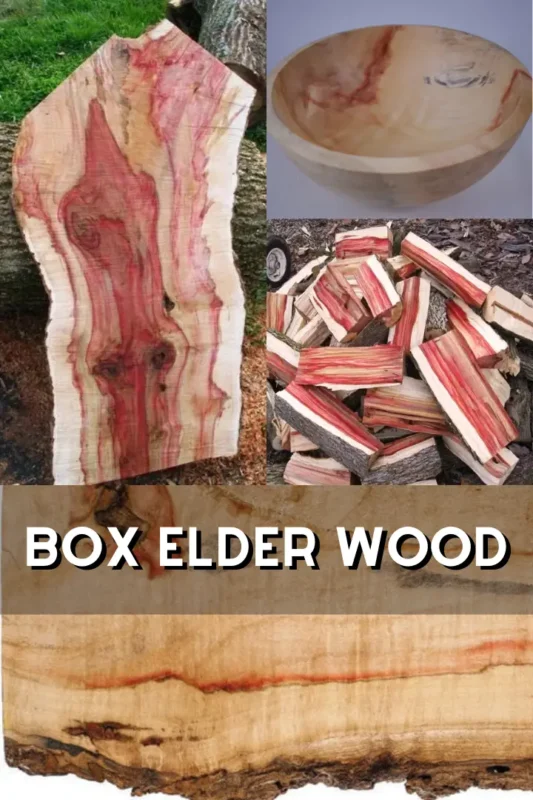
Red and pink streaks in box elder wood are associated with fungal activity and the tree’s response to colonization or injury. The color can occur in sound wood, but vivid pigment never proves that the surrounding fibers remain structurally solid.
Flame Box Elder Explained
Flame box elder is a trade description, not another species or official lumber grade. Sellers use the name for Acer negundo wood carrying strong red, pink, orange-red, or reddish-brown streaks linked in research and trade literature with Fusarium fungi.
Fungal names and proposed mechanisms vary between older and newer sources, so one organism shouldn’t be assigned to every board without testing. Research published through USDA Forest Products Laboratory discusses fungal pigments and decorative wood coloration.
Curl, Spalting, and Streaking
Color and figure differ. Red streaking is pigment; curl is wavy grain that changes brightness with viewing angle; spalting includes fungal staining or dark zone lines; stabilization fills dry, porous material with cured resin.
A board may show all four traits, yet the labels aren’t interchangeable. Compare decorative zone lines with the failure signs covered in our spalted wood guide.
Fungal Coloration and Soundness
Probe questionable areas with an awl before using them. Sound fibers resist and produce firm shavings; advanced decay feels corky, crumbles under a fingernail, gives off dusty fragments, or leaves a soft depression after light pressure.
Preserving the Red Color
Red pigment may fade under ultraviolet light. Keep finished pieces away from strong windows, apply a finish sold with UV inhibitors, and test an offcut because oils can warm the cream background and shift the perceived red toward orange or brown.
No clear coating can promise permanent color. Photograph the freshly sanded surface and the finished piece under the same light; that simple record reveals changes that memory tends to miss.
Box Elder Wood Uses
The best box elder wood uses are lightweight, dry, indoor projects where appearance and easy shaping matter more than hardness. Avoid untreated stock for wet locations, structural loads, high-impact edges, floors, or long-term exterior exposure.
Best Indoor Uses
- Decorative bowls and hollow forms
- Pens, ornaments, bottle stoppers, and small vessels
- Carvings, models, intarsia, and inlay
- Small boxes, drawer sides, and cabinet accents
- Veneer, wall panels, and protected live-edge displays
- Light shelving with short spans and firm support
Furniture and Cabinetry
Box elder furniture works best as low-wear indoor furniture, decorative panels, drawer parts, doors, and visual accents. A fingernail, belt buckle, pet claw, or dropped mug can mark a bare edge, so round vulnerable corners and use harder wood for legs, chair joints, and work surfaces.
Bowls, Turning, and Carving
A sound box elder bowl feels light in the hand and cuts with little resistance. Sharp tools leave silky ribbons, while a dull gouge produces pale fuzz and torn patches around curl, end grain, or soft fungal pockets.
Carvers benefit from its low hardness, but fine details can crush where grain changes direction. Stabilized material holds crisp beads and narrow pen-barrel edges better than untreated, partially spalted stock.
Conditional Project Uses
Box elder can serve in light-duty handles, protected shelves, occasional-use tables, and food-contact pieces made from verified sound stock. For cutting boards, plain defect-free wood is workable, but hard maple withstands knife marks and repeated washing far better.
Uses to Avoid
Don’t use untreated stock for flooring, fence posts, decking, boats, structural beams, damp cabinetry, high-impact tool handles, or exposed outdoor furniture. Avoid uncertain urban salvage for toys and food-contact projects because hidden contamination may remain after surfacing.
Box Elder as Firewood
Box elder as firewood is usable but produces less heat per cord than oak, hickory, locust, or hard maple. Estimates commonly fall near 17–18 million BTU per full cord, with actual output changing according to density and moisture.
A full cord measures 128 cubic feet of stacked volume, traditionally 4 by 4 by 8 feet. Box elder ignites easily and suits mild-weather fires, yet it burns quickly, forms shorter-lived coals, and needs more frequent loading.
Split a sample and measure the freshly exposed center; aim for 20% moisture or lower. Never burn painted, glued, pressure-treated, dyed, or resin-stabilized wood, a practice supported by the EPA Burn Wise guidance.
Workshop Performance and Finishing
Box elder machines easily when edges are sharp, yet low-density fibers can fuzz, compress, or tear rather than sever cleanly. Figured, spalted, and stabilized pieces each need a different cutting and finishing approach.
Sawing and Milling
Before milling urban logs, scan them with a metal detector and inspect old fence lines, crotches, scars, and swollen trunk sections. Nails and wire can destroy a blade, while bark packed with sand produces a bright shower of grit and dulls teeth quickly.
Seal log ends soon after cutting. Reject load-bearing stock containing deep checks, included bark, hollow sections, extensive insect galleries, or soft decay, no matter how attractive the color appears.
Planing, Routing, and Sanding
Use light cuts and test both feed directions on curl. A card scraper, drum sander, or finely set hand plane often leaves a cleaner surface than aggressive planing across irregular grain.
Move through sanding grits without large jumps because compressed fibers can hide scratches until finish lands. Vacuum fragile spalted surfaces instead of blasting them with compressed air, which can break weak fibers and spread fungal dust.
Turning and Carving Performance
Present a sharp gouge for a slicing cut rather than forcing a scraper into soft end grain. Fresh ribbons feel cool and flexible, while dry dust and ragged fibers signal a dull edge, unstable decay, or an overly aggressive cut.
Gluing and Joinery
Clean, sound wood glues readily. Remove wax, loose fibers, oily contamination, and decayed material first; predrill near ends, enlarge load-bearing surfaces, and avoid relying on short screws in soft end grain.
Resin-stabilized blanks may need an adhesive compatible with cured resin. Follow the blank and glue maker’s directions rather than assuming ordinary woodworking glue will bond every stabilized surface.
Staining and Finishing
Pigment stains can turn blotchy across unevenly absorbent grain. Dye, gel stain, shellac, a washcoat, clear oil-varnish, or polyurethane offers more control, while cyanoacrylate can create a glossy shell on small turned pieces.
Test every schedule on scrap. Oil warms pale wood, sanding dust can muddy cream areas beside red streaks, and an overly thick film may make subtle curl look flat under side lighting.
Dust and Resin Safety
Treat all wood dust as hazardous. Use local extraction, a fitted particulate respirator, eye protection, and hearing protection; keep gloves away from rotating tools, chucks, bits, blades, and sanding spindles.
Spalted material can release fungal particles, while stabilized blanks create mixed wood-and-resin dust. Don’t dry-brush mold or use compressed air around contaminated stock.
Practical Notes From Real-World Use
The most common beginner mistake is judging a slab by its red face and ignoring its core. Probe both ends, inspect the underside, and cut a small test section before investing hours in flattening wood that may hide rot, metal, or radial checks.
Another frequent failure comes from sanding soft fibers too hard. Let fresh abrasive do the work, support thin walls while sanding a bowl, and stop if the surface becomes warm or develops ripples under your fingertips.
Drying and Salvage Management
Box elder lumber can cup, twist, check, stain, or decay when drying conditions are uneven. Seal the ends, support every layer, provide side airflow, and match final moisture content to the project’s service environment.
Air-Drying Box Elder Lumber
Place boards on a level base with uniform dry stickers aligned vertically through the pile. Add weight or straps, cover the top against rain, leave the sides open, and keep the lowest course well above wet soil.
Don’t wrap green lumber tightly in plastic. Trapped humidity encourages surface mold, musty odors, sticker stain, and fungal growth before the board’s interior loses much water.
Kiln-Drying Considerations
Set the schedule around thickness, initial moisture, figure, and existing defects. Wide flame slabs and valuable figured stock benefit from a conservative start, followed by equalization and conditioning to reduce moisture variation and drying stress.
A fixed schedule shouldn’t be copied blindly across all loads. The USDA Wood Handbook explains moisture movement, shrinkage, and drying principles used to assess lumber behavior.
Target Moisture Content
A practical target is 6–8% moisture for heated indoor furniture and roughly 8–12% for less-controlled interior spaces. Regional indoor humidity controls the final target, so acclimate boards in conditions similar to the finished room.
Measure thick blanks and slabs below the surface. A dry shell can hide a wet core that later shrinks, opens joints, distorts a bowl, or cracks after finish application.
Warp, Checks, and Distortion
Flat-sawn, wide, pith-centered, and reaction-wood boards carry the greatest distortion risk. Cut away unstable pith early, align stickers over supports, and leave extra thickness for flattening rather than machining green stock to final dimensions.
Salvage Log Inspection
- Scan the trunk and crotches for embedded metal.
- Probe scars, cavities, red zones, and dark end grain.
- Check end cracks for depth and radial spread.
- Look for included bark, insect galleries, grit, and pith.
- Smell for sour fermentation, mold, oil, or chemical contamination.
- Record log diameter, sweep, usable length, and defect position.
- Seal clean ends soon after trimming.
Fungi and Contamination Risks
Urban and storm-damaged logs may contain pesticide residue, oil, animal waste, embedded grit, wire, and advanced fungal decay. Keep unknown material away from food-contact work and children’s products, and discard wood that remains soft after the visibly damaged section is removed.
Box Elder Lumber Buying Guide
Buy box elder lumber by usable yield, dryness, dimensions, figure, and processing status rather than the species name alone. Plain local boards, kiln-dried flame slabs, spalted bowl blanks, and dyed stabilized pen blanks are different products with different costs and failure risks.
Board and Slab Inspection

Inspect both faces, every edge, and each end for checks, cup, twist, insect holes, sticker stain, included bark, metal staining, pith, and soft fibers. Ask whether dimensions are actual or nominal and whether the piece is green, air-dried, kiln-dried, rough, or surfaced.
Comparing Material Types
| Material | Main benefit | Main limitation | Suitable projects |
|---|---|---|---|
| Plain box elder | Light and easy to shape | Soft and perishable | Carving and indoor utility work |
| Flame box elder | Natural red streaks | Color can fade | Bowls, boxes, panels |
| Spalted box elder | Dark lines and contrast | Possible weak fibers | Inspected decorative objects |
| Stabilized box elder | Crisp detail and polish | Higher cost and resin dust | Pens, scales, jewelry |
| Dyed stabilized stock | Consistent bright color | Color isn’t natural | Gift pens and small turnings |
Board-Foot Cost Comparison
Calculate volume with board feet = thickness in inches × width in inches × length in feet ÷ 12. A 2-inch-thick, 12-inch-wide, 8-foot board contains 16 board feet before checks, sap loss, pith, and flattening waste are removed.
Ordinary salvage may cost little at the log, while selected flame stock commands a premium. Compare the cost per usable board foot after drying and defects, not a seller’s raw slab volume.
Shipping and Processing Costs
A cheap green slab can become expensive finished stock after freight, kiln time, storage, surfacing, flattening, crack removal, and discarded decay. Oversize shipping can exceed the wood price, particularly for wide slabs with low usable recovery.
Choosing Stock by Project
Choose untreated clear boards for light indoor work, flame stock for visible panels and bowls, inspected spalted stock for decorative pieces, and stabilized blanks for small parts requiring crisp detail. Select another species for wet, structural, high-wear, or impact-loaded work.
Stabilized Box Elder Blanks
Vacuum stabilization introduces resin into dry, porous wood, improving hardness, polish, and consistency. It doesn’t make ordinary box elder lumber share the same properties, and dyed blue, green, yellow, turquoise, or red blanks shouldn’t be presented as natural tree color.
These colored stabilized blanks suit pens and other small lathe projects; verify dimensions, resin type, and required adhesives before turning.

Turquoise Box Elder Pen Blank
- Stabilized box elder wood for dependable turning
- Vibrant turquoise color adds standout style
- Sized for crafting custom pen barrels
- Dense material helps support clean shaping
- Ideal for pen turning and small lathe projects
 Buy on Amazon

Red Box Elder Pen Blank
- Stabilized box elder wood for dependable turning
- Rich red color creates a bold finished look
- Sized for crafting custom pen barrels
- Dense material helps support clean shaping
- Great for pen turning and small lathe projects
Buy on Amazon

Blue Box Elder Pen Blank
- Stabilized box elder wood for dependable turning
- Vivid blue color gives pens a unique look
- Sized for crafting custom pen barrels
- Dense material helps support smooth shaping
- Ideal for woodturners and gift projects
Buy on Amazon

Yellow Box Elder Pen Blank
- Stabilized box elder wood for dependable turning
- Bright yellow color adds cheerful character
- Sized for crafting custom pen barrels
- Dense material supports smooth shaping and finishing
- Great for one of a kind handmade pens
Buy on Amazon

Green Box Elder Pen Blank
- Stabilized box elder wood for reliable turning
- Green color creates an eye catching pen design
- Sized for crafting custom pen barrels
- Dense blank supports clean cuts and shaping
- Ideal for woodturning gifts and personal projects
Buy on Amazon
FAQs
Is Boxelder A Hardwood Or A Softwood?
Boxelder is a hardwood, even though it is softer and lighter than many common hardwoods. It belongs to the maple family and has a fine, even grain that is easy to cut and shape. Its softness makes it less suitable for heavily used surfaces without added protection.
What Is Box Elder Wood Good For?
Box elder wood is good for small projects, turning, carving, decorative items, and rustic woodworking. Its pale color and occasional red streaks can create distinctive bowls, pens, boxes, and live-edge pieces. It also works well for practice projects because it machines and sands easily.
Can Box Elder Wood Be Used For Furniture?
Box elder wood can be used for furniture, especially for decorative or lightly used pieces. It is best suited to tables, cabinets, shelves, and accent furniture when properly dried and finished. For high-wear furniture parts, builders may prefer a harder wood or reinforce box elder with a durable finish.
Why Does Box Elder Wood Have Red Streaks?
Box elder wood has red streaks because of a natural fungal reaction within the tree. The coloration, often called box elder stain, usually develops after injury, stress, or moisture exposure. These red, pink, or orange markings are prized by woodturners and do not normally weaken sound, properly dried wood.
Is Box Elder Good For Firewood?
Box elder is acceptable firewood, but it burns faster and produces less heat than denser hardwoods such as oak or hickory. It is easy to split and can be useful for mild-weather fires or kindling. Season it thoroughly before burning to reduce smoke and improve heat output.
Affiliate Disclosure: Some links in this post are affiliate links. If you make a purchase through these links, we may earn a small commission at no extra cost to you. We only recommend products we genuinely believe in.