

Acacia wood flooring is a hard, visually varied floor sold as solid hardwood, engineered hardwood, or a printed acacia look. It can perform well in dry, climate-controlled rooms, but species, construction, moisture limits, finish quality, and installation method matter more than the acacia label alone.
Table of Contents
Acacia Wood Flooring Explained
Real acacia flooring has acacia through the plank or as the visible veneer over an engineered core. Laminate and vinyl may copy its striped grain without containing acacia wood.
Is Acacia Good for Flooring?
Yes, acacia is good for flooring when the product has sound milling, a durable finish, documented moisture limits, and a suitable construction for the room. Many acacia products resist dents better than oak, while the twisting grain and light-to-dark color shifts hide some daily wear.
Hard wood still scratches. Fine sand under a shoe can leave pale arcs across a dark glossy plank, and standing water can enter seams no matter how hard the timber feels. Read our broader guide to acacia wood for its uses beyond flooring.
Real Acacia vs Acacia Look
Solid and engineered acacia provide a real wood surface. An “acacia finish,” “acacia color,” laminate image, or luxury vinyl print describes appearance and doesn’t prove that the wear surface contains wood.
Check the specification sheet for surface material, botanical name, core, veneer thickness, and finish. Printed flooring may offer better water tolerance, but it can’t be sanded to expose fresh acacia because no acacia layer exists.
Common Product Names
- Natural or Asian acacia flooring
- Solid acacia hardwood flooring
- Acacia engineered hardwood flooring
- Small-leaf or hand-scraped acacia
- Asian walnut flooring
- Acacia-look laminate or luxury vinyl plank
Asian walnut is often a trade name for acacia, not true walnut from the genus Juglans. Ask for the botanical species before comparing its hardness with genuine black walnut wood.
Colors, Grain, and Variation
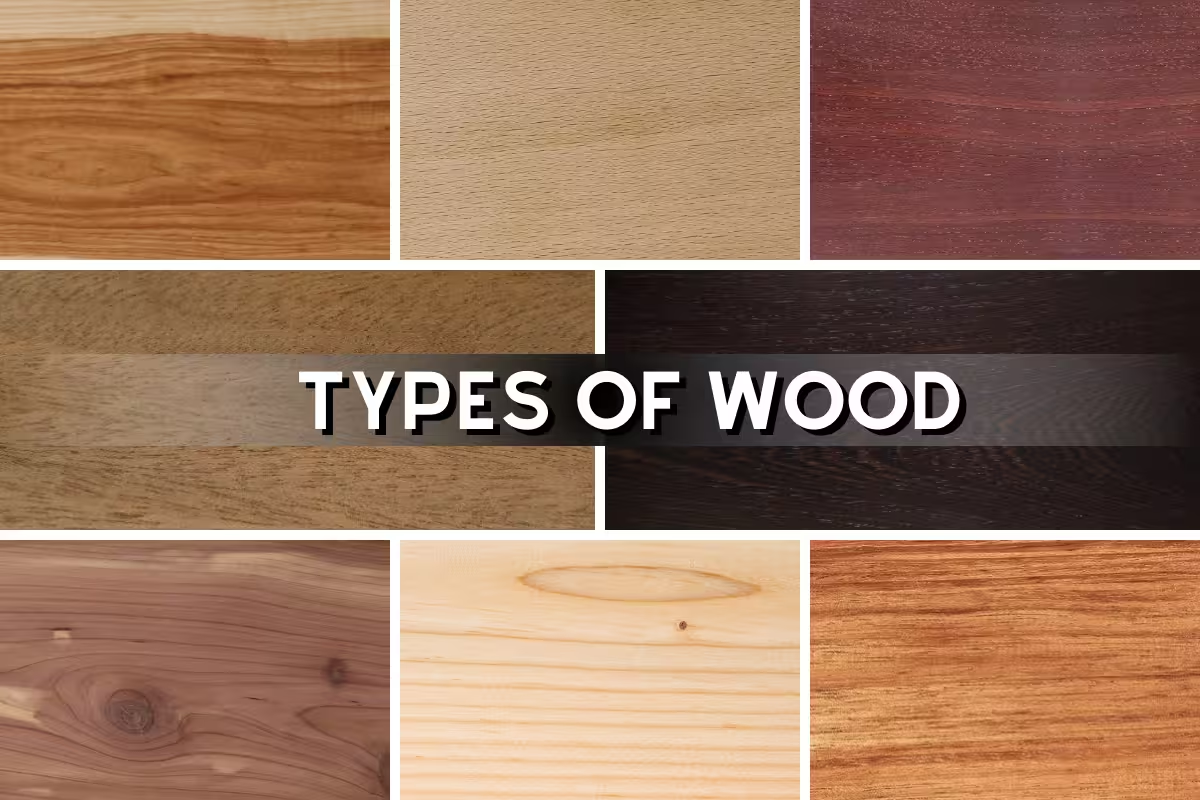
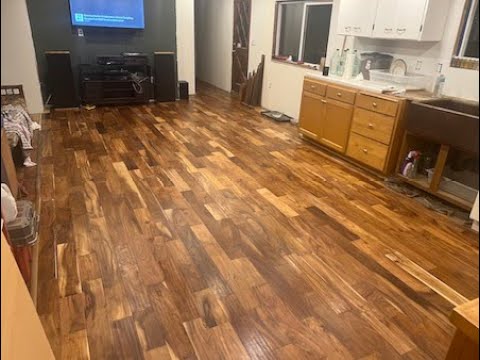
Natural acacia can combine golden tan, caramel, reddish brown, and chocolate streaks on the same floor. Curved or interlocked grain, knots, and sharp sapwood-to-heartwood contrast create an energetic appearance rather than a quiet, uniform field.
Freshly opened boards often smell faintly sweet and woody, while the grain can feel silky in smooth finishes and lightly ridged in wire-brushed products. Sunlight may mellow or darken selected tones, leaving lighter rectangles beneath rugs during early exposure.
Board Lengths and Textures
Short random boards create many end joints and make strong grain variation look busier. Request the minimum, maximum, and average length rather than relying on a carton marked only “random length.”
Smooth gloss highlights figure but also reveals dust and scratches. Matte, scraped, or brushed surfaces disguise small marks, though deep hand scraping loses much of its character during sanding.
Indoor Floors vs Deck Tiles
Outdoor acacia tiles aren’t substitutes for indoor hardwood. Deck tiles usually combine short wood slats with an interlocking plastic base, while interior flooring uses tongue-and-groove or click-joint planks over a prepared subfloor.
Use deck tiles only where drainage, ventilation, UV exposure, freeze-thaw conditions, and local building rules permit. A teak-colored acacia tile is still acacia, not teak.
Durability, Pros, and Cons
Acacia can be durable, yet hardness alone doesn’t predict scratches, water damage, seasonal movement, or finish wear. Product-specific species and construction data give a safer basis for comparison than one universal rating.
Species-Specific Janka Hardness
Published acacia hardness figures often range from roughly 1,700 to 2,300 lbf, but acacia covers many species. Growth conditions, moisture content, specimen orientation, and test source can change the result.
The Janka test measures the force needed to embed a steel ball to half its diameter. It measures indentation resistance, not waterproofing or dimensional stability; our wood hardness scale explains the test in greater depth.
Dents, Scratches, and Water
A higher Janka value can limit heel and furniture dents. Scratches occur in the finish first, so grit, pet nails, chair movement, finish chemistry, and sheen often have more visible influence than wood hardness.
Acacia flooring isn’t waterproof. Factory coatings slow surface absorption, yet water can seep through edges and swell boards, plywood cores, or subfloors. Wipe spills quickly and investigate cold, damp seams near appliances before staining or cupping appears.
Expected Service Life
Well-installed hardwood may remain serviceable for several decades. Solid planks often allow more sanding, while engineered floor life depends heavily on wear-layer thickness, core quality, water exposure, and prior refinishing.
Key Benefits
- Strong natural grain and broad color variation
- Potentially higher dent resistance than oak
- Solid and engineered product choices
- Textured finishes that conceal minor marks
- Compatibility with rustic, traditional, and mixed modern interiors
Drawbacks and Failure Risks
Common failure risks include moisture-related cupping, poor carton blending, thin veneers, brittle click edges, excessive filler, short boards, and unclear species claims. Wide solid planks are less forgiving where seasonal humidity changes sharply.
Beginners often install the darkest boards together, producing an accidental stripe. Lay out several rows and blend multiple cartons before fastening anything; reserve unusually light or dark pieces for closets and visually balanced areas.
Living Areas and Bedrooms
Living rooms and bedrooms suit acacia when humidity remains within the manufacturer’s range. Felt pads, hard-floor vacuum heads, and curtains that moderate intense sunlight reduce wear and uneven color change.
Kitchens and Entryways
Approved acacia flooring can work in kitchens, but dishwashers, ice-maker lines, sinks, and exterior doors raise the moisture risk. Use washable walk-off mats and leak sensors; avoid rubber backings without finish-compatibility approval.
Basements and Radiant Heat
Engineered acacia is usually the practical basement choice, provided the product allows below-grade use and the slab passes its required moisture tests. Radiant heat also needs written approval, a stated surface-temperature limit, and controlled temperature ramping.
Bathrooms and Laundry Rooms
Full bathrooms and laundry rooms present higher leak risk. Use acacia only with written manufacturer approval; waterproof resilient flooring is often safer around tubs, showers, floor drains, and washing machines.
Solid vs Engineered Acacia Flooring

Solid acacia flooring offers greater refinishing depth, while engineered acacia offers better dimensional stability and wider installation options. The better choice depends on the subfloor, grade level, climate, and wear-layer specification.
Solid Acacia Hardwood
Solid planks contain acacia through their thickness and are commonly nailed or stapled over wood. They can last a long time under stable conditions, but seasonal movement makes wide boards and humid sites more demanding.
Acacia Engineered Hardwood
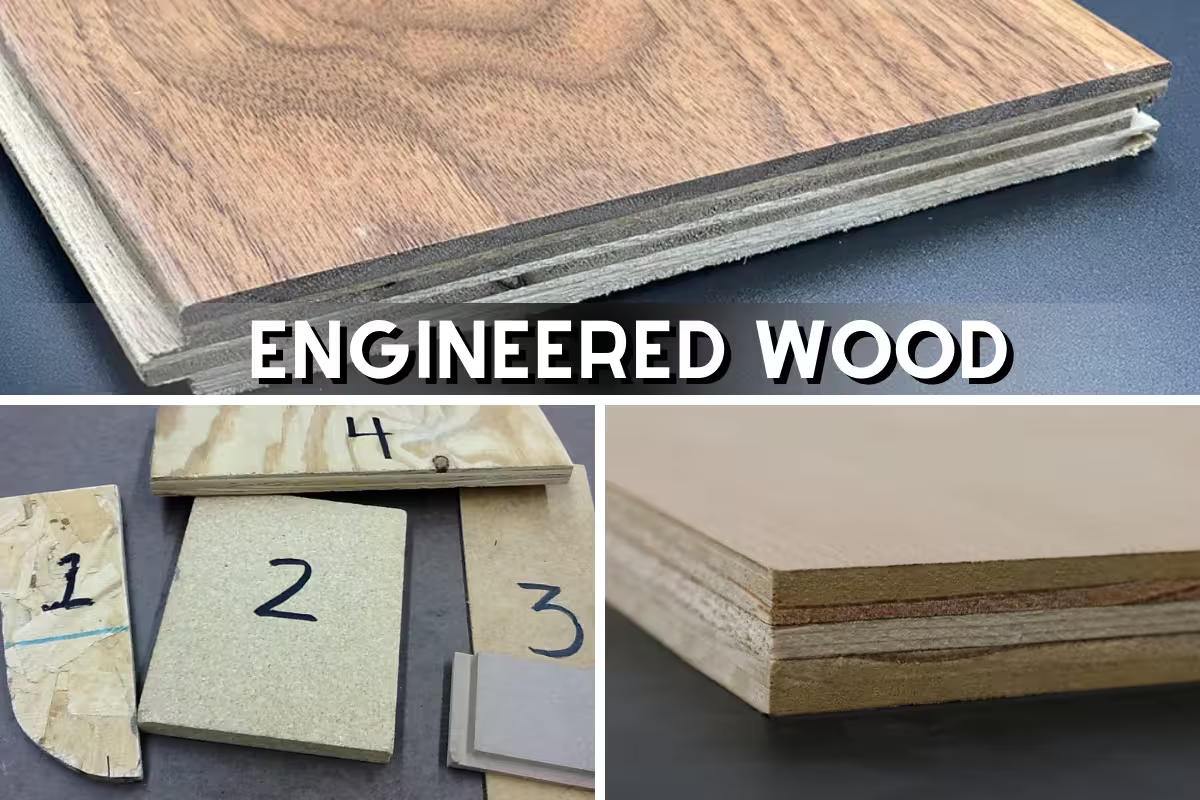
Acacia engineered hardwood uses a real acacia surface over plywood or another layered core. Depending on the model, it may support nail-down, glue-down, or floating installation over wood or concrete.
Stability and Moisture Resistance
Cross-laminated cores restrict some wood movement, making engineered planks more dimensionally stable than solid boards. That stability doesn’t make them waterproof; saturated cores can swell or delaminate.
Wear Layer and Refinishing
Total plank thickness isn’t the same as wear-layer thickness. A thin decorative veneer may permit recoating but no full sanding, while a thicker layer may allow one or more professional refinishing cycles after accounting for texture and prior work.
Concrete and Below Grade
Never assume a plank is approved for concrete or a basement. Confirm below-grade approval, slab moisture limits, vapor-control requirements, compatible adhesive, and whether a floating method is permitted.
Installation Method Compatibility
| Specification | Solid acacia | Engineered acacia |
|---|---|---|
| Acacia through plank | Yes | No; acacia wear surface |
| Dimensional stability | Lower | Usually higher |
| Concrete use | Often restricted | Common when approved |
| Below-grade use | Usually unsuitable | Product-dependent |
| Floating installation | Uncommon | Available on some lines |
| Refinishing | Often possible | Wear-layer dependent |
| Radiant heat | Product-dependent | More commonly approved |
Match the floor to its listed installation method. Substituting an unapproved adhesive, underlayment, fastener schedule, or floating system can cause movement and remove warranty protection.
Acacia vs Other Flooring Woods
Many acacia products are harder than oak, maple, and walnut, while hickory may be closer. Species-qualified data matter because “acacia” doesn’t identify one uniform wood.
Acacia vs Oak
Acacia usually displays stronger color contrast and may exceed oak in hardness. Oak offers better market continuity, clearer grading, longer replacement availability, and broad stain choices; compare red oak vs white oak before deciding.
Acacia vs Hickory
Both woods can look lively and resist dents. Hickory’s commonly cited rating is near 1,820 lbf; some acacia species exceed it, while domestic hickory often has clearer species and sourcing records.
Acacia vs Maple
Hard maple, near 1,450 lbf, has a cleaner and paler appearance. Acacia offers stronger grain contrast, while smooth light maple may display dents and gray surface scratches more plainly.
Acacia vs Bamboo
Bamboo is a manufactured grass product rather than hardwood. Strand density, pressing, adhesive, and finish produce large performance differences, so compare finished-product test data instead of generic species claims.
Acacia vs Walnut
Black walnut, near 1,010 lbf, is softer and visually calmer than many acacias. A listing for Asian walnut flooring may contain acacia rather than true walnut, making botanical identification necessary.
Hardness Comparison Table
| Flooring wood | Approximate Janka hardness | Visual character |
|---|---|---|
| Acacia products | About 1,700–2,300 lbf; species-dependent | Strong contrast and irregular grain |
| Hickory | 1,820 lbf | Pronounced color variation |
| Hard maple | 1,450 lbf | Fine, comparatively even grain |
| White oak | 1,360 lbf | Visible rays and straight grain |
| Red oak | 1,290 lbf | Open, prominent grain |
| Black walnut | 1,010 lbf | Dark, flowing grain |
These values are comparison guides, not guarantees. The USDA Wood Handbook explains how moisture and wood structure affect mechanical properties, while a flooring supplier should provide data for the actual product.
Taiwan Acacia Explained
Taiwan acacia usually means Acacia confusa, also called Formosan acacia. The phrase may identify a species, collection, harvest location, or manufacturing origin, so buyers should request all four details separately.
Botanical Identity
Acacia confusa is the botanical identity commonly linked with Formosan acacia and Taiwan acacia. It shouldn’t be treated as interchangeable with every Asian acacia used in flooring.
Acacia Confusa Characteristics
Acacia confusa may show warm brown tones, contrasting bands, and interlocked grain. Density, drying response, and movement vary by source, board orientation, and processing, so product test records carry more weight than a generic description.
Species vs Manufacturing Origin
A floor made in Taiwan may use wood harvested elsewhere. In the same way, Acacia confusa may be processed outside Taiwan. Ask for the species, harvest country, manufacturing country, and chain-of-custody record.
Taiwan Acacia Hardness
Don’t transfer a 2,200 or 2,300 lbf figure from another acacia species to Taiwan acacia. Request a documented Janka hardness result for the species and flooring line, including the test unit and source.
Ecological Context
Taiwan acacia has served timber, charcoal, fuel, reforestation, and soil-stabilization roles. Its ecological status varies by region; a useful tree in one location may behave invasively in another. The Kew plant database is a useful starting point for accepted names and distribution records.
Sustainable Taiwan Acacia
Fast growth isn’t proof of responsible forestry. Look for legal harvest documents, plantation or recovered-wood details, independent certification, chain of custody, and disclosure of the engineered core and adhesives.
Installation and Long-Term Care

Successful acacia flooring needs a dry building, measured moisture conditions, a flat subfloor, and an approved installation system. Installation failures often begin before the first board is fastened.
Site Conditions and Testing
The building should be enclosed and climate-controlled, with wet plaster and paint dry. Record room temperature, relative humidity, flooring moisture, wood-subfloor moisture, and concrete moisture results where a slab is present.
Common industry benchmarks limit the difference between solid strip flooring and a wood subfloor to about four percentage points, dropping to roughly two for wider planks. Treat these as general benchmarks, since the product instructions control the job.
Condition-Based Acclimation
Acclimation is a condition, not a fixed three-day timer. Flooring is ready when its measured moisture content suits the building, subfloor, local climate, and manufacturer’s limits.
Subfloor Preparation
Check flatness, strength, fastener security, cleanliness, and moisture. A hump can make a floating plank rock underfoot with a faint click, while a hollow glue-down area produces a drum-like tap and weak adhesive transfer.
Approved Installation Methods
- Nail or staple approved solid and engineered planks over suitable wood.
- Use full-spread adhesive approved for the plank and subfloor.
- Float only products built and listed for floating installation.
- Follow stated trowel, fastener, underlayment, and vapor-control requirements.
Expansion and Waste Allowances
Leave the specified perimeter and fixed-object expansion space. Plan around 5% waste for simple rooms and 10% or more for diagonal layouts, complex cuts, heavy color sorting, or products with many short boards.
Routine Cleaning
Vacuum with a hard-floor setting or use a microfiber dust mop. Apply only a finish-approved cleaner with minimal liquid; steam, wet mops, abrasive pads, unapproved oil soap, and vinegar blends can dull or damage the coating.
Scratch Prevention
Use felt pads, lift furniture, trim pet nails, and protect rolling-chair areas. Grit feels harmless between the fingers but acts like fine sandpaper underfoot, so entry mats and frequent dry cleaning make a visible difference.
Humidity Control
Many wood floors specify indoor relative humidity near 35% to 55%, though the actual warranty range may differ. Prolonged dryness causes gaps and checking; excessive moisture can create cupping, crowning, or buckling.
Refinishing Requirements
Solid acacia may be sanded while enough wood remains above the tongue. Engineered planks require a measured wear layer and professional review; dense, interlocked grain can sand unevenly, and deep textures disappear under aggressive sanding.
Practical Notes From Real-World Use
Real-world floor problems often appear at transitions, exterior doors, appliance lines, and sunny windows rather than across the room center. Inspect those areas first when boards feel raised, joints tighten, or seasonal gaps stop closing.
Before installation, stand at the room entrance and arrange several dry rows. This reveals dark clusters, repeated short-board joints, and awkward grain changes that remain hard to spot when viewing one plank at a time.
Acacia Flooring Cost
Acacia flooring costs commonly start around $3 per square foot for material and can exceed $10, while professional installation often adds $3–$8 per square foot. Preparation, moisture control, stairs, trim, and removal can change the final total sharply.
Material Price Range
Plan on roughly $3–$10+ per square foot for flooring. Species disclosure, plank width, board length, solid or engineered construction, wear-layer thickness, certification, finish, and warranty influence price.
Professional Installation Costs
Typical planning figures run around $3–$8 per square foot. Glue-down work, patterns, occupied homes, small rooms, and extensive cutting can raise labor beyond that range.
Removal and Floor Preparation
Removal and disposal often add $1–$4 per square foot. Grinding high spots, filling low areas, repairing joists, or replacing damaged panels may cost more than installation labor on a poor subfloor.
Moisture Control and Accessories
Budget for meters or slab testing, underlayment, vapor control, adhesive, fasteners, and approved cleaner. A damp slab may require a special mitigation system rather than ordinary flooring adhesive.
Trim, Stairs, and Delivery
Transitions, reducers, stair nosing, baseboards, door trimming, freight, and job-site handling often sit outside the headline price. Matching stair parts can carry a high unit cost and longer lead time.
500-Square-Foot Budget
| Budget item | Example calculation | Estimated amount |
|---|---|---|
| Flooring with 10% waste | 550 sq. ft. × $6 | $3,300 |
| Installation | 500 sq. ft. × $5 | $2,500 |
| Removal | 500 sq. ft. × $2 | $1,000 |
| Preparation and accessories | Site-dependent allowance | $500–$2,000+ |
| Example total | Before stairs and major moisture work | $7,300–$8,800+ |
This example uses planning figures rather than a national quote. Keep material and labor quantities separate: waste increases the flooring order to 550 square feet, while installers usually price the 500-square-foot room area.
Choosing Acacia Wood Flooring
Choose acacia wood flooring by verifying species, construction, wear layer, board lengths, finish, moisture limits, installation approvals, emissions records, and warranty exclusions. A physical sample should start the comparison, not finish it.
Product Specification Checklist
- Botanical species and harvest origin
- Solid or engineered construction
- Total thickness and wear-layer thickness
- Plank width, length range, and average length
- Core material and ply orientation
- Finish chemistry, sheen, texture, and edge profile
- Approved installation methods and subfloors
- Moisture limits and radiant-heat approval
- Carton coverage, returns, and warranty documents
Finish and Texture Selection
Choose matte or lightly textured flooring if visible scratches, pet hair, and dust are concerns. A dark glossy finish creates sharper reflections but exposes every fine mark, while oil finishes may need periodic product-specific maintenance.
Sample Evaluation Checklist
View samples in daylight, warm lamps, and cool artificial light beside cabinets, walls, and trim. Tilt the board across the light to reveal surface scratches, filler, gloss variation, milling defects, and water spotting.
One small swatch can’t show the full acacia range. Request several full planks or inspect an opened carton, then ask what percentage of boards commonly fall at the light and dark extremes.
Flooring Samples
A solid flooring sample helps judge natural tone and grain in the intended room. It doesn’t verify the full product’s hardness, dimensions, board-length mix, or current warranty.

Natural Acacia Flooring Sample
- Solid hardwood flooring sample
- Natural acacia wood tone
- Lets you assess color
- Helps compare wood grain
- Useful before ordering flooring
 Buy on Amazon
An engineered sample can show the visible wood surface, finish, and edge profile. Request the current technical sheet separately because collections, cores, and wear-layer specifications can change.

9 Mile Creek Acacia Floor Sample
- Engineered flooring sample
- Natural acacia appearance
- Elegance Plyquet collection
- Helps evaluate color and grain
- Compare before a full flooring purchase
Buy on Amazon
Certifications and Indoor Air
Ask for FSC or equivalent chain-of-custody evidence where available. Engineered cores should carry applicable composite-wood documentation, including CARB Phase 2 or TSCA Title VI compliance rather than a vague “eco-friendly” label.
The EPA formaldehyde standards cover regulated composite wood products. Also request finish, adhesive, VOC, and indoor-air certification documents for the exact model number.
Warranty Exclusions
A long residential finish warranty rarely covers pet scratches, dents, seasonal gaps, plumbing leaks, excessive humidity, improper cleaners, unapproved radiant heat, or installation errors. Natural color variation may also sit outside defect coverage.
Retailer and Installer Questions
- What is the botanical species and verified Janka result?
- What is the engineered wear-layer thickness in millimeters?
- Which subfloor moisture tests are included in the quote?
- Who pays for slab mitigation or flattening?
- How will boards from multiple cartons be blended?
- Are trim, transitions, stairs, and door cuts included?
- Does self-installation or radiant heat alter coverage?
- Who administers a claim: retailer, distributor, or manufacturer?
Get answers in writing and retain product labels, carton end panels, moisture records, invoices, and installation photos. These records often determine whether a warranty claim proceeds after cupping or finish failure.
Availability and Attic Stock
Acacia stains, widths, and locking profiles can disappear from catalogs. Keep at least one unopened carton from the same production lot in a dry, conditioned space for future appliance leaks, wall changes, or isolated repairs.
Before purchase, compare full specifications rather than retailer names or labels such as “natural acacia.” The safest shortlist pairs documented construction, room approval, realistic color sampling, qualified installation, and enough matching stock for later repairs.
FAQs
Is Acacia Wood Good for Flooring?
Acacia wood is a good flooring choice because it is durable, dense, and naturally attractive. Its varied grain and warm tones suit rustic and contemporary rooms. Choose properly dried, quality boards and use a suitable finish, since color and grain can vary noticeably between planks.
Is Acacia Flooring Harder Than Oak?
Acacia flooring is generally harder than many common oak species, although exact hardness varies by acacia and oak type. Its higher density can improve resistance to dents in busy rooms. Compare Janka ratings for the specific product, because construction and finish also affect real-world performance.
Does Acacia Flooring Scratch Easily?
Acacia flooring does not scratch easily compared with softer woods, but it can still be marked by grit, pet claws, and dragged furniture. A durable factory finish helps protect the surface. Use felt pads, entry mats, and regular sweeping to keep scratches and wear less visible.
What Is the Difference Between Solid and Engineered Acacia Flooring?
Solid acacia flooring is made from one thick piece of acacia, while engineered acacia has an acacia top layer bonded to stable plywood or core layers. Solid boards can usually be sanded more times. Engineered boards handle humidity changes better and are often suitable where solid wood is less practical.
What Is Taiwan Acacia?
Taiwan acacia commonly refers to Acacia confusa, a fast-growing hardwood tree native to Taiwan and parts of Southeast Asia. It is valued for dense wood, distinctive grain, and use in furniture, flooring, and other wood products. Product names can vary, so confirm the botanical species and construction when comparing flooring.
Affiliate Disclosure: Some links in this post are affiliate links. If you make a purchase through these links, we may earn a small commission at no extra cost to you. We only recommend products we genuinely believe in.