

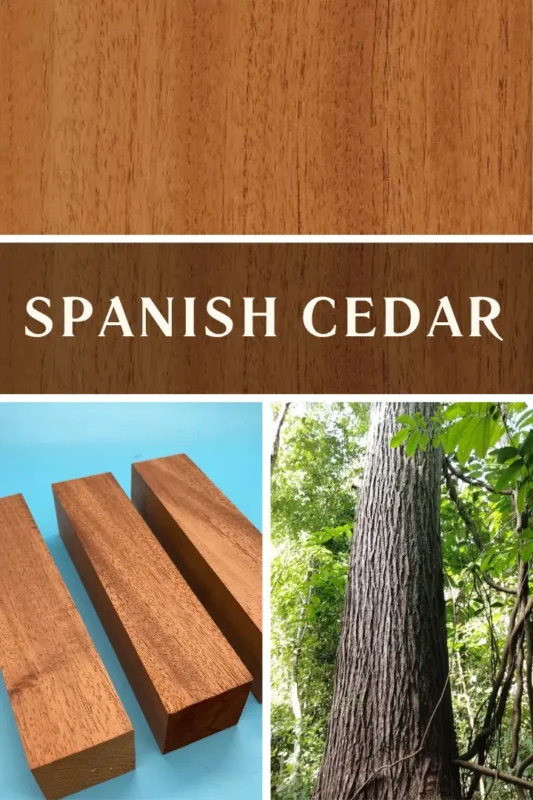
Spanish cedar is an aromatic tropical hardwood, usually Cedrela odorata, from the mahogany family rather than the true cedar genus. Its low weight, stable grain, spicy scent, and moisture-buffering capacity make it useful for humidors, cabinetry, boxes, musical instruments, and selected furniture.
Table of Contents
What Is Spanish Cedar?
Cedrela odorata Identity
Cedrela odorata wood belongs to Meliaceae, the same botanical family as mahogany. True cedars belong to Cedrus, so Spanish cedar is a trade name based on scent and historical use rather than botanical identity. The Kew Plants of the World Online database provides accepted taxonomy and distribution records.
Material sold under this name may come from another Cedrela species. A serious invoice should state the scientific species name, country of origin, and whether the product is solid wood, plywood, or veneer. A listing that says only “cedar wood” doesn’t establish identity.
Range and Growth
The native range covers parts of tropical America, including Mexico, Central America, the Caribbean, and northern South America. Trees commonly reach about 60–100 feet and may develop trunks 3–5 feet across in favorable sites, though plantation stock and younger trees often produce narrower commercial boards.
Selective removal of large, straight trees has reduced supplies of wide, clear lumber. Plantation growth can offer a more traceable source, but fast-grown boards may show wider growth rings, lower density, or more variable grain than old-growth material.
Color, Grain, and Aroma. Heartwood ranges from pale pinkish brown to warm reddish brown and darkens after exposure. Sapwood looks lighter. Grain is often straight, with shallow interlocking in some boards, while the medium texture feels dry and slightly woolly after coarse sanding. Fresh cuts release a spicy, resinous cigar-box scent that can cling to hands and workshop clothing.
Identification and Trade Names. Common names include cedro, cedro rojo, cedro amargo, West Indian cedar, and cigar-box cedar. Color and odor offer useful clues, but neither proves species. End-grain anatomy and supplier documentation carry more weight, since aromatic redcedar can also smell strong and display reddish heartwood. Our broader cedar wood guide explains these naming overlaps.
Furniture and Other Uses. Spanish cedar works well for drawer sides, cabinets, boxes, light furniture, boat interiors, musical instruments, carvings, and millwork. Its low hardness makes it easy to shape but prone to dents. For heavily used tabletops or chair rails, a harder species may retain crisp edges longer; compare options in our guide to furniture woods.
Outdoor Furniture Suitability. Spanish cedar can serve in sheltered outdoor furniture when properly detailed, but it isn’t the first choice for ground contact, wet climates, or exposed horizontal surfaces. Heartwood has moderate natural durability, yet soft fibers bruise and weather quickly. Use drainage gaps, raised feet, stainless fasteners, sealed end grain, and a maintained exterior coating. Compare exposure demands with other outdoor furniture woods before buying.
Spanish Cedar Properties and Safety

Spanish cedar properties combine low density, modest hardness, moderate shrinkage, and easy machining. Values vary with origin, growth rate, moisture content, and test method, so reference figures shouldn’t replace measurements from the purchased stock.
Physical Property Table
The following figures are typical clear, dry values reported for Cedrela odorata. The Spanish Cedar species profile provides supporting wood-property data and machining observations.
| Property | Typical reference value | Practical meaning |
|---|---|---|
| Average dried weight | 29 lb/ft³ or 470 kg/m³ | Light for a tropical hardwood |
| Specific gravity | 0.40 basic; 0.47 at 12% MC | Easy to carry and machine |
| Janka hardness | 600 lbf or 2,670 N | Dents more easily than mahogany or oak |
| Modulus of rupture | 10,010 psi or 69 MPa | Adequate for light cabinetry and trays |
| Modulus of elasticity | 1.32 million psi or 9.1 GPa | Moderate stiffness |
| Crushing strength | 5,860 psi or 40 MPa | Not suited to severe compressive loads |
| Radial shrinkage | 4.1% | Moderate movement across quartersawn grain |
| Tangential shrinkage | 6.2% | Flatsawn boards move more across their width |
| Volumetric shrinkage | 10.2% | Relatively manageable drying movement |
| T/R ratio | About 1.5 | Lower cupping tendency than many unstable woods |
Stability and Wood Movement
Its moderate shrinkage and low density make wood movement manageable, not nonexistent. At room conditions near 70% relative humidity, equilibrium moisture content can approach the low-teens range. A dry board moved into a damp humidor will swell across its grain, while an overly wet board may shrink and open gaps later.
Acclimate thin stock in the project room for several days, separated by stickers so both faces receive air. Don’t trap a wide solid panel between rigid walls without clearance. Veneer behaves differently because its substrate restrains movement.
Workability and Resin. Sharp tools leave a clean, slightly lustrous surface, while dull planer knives pull fuzzy strips from interlocked grain. Take light passes and use a backing board on thin parts. Gum pockets can smear cutters, clog abrasive paper, and weaken glue lines. Remove affected material or test the adhesive on an offcut rather than flooding the surface with solvent.
Durability and Pest Resistance. Heartwood is commonly rated durable to moderately durable against decay, with variation between sources. Natural extractives discourage some insects, but they don’t make the wood or nearby cigars immune to attack. Sapwood, end grain, joints, and permanently damp areas remain vulnerable.
Wood Dust Safety. Sawing and sanding can irritate eyes, skin, nose, and lungs. Repeated exposure may cause sensitization or asthma-like symptoms. Use source-capture extraction, eye protection, and a properly fitted particulate respirator. Vacuum the sweet-smelling fine dust instead of blowing it through the room with compressed air, and seek medical care for wheezing or persistent rashes.
Why Spanish Cedar Suits Humidors
A Spanish cedar humidor uses the wood because it buffers brief moisture changes, moves relatively little, machines easily, and supplies a traditional aroma. The lining doesn’t create a selected relative humidity by itself.
Moisture Buffering
Porous wood absorbs moisture when surrounding air becomes wetter and releases it as conditions dry. This passive buffering can soften short swings after opening the lid, but its capacity depends on exposed surface area, thickness, and moisture content. A paper-thin veneer stores much less moisture than a 1/4-inch liner.
Dimensional Stability
Moderate shrinkage helps trays, dividers, and liners keep their shape through routine humidity cycles. Problems still arise when unacclimated boards are installed tightly or when water is poured directly onto the wood. Swollen panels feel raised at their edges and may bind against the lid.
Aroma and Cigar Aging. Fresh Spanish cedar smells warm, spicy, and faintly peppery. Long storage can transfer subtle cedar notes, but more scent isn’t always better. Large amounts of fresh wood or loose shavings may overwhelm delicate cigars. Air strong-smelling new components outside the humidor before loading valuable stock.
Beetle Deterrence Limits. Aromatic compounds may discourage some insects, yet Spanish cedar doesn’t kill every tobacco beetle or egg. Inspect new cigars, isolate suspicious stock, and control temperature. Small round exit holes, loose tobacco dust, or moving beetles call for immediate separation and guidance from a cigar-storage specialist.
Humidity System Requirements. A working humidor needs a tight enclosure, calibrated hygrometer, stable room temperature, and suitable humidification device. The traditional 70% RH at 70°F reference isn’t mandatory; many users select 65–69% RH for cleaner burning and lower mold risk. Blend, storage time, and preference affect the best setting.
Choosing Spanish Cedar Humidor Materials
Choose Spanish cedar lumber for structural components and Spanish cedar sheets for thin lining over a stable enclosure. Product labels often blur the difference between veneer, sawn sheets, planks, and plywood, so verify construction and actual thickness.
Solid Spanish Cedar Lumber
Solid stock suits trays, shelves, dividers, boxes, and removable liners. Look for kiln-dried boards with stated dimensions, straight grain, limited gum pockets, and enough thickness for final surfacing. Thin edges split easily around screws, so pre-drill or use joinery that spreads the load.

Solid Spanish Cedar Lumber Pack
- Ten solid cedar boards
- Kiln dried for dependable use
- Sanded surfaces save prep time
- Great for trays and dividers
- Not thin veneer material
 Buy on Amazon

Spanish Cedar Planks for Humidors
- Five solid cedar planks
- Sized for DIY humidor liners
- Useful for trays and dividers
- Supports cigar storage and aging
- Fits boxes cabinets and tupperdors
Buy on Amazon
Spanish Cedar Sheets
Spanish cedar sheets may be raw veneer, backed veneer, thin solid wood, or plywood with a cedar face. Raw veneer needs a stable substrate and even clamping pressure. Thin sawn sheets can work loose or as dividers, but inspect grain direction before bending them.

Spanish Cedar Veneer Sheets
- Thirty-six cedar veneer sheets
- Ideal for humidor dividers
- Fits trays cases and tupperdors
- Adds natural cedar character
- Can also light cigars
Buy on Amazon

Spanish Cedar Humidor Sheets
- Ten Spanish cedar veneer sheets
- Made for lining humidors
- Creates simple cigar dividers
- Compact six point seven by four point four inch size
- Can be used to light cigars
Buy on Amazon
Trays and Dividers. Open slats promote air movement better than solid, tightly packed trays. Measure the narrowest internal width, available height, and humidity-device clearance before buying. Leave channels around the tray so humidified air can reach lower cigars rather than collecting near the lid.

Adjustable Spanish Cedar Cigar Trays
- Two open Spanish cedar trays
- Adjustable divider organizes cigars
- Includes twelve cedar sheets
- Fits larger humidors and boxes
- Supports cigar storage and aging
Buy on Amazon
Sheets Versus Lumber. The enclosure should guide the choice. Sheets save space and cover a stable box efficiently; lumber provides greater moisture-buffering mass and can hold joinery or support weight.
| Criterion | Thin veneer or sheets | Solid Spanish cedar lumber |
|---|---|---|
| Primary use | Surface lining and light dividers | Trays, shelves, boxes, and thick liners |
| Strength | Depends on substrate | Can form structural parts |
| Moisture buffering | Lower because mass is limited | Greater with more exposed wood |
| Installation | Usually glued or laid loose | Cut, joined, or friction-fitted |
| Tools | Knife, straightedge, roller | Saw, sander, clamps, joinery tools |
| Cost comparison | Price per usable square foot | Price per usable board foot |
| Common failure | Curling, bubbles, delamination | Gaps, cupping, splitting |
Liner Thickness. Traditional solid liners often measure about 1/8–1/4 inch. A thin box may need 1/8-inch stock to preserve capacity, while a cabinet can accept thicker panels. Leave clearance for swelling and account for both opposing liners when calculating the final internal width.
Building a Spanish Cedar Humidor
Building or relining a humidor starts with dry acclimated wood, accurate measurements, complete adhesive curing, and controlled seasoning. Most failures come from wetting the liner too aggressively or fitting solid panels with no movement allowance.
Planning and Acclimation
Measure each wall at several points because small boxes are rarely perfectly square. Stack the wood with thin spacers in the installation room for several days. A board that feels cool or slightly clammy compared with nearby dry stock may still be gaining or losing moisture.
Cutting and Dry-Fitting
Cut parts slightly oversized, then trim them to a controlled friction fit. Orient attractive grain consistently and lightly ease exposed edges, since sharp Spanish cedar corners crush easily. Dry-fit the full assembly before glue touches any surface.

Adhesives and Curing. Match the adhesive to both the cedar and substrate. Apply a thin, even layer and remove squeeze-out before it hardens. Resin pockets may weaken bonding. Friction-fit panels avoid interior glue and simplify future repairs. Keep cigars out until every adhesive odor has disappeared and the stated cure period has passed.
Unfinished Interiors. Leave the cedar bare inside the storage chamber. Paint, stain, polyurethane, oil, and scented wax can block moisture exchange or transfer odor. Exterior coatings are acceptable once fully cured and isolated from the interior.
Seasoning and Calibration. Test the hygrometer before blaming the box or humidity device. Follow the device maker’s directions, use distilled water where requested, and avoid standing water. Two-way humidity packs season small containers slowly with less risk of swelling. Add cigars only after the empty enclosure holds the chosen RH consistently.
Common Failures to Avoid. Beginners often wipe panels repeatedly with a wet sponge, use tap water, coat the interior, or trust an untested analog gauge. Excess water can lift veneer, buckle corners, and produce a sour, musty smell. A poor lid seal can’t be repaired by adding more cedar or a larger humidifier.
Practical Notes From Real-World Use. Removable side and bottom panels make repairs far easier than fully glued liners. Leave a hairline clearance around broad solid pieces, use narrow slats for trays, and place a second calibrated sensor low in a tall cabinet. Top-to-bottom readings may differ when densely packed cigars restrict circulation.
Spanish Cedar Alternatives
The best Spanish cedar substitute depends on whether the project needs structural strength, moisture buffering, aroma, or a stable substrate. No substitute copies every trait, and woods sharing “cedar” in their names may smell or perform very differently.
Spanish Cedar vs Mahogany
Mahogany and Spanish cedar share the Meliaceae family, but mahogany is commonly heavier, harder, and less aromatic. In a mahogany vs Spanish cedar choice, use mahogany for durable exterior cabinetry and Spanish cedar for the unfinished interior. Read our mahogany wood guide for wider property comparisons.
Okoume and Substrates
Okoume plywood, birch plywood, and medium-density fiberboard can form stable outer shells when properly covered and isolated from the storage space. They don’t supply the same aroma or buffering mass. Our okoume wood profile covers its low weight and panel uses.
Aromatic Red Cedar. Eastern redcedar, Juniperus virginiana, has a sharp closet-like scent that can dominate cigar aroma and flavor. It isn’t a direct humidor substitute. Review eastern red cedar before using leftover closet boards near cigars.
Western Red Cedar. Thuja plicata is soft, light, and decay resistant, yet its odor and extractive chemistry differ from Cedrela odorata. It works well for exterior construction but shouldn’t be assumed safe for cigar flavor merely because its common name includes cedar. See our western red cedar guide.
Choosing a Substitute. Use a stable, low-odor substrate for the shell and add removable verified Spanish cedar trays or panels if full lining isn’t practical. For odor-sensitive storage, test a sealed sample in an empty container for several days before exposing cigars.
Buying Spanish Cedar Responsibly
Responsible purchasing starts with species verification, legal-origin records, usable dimensions, and delivered cost. Spanish cedar is regulated in international trade, but regulated stock isn’t automatically banned or illegal.
Seller Verification Checklist
Ask the supplier for details before ordering expensive or international stock. Retain invoices and permit records for commercial work or later cross-border movement.
- Scientific name, preferably Cedrela odorata rather than “cedar” alone
- Country of origin and plantation or wild-harvest status where known
- Solid wood, raw veneer, backed veneer, or plywood construction
- Kiln-dried status and stated moisture range
- Rough, surfaced-two-sides, or finished dimensions
- Certification claim and certificate number
- CITES or re-export paperwork where the shipment requires it
- Actual-board photographs for costly or wide stock
CITES and Conservation
Neotropical populations of Cedrela are listed in CITES Appendix II under applicable annotations. Appendix II permits controlled commercial trade but may require proof of legal harvest, export permits, or re-export documents for covered products. Check the official CITES appendices before moving lumber internationally.
Lumber Pricing Factors. Origin, board width, thickness, grade, drying, certification, surfacing, and freight all affect cost. Wide clear boards command a premium because gum pockets, knots, checks, and sapwood reduce usable yield. Small packs can cost more per unit but save money when a project doesn’t justify milling equipment or oversized shipping.
Board-Foot Costs. Calculate board feet as thickness in inches × width in inches × length in feet ÷ 12. Divide the delivered price by usable board feet after removing defects and surfacing loss. A rough 1-inch board may finish well below 1 inch after flattening, so nominal volume can overstate final yield.
Sheet and Veneer Costs. Compare sheets by usable square foot, actual thickness, backing type, flatness, and defect rate. A low pack price loses value when pieces arrive curled, split, or too small to grain-match. Include adhesive and substrate expenses for raw veneer.
Waste, Shipping, and Yield. Add about 15–25% for trimming, saw kerf, defects, cutting mistakes, and grain matching on small projects. Long boards may trigger oversized freight, while short pre-cut stock ships cheaply. Calculate delivered cost before deciding that full-size lumber offers better value.
Purchase Red Flags. Avoid listings with no species, thickness, moisture condition, or construction details. Be cautious of “solid wood” used for paper-backed veneer, artificial perfume, unidentified coatings, guaranteed beetle prevention, or claims that cedar alone maintains exact humidity. Live edge cedar may suit decorative furniture, but irregular edges and sapwood make it inefficient for fitted humidor components.
What Is Cedar Wood in Spanish?
Cedar in Spanish is cedro, while cedar wood may be written as madera de cedro. “Spanish cedar” is an English trade name and doesn’t mean that Cedrela odorata comes from Spain.
Direct Translation
The direct English-to-Spanish translations are cedar = cedro and cedar wood = madera de cedro. A literal translation of Spanish cedar is cedro español, but regional timber names communicate species identity more accurately.
Regional Cedar Names
Cedrela odorata may be called cedro rojo, cedro amargo, cedro oloroso, or simply cedro, depending on country and trade context. The same common name can refer to another local species, so buyers should pair it with a scientific name.
Cedro in English. Cedro translates directly to cedar, but timber merchants may use it more narrowly for tropical Cedrela lumber. Context matters: a translated product label saying “cedar” doesn’t establish whether the wood is Spanish cedar, true cedar, redcedar, or another aromatic species.
Trade Name Meaning. “Spanish cedar” refers to historical commerce and the wood’s cedar-like fragrance. It describes a tropical hardwood from the mahogany family, not a tree native to Spain. For purchasing, Cedrela odorata, origin, product construction, and legal documentation offer more useful information than the trade name alone.
FAQs
Why Is Spanish Cedar Used In Humidors?
Spanish cedar is used in humidors because it helps stabilize humidity, resists tobacco beetles, and adds a mild aroma that complements cigars. Its porous wood absorbs and releases moisture gradually, reducing sudden swings. For best results, use untreated Spanish cedar rather than scented, painted, or sealed wood.
How Thick Should Spanish Cedar Be In A Humidor?
Spanish cedar lining should generally be about 1/4 inch (6 mm) thick for a humidor. This thickness provides useful moisture buffering without taking up excessive storage space. Thinner veneer can work when properly installed, but it has less effect on humidity stability. Larger cabinets may use thicker solid cedar shelves or panels.
Can Aromatic Cedar Be Used In A Humidor?
Aromatic cedar is not recommended for lining a humidor because its strong fragrance can overpower and alter cigar flavors. It is usually Eastern red cedar, not true Spanish cedar. Although it repels insects and looks attractive, its oils and aroma are too intense for cigar storage. Use untreated Spanish cedar instead.
Is Spanish Cedar Good For Outdoor Furniture?
Spanish cedar can be used for outdoor furniture, especially in covered or mild-climate spaces, because it is naturally resistant to decay and insects. However, it is softer than teak and can weather, dent, or fade without protection. Seal or finish it for exterior use, and maintain it regularly for longer service.
What Is Cedar Wood In Spanish?
Cedar wood in Spanish is usually called madera de cedro. The exact name can vary by region and species, since Spanish cedar is often called cedro or cedro español even though it is not a true cedar. When buying wood, ask for the botanical species to avoid confusion with aromatic cedar or other cedars.
Affiliate Disclosure: Some links in this post are affiliate links. If you make a purchase through these links, we may earn a small commission at no extra cost to you. We only recommend products we genuinely believe in.