

Ocote is a regional Spanish name for several resinous pine trees, their wood, and pine splinters used to start fires. It isn’t one universal species: Ocote Pine often means Pinus oocarpa in timber trade, while local usage may point to other Mexican or Central American pines.
The guide below separates the botanical, woodworking, cultural, and fire-starting meanings so you can identify what ocote means in each setting.
Table of Contents
What Is Ocote?
Direct Definition
Ocote may mean a living pine tree, ordinary pine lumber, aromatic torchwood, or resin-saturated kindling. In Spanish searches, el ocote para qué sirve asks what the material is used for; the practical answers include kindling, fuel, lumber, resin, and forestry.
The phrase árbol de ocote also lacks one fixed botanical identity. Scientific names matter when discussing native range, strength, conservation, or construction because a common name can cover trees with very different habitats and wood properties.
Nahuatl Word Origin
The Spanish word comes from Nahuatl ocōtl or ocotl, associated with pine, resinous pinewood, and wood burned for light. The Gran Diccionario Náhuatl records historical vocabulary from multiple sources, so spelling and translation can differ.
This origin explains the word’s dual role. Ocote can name the tree and the torchwood material cut from it, much like “pine” can identify both a plant and its lumber.
Common name ambiguity: no accurate statement should claim that “the scientific name of ocote is” one fixed name without a regional qualifier. Pinus oocarpa has the strongest link to the English trade name Ocote Pine, but it isn’t the sole pine called ocote.
Ocote Pine Species and Range
Ocote-associated pines grow from Mexico through parts of Central America, but range and elevation vary by species. Some favor warm, seasonally dry slopes; others occupy cold highlands near the upper tree line.
Species Comparison Table
| Species | Regional or trade association | Typical setting | Common uses |
|---|---|---|---|
| Pinus oocarpa | Strong Ocote Pine association | Warm uplands and seasonally dry pine forest | Lumber, fuel, resin, plantations |
| Pinus montezumae | Frequently called ocote regionally | Mexican and Central American highlands | Timber, fuelwood, restoration |
| Pinus pseudostrobus | Regional ocote names vary | Montane pine and pine-oak forest | Lumber and forestry |
| Pinus devoniana | Sometimes grouped under local ocote terms | Mexican pine-oak environments | Fuel and utility timber |
| Pinus hartwegii | Ocote name used in some local references | Cold, high-elevation mountains | Local timber and watershed cover |
| P. maximinoi, P. patula, P. tecunumanii | Occasional or source-dependent association | Humid uplands and montane forest | Plantations, pulp, lumber |
Pinus oocarpa is a tropical and subtropical pine native from Mexico into Central America. Mature trees often reach roughly 20–35 meters on suitable sites, while cone shape inspired the species name oocarpa, meaning egg-fruited.
Pinus montezumae commonly grows in mountain pine and pine-oak forest. Its long needles and highland ecology distinguish it from warmer-site P. oocarpa, so figures from one species shouldn’t be assigned to the other.
Pinus pseudostrobus supplies valuable lumber across parts of Mexico and Central America. Herbarium records or regional floras provide better identification than a seller’s use of “ocote,” especially where several pines grow together.
P. devoniana and P. hartwegii show how broad the name can be. Michoacán pine occupies Mexican mountain environments, while P. hartwegii survives at elevations far above many P. oocarpa stands.
P. maximinoi, P. patula, and P. tecunumanii appear in broader regional references, yet that doesn’t prove their wood is sold commercially as ocote. The Kew Plants of the World Online database is useful for checking accepted scientific names and documented distributions.
Geographic Range and Habitats
The strongest geographic links are Mexico, Guatemala, Belize, Honduras, El Salvador, and Nicaragua. That full area isn’t the native range of every ocote pine species; boundaries must be checked tree by tree.
Habitats include tropical pine forest, dry slopes, pine-oak woodland, volcanic mountains, and cool montane forest. P. oocarpa often occurs at warmer and lower sites than P. hartwegii, which can endure frost, intense sun, and thin mountain air.
Resin Formation and Wood Properties
Resin-rich ocote forms when a pine concentrates defensive resin around injuries, knots, branch junctions, roots, or old heartwood. A whole tree doesn’t become equally resinous, which is why fatwood and lumber from one pine can behave differently.
How Resin Accumulates and Fatwood Differs
Pines move sticky resin through ducts after physical damage or insect attack. When the tree dies or is cut, concentrated material often remains in old stumps, root collars, knots, and lower trunk sections after softer wood begins to decay.
Fatwood burns readily because terpene-rich resin supplies combustible compounds. Thin curls light more easily than a smooth stick since shaving creates more exposed surface and lets heat reach a smaller mass.
Normal pine boards contain resin, yet most don’t contain enough to act like commercial fire starter. Resin-rich pieces feel unexpectedly heavy, leave a waxy drag under a knife, and release a sharp pine-and-turpentine scent that clings to the fingers.
Appearance, Workability, and Durability
Ocote Pine lumber may have pale yellow sapwood, yellow-brown or reddish heartwood, straight grain, strong growth-ring contrast, and amber resin streaks. Compare these features with other wood grain patterns, but don’t identify species from color alone.
Published Pinus oocarpa figures commonly place dried weight near 545–575 kg/m³, Janka hardness around 550 lbf, bending strength near 11,000 psi, elasticity near 1.6 million psi, and crushing strength around 6,000 psi. The Wood Database Ocote Pine profile reports species-based lumber data rather than fatwood specifications.
Growth rate, moisture, age, site, and resin pockets shift these values. Weight from a resin-saturated stick tells you little about the strength of a graded board, while the figures above shouldn’t be transferred to P. montezumae or another regional ocote.
Normal lumber saws and shapes with little resistance, but resin can coat blades with a warm, tacky film and clog sandpaper within minutes. Wiping tools with a suitable resin cleaner and using fresh abrasive sheets prevents heat-polished surfaces that accept finish unevenly.
Seal resinous knots before painting. High resin content doesn’t make every ocote board suitable for outdoor or ground-contact work; sapwood decay, insects, wetting cycles, and local grading rules still govern construction use.
Traditional and Modern Ocote Uses
Ocote has long served as kindling, household fuel, torchwood, aromatic smoke, lumber, and a resin source. Its exact use depends on the species and community, so no single practice represents all of Mesoamerica.
Kindling, Torchwood, and Ceremony
Thin resinous splinters can start a cooking fire, hearth, stove, or larger fuelwood stack. A small piece often burns with a bright yellow flame, audible soft crackling, and dense pine aroma; it works best as starter material, not the main fuel.
Historical torchwood supplied portable light because concentrated resin sustained a bright flame. That use doesn’t make an open ocote torch safe indoors, where dripping resin, soot, carbon monoxide, and nearby combustible surfaces create serious hazards.
Some communities burn resinous pinewood for fragrance, cleansing, offerings, or ceremony. Ocote smoke shouldn’t be described as identical to every Indigenous incense practice, and cultural attribution should identify the community and location whenever a reliable source is available.
Lumber, Construction, Resin, and Forestry
Ocote-named species supply utility lumber, furniture components, crates, plywood, pulp, interior joinery, and local buildings. Drying quality and grade matter more than the common name; a twisted, resin-pocketed board can be poor structural stock despite looking rich and aromatic.
Forestry uses include resin collection, plantation production, reforestation, fuelwood, and erosion control. Deep or repeated tapping wounds may weaken living trees and invite pests, so managed collection needs conservative cuts, recovery periods, and source traceability.
How to Use Ocote Kindling

Use one or two narrow ocote sticks beneath dry kindling, ignite fine shavings, and add seasoned fuel after a stable flame develops. Thick pieces often char on the surface without catching, so preparation matters more than quantity.
Basic Fire-Starting Method
- Split a stick into pieces about pencil thickness.
- Shave feathered curls while leaving some attached to the stick.
- Place the curls below dry twigs with open air gaps.
- Ignite the thinnest edge using a match or long lighter.
- Wait for steady kindling flames before adding larger seasoned wood.
Keep your face and sleeves back during ignition. A highly resinous shaving can flare faster than expected, and heated resin may soften into a glossy bead that stains stone, gloves, clothing, or a stove floor.
Common Ignition Problems and Commercial Fatwood Examples
Ocote usually fails because the piece is wet, too thick, too smooth, packed without airflow, or followed by damp firewood. Strong wind can strip heat from fine curls, while an overloaded fireplace may choke its own draft.
Practical notes from use: scrape past a damp outer surface, split from the center, and aim the first flame at a translucent resin streak. If the knife makes dry powder rather than tacky curls and the wood has little aroma, the piece may be ordinary pine.
The products below are commercial pine fatwood. Their listings don’t confirm Pinus oocarpa or another botanically verified ocote species.

Natural Fatwood Fire Starters
- Two-pound supply of resin-rich fatwood
- Helps ignite fires quickly and reliably
- Made from natural pine kindling
- Suitable for fireplaces and wood stoves
- Useful for campfires grills and fire pits
 Buy on Amazon
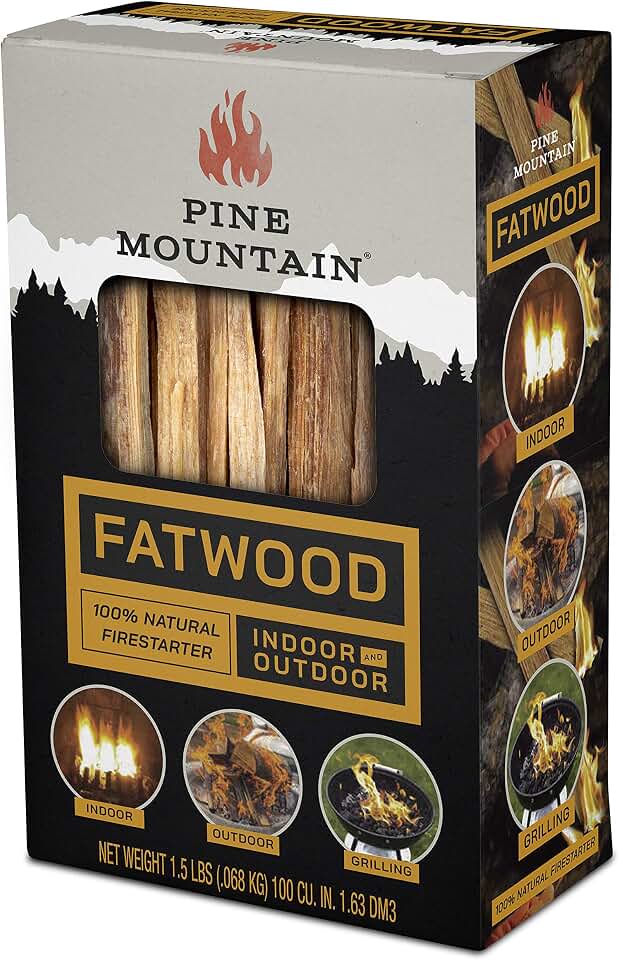
Pine Mountain Fatwood Sticks
- Natural fatwood firestarting sticks
- One and a half pound pack for occasional use
- Helps light fireplaces and wood stoves
- Suitable for indoor and outdoor fires
- Useful kindling for campfires and fire pits
Buy on Amazon

Ten-Pound Fatwood Fire Starter
- Large ten-pound box of natural fatwood
- Easy-light sticks for dependable fire starting
- Useful for fireplaces and wood stoves
- Great for fire pits BBQs and campfires
- Bulk quantity suits frequent use
Buy on Amazon
Ocote vs Fatwood, Copal, and Bocote
Ocote, fatwood, copal, pine resin, and bocote are different terms. Ocote is regional, fatwood describes resin saturation, copal is an aromatic resin category, and bocote is a dense tropical hardwood unrelated to pine.
Ocote, Fatwood, Copal, and Pine Products
| Material | What it is | Key distinction |
|---|---|---|
| Ocote | Regional name for pine trees, wood, or resinous kindling | Doesn’t prove one species or resin level |
| Fatwood | Naturally resin-saturated pinewood | Can come from many pine species |
| Copal | Aromatic tree resin, often from Bursera | Usually isn’t pinewood |
| Pine resin | Sticky secretion from a pine | Raw material rather than wood |
| Rosin | Solid residue left after resin distillation | Processed pine product |
| Turpentine | Volatile liquid distilled from pine resin | Flammable liquid, not kindling |
| Ordinary pine kindling | Dry split pine with normal resin content | Usually burns less vigorously than fatwood |
Ocote versus fatwood: not all wood cut from an ocote-named pine is fatwood, and commercial fatwood may come from a pine never called ocote. “Fatwood” describes material performance rather than taxonomy.
Ocote versus copal: copal commonly refers to aromatic resin from broadleaf trees such as Bursera. Ocote and copal may appear in related ceremonial settings, but their botanical origins and physical forms differ.
Pine resin products also need separation. Raw resin, distilled turpentine, solid rosin, and resin-bearing wood have different handling risks; never pour a liquid resin product onto an active fire.
Ordinary pine kindling can start a fire if it’s thin and dry. It often smells softer, weighs less, and needs more sustained flame than a dark, resin-heavy fatwood stick.
Ocote vs Bocote Wood and Hardness
Bocote wood—sometimes misspelled “bacote”—usually refers to decorative hardwood from Cordia species, especially Cordia elaeagnoides. Its bold dark stripes, oily feel, and fine texture bear little resemblance to ordinary Ocote Pine.
Bocote hardness is commonly listed near 2,010 lbf Janka, while Pinus oocarpa is near 550 lbf. Test source and specimen variation matter, but bocote is still far harder, heavier, and slower to machine than ocote pine.
Bocote’s oily dust can irritate skin and lungs, and its interlocked figure may tear during planing. Sharp carbide tooling, shallow cuts, and dust extraction reduce burning and chipped grain; bocote shouldn’t be confused with resinous pine fire starter.
Ocote Burning and Indoor Safety

Ocote can be used indoors as a small quantity of kindling in a functioning fireplace or approved wood stove. It still produces smoke, particles, gases, flare-ups, and residue, so natural doesn’t mean harmless.
Safe Burning, Smoke, and Creosote
Open the damper, establish draft, use one or two thin pieces, and keep a screen or stove door in place. Never leave the fire unattended or burn ocote in an unvented room, decorative gas appliance, or device whose manual bars wood starters.
Wood smoke contains fine particulate matter, carbon monoxide, volatile organic compounds, and respiratory irritants. The EPA wood-smoke guidance explains that fine particles can aggravate asthma and heart or lung conditions.
Pine doesn’t automatically cause a chimney fire. Creosote increases when wet fuel, low flue temperature, restricted draft, or prolonged smoldering sends unburned compounds into a cool chimney, where they condense.
Use resinous ocote only to establish the flame, then burn properly seasoned main fuel at the appliance’s intended rate. Arrange chimney inspection and cleaning based on use, deposit level, appliance guidance, and local fire-safety advice.
Cooking, Grilling, and Safe Storage
Don’t place food over the first smoky, resin-heavy flame. Let ocote burn down and wait for the main cooking fuel to produce a clean, stable coal bed; use only untreated wood approved for the grill or fire setup.
Store sticks in a cool, dry, ventilated container away from children, pets, sparks, heaters, and direct sun. Resin can soften in heat and bleed through cardboard, so a metal bin with a fitted lid protects shelves without trapping damp wood.
Buying and Sourcing Ocote Responsibly
Buy ocote by checking species disclosure, harvest source, added ingredients, intended appliance, stick size, and price per pound. Pine aroma alone can confirm resinous wood, but it can’t confirm a scientific species.
Visual Clues, Seller Questions, and Pricing
Useful visual and sensory clues include amber or reddish streaks, translucent resin pockets, glossy cut surfaces, extra weight, and a strong turpentine-like scent. Freshly split fatwood may feel slightly sticky and leave a bright resin line across a steel blade.
- What is the scientific species?
- Which country and forest supplied the wood?
- Was it recovered from dead stumps or cut from living trees?
- Does it contain wax, fragrance, petroleum, or another accelerator?
- Has it been painted, pressure-treated, glued, or chemically treated?
- Is it approved for fireplaces, stoves, grills, or outdoor fires?
- Is chain-of-custody or forest certification available?
Compare price per pound after shipping rather than package price. A 1.5–2-pound bag suits occasional fires, 4–5 pounds fits regular seasonal use, and a 10-pound box often costs less per fire for frequent stove or fireplace use.
Uniform thin sticks cost more because they need less splitting. Burlap, gift packaging, and the specialty “ocote” label may raise the price without improving ignition, while cheap bulk wood can contain thick pieces that require a hatchet.
Additives, Intended Use, and Sustainable Harvesting
Read the ingredient and use statements before buying. “Natural” doesn’t confirm that a product lacks wax, fragrance, accelerants, or prior treatment, and a fireplace product isn’t automatically suitable beneath food.
Prefer recovered forestry residue, naturally resinous dead stumps, traceable harvesting, and independently certified forest sources where available. Wild harvested isn’t proof of good practice: heavy stump removal can disturb soil, fungal networks, habitat, and nutrient cycling.
A responsible seller should identify the country, collection method, added ingredients, and intended use without relying on scent or tradition as proof. For lumber, request the scientific species, moisture level, grade, and treatment record before assigning structural or exterior work.
FAQs
What Is Ocote In English?
Ocote is commonly called resinous pine, pitch pine, or fatwood in English. The word is widely used in Mexico and Central America for pine wood that contains a high amount of natural resin. It is valued because it lights easily and burns with a strong flame.
What Kind Of Pine Tree Is Ocote?
Ocote is a common name for several resin-rich pine trees and their wood. In Mexico and Central America, it may refer to species such as Mexican yellow pine, including Pinus oocarpa. The exact tree can vary by region, but the wood is known for its fragrant, flammable resin.
Is Ocote The Same As Fatwood?
Ocote and fatwood are often the same thing in practical use, although the names are not always identical. Both describe resin-soaked pine wood used to start fires. Ocote usually refers to the wood or tree in Spanish-speaking regions, while fatwood is the more common English term.
What Is Ocote Used For?
Ocote is mainly used as a natural fire starter because its resin helps it ignite quickly. Small pieces can light fireplaces, wood stoves, campfires, grills, and outdoor cooking fires. It can also be used for kindling, but it burns hot and is usually best mixed with regular firewood.
Is Ocote Safe To Burn Indoors?
Ocote can be burned indoors in a properly vented fireplace or wood stove, but it should be used sparingly as a fire starter. Its high resin content creates a hot, smoky flame that may increase creosote buildup. Never burn it in an unvented space, and keep your chimney or stove pipe clean.
Affiliate Disclosure: Some links in this post are affiliate links. If you make a purchase through these links, we may earn a small commission at no extra cost to you. We only recommend products we genuinely believe in.