
Balsam Poplar Species Guide: Identification, Ecology and Uses

Balsam poplar, Populus balsamifera, is a fast-growing deciduous tree in the willow family, native to northern North America and recognized by large, sticky, fragrant winter buds. This guide covers identification, range, ecology, propagation, wood uses, aromatic buds, safety, and the naming confusion around western balsam poplar.
Table of Contents
What Is Balsam Poplar?
Populus balsamifera is a boreal and northern temperate tree that grows fastest on sunny, moist floodplains and stream terraces. Its resin-coated buds release a sweet, spicy scent that separates it from many other deciduous trees during winter.
Definition and Classification
Balsam poplar belongs to Salicaceae, the willow family, and the genus Populus, which also contains cottonwoods and aspens. The accepted scientific name is Populus balsamifera L.; Plants of the World Online provides an accepted-name and synonym record.
The tree is a deciduous broadleaf, not an evergreen. It sheds flat leaves in autumn, remains dormant through winter, and flowers in catkins rather than producing showy, petaled flowers.
Names and Synonyms
Older books may identify the species as Populus tacamahacca. Tacamahac, tacamahaca, Balm of Gilead poplar, and poplar balsam also appear in historical, forestry, and herbal sources, but these common names aren’t always limited to one species.
Balsam-Pappel is a German common name, while spellings such as Balsampappel, Balsam Pappel, and Balsampoppel occur in searches and regional writing. A label containing one of these names should still list Populus balsamifera if precise identification matters.
A mature balsam poplar commonly reaches about 18–24 m or 60–80 ft, with a trunk roughly 30–60 cm or 12–24 in across. Moisture, latitude, crowding, storm damage, and soil fertility can produce shorter trees or larger specimens.
Young trees tend to have an upright narrow crown with ascending branches. Older crowns become open and irregular, especially after ice or wind breaks the comparatively weak branches.
How to Identify Balsam Poplar
The most reliable balsam poplar identification combines pointed resinous buds, alternate finely toothed leaves, rounded or mildly compressed petioles, moist habitat, and regional range. Don’t identify it from bark or leaf shape alone because both change with tree age and shoot type.
Leaves and Petioles
Leaves are alternate, simple, and commonly 5–12 cm long, though vigorous suckers can produce larger blades. Most are ovate to broadly lance-shaped, with a pointed tip, fine teeth, a dark green upper surface, and a paler underside.
Run a fingertip gently along the edge and you’ll feel small even teeth, rather than the large rounded teeth found on bigtooth aspen. Some lower leaf surfaces carry rusty or resinous marks, but their absence doesn’t rule out the species.
The petiole is more rounded than the strongly flattened stalk of quaking aspen. Balsam poplar leaves can still flutter, so movement in the wind isn’t enough for a firm identification.
Aromatic Resinous Buds

Balsam poplar buds are large, sharply pointed, brown to reddish brown, and commonly 1.5–2.5 cm or 0.6–1 in long on vigorous shoots. Lateral buds occur alternately and often press close to the twig.
A fresh dormant bud feels tacky like soft resin. Warm it between gloved fingers and it releases a sweet, spicy, medicinal smell with hints of honey, wintergreen, and warm wood; the resin can leave a stubborn amber film on skin and tools.
Young twigs are usually yellow-brown to reddish, smooth, and marked by pale lenticels. Rubbing a twig near a bud may release the same balsamic scent, though older or weathered material can smell faint.
Young bark is smooth and gray-green to gray-brown. With age, the lower trunk develops dark furrowed bark, while upper limbs may remain smoother; this age-related change makes bark a supporting clue rather than a deciding one.
Balsam poplar is dioecious, so male and female catkins normally grow on separate trees. Male catkins shed wind-carried pollen, while female catkins develop capsules that split and release many tiny seeds.
The familiar white “cotton” consists of seed-carrying hairs, not pollen. Seed release usually occurs in late spring or early summer, but northern trees can run weeks behind trees near the southern range boundary.
- Confirm that the tree grows within a northern, boreal, floodplain, lakeshore, or streamside setting.
- Check for alternate leaves with pointed tips and fine marginal teeth.
- Compare the petiole with the strongly flattened petiole of quaking aspen.
- Inspect terminal buds for a large, narrow, pointed profile.
- Test one damaged or fallen bud for sticky resin and a strong balsamic smell.
- Look for smooth young bark and dark furrows near the base of mature trees.
- Use catkins or cottony seeds as supporting seasonal evidence.
In winter, focus on bud size and scent. During summer, combine leaves with petioles and habitat; in spring, add catkins, capsules, or cottony seed, and in autumn look for yellow foliage rather than relying on color alone.
A frequent beginner mistake is crushing several living terminal buds during identification. Use one fallen twig where possible because each terminal bud contains the next extension of that shoot.
Balsam Poplar and Similar Trees
Balsam poplar differs from aspens through its large sticky buds, more elongated leaves, and preference for moist alluvial sites. Black cottonwood is the harder comparison because it shares aromatic buds, river habitats, and a complicated taxonomic history.
Comparison Table
| Tree | Leaves and petioles | Buds | Typical habitat | Best field clue |
|---|---|---|---|---|
| Balsam poplar Populus balsamifera | Pointed, finely toothed; petiole rounded or mildly compressed | Large, pointed, sticky, strongly fragrant | Northern floodplains, wet lowlands, stream terraces | Aromatic resinous winter buds |
| Black cottonwood Populus trichocarpa | Ovate to heart-shaped; variable petiole | Large, sticky, aromatic | Western rivers, valleys, coastal and montane waterways | Western range and very large mature size |
| Quaking aspen Populus tremuloides | Nearly round; strongly flattened petiole | Smaller and less resinous | Broad range of upland and moist sites | Leaves tremble on flat petioles |
| Bigtooth aspen Populus grandidentata | Broad blade with large rounded teeth | Less sticky and aromatic | More often well-drained uplands | Coarse leaf teeth |
| Balsam fir Abies balsamea | Evergreen needles | Conifer buds, no poplar bud profile | Cool forests and moist uplands | Needles and upright cones |
No table can resolve every tree because hybrids and juvenile shoots blur neat differences. Compare several mature leaves, dormant buds, habitat, and geographic range before assigning a scientific name.
Black Cottonwood
Black cottonwood, Populus trichocarpa, occurs mainly in western North America and can reach roughly 30–50 m or 100–165 ft on favorable sites. That potential is much greater than the usual mature size of P. balsamifera.
Both trees have fragrant resinous buds and occupy wet alluvial ground. Range, mature scale, regional floras, and herbarium specimens often settle an identification more reliably than a single leaf.
Western balsam poplar usually means black cottonwood, Populus trichocarpa. Older sources may call it Populus balsamifera var. trichocarpa or subsp. trichocarpa, while many modern treatments recognize a separate species.
For quaking aspen, check the nearly round blades and thin, laterally flattened petioles described in this guide to quaking aspen wood. Aspen buds feel drier and lack the heavy coating associated with balsam poplar.
Bigtooth aspen has conspicuous rounded teeth along the leaf margin. It also favors well-drained uplands more often than balsam poplar, though local overlap can occur.
Balsam fir, Abies balsamea, is an evergreen conifer with needles and cones. The shared word “balsam” describes fragrant resin; it doesn’t signal a close relationship between the fir family and willow family.
Range, Life Cycle, and Ecology
The balsam poplar range stretches from Alaska across boreal Canada to Quebec, Labrador, and Newfoundland, then south into parts of New England, the Great Lakes region, Upper Midwest, and northern Rocky Mountain areas. Taxonomic treatment of western populations can change how a map draws the boundary.
Native Range
Balsam poplar is among the most northerly hardwoods in North America. The USDA Fire Effects Information System documents its distribution, regeneration, site relationships, and response to disturbance.
Regional records matter near range edges because planted trees and hybrids can occur outside mapped native populations. A location pin shows where a tree grows, but it doesn’t prove natural origin.
Habitat and Climate
Typical habitat includes riverbanks and floodplains, stream terraces, lake margins, wet lowlands, alluvial bars, and sunny disturbed ground. The roots benefit from continuing moisture, while young seedlings need oxygen around them and can fail in stagnant, compacted mud.
The species tolerates periodic flooding better than prolonged drought. Fresh sediment gives its tiny seeds a damp, open surface with little competition, which explains why new stands often trace recent river channels or deposits.
Winter dormancy protects the tree in a cold boreal climate. Spring warmth triggers bud swelling and catkin growth, yet frost can still damage tender expanding tissue after an unusually early warm spell.
Male and female catkins appear before or near leaf-out. Wind carries pollen from male trees, after which female capsules mature and split; the visible cotton attached to seed isn’t the pollen that triggers seasonal allergies.
Each seed has little stored energy and commonly remains viable for only days or a few weeks under natural conditions. A seed must reach moist exposed silt or mineral soil quickly, which is why a heavy cottony release can produce few seedlings.
Root suckers, stump sprouts, buried stems, and broken stem fragments support vegetative regeneration. A dense group of trunks may represent one genetic individual rather than many unrelated seedlings.
Along waterways, roots bind fresh deposits and slow bank erosion. Fallen leaves add organic matter, while the developing canopy shades sediment and creates sheltered conditions for later forest plants.
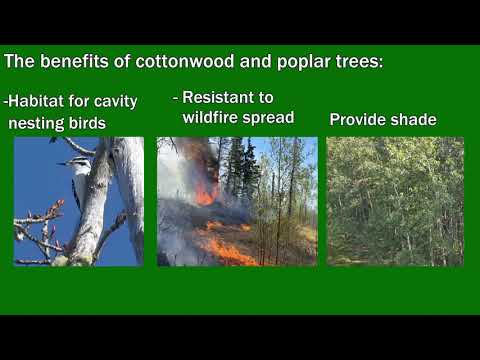
Moose, deer, beaver, snowshoe hare, porcupine, grouse, and insects may use buds, bark, foliage, twigs, or cavities. Feeding preference varies by region and season; bark gnawing that wraps around a young trunk can girdle it.
Floods can break trees yet expose new seedbeds, while fire may kill stems but leave roots capable of suckering. This disturbance response lets balsam poplar colonize open ground before shade-tolerant trees establish.
Wind and ice expose a trade-off: fast growth produces height quickly, but the light wood breaks more readily than many dense hardwoods. Damaged trunks can survive for years while decay enters through torn branch unions.
Growing Balsam Poplar
Grow balsam poplar in full sun, consistently moist aerated soil, and a location with space for a 60–80 ft tree. It suits restoration land, shelterbelts, broad stream margins, and large properties better than narrow residential planting strips.
Site Requirements
Allow substantial clearance from buildings and utilities, pavement, retaining walls, septic fields, drains, and overhead lines. The roots follow favorable moisture and may lift weak paving or enter defective pipe joints, though they don’t seek out sound concrete and intact pipes as if sensing them.
Moist loam, silt, sand, and gravelly alluvium can work if roots receive both water and oxygen. Dry compacted soil causes sparse growth, while permanently stagnant ground can suffocate fine roots.
Seed Propagation
Collect seed as capsules begin opening and sow it at once on damp, fine-textured substrate. Don’t bury it deeply; contact with a moist surface and steady light matters more than a thick soil covering.
A common propagation failure occurs when the cottony seed dries during transport. Prepare trays before collection, move seed in a cool shaded container, and mist the seedbed without washing the tiny seeds into piles.
Dormant hardwood cuttings may root when kept moist and planted with the correct end up. Mark the top before cutting, protect the lower end from moisture loss, and avoid leaving bundles in sun or drying wind.
Root suckers provide clonal planting stock, but a bare shoot with few attached roots often collapses after transplanting. Move suckers during dormancy with a broad root section and reduce the delay between lifting and planting.
Landscape drawbacks include surface roots, suckering, moisture demand, cottony seed from female trees, branch shedding, and a shorter service life than many slow-growing shade trees. Calling this native tree universally invasive is inaccurate; “vigorous colonizer” describes its behavior better in most of its native range.
Cankers, rusts, leaf spots, Cytospora-related dieback, borers, heart rot, and root injury can affect balsam poplar. Small amounts of leaf feeding are often tolerable, while large dead limbs, trunk cavities, extensive cankers, or sudden crown thinning call for an arborist’s inspection.
Yellow leaves don’t identify one disease. Check soil moisture, root disturbance, seasonal timing, drainage, and crown pattern before blaming a pathogen; sticky buds are normal resin, and white seed cotton isn’t fungal growth.
Practical Notes From Real-World Use: Newly planted trees often look healthy while spring soil stays wet, then wilt hard during their first dry summer. A wide mulch ring and deep watering over the root area work better than daily splashes beside the trunk, but mulch must stay off the bark.
Don’t stake a young tree so tightly that the trunk can’t move. Slight movement develops better trunk taper; use flexible ties only where wind threatens root stability, then remove them before they rub into the bark.
Balsam Poplar Uses and Wood
Balsam poplar uses center on pulp, paper, fiberboard, crates, pallets, core stock, utility lumber, and other applications where low weight matters more than hardness or outdoor durability. The tree also serves riparian restoration, wildlife habitat, wind protection, and limited firewood needs.
Wood Properties

The wood is pale, soft, lightweight, and usually straight to moderately textured. These traits place it among useful lightweight woods, but they also limit wear resistance and screw-holding strength.
Fresh wood feels surprisingly heavy with water, then loses much of that weight as it dries. Dull cutters can crush or fuzz the soft fibers, so sharp blades, light finishing cuts, and sanding sealer produce cleaner surfaces.
Natural decay resistance is low. Don’t use untreated balsam poplar for soil contact, exposed decking, or wet structural work; choose a more durable species or a rated treatment system suited to the application.
Forestry Uses
Industry values balsam poplar mainly as fiber and utility wood. Pulp and paper, composite panels, boxes, crates, pallets, matches, veneer cores, and lightweight components can use its workable, low-density material.
Balsam poplar shouldn’t be confused with every product sold as poplar wood. Commercial “poplar” may refer to several Populus species, hybrids, or even yellow-poplar, which belongs to a different genus.
As firewood, it burns but delivers less heat per stack than dense maple, oak, or birch. Split pieces dry faster than rounds, ignite readily once seasoned, and burn quickly, making them more useful for shoulder-season fires than long overnight heating.
Wet poplar can hiss, smoke, and leave the firebox sluggish. Stack split wood off the soil beneath a roof with open sides, then verify drying by checking the freshly split center with a moisture meter rather than judging the weathered surface.
Forestry references are most useful when their taxonomic treatment is clear. Older material may use Populus tacamahacca or place black cottonwood beneath P. balsamifera, so compare the scientific-name notes before transferring size or range data.

Balsam Poplar Silvics Guide
- Focused on Populus balsamifera
- Explores tree growth characteristics
- Useful for forestry research
- Helps identify ecological traits
- A specialized reference resource
 Buy on Amazon
Balsam Poplar Buds and Safety
Balsam poplar buds contain sticky aromatic resin traditionally infused into topical oils and salves. Traditional use and laboratory findings don’t prove that these preparations treat infection, wounds, arthritis, or another medical condition in people.
Poplar Balsam and Scent
Poplar balsam is the fragrant resin coating unopened buds, not ordinary sap from the trunk. Its chemistry can include phenolic compounds, flavonoids, volatile aromatics, and salicylate-related constituents, with proportions changing by species, location, harvest stage, and extraction method.
The balsam poplar scent is sweet and resinous, often described as spicy, honeyed, medicinal, or faintly wintergreen-like. Cold buds may smell weak, but warmth softens the resin and makes the aroma noticeably fuller.
Balm of Gilead
Balm of Gilead commonly means an infused oil or salve made with resinous poplar buds. North American products aren’t automatically the same botanical material as the ancient balm described in Near Eastern historical sources.
Commercial Balm of Gilead buds may come from Populus balsamifera, P. trichocarpa, another resinous poplar, or a cultivated hybrid. Look for a scientific name rather than relying on the common name.
Topical poplar preparations have traditionally been applied to dry or chapped skin and used in fragrant warming rubs. Indigenous practices belong to distinct communities and shouldn’t be compressed into a single broad claim without community-approved sources.
Laboratory studies of poplar extracts have reported antimicrobial, antioxidant, or anti-inflammatory activity under controlled conditions. An assay in a dish measures biological activity; it doesn’t establish an effective human dose, clinical benefit, or safe treatment protocol.
Collect dormant buds in late winter or early spring before opening, with landowner permission and any required permit. Prefer windfall or pruning material, avoid contaminated roadsides, and never strip a tree simply because the buds are abundant.
- Confirm the tree’s scientific identity before collecting.
- Check rules for private, public, Indigenous, and protected land.
- Use fallen branches or material from legitimate pruning first.
- Leave terminal buds, which direct shoot extension.
- Take a small share from several healthy trees rather than stripping one.
- Skip stressed trees, rare local populations, sprayed sites, and polluted roadsides.
Dried buds are raw botanical material, while an infused oil transfers oil-soluble material into a carrier oil. A salve adds wax or butter, and a concentrated aromatic or essential oil is a different product that requires much smaller quantities.
Fresh buds can add water to a homemade oil and encourage spoilage. Use clean, dry containers, follow a validated preparation method, discard anything with mold, gas, or rancid odor, and don’t treat a home infusion as sterile wound care.
Patch-test a small amount before wider application because poplar products can cause contact dermatitis. Stop after redness, itching, swelling, blistering, breathing trouble, or increasing discomfort, and keep salves away from eyes, mucous membranes, deep wounds, serious burns, and infected tissue.
Poplar tissues may contain salicylate-related compounds, though topical exposure isn’t equal to swallowing aspirin and product concentrations vary. People with aspirin sensitivity, aspirin-triggered asthma, anticoagulant or antiplatelet use, chronic skin disease, pregnancy, breastfeeding, or childhood use should ask a qualified clinician before application.
Don’t ingest balsam poplar essential oil. Keep concentrated oils away from children and pets, follow the supplier’s skin-dilution limits, ventilate diffusion areas, and stop if the aroma causes headache or airway irritation.
Organic certification concerns production standards; it isn’t proof of medical effectiveness or universal safety. A plant-derived product can still cause allergy, irritation, or poisoning when misidentified, concentrated, swallowed, or used on damaged skin.
Optional Botanical Products
Botanical products are optional resources, not requirements for learning about balsam poplar and not substitutes for medical care. Check identity, ingredients, extraction method, package size, origin, allergens, certification language, and seller documentation before buying.
Product and Price Checks
Compare dried buds by cost per ounce, finished salves by cost per ounce or gram, and aromatic oils by cost per milliliter. Package price alone makes a 5 mL bottle appear cheaper than an 18 mL bottle without showing which contains better value.
Verify listings just before ordering because availability, formulas, sizes, and marketplace prices can change. “Poplar oil” might mean a bud-infused carrier oil, concentrated aromatic extract, essential oil, or fragrance blend, and those products aren’t interchangeable.
Dried Poplar Buds
Dried buds should have a recognizable resinous aroma, an identified botanical source, and no dampness or visible mold. Store them sealed away from light, heat, and moisture, and check whether the listed weight refers to net botanical material.

Organic Balm of Gilead Buds
- Organic dried poplar buds
- Often known as Balm of Gilead
- Useful for herbal preparations
- One ounce bulk package
- A hands-on botanical ingredient
Buy on Amazon
A prepared poplar salve saves the time involved in infusion and wax blending, but read the complete ingredient list. Beeswax, cocoa butter, carrier oils, fragrances, and preservatives can each affect texture and allergy risk.

Balm of Gilead Repair Salve
- Made with poplar buds
- Formulated for dry skin
- Includes beeswax and cocoa butter
- Convenient ready-to-use salve
- Connects botanical lore with skincare
Buy on Amazon
Balsam poplar oils require careful label reading because infused and concentrated oils differ greatly. Confirm the scientific name, extraction method, dilution status, volume, storage directions, and whether the product is intended for diffusion or diluted topical use.

Organic Balsam Poplar Oil
- Pure balsam poplar essential oil
- USDA organic certified
- Compact five milliliter bottle
- Suitable for aromatherapy diffusion
- Captures the tree's resinous aroma
Buy on Amazon

Organic Balsam Poplar Oil
- Pure balsam poplar essential oil
- USDA organic certified
- Generous eighteen milliliter size
- Suitable for aromatherapy diffusion
- Captures the tree's resinous aroma
Buy on Amazon
FAQs
How Can You Identify A Balsam Poplar Tree?
You can identify a balsam poplar by its sticky, fragrant buds, shiny leaves, and deeply furrowed gray bark. The leaves are oval to triangular, with pale undersides and finely toothed edges. Mature trees often grow near rivers, wetlands, and other moist ground, reaching impressive heights.
Is Western Balsam Poplar The Same As Black Cottonwood?
Western balsam poplar is commonly considered the same tree as black cottonwood. Both names often refer to Populus trichocarpa in western North America, though some references classify it as a balsam poplar subspecies. Local field guides may use either name, so check the scientific name when certainty matters.
What Do Balsam Poplar Buds Smell Like?
Balsam poplar buds smell sweet, resinous, and strongly balsamic. Many people compare their scent to honey, vanilla, pine, or fresh spring air. The fragrance is strongest when the sticky buds are warmed between your fingers, which helps release their aromatic resin.
What Are Balsam Poplar Buds Used For?
Balsam poplar buds are commonly used to infuse oils, salves, and fragrant balms. Their sticky resin gives preparations a warm, sweet aroma and has a long history in traditional herbal practices. Harvest only fallen or spare buds responsibly, and avoid using homemade remedies on broken skin without professional advice.
Does Balsam Poplar Make Good Firewood?
Balsam poplar can be used as firewood, but it is not a top choice for long-lasting heat. It burns relatively quickly and produces less heat than dense hardwoods such as oak or maple. Season it thoroughly before burning, and use it for kindling, shoulder-season fires, or mixed wood loads.
Affiliate Disclosure: Some links in this post are affiliate links. If you make a purchase through these links, we may earn a small commission at no extra cost to you. We only recommend products we genuinely believe in.