

Quebracho is the common name for several dense South American trees, chiefly red Schinopsis species and white quebracho, Aspidosperma quebracho-blanco. Their wood is known for extreme hardness, tannin-rich heartwood, natural durability, heavy construction uses, dye extracts, and long-burning charcoal.
Table of Contents
What Is Quebracho?
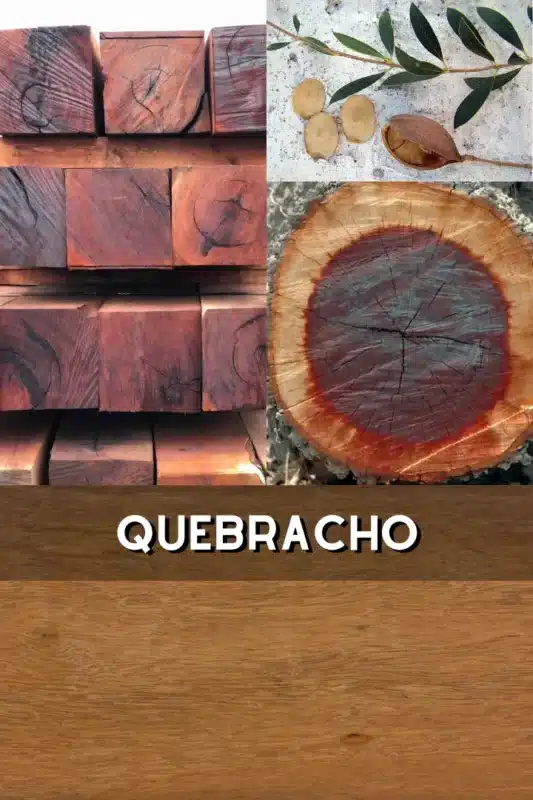
Several trees share the name quebracho, so it doesn’t identify one botanical species. The term can describe a living tree, dense lumber, tannin extract, dye powder, bark preparations, or lump charcoal.
Direct Definition
Quebracho is a group name applied to hard trees native to South America. Red quebracho normally means species in the genus Schinopsis, while white quebracho means Aspidosperma quebracho-blanco, a separate tree from a different botanical family.
The Axe-Breaker Name
Axe-breaker wood is an apt translation of the Spanish expression quiebra hacha. A sharp edge meets heavy resistance in dry red quebracho, and a dull blade can rub, squeal, and leave a faint scorched smell rather than producing a clean shaving. That cutting resistance gave the quebracho tree its memorable name.
Quebrache and Cobracho Spellings
Quebracho is standard in English-language botanical and timber references. “Quebrache” is commonly a misspelling or language-specific variation, while “cobracho” sometimes appears in searches and informal trade listings. A seller using either spelling should still provide the scientific species name.
Tree, Wood, and Products
Product form changes meaning. Quebracho wood refers to timber; quebracho tannin usually means a concentrated heartwood extract; charcoal may come from white quebracho or a species blend; and a supplement might contain bark, polyphenols, or a highly diluted homeopathic preparation. These materials aren’t interchangeable.
Quebracho Species and Native Range
Red and white quebracho grow mainly in the Gran Chaco, but they aren’t close botanical equivalents. Scientific names matter because wood properties, chemistry, habitat, and commercial uses differ by species.
Families and Taxonomy
Two families are involved: red Schinopsis quebrachos belong to Anacardiaceae, the cashew and sumac family, while Aspidosperma quebracho-blanco belongs to Apocynaceae. Accepted names and historical synonyms can be checked through Plants of the World Online.
Red Quebracho and Colorado
Quebracho colorado means red quebracho. The name usually covers tannin-rich Schinopsis trees with reddish-brown heartwood, yet regional timber markets may apply it to more than one species. “Colorado” describes color rather than establishing a precise botanical identity.
Schinopsis balansae
Schinopsis balansae is associated with northeastern Argentina, Paraguay, and wetter eastern Chaco forests. Its common names include quebracho colorado chaqueño. The dense, durable heartwood has served in posts, sleepers, structural work, charcoal, and industrial tannin extraction.
Schinopsis lorentzii
Schinopsis lorentzii, often called quebracho colorado santiagueño, is strongly linked with the drier western Gran Chaco. Dealers may combine it with other Schinopsis timber under “red quebracho,” making species-level figures more reliable than a broad commercial label.
White Quebracho
White quebracho is distinct, not a pale form of red quebracho. Aspidosperma quebracho-blanco has lighter wood, different bark chemistry, and a strong presence in commercial charcoal. It remains hard and heavy, but red quebracho density and tannin figures shouldn’t be copied onto it.
Species Comparison Table
| Feature | Red quebracho | White quebracho |
|---|---|---|
| Principal genus | Schinopsis | Aspidosperma |
| Botanical family | Anacardiaceae | Apocynaceae |
| Representative species | S. balansae, S. lorentzii | A. quebracho-blanco |
| Typical heartwood color | Brick red to deep reddish brown | Pale yellow to light brown |
| Main commercial associations | Heavy timber, tannin, dye, charcoal | Timber, charcoal, bark preparations |
| Common labeling risk | Several species grouped together | Mistaken for a pale red quebracho |
Common names hide differences, so this table works as an initial identification guide rather than proof of species. Leaves, bark, flowers, fruit, origin records, and verified botanical documentation provide stronger identification than color alone.
Quebracho vs. Baraúna Wood
Baraúna wood isn’t quebracho, though both names can refer to dense South American trees in Anacardiaceae. Baraúna commonly means Schinopsis brasiliensis, a Brazilian species with dark, durable timber. Similar genus placement doesn’t make its range, conservation position, or measured properties identical to Gran Chaco red quebracho.
Gran Chaco Range
The Gran Chaco spans large areas of Argentina, Paraguay, and Bolivia, plus a smaller part of Brazil. This subtropical plain includes dry forests, thorn scrub, savannas, wetlands, and seasonally flooded ground. Different quebracho species track variations in rainfall, drainage, soil, and fire exposure.
Habitats and Ecological Role
Mature trees shape habitat by storing carbon, stabilizing soil, casting shade, and providing food or shelter for insects, birds, and other wildlife. Slow growth and long replacement periods make repeated heavy cutting hard to reverse, while full agricultural conversion removes the wider forest community rather than selected trees alone.
Quebracho Wood Properties and Workability

Quebracho wood is exceptionally hard, heavy, wear-resistant, and demanding to machine. Representative red quebracho figures reach 1,200–1,250 kg/m³ in dried stock and about 4,570 lbf on the Janka scale, but species and moisture condition affect every comparison.
Density: 1,200–1,250 kg/m³
Commercial red quebracho density is often reported near 1,200–1,250 kg/m³, equal to roughly 75–78 lb/ft³. Those values place it near the upper end of a typical wood density chart. Moisture level, growth site, and species grouping can shift the measured result.
Janka Hardness: About 4,570 lbf
About 4,570 lbf, or 20,300 N, is a frequently cited Janka value for red quebracho. It is far above white oak, hard maple, and black walnut, yet it shouldn’t be called the uncontested hardest wood. Test standards, moisture, orientation, and natural variation change rankings.
Hardness isn’t toughness. Janka testing measures resistance to indentation by a steel ball; it doesn’t directly measure bending strength, impact resistance, splitting, blade wear, or outdoor durability. The wood hardness scale is most useful when compared under matching test conditions.
Color, Grain, and Durability
Red quebracho heartwood ranges from warm brick red to deep reddish brown and darkens with air and light. Its grain may run irregularly or interlock, while the fine-to-medium texture feels glassy after high-grit sanding. Lighter sapwood lacks the heartwood’s full decay resistance.
Natural durability is high, which explains its history in sleepers, posts, pilings, bridges, and heavy flooring. Durability doesn’t mean immunity: exposed end grain, trapped moisture, sapwood, ground contact, and local insects can still shorten service life. Construction detailing remains as meaningful as species choice.
Why Some Pieces Sink
Some quebracho sinks because its density can exceed water’s approximate 1,000 kg/m³ density. A dry-looking offcut may drop with a solid plunk rather than float, but air pockets, sapwood, moisture, cracks, and piece-to-piece density variation can keep another sample at the surface.
Drying and Checking Risks
Dense stock dries slowly and can develop end splits, surface checks, internal stress, or distortion when moisture leaves too fast. Freshly exposed end grain should be sealed, and thick sections need a conservative drying schedule. Bringing cold lumber straight into a dry heated shop invites fresh hairline checks.
Machining and Tool Wear
Sharp carbide tooling gives the cleanest results. Ordinary steel edges dull quickly, and slow feeding against a blunt cutter creates heat, brown burn marks, and an acrid warm-wood odor. Take light passes, maintain a steady feed, support interlocked grain, and replace abrasives before they glaze.
Real-world workshop lesson: don’t judge the tool by whether it still cuts softer wood. A blade that feels acceptable in pine may already be too dull for quebracho. Listen for rising pitch, feel for increasing feed resistance, and stop before heat damages the stock or cutter.
Fastening, Gluing, and Finishing
Predrill every fastener and use a properly sized clearance hole where the screw shank passes through the first piece. Driving a screw directly can split an edge or snap the screw. Lubricating threads with wax can reduce torque, but keep wax away from surfaces that will receive adhesive.
Fresh bonding surfaces work better than polished, dusty faces. Sand at a moderate grit, remove dust, follow the adhesive maker’s surface-preparation rules, and test on scrap. Dense extractive-rich wood can slow curing or weaken some bonds, while oily finishes may remain tacky longer than expected.
Dust and Iron Staining
Control fine dust with extraction, a fitted respirator, and clean clothing. Dust from unfamiliar tropical wood can irritate skin, eyes, or airways. Wet tannin-rich wood also reacts with iron, leaving blue-black marks, so use clean benches, nonferrous scrapers, or protected steel surfaces.
Quebracho Tannins and Extract Production
Red quebracho heartwood is a major commercial source of condensed vegetable tannins. Producers chip the wood, extract soluble compounds with hot water, concentrate the liquid, and sell it as solid, powder, or chemically modified extract.
Tannin-Rich Heartwood
Extractable tannin content may reach roughly 20% or more in suitable red quebracho heartwood, though percentages depend on species, tree, wood zone, moisture basis, and extraction method. Bark, sapwood, raw sawdust, and standardized extract shouldn’t receive the same concentration claim.
Condensed Tannin Chemistry
Condensed tannins dominate quebracho extract. These polyphenolic compounds bind with proteins, which makes them valuable in vegetable leather tanning. Their structure and reaction behavior differ from hydrolysable tannins found in materials such as chestnut or gallnuts.
Profisetinidins and Polyphenols
Profisetinidin-type structures are closely associated with quebracho’s condensed tannins. Molecular size, branching, pH, and chemical modification affect solubility, astringency, hide penetration, adhesive behavior, and color. Reviews of tannin chemistry and industrial use are available through Polymers.
Hot-Water Extraction
Extraction starts with chips or ground heartwood. Hot water pulls soluble tannins from the wood; filtration removes fibers, evaporation concentrates the liquor, and drying creates powder or solid extract. Temperature and time need control because harsh processing can change color, viscosity, and reactivity.
Sulfited Soluble Extract
Sulfitation improves solubility by chemically modifying condensed tannins that otherwise disperse poorly in cool water. “Soluble quebracho” is useful where fast mixing and penetration matter, but it isn’t identical to raw heartwood powder. Formulation instructions should state concentration, pH range, and intended industrial use.
Powder, Dye, and Extract Forms
- Ground wood or bark: minimally processed plant material with variable tannin content.
- Hot-water extract: concentrated soluble material made from chipped heartwood.
- Sulfited powder: modified extract that disperses more readily in water.
- Natural dye: extract sold for textile, leather, paper, or craft coloring.
- Specialized tannin: a standardized product for leather, wine processing, adhesives, or animal research.
Read the intended-use label before handling any powder. Industrial tanning extract isn’t automatically food grade, and ground bark won’t behave like a soluble standardized tannin. Gloves and local dust capture prevent the dry, mouth-puckering dust from coating skin and airways.
What Is Quebracho Used For?
Quebracho serves many roles: heavy timber, railway sleepers, posts, turned objects, leather tannin, natural dye, charcoal, adhesive ingredients, and research extracts. In Spanish, “quebracho para qué sirve” has the same basic answer, but the correct use depends on the species and product form.
Heavy Timber and Turning
Heavy-duty uses suit it better than portable furniture. Posts, sleepers, bridge parts, industrial blocks, flooring, and wear surfaces benefit from density and durability. Turning produces crisp details with sharp carbide tools, yet a large blank feels startlingly heavy and can magnify lathe imbalance, so low starting speed is prudent.
Leather Tanning
Quebracho tannin binds hide proteins and helps turn raw hides into stable leather. Extract concentration, sulfitation, liquor pH, temperature, and drum timing affect penetration and surface color. Adding strong extract too early may tan the outer layer faster than the center, producing uneven leather.
Natural Dye
Quebracho dye creates tan, rust, reddish-brown, or deeper brown shades. Fiber type, water hardness, pH, extract strength, heat, and mordant choice alter the result. Iron darkens tannin-rich baths sharply, so add it in measured amounts; too much can produce a dull gray-black and weaken some fibers.
White Quebracho Charcoal
White quebracho charcoal is sold for grilling, smoking, restaurants, and kamado cookers. Dense, large lumps can support steady high heat, making the material a candidate for the best lump charcoal for kamado grills, but species alone doesn’t guarantee clean lighting, low ash, or a long burn.

Quebracho Lump Charcoal for Grilling
- Made from white quebracho wood
- Extra large natural lump pieces
- Ideal for grilling and smoking
- Restaurant-style charcoal performance
- Generous 20 pound bag
 Buy on Amazon
Charcoal Quality Variables
Burn quality depends on production, including carbonization temperature, fixed-carbon percentage, residual moisture, lump size, airflow, ash content, and fines. A cheap bag can lose value when its lower third contains dusty fragments that choke a kamado fire. Large, dry, evenly carbonized pieces tend to respond more predictably.
“Without chemicals” needs context. Natural lump charcoal is carbonized wood, but packaging should still disclose binders, ignition additives, species blends, and country of production. Avoid products with a chemical odor or visible lighter-fluid treatment if you’re looking for charcoal without added ignition agents.
Carbon Monoxide Safety
Never burn charcoal indoors, in a tent, vehicle, garage, shed, or poorly ventilated patio. Charcoal creates odorless carbon monoxide during ignition and continued burning, including when lumps appear nearly spent. Use it outdoors, keep grills away from openings, and let ash cool fully before disposal.
Adhesives and Engineered Materials
Condensed tannins can replace part of the petrochemical ingredients in selected resins and composite-board adhesives. Performance depends on tannin modification, catalyst, pressing temperature, moisture, and substrate. A promising laboratory formulation isn’t automatically ready for factory production, where storage life and press-cycle speed affect feasibility.
Animal Nutrition Research
Quebracho tannins are studied for effects on rumen fermentation, protein use, parasites, and methane output. Results vary with animal species, diet, dose, and extract chemistry. High intake can reduce palatability or nutrient availability, so experimental findings don’t justify adding unmeasured tanning extract to animal feed.
Supplements and Homeopathy
Medical claims require caution. White quebracho bark has a history in respiratory preparations, while other products use red quebracho polyphenols or highly diluted homeopathic ingredients. Traditional use doesn’t prove that a product treats asthma, cough, digestive disorders, or another condition.
Check four label details: scientific name, plant part, extraction method, and amount per serving. Concentrated tannins can irritate the digestive tract, and Aspidosperma bark contains biologically active alkaloids. Pregnancy, breastfeeding, childhood use, chronic illness, and drug use call for qualified medical advice; NCCIH supplement guidance explains broader safety limits.
Homeopathic dilutions differ from measurable plant extracts. A 30C or 200C preparation shouldn’t be described as chemically equivalent to bark powder or standardized tannin. Neither form should replace diagnosis, emergency care, prescribed medicine, or evidence-based treatment.
History of the Quebracho Industry
Quebracho became an export commodity because its wood combined durable structural service with abundant vegetable tannins. Railways opened inland forests to large-scale cutting and moved logs or concentrated extract from Chaco factories to overseas leather markets.
Indigenous and Local Uses
Local uses came first, including fuel, posts, construction, tools, dyes, and plant preparations. These practices varied among communities and species. They shouldn’t be collapsed into one generic tradition, nor equated with the later industrial system that removed timber across much larger areas.
Railways and Tannin Exports
Rail lines changed extraction scale. Quebracho supplied durable sleepers while the same transport network carried logs and tannin from remote forests. International leather demand made concentrated extract easier and more valuable to ship than untreated wood alone.
La Forestal and Labor
La Forestal dominated much of the industry in northern Argentina through company towns, forests, transport links, and tannin factories. Its history includes harsh labor control, worker conflict, concentrated land ownership, and communities left vulnerable when extraction or processing ended.
Industrial Extraction Legacy
The legacy remains visible in altered forests, former factory settlements, railway corridors, and regional economic patterns. Synthetic tanning agents later reduced some demand for vegetable extract, yet quebracho persisted in leather, charcoal, specialty timber, and newer tannin-based material research.
Industry Timeline
| Period | Development | Lasting effect |
|---|---|---|
| Before industrial expansion | Indigenous and local use of trees for fuel, structures, tools, and plant preparations | Regional knowledge tied to distinct species and habitats |
| Late 19th century | Railway construction and rising demand for sleepers and tannins | Remote forests became accessible to export markets |
| Early 20th century | Large tannin factories and company-town systems expanded | Intensive logging, labor control, and forest change |
| Mid-to-late 20th century | Synthetic tanning materials gained market share | Factory closures and local economic disruption |
| 21st century | Charcoal, specialty timber, leather tannin, and material research continue | Traceability and habitat conversion remain buyer concerns |
This timeline links materials with people and land use. Treating quebracho history as a story of unusually hard wood misses how transport, labor systems, export demand, and factory ownership shaped the Chaco.
Sustainability and Responsible Buying
Responsible quebracho buying requires species identification, origin records, legal-harvest evidence, and product-specific quality data. A tree’s global conservation category can’t answer whether one shipment came from converted habitat or poorly documented cutting.
Gran Chaco Forest Pressures
Forest conversion is a major risk across parts of the Gran Chaco. Cattle ranching, soy production, roads, fragmentation, charcoal production, and illegal cutting can act together. Regional tree-cover patterns can be explored through Global Forest Watch, though map alerts don’t replace field verification or legal records.
Species Status vs. Habitat Loss
Species status and habitat loss answer different questions. A widespread species might receive a lower global threat category while local stands decline, become fragmented, or lose older trees. “Is quebracho endangered?” must identify the species, country, population, and date of assessment.
Wood Labels and Moisture
A useful lumber label lists the botanical name, commercial grouping, origin, dimensions, grade, defects, and measured moisture content. Ask whether checks extend beyond the surface and whether ends were sealed. Dense boards sold wet can lose usable width or split after delivery.
Charcoal Blends and Fines
Inspect blend disclosure, country of production, net weight, lump distribution, moisture, and ash claims. Shipping vibration creates some breakage, but a bag dominated by fines restricts airflow and reduces usable fuel. Compare cost per usable pound rather than package price alone.
Tannin and Dye Labels
Identify the exact form: ground wood, bark powder, concentrated extract, sulfited extract, or prepared dye blend. Ask for tannin content, solubility, additives, batch instructions, and intended market. A craft dye and an industrial leather chemical can share a color description while carrying different handling rules.
Extract and Supplement Labels
Never infer ingestibility from the word “natural.” Labels should name the species, plant part, extraction solvent, concentration, serving amount, other ingredients, and testing standard. Industrial quebracho extract can contain no directions or controls suitable for human use.
Pricing Units and Shipping
Prices use different units: lumber per board foot or cubic metre, charcoal per pound or kilogram, dye per ounce, turning blanks per piece, and supplements per serving. Quebracho’s high mass makes freight a large part of delivered cost, particularly for small lumber orders and charcoal bags.
Origin and Chain of Custody
Request origin documents that connect harvest region, processor, exporter, and retailer. Vague phrases such as “South American hardwood” or “restaurant-grade charcoal” don’t establish legality or forest practice. Keep invoices and species declarations with the material, especially for architectural or commercial work.
FSC and Reclaimed Wood
Certification can improve traceability when the certificate scope and chain-of-custody code cover the actual product. Verify claims rather than trusting a logo alone. Reclaimed sleepers, posts, or industrial stock can reduce demand for fresh cutting, but test for oils, preservatives, embedded metal, and structural cracks before reuse.
Frequently Asked Questions
These concise answers cover the most common questions about quebracho species, hardness, density, regional names, and conservation. Numerical values refer mainly to commercial red Schinopsis wood rather than every tree sold under the common name.
Is Quebracho One Species?
No, quebracho isn’t one species. The name most often covers red quebrachos such as Schinopsis balansae and Schinopsis lorentzii, plus white quebracho, Aspidosperma quebracho-blanco. Red and white quebracho belong to different botanical families.
Is It the Hardest Wood?
It is among the hardest commercially known woods, with a commonly reported red quebracho Janka value near 4,570 lbf. It isn’t safe to name one universal winner because species identification, moisture, test method, and natural variation affect hardness figures.
Does Quebracho Wood Sink?
Some red quebracho sinks because dried density may reach 1,200–1,250 kg/m³, above the approximate density of water. Sapwood, internal air, cracks, moisture, and natural variation mean that one sample may float while another falls below the surface.
What Is Quebracho Colorado?
Quebracho colorado means red quebracho and usually refers to tannin-rich trees in the genus Schinopsis. Regional names can cover multiple species, so use Schinopsis balansae, Schinopsis lorentzii, or another verified scientific name when precision matters.
Is Quebracho Endangered?
No single answer covers all quebrachos. Conservation status differs by species and assessment date, while Gran Chaco habitat loss can threaten local forests regardless of a tree’s global category. Buyers should examine scientific identity, harvest region, legality, chain of custody, and certification together.
FAQs
What Is Quebracho Wood Used For?
Quebracho wood is used for durable outdoor products, heavy construction, flooring, and tannin extraction. Its exceptional density and natural resistance to decay make it useful for fence posts, railroad ties, and decking. The bark and heartwood have also been widely used to produce vegetable tanning agents for leather.
What Is The Difference Between Red And White Quebracho?
Red and white quebracho differ mainly in species, color, density, and tannin content. Red quebracho, usually Schinopsis balansae or lorentzii, is darker and especially valued for strong tannins and very hard timber. White quebracho, often Aspidosperma quebracho-blanco, is paler, less tannin-rich, and used differently in woodworking and industry.
Why Is Quebracho Called The Axe-Breaker Tree?
Quebracho is called the axe-breaker tree because its wood is extremely hard and dense. The name comes from the Spanish phrase quebra hacha, meaning “break axe.” Cutting or shaping the timber can quickly dull ordinary tools, so workers typically use sharp, heavy-duty equipment designed for dense hardwoods.
Does Quebracho Wood Sink In Water?
Yes, quebracho wood generally sinks in water because it is exceptionally dense. Its density is often greater than water, especially when the wood is dry and sound. Small pieces may behave differently if they contain air pockets or have been altered, but solid quebracho is widely known for sinking.
Is Quebracho Endangered?
Some quebracho species face conservation pressure, but their status varies by species and region. Logging, habitat loss, and demand for tannins and hardwood have reduced natural populations in parts of South America. Choose responsibly sourced products and check current assessments from organizations such as the IUCN for the specific species.
Affiliate Disclosure: Some links in this post are affiliate links. If you make a purchase through these links, we may earn a small commission at no extra cost to you. We only recommend products we genuinely believe in.