Rainbow Eucalyptus Wood Guide: Color, Properties, Uses, and Buying

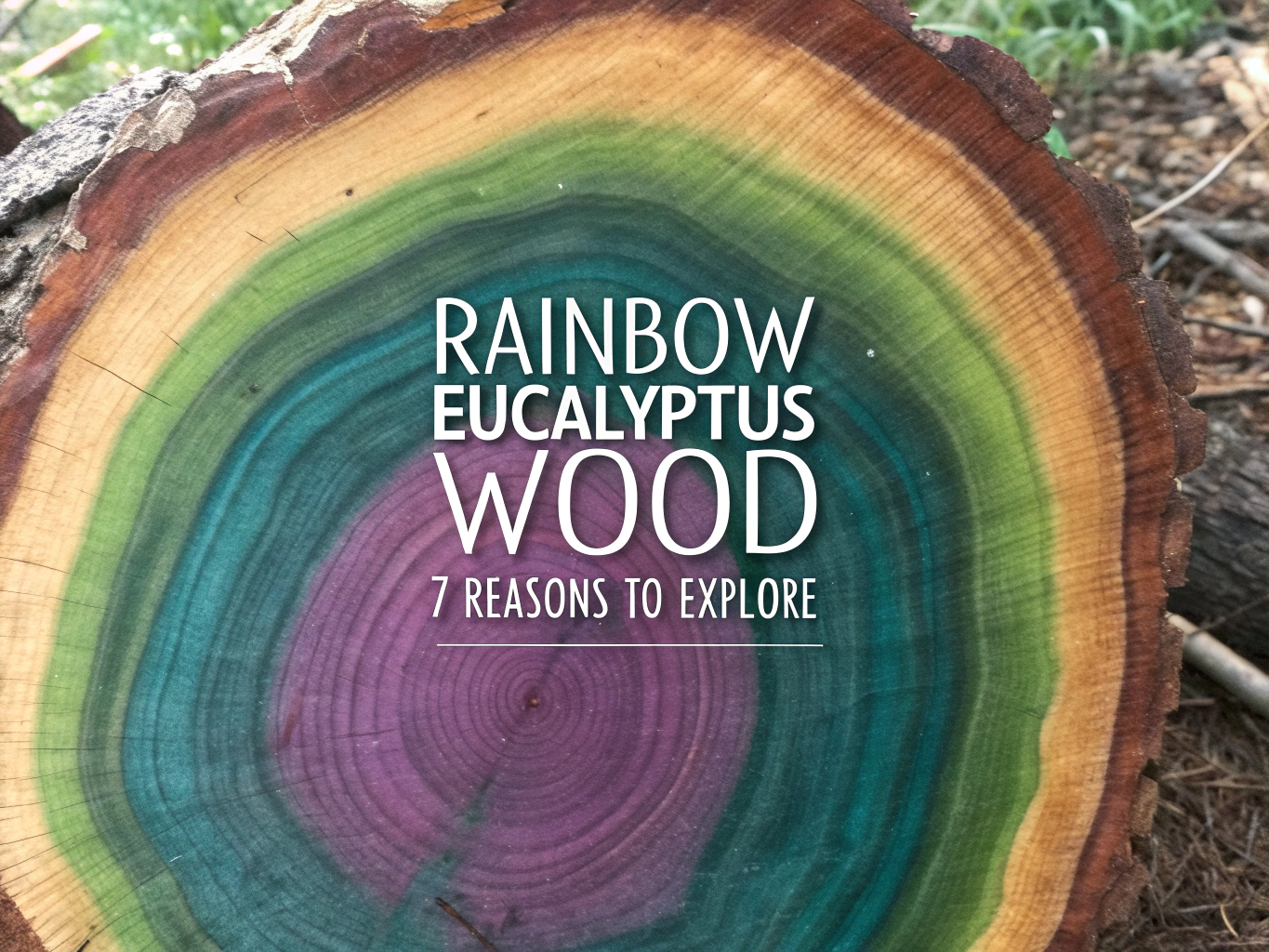
Rainbow eucalyptus wood isn’t naturally rainbow-colored inside: the famous green, blue, purple, orange, and red bands form in the living bark, while sawn heartwood is usually reddish to medium brown. This guide explains the timber’s properties, uses, drying risks, buying checks, and differences from blue gum eucalyptus.
Table of Contents
Is Rainbow Eucalyptus Wood Actually Rainbow?
The answer is no: the color is bark, not rainbow pigment running through the trunk. Cut rainbow eucalyptus wood normally reveals pale sapwood around reddish-brown or medium-brown heartwood, much like several other commercial eucalyptus woods.
Color Inside the Wood and Rainbow Bark Development
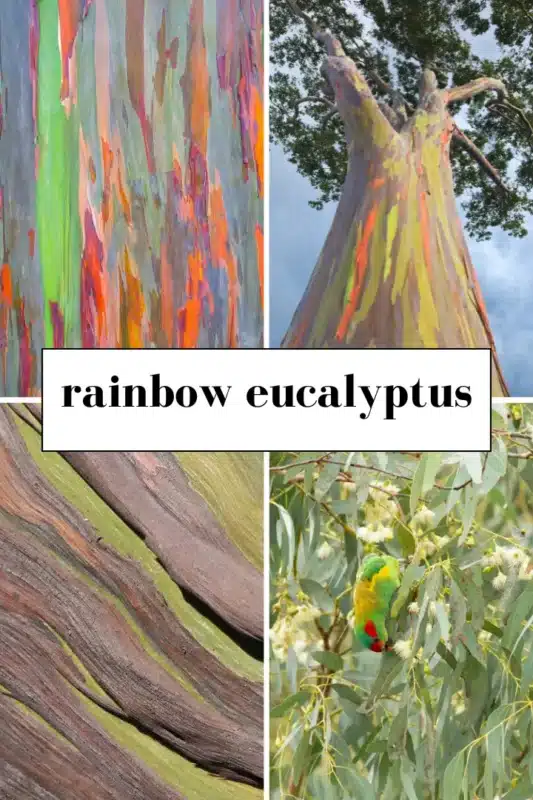
Freshly exposed inner bark starts bright green. Sunlight, oxidation, moisture, and aging change separate patches through teal, blue, purple, orange, red, maroon, and brown. Since the tree sheds patches at different times, its trunk carries several stages at once.
The rainbow effect stays near the trunk’s exterior. Removing the bark removes nearly all the dramatic color, so a rainbow eucalyptus inside view often surprises buyers expecting blue or orange grain. The natural board can still show ribbon figure, color variation, and darker streaks, but it won’t copy the living trunk.
Bark saturation varies with tree age, health, rainfall, light, and the current shedding cycle. Online photographs may use heavy saturation, while an actual trunk can look softer and earthier; wet bark feels slick and cool, and its green patches become richer after rain.
Bark Color Variations and Bark-On Wood Limitations
A bark-on bowl, slab, or branch section may retain patches of temporary surface color. Drying then changes the display: green areas dull, orange areas darken, thin strips curl, and bark may separate as wood and bark shrink at different rates.
Loose bark can conceal insects, eggs, fungal staining, and damp pockets. Before bringing bark-on stock into a workshop, isolate it, inspect holes and frass, follow local heat-treatment rules, and remove unstable bark rather than trusting a clear coating to hold it indefinitely.
Products advertised as rainbow wood require close inspection. Bright colors extending through the full thickness usually indicate dyed laminated hardwood, Pakkawood, Spectraply-style material, resin-stabilized blanks, or colored veneer—not natural Eucalyptus deglupta.
| Material | Typical appearance | What happens after cutting |
|---|---|---|
| Natural rainbow eucalyptus | Multicolored living bark | Brown timber appears beneath the bark |
| Bark-on rainbow eucalyptus | Colored patches on the outside | Bark can fade, crack, flake, or detach |
| Dyed laminated wood | Regular, intensely colored layers | Colors continue through the blank |
| Resin-stabilized wood | Bright color within pores or cracks | Color remains after shaping |
Rainbow Eucalyptus Tree Identification
The rainbow eucalyptus tree is Eucalyptus deglupta Blume, a broadleaf evergreen in the Myrtaceae family. It is a botanical hardwood and the eucalyptus species best known for a natural range extending north of the equator.
Botanical Identity, Common Names, and Native Range
Common names include rainbow eucalyptus, rainbow gum, Mindanao gum, Mindanao eucalyptus, and Indonesian gum. The informal phrase eucalyptus rainbow tree refers to the same species, though sellers sometimes apply it loosely to unrelated seedlings.
Its native range covers tropical parts of the Philippines, Indonesia, and Papua New Guinea. Plants of the World Online provides accepted botanical naming and distribution records; a seller’s common name alone isn’t equal to a documented species identity.
Outside its native range, the tree grows in warm areas such as Hawaii, Puerto Rico, and southern Florida. It prefers humid lowland conditions and steady rainfall, unlike several hardwood trees that tolerate prolonged frost or dry winters.
Tree Size, Growth, and Landscape Risks
Under favorable native conditions, mature trees can reach about 60–75 meters or 197–246 feet. Exceptional trunks approach 2.4 meters, nearly 8 feet, in diameter; ornamental trees are often smaller but can still overwhelm a residential lot.
Fast growth creates a wide crown, heavy leaf and branch litter, and an extensive root system. Falling limbs, storm exposure, lifted pavement, blocked gutters, and conflicts with foundations or utility lines matter more than the tree’s modest nursery size suggests.
A frequent beginner mistake is planting near a house because the young trunk appears slender. The safer workaround is to plan from the mature canopy, leave broad clearance on every side, and ask a local arborist about wind exposure, soil depth, and regional planting rules.
Rainbow Eucalyptus Wood Properties
Rainbow eucalyptus timber is a moderately heavy hardwood with average dried weight near 41 lb/ft³ or 655 kg/m³ and Janka hardness near 1,070 lbf. Its interlocked grain and high shrinkage often affect a project more than its hardness does.
Color, Appearance, Hardness, Density, and Strength
Heartwood usually ranges from reddish brown to medium brown and may deepen with age. Sapwood is paler and sometimes poorly defined. Clear finish brings out warm brown grain but can’t recreate green, blue, or purple bark colors; see the broader guide to wood colors for comparison.
| Property | Approximate reference value | Practical meaning |
|---|---|---|
| Average dried weight | 41 lb/ft³; 655 kg/m³ | Moderately heavy boards and slabs |
| Basic specific gravity | 0.50 | Moderate dry mass relative to green volume |
| Specific gravity at 12% MC | 0.66 | Useful for weight and machining comparisons |
| Janka hardness | 1,070 lbf; 4,760 N | Moderate dent resistance |
| Modulus of rupture | 15,680 psi; 108.1 MPa | Reference bending strength |
| Modulus of elasticity | 1.963 million psi; 13.54 GPa | Reference stiffness |
| Crushing strength | 7,840 psi; 54.1 MPa | Reference compression strength |
| Radial shrinkage | 6.5% | Movement across growth rings |
| Tangential shrinkage | 12.2% | Higher movement along growth rings |
| Volumetric shrinkage | 19.7% | Large green-to-oven-dry volume loss |
| T/R ratio | 1.9 | Meaningful cupping and distortion risk |
These are average reference values, not promises for each board. Site, age, growth rate, position in the trunk, moisture content, and test method change the result. Published figures are useful for comparison, while physical inspection governs buying and joinery decisions.
At roughly 1,070 lbf, this species sits in a useful middle range on the wood hardness scale. It resists ordinary dents better than many softwoods, yet its reversing grain can make it feel harder under a planer than its Janka figure implies.
Shrinkage, Stability, Grain, Texture, and End Grain
The 12.2% tangential and 6.5% radial shrinkage figures produce a T/R ratio of 1.9. Wide flatsawn boards face greater cupping risk than narrow or quartersawn stock, while an apparently flat green slab can change shape as its wet core catches up with the surface.
Grain is commonly interlocked, texture is medium to coarse, and natural luster tends to be low. Quartersawn faces may display ribbon-like bands where grain direction reverses; those same bands feel alternately smooth and fuzzy when a hand passes across a freshly planed face.
Rainbow eucalyptus is a diffuse-porous hardwood. End grain commonly has medium-to-large pores, solitary vessels and short radial multiples, occasional tyloses, vasicentric parenchyma, and narrow rays. These traits support identification but rarely prove species without microscopy or a traceable sample.
Property variation can be substantial in plantation material. Rapid juvenile growth may produce stock that behaves differently from mature trunk wood, while boards near the pith often contain more growth stress. Rejecting boxed-heart pieces can prevent dramatic splits after resawing.
Drying and Working the Wood
Slow, controlled drying is the main requirement for usable rainbow eucalyptus lumber. Rushed stock can develop end checks, honeycombing, cupping, bowing, twist, surface checks, and fungal discoloration before the core reaches a suitable moisture level.
Common Drying Defects, End Sealing, Stacking, and Moisture
Seal log and board ends soon after cutting with a commercial end-grain sealer. Thick end paint slows moisture loss less consistently, while ordinary plastic wrapped tightly around wet wood can trap warmth and produce sour odors, mold, or blue-gray sticker stain.
- Use dry, uniform stickers aligned vertically through the stack.
- Support the pile on a flat, rigid base above damp ground.
- Keep direct sun and rain off the boards while preserving airflow.
- Place moderate weight over the top layer to limit bowing.
- Check end grain, board faces, and stack temperature regularly.
- Dry thick slabs more slowly than one-inch boards.
- Record moisture readings instead of relying on touch.
A wet slab may feel dry and slightly chalky at the surface while holding high core moisture. Pin readings at several depths give better guidance than one shallow measurement, though meter correction may be needed for species density and temperature.
Indoor furniture stock often settles near 6–10% moisture content in conditioned buildings, but the proper target follows the destination’s equilibrium moisture content. Acclimate boards before final flattening and cut joinery only after the moisture reading stabilizes.
Readers comparing air drying with controlled schedules can use this guide to kiln-dried wood. A kiln can shorten drying time, but aggressive heat applied before the core is ready can lock in stress and internal honeycombing.
These moisture meters and drying tools can help track stock rather than guessing from surface feel.
Sawing, Planing, Fastening, Joinery, Gluing, Finishing, and Dust Safety
Moderate density makes sawing manageable with sharp carbide teeth. Interlocked grain causes the larger problem: a planer knife can cut cleanly for several inches, then strike reversing fibers and leave rough, pale craters that deepen with another pass.
Use light finishing cuts, firm work support, a high cutting angle, and a spiral or helical cutterhead where available. Stop planing once tear-out begins to deepen; a sharp cabinet scraper or careful sanding removes less material and preserves board thickness.
Predrill screws near ends and edges because dense eucalyptus fibers can split suddenly. Don’t overtighten fasteners. Tabletops and broad panels need figure-eight clips, sliding fasteners, or elongated holes that let solid wood move across its width.
Freshly machine glue faces, remove dust, verify moisture, and complete a sample bond when the surface seems unusually waxy or contaminated. A beginner error is sanding glue joints to a glossy burnish; a clean, freshly cut surface often bonds more predictably.
Stain absorption can change where grain reverses. Test a washcoat, dye, stain, and topcoat on an offcut from the same board. Clear finishes show the natural reddish-brown color, while exterior coatings need periodic renewal as sunlight and moisture break them down.
Wood dust protection matters during sawing and sanding. Eucalyptus dust may irritate skin, eyes, or airways, so use source extraction, eye protection, and a fitted particulate respirator. Wash exposed skin if fine dust leaves an itchy, dry sensation.
A compact moisture meter is useful before glue-up, milling, and finishing.
Durability and Wood Uses
Rainbow eucalyptus heartwood is usually classed as moderately decay-resistant, with low insect resistance. It works best indoors or in protected exterior assemblies rather than untreated ground contact, marine exposure, or permanently damp construction.
Natural Decay Resistance, Furniture, Bowls, Flooring, and Millwork
Furniture and cabinetry are practical uses when stock has dried evenly. Its brown color pairs well with pale interiors, and quartersawn ribbon figure can add visual movement. Wide doors and solid panels need room for seasonal movement rather than rigid cross-grain fastening.
A rainbow eucalyptus wood bowl won’t display rainbow bands after turning, though interlocked grain may produce attractive shifting figure. Green blanks often move while drying, so rough-turn the bowl with an even wall, seal exposed end grain, and leave extra thickness for later truing.
The common bowl failure starts with an overly thin green wall. The rim then turns oval, the pith side splits, or hidden bark loosens. Removing pith, balancing wall thickness, and drying the rough form slowly gives the blank a better chance of surviving.
Flooring can work where the boards are properly seasoned, accurately milled, acclimated, and coated for expected traffic. The moderate Janka hardness gives reasonable dent resistance, but poor moisture control can open gaps or crown boards after installation.
Interior trim, boxes, cabinet parts, veneer, and decorative components can use its warm color and visible grain. Reviewing common wood grain patterns helps distinguish true interlocked figure from machining scratches or stains.
Plywood, Pulp, Slabs, Weathering, and Food Contact
Plantation-grown material commonly goes into pulp and paper, plywood, veneer, and utility lumber. These industrial uses don’t mean every plantation log will yield stable furniture boards; fiber production tolerates defects that a tabletop maker can’t accept.
A rainbow eucalyptus slab can make a large table, but thick slabs carry high financial risk. Moisture gradients, pith, embedded bark, growth stress, and internal checks can appear after purchase. Ask for readings at several depths and allow extra thickness for flattening.
Does eucalyptus wood weather well? Rainbow eucalyptus weathers acceptably only with dry stock, drainage, sealed end grain, water-shedding joints, and a maintained exterior finish or preservative system. Repeated wetting and strong sun can cause checking, gray surfaces, insect damage, and coating failure.
Exterior furniture should stay above soil and shed rain rather than collect it in mortises or flat ledges. For alternatives with stronger natural resistance, compare species in the guide to the best outdoor furniture wood.
Use caution with bowls, spoons, and cutting boards. Don’t transfer claims about eucalyptus oil to the timber, and don’t assume unknown salvaged wood is clean. Food-contact pieces need sound wood, traceable treatment history, complete drying, and a suitable cured finish.
Rainbow Eucalyptus Versus Blue Gum
Rainbow eucalyptus and blue gum eucalyptus are different species. Rainbow eucalyptus is Eucalyptus deglupta; blue gum usually means Eucalyptus globulus, a Tasmanian and southeastern Australian species adapted to cooler Mediterranean or temperate conditions.
Species Identity, Name Confusion, and Climate
| Feature | Rainbow eucalyptus | Blue gum eucalyptus |
|---|---|---|
| Scientific name | Eucalyptus deglupta | Eucalyptus globulus |
| Recognizable feature | Multicolored peeling bark | Blue-gray juvenile leaves and pale shedding bark |
| Native region | Philippines, Indonesia, Papua New Guinea | Tasmania and southeastern Australia |
| Preferred climate | Humid, frost-free tropics | Mediterranean to temperate climates |
| Common commercial role | Pulpwood, local timber, ornamental planting | Pulp, poles, flooring, fuelwood, general timber |
| Same species | No | No |
The word “blue” in blue gum refers largely to foliage and common naming, not a blue stage of rainbow bark. Generic listings such as “gum tree lumber,” “blue eucalyptus,” or “eucalyptus wood” can hide this distinction.
Climate gives another clue. Rainbow eucalyptus favors tropical humidity and suffers in freezing weather, while blue gum tolerates cooler seasonal conditions. The dedicated blue gum guide covers its separate appearance and material traits.
Wood Property Differences and Buyer Identification Tips
Eucalyptus species aren’t interchangeable. Density, shrinkage, durability, color, internal stress, and machining behavior vary by species and growth site. Blue gum may be sold in established commercial channels, while genuine rainbow eucalyptus lumber appears less often as standardized dry stock.
Ask the seller for the scientific name, harvest location, moisture condition, and provenance records. Request clear photographs of both faces and freshly cut end grain. These checks can expose a listing that borrows a colorful tree photograph while offering another eucalyptus species.
End grain alone may narrow the genus without proving E. deglupta. For a valuable shipment, traceable documentation or laboratory identification carries more weight than color, smell, a common name, or an online seller’s visual guess.
Rainbow Eucalyptus Wood for Sale
Rainbow eucalyptus wood for sale appears mainly through specialty tropical-wood dealers, local sawyers, arborists, slab sellers, and turning suppliers. It is less standardized than oak, maple, or walnut, so species identity, moisture, defects, freight, and dry yield require close review.
Lumber, Slabs, Blanks, Seller Checks, Moisture, and Dimensions
Listings may include rough lumber, a live-edge rainbow eucalyptus slab, green rounds, bowl blanks, pen blanks, bark-on branches, or salvaged urban logs. Small blanks can look inexpensive per item while costing far more per cubic foot than full boards.
- Ask whether the species is documented as Eucalyptus deglupta.
- Request the harvest country and plantation or salvage source.
- Confirm whether the piece is green, air-dried, or kiln-dried.
- Get measured moisture readings rather than “dry” in the description.
- Request exact length, width, thickness, and bark inclusion details.
- Ask whether stated dimensions are nominal or actual.
- Inspect photographs for end checks, twist, insect holes, stain, and pith.
- Ask whether thick slabs were tested below the surface.
- Confirm treatment history for bark-on or imported stock.
A bright, glossy listing isn’t species proof. Natural boards should look brown, while evenly spaced colored stripes through the full thickness indicate manufactured rainbow material. Ask for an uncoated end-grain photograph if resin, dye, or a heavy finish obscures the surface.
Green slabs shouldn’t be compared directly with dry lumber. A cheap wet slab transfers shrinkage, checking, distortion, storage, and milling risk to the buyer. Pay based on usable dry material, not the attractive outline of the newly cut log.
Landed Cost, Import Rules, Legal Sourcing, and Certification
There is no dependable universal board-foot rate for this uncommon species. Calculate landed cost from the advertised price plus freight, import fees, phytosanitary work, drying, flattening, expected waste, and defect loss.
For example, a 10-board-foot green slab can yield much less usable stock after removing bark, checks, pith, twist, and flattening waste. If only six board feet survive, divide the complete cost by six rather than the original ten.
Heavy slabs create another trap: freight can exceed the timber price, and remote delivery fees may appear late in checkout. Get the packed weight, crate dimensions, delivery method, unloading requirements, insurance terms, and damage policy in writing.
International shipments may require phytosanitary certificates, bark removal, heat treatment, fumigation, declarations, or inspection. Rules differ for lumber, bark-on wood, seeds, and live plants, so check the destination country’s plant-health authority before paying.
The species isn’t listed in the CITES Appendices, but that doesn’t prove a board’s legality. The CITES Appendices address international controls; buyers still need valid harvesting, export, import, and chain-of-custody records.
Ask whether wood came from a plantation, urban removal, or natural forest. FSC, PEFC, or a credible regional certification can support sourcing claims, yet the certificate scope and chain-of-custody number should match the seller and material.
Fast growth doesn’t automatically make eucalyptus sustainable. Plantation effects can include high water use, simplified habitat, nutrient change, and escape into nearby ecosystems. Source, site management, rotation practice, and legal oversight provide a stronger basis than a broad “eco-friendly” label.
Growing the Eucalyptus Rainbow Tree
The eucalyptus rainbow tree grows best in tropical, frost-free conditions with full sun, steady moisture, deep soil, and ample space. It is commonly associated with USDA Zones 10–11, while protected Zone 9 attempts remain vulnerable to cold damage.
Climate, Frost, Soil, Sun, Water, and Root Space
Young plants are particularly frost-sensitive. A brief cold event can burn soft shoots, split tender bark, or kill the stem; repeated freezing makes long-term cultivation impractical. Containers can protect seedlings briefly, but this giant tree isn’t a permanent houseplant.
Choose full sun and deep, well-drained soil that holds moisture without remaining waterlogged. During establishment, steady irrigation supports growth. Chronic drought can reduce vigor and bark display, while saturated roots may decline from low oxygen and root disease.
Allow generous clearance from buildings, foundations, pavement, drains, septic systems, and overhead wires. Root and crown scale—not seedling size—should set the planting position. A site that suits a small ornamental won’t suit this tree after decades of growth.
One practical sign of a poor site is constant corrective pruning while the tree is young. Repeatedly cutting leaders or major limbs to fit a restricted space creates weak structure; relocating or selecting a smaller species is safer than forcing permanent size control.
Seeds, Plant Authenticity, Invasive Potential, and Long-Term Suitability
Rainbow eucalyptus seeds are extremely small, and marketplace packets may be stale or mislabeled. Verify Eucalyptus deglupta, collection or packing date, storage conditions, seller history, germination instructions, and agricultural import restrictions before purchase.
A traceably labeled nursery plant is often easier to authenticate than anonymous seed. Seedlings won’t show the mature rainbow display immediately; recognizable bark develops as trunks enlarge and repeated shedding exposes patches of different ages.
Invasive potential depends on climate, reproduction, disturbance, and local ecology. Check regional agricultural and invasive-species databases before planting. A species can behave quietly in one location and spread or consume scarce water in another.
Long-term suitability requires room for a very tall crown, large roots, litter, storm loads, and professional tree care. If the site can’t support those conditions, enjoying a documented botanical-garden specimen is a safer choice than planting one beside a home.
The practical rule is simple: buy rainbow eucalyptus for its brown figured timber, not for permanent rainbow boards, and plant the tree only where its mature size and tropical needs truly fit.
Workshop and site-planning guidance
FAQs
Is Rainbow Eucalyptus Wood Naturally Rainbow-Colored?
No, rainbow eucalyptus wood is not usually rainbow-colored inside. The tree’s famous colors appear on its peeling bark, where layers of green, blue, orange, and red are exposed.
The cut wood is generally pale to light brown, although its tone can vary with age and drying.
What Is Rainbow Eucalyptus Wood Used For?
Rainbow eucalyptus wood is mainly used for pulp, paper, and general timber products. It grows quickly in suitable tropical climates, making it valuable for plantation forestry.
It can also be used for utility lumber and occasional woodworking projects, while the living tree is widely planted as an ornamental.
Can You Buy Rainbow Eucalyptus Lumber Or Slabs?
Yes, you can sometimes buy rainbow eucalyptus lumber or slabs from specialty sawmills and exotic wood suppliers. It is much less common than widely traded eucalyptus species, so availability varies by region.
Ask the seller for the botanical species, moisture content, dimensions, and whether the wood has been properly dried.
Is Rainbow Eucalyptus The Same As Blue Gum Eucalyptus?
No, rainbow eucalyptus and blue gum eucalyptus are different tree species. Rainbow eucalyptus is Eucalyptus deglupta, known for its multicolored bark, while blue gum usually refers to Eucalyptus globulus.
Both are fast-growing eucalyptus trees, but they differ in appearance, preferred climate, and common commercial uses.
Is Rainbow Eucalyptus Wood Suitable For Outdoor Furniture?
Rainbow eucalyptus wood can be used for outdoor furniture, but it should be properly dried, sealed, and maintained. Its natural weather and decay resistance may vary, so it is not always the easiest choice for exposed projects.
For long-lasting outdoor furniture, use exterior-grade joinery, a suitable finish, and regular protection from standing water.
Affiliate Disclosure: Some links in this post are affiliate links. If you make a purchase through these links, we may earn a small commission at no extra cost to you. We only recommend products we genuinely believe in.