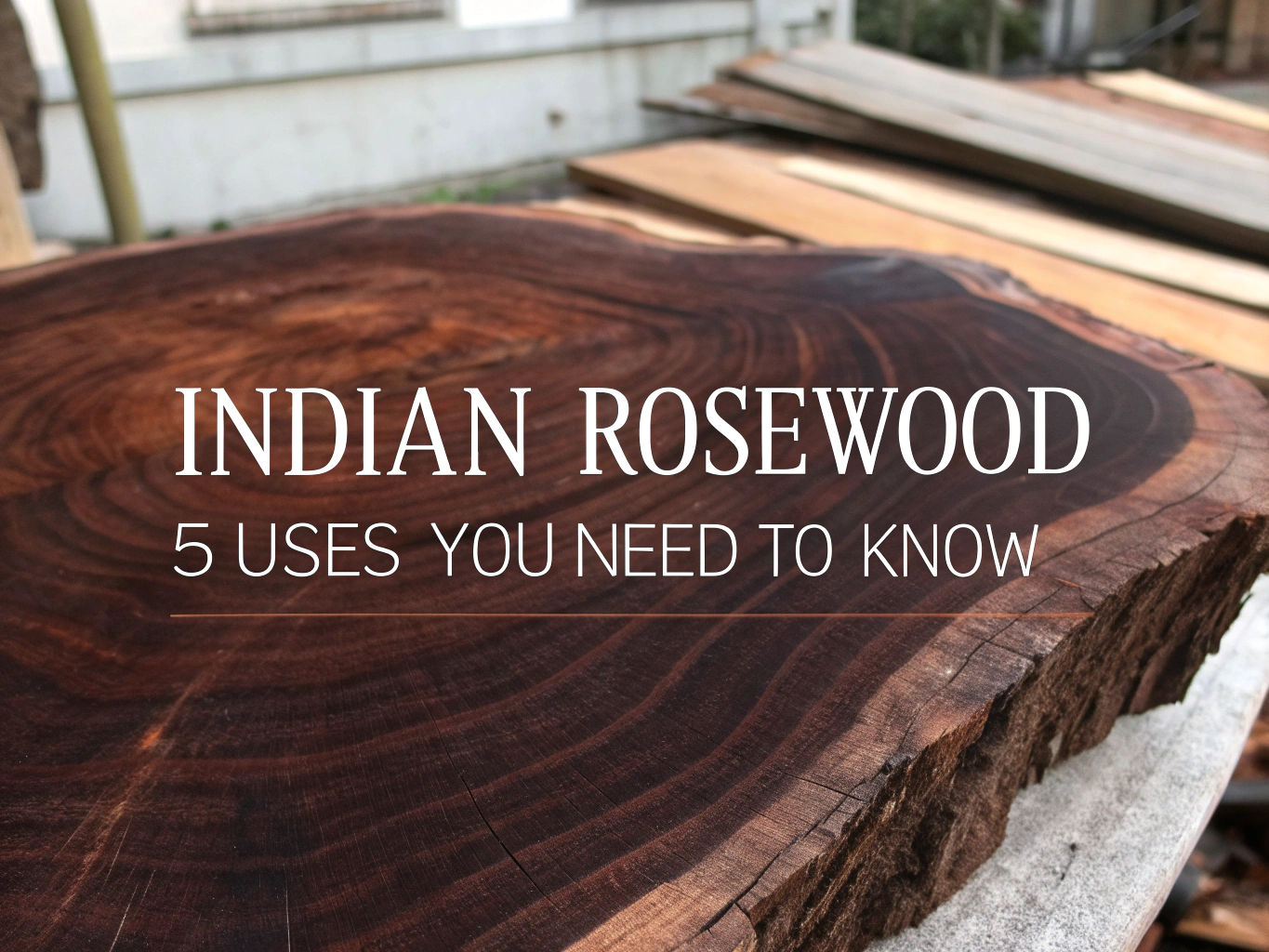
Indian Rosewood Guide: Properties, Identification, Uses and Sustainability

Indian rosewood most commonly means East Indian rosewood, Dalbergia latifolia, a dense tropical hardwood valued for musical instruments, furniture, veneer, turning, and carving. The name can also refer to sheesham, Dalbergia sissoo, so buyers should confirm the scientific name.
This species guide explains the tree, wood properties, identification clues, applications, workshop methods, conservation controls, and buying checks that separate documented material from vague “rosewood” claims.
Table of Contents
What Is Indian Rosewood?
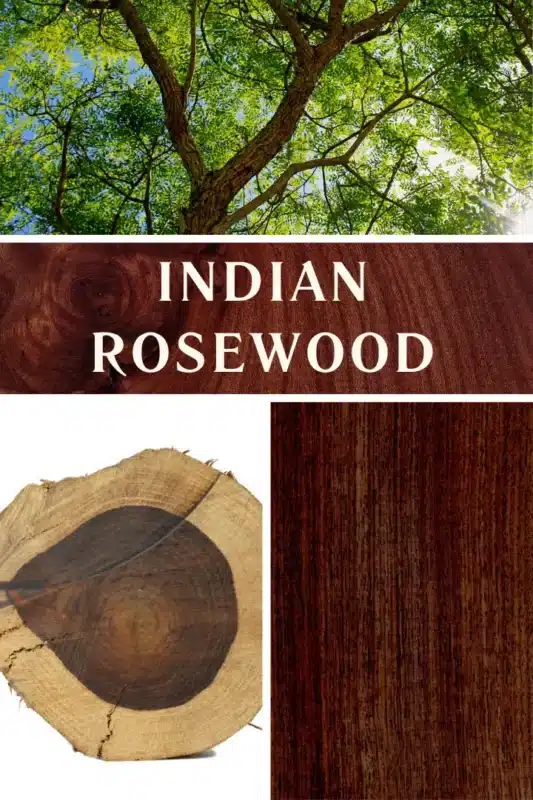
East Indian rosewood is the main commercial name for Dalbergia latifolia, a tropical hardwood in the Fabaceae family. It’s a genuine Dalbergia rosewood, but it isn’t related to garden roses in the Rosaceae family.
Rosewood Definition
To define rosewood accurately, treat it as a common and trade name rather than one botanical species. The term covers several dark, decorative woods, mainly members of Dalbergia, that often have dense fibers, colored extractives, and a noticeable scent when freshly worked.
The wider rosewood family guide explains different types of rosewood and why a product labeled “rose wood” may contain a related species, an unrelated substitute, veneer, or a rosewood-colored finish. A common name alone can’t prove botanical identity.
Names and Taxonomy
The accepted name is Dalbergia latifolia Roxb. It belongs to the order Fabales, family Fabaceae, and genus Dalbergia. Botanical acceptance and distribution records can be checked through Kew Plants of the World Online.
- East Indian rosewood
- Indian rosewood
- Bombay blackwood
- Malabar rosewood
- Java palisander
- Sonokeling, especially for Indonesian-grown or traded wood
Common name confusion: Some furniture sellers use Indian rosewood for Dalbergia sissoo, better known as sheesham or North Indian rosewood. Others use “rosewood finish” for stain color. Ask for a written scientific name before treating a listing as D. latifolia.
The Indian rosewood tree is a medium-to-large deciduous or semi-deciduous tropical tree. Mature specimens commonly reach about 20–30 metres, while exceptional trees may approach 40 metres where soil, rainfall, and competition support long growth.
Its compound leaves carry several broad leaflets. Small pale flowers develop into flat legume pods, while aging bark becomes gray and fissured. Large trunks can yield wide heartwood boards, though clear, old-growth dimensions are scarce and command a premium.
Range and regeneration: The species is associated with tropical South Asia, especially peninsular India, and with parts of Indonesia, including Java. Plantations exist outside the native range, but plantation origin doesn’t by itself prove legal harvesting or sound forest management.
Regeneration can be restricted by poor seed establishment, grazing, fire, forest conversion, and removal of mature seed-producing trees. Thick, dark heartwood takes decades to develop, so a large log can’t be replaced on the short cycle used for many plantation softwoods.
Appearance and Wood Properties
Indian rosewood wood has medium-brown to deep purple-brown heartwood, dark streaking, medium texture, and straight-to-interlocked grain. It’s dense, hard, wear-resistant, and fairly stable after correct drying, yet grain reversal can make machining difficult.
Heartwood and Sapwood
Heartwood colors range from golden brown and reddish brown to chocolate or deep purplish brown. Black-brown lines can form ribbons, stripes, or web-like figure. Fresh cuts sometimes darken as oxygen and light alter the wood’s extractives.
The pale sapwood usually creates an obvious boundary against the darker heartwood. Sapwood may be acceptable as a decorative feature, but it shouldn’t be assigned the same decay resistance or commercial grade as sound heartwood without supporting test data.
Grain, Texture and Odor
Grain may run straight for part of a board, then reverse around figure or growth stresses. Under a sharp plane, cooperative fibers leave a smooth, slightly lustrous ribbon; reversed fibers can lift with a dry crackling sound and leave rough pits behind the cutter.
Fresh dust may carry a sweet floral scent, sometimes mixed with a warm, spicy smell. Odor isn’t proof of species because scent fades during storage, and finishes, wax, smoke, or neighboring woods can mask it.
Physical property table: The figures below are representative values reported for Dalbergia latifolia. Tree age, growing site, moisture content, grain direction, and test method all change measured performance; reference values come from The Wood Database.
| Property | Representative value | Practical meaning |
|---|---|---|
| Average dried weight | 830 kg/m³ or 52 lb/ft³ | Heavy compared with many furniture woods |
| Specific gravity | 0.70 basic; 0.83 at 12% moisture | Dense fibers resist cutting and denting |
| Janka hardness | 2,440 lbf or 10,870 N | Good wear resistance with higher tool load |
| Modulus of rupture | 16,590 psi or 114.4 MPa | High bending strength in clear stock |
| Modulus of elasticity | 1.67 million psi or 11.5 GPa | Relatively stiff under load |
| Crushing strength | 8,970 psi or 61.9 MPa | Strong resistance to compression |
| Radial shrinkage | 2.7% | Lower movement across quarter-sawn faces |
| Tangential shrinkage | 5.9% | Flat-sawn faces move more across their width |
| Volumetric shrinkage | 8.5% | Moderate total drying movement |
| Tangential/radial ratio | About 2.2 | Grain orientation still affects stability |
Hardness and stability: A 2,440 lbf Janka rating makes East Indian rosewood harder than many common cabinet woods. The same density that resists dents also increases cutting heat, dulls edges faster, and raises the chance of splitting near screws.
Its moderate shrinkage supports good dimensional stability once moisture is balanced with the installation site. Stability doesn’t mean zero movement: a wide flat-sawn panel will still expand and contract more than a narrow quarter-sawn component.
Natural durability: Sound heartwood is commonly rated durable to very durable and offers useful resistance to decay organisms and termites. Standing water, trapped moisture, end-grain exposure, or ground contact can still cause checking, finish loss, staining, and eventual decay.
Identification and authentication: Dark streaks, pale sapwood, weight, medium texture, and scent provide screening clues. None offers conclusive proof. Stained sheesham, pau ferro, Indian laurel, and engineered veneer can look convincing in product photographs.
High-value or legally sensitive material may require laboratory identification through wood anatomy, chemical fingerprinting, mass spectrometry, or DNA analysis. Finished coatings and tiny samples can limit certainty, which makes provenance records more useful than color comparisons alone.
Indian Rosewood Wood Uses
Indian rosewood uses include guitar backs and sides, fingerboards, bridges, furniture, cabinets, veneer, inlay, turned objects, carving, flooring, and interior architectural details. Its weight, cost, dust, and restricted wide-board supply make selective use more practical than bulk coverage.
Guitar Backs and Sides
East Indian rosewood tonewood is widely used for steel-string and classical guitar backs and sides. Builders often describe a deep bass, clear treble, long sustain, rich overtones, and a slightly recessed midrange, but these are tendencies rather than fixed results.
Top species, body shape, plate thickness, bracing, finish mass, neck stiffness, and player technique can outweigh small differences between two rosewood sets. A stiff, well-quarter-sawn set may support thinner plates, while a flexible or runout-heavy set needs a different graduation plan.
A recorded comparison can reveal broad tonal differences, yet microphones, strings, room reflections, playing force, and audio compression alter the result. Listen for attack and decay rather than assuming every audible change comes from the back-and-side wood.
Fingerboards and Bridges
Fingerboards and bridges benefit from the wood’s hardness, wear resistance, visual warmth, and ability to hold crisp slots and edges. It also works well for headstock veneers, heel caps, binding, rosettes, and other details where a small amount of material creates strong contrast.
Don’t saturate an unfinished fingerboard with conditioner. A thin application on genuinely dry wood is enough; excess oil leaves a greasy, cool film, collects dark debris around frets, and may migrate into loose fret slots or future repair joints.
Other musical instruments: Makers use suitable stock for mandolins, ukuleles, electric-guitar fingerboards, classical guitars, steel-string guitars, and decorative instrument parts. Verify the species because many factory descriptions shorten unrelated woods to “rosewood.”
Furniture and cabinetry: Tables, cabinets, drawer fronts, boxes, panels, and high-wear interior components gain rich color and a polished surface. Weight becomes noticeable in large doors and tables; a solid slab can feel surprisingly heavy before hardware or finish is added.
Wide clear boards carry high material and environmental costs. Veneered panels, framed construction, or narrow solid accents often use the resource more efficiently. Readers comparing decorative hardwoods can also review walnut wood, which is lighter and usually easier to machine.
Veneer and inlay: Sliced veneer can display straight grain, cathedral figure, ribbon stripe, or dramatic crotch patterns while extending the visual yield of a log. Apply veneer to a stable substrate and balance the reverse face so unequal moisture response doesn’t bow the panel.
Turning and carving: Dense, fine fibers support crisp beads, coves, threads, and polished pen bodies. Inspect wax-coated blanks for end checks, pith, trapped bark, and moisture gradients; wax can conceal a hairline split until the first roughing pass opens it.
During turning, dull tools create heat and torn fibers instead of clean shavings. Fresh edges and controlled cuts produce thin, curling ribbons, while aggressive scraping can fill the air with irritating brown dust and leave bruised grain beneath a glossy surface.
Flooring and architecture: Hardness suits stair details, thresholds, specialty flooring, wall panels, and handrails. For large installations, cost, legal paperwork, movement, replacement availability, and sourcing impact may favor teak wood or a durable local species.
Working With East Indian Rosewood

Working East Indian rosewood calls for sharp cutters, light passes, accurate moisture readings, pre-drilled fasteners, tested adhesives, staged sanding, and dust control. Most failures come from machining unacclimated stock, forcing interlocked grain, overheating edges, or trusting an untested finish.
Drying and Moisture
Dry thick blanks slowly and seal exposed ends to limit end checking. Surface-dry stock can hide a wetter core, while boards dried too fast may retain internal stress that appears as cupping, pinching at the saw, or cracks after resawing.
Indoor furniture often reaches about 6–8% moisture content in dry climate-controlled rooms. A humid or less-controlled building may call for 8–12%. The correct target is the equilibrium moisture content of the destination, not one universal percentage.
Acoustic instruments are commonly kept near 45–55% relative humidity. Bringing cold or damp wood straight into a heated shop, machining it thin, and gluing it the same day invites warped sides and backs. Stack it with spacers and let readings stabilize first.
Moisture behavior, shrinkage, and equilibrium principles are covered in the USDA Wood Handbook. Check more than one location and account for meter species correction, board thickness, and surface temperature.
Practical Notes From Real-World Use
Cutting and planing: Interlocked grain can reverse within a few centimetres, so feeding the entire board in one presumed direction often tears one end. Sharp carbide cutters, shallow passes, a high-angle plane, or a cabinet scraper leave a cleaner face.
Watch the edge under raking light before every pass. Fibers leaning toward the cutter usually shear cleanly; fibers rising against it can lift. For risky router edges, remove most waste conventionally, then use a tiny controlled climb cut only with a secure setup and firm tool control.
Drilling and fastening: Drill pilot holes and countersink screw heads, especially near ends or thin edges. Dense stock can split around an aggressive coarse-thread screw. A backing board reduces breakout where the bit exits, while wax on suitable screws lowers driving torque.
Gluing East Indian rosewood: Fit joints accurately and prepare bonding faces close to assembly. Brush or vacuum away loose dust. Don’t use a routine solvent wipe without checking the adhesive instructions, since solvent can spread extractives or remain trapped in the joint.
For demanding joints, many makers test epoxy formulated for oily woods. Freshly machined scrap reveals whether the adhesive cures, wets the surface, and breaks wood fibers during testing. A failed sample costs far less than a lifting bridge or opening furniture joint.
Sanding and finishing: Move through a sensible grit sequence and remove every coarse scratch before changing grit. Under gloss, missed scratches appear as pale hooks against the dark grain. Excess pressure burnishes the surface, creates heat, and may weaken finish adhesion.
Natural extractives can slow some oil-based coatings or bleed into pale binding. Test shellac, lacquer, polyurethane, oil-varnish, or waterborne finish on an offcut. A compatible barrier seal coat may control bleed, but the seal coat and topcoat must be chemically compatible.
Dust and health risks: Rosewood dust may irritate skin, eyes, and airways, and repeated exposure can trigger allergic sensitization. An early session without symptoms doesn’t predict later reactions. Use source extraction, eye protection, long sleeves, and properly fitted respiratory protection.
Never clear the bench with compressed air. It launches fine dust back into the breathing zone, where it tastes dry and bitter and clings to sweaty skin. Vacuum tools and clothing, then wash exposed skin before touching the face or eating.
Indian Rosewood Comparisons

Indian rosewood comparisons depend on scientific species, not sales names. East Indian rosewood is Dalbergia latifolia; sheesham is usually Dalbergia sissoo; Brazilian rosewood is Dalbergia nigra. Each differs in appearance, supply, workability, acoustic use, and trade status.
Indian Rosewood vs Sheesham
Indian rosewood vs sheesham isn’t a comparison between two names for one species. East Indian rosewood normally refers to D. latifolia, while sheesham or sissoo refers to D. sissoo.
| Feature | East Indian rosewood | Sheesham |
|---|---|---|
| Scientific name | Dalbergia latifolia | Dalbergia sissoo |
| Typical color | Dark brown to purple-brown, often with black streaks | Golden to medium brown, often strongly variegated |
| Frequent market use | Instruments, veneer, premium cabinetry | Furniture, carving, cabinets |
| Visual consistency | Often darker and more uniform | Often lighter with stronger color swings |
| Name risk | May be sold simply as Indian rosewood | May also be sold as Indian rosewood |
The sheesham wood guide covers Dalbergia sissoo in greater detail. Color can overlap between species, so Dalbergia latifolia vs Dalbergia sissoo identification should rely on records and, where needed, laboratory analysis.
Dalbergia Species Differences
The genus Dalbergia contains numerous trees and shrubs with very different wood colors, densities, ranges, and trade controls. Cocobolo, African blackwood, Brazilian rosewood, sissoo, and East Indian rosewood shouldn’t be treated as interchangeable because they share a genus.
For example, cocobolo wood can show brighter orange and red tones with higher oil content, while African blackwood is much darker and often used for woodwind bodies. Each creates different tool, allergy, and sourcing concerns.
Indian vs Brazilian rosewood: East Indian rosewood often has straighter, more consistent brown-purple figure and broader commercial availability. Brazilian rosewood can show dramatic black spider-web lines, stronger color shifts, and documented old stock with exceptionally high value.
Brazilian rosewood, Dalbergia nigra, sits in CITES Appendix I and faces far tighter international controls. The Brazilian rosewood regulations page explains why old age or a seller’s verbal claim doesn’t replace paperwork.
East Indian material isn’t an exact acoustic substitute for Brazilian stock. Two sets from the same species can differ in stiffness, damping, mass, cut, and defects. Builders get more reliable results by measuring each set than by relying on a species reputation.
Common wood alternatives: Pau ferro, Indian laurel, ovangkol, walnut, maple, and selected ebonies can fill some visual or mechanical roles. An alternative should be chosen for the actual job—fingerboard wear, body weight, bending behavior, local availability, or finish appearance.
- Pau ferro: Dense and smooth, with brown, orange, or purple streaks; commonly used for fingerboards and instruments.
- Indian laurel: Often used as a lower-cost fingerboard or furniture wood, but it isn’t Dalbergia latifolia.
- Ovangkol: Decorative brown wood used for furniture and guitar bodies.
- Walnut: Lighter, easier to work, and widely available for furniture and instruments.
- Maple: Pale, hard, and visually distinct, with a clearer rather than rosewood-like appearance.
- Ebony: Often harder and darker, though some species carry their own conservation concerns.
Marketing terms can mislead. “Bolivian rosewood” commonly refers to pau ferro rather than a Dalbergia rosewood. Consult the pau ferro comparison before accepting a regional rosewood name as botanical evidence.
Conservation and Legal Trade
Indian rosewood is regulated in international trade, but ownership and every sale aren’t automatically illegal. Rules depend on species, origin, date, product form, shipment route, destination law, and the exact CITES annotation in force when the transaction occurs.
Conservation Status
Dalbergia latifolia has been assessed as Vulnerable on the IUCN Red List. Frequently quoted assessments may be old, so a category should be read with its assessment date rather than treated as a live count of present-day trees.
Historical overharvesting, illegal logging, forest conversion, selective removal of large trees, and slow replacement of mature heartwood have placed pressure on supply. A plantation can reduce pressure on wild forests only when legal origin, management, harvest records, and chain of custody hold up.
CITES Regulations
Most Dalbergia species are covered by CITES Appendix II, while Brazilian rosewood is listed in Appendix I. Appendix II permits controlled international trade; it doesn’t create a blanket ban. Check the current listing and annotation through CITES Species+.
Exemptions and documentation: Some annotations exempt qualifying finished musical instruments, finished parts, accessories, or other finished products. Exemptions have definitions and limits. Raw lumber, veneer, unfinished blanks, and commercial shipments may receive different treatment.
National rules can be stricter than CITES, and export rules may differ from import rules. Before an international shipment, check the origin-country wildlife authority, destination authority, customs requirements, weight thresholds, permits, and any personal-effects exemption attached to the exact item.
Responsible sourcing: Request the scientific name, country of harvest, plantation or forest origin, supplier invoice, applicable permits, and chain-of-custody records. If a seller claims FSC certification, ask for the certificate or license code and verify that it covers the supplier and product.
Reclaimed wood still needs credible provenance, especially across borders. “Old stock,” “estate wood,” and “pre-ban” are statements, not documents. A dated invoice, inventory record, permit, appraisal, or prior customs entry creates a much stronger transaction file.
Transaction verification: Retain invoices, product photographs, dimensions, species declarations, origin records, permits, and correspondence. Match document quantities to the shipment. A permit for one species, weight, or product type may not cover mixed parcels or later resales.
- Confirm the scientific species name in writing.
- Identify the country of harvest and country of export.
- Classify the item as raw wood, veneer, blank, part, or finished product.
- Check the current CITES appendix and annotation.
- Check export, transit, import, and domestic laws.
- Match permits and invoices to the actual shipment.
- Keep the complete record after delivery or resale.
Buying Indian Rosewood
Buy Indian rosewood by scientific name, usable dimensions, moisture content, grain orientation, defect allowance, and documented origin. Don’t compare rough lumber, prepared fingerboards, veneer sheets, turning blanks, and matched guitar sets by one headline price.
Project Buying Checklist
A useful listing states Dalbergia latifolia, actual dimensions, drying method, moisture content, grade, origin, and visible defects. Request photographs of both faces and both ends; one polished face can hide checks, sapwood, wormholes, twist, or severe runout.
- Confirm the scientific name and country of origin.
- Ask whether dimensions are nominal, rough, or finished.
- Add machining allowance to every finished dimension.
- Verify moisture content and the meter method used.
- Inspect end grain for checks, pith, and grain orientation.
- Check both faces for knots, sapwood, holes, stains, and repairs.
- Ask whether wax conceals the ends of turning blanks.
- Confirm the return policy for hidden drying defects.
- Retain the invoice and trade records.
For guitar backs and sides, confirm whether pieces are sequentially cut and genuinely matched. Ask for minimum usable width after jointing, side thickness, grain orientation, runout, and photos taken under neutral light. Decorative figure has little value if trimming removes it.
Grades and Dimensions
Rosewood grading varies between lumber dealers and tonewood suppliers. “Master grade,” “AAA,” and “presentation grade” aren’t universal standards. Compare measurable traits: quartering, straightness, usable area, color match, defect-free dimensions, stiffness, and moisture content.
Quarter-sawn instrument stock often costs more because it offers straighter edge grain and better cross-grain stability. Flat-sawn wood can show broad cathedral figure and work well in furniture, but wide pieces move more across their faces as indoor humidity changes.
Pricing and board feet: Rough lumber is commonly sold by the board foot, calculated as thickness in inches × width in inches × length in feet ÷ 12. A 1-inch-thick, 8-inch-wide, 6-foot board contains 4 board feet before waste and machining.
Veneer may be priced per square foot or sheet, fingerboards per piece, guitar backs and sides per matched set, and turning stock by blank size. A prepared set includes selection, resawing, matching, drying, storage, grading, and retail waste, so its price can’t be fairly compared with rough stock.
Small fingerboard blanks often fall around $15–$50 each, craft or turning blanks around $20–$100 or more, and acoustic back-and-side sets around $100–$400 or more. Wide, figured, quarter-sawn, defect-free, documented, or old stock can exceed those bands by a wide margin.
Species claims to avoid: Don’t accept “solid rosewood,” “genuine rosewood,” “Indian hardwood,” “rosewood color,” or “Arizona rosewood” as proof of D. latifolia. Arizona rosewood can refer to unrelated species, while a finish name may describe color alone.
A low price paired with no scientific name can signal sheesham, Indian laurel, another substitute, thin veneer, or an unsupported product claim. Ask the seller to put the species declaration and origin on the invoice before payment.
Optional project materials: Prepared headplates, fingerboards, and matched guitar sets can reduce resawing and grading work. Check dimensions, moisture, seller documentation, return terms, and legal shipping status independently; a product title isn’t botanical authentication.
These optional luthier materials illustrate common prepared formats for headstock, fingerboard, and acoustic guitar projects.

East Indian Rosewood Headplate Blanks
- Designed for guitar headstock veneers
- Rich rosewood coloring enhances custom builds
- Thin blanks are easy to trim and shape
- Suitable for luthier repairs and projects
- Adds a polished handmade detail
 Buy on Amazon

Rosewood Guitar Fingerboard Set
- Five blanks for multiple guitar projects
- East Indian rosewood offers classic visual warmth
- Sized for classical and steel string builds
- Unslotted design allows custom fret layouts
- Great for handmade guitar construction
Buy on Amazon

Figured Rosewood Dreadnought Set
- Matched set for dreadnought guitar projects
- Figured grain creates a striking visual look
- East Indian rosewood suits custom instruments
- Great foundation for handcrafted acoustic builds
- Gives each guitar a distinctive character
Buy on Amazon
Before cutting, let prepared parts acclimate and inspect them under low-angle light. Fine end checks cast narrow shadows, while twist appears when opposite corners rock on a flat surface. That two-minute check prevents a costly blank from becoming an undersized finished part.
FAQs
What Is Indian Rosewood?
Indian rosewood is a dense, durable hardwood commonly sourced from Dalbergia latifolia, a tree native to India and nearby regions. It is valued for its rich brown color, dark streaks, and smooth finishing qualities. The wood is used for furniture, flooring, decorative items, and musical instruments.
Is Indian Rosewood The Same As Sheesham?
Indian rosewood and sheesham are related woods, but they usually come from different tree species. East Indian rosewood typically refers to Dalbergia latifolia, while sheesham commonly refers to Dalbergia sissoo. Both are attractive, durable hardwoods, although their grain, color, density, and typical uses can differ.
Is Indian Rosewood Endangered Or Illegal?
Indian rosewood is not automatically illegal, but its trade is regulated to help protect rosewood species. Dalbergia latifolia is listed under CITES Appendix II, so international sales and transport may require permits or proof of legal origin. Always check local laws and documentation before buying, importing, or selling it.
How Can You Identify Genuine East Indian Rosewood?
Genuine East Indian rosewood usually has a medium-to-dark brown color with darker purple, black, or reddish streaks and a dense, oily feel. Its grain is often straight or lightly interlocked, with a distinctive natural luster. The most reliable identification comes from a reputable supplier, species label, and legal provenance documents.
Is Indian Rosewood Good For Guitars?
Indian rosewood is an excellent guitar tonewood because it produces warm bass, clear highs, and strong sustain. It is especially popular for acoustic guitar backs and sides, where its density helps create rich projection. Builders also value its attractive grain, although responsible sourcing and proper seasoning are essential.
Affiliate Disclosure: Some links in this post are affiliate links. If you make a purchase through these links, we may earn a small commission at no extra cost to you. We only recommend products we genuinely believe in.