


Yew woodworking uses dense, fine-textured timber from Taxus trees for turning, carving, furniture details, and traditional bows. Yew cuts cleanly and polishes well, but irregular grain, hidden cracks, unstable inclusions, and poisonous dust demand careful stock selection and effective workshop controls.
European or English yew is botanically a softwood, yet it feels heavy in the hand and resists dents more like many hardwoods. This guide explains working with yew wood from purchase and drying through machining, finishing, safety, and fault diagnosis.
Table of Contents
What Is Yew Wood?
Yew wood is timber from trees and shrubs in the genus Taxus. Most European woodworking stock comes from Taxus baccata, a slow-growing conifer valued for orange-brown heartwood, pale sapwood, fine texture, elasticity, and striking branch figure.
European and English Yew
European yew wood and English yew wood commonly mean the same species, Taxus baccata. “English” is often a trade name rather than proof of origin; a board sold under that label may come from elsewhere in Europe. Taxonomy, accepted names, and native distribution can be checked through Kew Science.
Slow growth and frequent branching produce narrow, waney-edged boards with knots, color shifts, and reversing grain. Wide clear boards are uncommon, which explains why English yew wood appears more often as slabs, veneer, bow staves, and turning blanks than standardized lumber.
Pacific and Other Yews
Pacific yew, Taxus brevifolia, grows in western North America and supplies carving, turning, and archery stock. Canadian, Japanese, and Himalayan yews also exist, but their strength, availability, conservation position, and trade controls differ. Ask for the botanical name rather than treating every piece marked “yew” as interchangeable.
Hardwood or softwood? Yew is a softwood because it comes from a coniferous gymnosperm. That botanical label doesn’t describe its working resistance: European yew has a cited Janka hardness near 1,520 lbf, placing it above many familiar examples of soft wood.
Color, grain, and texture. Heartwood ranges from warm orange to reddish or purplish brown, while sapwood is pale cream or yellow. Fresh cuts can look almost coppery before oxygen, light, and finish deepen the surface. The fine texture develops a smooth, slightly waxy feel after scraping and fine sanding. See how these features compare with other wood grain patterns.
Defects and identification. Look for pith, radial checks, ring separation, dead knots, bark pockets, reaction wood, insect holes, and pale sapwood. A dark line around a knot often marks loose bark rather than harmless color. Tap questionable areas: a dry, hollow click can reveal separation beneath an apparently solid face.
European yew properties. Representative figures vary with growth rate, moisture, and testing method. Values below summarize European yew data published by The Wood Database; they’re reference points, not guarantees for an individual board.
| Property | European yew reference value | Workshop meaning |
|---|---|---|
| Average dried weight | 42 lb/ft³ or 675 kg/m³ | Substantial feel and greater cutting effort |
| Specific gravity | 0.55 basic; 0.67 at 12% MC | Good detail retention in sound stock |
| Janka hardness | 1,520 lbf or 6,760 N | Resists dents better than many softwoods |
| Modulus of rupture | 15,890 psi or 109.6 MPa | Strong bending performance in clear grain |
| Modulus of elasticity | 1.33 million psi or 9.2 GPa | Elastic rather than exceptionally stiff |
| Crushing strength | 8,280 psi or 57.1 MPa | Useful compression resistance |
| Radial shrinkage | 3.8% | Moderate movement across quartersawn stock |
| Tangential shrinkage | 5.3% | Flatsawn boards move more across their width |
| Volumetric shrinkage | 9.7% | Green blanks need controlled drying |
| T/R ratio | About 1.4 | Good average stability, subject to local defects |
Workshop implications. Yew holds beads, coves, carved edges, and polished details cleanly. Published shrinkage looks favorable, but branch unions and reaction wood can move far more than an average figure suggests. Knots often make the blade note rise and the tool push back just before grain reverses.
Species comparison table. European yew is harder than cherry and Douglas fir by common Janka figures, while its typical commercial boards are less predictable than walnut or maple. Compare species-labelled data rather than transferring Pacific yew figures to European stock.
| Species | Classification | Approx. dried weight | Approx. Janka | Typical working character |
|---|---|---|---|---|
| European yew | Softwood | 42 lb/ft³ | 1,520 lbf | Fine, often irregular; excellent turning stock |
| Pacific yew | Softwood | 40 lb/ft³ | 1,600 lbf | Fine, dense, and often available in small sizes |
| Black walnut | Hardwood | 38 lb/ft³ | 1,010 lbf | Usually easier to plane and source as boards |
| Hard maple | Hardwood | 44 lb/ft³ | 1,450 lbf | Hard, pale, and prone to burn with dull cutters |
| Black cherry | Hardwood | 35 lb/ft³ | 950 lbf | Fine texture and relatively friendly machining |
| Douglas fir | Softwood | 32 lb/ft³ | 620 lbf | Strong for weight but prone to earlywood damage |
Selecting Yew for Projects
Yew suits decorative woodworking, turning, carving, boxes, furniture accents, veneer, and carefully selected bows. Choose stock by moisture, grain continuity, and internal soundness rather than buying solely for dramatic color or live edges.
Benefits and Limitations
Key benefits include crisp detail, natural luster, strong color contrast, and good bending behavior in clear straight grain. Limitations include expensive usable volume, short boards, knots, end checks, tear-out, dust precautions, and the difficulty of matching color across several components.
- Use clear stock for chair rails, handles, bows, and thin projections.
- Reserve knotty or burr material for decorative, low-stress parts.
- Reject loose inclusions near fasteners, joints, or lathe mounting points.
- Orient heartwood and sapwood deliberately before cutting components.
- Buy enough matching material at once because later color matching is difficult.
Moisture and Acclimation
Measure moisture with a calibrated meter after correcting for species where the instrument permits. Indoor furniture commonly settles near 6–9% moisture content in controlled rooms or 8–12% in more humid buildings. Match the wood to its final room rather than chasing one universal number.
Grain and structural stock. Continuous fibers matter more than decorative figure in loaded parts. Avoid short grain crossing narrow handles, chair components, and bow staves. Saw oversized pieces first, let them rest, then inspect whether released stress has introduced bow or twist.
Knots, pith, and cracks. Mark visible crack ends with pencil, then check whether they lengthen during acclimation. Pith-centered spindle blanks commonly split outward as they dry. Removing the pith before storage sacrifices volume but often saves the two sound halves.
Turning and carving. Fine texture makes carving yew wood rewarding, but the cutting direction may reverse within a few centimeters around a branch. A sharp edge produces thin, curled shavings; a dull edge leaves a fuzzy patch or pulls out a hard chip. Specialty wood turning blanks still require inspection on every face.
Furniture and cabinetry. Use yew for drawer fronts, cabinet panels, boxes, veneer, inlay, tabletop accents, and occasional tables. Clear stock can serve structurally, but wide panels benefit from balanced grain orientation and restrained dimensions. Compare its use with other furniture woods.
Longbows and bow staves. Traditional yew bows place elastic sapwood on the back and compression-resistant heartwood on the belly. A usable stave needs exceptional fiber continuity and controlled seasoning. Historical “English” longbows often used imported continental yew, so the name doesn’t establish where the tree grew.
Indoor and outdoor use. European yew heartwood has useful natural decay resistance, while sapwood is less dependable. Exterior work still needs drainage, protected end grain, suitable hardware, and finish maintenance. Avoid permanent soil contact or joints that trap water behind pale sapwood.
Projects to avoid. Don’t use yew for cutting boards, spoons, cups, chewable toys, pet items, smoking pipes, or cooking tools. Reject high-speed turned forms with unstable bark pockets and avoid load-bearing components made from checked, knotty, or sharply curved grain.
Drying and Storing Yew
Dry yew slowly and evenly because exposed end grain can check long before the center reaches a useful moisture level. Cut out pith where possible, seal fresh ends, provide shaded airflow, and delay final milling until movement settles.
Sealing Fresh Ends
Seal end grain soon after cutting with wax emulsion or a purpose-made end sealer. Apply it beyond the visible check because cracks often extend internally. Thin furniture finish dries too quickly to regulate moisture loss as effectively as a heavy end-sealing coating.
Air-Drying Practices
Build a level stack above damp ground, using dry stickers of equal thickness aligned in vertical columns. Shade the pile from direct sun and rain while preserving side airflow. Top weight can limit cup, but it won’t restrain severe reaction wood without creating stored stress.
Drying time depends on thickness, climate, airflow, and starting moisture; the familiar one-year-per-inch saying isn’t a reliable schedule. The USDA Wood Handbook explains moisture movement and dimensional change, while meter readings reveal what a particular board is doing.
Turning green yew. Rough-turn bowl walls to roughly 10% of diameter as a starting point, leaving more around uncertain grain. Seal vulnerable end-grain bands and weigh the blank periodically. When repeated readings stop falling, remount it and remove distortion during the final turning.
Preventing storage failures. Don’t place green blanks near heaters or store boards face-to-face without stickers. Label each piece with date, species, and starting weight or moisture. Waxed blanks can look stable while a concealed pith crack grows beneath the coating, so inspect them monthly.
Working With Yew Wood
Working with yew wood calls for sharp cutters, light passes, stable workholding, and frequent defect checks. Density supports clean detail, while reversing grain and hard knots punish aggressive feed rates with heat, chatter, and torn fibers.
Sawing and Metal Detection
Scan urban timber for fence wire, nails, screws, and masonry fragments before sawing. Yew from hedges and boundaries often contains buried metal that bark has swallowed over decades. Secure irregular slabs to a sled rather than balancing a rounded edge against a bandsaw or table-saw fence.
Use a sharp blade with adequate gullets and feed without forcing. A burning smell, polished cut face, or rising blade pitch signals excess friction. Pause to clear packed dust and check alignment rather than pushing harder into dense branch wood.
Planing and Routing
Read the grain before each pass and reduce depth around knots. If reversing the feed doesn’t cure tear-out, switch to a sharp high-angle plane, cabinet scraper, or card scraper. Back up cross-grain router exits and test the complete edge profile on an offcut.
Drilling and fastening. Predrill near ends and size pilot holes to the screw’s core diameter. Countersink without heavy pressure because narrow pieces can split suddenly along short grain. Use corrosion-resistant hardware outdoors and keep screws clear of cracks or bark pockets.
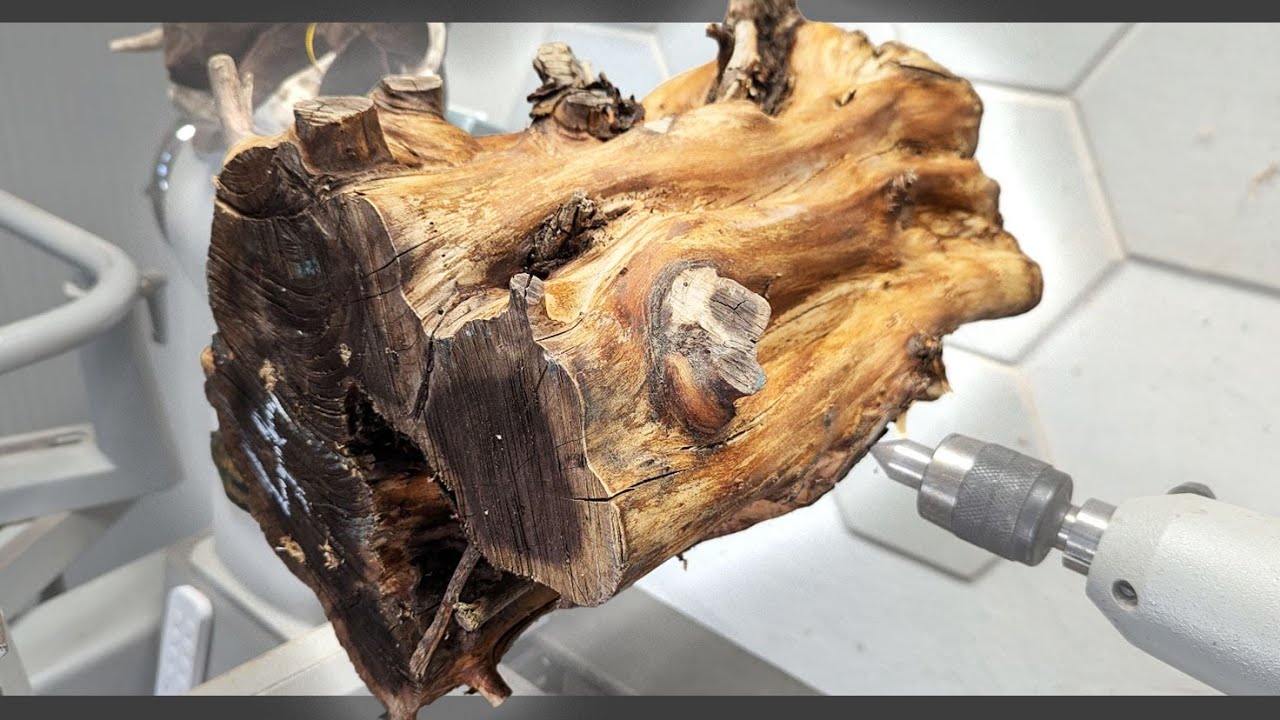
Yew wood turning. Bowls, lidded boxes, finials, pens, ornaments, and hollow forms benefit from yew’s density and fine texture. Position the pale sapwood deliberately: an accidental off-center stripe looks unbalanced, while a controlled crescent can frame dark heartwood.

Wood Turning Techniques Guide
- Explains core woodturning techniques
- Helps develop safe lathe skills
- Covers shaping and finishing methods
- Useful for turning dense yew wood
- Supports projects from basic to advanced
 Buy on Amazon
Lathe risks and tools. Loose knots, bark inclusions, and radial cracks can eject material. Start an unbalanced blank at low speed, stand outside its line of fire, and wear a full face shield. Stop after early cuts to inspect newly exposed faults and confirm that the chuck or faceplate remains secure.
Freshly sharpened bowl and spindle gouges should create clean ribbons rather than dusty crumbs. Use lighter cuts near knots and reduce speed for natural edges or voids. Shear scraping can refine troublesome end grain, but it can’t make a structurally weak blank safe.
Sanding yew wood. Start at P80 or P100 only when deep tool marks require it, then move through P120, P150, P180, P220, and perhaps P320. Raking light exposes scratches that overhead lighting hides. Excess pressure warms the wood, packs paper, and creates polished low spots.
- Vacuum the surface before changing grit.
- Mark the face lightly with pencil to track scratch removal.
- Sand flat work with the grain after random-orbit sanding.
- Reduce lathe speed before power sanding.
- Vacuum dust rather than blowing it through the room.
Core workshop techniques. Rough-mill stock oversize, alternate material removal between faces, and let stressed boards rest before final sizing. Use freshly prepared reference edges and dry-fit every joint. These habits reduce errors that expensive figured stock leaves little room to correct.

Woodworking Craftsmanship Basics
- Covers essential woodworking fundamentals
- Offers practical advice for better results
- Helps build sound shop habits
- Supports careful work with yew wood
- Useful reference for developing makers
Buy on Amazon
Practical shop insight. The most attractive side of a yew blank often hides the least stable fibers. Before committing to a show face, trace grain around all edges and compare the sound when each area is tapped. A dull response beside bark usually matters more than vivid color.
Gluing and Finishing Yew
Yew glues and finishes well when surfaces are fresh, dry, and fitted. Test the complete finish on matching heartwood and sapwood because end grain, burr figure, and pale areas can absorb products at very different rates.
Surface and Joint Preparation
Prepare joints freshly by planing, scraping, or sanding immediately before assembly. Remove loose dust with extraction and inspect for polished or oily-looking areas. A tight dry fit matters more than adhesive thickness; glue can’t restore continuous fibers across bark or end checks.
Choosing an Adhesive
PVA glue suits well-fitted indoor joints. Epoxy handles mixed materials and limited gaps, while polyurethane adhesive needs controlled moisture and space for expansion. Thin cyanoacrylate can manage hairline cosmetic cracks, but none of these products converts loose inclusions into dependable structural stock.
Crack stabilization limits. Mark crack tips, remove loose fibers, and decide whether the defect lies in a loaded zone. Resin may bind a dry, stable decorative void, yet it doesn’t reconnect severed grain. Keep repaired inclusions away from lathe jaws, chair joints, bow limbs, and narrow handles.
Oil finishes. Polymerized oils and oil-varnish blends deepen orange and red tones, producing a warm glow across heartwood. Figured end grain may turn much darker than adjacent long grain. Wipe excess product from knots and recesses before it forms sticky, glossy patches.
Film finishes. Shellac, lacquer, and varnish reveal yew’s natural luster and make the polished surface feel glassy rather than oily. A shellac barrier coat can reduce absorption differences after testing. Exterior varnish needs periodic renewal and won’t permanently prevent ultraviolet color change.
Water-based finishes. These products tend to retain a lighter, less amber appearance. The first coat may raise fine fibers, so de-nib lightly after it dries. Test pale sapwood separately because a finish that flatters reddish heartwood can leave the sapwood looking cold or gray.
Finish testing protocol. Sand an offcut exactly like the project, apply every planned coat, and record color, blotching, drying time, adhesion, and sheen. View it under daylight and warm artificial light. A one-coat swipe can’t predict the appearance of a complete finish schedule.
Yew Toxicity and Safety

Yew contains poisonous taxine compounds, and workshop dust can irritate the eyes, skin, and respiratory system. Control dust at its source, prevent ingestion, keep waste away from animals, and don’t use the species for food-contact or chewable objects.
Toxic Plant Compounds
Most yew tissues contain toxic compounds capable of causing severe poisoning and dangerous cardiac effects after ingestion. The fleshy red aril is often described as an exception, but its seed is poisonous. No plant or workshop material should enter the mouth or food area.
Wood Dust Exposure
Yew dust exposure has been associated with irritation, headache, nausea, and possible systemic symptoms. Leave the room and obtain medical advice if unusual symptoms appear. A loose disposable mask doesn’t compensate for clouds of fine dust hanging visibly in a sunbeam.
Dust control hierarchy. Capture particles at the saw, lathe, router, and sander; ventilate the room; vacuum surfaces; wash exposed skin; and use a properly fitted approved respirator suited to the task and local rules. The UK Health and Safety Executive gives practical wood-dust control guidance.
Food-contact projects. Don’t make yew cutting boards, bowls, spoons, cups, or utensils. A coating isn’t permanent isolation: knives, heat, washing, and abrasion can wear through it. Maple, beech, and other established alternatives remove this avoidable exposure question.
Children and pet items. Avoid rattles, teethers, chewable toys, pet bowls, perches, and objects likely to be gnawed. Store offcuts and shavings in closed containers, since pale curls on the floor can attract children, dogs, livestock, or nesting animals.
Burning and disposal. Never use yew scraps for cooking, smoking food, or an indoor open fire. Don’t add shavings to animal bedding or accessible compost. Bag dust securely and use the disposal route approved by the relevant local authority.
Safety decision guide. Use extraction and respiratory protection for dusty machining; reject cracked high-speed turning blanks; exclude yew from food and chewable products; and prevent animal access to waste. Decorative indoor objects are practical once machining dust is controlled and the finished item isn’t intended for ingestion.
| Proposed use | Recommendation | Reason |
|---|---|---|
| Decorative box | Suitable | Low ingestion risk after controlled machining |
| Furniture accent | Suitable with sound stock | Good detail and color contrast |
| Cutting board or spoon | Avoid | Direct food contact and surface wear |
| Chewable toy or pet item | Avoid | Foreseeable ingestion |
| Cracked natural-edge bowl blank | Reject or redesign | Impact and ejection hazard |
| Cooking or smoking fuel | Avoid | Smoke and food-contamination risk |
Buying Yew Wood
Buy yew by usable dry volume, not headline dimensions. Species, moisture, cracks, pith, shipping weight, provenance, and clear yield can turn an inexpensive blank or slab into costly project stock.
Yew Wood for Sale
Listings for yew wood for sale may include European yew lumber, English yew wood, slabs, veneer, bow staves, burr pieces, and turning blanks. Commercial names don’t confirm species or origin, so request the botanical name and provenance before comparing offers.
Boards, Slabs, and Blanks
Boards and slabs suit furniture and panels but may carry large deductions for waney edges, pith, and checks. Bowl and spindle blanks save processing time, yet per-piece pricing can hide a high board-foot rate. Burr or burl wood commands more while yielding less structurally sound material.
Seller questions. Ask what species it is, where the tree grew, why it was felled, how it was dried, and what moisture reading was taken. Request clear photographs of both faces and all edges, plus disclosure of pith, soft areas, bark inclusions, active checks, and metal risk.
- Are dimensions actual or nominal?
- Was moisture measured at the surface or with insulated pins?
- Is the blank green, air-dried, kiln-dried, or partly seasoned?
- Do price and shipping include tax or VAT?
- Can cracks be trimmed without entering the planned component?
- Is the stock legally sourced and traceable?
Pricing and usable yield. Scarcity, slow growth, width, thickness, dry condition, sapwood contrast, burr figure, and documented origin all affect price. Shipping is significant because European yew averages about 42 lb/ft³. Compare the effective cost after removing defects, not the gross sticker price.
Board-foot calculator. Multiply thickness in inches by width in inches by length in inches, then divide by 144. One board foot equals 144 cubic inches, about 2.36 liters; one cubic foot contains 12 board feet.
| Calculation | Example |
|---|---|
| Gross board feet | 2 × 10 × 48 ÷ 144 = 6.67 board feet |
| Estimated usable yield | 6.67 × 65% = 4.34 board feet |
| Effective material cost | Total delivered cost ÷ 4.34 |
| Data to retain | Species, moisture, defects, shipping, tax, and date |
Provenance and legal sourcing. Favor storm-fallen trees, documented safety removals, urban forestry recovery, estate-management salvage, or reclaimed timber. Check landowner permission, protected-tree rules, conservation-area notices, and felling requirements in the place where the tree stands.
Conservation and tree protection. Don’t assume every Taxus species shares the same conservation position. Ancient churchyard or culturally significant yews shouldn’t become lumber. Species-level trade status can be checked using the CITES species checklist, followed by local forestry and planning rules.
Troubleshooting Yew Woodworking
Most yew woodworking failures trace to hidden defects, moisture, or grain rather than weak timber. Diagnose the cause before adding adhesive, sanding deeper, or taking another aggressive machine pass.
Split Turning Blanks
Stop the lathe if a crack grows, clicks, or sheds dust. Common causes include retained pith, pre-existing checks, fast moisture loss, loose knots, and excessive speed. Remove the blank and reject it if the split reaches a mounting point or divides major sections of grain.
Planing Tear-Out
Reversing grain around branches is the usual cause. Try the opposite feed direction, reduce cut depth, sharpen the iron, increase the cutting angle, or switch to a scraper. Don’t keep lowering a planer bed after each torn patch; the defect may deepen faster than the board becomes flat.
Warped finished panels. Uneven moisture, reaction wood, or heavy removal from one face can release stress after assembly. Check moisture, rough-mill both faces in stages, sticker the panel during rest periods, and complete final sizing only after movement slows.
Failed decorative inclusions. Bark and loose knots aren’t continuous wood. Remove unstable material, redesign the component, or place the inclusion in a low-stress area. Clear resin may improve appearance, but a glossy fill doesn’t restore the strength of uninterrupted grain.
Open glue joints. Test moisture first, then examine fit, glue coverage, clamping pressure, and grain orientation. Machine or scrape fresh bonding faces and complete a dry fit before repair. Redesign joints that depend mainly on end-grain bonding rather than adding more adhesive.
| Symptom | Likely cause | Practical correction |
|---|---|---|
| Blank splits while turning | Pith, checking, fast drying, or high speed | Stop, inspect, reject doubtful stock, and reduce speed |
| Planer tears the surface | Reversing branch grain | Use light high-angle cuts or scrape |
| Panel bows after milling | Moisture gradient or released stress | Rest oversize stock and alternate faces |
| Resin-filled void breaks free | Loose bark or structural loading | Remove, redesign, or relocate the inclusion |
| Glue line opens | Wet stock, stale surfaces, or poor fit | Correct moisture and prepare a fresh fitted joint |
FAQs
Is Yew Good For Woodworking?
Yew is excellent for woodworking because it is strong, fine-grained, and highly attractive. Its heartwood often has rich orange-brown color, while the pale sapwood creates striking contrast. Yew works well for turning, carving, furniture details, bows, and decorative projects, although knots and irregular grain can require careful tool control.
Is Yew A Hardwood Or A Softwood?
Yew is botanically a softwood, although it behaves more like many hardwoods in practical use. It comes from a coniferous tree, but its wood is unusually dense, tough, and durable for a softwood. This combination makes yew suitable for detailed woodworking and projects that need strength.
Is English Yew The Same As European Yew?
English yew and European yew are the same tree species, Taxus baccata. The names are commonly used interchangeably because the tree is native across Britain, Europe, and parts of western Asia. Wood sold as English yew may simply indicate where the timber was grown or sourced.
Is Yew Wood Toxic To Work With?
Yew wood can be toxic to work with, especially when dust is inhaled or contacts sensitive skin. The tree contains toxic compounds, and some people may experience irritation, headaches, or respiratory discomfort from its dust. Wear a dust mask or respirator, use extraction, and wash your hands after handling yew.
Why Is Yew Wood So Expensive?
Yew wood is expensive because it grows slowly, is relatively scarce, and has strong demand for its distinctive appearance. Large, straight, defect-free boards are difficult to find, while usable pieces often contain knots, twists, and irregular grain. Its durability, color contrast, and popularity with turners also increase its value.
Affiliate Disclosure: Some links in this post are affiliate links. If you make a purchase through these links, we may earn a small commission at no extra cost to you. We only recommend products we genuinely believe in.


