

Spruce wood is a lightweight softwood from coniferous trees in the Picea genus, valued for its pale color, straight grain, and high stiffness relative to weight. It works well for framing, engineered timber, soundboards, furniture, models, veneer, pulp, and packaging, but untreated spruce has low resistance to dents, moisture, and decay.
Properties differ by species and grade. Engelmann spruce can make a responsive guitar top, grade-stamped SPF can carry structural loads, and knotty utility boards may suit painted shelving, yet those materials aren’t interchangeable.
Table of Contents
What Is Spruce Wood?
Spruce is a softwood harvested from evergreen conifers in the genus Picea. The label may identify a precise species, a regional timber, or part of a commercial species group, so buyers should read grade stamps and supplier descriptions rather than rely on “spruce” alone.
Botanical Identity
Spruce belongs to the Pinaceae family and Picea genus. Taxonomic authorities recognize roughly 35 species, subject to classification changes; accepted names and native ranges can be checked through Kew Plants of the World Online.
Living spruces usually have individually attached, stiff needles and woody cones that hang downward. Many species have four-sided needles that roll between the fingers, while true fir needles tend to feel flatter and softer.
Hardwood or Softwood?
Spruce is botanically a softwood, not hardwood, because it comes from a gymnosperm conifer. These categories describe plant reproduction and anatomy; they don’t create a reliable strength ranking, since some hardwoods are softer than some softwoods.
Common spruces are physically soft too, with representative Janka values near 380–510 pound-force. For context on what those numbers mean in daily use, see the wood hardness scale: a dropped mug or unpadded clamp can leave a visible hollow in spruce without breaking the board.
Solid spruce consists of sawn wood from one log, while SPF is a commercial grouping of spruce, pine, and fir species with comparable structural characteristics. An SPF stamp doesn’t promise that a particular stud is pure spruce.
Engineered products may include spruce plywood, glulam, cross-laminated timber, and laminated panels. Their capacity comes from the tested product system, layup, adhesive, grade, and installation details—not from an average value for clear spruce.
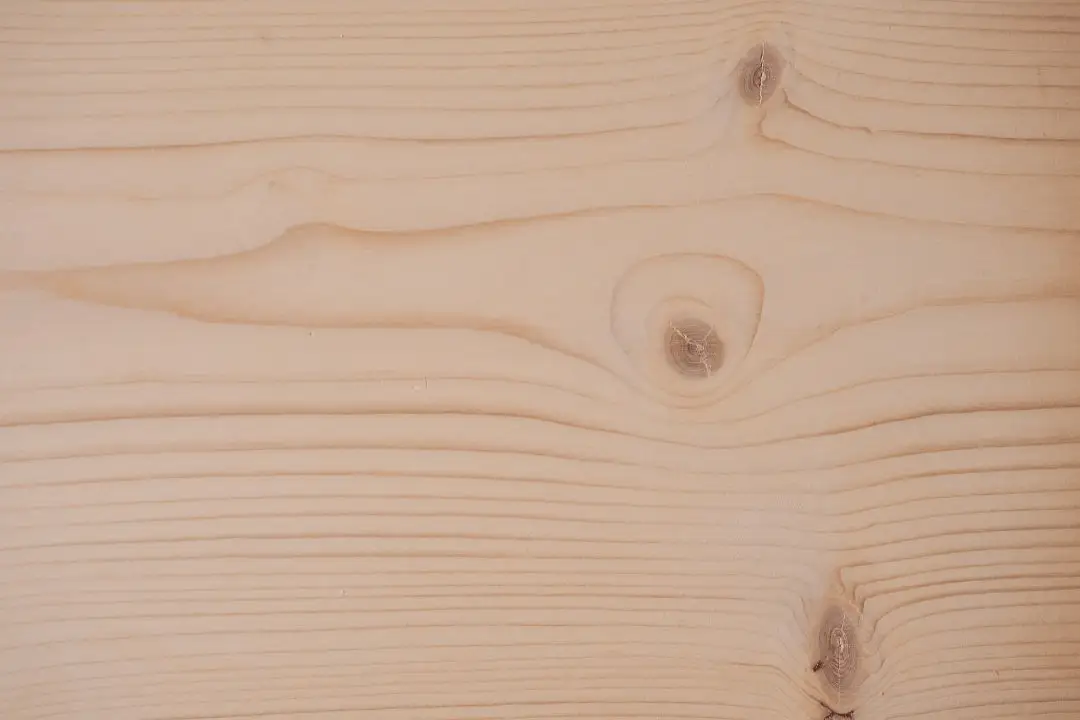
Natural spruce color ranges from creamy white and light straw to pale yellow or tan. Engelmann spruce can have a faint pink cast, while Norway spruce may develop a light reddish-brown warmth after exposure or an oil-based finish.
The grain is commonly straight with a fine, even texture. Quartersawn faces show narrow parallel lines, while flat-sawn faces display broader arches; under fingertips, hard latewood bands can feel slightly raised after the softer earlywood has been over-sanded.
Knots and resin need close inspection. Tight knots may be acceptable in rustic furniture, but loose knots, pitch pockets, checks, blue stain, soft decay, compression wood, and diagonal grain can impair machining, finishing, strength, or acoustic response.
Blue stain alone may be cosmetic, while a dark patch that feels soft, crumbly, or damp signals a larger concern. Compression wood often looks unusually dark and can move unpredictably as humidity changes, making it poor stock for doors, soundboards, and precision assemblies.
Spruce Wood Properties
Spruce wood properties combine low to moderate density, modest dent resistance, and useful stiffness relative to weight. Species averages help compare materials, but knots, grain direction, moisture, and lumber grade have greater influence on many finished projects.
Species Property Table
| Species | Average dried weight | Janka hardness | Modulus of rupture | Modulus of elasticity | Crushing strength |
|---|---|---|---|---|---|
| Engelmann spruce, Picea engelmannii | 23 lb/ft³ (370 kg/m³) | 390 lbf | 9,640 psi | 1.45 million psi | 4,490 psi |
| Norway spruce, Picea abies | 25 lb/ft³ (405 kg/m³) | 380 lbf | 9,120 psi | 1.57 million psi | 4,660 psi |
| Sitka spruce, Picea sitchensis | 27 lb/ft³ (425 kg/m³) | 510 lbf | 10,150 psi | 1.57 million psi | 5,550 psi |
| White spruce, Picea glauca | 27 lb/ft³ (425 kg/m³) | 480 lbf | 9,800 psi | 1.57 million psi | 5,480 psi |
Data Basis and Limits
These are representative clear-wood averages, commonly reported at about 12% moisture content, compiled from individual species entries at The Wood Database. Conversions and rounded figures can vary slightly between references.
Clear test specimens contain fewer defects than construction boards. Never use this table to size a joist, rafter, beam, scaffold, or load-bearing connection; use the member’s grade-specific design value, span information, and governing building requirements.
Density and weight. Engelmann spruce averages about 370 kg/m³, Norway spruce about 405 kg/m³, and Sitka and white spruce near 425 kg/m³ when dried. A wet, knotty board can weigh much more, so calculate shipping or roof loads from the supplied moisture condition rather than a species average.
Hardness and denting. Janka values near 380–510 lbf make spruce easy to cut and shape but vulnerable on table edges, floors, and worktops. A thumbnail pressed firmly across earlywood can leave a mark, while oak or hard maple resists the same pressure much better.
Strength and stiffness. Spruce isn’t weak simply because it dents. Clear, straight-grained stock carries useful bending loads at low weight, which explains its use in roof systems, aircraft components, ladders, spars, and acoustic soundboards.
A large knot or grain that runs off the edge creates a local break in the fiber path. That defect can reduce performance far more than the small numerical difference between two spruce species, especially in a thin brace or narrow structural member.
Shrinkage and stability. Engelmann spruce has representative shrinkage near 3.8% radial and 7.1% tangential; Norway spruce is near 3.9% radial and 7.8% tangential. Tangential movement approaching twice radial movement helps explain why wide, flat-sawn boards cup more readily.
Kiln drying doesn’t stop moisture exchange. Spruce continues moving toward equilibrium with surrounding air, so a dry shelf installed against a damp masonry wall may swell on one face and bow away from the wall.
Thermal and acoustic behavior. Low-density wood slows heat flow more effectively than many dense materials, but wall insulation depends on the complete assembly. Spruce soundboards work through high longitudinal stiffness, low mass, controlled damping, quartering, thickness, and bracing—not species reputation alone.
Important Spruce Species
The main commercial species differ in weight, hardness, availability, and customary use. The best choice depends on the individual board, required grade, exposure, and project rather than the common name by itself.
Engelmann Spruce
Engelmann spruce, Picea engelmannii, grows in high-elevation parts of western North America. Its creamy white to pale yellow-brown wood averages about 23 lb/ft³, making it one of the lightest major commercial spruces.
Its fine texture and low mass suit guitar soundboards, lightweight boxes, pulp, and selected construction work. The detailed Engelmann spruce guide covers the species in greater depth, but instrument buyers should still judge each set for quartering, runout, stiffness, and defects.
Norway Spruce Tree Wood
Norway spruce tree wood, from Picea abies, is a major European construction and engineered-timber material. It has creamy white to pale yellow wood, usually straight grain, moderate stiffness, and an average dried weight near 25 lb/ft³.
Common uses include framing, glulam, cross-laminated timber, furniture components, packaging, paper, violin tops, and guitar soundboards. “Norway spruce” identifies the species, not the country where every commercial board grew or was milled.
Sitka spruce, Picea sitchensis, averages around 27 lb/ft³ and 510 lbf Janka. Selected clear stock combines good bending performance with low mass, supporting its history in aircraft structures, spars, ladders, boats, and instrument tops.
White spruce, Picea glauca, grows across northern North America and appears in construction lumber, regional SPF groups, pulp, crates, and utility work. Its representative density resembles Sitka spruce, but its market and grading context differ.
Other spruce species include red spruce, valued for eastern North American tonewood; black spruce, important in pulp and some SPF supplies; Oriental spruce, used regionally for instruments and construction; and Colorado blue spruce, which has greater importance as an ornamental tree than as mainstream lumber.
Common Spruce Wood Uses
Common spruce wood uses include structural framing, engineered construction, soundboards, painted furniture, models, veneer, paper, and packaging. Suitability changes sharply with grade: a clear quartersawn top and a knotty framing stud may come from the same genus but serve different jobs.
Structural and Engineered Construction
Grade-stamped spruce and SPF lumber can serve as studs, joists, rafters, roof trusses, and light framing. Glulam and cross-laminated timber use controlled laminations to distribute defects and create larger components, yet every load-bearing selection must follow approved construction wood specifications.
Beginners often pick the straightest-looking board while ignoring the stamp, edge knots, moisture designation, or grain deviation. For structural work, retain identification until inspection and don’t cut a high-grade member into pieces before confirming the approved layout.
Guitar and Violin Tonewood

Spruce is one of the principal guitar woods for acoustic tops because a thin, well-braced plate can remain stiff while moving air efficiently. Engelmann, Sitka, red, and Norway or European spruce all appear in professional instruments, but no species guarantees a fixed sound.
In a violin, spruce usually forms the carved top while denser maple forms the back, ribs, and neck. Spruce provides a light vibrating plate; maple adds harder wearing edges, structural support, and acoustic reflection. Poor humidity control can crack the spruce top, while impacts may bruise it long before maple shows comparable damage.
A useful soundboard shows near-vertical growth rings at the edge, straight fibers, minimal runout, and no loose knots or pitch pockets. Tapping a loose plate produces a dry, ringing response, but the sound alone can’t replace measurements of thickness, mass, grain orientation, and stiffness.

Spruce Guitar Soundboard
- Spruce tonewood for guitar building
- Grade LA soundboard stock
- Supports bright responsive tone
- Ideal for custom acoustic instruments
- Ready for careful shaping and bracing
 Buy on Amazon

Engelmann Spruce Guitar Top
- Engelmann spruce tonewood
- Book-matched two-piece soundboard
- Grade B stock for guitar builds
- Natural light pinkish tan color
- Sized for acoustic guitar tops
Buy on Amazon

Engelmann Spruce Soundboard Set
- Engelmann spruce guitar tonewood
- Grade B soundboard material
- Large panel for instrument making
- Supports clear responsive acoustic tone
- Ready for custom guitar construction
Buy on Amazon
Is spruce good for furniture? Yes, it works for painted furniture, rustic tables, cabinet interiors, drawers, shelving, and lightweight casework. It’s a weaker choice for exposed table edges, chair joints, or heavily used tops where dents and compressed screw holes create early wear.
For a spruce or pine tabletop, a durable film-forming polyurethane is often the most practical finish, while a hardwax oil offers easier spot repair but less resistance to standing liquid. Neither finish prevents impact dents, so use coasters, felt pads, and harder edge strips where abuse is likely.
Models and small builds benefit from spruce’s low mass and easy cutting. Architectural models, model aircraft, trim, braces, and repair splints need straight fibers; a thin strip with diagonal grain can snap with a crisp, sudden break under light bending.
- Choose straight-grained strips for long braces and model spars.
- Reject pieces with grain running sharply across the narrow edge.
- Cut with a sharp blade against a firm backing board.
- Predrill thin stock rather than forcing nails or screws.
- Store long strips flat so they don’t acquire a permanent bow.
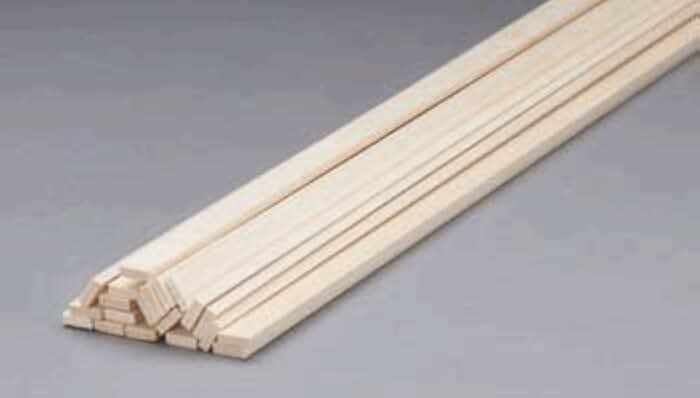
Spruce Wood Strips Set
- Ten narrow spruce strips
- Measures one eighth by three eighths by 36 inches
- Useful for models and trim
- Lightweight wood for detailed work
- Convenient stock for small projects
Buy on Amazon

Spruce Wood Strips for Crafts
- Eight slim spruce strips
- Measures one eighth by one half by 36 inches
- Suitable for models and repairs
- Easy size for precision projects
- Useful for trim and small builds
Buy on Amazon

Square Spruce Wood Strips
- Ten square spruce strips
- Measures three sixteenths by three sixteenths by 36 inches
- Handy for model framing
- Lightweight stock for detailed builds
- Useful for bracing and trim
Buy on Amazon
Veneer and binding provide a spruce surface without the weight or cost of a thick solid board. A 0.6 mm veneer bends readily across some curves, but grain direction, moisture, and backing determine how tightly it can bend before splitting.
Apply veneer to a flat, stable substrate with even adhesive coverage and pressure. A common beginner error is wetting one face heavily, which causes immediate curling; balance moisture, use cauls, and flatten the sheet before the adhesive begins grabbing.

Spruce Guitar Binding Strips
- Eight sprucewood binding strips
- Made for guitar body detailing
- Adds natural wood edge accents
- Suitable for luthier repair work
- Useful for custom instrument builds
Buy on Amazon

Natural Spruce Wood Veneer Roll
- Natural spruce wood veneer
- Thin 0.6 millimeter sheet
- Flexible roll for decorative surfaces
- Suitable for furniture and instrument accents
- Useful for cabinet and DIY projects
Buy on Amazon
Pulp and packaging use spruce for its long fibers, low density, availability, and workability rather than decorative appearance. Boxes, crates, lightweight pallets, and paper products can use grades that would be unsuitable for furniture or instruments.
Spruce Wood Advantages and Limitations
The main advantages of spruce wood are low weight, useful stiffness, easy machining, a neutral pale color, broad availability, and strong performance in carefully graded soundboards. Its main limits are low dent resistance, modest fastener holding, moisture movement, resin bleed, and poor natural outdoor durability.
Main Advantages
- Low mass reduces carrying weight and dead load.
- Good stiffness relative to weight suits framing and resonant plates.
- Sharp tools cut the straight grain cleanly.
- Pale wood accepts paint and many clear finishes.
- Solid boards, structural lumber, veneer, strips, and engineered products are widely available.
- Clean, freshly prepared surfaces usually glue well.
Denting and Fastener Issues
Dents and clamp marks are common because soft earlywood crushes under concentrated pressure. Use broad cauls, cork or leather pads, and only enough pressure to close a glue line; forcing a clamp harder won’t compensate for poorly fitted surfaces.
Screws can strip when driven too deeply, and fasteners near an end can split the board. Drill pilots, use an appropriate shank clearance hole in the upper part, keep hardware away from edges, and stop driving as soon as the head seats.
Warping and moisture movement become visible when one face gains moisture faster than the other. Wide flat-sawn boards are most exposed to cupping, while quartered stock, balanced finishing, airflow, narrower components, and sensible joinery reduce distortion.
Is spruce waterproof? No. Waterproof glue may keep a joint intact and paint may slow water entry, but neither changes the untreated wood’s low natural decay resistance.
Outdoor spruce lasts longer when preservative-treated for the exposure, raised above soil, sloped to shed water, ventilated, sealed at end grain, and maintained. Horizontal ledges, hidden end grain, and tight joints that trap dampness are typical starting points for decay.
Outdoor alternatives include cedar, redwood, black locust, suitable white oak, modified wood, and pressure-treated lumber. Match the alternative to ground contact, structural loading, fastener corrosion, paintability, and local availability rather than choosing solely by decay rating.
Soundboard failure risks include runout, poor quartering, hidden checks, over-thinning, unsuitable bracing, and humidity extremes. Dry air can open a sharp hairline crack beside the bridge; high humidity can soften response and encourage the top to swell or distort.
Working and Finishing Spruce Wood
Spruce machines cleanly with sharp edges, light cuts, and controlled pressure. Its soft earlywood makes it forgiving to shape but easy to crush, ripple, tear around knots, or stain unevenly.
Cutting, Planing, Drilling, and Gluing
Cutting and planing require sharp cutters because a dull edge compresses fibers before tearing them apart. Feed knotty boards slowly, take shallow passes, and read the grain on both edges; resin buildup on a blade increases heat and leaves dark burnished tracks.
Predrill near ends and support the exit face when boring to prevent splintering. Avoid relying on end-grain screws for major loads, and select structural connectors for their approved load and exposure rather than convenience.
Gluing spruce is straightforward when mating surfaces are flat, clean, freshly prepared, and free from resin. Spread a continuous thin film, apply moderate pressure, and follow open-time limits; excessive force can squeeze out too much adhesive and leave permanent clamp hollows.
Sanding, Finishing, and Storage
Sanding soft grain takes a flat block and progressive grits. A soft sanding pad follows low earlywood and removes it faster, leaving latewood ridges that become obvious when light skims across the finished surface.
For clear finishing, water-based products retain a paler spruce color, while oil-based varnish adds amber warmth. The USDA Wood Handbook explains moisture, machining, gluing, and finishing principles that apply across wood species.
Staining and blotching occur because earlywood and latewood absorb color at different rates. Test a washcoat, gel stain, dye-and-glaze schedule, or compatible conditioner on an offcut; conditioner can reduce contrast but won’t always remove it.
Painting and resin bleed require extra preparation around knots and pitch pockets. Scrape active resin, clean without flooding the fibers, and spot-seal suspect areas with a compatible stain-blocking primer before applying the full primer and topcoat system.
Acclimation and storage prevent many later failures. Stack boards flat with aligned stickers, protect them from sun and concrete, allow airflow, and compare moisture readings with the intended room rather than relying on a fixed waiting period.
Spruce Compared With Other Woods
Spruce is usually lighter and softer than common hardwoods, less naturally durable outdoors than cedar, and often lighter than Douglas-fir. Exact species and grade matter more than broad labels such as pine, fir, cedar, or hardwood.
Spruce vs Pine and Fir
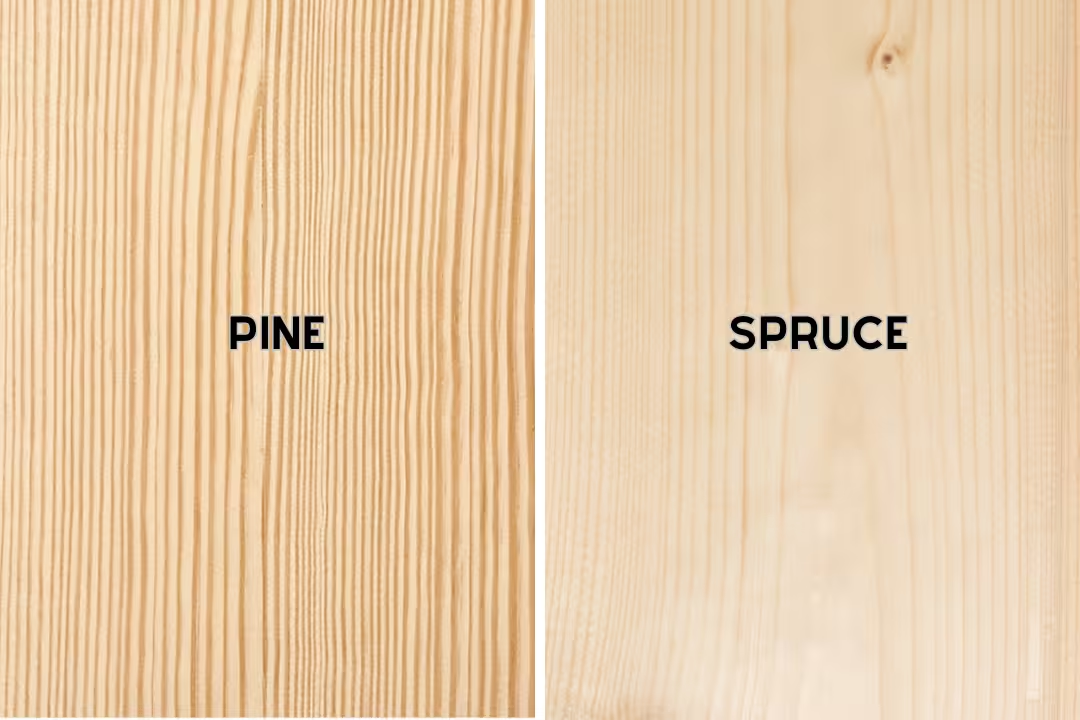
Spruce vs pine isn’t a single strength comparison because both names cover many species. Spruce often has subtler color contrast and less conspicuous resin, while several pines display darker heartwood, bold growth rings, and more frequent pitch.
Pine can be softer or harder than spruce depending on species. Compare an exact board’s grade, density, knots, moisture, and dimensions; useful references include white pine rather than a generic pine average.
Spruce vs fir also needs precise names. True fir belongs to Abies, while Douglas-fir belongs to Pseudotsuga; Douglas-fir is commonly denser and harder than lightweight spruce and has strong structural uses, while selected spruce often wins where low mass and acoustic response matter.
Spruce vs Cedar and Hardwoods
Spruce vs cedar presents a durability trade-off. Cedar commonly provides better natural decay resistance for siding, shingles, and outdoor furniture, while spruce supplies a pale appearance, useful stiffness, and broad framing or instrument applications.
Spruce vs hardwoods favors spruce where low weight, paintability, acoustic movement, and quick machining matter. Oak, maple, and beech provide better dent resistance, wear life, and screw holding for floors, chair joints, worktops, and frequently handled edges.
| Project need | Likely better starting choice | Reason |
|---|---|---|
| Light acoustic soundboard | Clear, quartered spruce | High longitudinal stiffness at low mass |
| Exposed outdoor siding | Cedar or treated material | Better decay resistance or preservative protection |
| Heavy-use tabletop | Hardwood | Greater dent and wear resistance |
| Painted lightweight cabinet | Spruce | Low weight and easy machining |
| High-load structural member | Grade-specified engineered wood or lumber | Documented design values govern selection |
Choosing and Buying Spruce Wood
Buy spruce by project, grade, moisture, and actual dimensions—not by species name alone. Commodity framing, clear furniture boards, bookmatched tonewood, craft strips, and veneer use different grading systems and pricing units.
Construction Lumber, Furniture Stock, and Instrument-Grade Spruce
For construction lumber, check the grade stamp, species group, moisture designation, knot position, wane, splits, and straightness. Structural design values should come from accepted standards and grading information such as the American Wood Council NDS, paired with local requirements.
For furniture, choose dry boards with minimal twist, stable grain, and defect placement that suits each part. Clear wood belongs on visible edges and joinery; attractive tight knots can remain in broad rustic panels where they won’t weaken a narrow rail.
Instrument-grade spruce should be quartered, straight-grained, seasoned, and free from checks, loose knots, and harmful pitch pockets. “Master,” “AAA,” and similar labels lack one universal standard, so ask for ring orientation, runout, dimensions, moisture condition, and the seller’s grading criteria.
Craft Strips, Veneer, Grades, and Sourcing
For craft strips and veneer, verify actual width, thickness tolerance, straightness, grain direction, backing, and minimum practical bend radius. Product photos can hide bowed strips, diagonal fibers, end checks, or torn veneer edges, so confirm the return policy before ordering.
Grades and moisture content answer different questions: grade describes allowed defects or performance, while moisture affects weight, movement, machining, and installation. “Kiln-dried” doesn’t state the board’s present moisture after storage; measure it when dimensional accuracy matters.
Nominal construction sizes differ from dressed measurements, as explained in this guide to lumber dimensions. Tonewood is often priced by the set, veneer by area, and craft strips by piece, so a single board-foot comparison can mislead.
Is spruce wood expensive? Commodity SPF is often economical, while clear quartered spruce, long knot-free stock, aircraft-grade lumber, and bookmatched soundboards command far higher unit prices. Sorting yield, dimensions, stiffness, grain quality, shipping length, and certification create that gap.
- Confirm the exact species or commercial species group.
- Check actual rather than nominal dimensions.
- Request the moisture condition and grade definition.
- Inspect knots, checks, pitch pockets, runout, bow, cup, and twist.
- Ask how warped, split, or misgraded pieces are handled.
- Include oversized shipping and waste in the total cost.
- Confirm bookmatching and quartering for soundboards.
- Look for documented forest certification where available.
Sustainable sourcing depends on forest management, species, origin, processing, and traceable documentation. FSC explains how chain-of-custody certification tracks qualifying material through supply networks at the Forest Stewardship Council; PEFC-certified, reclaimed, regional, veneered, and engineered options may also reduce waste when they fit the project.
Fast growth or wide distribution doesn’t prove responsible harvesting. Ask for the certification claim shown on invoices, avoid assuming every spruce species has the same conservation status, and check species and origin for regulated or sensitive supplies.
Practical Notes From Real-World Use
Real boards reveal problems that specification sheets can’t show. A straight stud may twist after one face dries beside a heater, a flawless model strip may snap along hidden runout, and a pale tabletop can turn patchy brown within seconds of applying penetrating stain.
At the lumber rack, sight each board from one end at eye level and rotate it through both axes. Bow appears as a long curve, twist makes opposite corners rise, and cup shows as a shallow trough across the face; placing two candidate boards face-to-face makes subtle distortion easier to detect.
Use your fingertips around knots and along edges. Loose fibers, abrupt grain direction, sticky resin, raised latewood, and cool damp areas often become apparent by touch before they stand out under store lighting.
For furniture, orient the cleanest straight grain through narrow rails and loaded shelves, then place knots in wide low-stress panels. Add hardwood edging to vulnerable table fronts, use padded clamps, and keep screw torque low so the soft fibers retain their grip.
For soundboards, compare sets under raking light and inspect both faces for grain runout. A plate can look perfectly straight from above while fibers exit one face at an angle, reducing splitting resistance and creating uneven reflection across a bookmatched joint.
Spruce works best when its strengths—lightness and stiffness—match the job and its weak points receive practical protection. Select by grade, control moisture, support soft surfaces during assembly, test the finish, and keep untreated material away from persistent outdoor wetting.
FAQs
Is Spruce A Hardwood Or A Softwood?
Spruce is a softwood. It comes from coniferous evergreen trees, which generally grow faster than hardwood trees. Despite its name, softwood can still be strong and durable enough for many building, crafting, and furniture projects.
Is Spruce Wood Good For Furniture?
Spruce wood is good for lightweight furniture, rustic pieces, and painted projects. It is affordable, easy to cut, and has a clean, straight grain, but it dents more easily than harder woods. Use a protective finish and avoid it for heavily used surfaces such as dining tables.
What Color Is Spruce Wood?
Spruce wood is usually pale white, cream, or light yellow. The heartwood may be slightly darker than the sapwood, and the color can deepen to a warmer honey tone over time. Clear finishes highlight its subtle grain, while stains can make its color more uniform.
Is Spruce Stronger Than Pine?
Spruce is generally slightly stronger and stiffer than many common pine species. Its straight grain gives it a good strength-to-weight ratio, which is why it is widely used for framing and structural lumber. Actual strength varies by species, grade, moisture level, and board quality.
Can Spruce Wood Be Used Outdoors?
Spruce wood can be used outdoors only when it is properly treated and protected. Untreated spruce has limited natural resistance to moisture, insects, and decay, so it can rot when exposed to rain and ground contact. Seal it regularly or choose pressure-treated spruce for exterior projects.
Affiliate Disclosure: Some links in this post are affiliate links. If you make a purchase through these links, we may earn a small commission at no extra cost to you. We only recommend products we genuinely believe in.