

Engelmann spruce is a cold-adapted evergreen conifer native to western North America’s mountain forests. Known scientifically as Picea engelmannii, it has sharp four-sided needles, hairy young twigs, hanging papery cones, and a narrow crown built to shed heavy snow.
Table of Contents
What Is Engelmann Spruce?
Engelmann spruce is a high-elevation tree in the pine family, Pinaceae. It commonly shares cold, moist subalpine forests with subalpine fir and supplies habitat, watershed cover, lumber, pulp, and selected acoustic wood.
Name and Classification
The accepted botanical name is Picea engelmannii Parry ex Engelm. The genus Picea contains the spruces, while the species and common names honor German-American botanist George Engelmann. Its accepted name and native distribution appear in Kew Science plant records.
Engelmann spruce is a gymnosperm, meaning its seeds develop on exposed cone scales rather than inside fruit. It isn’t a pine tree: pine needles grow in bundles, while each spruce needle attaches singly to a woody peg called a sterigma.
Engelmann Spruce Quick Facts
| Feature | Engelmann spruce facts |
|---|---|
| Scientific name | Picea engelmannii |
| Family | Pinaceae |
| Plant type | Evergreen conifer |
| Native range | Western Canada to the southwestern United States |
| Typical mature height | 80–130 ft (25–40 m) |
| Needle length | 0.6–1.2 in (15–30 mm) |
| Cone length | 1.5–2.75 in (4–7 cm) |
| Typical habitat | Cool, moist mountain and subalpine forests |
| Potential lifespan | Several centuries; 400–500 years on favorable sites |
| Conservation status | Least Concern globally |
Conservation status. Engelmann spruce remains widespread and is assessed as Least Concern at the species level. That broad category doesn’t mean each stand is secure; drought, severe fire, beetles, past logging, and poor regeneration can cause major local losses.

Engelmann Spruce Book
- Dedicated to Engelmann spruce
- Useful for learning about the species
- Supports tree and conifer research
- A relevant reference for readers
- Fits forestry book collections
 Buy on Amazon
How to Identify Engelmann Spruce

Identify Engelmann spruce from a combination of traits: sharp four-sided needles, fine hairs on young twigs, hanging cones with thin ragged scales, and a narrow spire-like crown. Color or silhouette by itself can mislead you.
Needles
The needles occur singly and measure about 0.6–1.2 inches (15–30 mm). Roll one gently between your fingertips: its four-sided shape feels angular, and the sharp tip gives a distinct dry pinprick rather than the soft brush of a fir needle.
Needle color ranges from yellow-green to bluish green. Pale stomatal lines can create a silvery cast, so blue foliage doesn’t prove that a tree is blue spruce. Fallen needles leave their woody pegs behind, making bare spruce twigs feel rough and rasp-like.
Twigs and Buds
Young shoots commonly carry fine short hairs, best seen with a hand lens or side lighting. Twig hair is one of the stronger field distinctions from blue spruce, whose young shoots are commonly hairless, but hybrids can blur this difference.
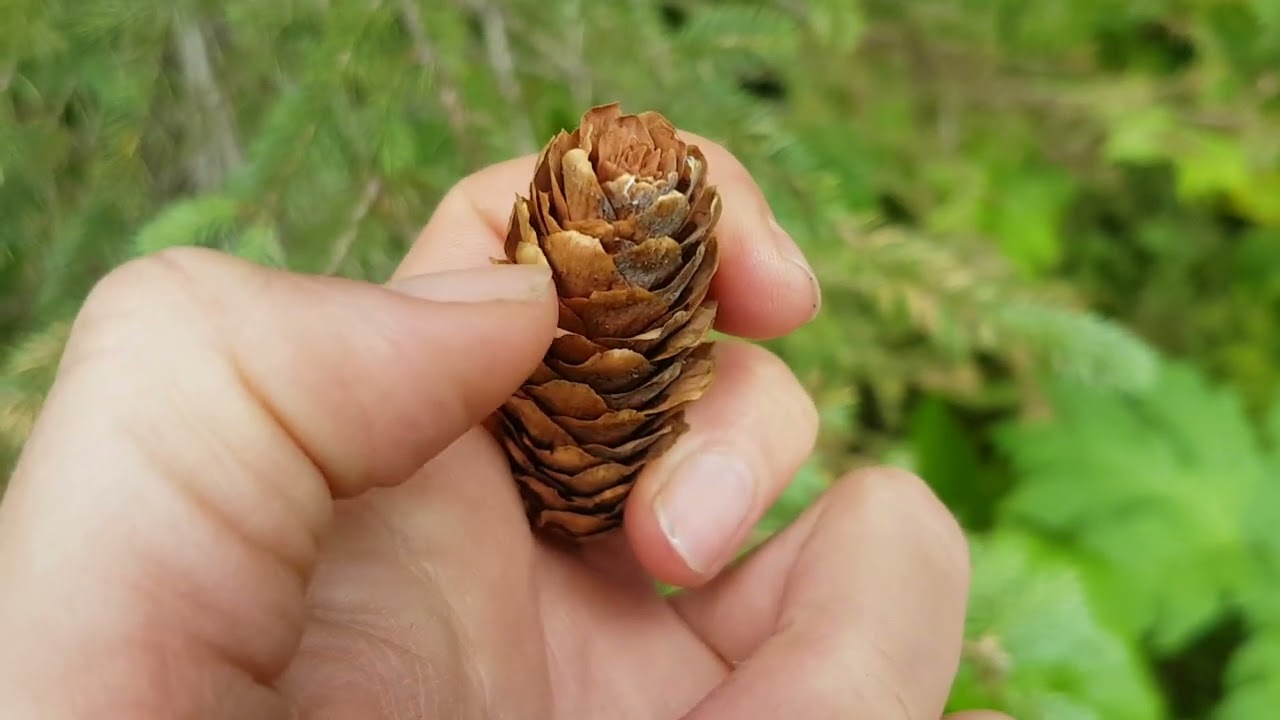
Cones. Seed cones hang downward and commonly reach 1.5–2.75 inches (4–7 cm). Their scales feel thin, flexible, and papery, with irregularly toothed margins; dry scales give a faint crackle when flexed, unlike the stiffer scales of blue spruce.
Engelmann spruce bark starts thin, gray, and fairly smooth before separating into loose gray-brown or reddish-brown scales. Bark varies with age and exposure, so confirm it with foliage, twigs, cones, and location rather than matching bark photos alone.
Crown and form. Mature trees commonly develop a narrow conical crown, pointed leader, and slightly drooping branchlets that release snow. Open-grown trees retain low branches, while crowded forest trees develop cleaner trunks and smaller crowns after shaded limbs die.
Engelmann Spruce vs Similar Species
The safest comparison uses several independent features. Habitat narrows the options, while twig hair, needle attachment, cone direction, and cone-scale texture provide better confirmation than foliage color.
Blue Spruce
Blue spruce, Picea pungens, usually has stiffer needles, mostly hairless young twigs, and larger cones with thicker scales. Selected landscape forms may look intensely blue, but wild Engelmann spruce can also carry a blue-gray bloom.
White Spruce
White spruce, Picea glauca, is associated more strongly with northern boreal forests and lower elevations. Engelmann spruce occupies western mountain forests, yet the species form an interior spruce complex where their ranges meet.
| Species | Young twigs | Cones | Strong habitat clue |
|---|---|---|---|
| Engelmann spruce | Usually finely hairy | Small, hanging, thin flexible scales | Interior mountain and subalpine forests |
| Blue spruce | Usually hairless | Larger, thicker and stiffer scales | Rocky Mountain valleys and stream corridors |
| White spruce | Often hairless to lightly hairy | Small, hanging cones | Boreal and northern forests |
| Sitka spruce | Usually hairless | Thin scales with wavy or toothed tips | Humid Pacific coast |
| Subalpine fir | Smooth after needles fall | Upright and disintegrating | High-elevation spruce–fir forest |
Sitka spruce. In an Engelmann spruce vs Sitka spruce comparison, geography provides the clearest first clue. Sitka spruce is a humid coastal species that can become massive, while Engelmann spruce favors colder interior mountains and has commonly hairy young twigs.
Subalpine fir. Fir needles are flatter, softer, and attached directly to the shoot. Its cones stand upright and fall apart on the branch. Engelmann spruce cones hang intact, and its persistent needle pegs leave a rough twig; see the full subalpine fir guide for further comparison.
Hybrid identification challenges. Engelmann and white spruce exchange genes in overlap zones, creating intermediate trees that resist tidy field labels. Cone measurements, twig hair, elevation, and regional population context may still leave uncertainty; genetic testing or herbarium review can settle high-stakes identifications.
Native Range, Habitat, and Ecology
Engelmann spruce grows naturally in cool western mountains, from British Columbia and Alberta through the western United States to Arizona and New Mexico. Latitude, slope direction, snow retention, and local moisture control where it succeeds.
Geographic Distribution
Major populations occur through the Rocky Mountains and nearby western ranges, including parts of Washington, Oregon, California, Idaho, Montana, Wyoming, Nevada, Utah, Colorado, Arizona, and New Mexico. The USDA Fire Effects Information System documents its distribution and ecological setting.
Elevation and Climate
Across its continental range, reported elevations run from roughly 2,000 feet to above 11,500 feet (600–3,500 m). Northern populations occur lower, while southern populations occupy high mountain sites and may approach treeline.
Cold winters, cool summers, short growing seasons, and deep seasonal snow suit the species. Snowpack stores water for spring and early summer; prolonged heat or early snowmelt can leave its shallow absorbing roots in warm, drying soil.
Soil, moisture, and shade. Engelmann spruce accepts varied mineral substrates but performs best where soil stays cool, moist, aerated, and well drained. Young trees tolerate shade, yet dense cover slows growth. Saturated clay can suffocate roots despite the tree’s demand for dependable moisture.
Spruce–fir forests. Engelmann spruce commonly becomes a large canopy tree above shade-tolerant subalpine fir. Fir may dominate the understory, while spruce gains openings after wind, insects, or treefall expose light and suitable seedbeds.
Associated tree species include lodgepole pine, Douglas-fir, western larch, alpine larch, whitebark pine, limber pine, quaking aspen, blue spruce, and white spruce. Associations shift with latitude, elevation, drainage, and fire history; compare its range with western larch.
- Dense foliage supplies nesting, hiding, and winter thermal cover.
- Seeds and bark-dwelling insects contribute food for birds and small mammals.
- Snags and fallen trunks provide cavities, fungal habitat, and decaying wood.
- Mountain stands hold snow, shade streams, slow erosion, and return nutrients to soil.
Wildlife and watersheds. Ecological effects vary by slope and stand condition. A living canopy intercepts snow, but gaps can accumulate deeper drifts; after severe mortality, runoff timing depends on remaining vegetation, burn severity, soil structure, and later storms.
Size, Growth, and Reproduction
Typical mature forest trees reach 80–130 feet (25–40 m), though exceptional specimens grow larger. Growth ranges from slow to moderate and responds strongly to temperature, light, soil oxygen, and summer moisture.
Mature Dimensions
Trunk diameter and crown width vary with competition. A tree in a dense stand builds a narrow crown and long clear stem; an open-grown tree keeps wider lower limbs. Nursery cultivar dimensions shouldn’t be substituted for the wild species size.
Growth Rate and Lifespan
Seedlings often grow slowly in cold, shaded settings, then respond after a canopy opening. Favorable trees can live 400–500 years, while fire, root failure, beetles, and wind commonly end individual lives much sooner.
Roots, windthrow, and snow. Root form follows soil depth and aeration rather than one fixed pattern. Cold, wet, shallow soils encourage plate-like rooting. Removing neighboring trees can suddenly expose retained spruce to wind, especially when saturated ground provides weak anchorage.
A narrow crown and flexible, drooping branchlets help shed snow, but heavy wet snow can still bend leaders or split forks. Beginners sometimes knock snow from frozen branches; the expert workaround is to let it melt because brittle wood can snap under abrupt movement.
Pollination and seed crops. Male and female reproductive structures grow on the same tree, and wind carries pollen. Female cones mature during one growing season. Winged seeds escape as scales open, with useful crops appearing irregularly rather than on a fixed annual schedule.
Seedling establishment. Moist mineral soil, decayed logs, and sheltered pockets give roots access to water without dense competition. Bare dark soil can become hot enough to kill emerging seedlings; nearby woody debris moderates temperature and reduces surface drying.

Engelmann Spruce Genetics Study
- Explores Engelmann spruce genetics
- Useful for advanced tree research
- Relevant to forestry students
- Supports scientific reference collections
- Focused on species variation
Buy on Amazon
Disturbances, Threats, and Management
Engelmann spruce is vulnerable to intense fire, beetles, root disease, drought, and windthrow. These forces often interact: wind creates breeding material, drought weakens defense, beetles increase dead fuel, and later fire affects seed sources.
Fire and Postfire Recovery
Thin bark, low branches, and shallow roots give mature trees poor fire resistance. Severe fire commonly kills them. The species can recolonize burned ground from wind-dispersed seed, but it can’t resprout from a killed trunk or root crown.
Recovery proceeds faster near surviving trees and unburned islands. Large high-severity patches may remain short of seed for years, allowing lodgepole pine, aspen, shrubs, or grasses to occupy the site before spruce returns.
Spruce Beetle
Spruce beetle, Dendroctonus rufipennis, is a major native mortality agent. Adults tunnel beneath bark, where larvae feed through conductive tissue. Outbreaks often hit large mature spruce and stands containing windthrown or drought-stressed material.
Fading foliage doesn’t prove beetle attack. Planting depth, severed roots, drought, waterlogging, and root rot produce similar crown symptoms. Check for boring dust, pitch, galleries beneath bark, exit holes, root condition, and the timing of color change before assigning a cause.
Other pests and diseases. Western spruce budworm can defoliate shoots, while Armillaria, Heterobasidion, and tomentosus root diseases weaken support and water transport. Spruce dwarf mistletoe affects some populations. Treatment depends on a sound diagnosis rather than crown appearance alone.
Climate and range shifts. Warmer summers, earlier snowmelt, and drought can reduce seedling survival and increase host stress. Some populations may establish higher on slopes, but thin alpine soil, exposure, limited terrain, and slow seed movement can block upward migration.
Forest management. Useful measures include retaining structural and age diversity, protecting surviving seed trees, monitoring young regeneration, and choosing seed sources suited to the planting climate. Removing surrounding trees in one heavy cut can increase windthrow among retained spruce.
Engelmann Spruce Wood and Uses
Engelmann spruce wood is pale, lightweight, soft, and commonly straight grained. It works cleanly with sharp tools, but dents readily and has little natural resistance to decay, making untreated ground contact a poor use.
Wood Characteristics
The heartwood and sapwood often show little color separation, ranging from creamy white to light yellow-brown. Straight grain creates a quiet, even surface; compression wood, knots, and grain runout can make cutting feel more resistant and cause torn fibers.
See the broader spruce wood guide for grain, durability, finishing, and species-group context. Engelmann material is sometimes sold within mixed commercial categories, so a retail stamp may not verify every board to species.
Physical Properties
| Property | Representative value | Practical meaning |
|---|---|---|
| Average dried weight | 23 lb/ft³ (370 kg/m³) | Light for handling and acoustic components |
| Janka hardness | 390 lbf (1,730 N) | Dents more easily than many flooring woods |
| Modulus of rupture | About 9,400 psi | Moderate bending strength for its weight |
| Modulus of elasticity | About 1.57 million psi | Useful stiffness at relatively low mass |
These are representative clear-wood values, not guarantees for a board or structural grade. Moisture, growth rate, grain direction, knots, and testing method affect results. The figures align with the Wood Database species profile.
Lumber and pulp. Uses include framing, sheathing, plywood, boxes, crates, millwork, pulp, and paper. Light weight helps during handling, but softness leaves edges and exposed surfaces prone to crushing. Structural buyers should use grade stamps and engineering values rather than species reputation.
Tonewood and instruments. Selected Engelmann spruce becomes guitar and violin-family soundboards because low mass can pair with useful stiffness. A good top feels light in the hand and rings clearly when tapped, while a weak or poorly cut billet gives a shorter, duller response.
Grades, labels, and value. Acoustic grade depends on quarter-sawn orientation, straight grain, low runout, even ring structure, billet size, seasoning, and freedom from knots or compression damage. Species name alone doesn’t establish tone or market value.
Beginners often equate narrow growth rings with superior sound. Ring width matters less than the whole piece’s stiffness-to-weight balance and grain continuity. Experienced makers flex, weigh, tap, and inspect each billet instead of purchasing from visual grade alone.
Growing Engelmann Spruce in Landscapes
Engelmann spruce grows best in a cool climate with moist, aerated soil, a cool root zone, and enough space for its mature form. Hot lowlands, reflected pavement heat, compacted soil, and repeated summer drought commonly cause decline.
Suitable Growing Conditions
Choose full sun in cool districts or light afternoon shade where summers are warmer. Soil should retain moisture without staying saturated. Regional hardiness recommendations vary by seed source and cultivar, so buy material propagated from a climate-compatible provenance.
Site and Space Limits
The straight species can outgrow small residential lots. Account for an 80–130-foot potential height, crown spread, overhead cables, buildings, drainage lines, and long-term root volume. A young narrow tree placed beside a house can become an expensive removal.
Planting and establishment. Set the first structural roots near finished soil level rather than burying the trunk flare. Dig a broad hole no deeper than the root ball, loosen circling roots where feasible, backfill with site soil, and water the full root zone.
- Confirm drainage before planting by checking whether water lingers in the hole.
- Remove trunk ties, excess soil over the root flare, and nondegradable wrapping.
- Water deeply when the upper root zone begins to dry rather than sprinkling daily.
- Spread mulch over the root area while leaving a gap around the trunk.
- Stake only on unstable or windy sites and remove supports after establishment.
Common planting failures. Deep planting and mulch piled against the trunk trap moisture around bark that needs air. Constant irrigation at the root collar encourages decay, while shallow daily watering leaves deeper roots dry. Direct water outward across the root ball and surrounding soil.
Another common mistake is treating a mountain tree as a bog plant. Dependable moisture doesn’t mean stagnant soil. If a planting hole fills like a smooth clay basin, raise the root crown slightly and improve surface drainage rather than filling the hole with loose amended soil.
Practical notes from use. Container trees often hide several inches of soil above the first roots. Scrape this excess away before measuring hole depth. After watering, the root zone should feel cool and evenly damp, not slick, sour-smelling, or airless.
Large transplanted specimens lose a major share of their absorbing roots. A smaller tree with an intact root system often establishes faster than an impressive large specimen. Keep the root ball shaded and moist during handling, since fine roots can dry within minutes in warm wind.
Ornamental cultivars. Weeping, blue-foliaged, and compact selections can differ sharply from wild trees. Confirm the full cultivar name and its documented mature size. A grafted weeping form may suit a specimen bed, but rootstock shoots should be removed before they dominate.

Weeping Engelmann Spruce Live Plant
- Live Engelmann spruce cultivar
- Distinctive weeping growth habit
- Adds conifer texture to landscapes
- A choice for specimen planting
- Botanical name Picea engelmannii
Buy on Amazon

Planting Engelmann Spruce Guide
- Focused on planting Engelmann spruce
- Useful for establishment research
- Relevant to forestry and restoration
- Supports conifer growing studies
- A practical species-specific reference
Buy on Amazon
FAQs
How Can You Identify An Engelmann Spruce?
Engelmann spruce is identified by its narrow conical shape, bluish-green needles, and small woody pegs along its twigs. Its sharp, four-sided needles are usually 1 to 1.5 inches long and can be rolled between your fingers. Mature trees develop thin, scaly gray-brown bark.
Where Does Engelmann Spruce Grow?
Engelmann spruce grows in cool, moist mountain forests across western North America. It is common in the Rocky Mountains and high-elevation areas from British Columbia and Alberta south to Arizona and New Mexico. The tree thrives in places with snowy winters, mild summers, and well-drained soil.
Is Engelmann Spruce The Same As Blue Spruce?
Engelmann spruce and blue spruce are different but closely related tree species. Engelmann spruce usually has softer bluish-green needles and grows naturally at higher elevations, while blue spruce often has stronger silver-blue foliage. Both are native to western North America and may grow near each other.
How Tall And Long-Lived Is Engelmann Spruce?
Engelmann spruce commonly reaches 80 to 130 feet tall and can live for 300 years or more. In ideal high-mountain conditions, some trees grow taller than 200 feet and survive for 500 years. Growth is generally slow to moderate, especially in cold or exposed locations.
Is Engelmann Spruce Good For Lumber And Guitars?
Engelmann spruce is valued for lightweight lumber and high-quality acoustic guitar soundboards. Its straight grain, strength, and clear tone make it popular for musical instruments, especially guitars and pianos. It is also used for framing, plywood, and other projects where a strong, workable softwood is useful.
Affiliate Disclosure: Some links in this post are affiliate links. If you make a purchase through these links, we may earn a small commission at no extra cost to you. We only recommend products we genuinely believe in.