
Subalpine Fir Tree Guide: Identification, Habitat and Ecology

Subalpine fir, usually classified as Abies lasiocarpa, is a narrow-crowned evergreen conifer native to cold mountain forests of western North America. A subalpine fir tree has soft needles, smooth twigs, and upright cones that break apart while still attached to the branch.
This guide explains how to identify the species, where it grows, how it functions in high-elevation forests, what threatens it, and why cultivation outside a cool mountain climate often fails.
Table of Contents
What Is a Subalpine Fir?

A subalpine fir is a cold-adapted true fir found from Alaska and Yukon south through western mountain systems to Arizona and New Mexico. “Subalpine” describes the cool forest belt below climatic treeline; it doesn’t mean every specimen grows beside an alpine meadow.
Definition and Key Facts
Mature trees commonly reach 20–40 meters (65–130 feet) on favorable sites, with trunks approaching 1 meter (3 feet) in diameter. Exposed trees near treeline may remain waist-high, crooked, or pressed close to the ground, so height alone can’t confirm identification.
| Key fact | Subalpine fir |
|---|---|
| Scientific name | Abies lasiocarpa |
| Family | Pinaceae |
| Plant type | Evergreen conifer and true fir |
| Typical height | 20–40 m (65–130 ft) |
| Needle length | About 1.5–3 cm (0.6–1.2 in) |
| Cone length | About 6–12 cm (2.4–4.7 in) |
| Typical lifespan | Roughly 120–200 years |
| Fire resistance | Low |
The species is one of the characteristic evergreen trees of BC and the Rocky Mountains. It also occurs in northern maritime areas, interior plateaus, the Cascades, and isolated high mountains farther south.
Taxonomy, Scientific Names, and True Fir Meaning
This guide follows the widely used name Abies lasiocarpa. It belongs to Pinaceae, the pine family, and Abies, the true-fir genus; the Plants of the World Online database is a useful reference for checking accepted botanical names and synonyms.
Taxonomic treatments differ across western North America. Some botanists recognize Rocky Mountain populations as Abies bifolia, while others keep them within A. lasiocarpa; corkbark fir may appear as Abies lasiocarpa var. arizonica or under another regional treatment.
The true fir meaning is botanical rather than a statement about appearance. True firs belong to Abies, while Douglas-fir belongs to Pseudotsuga; this difference explains their contrasting cone structure, bark, and needle attachment.
Subalpine Fir Identification
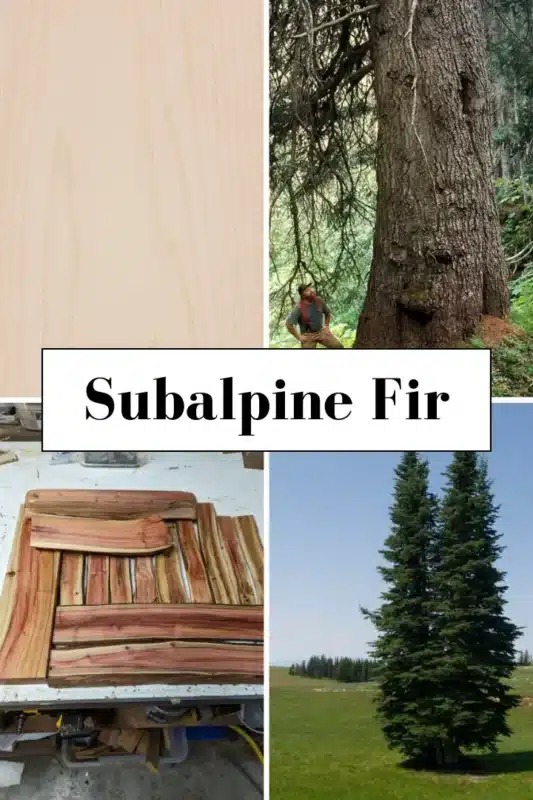
Identify subalpine fir by combining four features: a narrow spire-like crown, soft flat needles, smooth twigs without woody pegs, and erect cones that disintegrate on the tree. Cone-free trees require closer inspection because crown shape changes with age, snow, wind, and available light.
Height, Shape, Size, Needles, and Leaf Scars
A forest-grown tree often forms a slender conical crown with short, dense branches. Open-grown specimens may retain branches almost to the ground, while crowded trees lose shaded lower limbs and carry a smaller live crown.
The needles measure about 1.5–3 centimeters and feel soft and flexible when drawn between the fingers. Their tips are usually blunt or slightly notched rather than needle-sharp, and two pale stomatal bands occur on the lower surface.
Needle arrangement isn’t fixed. Shade-grown shoots may look flattened and two-ranked, while sunlit upper shoots carry upcurved radial needles; beginners often treat this light-driven variation as evidence of two species.
Pulling off one needle exposes a round smooth scar. Spruce leaves a raised woody peg, so a bare section of twig provides one of the best identification checks after fallen or browsed branches have lost their foliage.
Upright Purple Cones, Bark, Twigs, Buds, and Krummholz
Young seed cones are often deep purple or bluish purple and stand upright on upper branches. They mature to brown, then shed their scales around a persistent central axis; finding a whole fallen cone beneath the tree is uncommon.
Young bark feels relatively smooth and may show raised resin blisters. Pressing a fresh blister can release sticky, sharply aromatic resin, while old trunks develop gray-brown scales and shallow fissures that make bark-only identification less dependable.
Twigs range from grayish to brown and can carry fine hairs. The buds are usually rounded and resinous, unlike the sharply pointed buds found on some other western conifers.
Near treeline, severe wind and abrasive ice produce flagged crowns, multiple stems, and krummholz growth. Krummholz means low, contorted woody growth shaped by cold and wind; protected branches may look healthy and dense while exposed tips appear brown and sandblasted.
- Check for soft, individually attached needles.
- Look for smooth circular scars rather than spruce pegs.
- Search upper branches for upright cones or bare cone axes.
- Use bark only as supporting evidence.
- Allow for distorted crowns at treeline.
Range, Elevation, and Habitat

Subalpine fir grows across western North America, from Alaska and Yukon through British Columbia and Alberta, then south through the Cascades, Rockies, and high mountains of Arizona and New Mexico. Elevation rises from north to south because comparable cold conditions occur higher on southern mountains.
Western North American Range and Elevation by Region
In the far northern maritime range, subalpine conditions can occur near sea level. Across Canada and the northern United States, the tree occupies montane and subalpine forests, while southern Rocky Mountain populations may grow above 3,000 meters (10,000 feet).
| Region | Typical elevation pattern | Field context |
|---|---|---|
| Alaska and Yukon | Locally low elevation to mountain slopes | Cold climate lowers the subalpine belt |
| British Columbia and Alberta | Montane to subalpine | Common in cold, snowy interior forests |
| Northern US Rockies and Cascades | Mainly middle to upper mountain elevations | Often mixed with spruce, hemlock, or lodgepole pine |
| Central and southern Rockies | Often about 2,400–3,650 m (7,900–12,000 ft) | Local slope, exposure, and snow alter the limits |
| Arizona and New Mexico | Restricted to high, cool mountains | Populations may be isolated by dry lowlands |
A single universal elevation range is misleading. Latitude, maritime influence, cold-air drainage, slope direction, and local snow retention can shift the species hundreds of meters above or below a regional average.
Climate, Snowpack, Soil, and Moisture Needs
Subalpine fir favors long cold winters, a deep seasonal snowpack, short cool summers, and steady moisture. Historic forestry accounts describe frost-free periods of roughly 45–90 days on some sites, though local growing seasons vary widely.
Snow insulates shallow roots and low branches from extreme air temperatures. Its slow spring melt supplies moisture after precipitation declines, but late-lying snow can shorten the already brief period available for shoot extension and wood formation.
Roots perform best in cool aerated soil that remains moist without staying saturated. The species grows across several parent materials, yet compacted ground, standing water, warm soil, and prolonged summer drought frequently cause root loss or sparse foliage.
Shallow rooting increases the chance of windthrow, particularly where wet soil, bedrock, or a dense subsurface layer restricts depth. A tree may appear stable until snowmelt softens the ground and a strong wind tips the entire root plate.
Ecological Role and Adaptations
Subalpine fir is a highly shade-tolerant component of cold upper-mountain forests. It supplies dense cover, captures snow, protects headwater soils, and often increases beneath older stands after faster-establishing trees create shelter.
Spruce–Fir Forests, Associated Species, Wildlife, and Watersheds
Engelmann spruce, Picea engelmannii, is its most characteristic companion across much of the Rockies. Spruce often becomes larger and older on productive sites, while fir regenerates readily beneath partial canopy; see the detailed Engelmann spruce guide for its distinguishing features.
Regional associates include lodgepole pine, whitebark pine, limber pine, mountain hemlock, Pacific silver fir, grand fir, Douglas-fir, and quaking aspen. The mix reflects elevation, fire history, snow depth, and moisture rather than a fixed forest recipe.
Dense crowns provide thermal and hiding cover for birds and mammals during windy, snowy weather. Seeds and tissues feed small animals, though the tiny winged seeds carry less food than the large seeds of whitebark or limber pine; the latter is covered in the site’s limber pine profile.
At headwaters, these forests intercept snowfall, shade the soil, stabilize steep slopes, and influence melt timing. No single species controls an entire watershed, but losing broad areas of spruce–fir canopy can change snow accumulation patterns, soil temperature, and runoff timing.
Cold-Climate Adaptations, Fire Ecology, and Succession
The narrow crown sheds snow more readily than a broad crown, while flexible branches bend beneath heavy loading. Evergreen needles let the tree resume photosynthesis during favorable cool periods without rebuilding a full crown each spring.
High shade tolerance helps seedlings survive beneath older trees. Near treeline, compact growth reduces wind exposure, and low branches can root where they touch damp soil, preserving a genotype when seedling establishment is poor.
Thin bark, shallow roots, low branches, and dense stands give subalpine fir low fire resistance. The USDA Fire Effects Information System describes its fire response and the strong variation among subalpine forest types.
Many high-elevation stands experienced long gaps between severe fires rather than frequent ground fires. Following stand-replacing fire, lodgepole pine may establish from serotinous cones, aspen may sprout, and shade-tolerant spruce and fir can return gradually beneath the developing canopy.
Growth, Reproduction, and Longevity
Subalpine fir grows slowly in cold exposed settings and faster on moist, sheltered sites. Many trees live 120–200 years, while protected individuals may exceed 250 years if they escape fire, insects, disease, and windthrow.
Growth Rate, Lifespan, Cones, and Seed Production
There isn’t one reliable answer to “how fast do they grow?” Seedlings may add only a few centimeters during harsh years, while established trees on cool moist sites can make noticeably longer annual shoots; compact buds and short internodes reveal years of stress.
Young trees can form cones, but abundant crops tend to come later. Production varies sharply between years, and insects, frost, poor pollination, or storms can reduce viable seed even when branches carry many cones.
The winged seeds disperse by wind after cone scales separate. Most land near the parent stand, though strong winds and steep topography can carry a portion farther; uphill migration remains slow because mountains offer less ground near summits.
Germination, Establishment, and Layering Near Treeline
Seeds germinate on moist mineral soil, decayed wood, and well-decomposed humus. Thick dry litter can prevent a short new root from reaching moisture, while exposed mineral soil may become too hot or dry during an open summer.
Seedlings tolerate considerable shade but still need enough light to maintain foliage. A sheltered microsite beside a log often works better than an open patch because the wood catches snow, reduces wind, and keeps the root zone damp.
Layering occurs when a low branch touches moist soil and produces roots. Near treeline, groups that resemble separate seedlings may be genetically connected stems, with the exposed parent sheltering younger rooted branches on its leeward side.
Similar Conifer Comparisons
Subalpine fir differs from spruce most clearly through its smooth twigs and upright cones. Geographic location, needle arrangement, bark, and scent help separate it from other firs when cones aren’t present.
Subalpine Fir vs Spruce, Balsam Fir, and Grand Fir
| Feature | Subalpine fir | Engelmann spruce |
|---|---|---|
| Needle feel | Soft and flattened | Stiff and often sharp |
| Twig attachment | Smooth round scars | Raised woody pegs |
| Cone position | Upright | Hanging |
| Mature cone | Breaks apart on tree | Falls mostly intact |
| Crown | Very narrow and dense | Narrow but often less uniform |
A gloved hand can miss the difference, but bare fingers usually detect spruce’s sharp four-sided needles. The raised pegs on a spruce twig feel like tiny rasp teeth; more examples appear in the guide to spruce wood.
Balsam fir, Abies balsamea, shares resin-blistered bark, soft needles, and upright cones. Distribution gives the quickest separation: balsam fir is primarily boreal and eastern, while subalpine fir is western and tied to mountain climates.
Grand fir commonly has longer needles arranged in distinct flattened rows. Crushed foliage often releases a strong citrus scent, and the species tends to occupy lower, milder sites where its range overlaps subalpine fir.
Subalpine Fir vs Douglas-Fir and Corkbark Fir
Douglas-fir isn’t a true fir. Its hanging cones carry three-pointed projecting bracts, while subalpine fir cones stand erect and fall apart; mature Douglas-fir also develops thick, deeply furrowed bark, as shown in the Douglas-fir wood guide.
Corkbark fir occurs mainly in the southern Rockies and Southwest and may develop pale corky bark. Identification becomes harder in contact zones because botanical authorities disagree on whether it is a variety, a regional form, or part of a separately named Rocky Mountain taxon.
Don’t confuse subalpine fir with mountain silverbell, handkerchief tree, or hanky tree. Those names refer to broadleaf flowering trees, not needle-bearing western conifers, and they lack the erect woody cones characteristic of Abies.
Threats, Decline, and Conservation
Subalpine fir decline often results from interacting stresses, including drought, heat, insects, root disease, stand crowding, and fire. A red crown doesn’t prove one cause, so bark, roots, galleries, foliage, and nearby stand conditions all need inspection.
Western Balsam Bark Beetle, Fir Engraver, and Balsam Woolly Adelgid
Western balsam bark beetle, Dryocoetes confusus, is a major mortality agent in mature and stressed subalpine fir. Outbreaks may create scattered red trees, expanding patches, or broad areas of gray standing stems, often following drought or root stress.
Fir engraver, Scolytus ventralis, attacks true firs weakened by drought, injury, disease, or defoliation. Peeling loose bark may expose galleries, but gallery shape and beetle specimens are needed because external symptoms overlap among bark beetles.
Balsam woolly adelgid, Adelges piceae, is an introduced sap-feeding insect. It can cause stem swelling, deformed crowns, reduced growth, and death, but its distribution is regional; the insect shouldn’t be blamed where its presence hasn’t been confirmed.
Defoliators, Root Diseases, Climate Stress, Conservation, and Management
Western spruce budworm can remove new foliage, leaving branch tips thin and reddish. Root and butt rots weaken structural roots, increase windthrow, and can work with insect attacks; a tree that falls with a small decayed root plate often had hidden damage long before its crown faded.
Warmer summers, earlier snowmelt, drought, changing beetle activity, and more severe fire can reduce suitable habitat. High-elevation forest climate change can’t be reduced to a simple uphill shift because summit area shrinks, soils may be shallow, and seed dispersal is finite.
Subalpine fir remains widespread and is listed as Least Concern by the IUCN Red List, subject to assessment updates and taxonomic treatment. Continental security doesn’t protect every local population from invasive insects, severe fire, development, or repeated drought.
Useful management actions include retaining species and age diversity, avoiding root damage during road or trail work, monitoring invasive pests, and reducing unnecessary soil compaction. Removing every old fir can also remove habitat and seed sources, so treatment should match the documented local threat.
Human Uses and Site Suitability
Subalpine fir supplies pulp, light lumber, boxes, crates, panels, and limited construction material. It can also serve as an ornamental tree in cool climates, but cold hardiness doesn’t equal heat tolerance.
Wood, Forest Products, Traditional Uses, and Ornamental Qualities
The wood is pale, low in density, soft, and relatively weak compared with many structural conifers. It has poor natural decay resistance, so untreated boards aren’t a sound choice for ground contact or persistently wet outdoor work.
Commercial grading may combine it within spruce–pine–fir groups. Its low mass can be useful where weight matters, but buyers should check the assigned grade rather than infer strength from the species name; compare these traits with other soft wood species.
Indigenous uses differ among nations and regions and may include fragrant boughs, bedding, practical household materials, and medicinal preparations. These practices should be linked to named communities and sources rather than compressed into one generalized claim.
Ornamental appeal comes from the narrow crown, blue-green foliage, and formal mountain-conifer shape. The needles feel cool and pliable in the hand, while broken twigs release a clean resinous aroma that is sharper than the citrus scent often associated with grand fir.
Suitable Growing Conditions, Common Cultivation Failures, and Practical Notes From Real-World Use
A planted subalpine fir performs best with cool summers, cold winters, moist well-drained soil, an open root zone, and protection from reflected afternoon heat. Cold-climate ratings alone can’t predict success because warm nights and hot soil may damage a tree that easily survives severe winter temperatures.
- Choose a cool site with moving air and no reflected heat from walls or paving.
- Provide consistent moisture without keeping the root zone saturated.
- Keep mulch shallow and away from the trunk flare.
- Allow room for a 20–40 m tree rather than relying on repeated topping.
- Inspect nearby firs for adelgids, beetle activity, and root disease.
Common failures include planting in hot low-elevation cities, compacting soil during construction, placing the root flare below grade, and irrigating it like turf. Constantly wet soil develops a sour smell and oxygen-starved roots, while drought produces dull gray-green foliage before widespread browning appears.
Transplant shock can be severe because roots are disturbed just as the tree faces a new soil temperature and moisture pattern. Moving a small container-grown tree with an intact root mass is usually less damaging than relocating a larger specimen with cut structural roots.
One useful field check is to compare annual shoot lengths from several years. Progressively shorter spaces between branch whorls indicate declining growth before browning, giving time to correct irrigation, drainage, mulch depth, or soil compaction before secondary pests arrive.
Avoid topping a tree that outgrows its allotted space. Removing the leader destroys the characteristic spire, encourages competing tops with weak attachments, and creates wounds; the professional workaround is proper site selection or removal and replacement with a smaller species.
Where summers are hot or irrigation is unreliable, choose a tree matched to those conditions rather than forcing a high-elevation species into chronic stress. Subalpine fir succeeds when the planting site reproduces its basic mountain pattern: cool roots, steady moisture, winter cold, and enough room to retain its natural form.
FAQs
How Do You Identify A Subalpine Fir Tree?
A subalpine fir is identified by its narrow, spire-like shape, blue-green needles, and smooth gray bark on young trees. Its short, soft needles often curve upward, while mature cones stand upright near branch tips. Older trunks develop rough, fissured bark, especially in high-elevation forests.
How Tall Does A Subalpine Fir Grow?
A subalpine fir usually grows 60 to 100 feet tall in the wild. In ideal mountain conditions, some trees can reach about 130 feet, although harsh wind, cold, and shallow soils often keep them shorter. Yard-grown trees are typically smaller and grow slowly.
Where Does Subalpine Fir Grow?
Subalpine fir grows in cool, moist, high-elevation forests of western North America. It is common in mountain regions from Alaska and western Canada through the Rocky Mountains to Arizona and New Mexico. The tree tolerates deep snow, cold winters, and short growing seasons.
Is Subalpine Fir The Same As Balsam Fir?
Subalpine fir and balsam fir are different species, although they are closely related true firs. Subalpine fir grows mainly in western mountain areas, while balsam fir is native to northeastern North America. Both have soft needles and upright cones, but their ranges and growth habits differ.
Can A Subalpine Fir Grow In A Yard?
A subalpine fir can grow in a yard if the climate is cool, the soil drains well, and there is enough space. It performs best in USDA hardiness zones 3 through 6 and may struggle in hot, humid, or drought-prone locations. Plant it in sun to partial shade and water regularly while established.
Affiliate Disclosure: Some links in this post are affiliate links. If you make a purchase through these links, we may earn a small commission at no extra cost to you. We only recommend products we genuinely believe in.