

Sequoia wood usually means coast redwood lumber from Sequoia sempervirens, a lightweight, stable softwood with naturally decay-resistant heartwood and a warm red-brown color. Giant Sequoia is a separate species, rarely supplies commercial lumber, and isn’t the source of typical redwood decking, fencing, or siding.
Table of Contents
What Is Sequoia Wood?
Direct Definition
The name sequoia wood is ambiguous because people use it for related trees and their timber. In normal lumber-yard use, redwood wood or California redwood lumber comes from coast redwood, Sequoia sempervirens, rather than the massive Sierra Nevada tree called Giant Sequoia.
Commercial redwood feels surprisingly light when lifted, especially beside Douglas fir or oak of the same dimensions. A fresh cut exposes pink, cinnamon, and reddish-brown bands, while the saw releases a dry, resinous scent that’s milder than cedar.
Is sequoia a hardwood? No. Coast redwood, Giant Sequoia, and dawn redwood are gymnosperm conifers, so the lumber trade classifies them as softwoods. The label describes botanical reproduction rather than physical softness, yet coast redwood is also physically soft at about 450 pounds-force on the Janka scale. Our guide to soft wood explains why some softwoods can be harder than certain hardwoods.
Family and Botanical Names
All three living redwood relatives belong to the cypress family, Cupressaceae, and the subfamily Sequoioideae. Their accepted scientific names are Sequoia sempervirens for coast redwood, Sequoiadendron giganteum for Giant Sequoia, and Metasequoia glyptostroboides for dawn redwood.
Commercial coast redwood grows in a narrow coastal belt extending from southwestern Oregon through northern and central coastal California. Managed second-growth forests, reclaimed buildings, and authorized salvage now provide lumber; protected ancient groves aren’t normal commercial harvest sources.
A seller using “sequoia” without a scientific name leaves several questions unanswered. Ask for the exact species, grade, heartwood content, moisture condition, source, and structural stamp before treating an unusual board as standard California redwood lumber.
Redwood Species Compared

Coast redwood supplies established commercial lumber, Giant Sequoia appears mainly as documented salvage or cultivated-tree material, and dawn redwood has limited specialty use. Their shared ancestry doesn’t make their lumber interchangeable.
Coast Redwood
Sequoia sempervirens is the tallest living tree species. Individual trees exceed 350 feet, while Hyperion has been measured near 380 feet; precise access information is restricted to protect its roots and surrounding habitat.
Some coast redwoods live beyond 2,000 years, but a redwood board shouldn’t be called old-growth from ring spacing alone. Site quality, competition, rainfall, and position within the trunk also affect growth-ring width.
Giant Sequoia
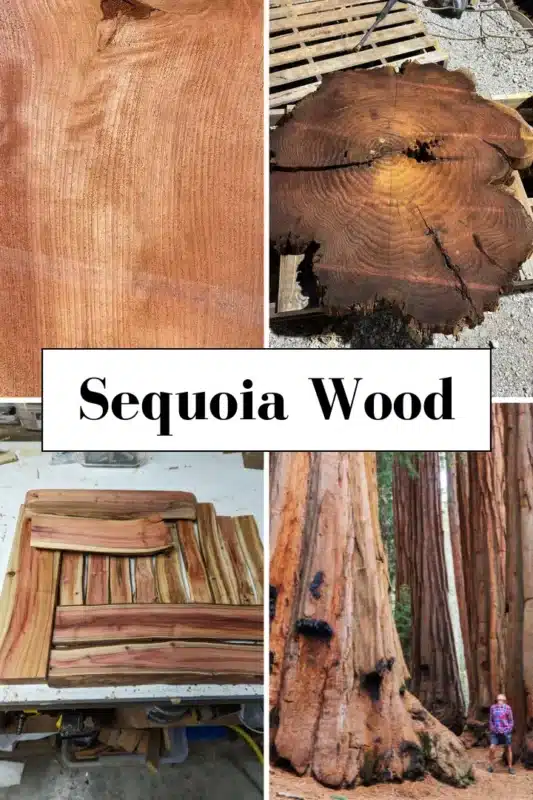
Sequoiadendron giganteum grows naturally in scattered groves on the western Sierra Nevada slopes. It produces the largest single-stem trees by trunk volume rather than the tallest trees; mature specimens often reach roughly 250–300 feet and can exceed 3,000 years of age.
The General Sherman Tree is widely identified as the largest living single-stem tree by volume. Giant Sequoia lumber never became a routine substitute for coast redwood because the wood is relatively brittle, and enormous trunks sometimes shattered on impact during historical felling.
Dawn redwood, Metasequoia glyptostroboides, is native to central China and sheds its needles each year. It’s planted chiefly as an ornamental tree; isolated boards or turning blanks shouldn’t be sold as equivalent to graded California redwood lumber.
The National Park Service documents the distinct ranges and growth forms of coast redwoods and Giant Sequoias. That botanical distinction matters whenever durability, structural values, legality, or expected machining behavior informs a purchase.

Range, size, and age describe living trees, not automatic lumber quality. A large or old tree can contain brittle zones, decay, embedded metal, fire damage, compression wood, or drying checks that reduce usable yield.
Species comparison table: use the scientific name rather than color alone when identifying redwood-family lumber.
| Attribute | Coast redwood | Giant Sequoia | Dawn redwood |
|---|---|---|---|
| Scientific name | Sequoia sempervirens | Sequoiadendron giganteum | Metasequoia glyptostroboides |
| Native range | Coastal California and southwestern Oregon | Western Sierra Nevada, California | Central China |
| Primary distinction | Tallest tree species | Largest trees by trunk volume | Deciduous redwood relative |
| Commercial lumber role | Established redwood lumber species | Rare salvage or cultivated-tree wood | Limited specialty stock |
| Typical buyer expectation | Decking, siding, fencing, trim | Novelty slabs, turning, display pieces | Ornamental or specialist interest |
Sequoia and Redwood Wood Properties
Coast redwood is light, soft, and stable, with straight grain and lower shrinkage than many construction softwoods. Those traits make boards easy to handle and machine, but concentrated impacts leave dents readily.
Color, Grain, and Weathering
Fresh coast redwood heartwood ranges from pale pinkish brown to warm cinnamon and deep reddish brown. The sapwood is pale, often cream, yellow-white, or nearly white, and it lacks the heartwood’s full natural decay resistance.
Grain usually runs straight with a medium-to-coarse texture. Flat-sawn faces display curved cathedral patterns, while vertical-grain boards show narrow parallel lines and usually move less across their faces. Figured, curly, or irregular wood grain patterns occur but command higher prices.
Appearance image guide: identify the pale sapwood first, then compare flat-sawn arches with vertical-grain lines. Freshly planed heartwood looks warm and saturated; outdoor boards exposed without pigment fade unevenly before settling into silver-gray.
A transparent water repellent won’t permanently hold the fresh red color. Sunlight breaks down surface lignin, and rain carries loosened fibers away. A pigmented penetrating finish blocks more ultraviolet light and produces more even weathering.
Density and weight: coast redwood averages about 26 pounds per cubic foot, or 415 kilograms per cubic meter, when dry. Moisture, ring density, growth conditions, and old-growth versus second-growth origin cause meaningful variation between boards.
The low density becomes obvious while moving long decking boards; a 16-foot piece feels far less punishing on the shoulder than a similarly sized wet treated-pine board. Compare this figure with our broader guide to wood density.
Janka hardness: an approximate rating of 450 lbf, or 2,000 N, places coast redwood above western red cedar at roughly 350 lbf but below Douglas fir at about 620 lbf and white oak at around 1,360 lbf. The wood hardness scale helps compare dent resistance across species.
A dropped hammer can leave a rounded crater, and gritty patio furniture feet can score deck boards. Wider furniture glides spread the load, while careful screw-gun clutch settings prevent deep fastener dimples.
Technical Property Table
Strength and stiffness are useful for the wood’s low weight, but reference values from clear specimens aren’t safe substitutes for grade-stamped design values. Knots, slope of grain, moisture, member size, load duration, and grade can change structural capacity.
Representative clear-wood figures include bending strength near 10,000 psi, modulus of elasticity around 1.2 million psi, and crushing strength near 6,150 psi. The USDA Wood Handbook explains why species averages and structural design values serve different purposes.
Shrinkage and stability: representative green-to-oven-dry shrinkage is about 2.4% radial, 4.9% tangential, and 7% volumetric. Low shrinkage reduces—but doesn’t eliminate—cupping, checking, twisting, open joints, and seasonal width change.
Vertical-grain stock exposes more radial movement across the face and often stays flatter. Flat-sawn boards need sensible spacing, dry storage, sealed ends, and fasteners that hold the board without pinning every possible seasonal movement.
| Property | Approximate coast redwood value | Practical meaning |
|---|---|---|
| Average dried weight | 26 lb/ft³ / 415 kg/m³ | Easy handling for large boards |
| Janka hardness | 450 lbf / 2,000 N | Dents and scratches relatively easily |
| Modulus of rupture | 10,000 psi | Reference bending strength only |
| Modulus of elasticity | 1.2 million psi | Moderate stiffness |
| Crushing strength | 6,150 psi | Clear-wood compression reference |
| Radial shrinkage | 2.4% | Low movement across quarter-sawn faces |
| Tangential shrinkage | 4.9% | Greater movement across flat-sawn faces |
| Volumetric shrinkage | About 7% | Relatively modest overall change |
Sequoia Wood Durability, Uses, and Limitations
Redwood heartwood resists decay in many exterior settings, but redwood isn’t rot-proof. Sapwood, wet end grain, trapped debris, soil contact, and joints that never dry can lead to early fungal damage.
Heartwood versus sapwood: reddish heartwood contains extractives and tannins that discourage many decay organisms and insects. Pale sapwood doesn’t offer equal protection, so mixed boards shouldn’t be treated as all-heart material near grade or in persistently damp areas.
Rot and ground contact: above-ground redwood heartwood performs well when air can circulate around it. For posts, retaining structures, sill areas, or soil contact, use material documented for the required exposure category and accepted by the local building authority.
Fire resistance has limits. Thick bark helps mature living trees survive some low- and moderate-intensity fires, yet dry lumber burns. Severe wildfires can penetrate tree crowns and roots, killing ancient Giant Sequoias rather than leaving them unharmed.
National Park Service reporting states that an estimated 13–19% of large Giant Sequoias were killed or mortally injured by severe fires during 2020 and 2021. Its Giant Sequoias and fire resource explains the difference between beneficial lower-intensity fire and destructive high-severity events.
Is Sequoia Wood Good for Building?
Yes, coast redwood is good for building decks, siding, fences, trim, and garden structures when the grade and detailing match the exposure. Load-bearing beams, joists, posts, and stairs need grade-stamped stock plus code-approved spans and connections.
Decking and outdoor stairs benefit from redwood’s low weight, stability, and comfortable surface. Bare boards feel less harsh underfoot than splintered treated stock, yet dog claws, grit, dragging planters, and dropped tools can mark the soft face.
Set deck spacing from the wood’s installation moisture rather than copying a fixed gap. Green boards need room to shrink, while dry boards need room to expand during wet weather. Stainless or approved hot-dipped galvanized screws reduce tannin staining.
Fencing and siding are traditional redwood uses. Fence gates still need diagonal bracing or a rigid frame, while siding needs flashing, ventilation, back-priming where specified, sealed end cuts, and clearance from roofs, soil, and paving.
For project-specific ideas, compare redwood with other wood fence options. Near-ground fence components deserve higher heartwood content or a verified ground-contact product because splashback keeps lower edges damp.
Garden structures include pergolas, arbors, trellises, raised-bed surrounds, privacy screens, and benches. Line planter interiors or create an air gap so wet compost doesn’t press against untreated sapwood; cap upward-facing end grain where water can pool.
Furniture and interior woodwork can use coast redwood for paneling, ceilings, carving, decorative trim, cabinetry, and lightweight furniture. A fingernail can sometimes mark softer earlywood, so dining tables, chair edges, and work surfaces benefit from pads or a harder wear layer.
Redwood suits sheltered seating when users accept occasional dents and color change. Our comparison of outdoor furniture wood covers harder options for abrasive or public settings.
Poor-fit applications include busy interior flooring, chopping blocks, commercial counters, heavy-duty workbench tops, unverified ground contact, and highly abrasive spaces. Generic property figures also can’t qualify an ungraded slab for structural use.
Is Sequoia Good Firewood?
Sequoia is mediocre firewood because its low density means each split contains less stored heat than dense hardwoods. Dry redwood catches readily and works as kindling, but it burns faster, produces shorter-lasting coals, and requires more storage volume per unit of heat.
Use clean, dry, unfinished offcuts only where local burning rules permit. Never burn painted, pressure-treated, glued, mold-contaminated, or unknown reclaimed lumber; coatings and preservatives can release hazardous smoke and ash.
Working and Finishing Redwood Wood
Redwood cuts and finishes easily, but its soft earlywood fibers punish dull cutters and heavy sanding pressure. Sharp edges, light finishing passes, clean surfaces, and corrosion-resistant fasteners prevent most shop and installation failures.
Sawing, Routing, and Sanding
A sharp carbide blade leaves a clean edge, while a dull blade compresses the surface and pulls stringy fibers from reversing grain. Take a light final pass when routing and support the exit edge to prevent corner breakout.
Sand with the grain through a sensible sequence such as 100, 120, and 150 grit for penetrating exterior finishes. Pressing hard creates shallow troughs because soft spring growth abrades faster than dense latewood; the unevenness becomes obvious when low-angle light crosses the board.
Fasteners and tannin stains: use stainless steel or exposure-rated hot-dipped galvanized hardware. Ordinary steel reacts with tannins and leaves blue-black halos or streaks, especially after rain; a stain centered on each nail is more likely a metal reaction than mold.
Pre-drill near ends, keep fasteners a sensible distance from edges, and stop screw heads flush rather than burying them. Overdriving crushes fibers, forms a water pocket, and creates a dark circular depression around the screw head.
Gluing and preparation: freshly planed, dry redwood bonds well with an adhesive rated for the project’s moisture exposure. Remove gray weathered fibers, oily residue, old finish, and dust before gluing; test reclaimed stock for incompatible coatings.
Finishes and UV: a pigmented penetrating stain gives better color retention than a fully clear coating. Film finishes look glossy and rich at first, but moisture entering through joints or unsealed ends can lift the coating in pale, curling flakes.
Use a stain-blocking primer beneath pale paint to control extractive bleed. Coat all specified faces, pay close attention to fresh end cuts, and let wet lumber dry before finishing. Horizontal rails and deck surfaces need more frequent maintenance than sheltered vertical siding.
Practical Notes From Real-World Use
Rot at board ends usually starts where end grain touches standing water, mulch, concrete, or debris. Trim damaged material back to sound fibers, correct the drainage fault, seal the exposed end, and replace any member whose structural section has been reduced.
Peeling finish often points to wet wood, reverse-side moisture, weak preparation, or an overly rigid film. Stripping only the loose patches leaves visible borders; prepare the whole board or defined architectural area before applying a compatible system.
Blotchy gray weathering develops under mixed shade, roof runoff, planters, and partial old coatings. Clean the complete surface and use pigment if uniform color matters. Bare wood rarely turns gray at the same pace on every face.
Splits and surface dents are common around dry ends and overdriven screws. Pre-drilling, sealing ends, using broad furniture feet, and lifting rather than dragging planters prevent damage. Replace deeply split structural boards instead of hiding them with flexible filler.
Redwood dust can sting the eyes, dry the skin, and irritate airways; the fine pink-brown powder clings to sweaty forearms and settles inside an unsealed mask. Use dust extraction, eye protection, and a properly fitted particulate respirator during machining and sanding.
Before cutting reclaimed boards, scan them with a metal detector and inspect all faces for paint, tar, preservatives, and insect galleries. A hidden nail can chip a carbide tooth and throw a sharp fragment, while unknown coatings make offcut burning unsafe.
California Redwood Lumber Grades and Buying
Buy California redwood lumber by species, grade, moisture, and yield, not by color or price per linear foot alone. Heartwood percentage, knots, grain orientation, surfacing, usable dimensions, long-length premiums, and freight can outweigh the species name.
Heartwood-Based Grades
Grade names containing “Heart” set heartwood requirements, which matters where natural decay resistance drives the choice. Common names include Clear All Heart, Clear Heart, Construction Heart, and Deck Heart, but buyers should check the grading agency’s exact definition.
Appearance and architectural grades limit defects and may specify clear faces or vertical grain. They suit exposed siding, doors, trim, millwork, and furniture where straight visual lines and predictable movement justify a higher material cost.
Garden and construction grades permit more knots and other characteristics. Knotty stock can work well for fences, pergolas, rustic siding, and some decks, provided knots are sound, boards are straight enough to install, and the heartwood level suits the exposure.
A lower grade isn’t automatically weak or wasteful. Short components can be cut between defects, while a long clear fascia requires far higher recovery. Estimate usable yield from the actual cutting list rather than assuming every square foot becomes part of the project.
| Project | Important selection criteria |
|---|---|
| Exterior trim | Clear appearance, stable grain, finish compatibility |
| Deck boards | Sound knots, suitable grade, heartwood preference, straight stock |
| Fence boards | Cost, knot allowance, heartwood near grade |
| Structural framing | Grade stamp and code-approved design values |
| Furniture | Dry stock, attractive grain, limited defects |
| Ground-contact work | Documented use suitability, not species name alone |
Confirm the species before buying redwood for sale online. Ask whether it is coast redwood, Giant Sequoia, dawn redwood, reclaimed redwood, or another wood carrying a regional redwood name. Structural and durability choices require more than a seller’s color description.
Moisture and surfacing affect both price and final dimensions. Determine whether boards are green, air-dried, kiln-dried, rough-sawn, surfaced on two sides, or surfaced on four sides. “S-Dry” commonly refers to lumber surfaced at 19% moisture content or less, but verify the stamp.
Nominal labels such as 1×6 and 2×6 don’t state the finished measurements. Measure actual thickness and width, especially when matching old siding, calculating coverage, replacing deck boards, or comparing rough lumber with surfaced stock.
Board-foot calculation: multiply thickness in inches by width in inches by length in feet, then divide by 12. A rough 2-inch × 8-inch × 10-foot board contains 13.33 board feet before surfacing or defect removal.
Linear-foot prices can mislead when widths differ, while square-foot coverage can hide thickness differences. Compare the delivered cost of usable finished material after surfacing, freight, defect cutting, and waste.
Price drivers and waste include grade, all-heart content, clear faces, vertical grain, board width, long lengths, dryness, certification, reclaiming labor, and distance from western suppliers. Allow about 10–15% waste for straightforward layouts and more for grain matching or defect-heavy reclaimed stock.
Seller Question Checklist
Ask these questions before ordering California redwood lumber, particularly when freight or custom milling makes returns expensive:
- What is the scientific species?
- Is the stock all heartwood, mixed, or mainly sapwood?
- What recognized grade does it carry?
- Is load-bearing stock grade-stamped?
- What is its measured moisture content?
- Are the listed dimensions nominal or actual?
- Is it green, air-dried, kiln-dried, reclaimed, or salvaged?
- Does the documentation cover ground-contact use?
- Is chain-of-custody evidence available for this product?
- Does the quote include surfacing, packaging, and freight?
Inspect boards along both edges rather than judging them flat on a stack. Reject severe twist early; clamps can close a mild bow during fastening, but forcing a corkscrewed deck board creates stored stress and uneven gaps.
Giant Sequoia Lumber and Sustainability
Giant Sequoia lumber is rare because native groves are limited and widely protected, while the brittle wood had poor historical recovery from immense felled trunks. Material offered today should come with clear evidence of lawful cultivated-tree removal, authorized salvage, reclamation, or documented old stock.
Why Giant Sequoia Is Rare
Giant Sequoia’s enormous size didn’t translate into efficient lumber production. Historical logs could break apart when they struck the ground, damaging long clear fibers before milling. Transporting and drying such sections created further yield losses.
Legal salvage and provenance can include documented landscape-tree removals, cultivated trees outside native groves, authorized hazard trees, storm-damaged stock, or reclaimed material. The word “salvaged” alone doesn’t establish lawful origin, good drying, or responsible collection.
Protected groves and collection: don’t remove bark, cones, branches, wood, or seedlings from national parks or other protected sites. Rules vary by land manager, and a fallen piece remains part of the protected ecosystem rather than becoming free lumber.
A live Giant Sequoia seedling is a horticultural product, not a future source of casual lumber. Check climate suitability, mature dimensions, overhead clearance, root space, local planting rules, and shipping restrictions before planting this very large species.

Giant Sequoia Tree Seedling
- Live Giant Sequoia starter tree
- Iconic California native species
- A memorable choice for tree lovers
- Suitable for planting and nurturing
- Connects your garden to forest history
 Buy on Amazon
Conservation and legality differ. Coast redwood lumber may legally come from managed private second-growth forests, reclamation, or authorized salvage. Legal status alone doesn’t reveal harvest practices, transport impacts, habitat effects, product life, or usable yield.
Service Life and Sustainability
Certification and chain of custody help trace wood from an audited source through processing and sale. Verify that certification applies to the exact boards or product line, rather than accepting a seller’s general statement about unrelated inventory.
The Forest Stewardship Council describes how chain-of-custody certification tracks forest-based products. Reclaimed stock needs different evidence, such as deconstruction records, invoices, site photographs, and written source descriptions.
Fire impacts and protection affect living groves far beyond lumber supply. High-severity wildfire, drought stress, dense fuel accumulations, and climate conditions can kill mature trees, so the species’ thick bark shouldn’t be described as complete fire immunity.
Long service life can reduce replacement demand, but durability depends on design. A well-drained redwood fence may outlast poorly detailed material with stronger environmental claims. Compare harvest method, transport, finish, maintenance, repairability, expected life, and end-of-life options.
Reclaimed redwood can preserve valuable material, yet it often contains nails, brittle ends, coatings, and hidden decay. Include metal detection, de-nailing, resawing, dust control, and lost thickness when estimating its true recovery rate.
Redwood Versus Common Alternatives

Redwood works best where low weight, natural appearance, dimensional stability, and heartwood durability matter more than high hardness. Cedar, treated pine, Douglas fir, composites, and dense hardwoods each offer different cost and performance trade-offs.
Western Red Cedar
Redwood and western red cedar are lightweight, workable exterior woods with naturally durable heartwood. Redwood is somewhat harder at about 450 lbf versus cedar near 350 lbf, yet both dent under concentrated loads.
Regional availability often decides between them. Compare grade and heartwood content board by board; pale sapwood in either species doesn’t perform like durable heartwood merely because the invoice names a naturally resistant species.
Pressure-treated pine is widely available and offers products approved for demanding ground-contact exposures. It may arrive wet and heavy, then shrink or check during drying. Redwood offers a natural red-brown appearance but requires careful heartwood and grade selection near moisture.
Compare total installed cost rather than board price alone. Fasteners compatible with the treatment, drying time, heavier handling, finish consumption, replacement cycle, and disposal rules can change the project total.
Douglas fir is harder and stiffer than coast redwood, making graded stock common for structural framing. Untreated Douglas fir lacks redwood heartwood’s exterior durability reputation, so sheltered framing and exposed finish work often favor different choices. See the full Douglas fir guide.
Composite decking resists many wood-specific checks and doesn’t require staining, but surface temperature, thermal movement, support spacing, fastening systems, scratches, warranties, and repair options vary by manufacturer. Dark composite boards can feel sharply hot under bare feet in direct summer sun.
Ironwood and Other Hardwoods
Ironwood versus redwood is mainly a hardness, weight, tooling, and sourcing comparison. Woods sold as ironwood are often several times harder and much heavier, resisting dents better but demanding carbide tooling, careful pre-drilling, stronger framing, and greater lifting effort.
Dense tropical hardwoods can deliver high wear resistance and long exterior life, yet species identification and traceable sourcing need close attention. They also move, check, stain, and weather according to species; density alone doesn’t guarantee a trouble-free deck.
| Material | Main advantage | Main limitation | Good fit |
|---|---|---|---|
| Coast redwood | Stable, light, attractive heartwood | Soft and grade-sensitive | Decking, siding, fencing, trim |
| Western red cedar | Light and easy to machine | Very soft | Siding, fences, light structures |
| Pressure-treated pine | Ground-contact products available | Can arrive wet and check while drying | Posts, framing, utility structures |
| Douglas fir | Higher stiffness and structural availability | Lower natural exterior durability when untreated | Framing and sheltered structures |
| Composite decking | No staining cycle | Heat, movement, and system-specific repairs | Low-coating-maintenance decks |
| Ironwood or dense hardwood | High dent and wear resistance | Heavy, hard on tools, sourcing concerns | High-wear exterior surfaces |
The practical choice depends on exposure, structural demand, local supply, maintenance tolerance, and desired appearance. For most buyers searching for sequoia wood, the correct material is graded coast redwood with documented heartwood, moisture, dimensions, and source—not rare Giant Sequoia lumber.
FAQs
Is Sequoia Wood The Same As Redwood?
Sequoia and redwood are closely related, but they are not always the same tree. Coast redwood is commonly sold as redwood lumber, while giant sequoia comes from a different species. Both are naturally durable softwoods with a reddish color, but coast redwood is the more common commercial wood.
Is Sequoia A Hardwood Or Softwood?
Sequoia is a softwood, even though it can be durable and long-lasting. It comes from conifer trees, which generally produce softwood rather than hardwood. Its relatively light weight and easy workability make it useful for projects, while its natural decay resistance helps it perform well outdoors.
Is Giant Sequoia Used For Lumber?
Giant sequoia is used for lumber only in limited amounts. Most mature giant sequoias are protected because of their size, age, and ecological importance. Lumber may come from fallen trees, managed lands, or salvaged material, but coast redwood is far more commonly available for commercial building and woodworking.
Is Sequoia Wood Good For Building?
Sequoia wood can be good for building, especially for outdoor projects where decay resistance matters. It is lightweight, stable, and easy to cut, drill, and finish. Because it is softer than many construction woods, it works best for siding, trim, decking, fencing, and similar uses rather than heavy structural applications.
Is Sequoia Good Firewood?
Sequoia can be burned as firewood, but it is not usually the best choice for long-lasting heat. It is a softwood, so it burns quickly and generally produces fewer coals than dense hardwoods. Properly seasoned sequoia is suitable for kindling or mild fires, but hardwood is better for sustained heating.
Affiliate Disclosure: Some links in this post are affiliate links. If you make a purchase through these links, we may earn a small commission at no extra cost to you. We only recommend products we genuinely believe in.