
Mockernut Hickory Field Guide: Bark, Leaves, Nuts, and Saplings

Mockernut hickory (Carya tomentosa) is a native eastern North American deciduous tree identified by aromatic compound leaves, hairy twigs and buds, tightly ridged bark, and thick-shelled edible nuts. Its durable wood, wildlife value, long life, and dry-site tolerance make it useful in forests and large naturalized plantings, though its taproot and falling nuts create practical limits.
Table of Contents
Mockernut Hickory at a Glance
Mockernut hickory facts point to a slow-growing, long-lived canopy tree. It commonly reaches 50–80 feet, while exceptional forest specimens approach 100 feet and may survive for several centuries.
Scientific Classification
The accepted scientific name is Carya tomentosa (Lam.) Nutt. It belongs to the walnut family, Juglandaceae, and the genus Carya, which includes true hickories and pecan. The Plants of the World Online record provides current taxonomic references.
Common Names
Regional common names include mockernut, white hickory, whiteheart hickory, bullnut, and hognut. Since those names can overlap with other trees, use Carya tomentosa when ordering plants, recording surveys, or confirming wood sources.
Size and Lifespan. A mature tree usually spreads 20–40 feet and may develop a trunk 2–3 feet across. Growth is slow when the crown sits beneath taller trees, but open-grown trees develop broader crowns and heavier branches. Lifespans approaching 500 years are possible on stable forest sites.
Name Meaning. The Latin word tomentosa refers to the felt-like hairs on young shoots, buds, leaf stalks, and leaf undersides. “Mockernut” is conventionally linked to the thick shell and small kernel that seem to mock anyone trying to open the fruit.
Fast Identification Checklist. Confirm several traits rather than trusting bark or leaflet count alone:
- Alternate, pinnately compound leaves with usually seven leaflets.
- Soft hairs beneath the leaf and along its central rachis.
- Stout twigs with large, oval, hairy terminal buds.
- Gray mature bark with tight, interlacing ridges.
- A thick four-part husk surrounding an exceptionally hard nut.
Seasonal Identification. Spring brings fuzzy shoots and hanging male catkins. Seven-leaflet foliage is easiest to inspect in summer, yellow leaves and fallen nuts help in autumn, and winter identification relies on stout twigs, hairy buds, leaf scars, and tight bark.
| Season | Best feature | Field limitation |
|---|---|---|
| Spring | Hairy buds, shoots, and expanding leaves | Leaflets may still be folded |
| Summer | Usually seven hairy-backed leaflets | Leaflet count occasionally varies |
| Autumn | Yellow foliage and thick-husked nuts | Fallen nuts may roll from nearby trees |
| Winter | Large hairy buds and tight ridged bark | Young bark lacks mature ridges |
Mockernut Hickory Identification Features

Reliable identification combines leaves, buds, twigs, bark, and fruit. A single feature can mislead because young bark differs from mature bark, while individual leaves may carry five, seven, or nine leaflets.
Mockernut Hickory Leaf
A mockernut hickory leaf is alternate and pinnately compound, usually 8–14 inches long with seven serrated leaflets. The terminal leaflet is normally largest, the upper side feels lightly textured, and the underside has soft hair that catches against a fingertip rather than feeling slick.
Crushing a fresh leaflet releases a resinous, spicy scent. Odor varies with moisture and the person smelling it, so treat scent as supporting evidence rather than a final test.
Bark Changes With Age
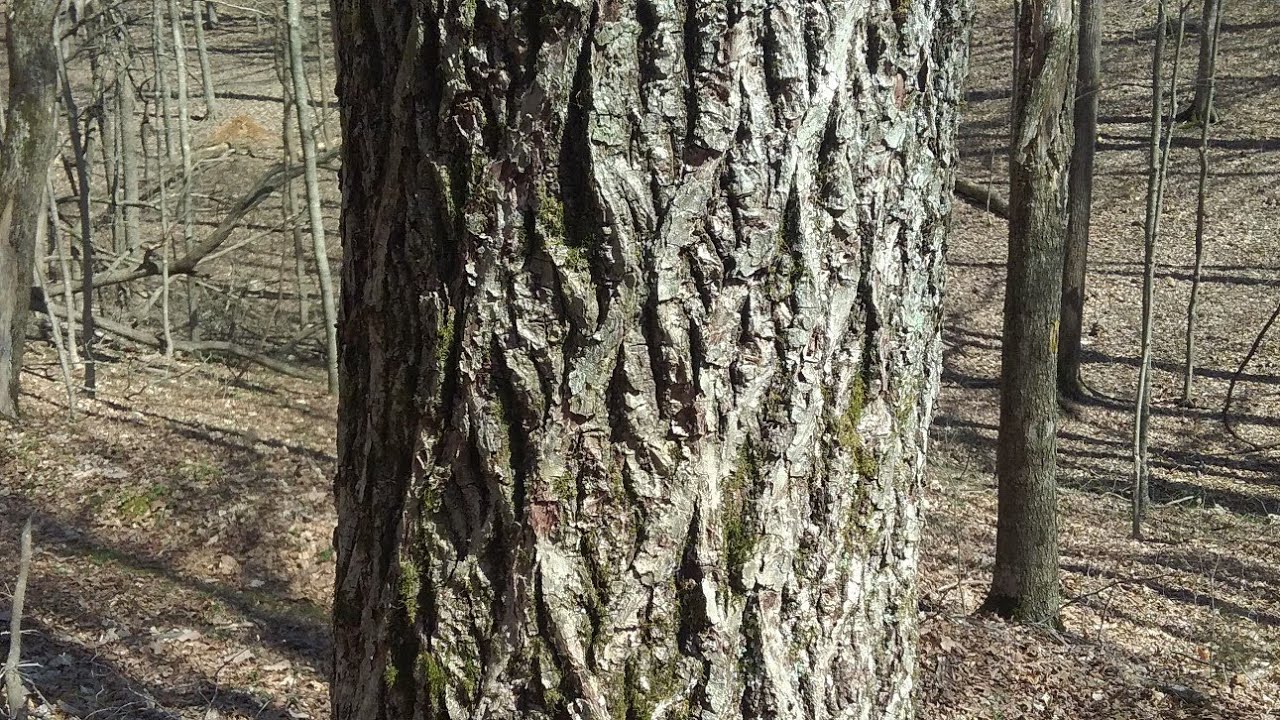
Young mockernut hickory bark is comparatively smooth and gray. Mature bark becomes darker and develops tight furrows with rounded, interlacing ridges; it stays close to the trunk instead of peeling into the long curling plates seen on shagbark hickory.
Twigs and Hairy Buds. New twigs are stout, reddish brown to gray-brown, and often densely hairy. The broad terminal bud has overlapping tan or brown scales; rubbing it gently reveals a dry, felted surface that is particularly useful during winter surveys.
Leaf Scars. Fallen leaves leave heart-shaped or three-lobed scars with several bundle marks inside. Use a hand lens and examine a current twig because rough bark and old scars can hide the pattern.
Sapling Identification. A mockernut hickory sapling has smooth gray-brown bark, alternate compound leaves, hairy rachises, stout twigs, and large hairy terminal buds. Check branch arrangement first: opposite branches point more strongly to ash, while hickory branches alternate.
Common Identification Mistakes. Beginners often call any ridged tree a hickory or identify a species from one fallen nut. Nuts can move downhill, squirrels carry them, and bark changes with age; inspect attached foliage and twigs before naming the trunk.
Identification Photo Gallery. A useful image set should show the whole crown, mature and young bark, a complete leaf, its hairy underside, terminal bud, leaf scar, intact green fruit, split husk, and shell cross-section. Use alt text such as “mockernut hickory leaf with seven serrated leaflets” rather than vague labels like “tree leaf.”
Field Experience Insights. The quickest dependable field sequence is branch arrangement, leaflet count, underside hair, terminal bud, then bark. Hair is easiest to detect by angling a leaf toward low sunlight; the pale fuzz forms a soft halo along the veins, while a wet leaf can hide it.
Mockernut Hickory Nuts and Reproduction

Mockernut hickory nuts are edible, often sweet, and frustrating to process. A thick husk surrounds a very hard shell with internal ridges that hold a small kernel, explaining why the species has little value as a commercial nut crop.
Fruit, Husk, and Shell
The fruit is broadly oval, rounded, or slightly pear-shaped and commonly measures 1.5–2 inches. Its fleshy green husk dries brown and splits along four seams, often nearly to the base; the shell inside feels unusually heavy and stone-like.
Nut Edibility
Yes, the kernels are edible. Sound kernels may taste rich and sweet, but they break into small pieces during extraction. Anyone with a tree-nut allergy should avoid them without medical guidance, and no wild nut should be eaten if its identity remains uncertain.
Harvest and Quality Checks. Gather nuts after natural fall in September or October, then let stubborn husks dry until the seams open. Reject shells with exit holes, mold, deep cracks, an unusually light feel, or kernels that smell like stale oil. A float test removes some empty nuts but also rejects occasional sound ones.
Safe Cracking Methods. Wear eye protection and hold the nut in a hard-shell nutcracker or bench vise. Apply steady pressure across the shell’s widest point, rotate it, and press again; uncontrolled hammer blows send sharp fragments sideways and often pulverize the kernel.
Flowers and Pollination. Mockernut is monoecious, carrying hanging male catkins and small female flower spikes on one tree. Wind moves pollen in spring, while pollen from genetically different nearby trees can improve fruit set.
Seed-Bearing Age. Trees may begin producing seed near age 25, but substantial crops usually come from mature crowns. Forestry records place stronger production around ages 40–125, with health, light, late frost, and pollen supply affecting each crop.
Mast Crop Timing. Heavy nut crops often occur every two or three years, with lighter production between them. A mature tree that produces little one autumn may be following its normal mast cycle rather than suffering decline.
Mockernut Versus Similar Hickories
Mockernut differs from similar hickories through the combined presence of usually seven leaflets, dense hair on young parts, brown hairy buds, tight bark, and a thick four-part husk. The following comparison prevents common one-feature identification errors.
Hickory Comparison Table
| Species | Leaflets | Bud and hair | Bark | Fruit |
|---|---|---|---|---|
| Mockernut, C. tomentosa | Usually 7 | Brown, large, hairy | Tight interlacing ridges | Thick four-part husk; hard shell |
| Shagbark, C. ovata | Usually 5 | Less densely hairy | Long loose strips | Thinner shell; desirable kernel |
| Pignut, C. glabra | 5–7 | Often smoother | Tight ridges | Thinner husk; partial splitting |
| Bitternut, C. cordiformis | 7–11 | Sulfur-yellow bud | Gray ridges | Thin wing-seamed husk; bitter kernel |
| Shellbark, C. laciniosa | 7–9 | Large buds | Broad shaggy plates | Very large fruit |
| Red, C. ovalis | 5–7 | Less hairy | Narrow plates | Variable husk splitting |
Shagbark Hickory
Shagbark hickory usually has five leaflets and mature bark that pulls away in long strips. Mockernut’s bark stays tight, its young growth is hairier, and its thick shell yields less kernel. Compare the wider wood context in this guide to hickory wood.
Pignut Hickory. Pignut commonly has five to seven leaflets and tight bark, making it a frequent source of mistakes. It is usually less hairy, and its thinner fruit husk may split only partway; see the complete pignut hickory guide.
Bitternut Hickory. Sulfur-yellow terminal buds separate bitternut quickly from mockernut’s brown, hairy buds. Its thin husk has raised or winged seams, and the kernel has a strongly bitter flavor.
Shellbark Hickory. Shellbark develops broad, loose bark plates and often carries seven to nine leaflets. Its fruit is much larger, and it favors wetter bottomlands more often than upland mockernut; review shellbark hickory for closer comparison.
Red Hickory. Red hickory usually has five to seven leaflets, less hair, and bark broken into narrow plates. Taxonomic treatments vary, so herbarium-quality identification may require mature fruit and twig samples rather than photographs alone.
Ash, Walnut, and Pecan. Ash has opposite branches, immediately separating it from alternate-branched hickory. Black walnut and pecan carry more numerous, narrower leaflets; compare familiar black walnut traits and the related pecan wood.
Native Range and Ecological Value
Mockernut hickory is native across much of eastern North America, from parts of the Northeast and southern Ontario through the Midwest, Southeast, and south-central states. It is most characteristic of well-drained upland oak-hickory forests rather than frequently flooded ground.
Native Range Map
Written boundaries hide county-level gaps, so verify records through the USDA PLANTS profile. A tree outside the mapped range may be planted, naturalized, misidentified, or part of an overlooked local population.
Upland Forest Habitat
Typical habitat includes ridges, dry-to-mesic slopes, woodland edges, and well-drained loam or clay-loam. Established trees tolerate seasonal dryness through deep roots, but prolonged flooding deprives those roots of oxygen.
Associated Trees. Common neighbors include white oak, black oak, post oak, chestnut oak, southern red oak, pignut hickory, shagbark hickory, and shortleaf pine. On richer slopes, tulip tree and other mesic hardwoods may join the canopy.
Wildlife Food Value. Squirrels, chipmunks, mice, wild turkeys, black bears, and other animals consume the nuts. Deer may browse young shoots and eat fallen mast, though mockernut isn’t equally significant to every animal across its range.
Insect Host Value. Hickory foliage feeds regal moth larvae, hickory tussock moth caterpillars, and other insects associated with walnut-family hosts. Their chewing can leave ragged margins and papery droppings beneath the crown, yet modest feeding rarely threatens a healthy mature tree.
Forest Habitat Functions. Old trees supply shade, nesting structure, leaf litter, carbon storage, and cavities formed where limbs break or decay. Those cavities become more valuable with age, which is one reason standing safe veterans deserve retention in woodland management.
Growing Mockernut Hickory
Grow mockernut hickory in full sun, well-drained soil, and enough space for a 50–80-foot tree. Plant seed or very small nursery stock near its final position because the early taproot makes older saplings difficult to move.
Landscape Benefits and Drawbacks
Landscape benefits include longevity, golden fall color, wildlife food, drought tolerance after establishment, and strong regional habitat value. Drawbacks include slow juvenile growth, limited nursery supply, a broad mature crown, and hard nuts that strike roofs or clatter across paving in autumn.
Light and Soil
Full sun works best. Seedlings can persist with partial shade, but dense competition produces thin crowns and slow growth. Choose draining loam, sandy loam, or clay-loam; avoid standing winter water and heavily compacted construction soil.
Space and Placement. Keep the tree away from buildings, overhead lines, narrow sidewalks, septic fields, and busy patios. A woodland edge or large lawn gives the crown room while keeping falling husks away from frequently used surfaces.
Transplanting Saplings. Move small dormant seedlings while roots remain manageable. Keep roots cool and damp, spread them without curling the taproot, set the root flare level with the soil, and apply mulch in a broad ring without touching the trunk.
Seed Collection. Gather freshly fallen nuts from healthy regional trees. Remove loose husks and reject moldy, cracked, holed, or very light seed; local provenance often performs better than seed collected from a markedly warmer or colder climate.
Cold-Moist Stratification. Mix nuts with barely damp sterile sand or another clean medium and refrigerate at 34–41°F for 90–120 days. The bag should feel cool and humid without free water pooling at the bottom; saturated media invite decay, while dry storage reduces viability.
Sowing Hickory Nuts. Sow nuts 1–2 inches deep in tall tree pots or directly at the permanent site. Cover outdoor beds with anchored wire mesh against squirrels and mice, then remove the barrier before it constricts emerging stems.
- Collect sound nuts after natural fall.
- Remove husks without damaging the shell.
- Cold-stratify in moist medium for 90–120 days.
- Sow 1–2 inches deep in a tall container or final site.
- Protect the seed from rodents and label its source.
- Move container seedlings before the taproot becomes crowded.
Germination Failure Points. Common losses come from dried seed, insect damage, warm interruptions during stratification, waterlogged media, shallow pots, rodents, and broken taproots. A useful workaround is to sow two or three nuts per protected station, then retain the strongest correctly identified seedling.
Buying Nursery Stock. Confirm the botanical name, seed origin, container depth, root flare, and whether the plant was seed-grown. Avoid tall trees in shallow pots: a compact crown can hide a bent, cut, or circling taproot that later causes weak establishment.
Nursery Price Ranges. Bare-root seedlings commonly cost about $5–$20 each, small container plants about $25–$80, and larger stock may exceed $100 before freight or planting. Bulk forestry orders can cost less per tree, while local-provenance stock may command a higher price.
Relevant planting and nut-processing products are shown below; verify that each item fits hard-shelled hickory use before purchase.
Mockernut Hickory Uses and Wood
Mockernut hickory uses include tool handles, flooring, furniture parts, sporting goods, firewood, charcoal, smoking wood, wildlife plantings, and forest restoration. Its dense, shock-resistant wood can be valuable, but logs are commonly sold as mixed hickory rather than separated by species.
Wood Properties and Value
Mockernut hickory wood is hard, dense, wear-resistant, and exceptionally good at absorbing shock. Pale sapwood contrasts with reddish-brown heartwood, while the grain often appears straight but can tear during machining if tools are dull. Compare its position on the wood hardness scale.
A standing hickory may be worth money if it has a large straight trunk, few defects, road access, and enough nearby timber to justify harvesting. One yard tree often has lower commercial value because embedded nails, branch knots, transport costs, and damage risk reduce a mill’s interest.
Lumber Uses
Lumber applications include tool handles, ladder rungs, flooring, agricultural parts, furniture components, and sporting equipment. Dense boards feel noticeably heavy in the hand and resist dents, but they also increase tool wear and can move if dried too quickly.
Firewood and Charcoal. Hickory produces long-lasting heat and dense coals, yet green rounds are heavy and hard to split. Split them while fresh, stack under a roof with open sides, and burn only after internal moisture has fallen to a suitable level.
Smoking Wood Safety. Use clean, untreated, correctly identified wood. Painted, stained, pressure-treated, moldy, or chemically contaminated scraps don’t belong in a smoker; start with a small amount because heavy hickory smoke creates an acrid taste and a dry, throat-catching sensation.
Nut and Traditional Uses. The kernels can be eaten fresh or added to hickory nut recipes, baked goods, porridge, or nut milk. Their nutrition resembles other energy-dense hickory kernels, yet the low kernel yield makes collecting mockernuts more labor-intensive than processing shagbark nuts.
Restoration Uses. Mockernut suits upland forest restoration, wildlife corridors, mine-land recovery on draining soil, and oak-hickory reforestation. Protect young trees from browsing and match seed provenance to the region rather than planting one distant genetic source across a large project.
A hard-shell nut tool may reduce flying shell fragments during controlled cracking.
Pests, Diseases, and Tree Problems
Healthy mockernut hickories tolerate modest leaf feeding and occasional blemishes, but root injury, drought during establishment, bark beetles, cankers, and decay can combine into serious decline. Sudden thinning, large dead limbs, basal fungi, or structural cracks call for closer assessment.
Common Insect Pests
Potential insect pests include hickory bark beetles, twig girdlers, shuckworms, nut weevils, and native defoliating caterpillars. A few chewed leaves or dropped twigs rarely justify treatment; widespread canopy thinning paired with numerous bark holes deserves attention.
Diseases and Decay
Recorded problems include anthracnose, leaf spots, cankers, root rot, trunk decay, and witches’-broom symptoms. Diagnosis requires the pattern of damage, affected tissue, weather, and site history because similar symptoms can result from drought, root loss, or several organisms.
Environmental Stress. Compaction, trenching, grade changes, prolonged flooding, establishment drought, fire, and construction injury can damage roots long before the crown reacts. Keep machinery beyond the drip line where practical and avoid piling soil or mulch over the root flare.
Sapling Protection. Deer browse shoots and rub flexible stems, while rabbits and rodents chew bark near ground level. Use a ventilated guard or wide wire cage, keep grass from touching the stem, and check ties twice yearly so protection doesn’t become a girdling hazard.
Professional Tree Assessment. Contact a qualified arborist for large dead branches over occupied areas, cracks at major unions, cavities with moving edges, extensive bark loss, basal mushrooms, sudden crown thinning, or beetle holes paired with fading foliage. Don’t climb, strike, or excavate around a declining mature hickory to test it yourself.
FAQs
How Do You Identify A Mockernut Hickory Tree?
You can identify a mockernut hickory by its large compound leaves, usually with seven to nine leaflets, and its thick-shelled nuts. The leaflets often have a slightly hairy underside, while mature trees develop gray bark with deep, narrow ridges. Mockernut hickories commonly grow in dry upland woods and forest edges.
Are Mockernut Hickory Nuts Edible?
Mockernut hickory nuts are edible, but they are usually less desirable than other hickory nuts. Their shells are very thick and the kernels are relatively small, making them difficult to crack and harvest. If the nut is fresh and sweet rather than bitter or moldy, it can be eaten raw or used in baking.
What Does Mockernut Hickory Bark Look Like?
Mockernut hickory bark is gray to dark gray with deep vertical furrows and narrow interlacing ridges. Unlike shagbark hickory, it does not peel away in long, loose strips. Young trees have smoother bark, while older trees develop a rough, tightly ridged texture that is useful for identification.
What Is The Difference Between Mockernut And Shagbark Hickory?
The main difference is that shagbark hickory has bark that peels into long, shaggy strips, while mockernut bark stays tightly ridged. Mockernut trees usually have seven to nine leaflets per leaf, whereas shagbark commonly has five. Shagbark nuts generally have thinner shells and larger, easier-to-eat kernels.
Can You Grow A Mockernut Hickory From A Nut?
Yes, you can grow a mockernut hickory from a fresh, viable nut. Plant it outdoors in fall, about one to two inches deep, and protect it from squirrels and other animals. The nut needs a cold winter period to germinate, and the young tree should be planted where it can remain because hickories form deep taproots.
Affiliate Disclosure: Some links in this post are affiliate links. If you make a purchase through these links, we may earn a small commission at no extra cost to you. We only recommend products we genuinely believe in.