

California Black Oak Guide: Identification, Habitat and Ecology

California black oak (Quercus kelloggii) is a deciduous red oak native mainly to California and western Oregon, identified by deeply lobed, bristle-tipped leaves, dark furrowed bark, and large acorns. This guide covers its range, identification, ecology, cultural importance, propagation, threats, and lumber.
Table of Contents
California Black Oak at a Glance

California black oak grows as a medium to large tree in oak woodland and montane forest. It loses its leaves in fall, produces acorns over two growing seasons, and can regrow from the root crown after its aboveground stem dies.
Black Oak Tree Facts
| California black oak fact | Details |
|---|---|
| Scientific name | Quercus kelloggii Newberry |
| Other common names | Black oak and Kellogg oak |
| Family | Fagaceae |
| Oak lineage | Red oak group, section Lobatae |
| Native range | California and western Oregon |
| Typical height | About 30–80 feet; favorable forest sites can produce taller trees |
| Foliage | Deciduous, alternate, deeply lobed, and usually bristle-tipped |
| Bark | Gray on young stems; dark, thick, ridged, and furrowed on older trunks |
| Fruit | Large acorn partly enclosed by a scaly cup |
| Acorn development | Two growing seasons |
| Pollination | Wind pollinated |
| Fire response | Thick-barked trees may survive surface fire; top-killed trees may resprout |
| Main values | Indigenous food and stewardship, wildlife habitat, restoration, wood, and fuel |
Tree dimensions change with soil depth and competition. An open-grown specimen often has a low, broad crown, while a forest tree may develop a long trunk and compact crown as it reaches through neighboring conifers.
Taxonomy and Scientific Name
The accepted scientific name is Quercus kelloggii Newberry. It belongs to Plantae, Fagales, Fagaceae, Quercus, and the red oak section Lobatae; the Jepson eFlora treatment provides the formal botanical description.
The species name honors Albert Kellogg, a physician and botanist linked with early California botanical work. “Black” refers to the dark appearance of an old trunk, not the color of the leaves, wood, or acorns.
Black Oak Name Warning. A common name isn’t enough for purchasing, planting, or recording this tree. Eastern black oak is Quercus velutina, while water oak is Quercus nigra; neither is a substitute for Quercus kelloggii.
Online listings create a frequent species mix-up because “black oak” appears in all three names. Check the botanical name on the plant label, invoice, seed packet, and phytosanitary documents rather than relying on a product title.
California Black Oak Identification and Lookalikes
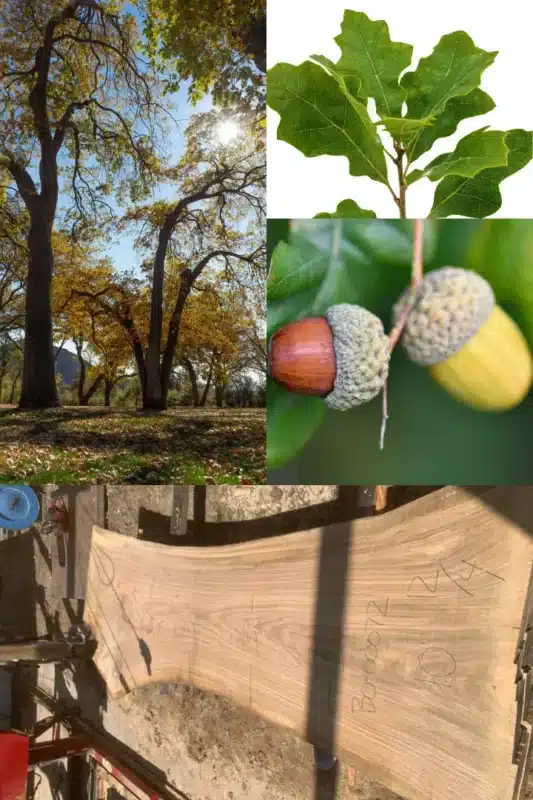
Identify a California black oak tree by combining deciduous foliage, deep pointed lobes, fine bristle tips, dark mature bark, large acorns, clustered terminal buds, and western range. One leaf isn’t reliable because shade leaves, stump sprouts, seedlings, and hybrids can look different.
Leaves, Bark, and Acorns
Black oak leaves are alternate and simple, commonly 4–10 inches long, with roughly five to eleven lobes. Deep sinuses divide the blade, and most pointed lobe tips carry a slender bristle associated with the red oak group.
Leaf texture varies in the same crown. Sun-exposed leaves can feel firm and slightly coarse, while shaded shoots often carry broader, thinner blades; the underside is paler and may feel softly hairy near the main veins.
Young bark looks gray and comparatively smooth. As the trunk ages, it becomes thick and deeply furrowed, with dark ridges or blocky plates that cast nearly black lines when wet.
The acorns are often around 1–1.5 inches long, though individual trees vary. A deep scaly cup surrounds part of the elongated or broadly egg-shaped nut, which develops during its second growing season rather than maturing in the spring after pollination.
Twigs, Buds, and Form
Twigs range from reddish brown to gray-brown. Several terminal buds cluster at the shoot tip; bud scale color and hairiness help with winter checks but shouldn’t override bark, habitat, and range evidence.
An open-grown tree develops heavy spreading limbs and a rounded crown. Dense forest competition produces a straighter trunk, while fire or cutting may leave multiple basal stems rising from one root crown.
Seasonal Identification. Spring brings soft young foliage and dangling male flower catkins. Summer offers the clearest mature leaf pattern; autumn foliage shifts through yellow, dull orange, russet, and brown, while winter reveals the tree’s bare crown, dark bark, and clustered buds.
During autumn fieldwork, fallen leaves may be crisp and curled enough to hide their lobes. Pair them with attached foliage or acorns, since wind can move loose oak leaves beneath neighboring trees.
Field Identification Checklist. This practical sequence reduces mistakes caused by relying on a dramatic-looking leaf alone:
- Confirm that the tree is deciduous rather than evergreen.
- Check whether the location falls within California or western Oregon range.
- Look for deep lobes ending in fine bristles.
- Inspect several sun and shade leaves, not one fallen specimen.
- Check mature bark for dark ridges and deep furrows.
- Look for a large nut held in a scaly cup.
- Inspect shoot tips for clustered buds during winter.
- Record the crown shape, associated plants, elevation, and site moisture.
A useful field habit is to photograph the whole tree, bark, both leaf surfaces, buds, and fruit before collecting anything. Close-up leaf photographs without scale often conceal the traits needed for later confirmation.
Black Oak Comparison. Geographic range and leaf persistence separate several commonly confused species more reliably than common names do.
| Species | Foliage and fruit | Range and easiest distinction |
|---|---|---|
| California black oak, Q. kelloggii | Deciduous; deep bristle-tipped lobes; two-season acorns | California and western Oregon |
| Eastern black oak, Q. velutina | Deciduous; pointed bristle-tipped lobes | Eastern and central North America |
| Water oak, Q. nigra | Leaves often spatula-shaped or shallowly lobed | Humid southeastern United States; see the water oak tree guide |
| Coast live oak, Q. agrifolia | Evergreen; small, thick, leathery leaves | Coastal and foothill California |
| Canyon live oak, Q. chrysolepis | Evergreen; thick leaves with entire or spiny edges | Western slopes and canyons; distinctive thick acorn cup |
| Tanoak, Notholithocarpus densiflorus | Evergreen with acorn-like fruit | Moist western forests; not classified as a true Quercus |
California black oak belongs to the red oak lineage, but its wood and living-tree traits shouldn’t be inferred from every eastern species. The guides to red oak wood and red oak vs white oak explain the broader group differences.
California Black Oak Range and Habitat
The California black oak range extends through much of California’s suitable foothill and mountain country into western Oregon. It isn’t distributed evenly across the state and is absent from many deserts, intensively farmed valleys, alpine areas, and unsuitable coastal sites.
Geographic Range
Major regions include the Klamath Mountains, North Coast Ranges, Cascade Range, Sierra Nevada, Transverse Ranges, Peninsular Ranges, and interior foothills. The Calflora distribution records help check documented local occurrence rather than treating a statewide label as proof of nativity at one property.
Range limits become patchy and discontinuous where rainfall, elevation, soil depth, and temperature stop aligning. A tree planted within California can still be outside the ecological conditions represented by nearby wild populations.
Elevation and Climate
Published elevation limits span from low foothills to roughly 7,000–8,000 feet, with local variation. California black oak tends to occur lower in northern areas and can occupy higher mountain sites farther south.
The tree is adapted to cool, wet winters followed by dry summers. Established roots tolerate seasonal dryness, but prolonged hot drought can thin crowns, reduce acorn production, and leave trees less able to resist borers or decay organisms.
Forest and Woodland Habitats. California black oak occurs in mixed-conifer forest, yellow-pine forest, montane hardwood forest, oak woodland, forest openings, ridges, and slopes with enough soil depth. It sometimes forms near-pure stands but commonly grows among conifers and other hardwoods.
Plant Communities and Associates. Frequent neighbors include ponderosa pine, Jeffrey pine, Douglas-fir, white fir, incense cedar, sugar pine, Pacific madrone, canyon live oak, and tanoak. Readers comparing western hardwood associates can also review Pacific madrone and Oregon oak.
Soil, Light, and Water. Well-drained soils support the safest establishment, and deep soils produce the largest trees. Seedlings tolerate some cover, yet dense conifer shade can keep them suppressed for years and limit the crown space needed for heavy acorn crops.
Surface roots and young seedlings react poorly to both saturation and prolonged drying. Native status doesn’t make a newly planted tree instantly drought-proof; the small root zone can become warm and powder-dry while deeper soil around mature trees still holds moisture.
Growth, Reproduction, and Wildlife Value
California black oak commonly reaches 30–80 feet tall, grows at a moderate rate on suitable sites, and may persist for centuries. Its ecological value rises with age because large trees produce substantial mast, cavities, broad branches, shade, and coarse woody material.
Size, Growth, and Lifespan
No single annual growth figure describes the species. Light, soil moisture, elevation, browsing, fire history, root establishment, and competition change growth enough that two trees of equal age can have very different diameters.
Young trees may appear slow aboveground while they build roots. Older open-grown specimens often become wider than expected, making this a poor choice for narrow strips, beneath utility lines, or close to foundations and pavement.
Acorns and Reproduction
Wind carries pollen between flowers, and fertilized acorns complete development in their second growing season. Crops fluctuate from light years to heavy mast years, so one poor autumn doesn’t prove that a mature tree is sterile.
Regeneration occurs through seed and vegetative sprouts. Jays and squirrels cache nuts, and forgotten acorns may establish beyond the crown; fire, cutting, or stem injury can trigger vigorous shoots from the base or root crown.
Wildlife Food and Habitat. Acorns feed mule deer, black-tailed deer, black bears, western gray squirrels, California ground squirrels, acorn woodpeckers, band-tailed pigeons, wild turkeys, and jays. Cavities, dead limbs, peeling bark pockets, and fallen logs provide shelter for birds, bats, reptiles, and small mammals.
Fungi and Food Webs. Mycorrhizal fungi connect with fine roots and exchange soil nutrients and water for plant sugars. Oak leaves also support caterpillars and other insects, which transfer that stored energy to nesting birds and predators.
Oak litter feels leathery when freshly fallen and breaks down more slowly than soft green foliage. The accumulating layer moderates surface temperatures, slows moisture loss, and returns nutrients, though very thick litter can conceal rodents and make direct-seeded acorns harder to monitor.
Restoration Value. Planting California black oak works best where managers also protect mature seed trees, young sprouts, openings, and local genetic variation. Tree guards, browsing control, selective release from dense conifers, and follow-up care often matter more than the number of acorns initially planted.
Fire, Threats, and Conservation

California black oak is fire-adapted, not fireproof. Thick bark can protect mature stems during some surface fires, while severe heat, long flame residence, root-crown damage, drought stress, and repeated reburning can kill trees of any size.
Fire Response and Resprouting
Low- to moderate-intensity fire may reduce competing vegetation and create brighter growing space. If the trunk is killed, stored carbohydrates can support basal or root-crown sprouts, producing a ring of shoots around the old stem.
Seedlings and saplings top-kill readily because their bark is thin. Vigorous shoots after a fire show that living tissue remains belowground, but repeated fire before leaf area and reserves recover can exhaust the root system.
Post-Fire Assessment
Don’t remove a scorched oak solely because the canopy is brown. Check for later bud activity and basal shoots, then assess trunk cracks, root injury, cavities, char depth, unstable limbs, and delayed crown decline.
Large burned trees beside homes, roads, or trails need a qualified risk assessment. Sprouting proves biological survival, not structural safety, and damaged roots may fail long after the visible flames have passed.
Fire Exclusion Effects. Long fire-free periods can let shade-tolerant conifers grow beneath oak crowns. Their shade reduces oak foliage and acorn production, while lower conifer branches create fuel ladders that can carry a later wildfire into the canopy.
Pests and Diseases. Goldspotted oak borer larvae feed beneath bark and interrupt water transport. Warning signs include crown thinning, bark staining, woodpecker foraging, and D-shaped exit holes; moving untreated firewood can carry the insect into new oak stands.
Sudden oak death, caused by Phytophthora ramorum, may produce bleeding trunk cankers and crown decline. Armillaria, other decay fungi, mistletoes, and secondary beetles can compound stress, and the UC ANR oak health resources describe diagnosis and management concerns.
Drought and Regeneration. Hot drought weakens crown growth and tree defenses, while deer, livestock, and rodents consume acorns or repeatedly browse sprouts. Dense shade can leave many small seedlings present without any growing into the next height class.
Conservation and Management. Protect mature acorn producers, young age classes, and root zones from compaction, trenching, fill soil, and grade changes. Local plans may also call for conifer thinning, authorized prescribed fire, cultural burning, pest monitoring, and controls on firewood movement.
Broad distribution doesn’t guarantee a healthy local population. A woodland filled with old trees but few saplings may look intact while losing its ability to replace canopy trees after drought, development, disease, or severe fire.
Indigenous Cultural Importance
California black oak acorns are an important food and cultural resource for many California Native peoples, and these relationships continue in the present. Gathering, food preparation, tending, and cultural burning form connected stewardship practices rather than isolated historical uses.
Acorns as Food
Acorns supply carbohydrates, fats, protein, and minerals, but raw kernels contain bitter tannins. Processing may involve gathering, drying, shelling, grinding, leaching, and cooking the meal into mush, soup, or bread, with methods differing among families and communities.
Raw or partly processed acorns aren’t ready-to-eat snacks. Anyone learning food preparation should use instruction from a knowledgeable cultural practitioner or tested food-safety source rather than guessing from color or taste alone.
Tannin Removal and Preparation
Repeated water leaching removes soluble tannins from ground acorn meal. The required time changes with particle size, water temperature, acorn chemistry, and method; coarse meal leaches slowly, while overheated starch can behave differently during later cooking.
The bitter, mouth-drying sensation of insufficiently leached meal comes from tannins binding with saliva proteins. Taste can serve as one observation within an established method, but it shouldn’t replace community knowledge and safe handling.
Ongoing Indigenous Stewardship. Practices include tending productive trees, clearing gathering areas, managing competing plants, pruning or removing selected growth, gathering and storing acorns, and maintaining access. Regional claims should name a tribal source rather than treating all California Native traditions as identical.
Cultural Burning. Carefully applied fire can maintain open structure, improve access, influence pests and understory plants, and reduce some accumulated fuels. Cultural fire remains living knowledge led by Native communities; it isn’t interchangeable with unsupervised burning or a generic agency prescription.
Growing and Buying California Black Oak
Grow California black oak only where the climate, space, drainage, and regional ecology suit a large deciduous tree. Success depends heavily on fresh viable acorns, deep root space, animal protection, careful establishment water, and locally suitable provenance.
Site Selection
Allow room for a broad crown and extensive roots. Keep the future trunk away from foundations, septic systems, pavement, utility lines, and narrow planting beds, and avoid low sites where winter water remains stagnant.
Full sun or bright partial cover supports long-term crown development. In restoration work, nearby plant communities often provide a better site test than a generic soil-pH figure, since drainage and seasonal moisture drive establishment.
Collecting Healthy Acorns
Get permission before collecting, then choose recently fallen mature acorns. Reject nuts with holes, deep cracks, soft tissue, heavy discoloration, or mold, and keep a provenance label for each parent tree or collection site.
A float test can screen out some hollow or insect-damaged nuts, but it isn’t conclusive. Firmness, weight, cap removal, and direct inspection catch viable acorns that a simple sink-or-float rule may misclassify.
Storage and Germination. Oak acorns are recalcitrant seeds, meaning excessive drying can kill them. Keep them cool and slightly moist without sealing them in wet, airless conditions, inspect for mold, and plant any nut whose root has started emerging without snapping the tender white tip.
Planting and Early Care. Place an acorn about one to two acorn-widths deep. Use a tall tree container if direct sowing isn’t practical, since a shallow pot quickly bends the taproot into a hard hook or tight circle.
- Plant fresh, firm acorns before they lose moisture.
- Use deep containers or a protected permanent site.
- Install rodent protection without trapping moisture against the seedling.
- Water deeply when the root zone begins drying during establishment.
- Keep mulch several inches away from the stem.
- Transplant young, before roots circle or become densely woody.
- Protect shoots from deer and livestock until they clear browsing height.
Frequent shallow watering creates a damp surface with dry soil below. A better practice is to check several inches down, water the root zone thoroughly, and let air return to the soil before the next application.
Established Oak Watering. Mature native oaks normally experience dry summers. Repeated irrigation against the trunk, saturated soil, lawn sprinklers, or newly raised soil grades can favor root and crown disorders rather than helping an established tree.
Buying Verified Seedlings. The nursery label must state Quercus kelloggii. Inspect the root collar, terminal bud, stem, drainage, container depth, circling roots, wounds, staining, and borer holes, then ask where the seed was collected.
This seedling listing is relevant only if the seller confirms the botanical identity and origin before purchase.

California Black Oak Seedling
- Native California oak species
- Medium-sized young tree
- Adds natural woodland character
- Suitable for patient gardeners
- A thoughtful gift for tree lovers
 Buy on Amazon
Provenance and Shipping. Seed origin affects adaptation to temperature, rainfall timing, elevation, and drought. Favor stock from an ecologically similar region, particularly for restoration, and check state shipping rules, nursery certification, pest quarantines, and seasonal dormancy before ordering.
A listing called “black oak” may contain eastern black oak or water oak. Never accept a common-name substitution, and don’t move soil, plants, or untreated oak material from a regulated pest or disease area.
California Black Oak Wood and Lumber
California black oak wood is a ring-porous hardwood with visible grain, lighter sapwood, and brownish heartwood. It can become furniture, cabinets, flooring, interior finish, pallets, fuel, and specialty products, but log form and drying behavior limit recovery.
Wood Characteristics and Uses
Boards may show strong earlywood pores, mineral streaks, color shifts, knots, and grain deviation around old branches. Freshly cut material can feel cool and waxy-damp, while dry end grain exposes open pores and hard ray tissue.
Quarter-sawing can reveal ray figure, though yield and log quality govern whether that cut makes sense. The article on quarter-sawn oak explains how growth-ring orientation changes figure and movement.
Lumber Drying Challenges
California black oak lumber can check, cup, warp, honeycomb, or collapse when moisture leaves too quickly. Thick stock and boards cut near the pith carry greater risk because the shell may dry and shrink while the core remains wet.
Seal log and board ends soon after cutting, stack on a flat foundation, align stickers vertically, maintain even spacing, weight the pile, and control airflow. Direct hot wind can leave sharp end checks within days, while poor airflow encourages staining and mold.
A moisture meter reading at the surface can hide a wet interior core. Sample boards, insulated pins, or oven-dry tests give better evidence before machining thick stock, and a conservative kiln schedule reduces steep moisture gradients.
Forestry and Utilization. The species has often received less commercial use than western conifers because supply is scattered and logs may contain knots, sweep, fire scars, decay, or poor form. Harvest decisions also need to account for acorn production, habitat, shade, cultural value, and regeneration.
Using eastern black oak density or hardness data for this species is a common technical mistake. Verify that every property table and drying schedule names Quercus kelloggii, since “red oak” can describe a broad commercial grouping rather than one tested species.
Technical Resources. The following references focus on California black oak drying, silvics, and regional hardwood utilization, making them useful beside measured shop records and species-confirmed material.
Drying California Black Oak Guide
- Focused resource on oak drying
- Covers California black oak
- Useful for woodworkers
- Supports better lumber handling
- Compact reference for hardwood projects
Buy on Amazon

California Black Oak Research Paper
- Detailed forest research reference
- Examines Quercus kelloggii
- Covers silvical characteristics
- Helpful for forestry studies
- Archival USDA Forest Service publication
Buy on Amazon

California Hardwood Utilization Handbook
- Practical guide to regional hardwoods
- Covers management and manufacturing
- Explores marketing considerations
- Includes black oak and tanoak
- Useful for wood industry professionals
Buy on Amazon
Keep records of initial thickness, moisture content, sticker spacing, airflow, temperature, relative humidity, defects, and final moisture. Those shop-specific drying notes are more useful for the next batch than copying an aggressive schedule from another oak species.
FAQs
How Do You Identify A California Black Oak Tree?
California black oak is identified by its deeply lobed, glossy green leaves, dark furrowed bark, and large acorns with shallow, scaly caps. Its leaves often turn yellow, orange, or red in autumn. Mature trees can grow broad crowns and reach 50 to 100 feet tall.
Where Does California Black Oak Grow?
California black oak grows mainly in California and southern Oregon, especially in mountain foothills, mixed conifer forests, and sunny woodland areas. It prefers well-drained soils and elevations from low valleys to about 8,000 feet. The tree is common along the Sierra Nevada and Coast Ranges.
Is California Black Oak The Same As Eastern Black Oak?
No, California black oak and eastern black oak are different oak species. California black oak is Quercus kelloggii and grows primarily in California and southern Oregon, while eastern black oak is Quercus velutina and occurs across eastern North America. Their leaves, bark, habitat, and acorns have noticeable differences.
Are California Black Oak Acorns Edible?
Yes, California black oak acorns are edible after their bitter tannins are removed by leaching. Indigenous communities have traditionally processed the acorns into flour, mush, and other foods. Do not eat raw acorns in large amounts, because their high tannin content can cause an unpleasant bitter taste and stomach upset.
Can California Black Oak Survive Wildfire?
Yes, California black oak can survive wildfire because mature trees often resprout from their roots or trunk after damage. Its thick bark offers some protection from lower-intensity fires. Severe, repeated fires can still kill trees, especially young oaks or trees weakened by drought, disease, or heavy fuel buildup.
Affiliate Disclosure: Some links in this post are affiliate links. If you make a purchase through these links, we may earn a small commission at no extra cost to you. We only recommend products we genuinely believe in.