

Quarter sawn oak is oak lumber cut so its annual growth rings meet the board face at about 60–90 degrees, producing straight grain, decorative ray fleck, and better resistance to cupping than plain-sawn oak. This guide explains its benefits, limits, uses, identification, cost factors, buying formats, and differences from rift cut white oak.
Table of Contents
What Is Quarter Sawn Oak?
Quarter sawn oak describes grain orientation and a log-cutting method, not an oak species. A mill divides a log into quarters and cuts boards with their wide faces running close to radial lines from the pith to the bark.
Cutting Method and Ring Angles
Ring angle is measured where annual growth rings meet a board’s wide face. One common system classifies 0–30 degrees as plain sawn, 30–60 degrees as rift sawn, and 60–90 degrees as quarter sawn, though mills may set different boundaries.
Boards near 90 degrees show the most vertical end-grain lines and often reveal broad rays. Material near the 60-degree boundary can look closer to rift cut white oak, especially when the face has restrained fleck.
Quarter-Sawing Patterns
Several cutting patterns can produce quartered grain. Some mills rotate each quarter between cuts; others use parallel cuts through the quarter and sort the resulting white oak boards by end-grain angle.
Rotating a heavy quarter repeatedly takes time, while parallel cutting is faster but yields a mixture of rift and quartered faces. This production difference explains why “quarter sawn,” “vertical grain,” and “rift and quartered” don’t always describe identical stock.
Oak species matter separately from the cut. White oak, red oak, pedunculate oak, Korean oak, and other oak woods can all be quarter sawn, though commercial North American stock is commonly sold as quarter sawn white oak or red oak.
White oak color usually ranges from pale tan to medium brown, sometimes with gray or olive notes. Sapwood looks creamier, while oxidation, steaming, kiln schedules, soil, species, and finish can shift the final tone; quarter sawing itself doesn’t create a particular color.
Medullary rays run across the tree’s radius and store or transport material. A radial cut slices along these structures, exposing reflective bands called ray fleck, flake, ribbon figure, or tiger stripe.
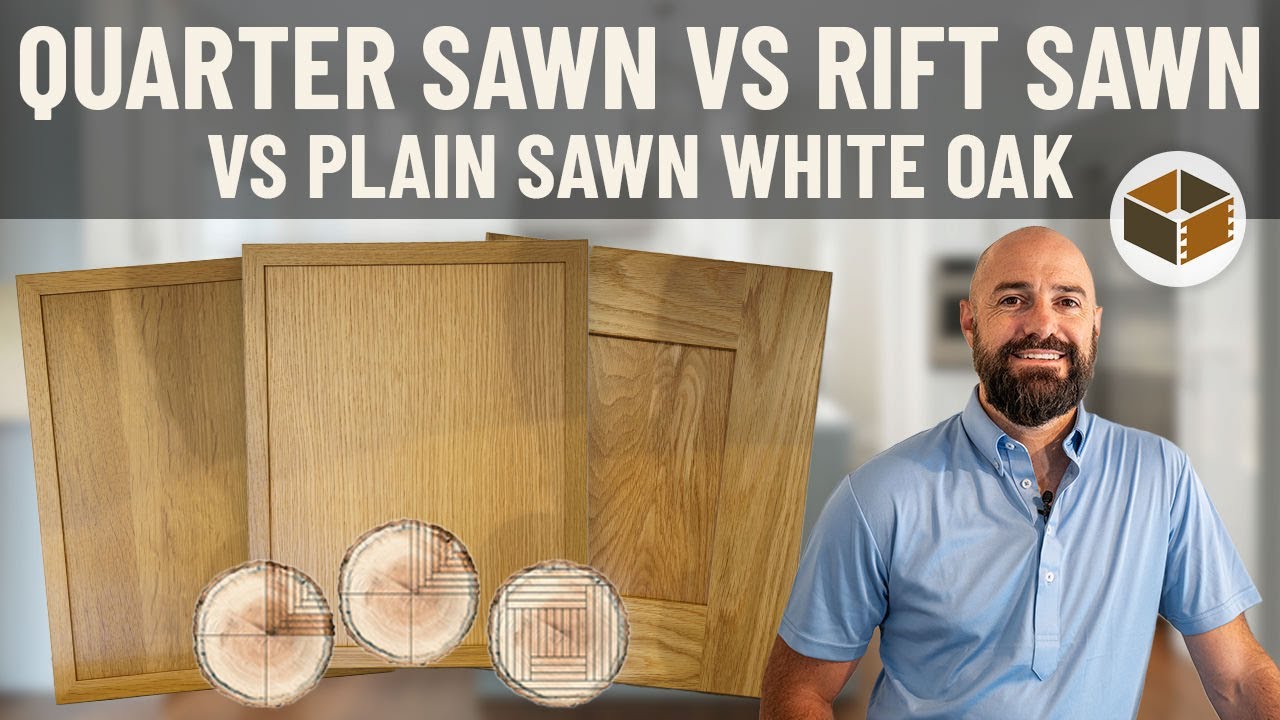
Read the diagram by picturing a round log with concentric growth rings. A plain-sawn board lies tangent to the rings, a rift board crosses them diagonally, and a quartered board points close to the log center; the wide face sits perpendicular to the rings.
Quarter Sawn White Oak Benefits
The main benefits of quarter sawn white oak are straight natural grain, distinctive ray figure, and reduced width movement. These traits make it useful for visible furniture parts, doors, floors, and wide panels, but they don’t make the wood immune to warping.
Straight Natural Grain
Straighter grain appears because a quartered face follows the trunk’s radial plane rather than cutting tangentially through many growth-ring curves. Long fibers create narrow, parallel lines instead of the cathedral shapes common in flat-sawn lumber.
This direction makes rails and stiles look visually continuous, yet grain selection still matters. Two boards from the same log can differ in latewood density, color, ray size, and growth-ring spacing, so arrange parts under the same lighting before marking cuts.
Ray Fleck and Figure
Ray fleck can look like pale ribbons in unfinished wood and flash gold or bronze after oil is applied. Tilting a board under side light makes the figure brighten and fade, much like satin changing shade as it moves.
Fleck intensity varies with species, exact cutting angle, ray size, and position in the log. A legitimate quarter sawn board may carry modest figure, so buyers wanting dramatic oak furniture should specify the desired fleck and request face photographs.
Dimensional stability improves because wood changes less in its radial direction than in its tangential direction. Quarter sawing redirects much of a board’s width movement closer to the radial plane, which reduces the tendency of a wide face to become dish-shaped.
Published values for Quercus alba place green-to-oven-dry shrinkage near 5.6% radially and 10.5% tangentially. The USDA Wood Handbook explains why shrinkage direction affects cupping, joinery, flooring gaps, and panel movement.
| White oak reference property | Approximate value | Practical meaning |
|---|---|---|
| Average dried weight | 47 lb/ft³ or 755 kg/m³ | Heavy boards and finished parts |
| Janka hardness | 1,350–1,360 lbf | Good dent and wear resistance |
| Radial shrinkage | 5.6% | Lower movement across a quartered face |
| Tangential shrinkage | 10.5% | Greater movement across a flat-sawn face |
| Volumetric shrinkage | 16.3% | Substantial total change from green to oven dry |
Species reference values aren’t guarantees for one board. Commercial white oak wood may include several species in the white-oak group, while growth conditions, density, drying, and moisture history alter working behavior.
Heartwood tyloses block many vessel openings in white oak and reduce permeability. That trait helped make the species useful for barrels, boat components, and exterior joinery, but checks, end grain, joints, machining damage, and sapwood can still admit water.
White oak heartwood has useful natural decay resistance; pale sapwood doesn’t offer the same durability. Quarter sawing adds no preservative effect, so exterior life still depends on drainage, ventilation, corrosion-resistant fasteners, finish, and maintenance.
- Advantages include straight grain, visible ray figure, reduced cupping, steady seasonal width movement, and good wear resistance.
- Limitations include lower log yield, narrower boards, higher sorting costs, difficult figure matching, and a visually busy face in minimalist rooms.
- Quartered stock can still bow, twist, check, shrink, swell, or crack when moisture and construction details are wrong.
- Quarter sawn oak isn’t universally stronger; species, grade, defects, loading direction, and part dimensions remain controlling factors.
Plain, Rift, and Quarter Sawn Oak

Plain-sawn oak usually shows cathedral grain, riftsawn oak shows quiet linear grain, and quarter sawn oak combines straight grain with ray fleck. Rift and quartered stock is a mixed commercial category rather than a strict fourth ring angle.
Plain-Sawn Oak
Plain sawing cuts successive boards across a log with limited repositioning. It provides high yield, broad boards, and a lower production cost, while growth rings commonly meet the face at 0–30 degrees.
The sweeping cathedral pattern suits traditional furniture and general millwork, but the curved ring geometry makes wide boards more prone to cupping. A flat-sawn panel can still perform well when dry stock, suitable joinery, balanced finishing, and movement clearance are used.
Rift-Sawn Oak
Rift-sawn oak commonly has rings meeting the face at 30–60 degrees. Its narrow, straight lines and limited ray fleck suit contemporary cabinet doors, matched wall panels, long trim runs, and restrained architectural work.
The main benefits of rift sawn white oak are visual consistency, linear grain, and good width stability. These qualities make rift cut white oak popular for full-height cabinets where dramatic fleck could interrupt the vertical rhythm.
True radial rift sawing creates wedge-shaped boards and substantial triangular waste. Lumber sellers sometimes use “rift cut” to describe appearance rather than one exact log breakdown, so inspect the end grain instead of relying solely on a product label.
Quarter-sawn oak places growth rings near 60–90 degrees to the face. It offers steady width behavior and prominent rays, making it a better visual fit than rift oak for Mission furniture, character panels, and period interiors.
Rift-and-quartered oak, often marked R&Q, contains both orientations. Flooring producers use the mix because it gives straighter grain and better log recovery than selecting strict quartered boards, yet every strip won’t display broad fleck.
| Characteristic | Plain sawn | Rift sawn | Quarter sawn |
|---|---|---|---|
| Common ring angle | 0–30° | 30–60° | 60–90° |
| Dominant face grain | Cathedral or flame | Straight and uniform | Straight with ray fleck |
| Ray figure | Limited or irregular | Usually restrained | Often prominent |
| Relative log yield | Highest | Lowest with true radial cutting | Lower than plain sawn |
| Width stability | Lowest of these orientations | High | High |
| Common style | Traditional or general use | Contemporary | Mission or Craftsman |
| Typical cost position | Usually lowest | Often a premium | Premium over plain sawn |
Mill definitions vary, and the angle ranges above aren’t legal grading standards. Before ordering, ask whether classification applies to each board, its best face, both faces, or the overall batch.
Quarter Sawn Oak Uses
Quarter sawn oak uses include furniture, flooring, cabinetry, architectural millwork, veneer, wall panels, cooperage, and selected exterior parts. The right choice depends on whether the project values visible fleck, quiet grain, width stability, or economical yield.
Mission and Craftsman Furniture
Mission furniture uses quarter sawn white oak to make structure and ornament read as one design. Ray figure brings movement to broad drawer fronts and side panels, while straight grain reinforces the upright lines of legs, rails, and stiles.
Lay out an oak furniture project before milling and place the strongest fleck where it can be seen. Saving quieter boards for internal rails, drawer sides, and hidden supports prevents a random patchwork appearance and lowers the usable cost of oak.
Flooring
Quartered flooring gives a straighter visual field and reduces width movement, but it can still gap or swell. Common failures come from damp subfloors, stock installed far from service moisture content, restricted expansion space, or large seasonal humidity swings.
Ask whether a quote covers strict quarter sawn, rift and quartered, solid, or engineered material. Grade also changes the appearance: select boards look calmer, while character flooring includes knots and color shifts that can compete with ray figure. See the separate guide to white oak flooring for installation details.
Cabinetry and millwork benefit from straight grain and restrained seasonal movement. Quartered stock works well for Craftsman doors, face frames, stair parts, trim, and built-ins, while careful part selection keeps neighboring fleck patterns from fighting each other.
Rift cut cabinets are more common in modern rooms because the grain forms long, quiet lines. Specify veneer leaf sequence, door orientation, heartwood color range, and whether panels will be slip matched or book matched; “rift white oak” alone doesn’t control these details.
Our guide to white oak cabinets covers door construction and design choices. In practice, slip matching often gives cleaner directional flow, while book matching creates mirrored figures that may appear light on one leaf and dark on the next.
Veneer and panels place valuable quartered faces over plywood or MDF, reducing solid-wood use and keeping large panels flatter. Book matching mirrors adjacent leaves, slip matching repeats them in one direction, and random matching produces a less formal field.
A veneered oak panel board needs a flat, clean substrate and balanced construction on both sides. Applying veneer to one face of a thin panel can pull it into a bow; a backing veneer helps equalize stress and moisture exchange.
Exterior work should use sound white oak heartwood, moisture-shedding joints, and suitable fasteners. Cooperage relies partly on tyloses and precise stave joints, not on quarter sawing alone, so a random board shouldn’t be treated as watertight barrel stock.
Ribbed oak describes repeated grooves, reeds, flutes, slats, or raised lines machined into a surface. It isn’t a lumber cut: ribbing can be made from plain, rift, or quarter sawn solid oak, veneered MDF, or assembled strips.
Rift and quartered faces can reinforce the long shadows of a ribbed panel. Run a hand across deep flutes and the surface alternates between cool ridges and darker recesses; sharp arrises feel crisp, while lightly eased edges feel softer and collect less finish.
How to Identify Quarter Sawn Oak

To identify quarter sawn oak, inspect the end grain for rings meeting the wide face at roughly 60–90 degrees. Straight face grain and reflective ray fleck support the identification, but neither is conclusive without an end-grain view.
Inspect the Face Grain
Face grain clues include parallel growth lines crossed by flakes, ribbons, or short bright bands. Plain-sawn boards more often show cathedral arches, while riftsawn oak tends to look straight without broad, repeated rays.
Clean unfinished stock with a hand plane or light sanding before judging it. Rough saw marks scatter light and hide fine structure; a freshly cut face feels smooth but open-pored, and side lighting makes ray figure easier to see.
Check the End Grain
End grain gives the strongest evidence. Square the end, remove dust, identify the board’s wide face, and estimate where the visible annual rings meet that face rather than measuring their angle against the narrow edge.
- Find the wide face whose orientation you need to verify.
- Trace several annual rings across a clean end rather than relying on one curved ring.
- Classify 60–90 degrees as quartered under the common system.
- Check the opposite end because grain orientation can change along a tapered or curved log.
- Ask the seller how its own cut specification differs from this range.
Ray fleck changes with viewing angle, appearing bright and then subdued as the board moves. Checks remain narrow separations, machine marks repeat mechanically, mineral stains lack anatomical shape, and sapwood streaks follow color boundaries rather than reflective rays.
Verify the species before treating fleck as proof of white oak. Quarter sawn red oak also has strong rays, while its open vessels differ from the frequently plugged pores of white oak; finished surfaces can make this distinction difficult.
Compare uncertain stock with the guide to red oak vs white oak. For valuable work, supplier documentation or anatomical inspection is safer than guessing from color, since stain can make the species look nearly identical.
Buying Quarter Sawn White Oak Lumber
When buying quarter sawn white oak lumber, confirm the cut, grade, moisture content, rough or finished dimensions, appearance standard, and usable yield. Quarter sawn oak is usually more expensive because mills recover less saleable lumber and spend more time handling and sorting it.
Confirm the Cut
Ask direct questions: Is the stock strict quarter sawn, selected vertical grain, rift sawn, or mixed R&Q? Does the specification apply to both faces, and can the seller provide end-grain and full-face photographs?
Sight-unseen purchases need written appearance details covering ray-fleck intensity, sapwood limits, color range, minimum width, and bow tolerance. A seller offering oak wood for sale may guarantee species and dimensions without promising the figure shown in a sample image.
Grades and Appearance
Hardwood grade measures potential clear-cutting yield rather than beauty. FAS, FAS One Face, Select, No. 1 Common, and No. 2A Common don’t guarantee heartwood color, ray intensity, matched grain, or freedom from sapwood.
The NHLA Rules for the Measurement and Inspection of Hardwood provide formal grading guidance. Add a separate appearance specification whenever adjacent cabinet doors, tabletop boards, or long architectural parts must match.
Thickness labels such as 4/4, 5/4, 6/4, and 8/4 refer to rough hardwood increments. Rough 4/4 starts near one inch but may finish around 3/4 inch after cup, twist, jointing, and planing are removed.
S2S, S3S, and S4S describe how many faces or edges have been surfaced, not one universal final dimension. Check actual measurements against the separate lumber dimensions guide before designing joinery.
Board-foot calculation uses thickness in inches × width in inches × length in feet ÷ 12. A rough board measuring 1 × 8 inches × 8 feet contains 5.33 board feet before surfacing and defect removal.
Suppliers may calculate from rough dimensions rather than the smaller surfaced size. Small online white oak boards are usually priced by the piece, making their board-foot equivalent high while saving the buyer from milling a full rough board.
Waste allowance commonly runs 15–30% for end checks, sapwood, defects, test cuts, milling loss, and figure matching. Long clear rails, broad matched panels, low grades, or strict color requirements can push the allowance above that range.
Is quarter sawn oak more expensive? Usually, yes. Lower log recovery, extra quarter handling, sorting by ring angle, premium figure selection, thickness, width, length, grade, surfacing, order size, and freight all affect the final cost of oak.
Compare usable cost, not the price tag alone. Divide the delivered price by the board feet left after milling and defect removal, then add shop time; a costly wide board can save labor and glue joints, while cheaper low-grade stock may suit short components.
| Buying format | Main advantage | Hidden cost or limit |
|---|---|---|
| Rough white oak lumber | Lower material cost and full control over milling | Machinery, time, defects, and thickness loss |
| S4S project boards | Ready for compact shop projects | High equivalent board-foot cost |
| Matched boards | Better continuity between visible parts | Matching may cover color, not exact ray figure |
| Quarter sawn veneer | Covers large stable panels economically | Thin edges, substrate preparation, and matching work |
| Rift and quartered flooring | Straight grain with practical log yield | Doesn’t guarantee fleck on every strip |
Local hardwood dealers let you inspect ends, reject bowed stock, and compose a matching set before purchase. Online sources suit small repairs or shops without milling equipment, while large furniture and flooring orders often become freight shipments rather than parcel deliveries.
Quarter Sawn Oak Buying Formats
Buying formats range from short matching boards to four-foot project stock and adhesive-backed veneer. Choose by finished part size, required grain continuity, available machinery, and acceptable glue joints rather than package price alone.
Small Matching Boards
Small board pairs suit boxes, drawer fronts, samples, inlays, repairs, and finish trials. Two boards measuring 3/4 × 4 × 12 inches provide only 0.5 board foot in total, so map each component before cutting.

Quarter Sawn White Oak Boards
- Quarter sawn white oak lumber
- Two matching boards included
- Three-quarter inch thickness
- Four inch board width
- Twelve inch length for small projects
 Buy on Amazon
Confirm whether listed dimensions are exact or nominal and allow room for saw kerfs and squaring. “Matching” may mean boards came from the same lot; it doesn’t always promise consecutive cuts, identical fleck, or a color match across both faces.
Longer Project Boards
Forty-eight-inch boards are more useful for narrow rails, frames, trim, and small table parts. Sight down each edge on arrival, since a slight bow that seems harmless can consume much of a 3/4-inch finished thickness during flattening.
Long Quarter Sawn White Oak Boards
- Quarter sawn white oak lumber
- Two matching boards included
- Three-quarter inch thickness
- Four inch board width
- Forty-eight inch length for longer parts
Buy on Amazon
Quarter sawn veneer can cover cabinet faces, furniture panels, repairs, and prototypes without a wide solid-wood glue-up. A 24 × 48-inch sheet offers eight square feet before trimming, but its 10-mil thickness leaves little room for sanding.

White Oak Quarter Sawn Veneer Sheet
- Quarter sawn white oak veneer
- Pressure sensitive adhesive backing
- Ten mil veneer thickness
- Twenty-four inch sheet width
- Forty-eight inch sheet length
Buy on Amazon
Pressure-sensitive backing needs a dust-free substrate, firm rolling pressure, and stable temperature. Beginners often position a full sheet at once and trap a crease; expose a narrow strip of liner, register one edge, then remove the backing gradually while pressing from the center outward.
Format limitations matter before purchase. Narrow boards force glue-ups, short packs can’t yield continuous rails, thin veneer can telegraph substrate defects, and parcel-size stock isn’t a substitute for graded lumber needed for doors, flooring, or large furniture.
Preparing, Working, and Finishing Oak
Prepare quarter sawn oak by measuring moisture, acclimating it near service conditions, and milling in stages. Use sharp cutters, corrosion-resistant fasteners, tested adhesives, and finish samples because quartered orientation reduces movement but doesn’t correct wet stock or poor construction.
Moisture Content and Measurement
Indoor moisture targets often fall near 6–8%, with 6–10% workable in some climates and buildings. The right value matches the room where the finished piece will live; exterior lumber normally reaches a higher equilibrium moisture content.
Use a calibrated meter on several boards and locations. Pin meters read electrical resistance between probes, while pinless meters scan a wider area but need suitable species settings, material thickness, and flat contact; consult the meter instructions for white oak correction.
One dry surface doesn’t prove the core is dry. Compare readings near both ends and the center, avoid measuring directly over defects or metal, and record values over time rather than trusting a single reading.
Acclimation and Stacking
Stack and sticker boards with aligned supports so air reaches both faces without introducing sag. Keep lumber off concrete and away from damp walls; acclimation ends when readings stabilize near service conditions, not after a fixed number of days.
The guide to kiln-dried wood explains drying targets and storage. Kiln drying lowers moisture efficiently, yet boards can retain case-hardening stress, honeycombing, checks, or uneven moisture when the schedule or conditioning stage goes wrong.
Staged milling starts by rough-cutting parts oversize, flattening them lightly, and letting them rest before final jointing and planing. Remove material from both faces where practical and leave enough thickness to correct movement revealed after the first cut.
Lessons learned in practice: a straight rough board can pinch a saw blade or spring into two curves after ripping because the cut releases internal stress. Stop if the kerf closes, use a riving knife, and move that board to shorter parts rather than forcing it into a long rail.
Freshly planed white oak has a faint sweet, earthy smell, while a dull cutter leaves a warm, polished streak and a sharper burnt odor. That glazed surface can weaken glue bonding and obscure finish absorption, so take a clean final pass rather than sanding only the obvious burn.
| Failure | Likely cause | Practical workaround |
|---|---|---|
| Board moves after ripping | Residual drying stress | Rough-cut early, rest the stock, and remill |
| Wide panel cracks | Cross-grain movement was restrained | Use slotted fasteners or movement-friendly joinery |
| Cabinet door twists | Uneven moisture or poorly matched parts | Measure every component and mill in stages |
| Flooring gaps | Installation moisture differs from service conditions | Test flooring and subfloor before installation |
| Veneer bubbles | Dust, low pressure, weak bond, or unstable substrate | Clean, roll firmly, and veneer both panel faces |
| Blue-black marks | Iron reacting with wet oak tannins | Remove metal debris and use suitable fasteners |
| Ray tearout | Dull edge or cutting against changing grain | Use sharp cutters, light passes, and backing support |
Cutting white oak works best with sharp carbide blades and clean router bits. Take light passes around reversing grain, support fibers at exits, use a backer for crosscuts, and pre-drill near board ends to prevent splits.
Glue fresh surfaces that aren’t burnished, dusty, oily, or finish-contaminated. Interior PVA suits dry furniture, water-resistant formulations fit intermittent moisture exposure, and selected epoxies suit some exterior or gap-filling tasks when used within their product instructions.
Too much clamp force can starve a joint and bow a panel. Apply enough pressure to close the seam and produce a thin, continuous squeeze-out line, then check the panel with a straightedge before the adhesive sets.
Oak tannins react with iron in the presence of moisture, creating blue-black marks that can penetrate below the surface. Stainless steel, silicon bronze, or properly rated coated fasteners reduce the risk in damp and exterior work.
Steel wool fragments, rusty clamps, drill swarf, and dirty water can create the same staining before finishing. Vacuum the pores carefully and avoid steel wool before a waterborne coat; oxalic acid can reduce some marks, but test it on scrap and follow its safety directions.
Highlighting ray fleck starts with samples from the actual project boards. Oil and warm stains deepen contrast and add amber color, while waterborne finishes keep white oak paler; fleck and earlywood pores may accept color at different rates.
White oak is ring porous, so unfinished pores feel like shallow channels under a fingertip. Use grain filler for a level, piano-smooth coating, or leave the pores open when a tactile, natural grain surface fits the design.
Ammonia fuming darkens oak through a tannin reaction and can produce the brown tones associated with Arts and Crafts furniture. Tannin levels vary between boards, so color can shift across one project; commercial stains and reactive oak finishes offer safer, more predictable options.
Concentrated ammonia fumes can cause severe eye, skin, and respiratory injury. This process calls for controlled chemical handling, suitable protective equipment, isolated ventilation, and tested procedures; beginners should choose a formulated finish rather than improvising a fuming tent.
FAQs
What Are The Benefits Of Quarter Sawn White Oak?
Quarter sawn white oak is valued for its stability, strength, and distinctive grain pattern. Its vertical grain resists cupping and movement better than many flat-sawn boards. It also displays attractive ray flecks, making it a popular choice for furniture, cabinetry, flooring, and traditional woodworking projects.
Is Quarter Sawn Oak More Expensive Than Plain Sawn Oak?
Yes, quarter sawn oak is usually more expensive than plain sawn oak. It produces less usable lumber from each log and requires more cutting time, which increases cost. Many buyers consider the added price worthwhile for its improved stability, durability, and decorative grain.
What Is The Difference Between Rift Sawn And Quarter Sawn Oak?
Rift sawn oak has a very straight, uniform grain, while quarter sawn oak often shows prominent ray flecks. Both cuts create boards with vertical grain and good dimensional stability. Rift sawing creates more waste and is often costlier, whereas quarter sawing offers a more traditional figured appearance.
How Can You Tell If Oak Is Quarter Sawn?
You can identify quarter sawn oak by its straight vertical grain and visible medullary ray flecks on the board face. The growth rings usually run roughly 60 to 90 degrees to the board surface. Plain sawn oak, by comparison, commonly has broad cathedral-shaped grain patterns.
Does Quarter Sawn Oak Still Warp?
Yes, quarter sawn oak can still warp, but it is generally more stable than plain sawn oak. Changes in moisture, poor drying, improper storage, or uneven finishing can cause bowing, twisting, or cupping. Let the wood acclimate and seal all sides to reduce movement.
Affiliate Disclosure: Some links in this post are affiliate links. If you make a purchase through these links, we may earn a small commission at no extra cost to you. We only recommend products we genuinely believe in.