Monkeypod Tree Guide: Facts, Care, Uses, and Monkey Pod Wood

Table of Contents
The monkeypod tree, also called rain tree or saman tree, is a huge tropical shade tree known scientifically as Samanea saman. It has a wide umbrella canopy, folding leaves, pink powder-puff flowers, dark seed pods, and valuable monkey pod wood used for slabs, bowls, and furniture.
What Is a Monkeypod Tree?

Quick definition
A monkeypod tree is a large tropical legume tree grown for shade, ornament, pasture use, and timber. In open ground it forms a low, spreading crown that can feel almost like a living roof, with cool air under it and dry, papery leaflets crunching underfoot during seasonal drop.
Names and taxonomy
The accepted scientific name is Samanea saman, and the tree belongs to the Fabaceae family, the same broad plant family as beans, peas, acacias, and many pod-producing trees. Taxonomic records list older names such as Albizia saman and Pithecellobium saman; the USDA GRIN taxonomy record is a useful reference for name history.
Monkeypod tree facts
| Feature | Monkeypod tree detail |
|---|---|
| Common names | Monkeypod tree, monkey pod tree, rain tree, saman tree |
| Scientific name | Samanea saman |
| Family | Fabaceae |
| Native range | Tropical Americas |
| Mature height | Usually 50–80 feet |
| Mature spread | Often 80–100+ feet in open tropical sites |
| Light | Full sun |
| USDA zones | Usually zones 10–12, depending on frost exposure |
| Flowers | Pinkish-white powder-puff clusters |
| Fruit | Dark pods with sweet, sticky pulp |
| Wood hardness | About 900 lbf Janka |
| Main risk | Very large canopy, broad roots, pod litter, local spread |
Rain tree meaning
The name rain tree usually refers to the way the leaflets fold at night, in cloudy weather, and during rain. When the leaflets close, rain passes through the canopy more freely, so the ground can look wetter beneath the tree than under a dense broadleaf canopy.
Common name confusion
Monkeypod, monkey pod, rain tree, and saman tree usually mean the same species, but furniture sellers sometimes use names loosely. If you’re comparing the tree to acacia, parota, or other tropical hardwoods, confirm the Latin name rather than relying only on a sales label.
Monkeypod Tree Identification
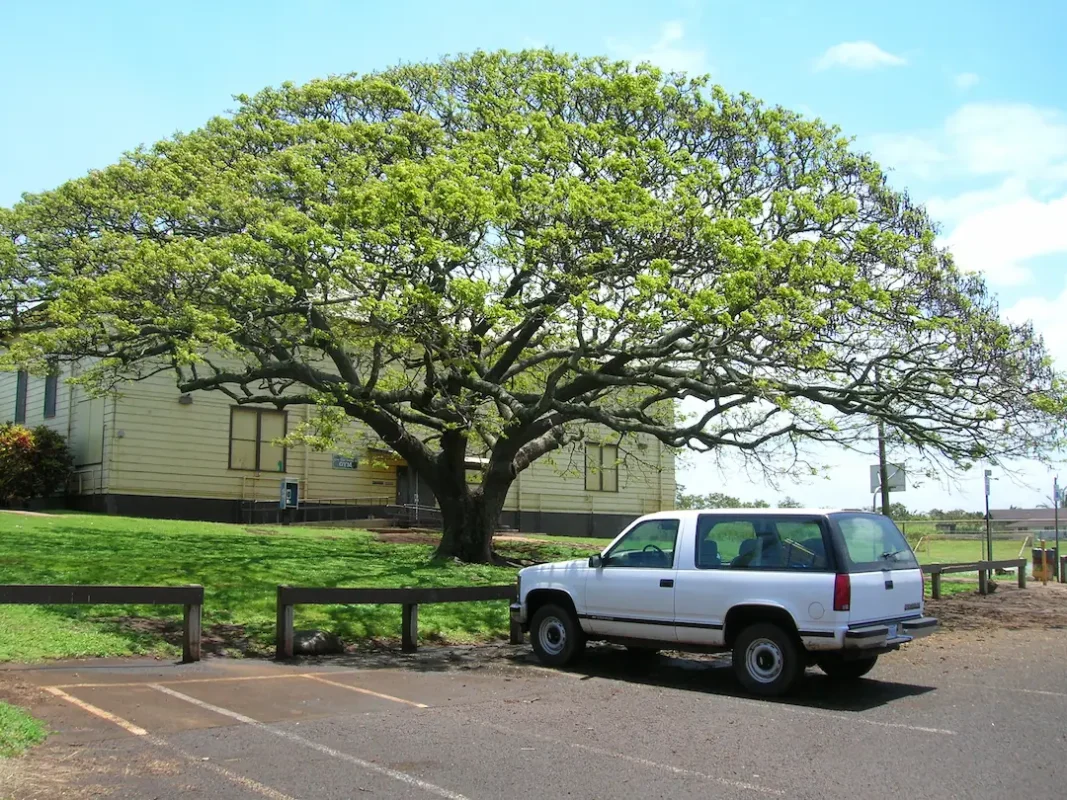
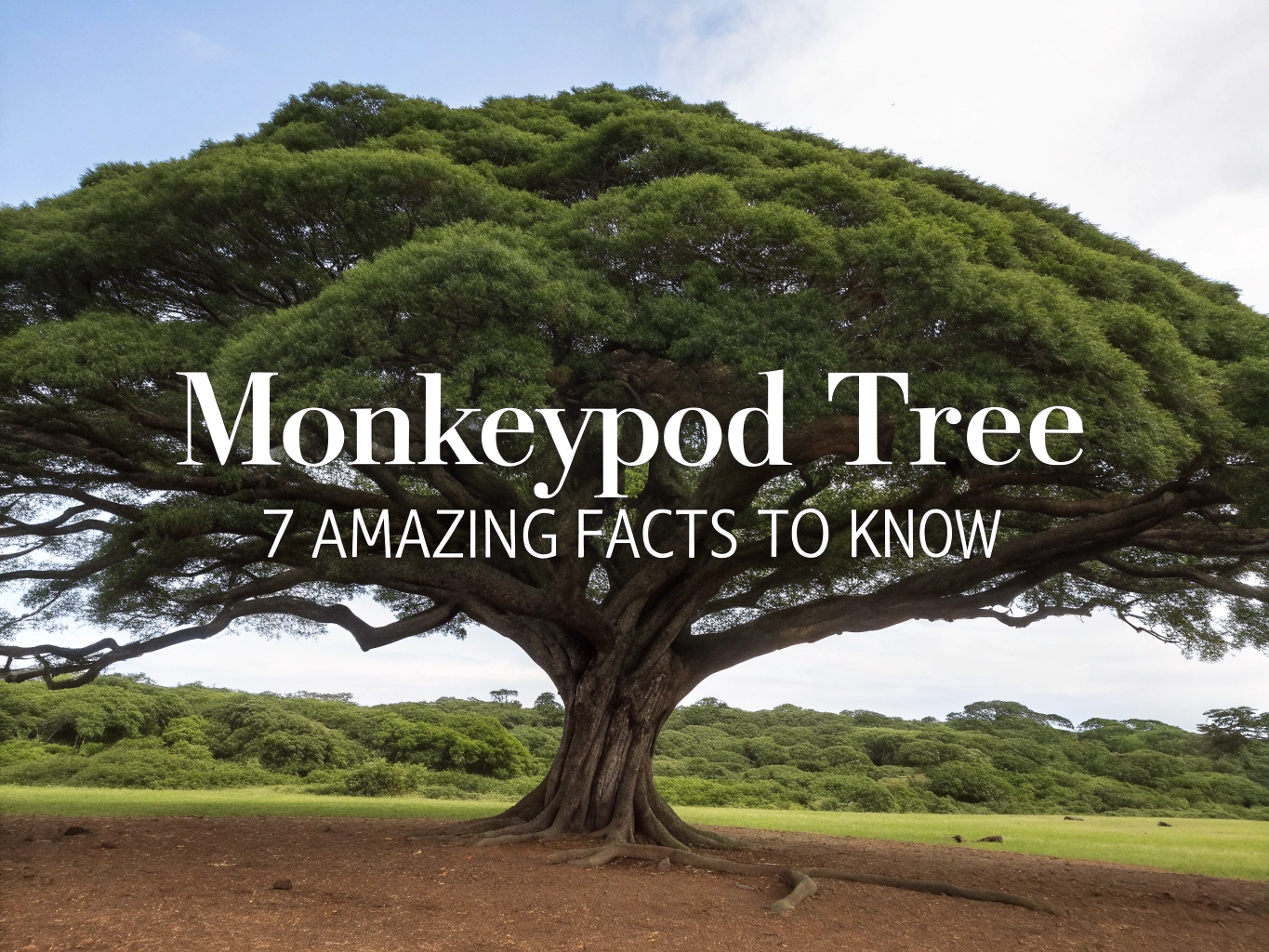
You can identify a monkeypod tree by its wide umbrella crown, small paired leaflets, pink-and-white powder-puff flowers, and dark flattened pods. The full shape matters more than any single leaf because young trees, pruned street trees, and storm-damaged trees can look less typical.
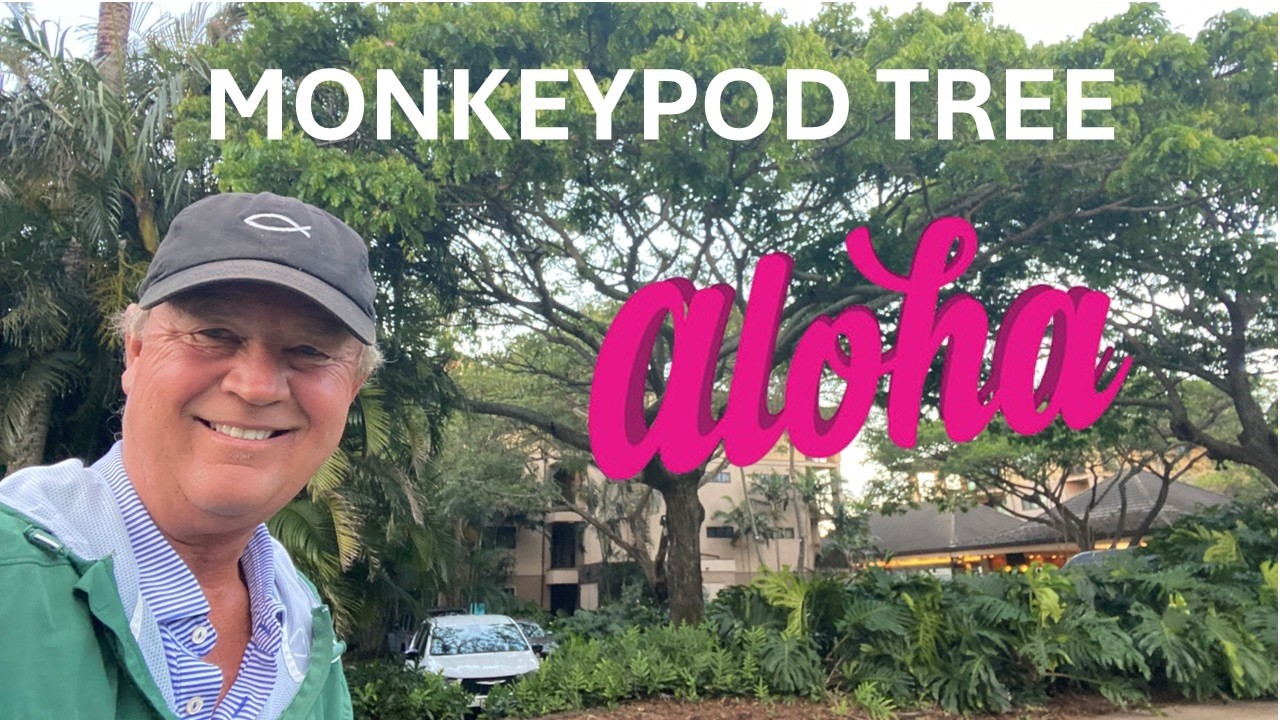
Umbrella canopy
The most obvious trait is the umbrella canopy, which spreads wider than the tree is tall when it has space. In parks and pastures, the outer limbs stretch almost level, creating a broad shaded circle that feels cooler and slightly damp after rain.
Bipinnate leaves
Monkeypod leaves are bipinnate, which means each leaf divides into smaller side branches carrying paired leaflets. The leaflets fold at night and during gloomy weather through a movement called nyctinasty, so a tree can look thin and feathery in the evening.
Pink powder-puff flowers
The flowers look like soft brushes with pale bases and pink-tipped stamens. They aren’t heavy, waxy blossoms; they feel airy and delicate visually, and after bloom they can leave a faint scatter of cream and pink threads on pavement or grass.
Dark seed pods
Mature pods turn dark brown to nearly black and often contain sticky sweet pulp around the seeds. Beginners often underestimate the mess: pods can thud onto roofs, stain light paving, and create slick spots in walkways after rain.
Bark and trunk
Older trees develop a massive trunk, broad scaffold limbs, and grayish-brown bark that becomes rougher with age. Look for a trunk that quickly divides into large limbs rather than a narrow, upright street-tree form.
Pod edibility caution
The sweet pod pulp is used as livestock fodder in some regions, but don’t treat fallen pods as human food without a reliable local edible-plant source. A common beginner mistake is assuming “animals eat it” means “people should eat it,” which isn’t a safe rule.
Image checklist
- Look for a wide canopy that spreads like a low umbrella.
- Check for bipinnate leaves with many small paired leaflets.
- Search the ground for dark pods, small leaf litter, and flower threads.
- Compare flowers to pink powder-puffs, not large petals.
- Photograph the full tree, leaves, pods, bark, and growing site for better ID.
Where Monkeypod Trees Grow

Monkeypod trees grow best in warm tropical and frost-free subtropical regions. They are native to parts of the American tropics but now appear in Hawaii, Florida, Puerto Rico, Pacific islands, tropical Asia, India, Sri Lanka, and other warm regions.
Native range
The native range is usually described as the tropical Americas, including areas of Central America, northern South America, and nearby Caribbean-influenced regions. Range maps can vary because the tree has been moved by people for shade, fodder, and ornament for a long time.
Introduced regions
Introduced populations occur across many warm regions, and the tree is planted as a park tree, pasture tree, roadside tree, and estate specimen. The CABI datasheet for Samanea saman gives a broad view of its distribution and introduced status.
Monkeypod tree Hawaii
The monkeypod tree Hawaii connection is strong because large trees are common in parks, resorts, older neighborhoods, and public landscapes. Many visitors first notice monkeypod in Hawaii by standing under its shade, smelling wet leaf litter, and seeing souvenir bowls made from Hawaiian monkeypod wood.
Monkey pod tree Kauai
Searches for monkey pod tree Kauai usually come from travelers who saw a huge spreading tree along roads, gardens, farms, or resort grounds. Kauai’s warm climate supports monkeypod well, but the same size that makes it photogenic also makes it unsuitable for tight residential planting.
Hitachi Tree, Oahu
The famous Hitachi Tree at Moanalua Gardens on Oahu is a monkeypod known worldwide through branding and tourism. Public descriptions often cite a huge canopy, showing how a mature tree can become a landmark rather than a normal backyard tree; see the Hitachi Tree profile for site details.
Climate and USDA zones
USDA zones 10–12 are the usual fit, with the best performance in frost-free sites. Young trees are cold-sensitive; a short hard freeze can blacken tender leaves and kill branch tips before the trunk has enough mass to recover.
Soil and rainfall
Monkeypod tolerates sandy soil, loam, and clay loam, but good drainage matters. It grows best with moderate to high rainfall and can handle seasonal dry periods after establishment, yet waterlogged planting holes often lead to weak roots and poor anchoring.
Size, Roots, and Growth Rate
A mature monkeypod tree is often 50–80 feet tall with a canopy that can spread 80–100+ feet. The root zone can extend far past the trunk, so planting space is the main deciding factor, not just climate suitability.
Mature height
Typical monkeypod tree height falls around 50–80 feet, with larger specimens in ideal tropical sites. Height changes with soil depth, irrigation, wind exposure, pruning history, and age, so a nursery tag rarely tells the whole story.
Canopy spread
The canopy spread is the feature that causes the most surprises. In open full sun, monkeypod often grows wider than tall, which is perfect for parks and pastures but awkward near rooflines, pools, power lines, and narrow streets.
Growth rate
The growth rate is fast in warm, moist, sunny conditions, especially while the tree is young. Growth slows as the crown broadens, and poor soil compaction or repeated drought can make a tree look sparse, with folded leaflets and twig dieback.
Surface roots
Surface roots are common on older monkeypod trees, especially in compacted or shallow soils. These roots can lift paving, break mower blades, trip pedestrians, and push into irrigated lawn edges where moisture stays close to the surface.
Planting space
Allow space for both roots and canopy, not just the trunk. A practical rule is to plant monkeypod only where a future 100-foot crown would look natural rather than like a pruning problem waiting to happen.
Near-house cautions
A monkeypod near house planting can become costly because falling pods, limb weight, roots, and shade all affect structures. If a client wants the tropical look close to a home, a smaller tree is the safer workaround; browse broader options in our guide to hardwood trees.
Monkeypod Tree Care and Landscaping
Monkeypod tree care is simple only when the site is large, warm, sunny, and well drained. Most failures come from planting in cramped places, pruning too late, or treating a giant tropical tree like a normal residential shade tree.
Full sun
Full sun gives monkeypod its strongest canopy, best flowering, and fastest young growth. Shade-grown trees often stretch unevenly, then form weak branch angles as they chase light around buildings or taller trees.
Watering needs
Young trees need regular watering until roots reach stable moisture. Mature trees tolerate seasonal dryness better, but long dry spells may cause leaflet folding, thinner shade, and partial leaf drop that can make owners think the tree is dying.
Soil and drainage
Use well-drained soil and avoid planting in a bathtub-like hole surrounded by compacted clay. The expert workaround is to correct grading and drainage before planting; adding rich soil into a poorly draining pit often makes root problems worse.
Structural pruning
Structural pruning should start early, while cuts are small and wood seals cleanly. Remove crossing limbs, crowded leaders, and weakly attached branches; waiting until limbs are the size of a thigh makes each cut riskier and more expensive.
Fertilizing needs
Heavy fertilizer is rarely needed in fertile tropical soil. Because monkeypod is a legume-family tree, soil biology may support nitrogen-related gains, but a soil test beats guessing, especially near lawns that already receive fertilizer.
Best landscape uses
The best sites are large landscapes: parks, campuses, estates, botanical gardens, pastures, roadside corridors, and public shade areas. In those spaces, the broad crown becomes an asset rather than a constant clearance battle.
Poor planting sites
Avoid tight sites such as small yards, sidewalk strips, parking islands, septic fields, pool edges, and areas under power lines. The tree’s natural form wants width; repeated hard pruning creates decay pockets and ugly regrowth.
Pests and diseases
Pest pressure is region-specific, but borers, scale insects, caterpillars, decay fungi, termites in dead wood, and soil compaction can appear. For large mature trees, a qualified arborist inspection is cheaper than waiting for a heavy limb to fail in a storm.
Propagation cautions
Monkeypod can grow from hard-coated seeds, often with scarification or soaking to improve germination. Don’t propagate it in regions where it is restricted or spreading locally, and don’t start seedlings unless there is space for a future giant.
Benefits, Problems, and Invasiveness
The monkeypod tree gives outstanding tropical shade, wildlife value, soil organic matter, and attractive wood, but it also creates litter, root conflicts, storm concerns, and possible spread. Local climate and site size decide whether it is a smart planting or a future liability.
Shade value
Shade value is the tree’s greatest strength. The wide crown can cool pastures, picnic areas, campuses, and public gathering spaces, and the filtered edge light allows some turf or groundcover to survive beyond the densest center.
Soil and pasture benefits
As a legume-family tree, monkeypod can contribute leaf litter, pod residue, shade for livestock, and organic matter under the canopy. In pasture settings, animals may eat pods and rest below the crown, which is useful but also spreads seed.
Wildlife and pollinators
The flowers can attract pollinators, while the branches offer perching, nesting, and shelter. Seed pods may feed mammals, and that animal interest is exactly why naturalization risk rises in some warm regions.
Pod and leaf litter
Leaf litter is fine-textured and can pack into gutters, drains, gravel, and pool baskets. Pods are heavier and messier; on walkways they can become slippery, especially when the sticky pulp breaks down after rain.
Storm and branch risk
Large limbs need good structure from a young age. Wide crowns catch wind, and branches with included bark, decay, or old storm cracks may fail; the workaround is early corrective pruning followed by periodic inspections.
Invasive risk
Invasive risk is local, not universal. Monkeypod can naturalize in warm, humid, disturbed places because animals eat the sweet pods and move seeds; the Pacific Island Ecosystems at Risk profile shows why island checks matter.
Local planting checks
Before planting, check local guidance from extension offices, forestry departments, municipal tree lists, botanical gardens, or native plant groups. If a region flags monkeypod as invasive, choose a non-spreading shade tree rather than hoping seed cleanup will control it.
Monkey Pod Wood Properties

Monkey pod wood is a medium-density tropical hardwood from Samanea saman, valued for warm brown color, pale sapwood contrast, large slabs, and easy finishing. It is good for furniture and bowls, but it must be dried correctly to avoid checking, cupping, and movement.
Wood source
The wood comes from the same tree discussed above, not a separate “monkey wood” species. For a deeper wood-only profile, see our full guide to monkey pod wood.
Heartwood and sapwood
Heartwood is usually golden brown to darker brown, while sapwood is pale yellow, cream, or whitish. Slab buyers often pay extra for strong contrast because it frames the live edge and makes a tabletop look wider and more dramatic.
Color and grain
The grain may be straight, wavy, interlocked, or figured. Freshly sanded monkeypod can smell faintly earthy and sweet, and an oil finish often deepens the brown tones within minutes, making pale sapwood stand out sharply.
Dried weight: 38 lb/ft³
Average dried weight is about 38 lb/ft³, or roughly 600 kg/m³. That puts monkeypod in a workable middle range: heavy enough for furniture presence, but easier to handle than many dense tropical woods like cumaru.
Janka hardness: 900 lbf
The Janka hardness is about 900 lbf, close to many furniture hardwoods but softer than flooring-heavy species. The Wood Database monkeypod profile lists common mechanical values used by woodworkers and buyers.
Strength and shrinkage
Shrinkage values are relatively moderate: radial shrinkage about 2.1%, tangential about 4.6%, and volumetric about 6.9%. Large slabs still move because width magnifies stress, so sealed ends, slow drying, and balanced finishing matter.
Workability and finishing
Monkeypod usually cuts, sands, glues, and finishes cleanly, but interlocked grain can tear out under a planer. Sharp blades, light passes, skewed hand-plane cuts, and card scraping help keep figured areas from fuzzing.
Durability limits
Durability varies by board, growing site, and exposure. Monkeypod can perform well indoors, but it isn’t a first choice for ground contact; outdoor pieces need sealing, drainage gaps, shade when possible, and routine finish care.
Common wood uses
- Live-edge tables and conference tables
- Bowls, including Hawaiian souvenir bowls and “monkey cups” style turned pieces
- Carvings, trays, and decorative objects
- Cabinetry, panels, and veneer
- Furniture such as benches, coffee tables, and sideboards
For broader furniture comparisons, our guide to types of wood for furniture helps place monkeypod beside common domestic and tropical options.
Wood dust safety
Wood dust can irritate eyes, skin, and breathing passages, especially during sanding. Use dust collection, a respirator, eye protection, and airflow; the fine dust feels dry and peppery in the nose when extraction is poor.
Buying and Sustainability
Monkeypod wood can be a sound purchase when the seller verifies species, drying, moisture content, and source. The biggest buying mistakes are accepting vague “tropical acacia” labels, buying wet slabs, and ignoring freight, flattening, and finishing costs.
Sustainable sourcing
Sustainable monkeypod depends on origin, not the name alone. Wood from urban removals, managed plantings, storm-felled trees, or non-native landscape trees is usually easier to justify than wood with no harvest story or paperwork.
Hawaii monkeypod wood
Hawaii monkeypod wood often means wood grown, milled, or made in Hawaii, not a native Hawaiian species. If you like island hardwoods, compare it with koa wood, which has a very different cultural and botanical background.
Slab buying checks
Before buying a monkey pod slab, check width, thickness after flattening, cracks, end checks, insect holes, pith location, bow, cup, and whether both faces were surfaced. A slab can look flat in photos but rock corner-to-corner on a shop floor.
Moisture and kiln drying
Ask for a moisture reading, not just the phrase “dry.” Thick slabs dry slowly, and a wet core can later shrink, open cracks, or make a finish look cloudy; kiln drying and equalization reduce those risks.
Monkeypod wood price factors
Monkeypod wood price changes with slab width, thickness, figure, sapwood contrast, bookmatching, drying quality, surfacing, shipping distance, and finished labor. It may be moderate near growing regions but expensive as a wide kiln-dried dining table slab far from the source.
Species verification
Ask whether the wood is Samanea saman and request the seller’s source notes if authenticity matters. Trade names can blur together, especially in imported furniture listings that use “monkeypod,” “rain tree,” “suar,” and “acacia” unevenly.
Monkeypod vs acacia
Monkeypod vs acacia confusion is common because both are legume-family woods and both can show warm brown color. Acacia varies widely by species, and some acacias are harder or denser; compare details in our acacia wood guide before buying.
Walnut, cherry, mahogany
Monkeypod at about 900 lbf Janka sits near black cherry and slightly below black walnut, while many mahogany species overlap around the same range. For color and use comparisons, see walnut wood and mahogany wood.
Bottom line: plant a monkeypod tree only in a large, warm site where its canopy and roots have room, and buy monkey pod wood only when the slab is identified, dry, and responsibly sourced. The tree is magnificent at the right scale, but it’s too large and messy for many small properties.
Monkeypod Meaning and Common Misspellings
The monkeypod meaning is simply the common name for Samanea saman, also written as monkey pod and widely called rain tree or saman tree. In Hawaii, phrases such as Hawaiian monkey pod tree describe where a tree grows, not its botanical origin: monkeypod was introduced to Hawaii and is not native to the islands.
Searches for monkey tree Hawaii, monkey paw tree Hawaii, or monkey pot tree usually refer to monkeypod and are spelling or voice-search variations rather than accepted species names. Confirm the umbrella-shaped crown, bipinnate leaves, pink powder-puff flowers, dark pods, and scientific name. Wood listings may also confuse monkeypod with acacia, so compare the species details in this acacia wood guide before buying.
FAQs
Is A Monkeypod Tree The Same As A Rain Tree?
No, a monkeypod tree is not the same as a rain tree. They are different species, although both are large tropical shade trees with broad canopies. The names are sometimes confused because they can look similar in landscapes.
Where Do Monkey Pod Trees Grow?
Monkey pod trees grow best in warm, tropical, and subtropical climates. They are commonly found in places like Hawaii, Southeast Asia, and parts of Central and South America. They need plenty of sun and room to spread out.
How Big Does A Monkeypod Tree Get?
A monkeypod tree can grow very large, often reaching 40 to 80 feet tall with a wide canopy. In good conditions, it may spread even wider than it is tall. Its size makes it a popular shade tree in parks and large yards.
Is The Monkeypod Tree Invasive?
In some tropical areas, a monkeypod tree can become invasive or spread aggressively. In other places, it grows well without causing problems. It is best to check local planting guidelines before adding one to your property.
Is Monkey Pod Wood Good For Furniture?
Yes, monkey pod wood is good for furniture. It is valued for its attractive grain, rich color, and durability. Many people use it for tables, chairs, bowls, and decorative pieces because it is both beautiful and sturdy.
Affiliate Disclosure: Some links in this post are affiliate links. If you make a purchase through these links, we may earn a small commission at no extra cost to you. We only recommend products we genuinely believe in.