

Chestnut oak (Quercus montana) is a native eastern North American white oak recognized by deeply ridged bark, rounded leaf teeth, and large acorns. It grows mainly on dry, rocky slopes and produces dense timber, valuable wildlife food, and long-lived forest cover.
Table of Contents
What Is a Chestnut Oak?
A chestnut oak tree is a deciduous hardwood in the white oak group. Its common name refers to leaves that resemble American chestnut leaves, not to any close relationship with true chestnuts.
Classification and Names
The accepted botanical name is Quercus montana, while older forestry books often use Quercus prinus. Both names can appear in nursery records, herbarium labels, lumber references, and older property surveys.
Chestnut oak belongs to the Fagaceae family and the white oak section of Quercus. Its closest practical relatives include white oak, post oak, swamp chestnut oak, and overcup oak. Readers comparing the group can review white oak wood and post oak wood.
Common regional names include rock oak, rock chestnut oak, and mountain oak. “Rock oak” describes its habit of growing in thin, stony soil where many faster-growing trees struggle.
Native Range
Chestnut oak is native to the eastern United States, with its strongest populations along the Appalachian Mountains and nearby uplands. Its distribution runs from parts of Maine and New York south through Georgia and Alabama, then west into portions of the Ohio and Tennessee valleys.
The species becomes most common on dry ridges, rocky hillsides, and upper slopes. The U.S. Forest Service’s Chestnut Oak species account describes it as a major tree on poor Appalachian sites where its root system and drought tolerance offer an advantage.
Size and Lifespan
A mature chestnut oak commonly reaches 60 to 80 feet tall with a crown 40 to 60 feet wide. Protected forest specimens can pass 100 feet, while exposed ridge trees may remain shorter and develop broad, irregular crowns.
Healthy trees may live 300 years or longer. Growth is slow on dry rock, but that slow development creates tight annual rings and heavy wood. Open-grown trees form thick trunks sooner because their crowns receive light from every side.
How to Identify Chestnut Oak

Identify chestnut oak by combining four field marks: a rounded crown, thick ridged bark, leaves with rounded chestnut-like teeth, and large acorns with deep bowl-shaped caps. One feature alone can mislead, especially on young trees.
Tree Shape
Forest-grown trees usually have a straight central trunk and a narrow crown held above neighboring trees. Open-grown examples branch lower and develop wide limbs that bend upward at their ends.
On an exposed ridge, the crown may look crooked or one-sided after decades of wind, ice, and competition. Don’t reject an identification because the silhouette differs from a nursery-grown specimen; habitat changes tree form substantially.
Bark Characteristics
Mature bark is dark gray to brown and divided into massive vertical ridges. The ridges feel firm and corky under the fingertips, with deep channels that can hold dry leaf fragments and pale lichen.
Older trunks can resemble white oak, but chestnut oak bark is often darker and more deeply furrowed. Young stems stay smoother and may show pale horizontal marks, so bark works best after the trunk reaches several inches in diameter.
Leaves and Color
The leaves are commonly 4 to 8 inches long, oblong to narrowly oval, and widest near the middle. Each edge carries roughly 10 to 16 pairs of rounded teeth without the pointed bristle tips found on red oak leaves.
The upper surface feels thick and slightly leathery, while the underside is paler and may carry fine hairs. New spring leaves can look yellow-green or bronze. Summer foliage turns dark green, followed by yellow, orange-brown, or russet fall color.
- Look for rounded, regular teeth rather than deep lobes.
- Check that the leaf tip lacks a slender bristle.
- Compare several sun and shade leaves from the same tree.
- Inspect fallen leaves beneath the crown rather than pulling live foliage.
Acorns and Caps
Chestnut oak produces large oval acorns, often 1 to 1½ inches long. The nut is shiny brown at maturity, while the cap is gray-brown, rough, and shaped like a deep cup covering about one-third of the acorn.
Acorns mature in one growing season, a trait shared by white oaks. Fresh nuts can begin root growth soon after falling, so a sound autumn acorn may already have a white root tip before winter.
A common beginner mistake is using acorn size alone. Soil moisture and crop density change nut size, and overcup oak carries a much deeper cap. Match the cap, leaf, bark, and growing site before naming the tree.
Pictures by Season
A useful picture of chestnut foliage should show the leaf edge, underside, twig, and buds. A distant crown photograph helps with shape but rarely separates chestnut oak from nearby white oaks.
| Season | What a Useful Picture Shows | Likely Identification Trap |
|---|---|---|
| Spring | Bronze-green unfolding leaves and pale young shoots | New leaves can resemble true chestnut |
| Summer | Dark leathery leaves with rounded teeth | Shade leaves may be broader than sun leaves |
| Autumn | Russet foliage, brown acorns, and deep rough caps | Swamp chestnut oak may have similar acorns |
| Winter | Dark ridged bark, stout twigs, and clustered buds | Old white oak bark can appear similar |
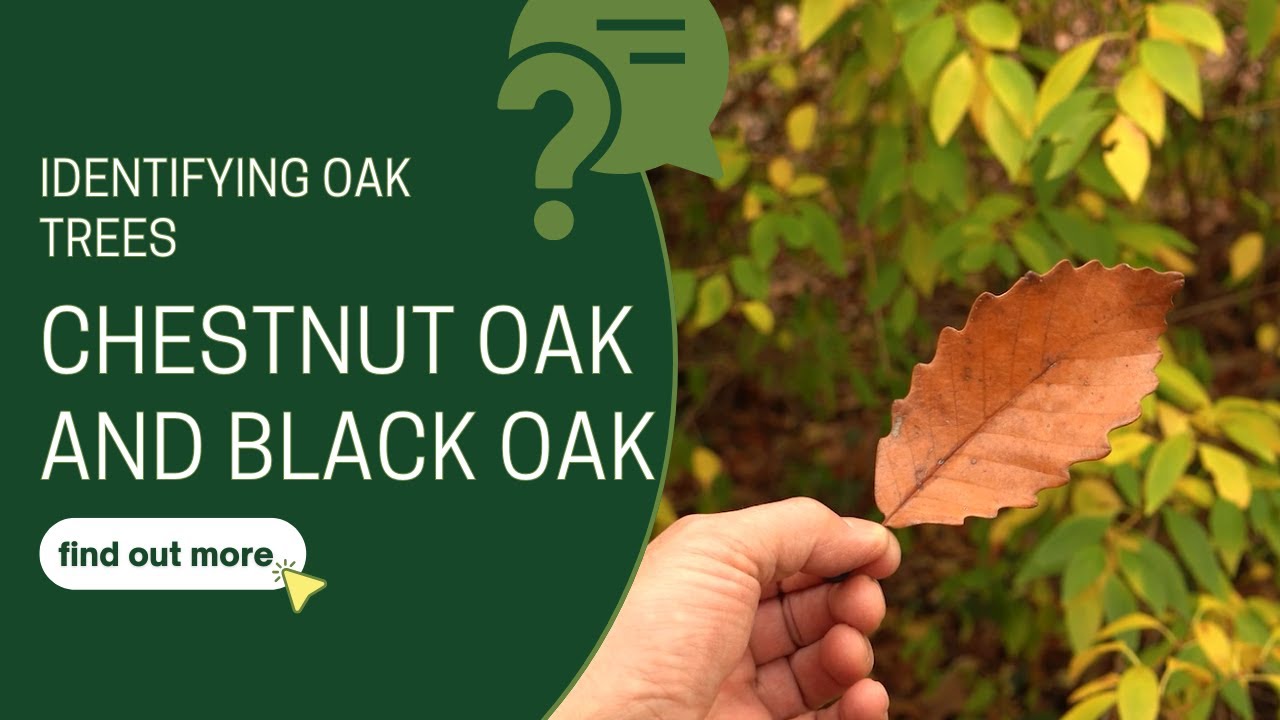
The following video offers a visual field reference that can be compared with leaves, bark, and the tree’s growing site.
Chestnut Oak vs Similar Trees
Chestnut oak differs from similar trees through its alternate simple leaves, rounded teeth, deeply ridged bark, and true acorns. True chestnuts have sharply toothed leaves and spiny burs, while horse chestnuts and buckeyes have opposite compound leaves.
Swamp Chestnut Oak
Swamp chestnut oak (Quercus michauxii) favors moist bottomlands, floodplain terraces, and rich low slopes. Chestnut oak usually occupies dry, rocky uplands, making habitat one of the quickest separation clues.
Swamp chestnut oak often has larger, broader leaves with coarse rounded teeth and a pale, softly hairy underside. Its bark tends to be lighter and flaky, while chestnut oak bark develops darker blocky ridges. Swamp chestnut acorns are often larger and noticeably sweet to wildlife.
American Chestnut
American chestnut (Castanea dentata) has long leaves with sharp hooked teeth, not rounded oak teeth. It produces nuts inside a densely spined bur rather than an acorn cap.
American chestnut bark develops long flat ridges that may form a diamond-like pattern. Young sprouts remain common in eastern forests, but chestnut blight often kills them before they become mature canopy trees.
Dunstan Chestnut Trees
Dunstan chestnut trees are cultivated chestnut hybrids associated with American and Chinese chestnut ancestry. They are planted for edible nut crops and blight resistance, but they aren’t oaks and don’t produce acorns.
Dunstan leaves have pointed saw-like teeth, and their nuts grow inside needle-sharp burs. Gloves help during harvest; dry burs prick through thin fabric and can lodge small spines in the fingertips. Chestnut oak acorns can be handled without that risk.
European Horse Chestnut
European horse chestnut (Aesculus hippocastanum) has opposite, palmately compound leaves made of five to seven leaflets. Its upright flower clusters and green husks make it easy to separate from chestnut oak during spring and summer.
Horse chestnut seeds, called conkers, are smooth and glossy with a broad pale scar. They aren’t edible chestnuts and contain toxic compounds. The University of Kentucky’s horse chestnut profile identifies its compound leaves, fruit, and ornamental growth habit.
Chestnut vs Buckeye
In a chestnut vs buckeye comparison, leaf arrangement gives the fastest answer. True chestnuts carry alternate simple leaves; buckeyes carry opposite compound leaves with several leaflets meeting at one point.
Buckeye fruit has a leathery outer case containing one or more smooth seeds. True chestnut fruit has an extremely spiny bur, while chestnut oak has a woody acorn cap. None of these fruit types should be identified for eating by color alone.
| Tree | Leaves | Fruit | Typical Site |
|---|---|---|---|
| Chestnut oak | Alternate, simple, rounded teeth | Acorn in rough cap | Dry rocky uplands |
| Swamp chestnut oak | Alternate, broad, coarse teeth | Large acorn | Moist bottomlands |
| American chestnut | Alternate, simple, sharp teeth | Edible nuts in spiny bur | Well-drained eastern forests |
| European horse chestnut | Opposite, palmately compound | Conker in green husk | Planted parks and streets |
| Buckeye | Opposite, palmately compound | Smooth seed in leathery case | Varies by species |
Habitat and Ecological Value
Chestnut oak supports upland forests by producing high-value acorns, shelter cavities, durable leaf litter, and stable roots on erosion-prone slopes. Its tolerance for poor soil lets it maintain canopy cover where richer-site trees grow slowly or fail.
Preferred Habitat
The species performs best in acidic, well-drained soil on ridges and upper slopes. Natural sites often contain sandstone, shale, gravel, or exposed bedrock beneath a thin organic layer.
Chestnut oak tolerates drought after establishment, yet seedlings still need enough moisture to build roots. It performs poorly in permanently saturated ground; swamp chestnut oak or overcup oak fits wet lowland sites better.
Wildlife Benefits
Acorns feed deer, wild turkey, squirrels, chipmunks, mice, jays, and other wildlife. Because the nuts belong to the white oak group, they contain less bitter tannin than many red oak acorns and are often eaten soon after falling.
Heavy crops don’t occur every year. A mast season can cover the ground with hard brown nuts that roll under boots, followed by one or more sparse years. Mixed stands offer a steadier food supply because oak species don’t always crop at the same time.
Forest Ecology
Chestnut oak commonly grows with scarlet oak, black oak, white oak, red maple, sourwood, hickory, and pine. Its thick bark gives larger trees some resistance to low-intensity surface fire, though repeated fire can scar trunks and open routes for decay.
The species often dominates poor ridges through persistence rather than speed. Shade-tolerant seedlings can wait beneath gaps, then respond when a nearby tree falls. Compare this upland association with scarlet oak, another common dry-site hardwood.
Chestnut oak, white oak, sugar maple, hickory, and black cherry are often named among the top five hardwood trees for combined timber and ecological value in eastern forests. Four examples of hardwood trees can also be identified simply as chestnut oak, red oak, maple, and hickory; the useful ranking changes with soil, climate, and the intended product. See the broader guide to hardwood trees for added context.
Growing and Caring for Chestnut Oak
Grow chestnut oak in full sun with deep, well-drained soil and enough room for a broad mature crown. Young trees need steady moisture, trunk protection, and minimal root disturbance during establishment.
Site Requirements
Choose a location receiving at least six hours of sun each day. Mature roots and limbs require distance from buildings, pavement, septic fields, buried utilities, and overhead wires.
A rocky native habitat doesn’t mean a young tree prefers a dry planting hole. Seedlings establish faster in moderately moist soil that drains after rain. Avoid low pockets where water remains for several days.
Chestnut oak develops a strong root system and can be difficult to move once established. Container trees may have circling roots, while field-dug trees can lose much of their root mass. Inspect the root flare and reject stock with severe girdling roots.
Planting Methods
Plant nursery stock during cool weather while the tree is dormant. Dig a hole two to three times wider than the root system but no deeper than the distance from the root flare to the root-ball base. A buried flare leads to slow decline and stem decay.
- Remove wire, twine, tags, and as much burlap as possible after positioning the root ball.
- Set the first major root at or slightly above the finished soil level.
- Backfill with the excavated native soil rather than a rich potting mix.
- Water slowly to settle air pockets without stamping the soil hard.
- Add 2 to 3 inches of mulch while keeping it several inches from the trunk.
Acorns can be sown outdoors in autumn soon after collection. Place each nut on its side about 1 to 2 inches deep and cover the bed with wire mesh. Rodents can remove an entire crop overnight, so physical protection matters more than fertilizer.
Helpful planting and protection supplies can reduce seedling losses during the first seasons.
Watering and Maintenance
Water deeply after planting, then check soil moisture once or twice a week during the first growing season. Apply water when the upper 2 to 3 inches feel dry. Constant shallow sprinkling encourages surface roots and leaves deeper soil dry.
Mulch should resemble a wide, flat ring rather than a mound against the trunk. “Mulch volcanoes” keep bark damp, hide rodents, and promote roots above the natural soil line. Keep the trunk flare open to air.
Prune dead, broken, or crossing branches while the tree is young, but retain enough foliage for root growth. Removing more than roughly one-quarter of the living crown at once can trigger weak shoots and reduce stored energy.
A basic moisture meter can help beginners compare wet and dry zones, though a hand-dug soil check remains more reliable around stones and mulch. Probe several spots rather than trusting one reading.
Growth Rate
Young chestnut oaks may add about 12 to 24 inches of height in a favorable year. Growth falls below that range on dry ridges, under shade, after transplanting, or during repeated summer drought.
Fast top growth isn’t the best early target. A newly planted tree may extend only a few inches while forming roots, then grow more strongly in its third or fourth season. Fertilizing a stressed tree can produce soft shoots without solving the root-zone problem.
Field Experience Insights
Real planting failures usually trace back to depth, water distribution, or animal damage rather than poor genetics. The most reliable check is to expose the root flare, push a narrow trowel 4 to 6 inches into the soil, and feel the sample. Properly moist soil feels cool and crumbly, not dusty or slick like putty.
Deer browse can strip tender shoots, while bucks may shred thin bark during antler rubbing. Use a wide cage rather than a tight plastic tube in humid areas. Tight guards trap heat and moisture against the stem and can hide vole damage near the soil line.
Acorns collected from local healthy trees often match regional climate better than distant stock. Float tests can remove some hollow or insect-damaged nuts, but floating isn’t a perfect test. Cut a small sample open; sound kernels should look firm and cream-colored without tunnels or sour odor.
Chestnut Oak Wood and Uses

Chestnut oak produces hard, heavy timber commonly sold within the commercial white oak group. The wood works for flooring, furniture, cabinets, timbers, pallets, fence material, and firewood, though drying defects can reduce recovery from thick boards.
Hard Timber Properties
Chestnut oak is a tree that produces hard timber with prominent rays, visible growth rings, and pale brown to medium brown heartwood. Its Janka hardness is commonly listed near 1,130 pounds-force, close to commercial white oak but subject to variation between trees and test samples.
The wood feels noticeably heavy when lifting a green board. Freshly cut surfaces can carry a sharp, tannic odor, and coarse earlywood pores create a textured grain under the fingertips. For comparisons, the wood hardness scale explains what Janka values do and don’t predict.
Oak vs Chestnut Wood
In an oak versus chestnut wood comparison, oak is usually harder, heavier, and more resistant to denting. American chestnut is lighter and softer, with coarse ring-porous grain that can resemble oak at first glance.
Oak displays strong medullary rays, especially on quarter-sawn faces. Chestnut has far smaller rays and often shows old insect channels in reclaimed stock sold as wormy chestnut. End grain offers a better identification clue than stain color.
| Property | Chestnut Oak | American Chestnut Wood |
|---|---|---|
| Commercial group | White oak | Chestnut |
| Relative weight | Heavy | Light to medium |
| Hardness | About 1,130 lbf Janka | About 540 lbf Janka |
| Ray visibility | Large, prominent rays | Small, inconspicuous rays |
| Typical use | Flooring, furniture, timbers, firewood | Paneling, furniture, reclaimed decorative work |
Lumber and Firewood
Sawmills often mix chestnut oak with other white oaks rather than market it by species. Boards can show attractive ray fleck when quarter-sawn, while plain-sawn faces display pointed cathedral grain. Learn how grain orientation changes appearance in the guide to quarter-sawn oak.
Slow drying reduces checking, honeycombing, and end splits. Thick stock needs sealed ends, dry stickers, level support, and airflow from all sides. Rushing heavy oak into a hot kiln can leave a dry shell around a wet internal core.
As firewood, chestnut oak burns hot and forms durable coals. Dense rounds can be stubborn to split where branches meet the trunk; the fibers pull apart with a stringy snap rather than a clean pop. Split it green, stack it off the ground, and allow ample drying time before burning.
Chestnut Oak Among Hardwoods
Chestnut oak ranks among useful eastern hardwoods because it combines strength, wear resistance, large-tree size, and broad availability. It isn’t automatically the best choice for every project: maple offers a smoother fine texture, cherry machines cleanly, and hickory provides greater shock resistance.
For floors and furniture, chestnut oak behaves more like white oak than red oak wood. White oak vessels contain tyloses that reduce liquid movement, while red oak’s open pores can carry air or water along the board.
Beginners often select wood from species reputation alone. Board grade, moisture content, grain direction, defects, and cut orientation can matter more than the exact oak species. Measure moisture in several boards and acclimate stock before milling to limit warping after assembly.
Pests, Diseases, and Tree Health
Chestnut oak can develop insect damage, leaf diseases, root stress, decay, and oak wilt symptoms, but many mature trees tolerate minor problems. Diagnosis should start with the whole tree, including recent weather, soil changes, root damage, crown pattern, and trunk condition.
Common Oak Pests
Potential pests include spongy moth caterpillars, scale insects, borers, leaf miners, gall-forming wasps, and acorn weevils. Many galls look alarming but cause little lasting harm. Repeated defoliation or boring into stressed trunks presents a greater threat than scattered leaf spots.
Acorn weevil larvae leave a round exit hole in the nut. Their presence reduces seed viability but doesn’t mean the parent tree is dying. Collect more acorns than needed, discard lightweight damaged nuts, and protect stored seed from drying out.
Disease Symptoms
Watch for rapid crown thinning, wilted leaves, dead branches, bleeding bark, mushrooms at the root flare, and loose bark over discolored wood. Scattered brown spots after wet weather often indicate a foliar disease, while dying sections of the crown can point to vascular or root trouble.
Oak wilt can cause fast leaf discoloration and crown loss, though symptoms differ across oak groups. White oaks may decline branch by branch rather than die in one season. The U.S. Forest Service oak wilt guide provides symptom and management details.
Don’t treat from a photograph of one leaf. Herbicide drift, drought, compacted soil, construction injury, and altered drainage can imitate disease. Examine whether damage appears on one side, throughout the crown, or across several nearby species before choosing a control method.
Chestnut Blight Confusion
Chestnut oak isn’t an American chestnut, so the disease known for destroying American chestnut doesn’t produce the same widespread lethal pattern in this oak. The shared common name causes frequent chestnut blight confusion.
What does chestnut blight look like? On true chestnuts, it commonly creates sunken orange-brown cankers, cracked bark, yellow-orange fruiting structures, dead stems above the canker, and clusters of sprouts below it. The bark may feel loose, with pale fan-shaped fungal growth beneath. The American Chestnut Foundation’s chestnut blight guide shows the disease on susceptible chestnuts.
Chestnut blight fungi can occur on some oak species without causing the classic devastation seen in American chestnut. Don’t label every orange patch as blight; lichens, old wounds, fungal fruiting bodies, and exposed inner bark can share a similar color.
When to Seek Help
Contact a qualified arborist when a large limb has cracked, roots have been cut, mushrooms appear at the trunk base, bark separates from the stem, or dieback spreads through the crown. Trees beside homes, roads, parking areas, and play spaces require a risk-based inspection.
Seek laboratory diagnosis before applying fungicides or insecticides to a valuable tree. Random treatment wastes money, can harm beneficial organisms, and may hide the real cause. Collect fresh leaves, affected twigs, clear trunk photographs, and notes about irrigation, excavation, storms, and symptom timing for a better diagnosis.
A final beginner mistake is waiting for complete crown failure. Early changes such as smaller leaves, sparse twig growth, premature autumn color, or a widening trunk wound provide more options than a nearly dead tree. Keep annual photographs from the same angle to track subtle decline.
FAQs
How Can You Identify A Chestnut Oak Tree?
You can identify a chestnut oak by its long, chestnut-like leaves with rounded teeth, deeply ridged dark bark, and large acorns. The leaves are usually glossy green above and pale or fuzzy underneath. Chestnut oaks commonly grow on dry, rocky slopes and ridges in eastern North America.
Is Chestnut Oak The Same As Swamp Chestnut Oak?
No, chestnut oak and swamp chestnut oak are different but closely related oak species. Chestnut oak usually grows in dry, upland sites, while swamp chestnut oak prefers moist bottomlands and floodplains. Swamp chestnut oak also typically has larger leaves and acorns than chestnut oak.
How Fast Does A Chestnut Oak Grow?
A chestnut oak grows at a slow to moderate rate, often adding about 1 to 2 feet per year in good conditions. Young trees grow best with full sun, well-drained soil, and regular watering while they establish. Growth may be slower in rocky, dry, or poor soil.
Are Chestnut Oak Acorns Edible?
Chestnut oak acorns are edible after the bitter tannins have been removed by leaching. Do not eat them raw, because their high tannin content can taste unpleasant and upset your stomach. Once leached, dried, and ground, the nuts can be used for flour or other recipes.
Is Chestnut Oak Wood Good For Firewood?
Yes, chestnut oak wood makes excellent firewood because it is dense, long-burning, and produces good heat. It should be split and seasoned thoroughly, usually for at least one to two years, before burning. Properly dried oak also burns cleaner and is easier to light than green wood.
Affiliate Disclosure: Some links in this post are affiliate links. If you make a purchase through these links, we may earn a small commission at no extra cost to you. We only recommend products we genuinely believe in.