
Norwegian Maple Tree Guide: Identification, Growth, and Types

Norwegian maple usually means Norway maple, the common name for Acer platanoides, a broad-canopied deciduous tree native to Europe and western Asia. It grows quickly, has milky petiole sap and wide-spreading seed wings, and can become invasive in parts of North America, including Ontario.
Table of Contents
Norwegian Maple Overview
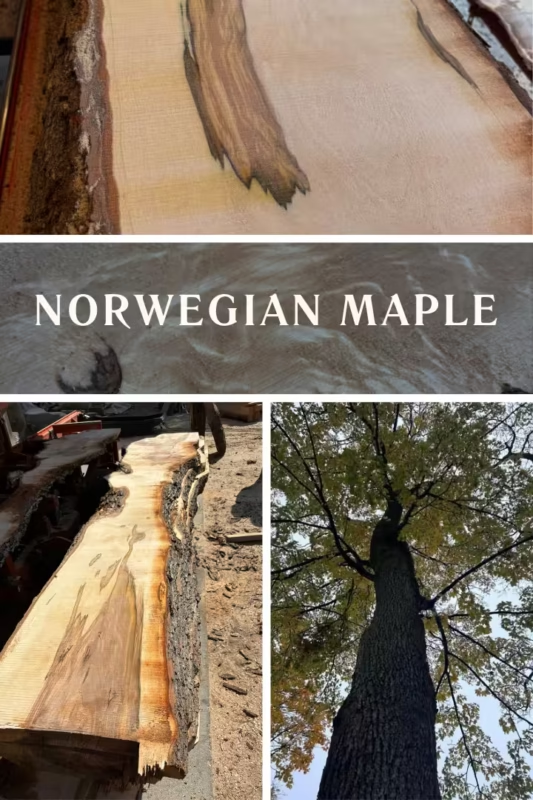
The Norway maple is a medium-to-large shade tree with opposite leaves, yellow spring flowers and a dense, rounded crown. Mature trees commonly reach 40 to 60 feet tall, though soil depth, moisture, pruning and competition can produce much smaller or larger specimens.
Its dense foliage tolerates city heat, compacted soil and roadside conditions better than many native maples. Those same traits let seedlings survive beneath woodland canopies, which explains why the tree has moved from planted streets into natural areas.
Norway Maple Naming
Norway maple is the accepted English common name. People sometimes say Norwegian maple tree, Norwegian maple or European maple, but “European maple” can also refer to sycamore maple and other species, so it lacks botanical precision.
The genus name Acer refers to maples, while platanoides means plane-like, a reference to leaves that resemble those of a plane tree. The accepted species and native distribution are recorded by Kew Plants of the World Online.
Common names create problems in lumber listings because “Norwegian maple wood” may be grouped with European maple or sold simply as maple. A botanical name on a log, slab or seedling label provides a more reliable identity than a regional trade name.
Acer platanoides Tree
An Acer platanoides tree develops a short to moderately long trunk and stout limbs that form heavy shade. Its leaves usually have five main lobes, while mature bark becomes gray-brown with narrow, interlacing ridges rather than the loose plates seen on some older native maples.
Clusters of yellow-green flowers appear before or with the leaves in early spring. By late summer, paired samaras hang from the twigs with their wings spread almost horizontally, making them look like a shallow propeller.
Norway maple sits within a much larger group of species that differ in size, habitat and wood properties. Our guide to types of maple trees places it beside native and ornamental maples for a broader comparison.
How to Identify a Norway Maple

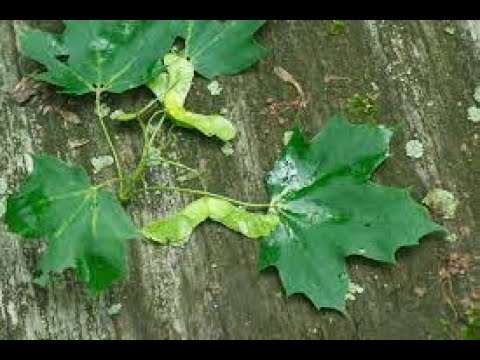
To identify a Norway maple, check for opposite five-lobed leaves, milky petiole sap, large pointed terminal buds and paired seeds whose wings form a nearly straight line. Use several features because shade, drought and cultivar genetics can alter leaf size and color.
Identification Features
The quickest field test uses a fresh leaf stalk. Break the petiole near its base and watch the cut surface: Norway maple releases an opaque white latex that forms a small, sticky bead, while sugar maple petiole sap stays clear. Old, dry or frost-damaged leaves may produce too little liquid for this test.
- Leaves: opposite, usually 4 to 7 inches wide, with five to seven sharply pointed lobes and relatively few large teeth.
- Buds: plump terminal buds with overlapping reddish-purple, green or brown scales.
- Flowers: upright yellow-green clusters appearing around leaf emergence.
- Fruit: broad paired samaras with wings commonly spreading close to 180 degrees.
- Bark: smooth and gray on young stems, later developing narrow vertical ridges and shallow furrows.
- Fall color: usually yellow, sometimes with brown patches; purple-leaved cultivars can turn bronze.
Leaf arrangement helps rule out plane trees and sweetgum because maples carry leaves in opposite pairs. The Penn State Extension Norway maple profile also documents the tree’s leaves, fruit, bark and invasive behavior.
A common beginner mistake is identifying the tree from leaf shape alone. Photograph the twig, buds, petiole sap, bark and seeds, then record whether the leaves occur opposite one another; this set of evidence remains useful after autumn color disappears.
Maple Species Differences
Norway maple is most often confused with sugar maple. Black maple can also look similar, while red maple and silver maple are easier to separate through their toothed leaves and narrower samara angles.
| Feature | Norway maple | Sugar or black maple | Silver maple |
|---|---|---|---|
| Broken petiole | Milky white latex | Clear sap | Clear sap |
| Leaf lobes | Broad with long, sharp tips | Rounded U-shaped spaces between lobes | Very deep, narrow spaces |
| Leaf margin | Few coarse teeth | Mostly smooth between main points | Coarsely toothed |
| Seed wings | Wide angle, often near 180° | U-shaped pair | Large pair at an acute angle |
| Typical fall color | Yellow | Yellow, orange or red | Yellow to brown |
| Mature bark | Narrow crossing ridges | Irregular vertical plates | Loose, shaggy strips |
The thick, slightly glossy Norway maple leaf often feels firmer and more leathery than a sugar maple leaf. Its pointed lobes can press sharply against the palm, while the broken stalk leaves tacky white residue on a fingertip.
For close comparisons, see the profiles of black maple, silver maple and striped maple. Each profile shows why a single leaf photo can hide meaningful species differences.
Norway Maple Growth Rate
Norway maples commonly grow about 1 to 2 feet per year after establishment. Young trees on moist, deep soil may exceed that range, while drought, root confinement, shade or repeated pruning can reduce annual extension to several inches.
How Fast It Grows
Growth isn’t constant through the tree’s life. A newly planted tree often spends its first season rebuilding roots, then produces longer shoots during the next several years; extension slows as the crown reaches mature size or roots meet pavement and compacted subsoil.
The NC State Extension plant profile describes Norway maple as a fast-growing tree reaching roughly 40 to 50 feet tall. Regional specimens may fall outside that height range.
- Measure one healthy terminal shoot from the previous year’s bud-scale scar to the terminal bud.
- Repeat the measurement on four sides of the crown rather than relying on one vigorous watersprout.
- Average the measurements and compare them with rainfall, pruning and soil changes from the same season.
- Track trunk diameter at the same marked height each winter for a second measure of growth.
Beginners often apply excess nitrogen after seeing short shoots. This can produce soft, weak growth without fixing compacted soil or limited rooting space. A better workaround is to inspect drainage, expose the root flare, add a broad mulch ring and water slowly during extended dry periods.
These measuring and pruning products can help with tree growth checks and routine care.
Mature Growth Form
An open-grown Norway maple forms a broad, oval-to-rounded crown that may spread 30 to 50 feet. Trees crowded by buildings or neighboring trunks grow narrower, taller crowns and may lean toward open light.
Shallow roots can raise turf, enter loosened planting soil and compete strongly with grass. Dense summer shade then leaves the ground cool and bare; adding more grass seed rarely solves the combined shortage of light, moisture and rooting room.
Practical notes from real-world use: inspect branch unions while the tree is young. Two upright stems can press bark between them, creating a dark seam and weak attachment; gradual structural pruning is safer than removing a large co-dominant stem after it thickens.
A second common mistake is piling mulch against the trunk. Keep the root flare visible and spread mulch outward in a shallow layer, since buried bark stays damp and circling roots can tighten around the stem years later.
Norway Maple Cultivars

Norway maple cultivars include compact globe forms, narrow columnar trees, purple-leaved selections and cream-edged variegated trees. Their crown shape and foliage differ, but most retain the species’ tolerance for urban soil and its potential to produce seedlings.
Globe Norway Maple
The globe Norway maple, commonly sold as ‘Globosum,’ develops a dense, rounded head with little or no dominant leader. It’s often grafted onto a straight Norway maple trunk, so the final trunk height depends largely on the nursery graft position.
A mature specimen commonly stays near 15 to 20 feet tall and wide, though repeated shearing can keep the crown smaller. The canopy feels dense and twiggy from beneath, with little filtered light reaching a bench, lawn or planting bed.
Don’t cut below the graft or allow vigorous shoots from the trunk and roots to remain. Those shoots belong to the rootstock and can grow into the full-size species, eventually crowding or replacing the globe-shaped crown.
Columnar Maple Trees
Columnar maple trees fit narrower sites than the standard species, but “columnar” doesn’t mean pencil-thin forever. Cultivars such as ‘Columnare’ and compact purple forms widen with age, so labels should provide both mature height and spread.
Tight upright branches sometimes form included bark at their bases. Inspect the inner crown every few years and shorten competing stems before they become large; aggressive topping produces clusters of fast shoots and ruins the natural columnar outline.
Planting one close to a wall can create a delayed clearance problem. Allow room for the mature half-width, trunk growth and air movement rather than using the narrow nursery crown as the spacing guide.
Drummond (Drummondii) Maple
The Drummond Norway maple, listed as ‘Drummondii,’ has green leaves edged with cream or pale white. From a distance, the crown appears bright and cool-toned; at close range, strong sun can leave the light margins crisp, tan and papery.
Variegated foliage contains less chlorophyll, so ‘Drummondii’ often grows more slowly than a plain green Norway maple. Hot afternoon sun, reflected heat and dry soil increase edge scorch, while very deep shade can weaken growth and reduce color contrast.
Green shoots sometimes appear through cultivar reversion. Remove each reverted branch at its point of origin because its fully green leaves feed faster growth and can overtake the variegated portion of the crown.
A quality pruning tool helps make clean cuts at reverted shoots and small competing branches.
Is Norway Maple Invasive in Ontario?
Yes, Norway maple is considered invasive in Ontario because it escapes cultivation, produces many wind-carried seeds and forms dense shade in forests and ravines. Its ecological status doesn’t automatically mean that every existing tree is illegal to own or must be removed.
Ontario Invasive Status
The Ontario Invasive Plant Council identifies Norway maple as an invasive plant and describes its spread into natural habitats. Provincial invasive classification, municipal planting rules and legal regulation are separate matters, so property owners should check local bylaws before planting or removing a street tree.
Seedlings commonly appear beneath hedges, along fences and in shaded soil beyond the parent crown. Their broad seed wings carry them farther during gusty autumn weather, while a dense layer of young trees can reduce light reaching native shrubs and spring wildflowers.
Pull small seedlings after rain when the soil feels soft enough to release the entire root. Cutting larger saplings at ground level may trigger regrowth, so repeated cutting, careful digging or a locally approved treatment may be needed.
Never move seed-bearing branches into a woodland compost pile. Bag ripe samaras where local waste rules permit, and clean mud and seeds from boots, tarps and mower decks before leaving the site.
For replacement planting, select a tree matched to the site’s soil, drainage, overhead clearance and available width. Native maples aren’t interchangeable: some prefer moist low ground, while others need deep, well-drained soil and enough room to become full-size hardwood trees.
Norway Maple Wood Weight
Air-dried Norway maple weighs about 37 pounds per cubic foot, or roughly 3.1 pounds per board foot at around 12% moisture content. Actual weight varies with moisture, growth conditions, heartwood percentage and defects such as bark inclusions.
Is Maple Heavy Wood?
Maple ranges from medium-weight to heavy depending on the species. Norway maple is heavier than many softwoods but usually lighter than hard sugar maple; the Wood Database Norway maple profile reports an average dried weight of 37.4 pounds per cubic foot and a Janka hardness near 1,010 pound-force.
| Norway maple wood measure | Approximate value | Practical meaning |
|---|---|---|
| Average dried density | 37.4 lb/ft³ (600 kg/m³) | Medium-heavy hardwood |
| Weight per board foot | About 3.1 lb at 12% moisture | Ten board feet weigh about 31 lb before allowances for variation |
| Janka hardness | About 1,010 lbf | Moderately resistant to dents |
| Freshly cut condition | Heavier than dried stock | Water weight raises handling and transport loads |
| Typical color | Cream to pale tan | May yellow or darken with age and finish |
A fresh urban log can feel much heavier than the dry figures suggest. Water may fill a large share of its initial mass, and mud, branch forks or hidden decay make casual lifting estimates unreliable; use mechanical handling for large rounds rather than relying on a dry-density calculation.
The wood cuts to a pale, smooth surface and can produce tight, curled shavings under a sharp plane. Dull cutters compress the fibers and leave fuzzy patches, while reversing grain around branch unions can tear out with a dry, clicking sound.
Urban Norway maple logs carry a hidden metal risk. Scan trunks before milling because nails, fence wire and old hooks can sit under decades of wood, damaging a blade and sending fragments from the cut.
Weight and hardness answer different questions. The density of wood affects lifting and mass, while the wood hardness scale estimates resistance to indentation.
For finishing or material selection, compare Norway maple with the broader maple wood guide. Pale boards can show subtle grain, mineral streaks and localized figure that become much clearer after the surface is wetted with finish.
Norway Maple Fun Facts
Norway maple has several memorable traits beyond its shade and invasive behavior. These Norway maple fun facts also provide useful clues for identification and care.
- The milky liquid in a broken leaf stalk is latex, making it one of the quickest ways to separate Norway maple from sugar maple.
- Its yellow-green flower clusters can make an entire crown look hazy and gold before full leaf-out.
- Paired samaras often spread close to a straight line, wider than the horseshoe-shaped seed pairs of sugar maple.
- Dark purple cultivars remain Norway maples; leaf color doesn’t create a separate species.
- ‘Globosum’ is commonly top-grafted, so a taller trunk won’t keep extending upward like a seed-grown central leader.
- ‘Drummondii’ can send out plain green branches that grow faster than its cream-edged foliage.
- Norway maple can produce usable lumber, but urban trunks frequently contain metal, staining, internal cracks or embedded bark.
- The Canadian flag’s maple leaf is stylized and doesn’t serve as a dependable species-identification diagram.
- Dense shade and shallow feeder roots work together, which is why grass often thins beneath an old crown.
- Yellow autumn foliage may remain on the tree later than leaves on nearby native maples, creating another seasonal clue.
Decorative figure can occasionally appear in maple from irregular grain rather than species identity alone. Features such as curly maple or birdseye maple describe grain effects, so they shouldn’t be used to identify a standing Norwegian maple tree.
FAQs
Is A Norwegian Maple The Same As A Norway Maple?
Yes, Norwegian maple and Norway maple are common names for the same tree, Acer platanoides. It is a large deciduous maple native to Europe and western Asia. The name Norway maple is used more often in North America, especially in gardening, forestry, and invasive-species discussions.
How Can I Identify A Norway Maple Tree?
You can identify a Norway maple by its broad, five- to seven-lobed leaves and milky sap from a broken leaf stalk. Its leaves are usually wider and darker green than sugar maple leaves, with pointed lobes. In spring, it produces clusters of yellow-green flowers before the leaves fully emerge.
How Fast Do Norway Maples Grow?
Norway maples grow at a moderate to fast rate, often adding about 30 to 60 centimetres of height each year when young. Growth depends on soil, moisture, sunlight, and available space. They establish quickly in many urban settings, which is one reason they were widely planted as shade trees.
Is Norway Maple Invasive In Ontario?
Yes, Norway maple is considered invasive in parts of Ontario, particularly in southern woodlands and urban natural areas. It can spread beyond planted landscapes and create dense shade that limits native tree seedlings and wildflowers. Removing seedlings early and choosing native maples for new plantings can help reduce its spread.
What Are The Main Norway Maple Cultivars?
Common Norway maple cultivars include ‘Crimson King’, ‘Crimson Sentry’, ‘Royal Red’, ‘Schwedler’, ‘Columnare’, and ‘Emerald Lustre’. Many were selected for purple foliage, upright form, dense shade, or urban tolerance. Although cultivars can look different, they may still produce seed and contribute to invasive spread in suitable areas.
Affiliate Disclosure: Some links in this post are affiliate links. If you make a purchase through these links, we may earn a small commission at no extra cost to you. We only recommend products we genuinely believe in.